If your library has a copy of the 1991 IPPC First Assessment Report, you should take a look at the section on historical climate. It has a graph of temperature reconstruction for the last 1,000 years or so. It corresponds to what you find in every other standard work before 2000. Like this one:
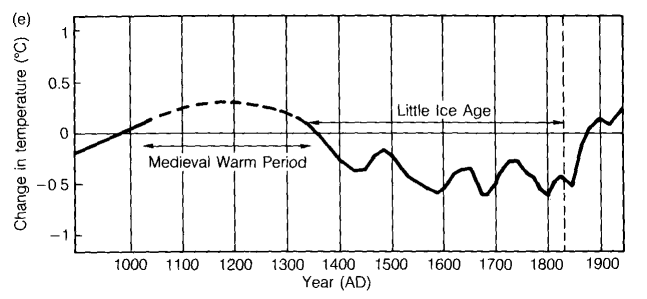
From "Holmes' Principles of Physical Geology" 4th Ed. 1993
(You can’t get the 1991 IPCC report online, although you can see subsequent reports).
Now take a look at the IPCC Third Assessment Report from 2001 (the “TAR”). In chapter 2, on page 134 you see this temperature reconstruction:

From IPCC Third Assessment Report
Whew! How did that happen?
It’s possible that this is science progress – new research uncovers new data and overturns old paradigms. Decades of work and hundreds of peer-reviewed papers did produce the consensus you see in the first graph. Maybe they were wrong.
This isn’t the place to write about the Hockey Stick debate, as its known. You can read about it for days – weeks even – and honestly, it’s probably worth every minute.
One place to start is with the Wegman report, one cherry-picked extract: “Overall, our committee believes that Mann’s assessments that the decade of the 1990s was the hottest decade of the millennium and that 1998 was the hottest year of the millennium cannot be supported by his analysis.”
Edward J. Wegman analyzed the Mann et all 1998 paper – the paper upon which the IPCC based its new temperature reconstruction. But don’t take my cherry-picked word for it, read the whole thing for your yourself, make up your own mind.
And while we are on that subject, Wegman might well have great stature in the science community, but you have to judge for yourself, after all he’s not infallible. Other links for the hockey stick debate: the wonderful people at Real Climate, “Climate Science from Climate Scientists“; and Climate Audit (the link is a new mirror site, it just got overloaded due to popularity). Real Climate includes Michael Mann – no, not the director of Heat with Pacino and De Niro – he’s the author of the controversial 1998 paper that started the whole debate. And Climate Audit is run by Steve McIntyre, whose joint investigation with Ross McKitrick got the whole debate finally kicked into the hands of the NAS and Edward J. Wegman.
The history of our climate has a huge impact on the science of climate.
Here’s a climate reconstruction of the last 1,000,000 years:
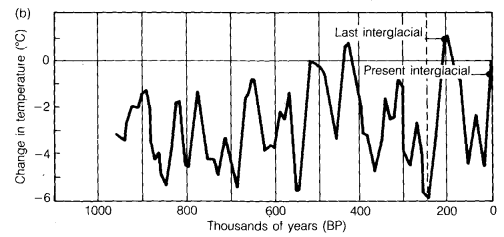
From "Holmes' Principles of Physical Geology" 4th Ed. 1993
And a focus on the last 150,000 years from the same work: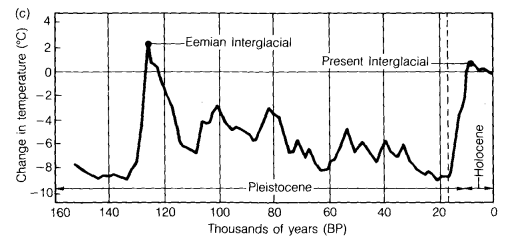
Here’s a comment from this reference work (Holmes) in respect of these reconstructions:
The recent past has known dramatic and fundamental changes of climate and environment which have affected the whole Earth, from the top of the highest mountains to the bottom of the deepest oceans. Morever, many of these changes have occurred at surprising speeds. Although the Earth’s environment may now be changing in response to human activities, even without them, rapid and dramatic changes in the environment would occur quite naturally.
(Emphasis added)
The earth’s recent history and its implications will be an important theme of this blog.
A note for those new to temperature history. Proper temperature measurement on a worldwide basis only goes back into the second half of the 19th century. And the longest temperature series (from Central England) only goes back to the mid 17th century. So all attempts to measure the past history of our climate rely on proxies. Temperature proxies include ice core data and tree rings. Proxies aren’t like perfect thermometers and the further you go back the more difficult the analysis becomes.
In the cause of science and the spirit of balance I think the IPCC should display the million year temperature reconstruction prominently in its next assessment report.
Sharp-eyed observers will think this unlikely to happen.


 The Science of Doom
[…] a look at An Inconvenient Temperature Graph if you want to see how the temperature has varied over the last 150,000 and the last million years. […]
Hi! I’m new to your site – came to it from hot-topic.
The Wegman Report – nothing to do with the presigious NAS, everything to do with Sen Joe Barton and his CO2 producing friends. There’s good analysis at Deep Climate and subsequently, and earlier at Deltoid
Ian Love:
Generally this site aims to stay away from attributing motives, and working out people’s politics, but I do like to get facts right. Are you saying Wegman wasn’t appointed by the NAS?
Also, as I commented, it’s possible that the new reconstructions are scientific progress.
What’s interesting about climate history is how much temperature has changed in the past. This in itself is a surprise to most people.
Ian Love is correct that Wegman was NOT appointed by the NAS. Gerald R. North chaired the NAS panel. The Wegman report appears to have been prepared at the behest of certain members of Congress — it certainly was touted by them (see the links Ian provided). In any case, it had absolutely nothing to do with the NAS.
The real NAS report is available easily on the web, and is well worth reading:
http://www.nap.edu/catalog.php?record_id=11676#description
I find this stuff fascinating personally… so it kinda sticks out that the glacial periods between this interglacial and last wasnt as severe as the ones during the previous 800k years.. And this interglacial is obviously longer lived than the previous… wild speculation follows;-) So what is the current theory for the reasons for this? has there been subsidence of the land bridge in the berring strait? Or is this the result o incremental continental drift? Too my simple mind the malkovich cycles dont seem to fit the bill, maybe for a interglacial, but not the last 150k and then not the previous 850k years.
P.S great blog, ive wasted a few hours here already.
MIke Ewing:
Off-topic, I know, but your comment about the length of the recent inter-glacial has reminded me of an hypothesis of mine: since Homo Sapiens antedated the previous inter-glacial period, may be it’s only the current one’s length that has permitted our current proliferation and consequent technological state?
Yes… i dare say km thick ice sheets across the main land masses in the northern hemisphere would be adverse to agriculture… and civilization as a whole 😉
Mike Ewing:
Thanks for the kind comments.
Challenging questions – and detailed reconstructions of temperature are not available from more than a few locations.
Hopefully there will be some posts to follow Ghosts of Climates Past which try and begin to cover these questions.
Yes, read the NAS report. Their comments essentially say that Mann’s reconstruction is probably very good for the last 400 years, and less certain further back.
If you look at the IPCC graph you’ve posted, you’ll see that the two std deviation grey blur widens noticeably just at the 400 year mark. In other words, the greater uncertainty before 1600 was in Mann ’98. I haven’t seen a lot written on the ——-ist side about all the caveats in Mann ’98.
I’m curious about the first graph you show. The arc for the MWP is a dashed line rather than a solid one. It’s … interpolated? Speculation? Did your source give a reason for its been dashed rather than solid? There must be a reason for it. My immediate reaction is that the author of the graph is showing us that this part of the graph is less reliably known than the rest.
It would be interesting if you’d post their explanation if you have the book available.
Oh, I think when the available data grows by orders of magnitude that indicates progress of some sort. Given the near-constant attack on modern reconstructions, I think the fact that only a few criticisms have stuck and that the major one – Wegman’s criticism of short-centered PCA – makes no material difference to the Mann ’98 results, odds are that results are robust.
You could blow up every paper written by Mann and there’d still be enough reconstructions around that give similar results to outfit a hockey team.
dhogaza:
Your comment got trapped by the amazing spam filter for breach of etiquette. Check out the rules.
Interesting question on why the dashed line. There is no comment in Holmes. I wondered about it at the time I scanned it but it was the only geology book I had to hand. I’ve seen the same graph in a bunch of other ones, don’t think there were dashed lines.. we will never know.
Your assessment of the reasons for the dashes makes sense.
This isn’t the place to revive the hockey stick debate. Even if I understood principal component analysis well enough to write about it (I don’t) there are way too many websites that discuss it to a very high level.
More interesting for people to see the last million years, the last 150,000 years – not well-covered ground.
Newcomers to the climate debate are usually amazed.
I hope we can take a good look at what’s known and unknown about the twists and turns of the Eemian and our current interglacial..
Paleoclimate reconstructions didn’t stop with the 1999 Nature paper by Mann, Briffa, and Hughes. A major effort to broaden the proxies used to model past climates was published in the journal PNAS by Prof. Mann’s group in 2008.
The methodology of this paper has been nearly universally accepted in public by the majority of climate scientists, and has not been questioned in public by any who adhere to the current consensus thinking, to my knowledge.
In contrast, the paper’s methods have come under withering criticism by many commenters doing “blog science.”
The most readily understood problem is this: the Mann group used a set of four proxies from Lake Korttajarvi, Finland that cannot be calibrated to the instrumental temperature record, 1850-on, due to spurious signals over that time. The Mann et al method requires such calibration. Therefore the relationship that Mann’s group accomplished to the temperature record is a miscalibration. In fact, it so so bad that two of the four proxies are used in an upside-down orientation, such that the “warmer” signal in the data is added to the reconstruction as “colder”, and vice versa.
Mann et al. were challenged in PNAS on this point by McIntyre and McKitrick. In their Reply, Mann et al. dismissed McIntyre’s description as “bizarre” — but without addressing the substance of the challenge.
More on these issues at this digest of a thread last fall at Stoat.
In my own view, the paper’s methods are so defective that its broad acceptance by the professional climatology community raises questions about the credibility of the entire proxy-based climate reconstruction enterprise. At least on the scale of many-hundreds to a-few-thousands of years.
AMac:
An interesting subject, but then we get to: do most climate scientists accept it? if yes, do they accept it because it’s good? because they are gullible? because it fits the preconceived agenda? if no, why don’t they say so…
Then lots of questions about motives and morals, which is not a topic for this blog, and before long we will join so many other blogs.
I think other blogs cover the MBH98/99 subject so much more thoroughly..
Now, Eemian interglacial reconstructions.. there’s a subject for this blog.
Excellent source of well organized rational thinking!
I am a retired scientist and conservationist. There seems to be cult pervading science that does not accept debate, proof, peer review and uses the additional cult of personality attack to replace proof.
Keep up the good work.
HWB
[…] example, the usually meticulous Science of Doom was, in my opinion, off the mark with his analysis of the development of the science here, skipping straight from the First to the Third Assessment […]
I realise I’m a bit late to be commenting on this post but just found something that’s particularly relevant…
If you have a look at the appendix in Jones et al. 2009 (“High-resolution palaeoclimatology of the last millennium: a review of current status and future prospects” The Holocene, 19, 3-49) they try to describe where the IPCC 1990 Fig. 7c comes from.
It seems that it was compiled from a series of publictions by H. H. Lamb and was only based on temperature records associated with Central England, so not global.
Further, Jones et al. point out that “At no place in any of the Lamb publications is there any discussion of an explicit calibration against instrumental data, just Lamb’s qualitative judgement and interpretation of what he refers to as the ‘evidence’”.
The plot was then dropped from the IPCC 1992 Supplementary Report because it was not up to scratch. In the 1995 IPCC report things got better (although the reconstruction only went back to 1400) and then by IPCC 2001 we have the “Hockey Stick”…
SoD, do you not make corrections to your posts, in this case regarding the sponsorship of the Wegman report? Note that the very first sentence of the report says who asked for it, i.e. Joe Barton and another Republican politician.
Re deep-time paleoclimate, the Eemian is certainly of interest, but I think that the Pliocene and Miocene intervals where climate was able to come to equilibrium while CO2 was at approximately current levels are of even greater interest, as is the rapid response of the ice sheets to climate forcing during the long cooling of the late Pliocene.
Steve Bloom:
I do try to correct my posts.
I’m less interested when the subject isn’t about the science.
However, until the time when I can get interested in who asked who directly & indirectly and who each person was actually hired by, and which political affiliations give the game away.. I have removed the NAS reference to Wegman.
Here’s an (admittedly tertiary) source you may want to take into account in determining “who asked who directly & indirectly”: http://www.quadrant.org.au/magazine/issue/2010/7-8/the-tree-ring-circus. In reviewing Montford’s book, it says:
“The Wegman panel was made up of three statisticians from three different universities, none of whom had any professional connection to paleoclimatology or the AGW debate. The North panel was made up of eleven paleoclimatologists and two statisticians, most of whom had been professionally connected to the IPCC or the Hockey Team, some of them closely connected.”
It also quotes a Mann e-mail message about the North panel’s provenance as follows:
“‘The panel is entirely legit[im]ate, and the report was requested by Sherwood Boehlert, who as you probably know has been very supportive of us in the whole Barton affair … The panel is solid. Gerry North should do a good job in chairing this, and the other members are all solid. Christy is the token skeptic, but there are many others to keep him in check. ‘”
SoD,
I recently discovered your blog and I love it. It has renewed my faith about tone in the climate discussion. I really enjoy your commitment to the robust findings of the science and your ability to frame matters in context.
That said, I wanted to address one issue in this article. You say:
1) The million year temperature reconstruction *is* already in the AR4-WG1 report (Chapter 6, pp 444, Fig 6.3).
2) This last sentence (“Sharp-eyed observers…”) carries a lot of subtext and skirts dangerously close to questioning motives and academic honesty of the IPCC authors. In the spirit of your excellent etiquette standards, I would recommend striking it altogether.
Thanks and keep up the good work!
Matt,
Thanks for your kind comments.
You may be correct that I have violated my own blog standards. I have had to delete some of my own comments before.
However, this was the very first Science of Doom blog article and it seems a shame not to let it stand untouched, if only as a calibration point to chart the course this blog has taken.
Matt
… skirts dangerously close to questioning motives and academic honesty of the IPCC authors.
Matt here skirts dangerously close to accepting the motives and academic honesty of IPCC authors.
The point is that being silent about motives is not being neutral – it is implicit acceptance. So why is the credulity implicit in the silence he urges, to be preferred to skepticism ? Surely science – all of it – is wedded to skepticism ?
While I can’t speak for others – I read this particular blog precisely because its skeptical and takes nothing for granted. The “silence” you mention so suspiciously is probably due to the fact that most knowledgable people agree on the fundamentals and are looking at other things of interest.
The conspiracy/competency memes that you are apparently trying to promote are certainly not welcome here and you will find many other venues in the blogosphere interested in such rubbish . (SoD, I hope you don’t mind me being slightly impolite).
Hello,
Lot of stuff there. However. In order to state how much the planet has warmed since 1850, one would have to know the temperature of 1850 and today, in equivalent terms. To say that science and technology and networks of 1850 knew the temperature of the planet in equal terms as today, is simple convenience not reality.
From 1850, 1880 types of data it also is clear that 75% of the warming took place between the years 1977 to 1998. The globe has warmed an additional 0.2 degrees since 1998. Not at all inline with the rate of CO2 emitted to the atmosphere and the rate for those previous 21 years.
The planet is current demonstrating that it can not seem to get any warming then the last 5 highest temperatures of 1998, 2005, 2010 and 20014. It needs more input, heat input. All the re-radiating CO2 and Water Vapor on the planet can not add heat it can only hold it back longer to warm the atmosphere. The rock (planet) itself has heat at its core and the magnetic shift we have seen since 1850…. well they needs to be more heat from some source other than burning fossil fuels.
If human-co2 is responsible for the noted warming, then the current temperature should be closer to 16.0 degrees C than the current 21st century-to-date average of 14.4 degrees C. Something of the AGW science must be missing.
When scientists use such data to prove the existence of unprecedented warming, these scientists do not merit the term scientist, regardless of how much they think they know. They don’t know. But they can show the “proof” that convinces them – its all they know, nothing more.
It follows also that for a scientist is going to claim they know how much C02 was in the Earth’s atmosphere in 1850 compared to today, they need to prove that frozen water that was once at the surface is now so many meters below other layers of ice, how an accurate account over all those years and that can not be done. To prove that, one would need an air sample at the time a given drop of water froze and is claimed to have sealed in the exact measure of CO2 in the atmosphere at that time and then that frozen water drop maintained that value without leakage or infusion.
The real science here about AGW or NGW or no GW, will be time. Time will tell the story, if the science is correct or if the science has it wrong.
The main reason science could have it wrong, is in your introduction. You are so sure you are right, you no longer look for any other evidence. Evidence and the possible science that could find something you did not and do currently accept. Your science and your unyielding belief in your science and your own self is not the only barrier to the fact of the matter.
Thank you for the amazing report, and good luck
We shall see in about 25 years.
AL
Just a few error of many:
1. It’s carbon dioxide. Carbon has a radioactive isotope, 14C, that allows one to date the gas in the bubble.
2. There are seasonal features in the ice core that allow one to date the ice accurately by simply counting layers. That’s how we know that the bubble is sealed later than the ice around it.
Al: We have known how to calibrate thermometers with boiling and freezing water since 1700. You correctly note that surface air temperature hasn’t always measured in exactly the same manner. About 1850, scientists realized that thermometers didn’t reliably measure AIR temperature unless the thermometer was shaded from the sun by a well-ventilated enclosure (called a Stevenson screen) located about 2 m above the ground. This methodology became standard world-wide before 1900. Measurement of temperature over or in the surface of the ocean was more problematic. No one taking measurements a century ago expected their data to be used to determine changes of 0.1 degC or less in mean global surface temperature, so the historical record is far from perfect. Modern measurements from space agree with the older methods where their records overlap. Recently a group of competent skeptics – partially funded by the Koch brothers – began reprocessing all of the available data, but their conclusions about warming have been similar to earlier work.
http://en.wikipedia.org/wiki/Stevenson_screen
http://en.wikipedia.org/wiki/Berkeley_Earth
You can read about dating ice cores and see a picture of layers at the link below. Evidence that counting layer works comes from looking at the volcanic ash that was deposited in a particular layer; say from the eruptions of Krakatoa (1883), Tambora (1815) or even Vesuvius (79). Since there are chemical differences between the volcanic ash deposited (both nearby and around the world) by different volcanos, the ice layers deposited at the same time as a major eruption have a chemical fingerprint that makes it easy to date them. If you had counted 1804 layers between ash from Krakatoa and Vesuvius, you would have confidence in this technique. Similar ash from large pre-historic eruptions is found the same number of layers down in both Antarctica and Greenland. (If one goes down far enough, the layers flow and thin slowly from the weight of ice above and dating become more difficult.
http://www.antarcticglaciers.org/glaciers-and-climate/ice-cores/ice-core-basics/
The earth’s surface temperature is highly variable. Mean temperature in March where you live probably varies an average of 1.5 degC from year to year. When temperatures from all over the globe are averaged for a whole year, it isn’t surprising to see a change of 0.1 degC from year to year. Between 1996 and 1998, mean global temperature rose 0.3 degC (from a record El Nino) and fell 0.2 degC in 1999. Given this much natural variability, we don’t expect to see mean global temperature rise exactly 0.02 degC every year. The IPCC’s climate models suggest that natural variability means that there is a 28% of seeing no warming in any 5-year period, a 9% chance of seeing no warming in a 10-year period and about a 2% chance of seeing no warming over a 15-year period. So the IPCC’s models haven’t been looking very good lately. A variety of reasons for this modest discrepancy (about 0.3 degC of missing warming) have been suggested. As you say, we shall see what happens over the next 25 years.
However, no matter what does happen, scientists will not change their minds about whether increasing GHGs should increase temperature (all other factors being the same). Laboratory measurements have established beyond any doubt that increasing GHGs will reduce the rate at which heat from the sun escapes to space. The surface of the planet emits an average of 390 W/m2 of thermal IR, but the GHGs in our atmosphere already slow down the rate of heat loss to space by about 150 W/m2, making the planet much warmer than it would be otherwise. More GHG’s will cause slightly more slowing in the future. The AMOUNT of warming scientists predict for a doubling of CO2 might change. That warming might be disguised by more natural variability than currently expect. The sun’s output could drop or more volcanos could erupt. Ocean currents could change. All of these complications make the Earth a lousy location for understanding how CO2 interacts with the infrared radiation that cools our planet. These complications were a good reason why the IPCC should have been making less confident projections for the past two decades. If you wanted to understand more, you could begin here.
“The IPCC’s climate models suggest that natural variability means that there is a 28% of seeing no warming in any 5-year period, a 9% chance of seeing no warming in a 10-year period and about a 2% chance of seeing no warming over a 15-year period. So the IPCC’s models haven’t been looking very good lately.”
1) The IPCC doesn’t have any models.
2) The real world surface datasets shows warming over any recent 15-year period.
This warming may not be “statistically significant”, meaning that the linearly regressed trend is greater than 0 with ~95% certainty, but that is an entirely different metric. This is not the metric that the “2% chance” pertains to; that’s for best estimate of warming rather than 2-sigma certainty.
3) When comparing models to the real world, we have to be careful to compare like-to-like. This means that if your observations use the sea surface, you should compare that to the sea surface in the models. Similarly, if your observations leave out chunks of data (say, in the Arctic), then you need to do the same with the model data you’re comparing to.
Accounting for #2 and #3, there is no inconsistency between the models and surface temperatures.
Of course the IPCC has models. The models they used in writing AR5 are listed in the report. The experiments run with those models were defined by an IPCC committee.
You are correct when you said that “The real world surface datasets shows warming over any recent 15-year period”. When I wrote the above statement, major indices were using the ERSST3 ocean temperature and there had been no global warming for about 15 years. ERSST4 moved some warming from before the Pause to during the Pause, making my statement obsolete. Even with that change, there are still 10-year periods with no warming in the record, an unlikely event according to climate models. However, I’m not a big fan of cherry-picking periods, especially now that temperatures haven’t fallen that much after the recent El Nino. If one looks at the last 40 years, the warming rate for whole period, the first half and the last half are NOW similar.
— “When I wrote the above statement, major indices were using the ERSST3 ocean temperature and there had been no global warming for about 15 years.”
I don’t believe this is correct.
Recall that “the pause” was not an actual cessation of warming (as measured by the best estimate of regressed linear trend), but a lack of warming at the 2-sigma level. This is a difference between saying “there’s a >50% chance there was non-noise warming” and “there’s a 95% chance there was non-noise warming”. Mathematically, one is a higher bar than the other.
With that in mind: even with ERSST3, there was still warming over recent 15-year periods. It just didn’t meet the 95% certainty mark. (The warming was still there during 1998-2013 because, while the warmest of those years were about the same, the colder years exhibited an uptrend. But don’t take my word for it. You can put a linear trend on it yourself and check).
The narrative of “the pause” was basically schlock sold to the innumerate, conflating the idea of no warming with no statistically significant warming. These are two very different things; a best estimate vs two-sigma certainty. Best estimate is normally what you want.
— “Even with that change, there are still 10-year periods with no warming in the record, an unlikely event according to climate models.”
Aye, I’m sure. I don’t know how often this occurs, though. Close to 10% of the time, as the models project? Or more often? Or, less often?
I’m certainly curious as to how accurately the models reproduce the statistics of temperature variability. But I don’t trust their physics of variability yet at that level, so I think if the statistics were correct it might just be coincidence. We’d expect the model’s internal variability to change somewhat as the models continue to be refined (particularly regionally!).
The temperature trend, on the other hand… thus far, there’s been pretty good agreement between the models and the observations, under the following conditions:
1) Model runs employ the real-world forcings for solar, volcanic, GHG, etc.
2) We compare like-to-like. Mask the model result data so that the temperature datasets cover the same areas, make sure both use the same metric for sea temperatures (the sea itself versus the air above it), etc.
When you compare like-to-like, the models reproduce the observations quite fine. Thus far.
A few things about the original post.
The 1991 report is available online
The figure in the 1991 report does not have a scale and is described as a “Schematic” It carried no attribution. In other words it was pretty useless.
I’m not sure about the “hundreds of peer reviewed papers” but the graph from which the “schematic” was taken was clearly the work of H.H.Lamb and only ever purported to be the an estimate of temperatures in England. In fact from about 1660 Lamb used the Central England Temperature record which represents the English midlands – about 20% of England. The section representing the Medieval Warm period is one of three versions given by Lamb and was labled by him as “Analyst’s Opinion”
Lamb was, rightly, a very respected climatologist of his time and reportedly the first to recognise that climate had changed significantly during historical times. However he was a long way from being infallible., For instance put a lot of weight on medieval English vinyards but appears to have ignored the fact that England has had a significant wine industry since the 1950s, and in fact was making wine during the Little Ice Age.
As for the Wegman report, it was commissioned by the same Joe Barton who subsequently apologised to BP for the nasty things that people said about them after the Deepwater Hoizon oil spill. Wegman later claimed that much of the report was in fact written by one of his students. Wegman worked closely with McIntyre but did not contact Mann for his side of the story.
As well as the NAS report there was also a Royal Society report which also supported Man.
The first assessment report (dated 1990) is now available online – see https://www.ipcc.ch/publications_and_data/publications_and_data_reports.shtml#1 for links to all assessment reports.
Paul wrote: “the graph from which the “schematic” was taken was clearly the work of H.H.Lamb and only ever purported to be the an estimate of temperatures in England. In fact from about 1660 Lamb used the Central England Temperature record which represents the English midlands – about 20% of England.”
If you are talking about the iconic Figure 7.1 from the FAR, you are wrong. The caption of the Figure says: “Schematic diagrams of GLOBAL temperature variations since the Pleistocene on three time scales: … c) the last thousand years.”
Although unsourced by the authors of the FAR, other variants of Figure 7.1 were available and used up until at least 1995. Some had quantitative temperature units on the y-axis. Figure 7.1 did represent the state-of-the-art understanding in 1990, not a one-time careless mistake.
Schmidt et al (2009) claim to have identified the source of Figure 7.1 as Lamb’s 1982 book. If so, the data represented 50-year smoothing and full scale vertically was 2.5 degC.
Click to access jones09.pdf
When I first started reading about climate more than a decade ago, the FAR was not available online. That may be the reason out host didn’t cite the original figure.
The SPM for AR5 WG1 now says this about the Medieval Warm Period (rechristened as the Medieval Climate Anomaly):
“In the Northern Hemisphere, 1983–2012 was likely the warmest 30-year period of the last 1400 years”
“Continental-scale surface temperature reconstructions show, with high confidence, multi-decadal periods during the Medieval Climate Anomaly (year 950 to 1250) that were in some regions as warm as in the late 20th century. These regional warm periods did not occur as coherently across regions as the warming in the late 20th century (high confidence).” (Section B1)
Who was right: Figure 7.1 of the FAR? or Mann’s Hockey Stick, from the AR3? The existence of an LIA and MWP is widely accepted today, but Mann’s Hockey Stick doesn’t show either of those periods. If you remember that Figure 7.1 ended in 1950 (before most of the warming in the last third of the century) and was smoothed over 50-years, it is possible that temperatures around mid-century hadn’t exceeded the MWP peak, while temperature by the end of the century had.
“The existence of an LIA and MWP is widely accepted today, but Mann’s Hockey Stick doesn’t show either of those periods.”
This requires some caveats. The MWP (now named MCA; Medieval Climate Anomaly) doesn’t show up synchronously worldwide. Thus, its magnitude is considerably lessened compared to what we see in just N. Atlantic proxies.
As used by “skeptics”, the MWP is not widely accepted in the scientific community.
Windchaser wrote: The MWP (now named MCA; Medieval Climate Anomaly) doesn’t show up synchronously worldwide. Thus, its magnitude is considerably lessened compared to what we see in just N. Atlantic proxies. As used by “skeptics”, the MWP is not widely accepted in the scientific community.”
It all depends on how one defines a “warm period”. I’d say a warm period is a period where the temperature is warmer than the period on either side. (I’ll leave it to you propose a useful and meaningful definition for a “climate anomaly”.) Therefore, to see if a Medieval Warm Period existed one needs a temperature reconstruction for the past 2000 years. However, there is limited proxy data from the Southern Hemisphere, it is mostly ocean, and there is lots of controversy about long temperature reconstructions there. The best one can do is probably the NH. The first useful graph that showed up on my image search was this one from the SkS website based on Ljungqvist (2010)
https://www.skepticalscience.com/new-remperature-reconstruction-vindicates.html
By my definition, there was a warm period about 1000 CE. SkS goes on to discuss several other long temperature reconstructions, which for the most part support the existence of this warm period, in the NH at least. Do you disagree?
Perhaps a Medieval Warm Period doesn’t exist in your mind because it wasn’t nearly as warm as the Current Warm Period. Unfortunately, that red line on the SkS graph didn’t come from Lunquist’s paper. Their Figure 3 shows the peak MWP much closer than to today’s (2000) instrumental temperature and their reconstructed temperature current temperature is essentially the same as the MWP peak. Temperature reconstructions can suppress the dynamic range of temperature fluctuations, so comparing instrumental and reconstructed temperatures is misleading.
Click to access ljungquist-temp-reconstruction-2000-years.pdf
As for the claim that the MWP warm period doesn’t show up as “synchronously” as the Current Warm Period (CWP), that may be because the CWP has been characterized by thousands of thermometers, while temperatures during the MWP must be reconstructed from much less reliable and more limited proxy data. If reconstructed CWP temperatures were compared with reconstructed MWP temperatures, would the CWP still exhibit more synchronous warming? (Don’t forget the “divergence” problem with tree rings and the large number of sites that have been rejected for use in reconstructions because they didn’t respond appropriately to 20th century warming.
Paul wrote: “As for the Wegman report, it was commissioned by the same Joe Barton who subsequently apologised to BP for the nasty things that people said about them after the Deepwater Hoizon oil spill. Wegman later claimed that much of the report was in fact written by one of his students. Wegman worked closely with McIntyre but did not contact Mann for his side of the story.”
After the NAS panel chartered to investigate the hockey stick and other climate reconstructions didn’t include any independent statisticians and chose not to comment specifically on the reliability of Mann’s hockey stick, Barton commissioned an independent second report from Wegman, a respected statistician with no ties to climate science. At a Congressional hearing, the chair of the NAS panel said they agreed with Wegman’s criticisms of Mann’s work. You can find links to the Wegman Report, the NAS report and the Congressional hearing at ClimateAudit.org, if you have the courage to read for yourself (rather than accept the propaganda of others).
IIRC, Wegman had one of his students do a network analysis of the scientists working on temperature reconstructions who peer-review each other’s papers and suggested that his group-think had led to numerous statistically dubious techniques being used and published. Their communications were a central part of the Climategate email release. In the rush to include this analysis in their report to Congress, an description of network analysis was copied from Wikipedia and not properly cited. Later, sections of the report were incorporated into a publication, resulting in an investigation for and admission of plagiarism.
If you read Wegman’s report, you will find that Wegman contacted all parties in the controversy and attempted to reproduce their calculations so that he fully understood the statistical procedures that produced the statistical conclusions reached in their papers. Wegman reported being able to implement M&M’s code with a little guidance, but reported being unable to do so with Mann’s. Wahl and Amman (a graduate student of Mann’s) later published papers claiming to show that Mann had been right. It will take a long time and an open mind to resolve the conflicting claims by both sides.
Frank wrote If you are talking about the iconic Figure 7.1 from the FAR, you are wrong. The caption of the Figure says: “Schematic diagrams of GLOBAL temperature variations since the Pleistocene on three time scales: … c) the last thousand years.” Which is reasonable considering the wording I used. I meant to say that Lamb never claimed that it represented anything more than the England. (In retrospect.I should have used which instead of and). Even there I was wrong, and unfair to Lamb, who labelled the graph as representing Central England.
It would be passing strange if global temperatures tracked Central England temperatures so closely over this period.
The match between Lamb’s graph for Central England and the “schematic” in the FAR is far too good to be coincidental. Clearly somehow a graph of the temperature record of a small part of the world (which Lamb labeled as his opinion) has somehow morphed into a schematic for average global temperature. Whether this was due to sloppiness on the part of the authors of the FAR or had been done by some intermediate author is something we will never know because the FAR does not quote its source. I tend to believe the fault lay with the authors of the FAR which is why they hide behind the term “schematic” and removed the temperature scale. In any case its removal from later reports was clearly justified.
Frank also wrote ” If you remember that Figure 7.1 ended in 1950 (before most of the warming in the last third of the century) and was smoothed over 50-years, it is possible that temperatures around mid-century hadn’t exceeded the MWP peak, while temperature by the end of the century had.” Basically I agree – though while the FAR report does not put a date on the right hand border of the graph, measuring the distance from the last tick mark suggests the end point is somewhat later than 1950. However it is true that the Central England Temperature has now risen well above the peak of Lamb’s graph. ( The legend reads “Years before present” while the tick marks are labelled with the actual year AD – just another example of the sloppiness surrounding FIg 7.1.)
Paul: Your SkS link concluded: “In short, Figure 7.1c from the IPCC FAR was based on Lamb’s approximation of the central England temperature.” Nonsense.
1) Figure 7.1 was labeled GLOBAL by the FAR. Similar Figures for global temperature were published about the same time by others and labeled global. You would realize this if you had bothered to read the ClimateAudit link I provided.
2) More than half of the Figure came from a period before CET existed. Most modern composite global instrumental temperature indices start in 1850 and BEST goes back to 1750. CET MIGHT have been the only instrumental record available to Lamb for about a century after 1659. At best, 10% of Figure 7.1 MIGHT have come ONLY from CET, with CET playing a major role in another 5%.
3) SkS and Jones (2009) (I mistakenly called this Schmidt 2009) shows a real 50-year Gaussian smooth of CET (the blue curve) which looks very different from Figure 7.1. If Figure 7.1 came from a different method of smoothing CET, the authors would have shown that smooth. Clearly, Lamb used other sources of data besides CET and there is no reason to assume they weren’t global.
4) How did Jones et al produce a 50-year smoothed curve in 2009 that ended about 2007? If you read the fine print, the data was “padded”. One technique for padding is to continue the trend for 1982-2007 by “reflecting” those temperatures through the 2007 data point and then smoothing. This means that the rapid temperature rise from 1982 to 2000 was counted twice during the smoothing process. Of course, in the real world the temperature didn’t continue rising after 2000. CET itself fell about 0.3 K (see Wikipedia) and global warming paused from 2001-2013. So the blue line post 2000 shooting well above the peak temperature of the MWP is an artifact of “smoothing with padding”. The climategate emails disclosed the infamous terms “Mike’s Nature Trick” and “Hide the Decline”, but SkS claims these were legitimate. Here padding and smoothing have hidden the fall in CET post 2000.
If you don’t like being deceived, consider getting your information from more than one source. Thera are some things one side doesn’t want you to know and some things the other side doesn’t want you to know. Deciding whom to trust requires a lot of work. I personally find this site particularly useful and took the time to rebut (or correct) your points. Others have corrected my mistakes. .
If this works the figure below is from Jones et al 2009. It shows just how good a match figure 7.1 is to Lamb’s graph.
OK it didn’ work. You can find it here.
I am not doing well with html – try https://skepticalscience.com/IPCC-Medieval-Warm-Period.htm
If I want to know what Lamb did I read Lamb – fortunately the local university library has copies of most of his books. There is no doubt that Fig 7.1 is lifted straight from the graph which he labeled
“Temperatures (degrees C) prevailing in Central England, 50 year averages)”
Obviously he could only use the CET from the time it existed and he used proxy data prior to that.
For the Medieval Warm Period he provides three options which he labels:
(1) Unadjusted values based on purely meteorological evidence;
(2) Analyst’s opinion; and
(3) Preferred values including temperatures adjusted to fit botanical evidence.
I have listed them in increasing order of peak medieval temperature. Fig.7.1 is clearly the “Analyt’s Opinion”.version.
Frank may believe that Lamb cheated and introduced data from outside Central England. I don’t.
Similarly Lamb makes it clear that he used the instrumental record from 1700 onwards (from 1675 if he was using 50 year moving averages) and he clearly believed that he had spliced the instrumental with proxy estimates correctly.
As it happens Lamb gives actual temperatures, not anomalies and the peak temperature for the Medieval Warm Period in his graph is about 10.05 degrees Centigrade. Looking at simple 50 year centered moving averages, the CET reached this high point in 1990 and increased in each of the following two years. As 20th century temperatures drop off the scale it will continue to increase, even if natural fluctuations temporarily overwhelm the temperature trend.
It is clear that both Lamb and Jones used some sort of padding to fill in the later years and it is also clear that Lamb used a much less flexible smoothing technique than Jones’ Gaussian smoothing.. However Jones’ and Lamb’s versions are sufficiently close to convince me that they are probably starting from the same time series.
I have reread Wegman and will post my comments when I get a chance – and yes I do read contrarian blogs and no I do not believe everything I read in the consensus blogs which I why I went down to the Uni to read Lamb.
Paul: Thanks for finding Lamb’s books and reporting back.
Paul wrote: “Frank may believe that Lamb cheated and introduced data from outside Central England. I don’t.”
I never meant to imply “cheating”. Jones (2009) and SkS claim that Figure 7.1 represented only temperature of central England, despite the fact that the FAR labeled it global. I assume the “global” (or at least northern hemisphere) label is correct, but don’t have enough evidence to prove it. Since you have Lamb’s work, I’d be interested in your conclusion.
Frank
Lamb labeled his chart “Temperatures prevailing in Central England, 50 year averages.” I think that is pretty self explanatory. The FAR uses the same chart (with the temperature scale removed but the tick marks left in) as Fig 7.1(c). Fig 7.1 is labeled “Figure 7.1: Schematic diagrams of global temperature variations since the Pleistocene on three time scales (a) the last million years (b) the last ten thousand years and (c) the last thousand
years The dotted line nominally represents conditions near the
beginning of the twentieth century.” – also self explanatory but, in the case of (c), wrong.
Incidentally your comment about Jones hiding the temporary decline in the CET record ignores the fact that a moving average is affected by the temperatures that drop out of the averaging window (or in the case of Gaussian smoothing receive lower weights) as much as it is by the temperatures that move into the window. In the case of a 50 year moving average the difference between two successive averages is simply the difference between two temperatures 50 years apart divided by 50. This inevitably hides most short term variation. As it happens the CET record had a temporary dip after the Jones paper but has since recovered.
My view is that the fig 7.1(c) is at best erroneous and misleading and should certainly have been dropped. Given that the FAR was the first attempt at an exercise of this magnitude, and would have been a very novel experience for the scientists involved, this is not surprising. Whether it should have been replaced by Mann’s graph is a different argument.
Paul: When smoothing, “padding” means adding artificial data to real data so that a 50-year smooth can be performed even with the last data point. For example, padding might mean using the 2007 temperature for the 2008 to 2032, so that a 50-year smooth of the 2007 data point could be plotted.
However, if one expected warming to continue after 2007, re-using the 2007 temperature for smoothing would place the smooth “too low”. So the data can be padded with artificial values that continue the trend apparent in the data for the 25 years before 2007 to the 25 years after 2007. That appears to be what happened with the CET data and why it continued to rise after 2000 despite the Pause.
Does Lamb give any information about his souces for temperatures that pre-date CET? Is there any reason to believe that information arises from outside central England?
To some extent, the text of Chapter 7 of the FAR answers some of these questions: “In the late 10th to early thirteenth centuries (about 950 to 1250) appear to have been exceptionally warm IN WESTERN EUROPE, ICELAND AND GREENLAND. This period is known as the Medieval Climate Optimum. China was, however, cold at the time (mainly in winter), but south Japan was warm. This period of WIDESPREAD warmth is notable in that there is no evidence that it was accompanied by an increase in GHGs.” Then they discuss evidence for a worldwide LIA. (The graphs for the past 10 and 1000 millennia are clearly not limited to central England.)
From these passages, it seems likely that 7.1(c) was representative of expectations for global warming and cooling over the past millennium. However, the cited evidence for a globally warm MWP was limited.
I now see that Lamb (1965) “The early medieval warm epoch and its sequel” is available online:
http://citeseerx.ist.psu.edu/viewdoc/download?doi=10.1.1.455.9147&rep=rep1&type=pdf
Lamb discusses evidence for a MWP warmer than present in: Arctic sea ice near Iceland and Greenland, Viking settlements in Greenland, Eskimo settlements in the Arctic including Alaska, farming in Norway, tree lines and vineyards in Central Europe, forests in New Zealand.
“World Summary” … “temperatures in many parts of the world at least between 1000 and 1200, and possibly over a rather longer period, were 1-2 deg above present values, though probably in latitudes under about 40 deg where increased moisture and precipitation is the main indication. The temperature anomaly was evidently bigger, probably 4 degC in places near the coast of Greenland and probably elsewhere along the rim of the Arctic Ocean.”
The second half of the paper deals with central England precursor graphs to Figure 7.1(c).
Frank
Thanks for finding the 1965 paper. I have to admit to making two errors in my post. Firstly I miscalculated the 50 year moving average – by 1990 it was only 9.89 and by 1992 only 9.92. Of course 1992 is as par as we can go without padding.
On the other hand I also overestimated the maximum of Lamb’s graph, because I was using a photo of a page of an open book which was slightly curved. From the image in the 1965 paper it is clear that Lamb’s graph did not get past 10 degrees.
Being a small area the average annual temperatures in Central England are much more variable (in the short term) than global temperatures. For instance in the three years starting in 2009 the annual average temperatures (in degrees centigrade) were 10.14, 8.86 and 10.72 respectively. Interannual global temperatures are strongly affected by ENSO. On the other hand I would expect that Central England would be most strongly affected by variations in the polar jet stream which has become increasingly erratic in recent years.
The point I was trying to make about moving averages is that in spite of the decline in CET temperatures between 2006 and 2014 the 50 year moving average continued to increase from 1981 to the 1992 as the temperatures that were added into the averaging window for the most part exceeded those that dropped out. On this basis Jones’ padding (whatever technique was used) appears to have worked fairly well so far. To see if it continues to work to a 50 year averaged centered on 2006 we will have to wait another 14 years.
Paul: Padding before smoothing always creates a potentially misleading smoothed curve. In Jones (2009), CET data up to about 2007 has been smoothed with a 50-year Gaussian filter. That means that the 1983 datapoint on the smoothed curve is the result of 49 years of real data and 1 year of padded data. The 2007 data point comes from 25 years of real data and 25 years of padded data. The former is not a problem, but the latter would be if the authors failed considered whether the their smoothed curve accurately represent what happened after 2000. Readers instinctively compare the current end of the smooth curve to the peak of the MWP and conclude that it is now significantly warmer than the peak of the MWP. Is the “significantly warmer” an artifact of padding?
If we look at this as a global record, after the plateau of 1950-1970, there has been 0.4-0.5 degC of warming. The blue curve exaggerated the warming. However, this is clearly CET, not global. And CET differs significantly from global. Based on 10-year smoothing, the 1940’s warm period in CET lasted until 1950 and then temperature fell 0.4 degC before starting back up. 1962 and 1963 were the coldest years of the 20th century, about 1.3 degC colder that the average in the 1940s. The rise from this trough to the 2000s is much higher than it was globally, 1.0 degC. Because it represents 50-year smoothing, the blue curve underestimates this change even after it has been padded in a manner would miss the Pause. And the Pause in CET didn’t start in 1998 or 2001 as it did globally. The 10-year average of real data (through 2017) rose through 2002-2004 and then fell 0.2-0.3 degC. (2010 was one of the coldest years in the past century in CET.)
When I look at decadal averages to “prove” that Jones (2009) has misrepresented the Pause, I need to look at smoothing over shorter periods, which makes everything look somewhat different, particularly in CET. Fifty year smoothing looks quite different from decadal smoothing (which is the time frame I instinctively consider. And Lamb’s curve ends about 1925. What do I conclude from all of this? Comparing the peak MWP to current temperature is a dubious undertaking with 50-year averaged data. Without padding, the data would end in 1982 when the temperature was in the vicinity of the MWP peak. When you want to discuss how much warmer it had gotten by the 2000’s, you are no longer talking about 50-year averaged data,so the discussion is poorly defined. The warmest decade of the MWP was certainly higher than the 50-year averages shown.
Frank Let;s see what we can agree on.
Firstly the last panel of figure 7.1 in the FAR cannot possible be a representation of global temperatures – even though it says it is. If it were it would mean that global temperature movements exactly followed temperatures in the English midlands. Clearly this graph should never have been included in the report in the form that it was.
Secondly the medieval section of the version of Lamb’s graph used by the FAR is clearly a freehand drawing for which Lamb does not give error bars and which he labels as his opinion and which peaks somewhere between 9.95 and 10 degrees.
Third while you say that the latest fifty year average temperature from the CET record is centred on 1982, I think a little thought will reveal it is centred around 1992 (50/2 =25 and 2017 – 25 =1992) and is 9.92 degrees, which is less than the peak of Lamb’s graph but well within the margin of error of Lamb’s estimate.
In conclusion Lamb’s work provides no evidence that temperatures in Central England during the peak of the medieval warm period were warmer than they were at the end of the 20th century much less that the same is true for average global or hemispheric temperatures.
Paul: Let’s see what we can agree on.
Paul wrote: “Firstly the last panel of figure 7.1 in the FAR cannot possible be a representation of global temperatures – even though it says it is. If it were it would mean that global temperature movements exactly followed temperatures in the English midlands. Clearly this graph should never have been included in the report in the form that it was.”
Frank: In that case, you should criticize all three panels of Figure 7.1 for being local temperature records, not global ones. In fact, the other two panels are likely worse representations of global change because polar amplification presumably exaggerates temperature swings. The discussion adjacent to Figure 7.1 (quoted in a previous comment) showed that Figure 7.1 was typical of what was believed to be true globally about the the ice ages, the Holocene and its “optimum” AND MWP in most locations.
Instead of GUESSING with hindsight and prejudice what Figure 7.1 meant to the authors of the FAR, read their words! Here are the key sentences from the Executive Summary for Chapter 7 of the FAR:
“Since the end of the last ice age, about 10,000 BP, globally averaged surface temperatures have fluctuated over a range of up to 2 degC on time scales of centuries or more. Such fluctuations include the Holocene Climate Optimum around 5,000-6,000 years ago, the shorter MWP around 1000 AD (which may not have been global), and the Little Ice Age …”
“We conclude that despite great limitations in the quantity and quality of the available historical temperature data, the evidence points consistently to a real but irregular warming over the last century. A GLOBAL warming of larger size has almost certainly occurred at least once since the end of the last ice age without any appreciable increase in greenhouse gases. Because we do not understand the reasons for these past warming eventS it is not yet possible to attribute a specific proportion of the recent SMALLER warning to an increase in greenhouse gases.”
When Lamb did most of his work, there was no observational evidence for GHG-mediated warming, temperature had been falling slightly, and some alarmism about a coming ice age was circulating. When the FAR was written, there had recently been a little more than 1 decade of relatively rapid warming (0.2 K). By AR3, warming had persisted for 2.5 decades and 0.4 K; today it is 4 four decades of warming and 0.6 K. So, when you ask whether “current temperature” is warmer than the peak of the MWP, the answer partly depends on when the question was answered. For the authors of the FAR, the mostly-unforced warming between 1920 and 1940 was bigger than the putatively GHG-mediated warming beginning in 1975. They almost certainly believed the “bigger” changes associated with the LIA and MWP dwarfed the changes of the last decade. When CAGW and the MWP later became political issues, it became politically incorrect to believe that natural variability in the Holocene was bigger than the crisis of a few tenths of a degC of GHG-mediated warming. To some extent, the authors of the FAR were right: AR5 admits that many locations were comparably (though not synchronously) warm during the MWP. And today, there has been much more warming (0.6 K) potentially attributable to GHGs than there was in 1990.
Paul wrote: “Secondly the medieval section of the version of Lamb’s graph used by the FAR is clearly a freehand drawing for which Lamb does not give error bars and which he labels as his opinion and which peaks somewhere between 9.95 and 10 degrees.”
Lamb clearly believed there was an MWP in England. The correlation between precipitation and temperature provided Lamb with the opportunity to quantify that relative warmth. Lamb chose among several possible relationships and acknowledged that that choice was an opinion.
Paul wrote: “Third while you say that the latest fifty year average temperature from the CET record is centred on 1982, I think a little thought will reveal it is centred around 1992 (50/2 =25 and 2017 – 25 =1992) and is 9.92 degrees, which is less than the peak of Lamb’s graph but well within the margin of error of Lamb’s estimate.”
We were discussing the CET record added by Jones (2009) to Figure 7.1 and publicized by SkS. In that publication (but not today), CET ended about 2007 and the last date that could be properly smoothed using a 50-year Gaussian was 1982. (Today, it would be 1992, as you say.) By padding that data by some undisclosed method, Jones 2009 was able extrapolate the smoothed curve until it was clearly above the MWP. It is impossible to predict what a 50-year smooth will look likely without 50 years of data (or close to it). but the smooth Jones 2009 provides misleads readers into two ways: The Pause that had been underway for a decade by 2009 and temperature was not rising as shown by the smooth. The conclusion that current CET had risen above the MWP peak arises from assumptions made in padding, not real data.
It is also interesting to compare Lamb’s graph with the one from Holmes given by SOD at the beginning of this post. While they are similar Holmes’ graph has substantially less variation than Lamb’s. Lamb shows a difference of 1.25 degrees between the peak of the medieval warm period and the trough of the little ice age. Holmes shows a difference of only 0.9 degrees.
If we assume that Holmes purports to cover the whole globe then we can compare his series with current instrumental series. Holmes gives the difference between 1900 and the peak of the medieval warm period as 0.15 degrees. Between 1900 and 1992 the smoothed version of GISS increased by about 0.6 degrees and since then by another 0.6 degrees. On this basis current global surface temperatures are already about as far above the medieval warm period peak as that peak is above the bottom of the little ice age. .