Redefining Physics
Dexter Wright re-defined the radiative transfer equations in his American Thinker article “Global Warming on Trial” with these immortal words:
Clearly, H2O absorbs more than ten times the amount of energy in the IR spectrum as does CO2. Furthermore, H2O is more than one hundred times more abundant in the atmosphere than CO2. The conclusion is that H2O is more than one thousand times as potent a greenhouse gas (GHG) as CO2.With such immutable facts facing the EPA, how will they explain their stance that CO2 is a greater danger to the public than water vapor?
So far, neither Dexter, nor his enthusiastic supporters at American Thinker have got around to updating the now defunct Wikipedia article on the Radiative Transfer Equations which describe the “old school” mathematics and are slightly more complicated.. (See also CO2- An Insignificant Trace Gas? Part Three.)
But in wondering why they hadn’t, it did occur to me that non-linearity is something that most people struggle with. Or don’t struggle with because they’ve never heard of it.
I think that the non-linear world we live in is not really understood because of the grocery factor..
(And it would be impolite of me to point out that Dexter didn’t know how to interpret the transmittance graphs he showed).
Groceries and Linearities
Dexter is in the supermarket. His car has broken down so he walked a mile to get here. He has collected a few groceries but his main buy is a lot of potatoes. He has a zucchini in his hand. He picks up a potato in the other hand and it weighs three times as much. He needs 100 potatoes – big cooking plan ahead – clearly 100 potatoes will weigh 300 times as much as one zucchini.
Carrying them home will be impossible, unless the shopping trolley can help him negotiate the trip..
Perhaps this is how most people are thinking of atmospheric physics.
In a book on Non-linear Differential Equations the author commented (my memory of what he stated):
The term “non-linear differential equations” is a strange one. In fact, books about linear differential equations should be called “linear differential equations” and books about everything else should just be called “differential equations” – after all, this subject describes almost all of the real-world problems
What is the author talking about?
Perhaps I can dive into some simple maths to explain. I usually try and avoid maths, knowing that it isn’t a crowd-puller. Stay with me..
If we had the weight of a zucchini = Mz, and the weight of a potato = Mp, then the weight of our shopping expedition would be:
Weight = Mz x 1 + Mp x 100, or more generally
Weight = Mz Nz + Mp Np , where Nz = number of zucchinis and Np = number of potatoes. (Maths convention is that AB means the same as AxB to make it easier to read equations)
Not so hard? This is a linear problem. If you change the weight (or number) of potatoes the change in total is easy to calculate because we can ignore the number and weight of zucchinis to calculate the change.
Suppose instead the equation was:
Weight = (Mz Nz) Np2 + (Mp Np) Nz3
What happens when we halve the number of potatoes? It’s much harder to work out because the term on the left depends on the number of zucchinis and the number of potatoes (squared) and the term on the right depends on the number of potatoes and the number of zucchinis (cubed).
So the final result from a change in one variable could not be calculated without knowing the actual values of the other variables.
This is most real-world science/engineering problems in a nutshell. When we have a linear equation – like groceries but not engineering problems – we can nicely separate it into multiple parts and consider each one in turn. When we have a non-linear equation – real world engineering and not like groceries – we can’t do this.
It’s the grocery fallacy. Science and engineering does not usually work like groceries.
Stratospheric Water Vapor
In many blogs, the role of water vapor in the atmosphere (usually the troposphere) is “promoted” and CO2 is “diminished” because of the grocery effect. Doing the radiative transfer equations in your head is pretty difficult, no one can disagree. But that doesn’t mean we can just randomly multiply two numbers together and claim the result is reality.
A recent (2010) paper, Contributions of Stratospheric Water Vapor to Decadal Changes in the Rate of Global Warming by Solomon and her co-workers has already attracted quite a bit of attention.
This is mainly because they attribute a significant proportion of late 20th century warming to increased stratospheric water vapor, and the last decade of cooling/warming/pause in warming/statistically significant “stuff” (delete according to preferences as appropriate) to reduced water vapor in the stratosphere.
(If you are new to the subject of the stratosphere, there is more about it at Stratospheric Cooling and useful background at Tropospheric Basics ).
There is much that is interesting in this paper.

Stratospheric water vapor - SW and LW effect vs altitude, Solomon (2010)
Firstly, take a look at the basic physics. The graph on the left is the effect of 1ppmv change in water vapor in 1km “layers” at different altitudes (from solving the radiative transfer equations).
Notice the very non-linear effect of “radiative forcing” of stratospheric water vapor vs height. This is a tiny 1ppmv of water vapor. Higher up in the stratosphere, 1 ppmv change doesn’t have much effect, but in the lower stratosphere it does have a significant effect. Very non-grocery-like behavior..
Unfortunately, historical stratospheric water vapor measurements are very limited, and prior to 1990 are limited to one site above Boulder, Colorado. After 1990, especially the mid-1990’s, much better quality satellite data is available. Here is the Boulder data with the later satellite data for that latitude “grafted on”:

Stratospheric water vapor measured 40'N, 1980-2010, Solomon (2010)
And the global changes from post-2000 less pre-2000 from satellite data:

Stratospheric water vapor change, measured vs latitude, Solomon (2010)
It looks as though the major (recent) changes have occurred in the most sensitive region – the lower stratosphere.
The paper comments:
Because of a lack of global data, we have considered only the stratospheric changes, but if the drop in water vapor after 2000 were to extend downward by 1 km, Fig. 2 shows that this would significantly increase its effect on surface climate.
The calculations done by Solomon compare the increases in radiative forcing from changes in CO2 with the stratospheric water vapor changes.
Increases in CO2 have caused a radiative forcing change of:
- From 1980-1996, about +0.36 W/m2
- From 1996-2005, about +0.26 W/m2
Changes in stratospheric water vapor have caused a radiative forcing change of:
- From 1980-1996, between 0 and +0.24 W/m2
- From 1996-2005, about -0.10 W/m2
The range in the 1980-1996 number for stratospheric water vapor reflects the lack of available data. The upper end of the range comes from the assumption that the changes recorded at Boulder are reflected globally. The lower end that there has been no global change.
What Causes Stratospheric Water Vapor Changes?
There are two mechanisms:
- methane oxidation
- transport of water vapor across the tropopause (i.e., from the troposphere into the stratosphere)
Methane oxidation has a small contribution near the tropopause – the area of greatest effect – and the paper comments that studies which only consider this effect have, therefore, found a smaller radiative forcing than this new study.
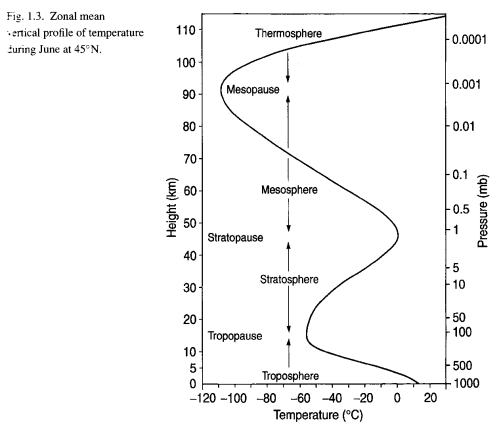
Water transport across the tropopause – the coldest point in the lower atmosphere – has of course been studied but is not well-understood.
Is this All New?
Is this effect something just discovered in 2010?
From Stratospheric water vapour changes as a possible contributor to observed stratospheric cooling by Forster and Shine (1999):
This study shows how increases in stratospheric water vapour, inferred from available observations, may be capable of causing as much of the observed cooling as ozone loss does; as the reasons for the stratospheric water vapour increase are neither fully understood nor well characterized, it shows that it remains uncertain whether the cooling of the lower stratosphere can yet be fully attributable to human influences. In addition, the changes in stratospheric water vapour may have contributed, since 1980, a radiative forcing which enhances that due to carbon dioxide alone by 40%.
(Emphasis added)
From Radiative Forcing due to Trends in Stratospheric Water Vapour (2001):
A positive trend in stratospheric H2O was first observed in radiosonde data [Oltmans and Hofmann, 1995] and subsequently in Halogen Occultation Experiment (HALOE) data [Nedoluha et. al., 1998; Evans et. al., 1998; Randel et. al., 1999]. The magnitude of the trend is such that it cannot all be accounted for by the oxidation of methane in the stratosphere which also show increasing trends due to increased emissions in the troposphere. This leads to the hypothesis that the remaining increase in stratospheric H2O must originate from increased injection of tropospheric H2O across the tropical tropopause.
And back in 1967, Manabe and Wetherald said:
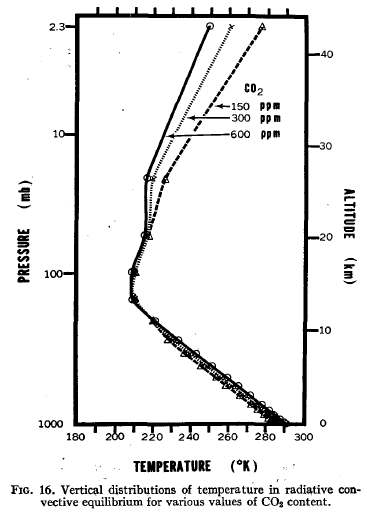
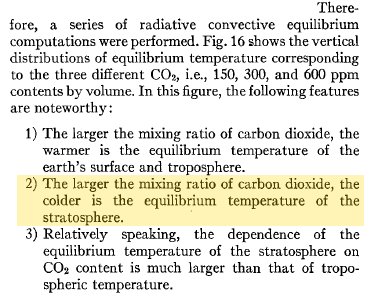
It should be useful to evaluate the effect of the variation of stratospheric water vapor upon the thermal equilibrium of the atmosphere, with a given distribution of relative humidity.. The larger the stratospheric mixing ratio, the warmer is the tropospheric temperature.. The larger the water vapor mixing ratio in the stratosphere, the colder is the stratospheric temperature..
Emphasis added – note that this paper was discussed a little in Stratospheric Cooling
Conclusion
The potential role of stratospheric water vapor on climate is not a new understanding – but finally there are some observations which can be used to calculate the effect on the radiative balance in the climate.
The paper does illustrate the non-linear effect of various climate mechanisms. It shows that small, almost unnoticed, influencers can have a large effect on climate.
And it demonstrates that important climate mechanisms are still not understood. The paper comments:
It is therefore not clear whether the stratospheric water vapor changes represent a feedback to global average climate change or a source of decadal variability. Current global climate models suggest that the stratospheric water vapor feedback to global warming due to carbon dioxide increases is weak, but these models do not fully resolve the tropopause or the cold point, nor do they completely represent the QBO, deep convective transport and its linkages to SSTs, or the impact of aerosol heating on water input to the stratosphere. This work highlights the importance of using observations to evaluate the effect of stratospheric water vapor on decadal rates of warming, and it also illuminates the need for further observations and a closer examination of the representation of stratospheric water vapor changes in climate models aimed at interpreting decadal changes and for future projections.
References
Contributions of Stratospheric Water Vapor to Decadal Changes in the Rate of Global Warming, by Solomon et al, Science (2010)
Thermal Equilibrium of the Atmosphere with a Given Distribution of Relative Humidity, by Manabe and Wetherald, Journal of Atmospheric Sciences (1967)
Stratospheric water vapour changes as a possible contributor to observed stratospheric cooling, by Forster and Shine, Geophysical Research Letters (1999)
Radiative Forcing due to Trends in Stratospheric Water Vapour, Smith et al, Geophysical Research Letters (2001)





 The Science of Doom
On the Miseducation of the Uninformed by Gerlich and Tscheuschner (2009)
Posted in Commentary on April 5, 2010| 226 Comments »
In On Having a Laugh – by Gerlich and Tscheuschner (2009) I commented that I had only got to page 50 and there were 115 pages in total.
Because there were so many errors already spotted, none central to the argument (the argument hadn’t started even at page 50), it seemed a pointless exercise to read it further. After all, many interesting papers await, on the thermohaline circulation, on models, on stratospheric cooling..
Perhaps most important of the criticisms was that Gerlich and Tscheuschner didn’t appear at all familiar with the climate science they were “debunking” – instead of commenting on encyclopedia references or throwaway comments in introductions to works unrelated to proving the inappropriately-named “greenhouse effect” they should be commenting on papers like Climate Modeling through Radiative-Convective Models by Ramanathan and Coakley (1978).
However, after noticing that a recent commenter actually cited Gerlich and Tscheuschner I went back and reviewed their paper. And in doing so I realized that many many misinformed comments by enthusiastic people on other popular blogs, and also this one, were included in the ground-breaking On Falsification Of The Atmospheric CO2 Greenhouse Effects by Gerlich and Tscheuschner.
It’s possible that rather than enthusiastic commenters obtaining misinformation from our duo that instead our duo have combined a knowledge of theoretical thermodynamics with climate science that they themselves obtained from blogs. The question of precedence is left as an exercise for the interested reader.
Miseducation
It is hard to know where to start with this paper because there is no logical flow.
Conductivity
The paper begins by reviewing the conductivity of various gases.
Clearly conductivity is the least important of means of heat transfer in the atmosphere. Radiation, convection and latent heat all get a decent treatment in studies of energy balance in the atmosphere.
If our duo had even read one book on atmospheric physics, or one central paper they would be aware of it.
Uninformed people might conclude from this exciting development that they have already demonstrated something of importance rather than just agreeing wholeheartedly with the work of atmospheric physicists.
Pseudo-Explanations to be Revealed in Part Two? Or Left as an Exercise for the Interested Student?
Following some demonstrations of their familiarity with mathematics and especially integration, they provide three conclusions, one of which refers to the Stefan-Boltzmann law, j=σT4:
and finish with (p21):
Unfortunately they don’t explain which ones. The climate science world waits with baited breath..
The footnote to their comment on Stefan-Boltzmann:
Sadly they are unfamiliar with the standard works in the field of the radiative-convective model.
Solar Energy Breakdown and A Huge Success in Miseducation
Solar Radiation Breakdown
They followed up this table with the hugely popular comment:
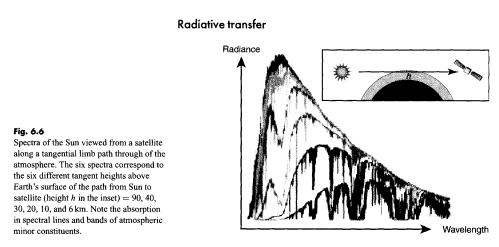
First, a comment on the “benefit” of this miseducation – being able to separate out solar radiation from terrestrial radiation is a huge benefit in climate understanding – it allows us to measure radiation at a particular wavelength and know its source. But many people are confused and say we can’t because 50% of the solar radiation is “infrared”. Infrared means >0.7μm. Conventionally, climate scientists use “shortwave” to mean radiation < 4μm and “longwave” to mean radiation > 4μm. As less than 1% of solar radiation is >4μm this is a very useful convention. Any radiation greater than 4μm is terrestrial (to 99% accuracy).
Many uninformed people who have become miseducated are certain that much solar radiation is >4μm – possibly due to confusing infrared with longwave.
We don’t speculate on motives on this blog so I’ll just point out that Gerlich and Tscheuschner know very little about any climate science, and from this comment probably don’t even understand the inappropriately-named “greenhouse” effect.
Why? Well, what has the visibility of the radiation have to do with the “greenhouse” effect? Of course it’s ignored. Our duo are just demonstrating their ignorance of the absolute basics.
Or they have some amazing insight into how the visibility or not of solar radiation affects the radiative transfer equations. All to be shared in part two probably..
The Core Question – the Radiative Transfer Equations
After a brief explanation of Kirchoff’s law, our duo discuss the core equations, the radiative transfer equations (RTE):
Absorption and emission coefficients get a very thorough treatment in the numerical solutions to the RTE, however, our duo are only familiar with work around the 1900’s and skip all modern work on the subject. Perhaps a more accurate statement would be:
Or they could actually show what effect that dependency actually had..
Then they decide to support the RTE:
Fantastic, 50 pages in we find the real RTE. This is what atmospheric physicists use to calculate the absorption and re-emission of radiation for each layer in the atmosphere. They follow this up with:
What do they mean? Of course you need boundary conditions to solve all real-world equations.
The separate directions are independent of one another? Yes, you find that in all treatments of radiative transfer.
So Gerlich and Tscheuschner agree that the RTE can be used to solve the problem? Or not? No one can tell from the comments here. If they do, the paper should be over now with support for the inappropriately-named “greenhouse effect”, unless they demonstrate that they can solve them for the atmosphere and get a different result from everyone else.
But they don’t.
Fortunately for those interested in what our duo really know and understand – they tell us..
The Modern Solution to the RTE – or How to Miss an Important 100 Years
After surveying works from more than 100 years ago, they conclude:
No explanation of Callendar and Keeling’s mistakes – this is left as an exercise for the interested student.
And no mention of the critical work in the 1960s and 1970s which used the radiative transfer equations and the convective structure of the atmosphere to find the currently accepted solutions.
In fact, the research results haven’t been vague at all. Regular readers of this blog will know about Ramanathan and Coakley 1978, and there are many more specific papers which find solutions to the RTE – using boundary conditions and separation of upward and downward fluxes, as wonderfully endorsed by our comedic duo.
More recent work has of course refined and improved the work of the 1960s and 1970s. And the measurements match the calculations.
But what a great way to write off a huge area of research. Show some flaws in the formative work 100 or so years ago and then skip the modern work and pretend you have demonstrated that the modern theory is wrong.
As we saw in the last section, our duo appear to support the modern equations – although they are careful not to come out and say it. Luckily, they are blissfully ignorant of modern work in the field, which all helps in the miseducation of the uninformed.
The main work of the paper should now be over, but our duo haven’t realized it. So instead they move randomly to the radiative balance concept..
Radiative Balance and Mathematical Confusion
In every introduction to atmospheric physics you find the concept of radiative balance – solar energy absorbed = terrestrial radiation emitted from the top of the atmosphere. These concepts are used to demonstrate that the atmosphere must absorb longwave (terrestrial) radiation.
This concept can be found in CO2 – An Insignificant Trace Gas? Part One
After looking at the basics of the energy balance, they comment – on the right value for albedo (or ‘1-albedo’):
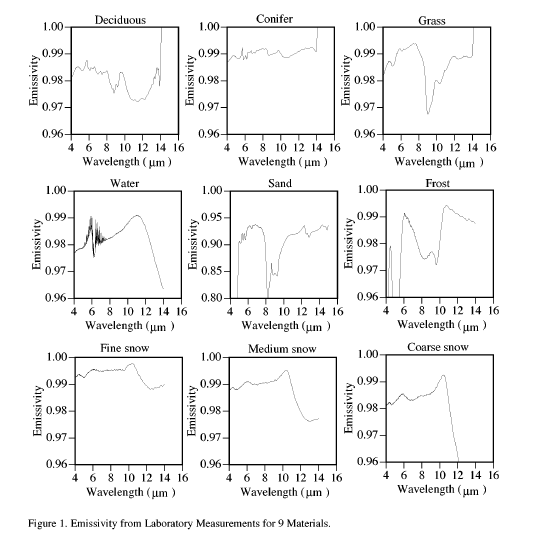
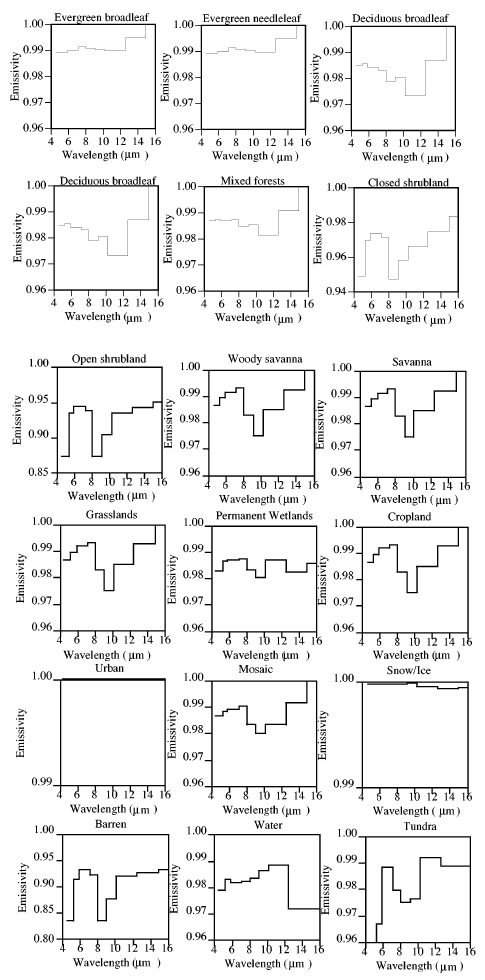
Being obscure impresses the uninformed. However, the informed will know that the earth’s emissivity and absorptivity will of course be different because the solar radiation is centered on 0.5μm while the terrestrial radiation is centered on 10μm. And the emissivity (and absorptivity) around 10um is very close to 1 (typically 0.98) while around 0.5μm the absorptivity is somewhat lower.
At this point, if we were to do a parody of our duo, we would write how their physics is extremely poor and do a three page derivation of absorptivity and emissivity as a function of wavelength.
Now follows many pages of maths explaining the impossibility of working out an average temperature for the earth during which they make the following interesting comment:
What they are saying is that for energy balance if we work out the radiation emitted from the earth we have dealt with the problem.
Fortunately for our intrepid duo, they are unacquainted with any contemporary climate science so the fact that someone has already done this work can be safely ignored. Earth’s Global Energy Budget by Trenberth, Fassulo and Kiehl (2008) covers this work.
So there is potential variation of a few W/m2 depending on the approach, and Trenberth et al settles on 396 W/m2 average – at least the values can be calculated, whereas our duo decided it was computationally impossible – perhaps as they saw the problem as requiring a totally accurate GCM.
With this information, the radiative balance problem can be resolved and we can see that there is a discrepancy between the solar energy absorbed and the terrestrial radiation emitted which requires explanation. The inappropriately-named “greenhouse effect”.
Without this information we can delight in much maths and pretend that nothing can be known about anything.
Why Conduction Can be Safely Ignored and Why We Just Demonstrated It
In fact in many texts on atmospheric physics conduction is safely ignored due to the very low value of heat conduction through gases. Strictly speaking, if we write an equation then all terms should be included, including latent heat and convection. Why just radiation and conduction?
As Ramanathan and Coakley pointed out in their 1978 paper, convection is what determines the temperature gradient of the atmosphere but solving the equations for convection is a significant problem – so the radiative convective approach is to use the known temperature profile in the lower atmosphere to solve the radiative transfer equations.
Still, no thought of conduction as that term is so insignificant – as our intrepid duo go on to realize..
Commenting on the insolubility of heat flow via conduction they take a “typical example”:
So heat flow by conduction is so low that achieving balance by this method will take more than the age of the universe. Therefore, it is insignificant in comparison with convection and radiation.
Good so we can move on and climate scientists are right to ignore it. Was that the point that Gerlich and Tscheuschner were making? Yes, although possibly without realizing it..
Finally, the Imaginary Second Law of Thermodynamics
In their almost concluding section we see where countless climate enthusiasts have obtained their knowledge (or the reverse).
First, here’s an extract from a contemporary work on thermodynamics. This is from Fundamentals of Heat and Mass Transfer, 6th edition (2007), by Incropera & Dewitt:
As can be seen in the text, radiation can be absorbed by a higher temperature surface from a lower temperature surface and vice versa. Of course, the net result is a heat transfer from the hotter to the cooler.
The same uncontroversial description can be found in any standard thermodynamics work, unless they consider it too unimportant to mention. Certainly, none will have a warning sign up saying “this doesn’t happen”.
The explanation of the “greenhouse effect” is that the earth’s surface warms the lower atmosphere by radiation (as well as convection and latent heat transfer). And the atmosphere in turn radiates energy in all directions – one of which is back to the earth’s surface. Believers in the imaginary second law of thermodynamics don’t think this can happen. And this is possibly due to the miseducation by our intrepid duo. Or perhaps they learnt their thermodynamics from many “climate science” blogs.
The result of the actual climate situation is that the earth’s surface is warmer than it would have been without this atmospheric radiation. Pretty simple in concept.
Here’s how Gerlich and Tscheuschner explain things:
Everyone agrees.
Now the confusion. What are they saying? This isn’t what atmospheric physicists describe. The net heat transfer is from the earth’s surface (which was warmed by the sun) to the atmosphere.
Are they saying that it is impossible for any radiation to transfer heat from the atmosphere to the earth? It would appear so –
Following their diagram above, they comment, first quoting Rahmstorf:
Our duo first attempt to confuse, as they frequently do in their opus by claiming that a clear explanation is obscure because precise enough terms aren’t used. It’s not obscure because they make the “correction” themselves.
Then add their masterstroke. It is inadmissible to apply the second law for the upward and downward heat separately redefining the thermodynamic system on the fly.
What on earth do they mean? Our comedic duo are the ones separating the system into upward and downward heat, followed by an enthusiastic army on the internet. Everyone else considers net heat flow.
As we saw in a standard work on thermodynamics, now in its 6th edition after two or three decades in print, there is no scientific problem with radiation from a colder to a hotter body – so long as there is a higher radiation from the hotter to the colder.
At this point I wonder – should I revisit the library and scan in 20 thermodynamic works? 50? What would it take to convince those who have been miseducated by our intrepid duo?
Perhaps Gerlich and Tscheuschner can now turn their attention to all of the unscientific text books like the one shown at the start of this section..
Conclusion
There is much to admire in Gerlich and Tscheuschner’s work. It can surely become a new standard for miseducation and we can expect its deconstruction by psychologists and those who study theories of learning.
From a scientific point of view, there is less to admire.
They have no understanding of modern climate science, content to dwell on works from over 100 years ago and ignoring any modern work. They appear to believe that the basis for the “greenhouse” effect is an actual greenhouse (as was covered in On Having a Laugh) even though no serious work on the subject relies on greenhouses. (Some don’t even mention it, some mention it to point out that the atmosphere doesn’t really work like a greenhouse).
In fact, the serious work of the last few decades relies on the radiative transfer equations – equations apparently endorsed by our duo, although their comments are “obscure”.
They take many other snipes at climate science by the approach of pointing out a term or dependency has been “neglected” (for example, like conduction through the atmosphere) without showing that the neglect has a significant impact – except in the case of conduction where (unwittingly?) they appear to show that conduction should definitely be ignored!
Someone could take issue with even modern work on climate science by the fact that they ignore relativistic effects.
And after 18 pages of unnecessary re-derivation of general relativity we find that “it’s therefore impossible to calculate this and the problem is insoluble“..
Well, although they haven’t read any modern climate science, it’s hard to see how they could be so confused about the application of the 2nd law of thermodynamics.
Perhaps in their follow up work they can explain why all the thermodynamics works are wrong, and especially where this 15μm (longwave) radiation comes from:
Measured downward longwave radiation at the earth's surface
According to their interpretation of the 2nd law of thermodynamics this can’t happen. No heat can flow from the colder atmosphere to the warmer surface as that would be a “perpetuum mobile” and therefore impossible.
Where is it coming from Gerlich and Tscheuschner?
Read Full Post »