Feeds:
Posts
Comments

Archive for 2010

With apologies to my many patient readers who want to cover more challenging subjects.

Many people trying to understand climate science have a conceptual problem.

I have written (too) many articles about the second law of thermodynamics – the real and the imaginary version. Resulting comments on this blog and elsewhere about those articles frequently contain comments of this form:

So if we take bucket A full of water at 80°C and bucket B full of water at 10°C, Science of Doom is saying that bucket A will heat up because of bucket B? Right! That’s ridiculous and climate science is absurd!

Yes, if anyone was saying that it would be ridiculous. I agree. To take one example from many, in The Real Second Law of Thermodynamics I said:

Put a hold and cold body together and they tend to come to the same temperature, not move apart in temperature.

Of course, it could be that I am inconsistent in my application of this principle.

One observation on the many contrary claims resulting from my articles – not a single person has provided a mathematical summary to demonstrate that the examples provided contradict the first or second law of thermodynamics.

It should be so easy to do – after all if one of the many systems I have outlined contravenes one of these laws, surely someone can write down the equations for energy conservation (1st law of thermodynamics) or for change in entropy (2nd law of thermodynamics) and prove me wrong. We aren’t talking complex maths here with double integrals or partial differentiation. Just equations of the form a + b = 0.

And here’s the reason why – the problem that people have is conceptual. It seems wrong so they keep explaining why it seems wrong.

Conceptual problems are the hardest to get around. At least, that’s what I have always found. Until a subject “clicks”, all the mathematical proof in the world is just a jumble of letters.

So with that introduction, I offer a conceptual model to help those many people who don’t understand how a cold atmosphere can lead to a warmer surface than would occur without the cold atmosphere.

And if you are one of those people in the “firmly convinced” camp, let me suggest this reason for making the effort to understand this conceptual model. If you understand why others are wrong you can help explain it to them. But if you just don’t understand the argument of people on “the other side” you can’t offer them any useful assistance.

Model 2 – Two bodies – The Boring One that Everyone Really Does Agree With

Very quickly, to “warm everyone up”, and to once again state the basics – if we have two bodies in a closed system, and body A is at temperature 80°C and body B is at 10°C, then over a period of time both will end up at the same temperature somewhere between 10°C and 80°C. It is impossible, for example, for body A to end up at 100°C and body B at 0°C.

Everyone is in agreement on this point.

Note that the “period of time” might be anything between seconds and many times the age of the universe – dependent upon the circumstances of the two bodies.

Model 3A – Three Bodies with the Third Body Being Quite Cold
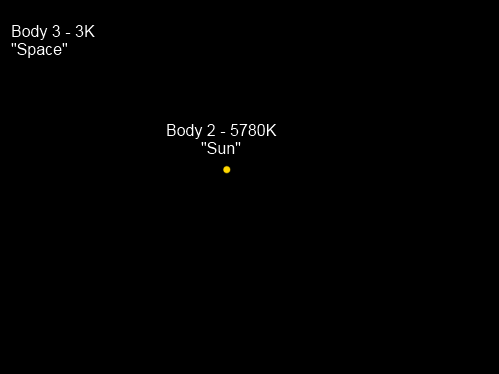
Where’s Body 1? This picture is the view from Body 1, also known as “Chilly Earth”, which is a spherical solid planet.

To make the problem much easier to solve we will state that the heat capacities of Body 2 and Body 3 are extremely high. This means that whether they gain or lose energy, their temperature will stay almost exactly the same. Body 1, “Chilly Earth”, has a much lower heat capacity and will therefore adjust quickly to a temperature which balances the absorption and emission of radiation.

“Chilly Earth” doesn’t have an atmosphere.

However, for the purposes of helping the conceptual model, “Chilly Earth” reflects 30% of shortwave radiation from the Sun but at longer wavelengths absorbs 100% (reflects 0%). This means its emissivity at longwave is also 100%.

“Chilly Earth” has a very high conductivity for heat, and therefore the whole planet is at the same surface temperature. (See note 1).

“Sun” is 150M km away from “Chilly Earth”, and “Chilly Earth” has a radius of 1,000 km (a little different from the planet we call home).

Let’s calculate the approximate equilibrium temperature of “Chilly Earth”, T1

How do we do this? By calculating the energy absorbed from Body 2 and from Body 3, and calculating the temperature of a surface that will radiate that same energy back out.

The method is simple – see below.

Energy Absorbed from Body 2, “Sun”

Radiation from “Sun” at 5780K = 6.3 x 10⁷ W/m² – near the surface of the sun. By the time the sun’s radiation reaches earth, because of the inverse square law (the radiation has “spread out”), it is reduced to 1,369 W/m². Remember that 30% is reflected, so the absorbed radiation = 958 W/m².

The surface area that “captures” this radiation = πr² = 3.14 x 10⁶ m².

Energy absorbed from body 2, Er2 = 958 x 3.14 x 106 = 3.01 x 10⁹ W.

Energy Absorbed from Body 3, “Space”

Radiation from “Space” at 3K = 4.59 x 10⁻⁶ W/m². Apart from the very tiny angle in the sky for “Sun”, the entire rest of the sky is radiating towards the earth from all directions in the sky.

The surface area that “captures” this radiation = 4πr² = 1.26 x 10⁷ m².

Energy absorbed from body 3, Er3 = 4.59 x 10-6 x 1.26 x 107 = 57.7W.

So energy from body 3 can be neglected which is not really surprising.

Energy Radiated from Body 1, “Chilly Earth”

For thermal equilibrium (energy in = energy out), “Chilly Earth” must radiate out 3.01 x 10⁹ W, from its entire surface area of 1.26 x 10⁷ m².

This equates to 239 W/m², which for a body with an emissivity of 1 (a blackbody) means T1 = -18°C.

So we have calculated the equilibrium temperature of “Chilly Earth”.

Now, if we change the model conditions – the reflected portion of solar radiation, the emissivity of the earth at longwave, or the conductivity of the planet’s surface – any of these factors would affect the result. They wouldn’t invalidate the analysis, they would simply lead to a different number, one that was slightly more difficult to work out.

But hopefully everyone can agree that with these conditions there is nothing wrong with the method. (I realize that a few people will not agree..)

Model 3B – Three Bodies with the Third Body Being Somewhat Warmer
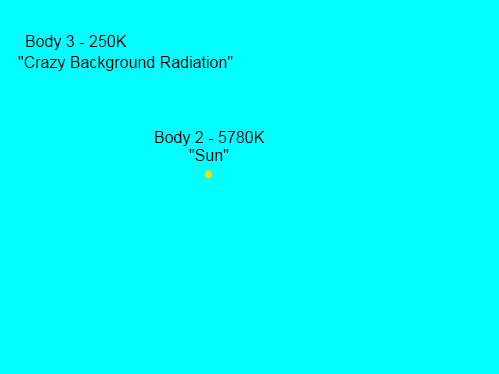
So now we are going to perform the same analysis with our new Body 1, “Warmer Earth” (a wild stab at an appropriate name).

The only thing that has really changed about the environment is that Body 3, “Crazy Background Radiation”, is now at 250K instead of 3K.

Note that the temperature of Body 3 is higher than before but lower than the equilibrium temperature of 255K calculated for “Chilly Earth” in the last model. As before, body 3 has an emissivity of 1 for longer wavelengths.

Body 1, “Warmer Earth”, still reflects 30% of solar radiation and is the same in every way as “Chilly Earth”.

What are we going to find?

We will do the same analysis as last time. Repeated in full to help those unfamiliar with this kind of problem.

Energy Absorbed from Body 2, “Sun”

Radiation from “Sun” at 5780K = 6.3 x 10⁷ W/m² – near the surface of the sun. By the time the sun’s radiation reaches earth, because of the inverse square law (the radiation has “spread out”), it is reduced to 1,369 W/m². Remember that 30% is reflected, so the absorbed radiation = 958 W/m².

The surface area that “captures” this radiation = πr² = 3.14 x 10⁶ m².

Energy absorbed from body 2, Er2 = 958 x 3.14 x 106 = 3.01 x 10⁹ W.

Energy Absorbed from Body 3, “Crazy Background Radiation”

Radiation from “Crazy Background Radiation” at 250K = 221 W/m². Apart from the very tiny angle in the sky for “Sun”, the entire rest of the sky is radiating towards the earth from all directions in the sky.

The surface area that “captures” this radiation = 4πr² = 1.26 x 10⁷ m². (See note 2).

Energy absorbed from body 3, Er3 = 221 x 1.26 x 107 = 2.78 x 10⁹ W.

In this case, energy from body 3 is comparable with body 2.

Energy Radiated from Body 1, “Warmer Earth”

Body 1 absorbs Etot= Er2 + Er3 = 5.79 x 10⁹ W

For thermal equilibrium (energy in = energy out). “Warmer Earth” must radiate out 5.79 x 10⁹ W, from its entire surface area of 1.26 x 10⁷ m².

This equates to 460 W/m², which for a body with an emissivity of 1 (a blackbody) means T1 = +27°C.

Discussion

Our two cases have revealed something very interesting.

A very very cold sky led to a surface temperature on our slightly different earth of -18°C, while a cold sky (colder than the original experiment’s planetary surface temperature) led to a surface temperature of 27°C.

Well, and here’s the thing, strictly speaking the temperature is actually caused primarily by the bright object in the middle of the picture, “Sun”. The energy absorbed from the sky just changes the outcome a little.

In both cases we calculated the equilibrium temperature by using the first law of thermodynamics (energy in = energy out).

If we do the calculation of entropy change we will find something interesting.. but first, let’s consider the conceptual model and what exactly is going on.

It’s very simple.

In a 3-body problem the temperature of the coldest body still has an effect on the equilibrium temperature of the body being heated by a hotter body.

I could make it more catchy, more media-friendly, but that would go against everything I stand for. I will call this Doom’s Law.

Entropy

The second law of thermodynamics says that entropy can’t reduce. The many cries of anguish that will now arise will claim that Model 3B has broken the Second Law of Thermodynamics. But it hasn’t.

See The Real Second Law of Thermodynamics for more on how to do this calculation. And even clearer, the article by Nick Stokes:

Change in entropy, δS = δQ / T

where δQ = change in energy, T = temperature

We will consider both models over 1 second.

Model 3A

Body 2, “Sun”, δS2 = -3.85 x 1026 / 5780 = -6.66 x 10²² J/K

Body 3, “Space”, δS3 = 3.85 x 1026 / 3 = +1.28 x 1026 J/K

And finally, Body 1, “Chilly Earth”, δS1 = 0 / 255 = 0 J/K

Total Entropy Change = δS1 + δS2 + δS3 = +1.28 x 1026 J/K  :a net increase in entropy.

Model 3B

Body 2, “Sun”, δS2 = -3.85 x 1026 / 5780 = -6.66 x 10²² J/K

Body 3, “Crazy Background Radiation”, δS3 = 3.85 x 1026 / 250 = +1.54 x 1024 J/K

And finally, Body 1, “Warmer Earth”, δS1 = 0 / 255 = 0 J/K

Total Entropy Change = δS1 + δS2 + δS3 = +1.47 x 1024 J/K   :a net increase in entropy.

Important points to note about the entropy calculation

Both scenarios increase entropy – by transferring heat from a high temperature source, “Sun”, to a low temperature source, “Space” in 3A, and “Crazy Background Radiation” in 3B (which is really also Space at a higher temperature).

The earth-like planet is sitting in the middle and doesn’t have a significant effect on the entropy of the universe.

In both cases the entropy of the system increases, so both are in accordance with the second law of thermodynamics.

The earth cools to space, but just at a slower rate when the background temperature of “space” is higher.

If we replaced “crazy background radiation” by an atmosphere that was mostly transparent to solar radiation, the analysis would be a little more complex but the result wouldn’t be much different.

Reasons Why It Might be Wrong

Just to be clear, these aren’t true..

1. The hotter body can’t absorb radiation from the colder body

a) see Amazing Things we Find in Textbooks – The Real Second Law of Thermodynamics for six textbooks on heat transfer which all say, yes it does. Actually, seven textbooks, thanks to commenter Bryan identifying his “non-cherrypicked” textbook by “real physicists” which also agreed.

b) see The Amazing Case of “Back Radiation” – Part Three which includes the EBEX experiment as well as a brief explanation of fundamental physics

c) see Absorption of Radiation from Different Temperature Sources – clearing up a few misconceptions on this idea

2. It’s not a real situation because the atmosphere isn’t a black body

It is true that the atmosphere is not a blackbody. But look back at model 3B. It doesn’t matter. Body 3 in this model could be a 250K body with an emissivity of 0.1 and the temperature would still increase over model 3A.

In fact, if the claim is that a colder body can never increase the temperature of a warmer body – all we need is one counter-example to falsify this theory. Now, if you want to modify your theory to something different we can examine this new theory instead.

Reasons Why It Has to be Right

1. The First Law of Thermodynamics. This neglected little jewel is quite important. Energy can’t disappear (or be created) or be quarantined into a mental box.

There is a reason why all the people disputing these basic analyses never explain where the energy goes (if it “can’t” go into changing the temperature of the hotter body that might have absorbed it). The reason – they don’t know.

2. The Second Law of Thermodynamics. This law says that in a closed system entropy cannot decrease. Despite angry claims about “no such thing as a closed system” – that’s what the second law says. Entropy is often simple to calculate.

If a solution uses simple radiation of energy (Stefan-Boltzmann’s law) and satisfies the first and second law of thermodynamics, and some people don’t like it, it suggests that the problem is with their conceptual model.

Conclusion

This is a conceptual model that is very simple.

The sun warms up the earth, and the earth cools to space. The colder “space” is, the faster the rate of net heat transfer. The warmer “space” is, the slower the rate of net heat transfer. And because the sun “pumps in” heat at the same rate, if you slow the rate of heat loss the equilibrium temperature has to increase.

The first law of thermodynamics is the key to understanding this problem. It is simple to verify that model 3A & 3B both satisfy the first law of thermodynamics. In fact, more importantly, a different result would contradict the first law of thermodynamics.

It is also easy to verify that in both 3A & 3B entropy increases.

Just to be clear on a tedious point, the earth and space do not have to radiate as a blackbody to have these conclusions. They just make the model simpler to explain, and the maths easier to understand. We could easily change the emissivity of the planet to 0.9 and the emissivity of space to 0.5 in both models and we would still find that Model 3B had a warmer planetary surface than Model 3A.

Many people will be unhappy, but this blog is not about bringing happiness. Clarity is the objective.

One more hopeless note of despair – this article uses simple theory to prove a point, which is actually a very valuable exercise. Next, some will say – “I don’t want that pointless over-theoretical theory, these people need to prove it with some experiments“.

And so I offer the series, The Amazing Case of “Back Radiation” as proof, especially Part Three. Result of Part Three was – “well, that can’t happen because it goes against theory“..

And so the circle is complete.

Notes

Note 1 – These strange conditions that don’t relate to the real world are to make the conceptual model simpler (and the maths easy). This is the staple of physics (and other sciences) – compare simple models first, then make them more complex and more realistic. If you can prove a theory with a simple model you have saved a lot of work and more people can understand it.

Note 2 – Solar radiation is from a tiny “angle” in the sky, and so the radiation is effectively “captured” by the earth as a flat disk in space. This area is the area of a disk = πr². By contrast, radiation from the sky is from all around the planet, and so the radiation is effectively captured by the surface area of the sphere. This area = 4πr². See The Earth’s Energy Budget – Part One for more explanation of this.
Read Full Post »

In New Theory Proves AGW Wrong! I said:

So, if New Theory Proves AGW Wrong is an exciting subject, you will continue to enjoy the subject for many years, because I’m sure there will be many more papers from physicists “proving” the theory wrong.

However, it’s likely that if they are papers “falsifying” the foundational “greenhouse” gas effect – or radiative-convective model of the atmosphere – then probably each paper will also contradict the ones that came before and the ones that follow after.

I noticed on another blog an article lauding the work of a physicist who reaches some different conclusions about the role of CO2 and other trace gases in the atmosphere.

This has clearly made a lot of people happy which is wonderful. However, if you want to understand the science of the subject, read on.

One of the areas that many people are confused by is the distinction between GCMs and the radiative transfer equations. Well, strictly speaking almost everyone who is confused about the distinction doesn’t know what the radiative transfer equations are.

So I should say:

Many people are confused about the distinction between GCMs and the effect of CO2 in the atmosphere

They are quite different. The role of CO2 and other trace gases is a component of GCMs.

Digression – As an analogy with less emotive power we could consider the subject of ocean circulation. Now it’s easy to prove theoretically that more dense water sinks and less dense water rises. We can do 100’s of experiments in tanks that prove this. Now if the models that calculate the whole ocean circulation don’t quite get the right answers one reason might be that the theory of buoyancy is a huge mistake.
But there could be other reasons as well. For example, flaws in equations for the amount of momentum transferred from the winds to the ocean, knowledge of the salinity throughout the ocean, knowledge of the variation in eddy diffusivity and tens – or hundreds – of other reasons. All we need to do to confirm buoyancy is to go back to our tank experiments.. End of digression.

Happily there is plenty of detailed experimental work to back up “standard theory” about CO2 and therefore prove “new theories” wrong.

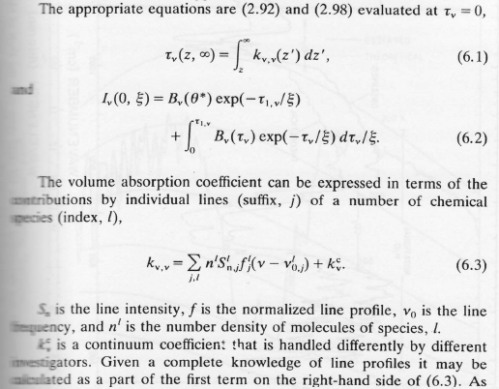
Richard M. Goody

RM Goody was the doctoral advisor to Richard Lindzen. He wrote the classic work Atmospheric Radiation: Theoretical Basis (1964). I have the 2nd edition, co-authored with Y.L. Yung, from 1989.

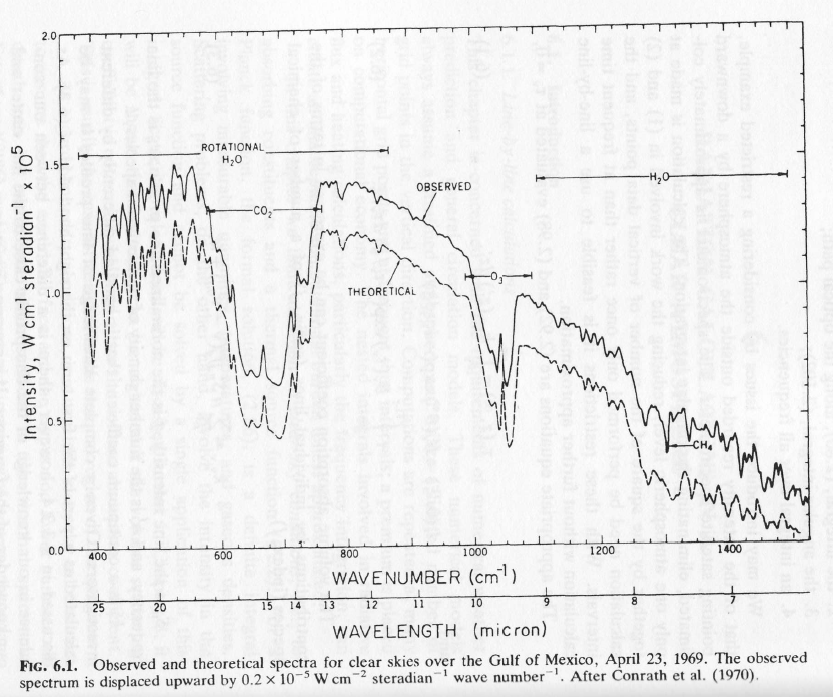
Here are measured vs theoretical spectra at the top of atmosphere. Note that the spectra are displaced for easier comparison:From Atmospheric Radiation, Goody (1989)

From Atmospheric Radiation, Goody (1989)

Click for a larger image

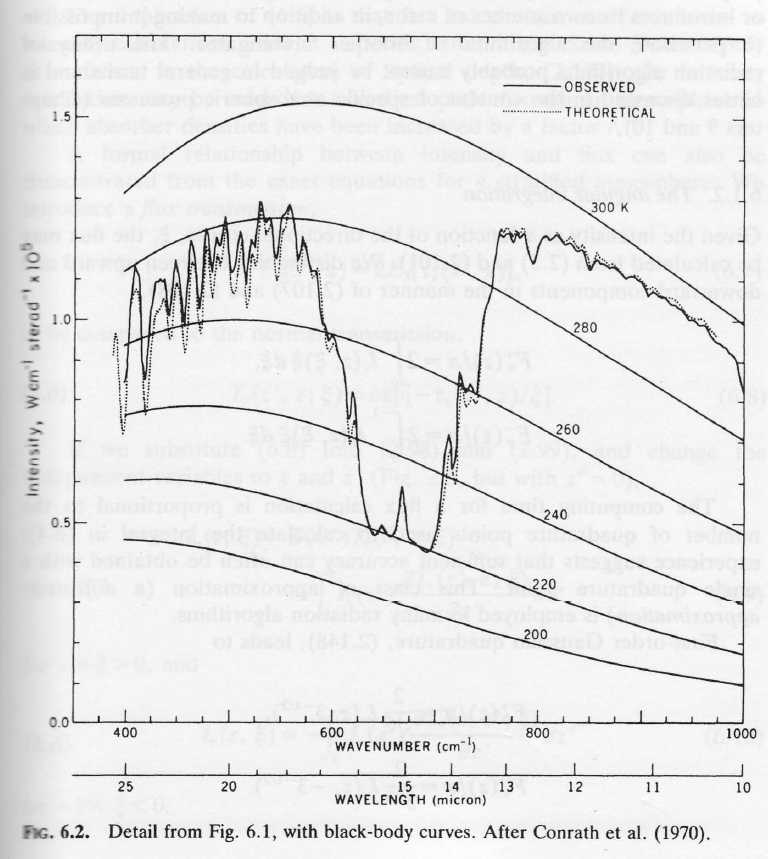
This extract makes it easier to see the magnitude of any differences:From Atmospheric Radiation, Goody (1989)

From Atmospheric Radiation, Goody (1989)

Click for a larger image

Goody & Yung comment:

The agreement between theory and observation in Figs 6.1 and 6.2 is generally within about 10%. It is surprising, at first sight, that it is not better. Uncertainties in the spectroscopic data are partially responsible, but it is difficult to assign all the errors to this source. Local variations in temperature and departures from a strictly stratified atmosphere must also contribute.

The radiosonde data used may not correctly apply to the path of the radiation. The atmospheric temperatures could be adjusted slightly to give better agreement..

How was the theoretical calculation done? By solving this equation, which looks a little daunting, but I will explain it in simple terms:

Before we look in a little detail about the radiative transfer equations, it is important to understand that to calculate the interaction of the atmosphere and radiation, there are two parameters which are required:

  • the quantity of radiatively-active gases (like CO2 and water vapor) vertically through the atmosphere (affects absorption)
  • the temperature profile vertically through the atmosphere (affects emission)

If we have that data, the equation above can be solved to produce a spectrum like the one shown. The uncertainty in the data generates uncertainty in the results.

Given the closeness of the match, if a “new theory” comes along and produces very different results then there are two things that we would expect:

  • demonstrating the improvement in experimental/theoretical match
  • explaining why the existing theory is wrong OR under what specific circumstances the new theory does a better job

When you don’t see either of these you can be reasonably sure that the “new theory” isn’t worth spending too much time on.

Of course, the result from the great RM Goody could be a fluke, or he could have just made the whole thing up. Better to consider this possibility – after all, if a random person has produced a 27-page document with lots of equations it is very likely that this new person if correct, so long as they support your point of view..

Dessler, Yang, Lee, Solbrig, Zhang and Minschwaner

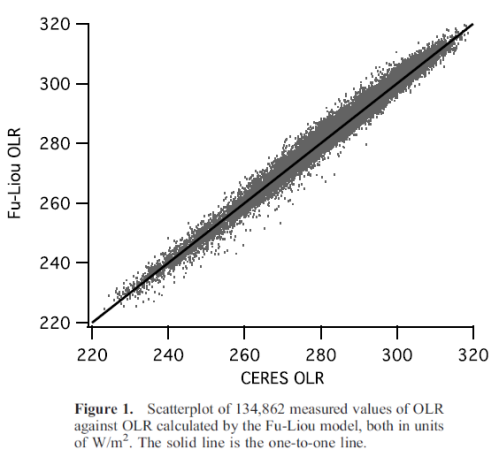
In their paper, An analysis of the dependence of clear-sky top-of-atmosphere outgoing longwave radiation on atmospheric temperature and water vapor, the authors provide a comparison of the measured results from CERES with the solution of the radiative transfer equations (using a particular band model, see note 1):


From Dessler et al (2008)

From Dessler et al (2008)


The authors say:

First, we compare the OLR measurements to OLR calculated from two radiative transfer models. The models use as input simultaneous and collocated measurements of atmospheric temperature and atmospheric water vapor made by the Atmospheric Infrared Sounder (AIRS). We find excellent agreement between the models’ predictions of OLR and observations, well within the uncertainty of the measurements.

Notice the important point that to calculate the OLR (outgoing longwave radiation) measurements at the top of atmosphere we need atmospheric temperature and water vapor concentration (CO2 is well-mixed in the atmosphere so we can assume the values of CO2).

For interest:

The uncertainty of an individual top-of-atmosphere OLR measurement is 5 W/m2 , while the uncertainty of average OLR over a 1-latitude  1-longitude box, which contains many viewing angles, is 1.5 W/m²

The primary purpose of this paper wasn’t to demonstrate the correctness of the radiative transfer equations – these are beyond dispute – but was first to demonstrate the accuracy of a particular band model, and second, to use that result to demonstrate the relationship between the surface temperature, humidity and OLR measurement.

So we have detailed spectral calculations matching standard theory as well as 100,000 flux measurements matching theory – at the top of atmosphere.

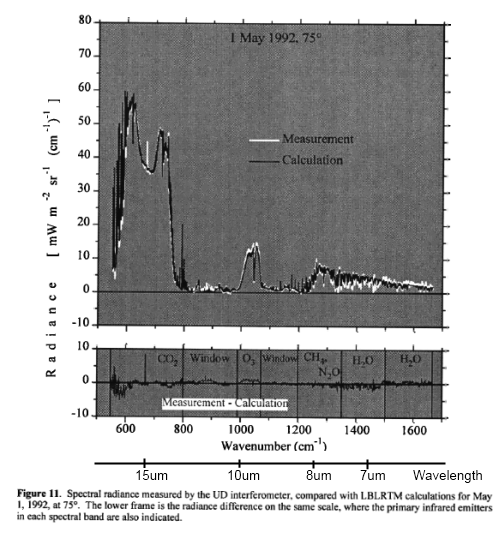
What about at the ground?

Walden, Warren and Murcray

In Measurements of the downward longwave radiation spectrum over the Antarctic plateau and comparisons with a line-by-line radiative transfer model for clear skies, the authors compare measured spectra at the ground with the theoretical results:


Antarctica - Walden (1998)

Antarctica - Walden (1998)


As you can see, a close match across all measured wavelengths.

I don’t remember seeing a paper which compares large numbers of DLR (downward longwave radiation) measurements vs theory (there probably are some), but I hope I have done enough to demonstrate that people with new theories have a mountain to climb if they want to prove the standard theory wrong.

Whether or not GCMs can predict the future or even model the past is a totally different question from Do we understand the physics of radiation transfer through the atmosphere? The answer to this last question is “yes”.

The Standard Approach – Theory

Understanding the theory of radiative transfer is quite daunting without a maths background, and as many readers don’t want to see lots of equations I will try and describe the approach non-mathematically. There is some simple maths for this subject in CO2 – An Insignificant Trace Gas? Part Three.

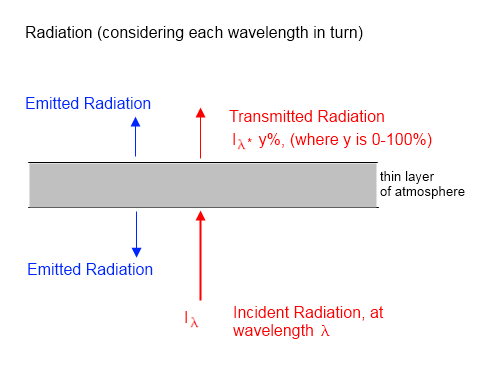
Consider a “monochromatic” beam of radiation travelling up through a thin layer of atmosphere:

Monochromatic means “at one wavelength”.

The light entering the layer at the bottom will be partly absorbed by the gas, dependent on the presence of any absorbers at that wavelength. The actual calculation of the amount of absorption is simple. The attenuation that results is in proportion to the intensity of radiation and in proportion to the amount of absorbers and a parameter called “capture cross section”. This last parameter relates to the effectiveness of the particular gas in absorbing that wavelength of radiation – and is measured in a spectroscopy lab.

There are complications in that the capture cross section of a gas is also dependent on pressure and temperature – and pressure varies by a factor of five from the surface to the tropopause. This just makes the calculation more tedious, it doesn’t present any major obstacles to carrying out the calculation.

That means we can calculate the intensity of radiation at that wavelength emerging from the other side of the slab of atmosphere. Or does it?

No, the problem is not complete. If a gas can absorb at a wavelength it will also radiate at that same wavelength.

Energy from radiation absorbed by the gas is shared thermally with all other gas molecules (except high up in the atmosphere where the pressure is very low) and so all radiatively-active gases will emit radiation. However, at the wavelength we are considering, only specific gases will radiate.

So the calculation for the radiation leaving the slab of atmosphere is also dependent on the temperature of the gas and its ability to radiate at that wavelength.

To complete the calculation we need to carry it out across all wavelengths (“integrate” across all wavelengths).

That calculation is then complete for the thin slab of atmosphere. So finally we need to “integrate” this calculation vertically through the atmosphere.

If you read back through the explanation, as it becomes clearer you will see that you need to know the quantity of CO2, water vapor and other trace gases at each height. And that you need to know the temperature at each height in the atmosphere.

Now it’s not a calculation you can do in your head, or on a pocket calculator. Which is why the many people writing poetry on this subject are usually wrong. If someone reaches a conclusion and it isn’t based on solving the equations shown above in the RM Goody section then it’s not reliable. And, therefore, poetry.

The Standard Approach – Doubling CO2

Armed with the knowledge of how to calculate the interaction of the atmosphere with radiation, how do we approach the question of the effect of doubling CO2?

In the past many people had slightly different approaches, so usually it is prepared in a standard way – explained further in CO2 – An Insignificant Trace Gas? Part Seven – The Boring Numbers.

The most important point to understand is that the atmosphere and surface are heated by the sun via radiation, and they cool to space via radiation. While all of the components of the climate are inter-related, the fundamental consideration is that if cooling to space reduces then the climate will heat up (assuming constant solar radiation). Which part of the climate, at what speed, in what order? These are all important questions but first understand that if the climate system radiates less energy to space then the climate system will heat up. See The Earth’s Energy Budget – Part Two.

Therefore, the usual calculation of the effect of doubling CO2 – prior to any feedbacks – assumes that the same temperature profile exists vertically through the atmosphere, along with the same concentration of water vapor. The question is then:

How much does the surface temperature have to increase to allow the same amount of radiation to be emitted to space?

See The Earth’s Energy Budget – Part Three for an explanation about why more CO2 means less radiation emitted to space initially.

The end result is that – without feedbacks – the surface will increase in temperature about 1°C to allow the same amount of radiation to space (compared with the case before CO2 was doubled).

The calculation relies on solving the radiative transfer equations as explained in words above, and shown mathematically in the extract from Goody’s book.

The “New Theory”

For reasons already explained, if someone has a new theory that gets a completely different result for the effect of more CO2, then we would expect them to explain where everyone else went wrong.

There is no sign of that in this paper.

For interested readers, I provide a few comments on the paper. The author is described as “John Nicol, Professor Emeritus of Physics, James Cook University, Australia”. Perhaps modesty prevents him mentioning the professorship in his own bio – in any case, he probably knows a lot of physics – as do the many professors of physics who have studied radiation in the atmosphere for many decades and written the books and papers on the subject..

In any case, on this blog, we weigh up ideas and evidence rather than resumés..

Here is his conclusion:

The findings clearly show that any gas with an absorption line or band lying within the spectral range of the radiation field from the warmed earth, will be capable of contributing towards raising the temperature of the earth. However, it is equally clear that after reaching a fixed threshold of so-called Greenhouse gas density, which is much lower than that currently found in the atmosphere, there will be no further increase in temperature from this source, no matter how large the increase in the atmospheric density of such gases.

So he understands the inappropriately-named “greenhouse” effect in basic terms but effectively claims that the effect of CO2 is “saturated”.

The paper’s advocate claimed:

..closely argued, mathematical and physical analysis of how energy is transmitted from the surface through the atmosphere, answers all questions..

– however, the paper is anything but.

There are some equations:

  • Planck’s law of blackbody radiation (p3)
  • Stefan-Boltzmann’s law of total radiation (p2)
  • Wien’s law of peak radiation (p3)
  • spectral line width due to natural broadening, doppler broadening and collision broadening (p7 &8)
  • density changes vs height in the atmosphere (p6)

These are all standard equations and it is not at all clear what equations are solved to demonstrate his conclusion.

He derives the expression for absorption of radiation (often known as Beer’s law – see CO2 – An Insignificant Trace Gas? Part Three). But most importantly, there is no equation for emission of radiation by the atmosphere. Emission of radiation is discussed, but whether or not it is included in his calculation is hard to determine.

Many of the sections in his paper are what you would find in a basic textbook (although line width equations would be in a more advanced textbook).

There are typos like the distance from the earth to the sun – which is not 1.5M km (p3). This doesn’t affect any conclusion, but shows that basic checking has not been done.

There are confusing elements. For example, the blackbody radiation curve (fig 1) for a 289K body, expressed against frequency. The frequency of peak radiation actually matches a wavelength of 17.6 μm, not 10 μm. (Peak frequency, ν = 1.7×10¹³ Hz, λ=c/ν = 3×10⁸/1.7×1013 = 17.6 μm. This corresponds to a temperature of 2.898×10⁻³/λ = 165 K).

And comments like this suggest some flawed thinking about the subject of radiative transfer:

The black inverted curve shows the fraction of radiation emitted at each frequency which escapes from the top of the troposphere at a height of 10 km and thus represents the proportion of the energy which could be additionally captured by an increase of CO2 and so contribute to the further warming of air in the various layers of the troposphere. It thus represents the effective absorption spectrum of CO2 within the range of frequencies shown after accounting for collisional line broadening which provides a reduced but significant level of absorption even in the very far wings of the line which is represented in Figure 3 on page 6.

Why flawed? Because the radiation emitted from the top of the troposphere is made up from two components:

  • surface radiation which is transmitted through the atmosphere
  • radiation emitted by the atmosphere at different heights which is transmitted through the atmosphere

Because other parts of the paper discuss emission by the atmosphere it is hard to determine whether or not it is ignored in his calculations, or whether the paper fails to convey the author’s approach.

One interesting comment is made towards the end of the paper:

The calculations show that doubling the level of CO2 leads to an escape of only 0.75 %, a difference of 1.8 %.  Thus, in this example where the chosen value of the broadening used is significantly less than the actual case in the atmosphere, an additional 6 Watts, from the original 396 Watts, would be retained in the 10 km column within the troposphere, when the density of carbon dioxide is doubled.

Now when we consider the effect of doubling CO2 the question is what is the “radiative forcing” – the change in top of atmosphere flux. The standard result is 3.7 W/m². (This is what leads to the calculation of 1°C surface temperature change prior to feedback).

It appears (but I can’t be certain) that Dr. Nicol thinks that the radiative forcing for doubling CO2 is even higher than the calculations that appear in the many papers used in the IPCC report. From his calculations he reports that 6W/m² would be retained.

On a technical note, although radiative forcing has a precise definition, it isn’t clear what exactly Dr. Nicol means by his value of “retained radiation”.

However, it does appear to conflict which his conclusion (extract reported at the beginning of this section).

There are many other areas of confusion in his paper. The focus appears to be on the surface forcing from changes in CO2 rather than changes in the energy balance for the whole climate system. There is a section (fig 6, page 21) which examines how much terrestrial radiation is absorbed in the first 50m of the atmosphere by the CO2 band at current and higher concentrations.

What would be more interesting is to see what changes occur in the top of atmosphere forcing from these changes, for example:


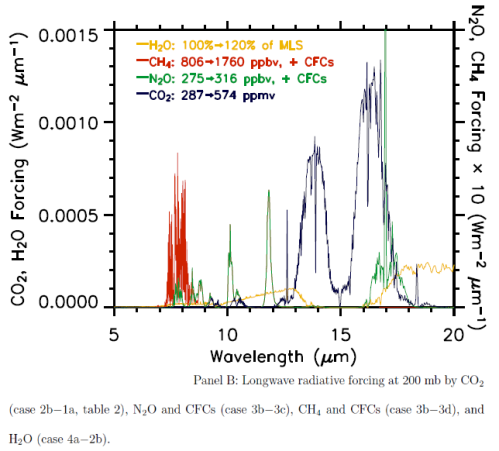
Longwave radiative forcing from increases in various "greenhouse" gases

Longwave radiative forcing from increases in various "greenhouse" gases


This graph is from W.D. Collins (2006) – see CO2 – An Insignificant Trace Gas? – Part Eight – Saturation.

Note the blue curve. This graph makes clear the calculated forcing vs wavelength. By contrast Dr. Nicol’s paper doesn’t really make clear what surface forcing is considered – how far out into the “wings” of the CO2 band is considered, or what result will occur at the surface for any top of atmosphere changes.

It is almost as if he is totally unaware of the work done on this problem since the 1960’s.

It is also possible that I have misunderstood what he is trying to demonstrate or what he has demonstrated. Hopefully someone, perhaps even Dr. Nicol, can explain if that is the case.

Conclusion

Calculations of radiation through the atmosphere do require consideration of absorption AND emission. The formal radiative transfer equations for the atmosphere are not innovative or in question – they are in all the textbooks and well-known to scientists in the field.

Experimental results closely match theory – both in total flux values and in spectral analysis. This demonstrates that radiative transfer is correctly explained by the standard theory.
New and innovative approaches to the subject are to be welcomed. However, just because someone with a physics degree, or a doctorate in physics, produces lots of equations and writes a conclusion doesn’t mean they have overturned standard theory.

New approaches need to demonstrate exactly what is wrong with the standard approach as found in all the textbooks and formative papers on this subject. They also need to explain, if they reach different conclusions, why the existing solutions match the results so closely.

Dr. Nicol’s paper doesn’t explain what’s wrong with existing theory and it is almost as if he is unaware of it.

References

Atmospheric Radiation: Theoretical Basis, Goody & Yung, Oxford University Press (2nd ed. 1989)

An analysis of the dependence of clear-sky top-of-atmosphere outgoing longwave radiation on atmospheric temperature and water vapor, by Dessler et al, Journal of Geophysics Research (2008)

Measurements of the downward longwave radiation spectrum over the Antarctic plateau and comparisons with a line-by-line radiative transfer model for clear skies, Walden et al, Journal of Geophysical Research (1998)

Notes

Note 1 – A “band model” is a mathematical expression which simplifies the complexity of the line by line (LBL) solution of the radiative transfer equations. Instead of having to lookup a value at every wavelength the band model uses an expression which is computationally much quicker.
Read Full Post »

This post covers some foundations which are often misunderstood.

Radiation emitted from a surface (or a gas) can go in all directions and also varies with wavelength, and so we start with a concept called spectral intensity.

This value has units of W/m².sr.μm, which in plainer language means Watts (energy per unit time) per square meter per solid angle per unit of wavelength. (“sr” in the units stands for “steradian“).

Most people are familiar with W/m² – and spectral intensity simply “narrows it down” further to the amount of energy in a direction and in a small bandwidth.

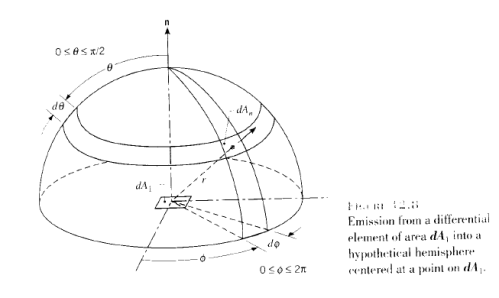
We’ll consider a planar opaque surface emitting radiation, as in the diagram below.


Hemispherical Radiation, Incropera and DeWitt (2007)

Hemispherical Radiation, Incropera and DeWitt (2007)


The total hemispherical emissive power, E, is the rate at which radiation is emitted per unit area at all possible wavelengths and in all possible directions. E has the more familiar units of W/m².

Most non-metals are “diffuse emitters” which means that the intensity doesn’t vary with the direction.

For a planar diffuse surface – if we integrate the spectral intensity over all directions we find that emissive power per μm is equal to π (pi) times the spectral intensity.

This result relies only on simple geometry, but doesn’t seem very useful until we can find out the value of spectral intensity. For that, we need Max Planck..

Planck

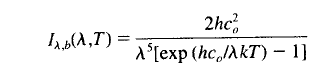
Most people have heard of Max Planck, Nobel prize winner in 1918. He derived the following equation (which looks a little daunting) for the spectral intensity of a blackbody:

Spectral Intensity, Max Planck

where T = absolute temperature (K); λ = wavelength; h = Planck’s constant = 6.626 x 10⁻³⁴ J.s; k = Boltzmann’s constant = 1.381 x 10⁻²³ J/K; c0 = the speed of light in a vacuum = 2.998 x 10⁸ m/s.

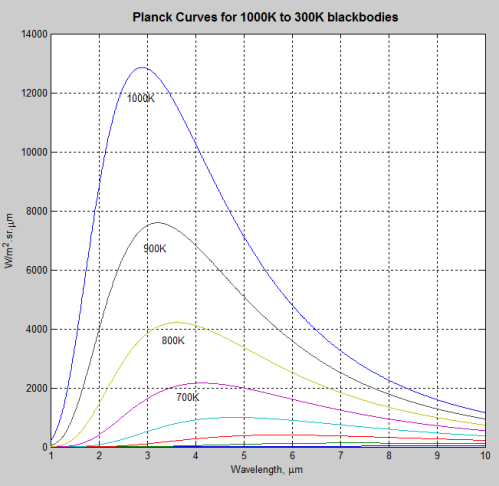
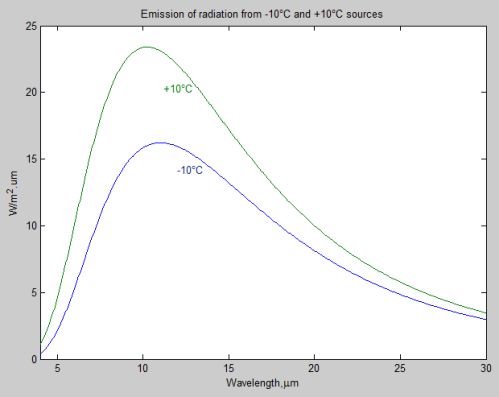
What this means is that radiation emitted is a function only of the temperature of the body and varies with wavelength. For example:

Note the rapid increase in radiation as temperature increases.

What is a blackbody?

A blackbody:

  • absorbs all incident radiation, regardless of wavelength and direction
  • emits the maximum energy for any wavelength and temperature (i.e., a perfect emitter)
  • emits independently of direction

Think of the blackbody as simply “the reference point” with which other emitters/absorbers can be compared.

Stefan-Boltzmann

The Stefan-Boltzmann equation (for total emissive power) is “easily” derived by integrating the Planck equation across all wavelengths and using the geometrical relationship explained at the start (E=πI). The result is quite well known:

E = σT4

where σ=5.67 x 10⁻⁸ and T is absolute temperature of the body.

The result above is for a blackbody. The material properties of a given body can be measured to calculate its emissivity, which is a value between 0 and 1, where 1 is a blackbody.

So a real body emits radiation according to the following formula:

E = εσT4

where ε is the emissivity. (See later section on emissivity and note 1).

Note that so long as the Planck equation is true, the Stefan-Boltzmann relationship inevitably follows. It is simply a calculation of the total energy radiated, as implied by the Planck equation.

The Smallprint

The Planck law is true for radiant intensity into a vacuum and for a body in Local Thermodynamic Equilibrium (LTE).

So that means it can never be used in the real world

Or so many people who comment on blogs seem to think. Let’s take a closer look.

The Vacuum

The speed of light in a vacuum, c0 = 2.998 x 10⁸ m/s. This value appears in the Planck equation and so we need to cater for it when the emission of radiation is into air. The speed of light in air, cair = c0/n, where n is the refractive index of air = 1.0008.

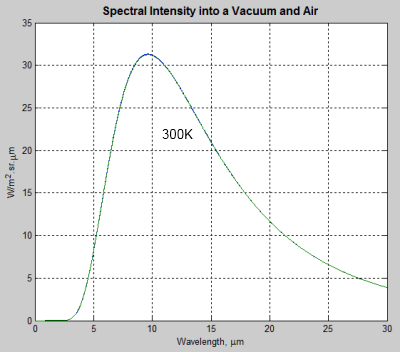
Here’s a comparison of the Planck curves at 300K into air and a vacuum:

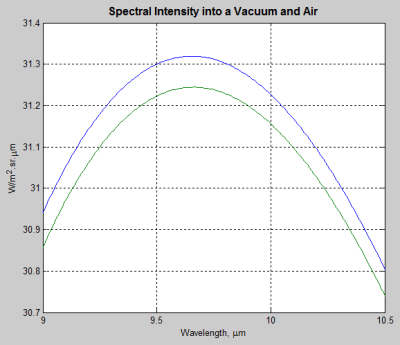
Not easy to separate. If we expand one part of the graph:

We can see that at the peak intensity the difference is around 0.3%.

The total emissive power into air:

E = n²σT4, where n is the refractive index of air

So the total energy radiated from a blackbody into air = 1.0016 x the total energy into a vacuum.

This is why it’s a perfectly valid assumption not to bother with this adjustment for radiation into air. In glass it’s a different proposition..

Local Thermodynamic Equilibrium

The meaning, and requirement, of LTE (local thermodynamic equilibrium) is often misunderstood.

It does not mean that a body is at the same temperature as its surroundings. Or that a body is all at the same temperature (isothermal).

An explanation which might help illuminate the subject – from Thermal Radiation Heat Transfer, by Siegel & Howell, McGraw Hill (1981):

In a gas, the redistribution of absorbed energy occurs by various types of collisions between the atoms, molecules, electrons and ions that comprise the gas. Under most engineering conditions, this redistribution occurs quite rapidly, and the energy states of the gas will be populated in equilibrium distributions at any given locality. When this is true, the Planck spectral distribution correctly describes the emission from a blackbody..

Another definition, which might help some (and be obscure to others) is from Radiation and Climate, by Vardavas and Taylor, Oxford University Press (2007):

When collisions control the populations of the energy levels in a particular part of an atmosphere we have only local thermodynamic equilibrium, LTE, as the system is open to radiation loss. When collisions become infrequent then there is a decoupling between the radiation field and the thermodynamic state of the atmosphere and emission is determined by the radiation field itself, and we have no local thermodynamic equilibrium.

And an explanation about where LTE does not apply might help illuminate the subject, from Siegel & Howell:

Cases in which the LTE assumption breaks down are occasionally encountered.

Examples are in very rarefied gases, where the rate and/or effectiveness of interparticle collisions in redistributing absorbed radiant energy is low; when rapid transients exist so that the populations of energy states of the particles cannot adjust to new conditions during the transient; where very sharp gradients occur so that local conditions depend on particles that arrive from adjacent localities at widely different conditions and may emit before reaching equilibrium and where extremely large radiative fluxes exists, so that absorption of energy and therefore populations of higher energy states occur so strongly that collisional processes cannot repopulate the lower states to an equilibrium density.

Now these LTE explanations are far removed from most people’s perceptions of what equilibrium means.

LTE is all about, in the vernacular:

Molecules banging into each other a lot so that normal energy states apply

And once this condition is met – which is almost always in the lower atmosphere – the Planck equation holds true. In the upper atmosphere this doesn’t hold true, because the density is so low. A subject for another time..

So much for Planck and Stefan-Boltzmann. But for real world surfaces (and gases) we need to know something about emissivity and absorptivity.

Emissivity, Absorptivity and Kirchhoff

There is an important relationship which is often derived. This relationship, Kirchhoff’s law, is that emissivity is equal to absorptivity, but comes with important provisos.

First, let’s explain what these two terms mean:

  • absorptivity is the proportion of incident radiation absorbed, and is a function of wavelength and direction; a blackbody has an absorptivity of 1 across all wavelengths and directions
  • emissivity is the proportion of radiation emitted compared with a blackbody, and is also a function of wavelength and direction

The provisos for Kirchhoff’s law are that the emissivity and absorptivity are equal only for a given wavelength and direction. Or in the case of diffuse surfaces, are true for wavelength only.

Now Kirchhoff’s law is easy to prove under very restrictive conditions. These conditions are:

  • thermodynamic equilibrium
  • isothermal enclosure

That is, the “thought experiment” which demonstrates the truth of Kirchhoff’s law is only true when there is a closed system with a body in equilibrium with its surroundings. Everything is at the same temperature and there is no heat exchanged with the outside world.

That’s quite a restrictive law! After all, it corresponds to no real world problem..

Here is how to think about Kirchhoff’s law.

The simple thought experiment demonstrates completely and absolutely that (under these restrictive conditions) emissivity = absorptivity (at a given wavelength and direction).

However, from experimental evidence we know that emissivity of a body is not affected by the incident radiation, or by any conditions of imbalance that occur between the body and its environment.

From experimental evidence we know that the absorptivity of a body is not affected by the amount of incident radiation, or by any imbalance between the body and its environment.

These results have been confirmed over 150 years.

As Siegel and Howell explain:

Thus the extension of Kirchhoff’s law to non-equilibrium systems is not a result of simple thermodynamic considerations. Rather it results from the physics of materials which allows them in most instances to maintain themselves in LTE and this have their properties not depend on the surrounding radiation field.

The important point is that thermodynamics considerations allow us to see that absorptivity = emissivity (both as a function of wavelength), and experimental considerations allow us to extend the results to non-equilibrium conditions.

This is why Kirchhoff’s law is accepted in thermodynamics.

Operatic Considerations

The hilarious paper by Gerlich and Tscheuschner poured fuel on the confused world of the blogosphere by pointing out just a few pieces of the puzzle (and not the rest) to the uninformed.

They explained some restrictive considerations for Planck’s law, the Stefan-Boltzmann equation, and for Kirchhoff’s law, and implied that as a result – well, who knows? Nothing is true? Not much is true?Nothing can be true? I had another look at the paper today but really can’t disentangle their various claims.

For example, they claim that because the Stefan-Boltzmann equation is the integral of the Planck equation over all wavelengths and directions:

Many pseudo-explanations in the context of global climatology are already falsified by these three fundamental observations of mathematical physics.

Except they don’t explain which ones. So no one can falsify their claim. And also, people without the necessary background who read their paper would easily reach the conclusion that the Stefan-Boltzmann equation had some serious flaws.

All part of their entertaining approach to physics.

I mention their papertainment because many claims in the blog world have probably arisen through uninformed people reading bits of their paper and reproducing them.

Conclusion

The fundamentals of radiation are well-known and backed up by a century and a half of experiments. There is nothing controversial about Planck’s law, Stefan-Boltzmann’s law or Kirchhoff’s law.

Everyone working in the field of atmospheric physics understands the applicability and limits of their use (e.g., the upper atmosphere).

This is not cutting edge stuff, instead it is the staple of every textbook in the field of radiation and radiant heat transfer.

Notes

Note 1 – Because emissivity is a function of wavelength, and because emission of radiation at any given wavelength varies with temperature, average emissivity is only valid for a given temperature.

For example, at 6000K most of the radiation from a blackbody has a wavelength of less than 4μm; while at 200K most of the radiation from a blackbody has a wavelength greater than 4μm.

Clearly the emissivity for 6000K will not be valid for the emissivity of the same material at a temperature of 200K.

Read Full Post »

In Part One we looked at how solar radiation and DLR (or “back radiation”) were absorbed by the ocean. And we had a brief look at how little heat would move by conduction into the deeper ocean if the ocean was “still”.

There were some excellent comments in part one from Nick Stokes, Arthur Smith and Willis Eschenbach – probably others as well – take a look if you didn’t see them first time around.

We will shortly look at mixing and convection, but first we will consider some absolute basics.

The First Law of Thermodynamics

How does the ocean sustain its (high) temperature? Every second, every square meter of the ocean is radiating energy. The Stefan-Boltzmann relationship tells us the value:

j = εσT4, where ε is the emissivity of the ocean (0.99), σ = 5.67 x 10⁻⁸ and T is the temperature in K

For example:

  • if T = 20°C (293K), j = 415 W/m²
  • if T = 10°C (283K), j = 361 W/m²

Now, many people are confused about how temperatures change with heat imbalances. If, for some reason, more heat is absorbed by a system than is radiated/conducted/convected away – what happens?

More heat absorbed than lost = heat gained. Heat gained leads to an increase of temperature (see note 1). When the temperature of a body increases, it radiates, conducts and convects more heat away (see note 2). Eventually a new equilibrium is reached at a higher temperature. It is important to grasp this concept. Read it again if it isn’t quite clear. Ask a question for clarification..

Questions are welcome.

A Simple Model

Evaluating a very simple energy balance model might help to set the scene.

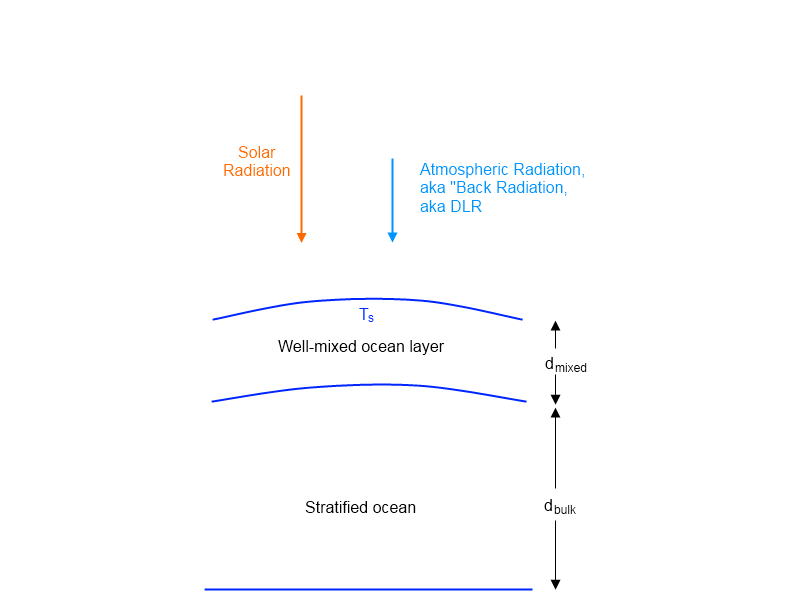
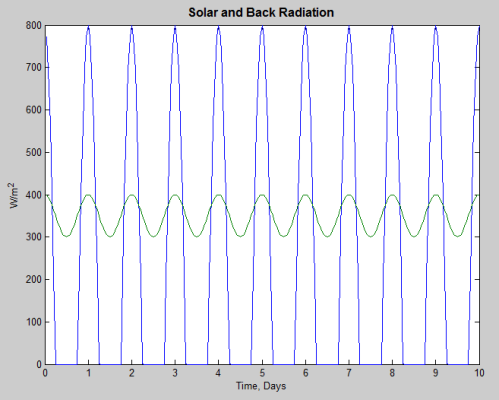
Here is the radiative input – solar radiation and “back radiation” from the atmosphere, with typical values for a tropical region:

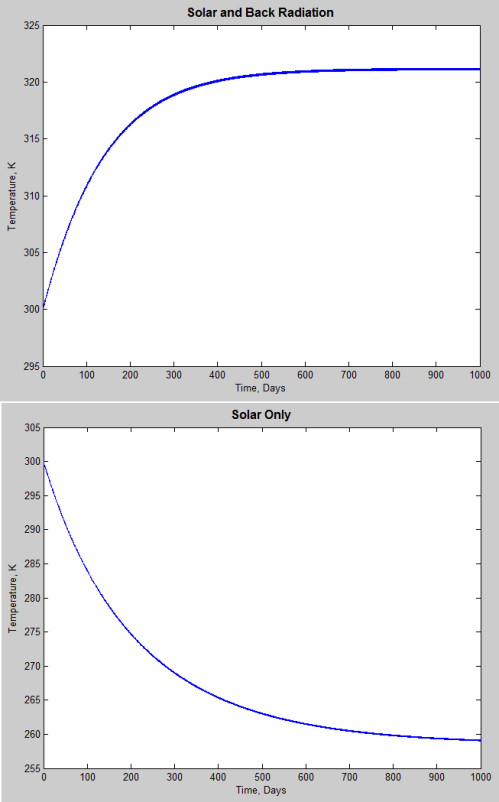
The primary question – the raison d’êtra for this article –  is what happens if only the solar radiation heats the ocean? And compared with if the back-radiation also heats the ocean?

It’s easy to find the basic equilibrium point using the first law of thermodynamics. All you need to know is the energy in, and the equation which links energy radiated with temperature.

For radiation, this is the Stefan-Boltzmann law cited earlier. The starting temperature for the ocean surface in this example was set to 300K (27°C). Depending on whether solar and back-radiation or just solar is heating the surface, here is the surface temperature change:

Notice the difference in the temperature trends for the two cases.

Now the model doesn’t yet include convective heat transfer from the ocean to the atmosphere (or movement of heat from the tropics to the poles), which is why in the first graph the temperature gets so high. Convection will reduce this temperature to a more “real world” value.

The second graph has only solar radiation heating the ocean. Notice that the temperature drops to a very low value (-15°C) in just a few years. Clearly the climate would be very different if this was the case, and the people who advocate this model need to explain exactly how the ocean temperature manages to stay so much higher.

By the way, if we made the “well-mixed layer”, dmixed, of the ocean deeper it would increase the time for the temperature to change by any given amount. That’s because more ocean has more heat capacity. But it doesn’t change the fact of the energy imbalance, or the final equilibrium temperature.

The model is a very simplistic one. That’s all you need to demonstrate that DLR, or “back radiation” must be absorbed by the ocean and contributing to the ocean heat content.

Turbulence and the Mixed Layer

Let’s take a look at a slightly more complex model to demonstrate an important point. This simulation has four main elements:

  • radiation absorbed in the ocean at various depths, according to the results in Part One
  • conduction between layers in the ocean
  • convective heating from the ocean surface to the atmosphere, according to a simple model with a fixed air temperature

This model is not going to revolutionize climate models as it has many simplifications. The important factor – there is no convection between different ocean layers in this model.

Now conductivity in still water is very low (as explained in Part One).

The starting condition – the “boundary condition” – was for the temperature to start at 300K (27°C) for the first 100m, with the ocean depths below to be a constant 1°C.

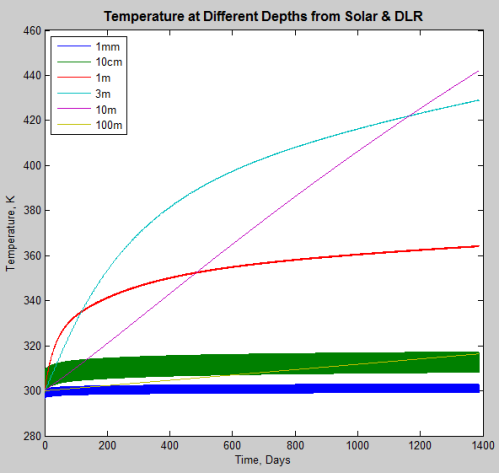
The model is for illumination. Let’s see what happens:

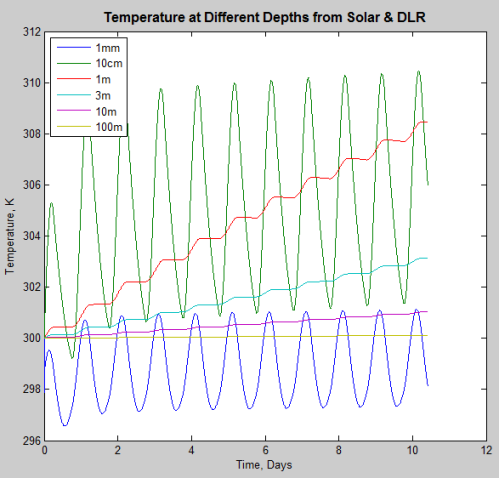
The wide bars of blue and green are because the day/night variation is significant but squashed horizontally. If we expand one part of the graph to look at the first few days:

You can see that the day/night variation of the top 1mm and 10cm are significant.

Look back at the first graph which covers four years. Notice the purple line, 10m depth, the blue line, 3m depth; and the red line, 1m depth.

Why is the ocean 1-10m depth increasing to such a high temperature?

The reason is simple. This model is flawed– these results don’t occur in practice. (And yes, the ocean would boil from within..)

The equations that make up this model have used:

  • the radiation absorbed from the sun and the atmosphere (as described in part one)
  • the radiation emitted from the surface layer (the Stefan-Boltzmann equation)
  • conductivity transferring heat between layers

If these were the only mechanisms for transferring heat, the ocean 1m – 10m deep would be extremely hot in the tropics. This is because the ocean where the radiation is absorbed cannot radiate back out.

For a mental picture think of a large thick slab of PVC which is heated from electrical elements within the PVC. Because it is such a poor conductor of heat, the inner temperature will rise much higher than the surface temperature, so long as the heating continues..

The reason this doesn’t happen in practice in the ocean is due to convection.

If you heat a gas or liquid from below it heats up and expands. Because it is now less dense than the layer above it will rise. This is what happens in the atmosphere, and it also happens in the ocean. The ocean under the very surface layer heats up, expands and rises – overturning the top layer of the ocean. This is natural convection.

The other effect that takes place is forced convection as the wind speed “stirs” the top few meters of the ocean. Convection is the transfer of heat by bulk motion of a fluid. Essentially, the gas or liquid moves, taking heat with it.

Price & Weller (1986) commented:

Under summer heating conditions with vanishing wind, the trapping depth of the thermal response is only about 1m (mean depth value), and the surface amplitude is as large as 2ºC or 3ºC. But, more commonly, when light or moderate winds are present, solar heating is wind mixed vertically to a considerably greater depth than is reached directly by radiation: the trapping depth is typically 10m, and the surface amplitude is reduced in inverse proportion to typically 0.2ºC. Given that the surface heating and wind stress are known, then the key to understanding and forecasting the diurnal cycle of the ocean is to learn how the trapping depth is set by the competing effects of a stabilizing surface heat flux and a destabilizing surface stress.

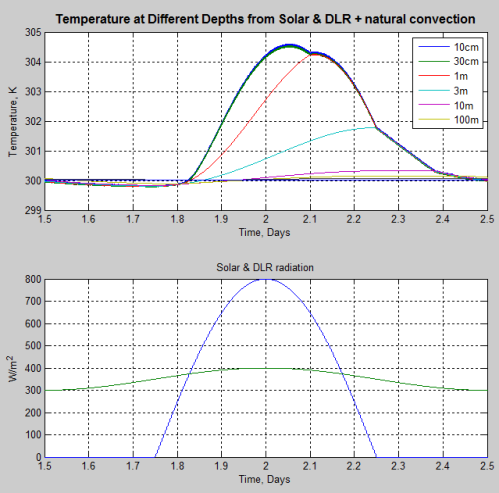
Here are the results from a model with another slight improvement. This includes natural convection. The mechanism is very rudimentary at this stage. It simply analyzes the temperature profile at each time step and if the temperature is inverted from normal buoyancy a much higher value of thermal conductivity is used to simulate convection.

The “bumpiness” you see in the temperature profile is because the model has multiple “slabs”, each with an average temperature. This could be reduced by a finer vertical grid.

During the early afternoon with peak solar radiation, the ocean becomes stratified. Why?

Because lots of heat is being absorbed in the first few meters with some then transported upwards to the surface via convection – but while the solar radiation value is high this heat keeps “pouring in” lower down. However, once the sun sets the surface will cool via radiation to the atmosphere and so become less buoyant. With no solar radiation now being absorbed lower down, the top few meters completely mix – from natural convection.

I did have a paper with a perfect set of measurements to illustrate these points. It showed day/night and seasonal variation. Sadly I put it down somewhere. Many hours of hunting for the physical paper and for the file on my PC but it is still lost..

Note that the large variation of surface temperature (4-5°C) is just a result of the convective mixing element in the model being too simplistic and moving heat much faster than happens in reality.

Kondo and Sasano (1979) said:

In the upper part of the ocean, a mixed layer with homogeneous density (or nearly homogeneous temperature) distribution is formed during the night due to free convection associated with heat loss from the sea surface and to forced convection by wind mixing.

During the daytime, the absorption of solar radiation which occurs mostly near the sea surface causes the temperature to rise, and a stable layer is formed there; as a consequence, turbulent transport is reduced.

Daily mean depth of the mixed layer increases with the wind speed. When the wind speed is lower than about 7-8 m/s, the mixed layer disappears about noon but it develops again in the later afternoon. A mixed layer can be sustained all day under high wind speeds..

Conclusion

The subject of convection and oceans is a fascinating one and I hope to cover much more. However, convection is a complex subject, the most complex mechanism of heat transfer “by a mile”.

There are also some complexities with the skin layer of the ocean which are worth taking a closer look at in a future article.

This article uses some very simple models to demonstrate that energy radiated from the atmosphere is being absorbed in the ocean surface and affecting its temperature. If it wasn’t the ocean surface would freeze. Therefore, if atmospheric radiation increases (for example, from an increase in “greenhouse” gases), then, all other things being equal, this will increase the ocean temperature.

The models also demonstrate that conduction of heat on its own cannot explain the temperature profiles we see in the ocean. Natural convection and wind speed both create convection, which is a much more effective heat transport mechanism in gases and liquids than conduction.

Updates: Does Back Radiation “Heat” the Ocean? – Part Three

Does Back Radiation “Heat” the Ocean? – Part Four

References

Diurnal Cycling: Observations and Models of the Upper Ocean Response to Diurnal Heating, Cooling and Wind Mixing, James Price & Robert Weller, Journal of Geophysical Research (1986)

On Wind Driven Current and Temperature Profiles with Diurnal Period in the Oceanic Planetary Boundary Layer, Kondo and Sasano, Journal of Physical Oceanography (1979)

Notes

Note 1 – For the purists, heat retained can go into chemical energy, it can go into mechanisms like melting ice, or evaporating water which don’t immediately increase temperature.

Note 2 – For the purists, the actual heat transfer mechanism depends on the physical circumstances. For example, in a vacuum, only radiation can transfer heat.

Read Full Post »

I have done a partial update of the Roadmap section – creating a few sub-pages and listed the relevant articles under the sub-pages.

It is a work in progress, the idea is to make it possible for new visitors to find useful articles. Most blogs have a high bias towards the last few articles.

I have split off:

CO2 – an 8-part series on CO2 as well as a few other related articles

Science Roads Less Traveled – science basics and alternative theories explained

“Back Radiation” – the often misunderstood subject of radiation emitted by the atmosphere

Just a note as well for new visitors. There are many articles explaining some climate science basics. Many people assume from this – and from other simplistic coverage on the internet – that climate science is full of over-simplistic models.

I don’t want to encompass all in a sweeping generalization.. but.. almost all comments I see on this subject are attacking simplistic models aimed at educating rather than models actually used in climate science.

For example, models aiming to give simple education on the radiative effect of CO2 range from:

  • ultra-simplistic/misleading – CO2 works like a “greenhouse”
  • simplistic – CO2 is an “insulator” trapping heat
  • basic radiative model – blackbody radiator of the surface, atmosphere & solar combination

But in a real climate model, there are equations from fundamental physics like:

And in atmospheric radiation textbooks:


From Vardavas & Taylor (2007)

From Vardavas & Taylor (2007)


Providing a set of equations doesn’t prove anything is right.

But my intent is to highlight that simple models are for illumination. It is easy to prove that simple models are simplistic.

The science of atmospheres and climate is much more sophisticated than these models designed for illumination.

Read Full Post »

Probably many, most or all of my readers wonder why I continue with this theme when it’s so completely obvious..

Well, most people haven’t studied thermodynamics and so an erroneous idea can easily be accepted as true.

All I want to present here is the simple proof that thermodynamics textbooks don’t teach the false ideas circulating the internet about the second law of thermodynamics.

So for those prepared to think and question – it should be reasonably easy, even if discomforting, to realize that an idea they have accepted is just not true. For those committed to their cause, well, even if Clausius were to rise from the dead and explain it..

On another blog someone said:

Provide your reference that he said heat can spontaneously flow from cold to hot. And not from a climate ‘science’ text.

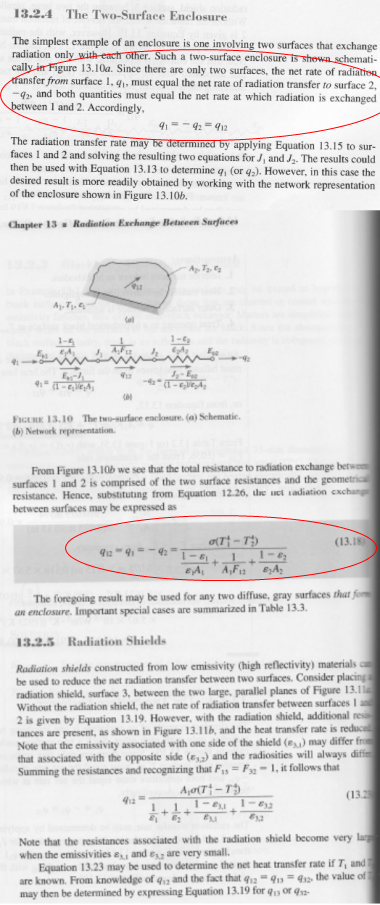
I had cited the diagram from Fundamentals of Heat and Mass Transfer by Incropera and DeWitt (2007). It’s not a climate science book as the title indicates.

However, despite my pressing (you can read the long painful exchange that follows) I didn’t find out what the blog owner actually thought that the writers of this book were saying. Perhaps the blog owner never grasped the key element of the difference between the real law and the imaginary one.

So I should explain again the difference between the real and imaginary second law of thermodynamics once again. I’m relying on the various proponents of the imaginary law because I can’t find it in any textbooks. Feel free to correct me if you understand this law in detail.

The Real Second Law of Thermodynamics

1a. Net heat flows from the hotter to the colder

1b. Entropy of a closed system can never reduce

1c. In a radiative exchange, both hotter and colder bodies emit radiation

1d. In a radiative exchange, the colder body absorbs the energy from the hotter body

1e. In a radiative exchange, the hotter body absorbs the energy from the colder body

1f. This energy from the colder body increases the temperature compared with the case where the energy was not absorbed

1g. Due to the higher energy radiated from a hotter body, the consequence is that net heat flows from the hotter to the colder (see note 1)

The Imaginary Second Law of Thermodynamics

2a. – as 1a

2b.  – as 1b

2c.  – as 1c

2d.  – as 1d

2e. In a radiative exchange, the hotter body does not absorb the energy from the colder body as this would be a violation of the second law of thermodynamics

Hopefully everyone can clearly see the difference between the two “points of view”. Everyone agrees that net heat flows from hotter to colder. There is no dispute about that.

What the Equations Look Like for Both Cases

Now, let’s take a look at the radiative exchange that would take place under the two cases and compare them with a textbook. Even if you find maths a little difficult to follow, the concept will be as simple as “two oranges minus one orange” vs “two oranges” so stay with me..

Here is the example we will consider:


Radiant heat transfer

Radiant heat transfer


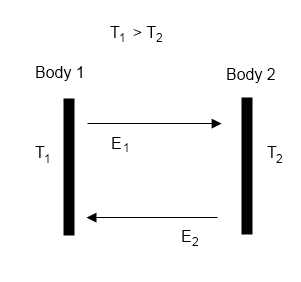
We will keep it very simple for those not so familiar with maths. In typical examples, we have to consider the view factor – this is a result of geometry – the ratio of energy radiated from body 1 that reaches body 2, and the reverse. In our example, we can ignore that by considering two very long plates close together.

E1 is the energy radiated from body 1 (per unit area) and we consider the case when all of it reaches body 2, E2 is the energy radiated from body 2 (per unit area) and we consider that all of it reaches body 1.

We define Enet1 as the change in energy experienced by body 1 (per unit area). And Enet2 as the change in energy experienced by body 2 (per unit area).

Radiation Exchange under The Real Second Law

E1 = εσT14; E2= εσT24 (Stefan-Boltzmann law)

Enet1 = E2 – E1 = εσT24 – εσT14

Enet2 = E1 – E2 = εσT14 – εσT24

Therefore, Enet1 = -Enet2

Under The Imaginary Second Law

Enet1 = – E1 = -εσT14

Enet2 = E1 – E2 = εσT144 – εσT24

Therefore, Enet1 ≠-Enet2 ; note that ≠ means “not equal to”

This should be uncontroversial. All I have done is written down mathematically what the two sides are saying. If we took into account view factors and areas then the formulae would like slightly more cluttered with terms like A1F12.

In the case of the real second law, the net energy absorbed by body 2 is the net energy lost by body 1.

In the case of the imaginary second law, there is some energy floating around. No advocates have so far explained what happens to it. Probably it floats off into space where it can eventually be absorbed by a colder body.

Alert readers will be able to see the tiny problem with this scenario..

What the Textbooks Say

First of all, what they don’t say is:

When energy is transferred by radiation from a colder body to a hotter body, it is important to understand that this incident radiation cannot be absorbed – otherwise it would be a clear violation of the second law of thermodynamics

I could leave it there really. Why don’t the books say this?

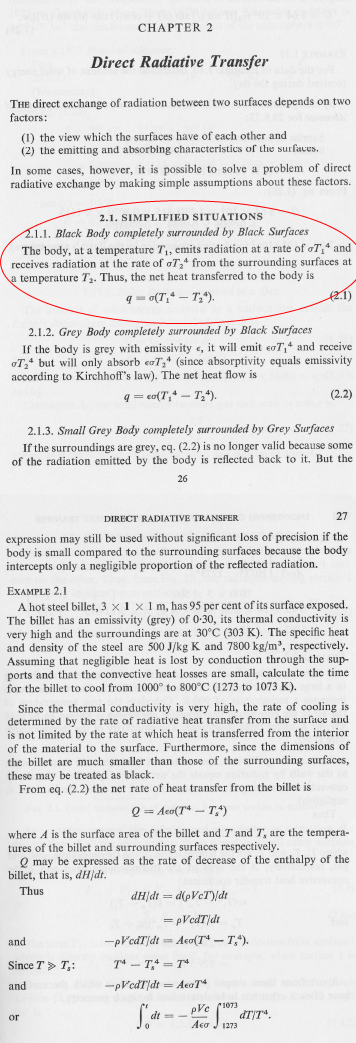
Engineering Calculations in Radiative Heat Transfer, by Gray and Müller (1974)

Note that if the imaginary second law advocates were correct, then the text would have to restrict the conditions under which equation 2.1 and 2.2 were correct – i.e., that they were only correct for the energy gain for the colder body and NOT correct for the energy loss of the hotter body.

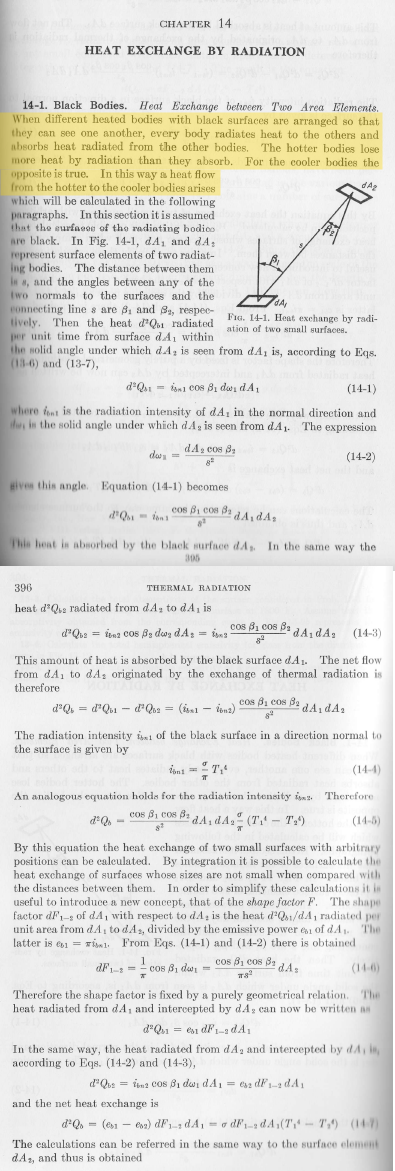
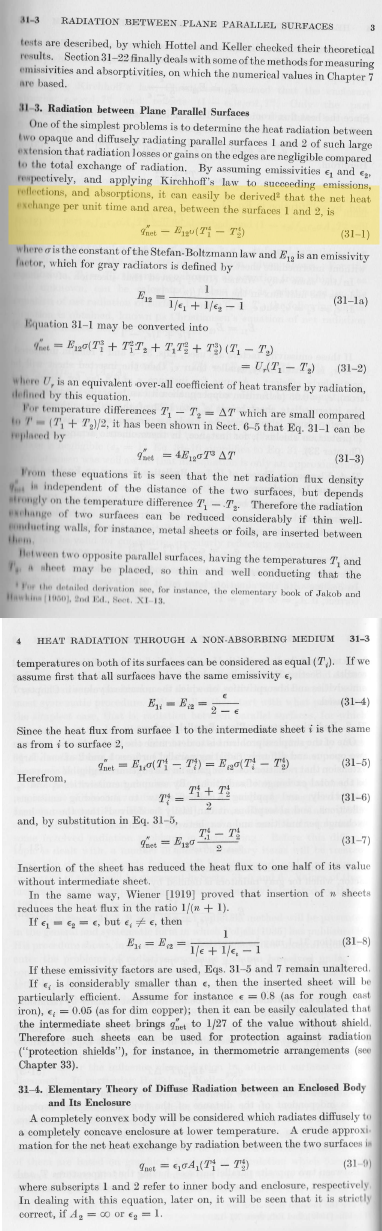
Heat and Mass Transfer, by Eckert and Drake (1959)

Note the highlighted area.

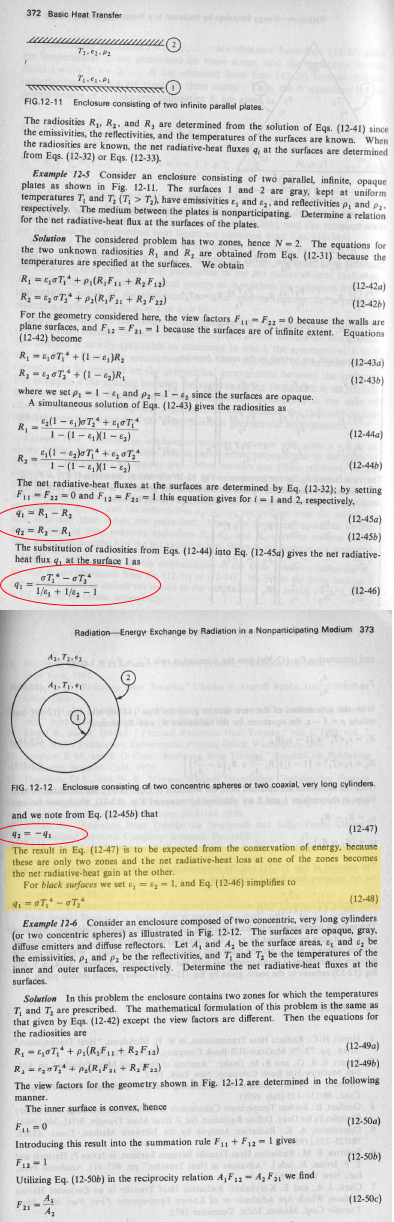
Basic Heat Transfer, M. Necati Özisik (1977)

Note the circled equations – matching the equations for the “real second law” and not matching the equations for the “imaginary second law”. Note the highlighted area.

Heat Transfer, by Max Jakob (1957)

Note the highlighted section, same comment as for the first book.

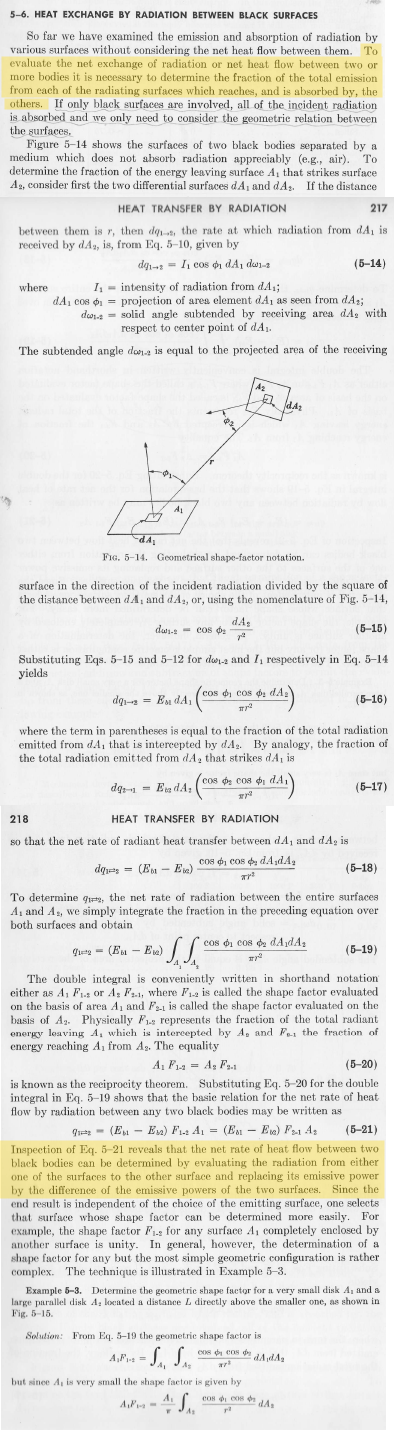
Principles of Heat Transfer, Kreith (1965)

Note the highlighted sections. The second highlight once again confirms the equation shown at the start, that under “the real second law” conditions, Enet1 = – Enet2. Under the “imaginary second law” conditions this equation doesn’t hold.

Fundamentals of Heat and Mass Transfer, Incropera and DeWitt (2007)

Note the circled section. This is false, according to the advocates of the imaginary second law of thermodynamics.

And the very familiar diagram shown many times before:


From "Fundamentals of Heat and Mass Transfer, 6th edition", Incropera and DeWitt (2007)

From "Fundamentals of Heat and Mass Transfer, 6th edition", Incropera and DeWitt (2007)


Conclusion

There are some obvious explanations:

1. Professors in the field of heat transfer write rubbish that is easily refuted by checking the second law – heat cannot flow from a colder to a hotter body.

2. Climate science advocates have crept into libraries around the world, and undiscovered until now, have doctored all of the heat transfer text books.

3. (My personal favorite) Science of Doom is refuted because these writers all agree that net heat flows from the hotter to the colder.

4. Look, a raven.

Relevant articles – The Real Second Law of Thermodynamics

Notes

Note 1 – Strictly speaking a hotter body might radiate less than a colder body – in the case where the emissivity of the hotter body was much lower than the emissivity of the colder body. But under those conditions, the hotter body would also absorb much less of the irradiation from the colder body (because absorptivity = emissivity). And so net heat flow would still be from the hotter to the colder.

To keep explanations to a minimum in the body of the article in 1e and 1f I also didn’t state that the proportion of energy absorbed by each would depend on the absorptivity of each body.

Read Full Post »

In the three part series on DLR (also known as “back radiation”, also known as atmospheric radiation), Part One looked at the network of stations that measured DLR and some of the measurements, Part Two reviewed the spectra of this radiation, and Part Three asked whether this radiation changed the temperature of the surface.

Very recently, on another blog, someone asked whether I thought “back radiation” heated the ocean. I know from a prominent blog that a very popular idea in blog-land is that the atmospheric radiation doesn’t heat the ocean. I have never seen any evidence for the idea. That doesn’t mean there isn’t any..

See note 1 on “heat”.

The Basic Idea

From what I’ve seen people write about this idea, including the link above, the rough argument goes like this:

  • solar radiation penetrates tens of meters into the ocean
  • atmospheric radiation – much longer wavelengths – penetrates only 1μm into the ocean

Therefore, solar radiation heats the ocean, but atmospheric radiation only heats the top few molecules. So DLR is unable to transfer any heat into the bulk of the ocean, instead the energy goes into evaporating the top layer into water vapor. This water vapor then goes to make clouds which act as a negative feedback. And so, more back-radiation from more CO2 can only have a cooling effect.

There are a few assumptions in there. Perhaps someone has some evidence of the assumptions, but at least, I can see why it is popular.

Solar Radiation

As regular readers of this blog know, plus anyone else with a passing knowledge of atmospheric physics, solar radiation is centered around a wavelength of 0.5μm. The energy in wavelengths greater than 4μm is less than 1% of the total solar energy and conventionally, we call solar radiation shortwave.

99% of the energy in atmospheric radiation has longer wavelengths than 4μm and along with terrestrial radiation we call this longwave.

Most surfaces, liquids and gases have a strong wavelength dependence for the absorption or reflection of radiation.

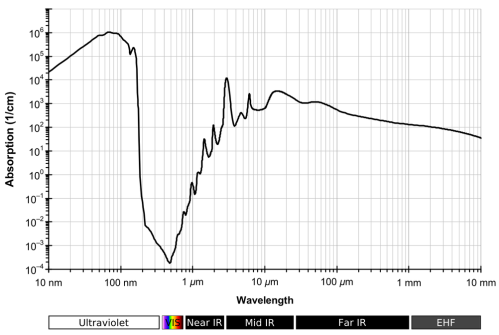
Here is the best one I could find for the ocean. It’s from Wikipedia, not necessarily a reliable source, but I checked the graph against a few papers and it matched up. The papers didn’t provide such a nice graph..

Absorption coefficient for the ocean - Wikipedia

Absorption coefficient for the ocean - Wikipedia

Figure 1

Note the logarithmic axes.

The first obvious point is that absorption varies hugely with the wavelength of incident radiation.

I’ll explain a few basics here, but if the maths is confusing, don’t worry, the graphs and explanation will attempt to put it all together. The basic equation of transmission relies on the Beer-Lambert law:

I = I0.exp(-kd)

where I is the radiation transmitted, I0 is the incident radiation at that wavelength, d is the depth, and k is the property of the ocean at this wavelength

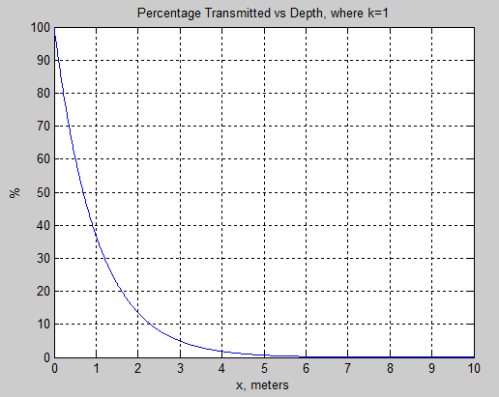
It’s not easy to visualize if you haven’t seen this kind of equation before. So imagine 100 units of radiation incident at the surface at one wavelength where the absorption coefficient, k = 1:

Figure 2

So at 1m, 37% of the original radiation is transmitted (and therefore 63% is absorbed).

At 2m, 14% of the radiation is transmitted.

At 3m, 5% is transmitted

At 10m, 0.005% is transmitted, so 99.995% has been absorbed.

(Note for the detail-oriented people, I have used the case where k=1/m).

Hopefully, this concept is reasonably easy to grasp. Now let’s look at the results of the whole picture using the absorption coefficient vs wavelength from earlier.

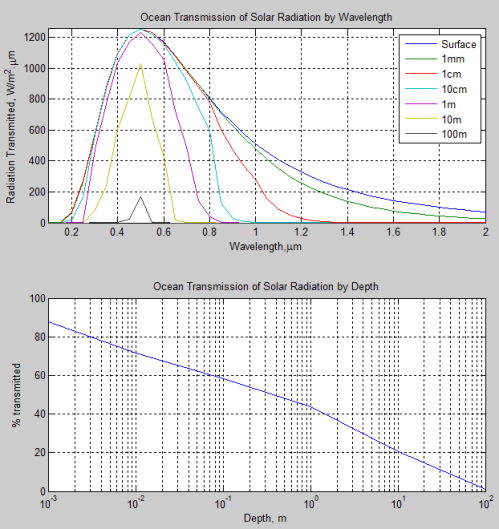
Figure 3

The top graph shows the amount of radiation making it to various depths, vs wavelength. As you can see, the longer (and UV) wavelengths drop off very quickly. Wavelengths around 500nm make it the furthest into the ocean depths.

The bottom graph shows the total energy making it through to each depth. You can see that even at 1mm (10-3m) around 13% has been absorbed and by 1m more than 50% has been absorbed. By 10m, 80% of solar radiation has been absorbed.

The graph was constructed using an idealized scenario – solar radiation less reflection at the top of atmosphere (average around 30% reflected), no absorption in the atmosphere and the sun directly overhead. The reason for using “no atmospheric absorption” is just to make it possible to construct a simple model, it doesn’t have much effect on any of the main results.

If we considered the sun at say 45° from the zenith, it would make some difference because the sun’s rays would now be coming into the ocean at an angle. So a depth of 1m would correspond to the solar radiation travelling through 1.4m of water (1 / cos(45°)).

For comparison here is more accurate data:

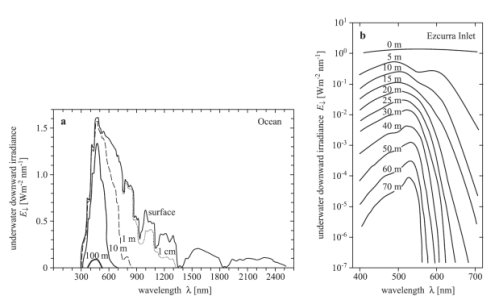
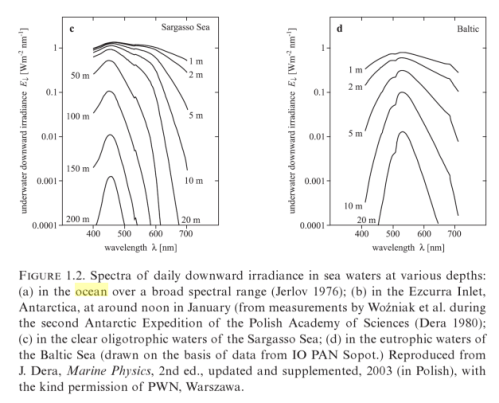
From "Light Absorption in Sea Water", Wozniak (2007)

From "Light Absorption in Sea Water", Wozniak (2007)

Figure 4

On the left the “surface” line represents the real solar spectrum at the surface – after absorption of the solar radiation by various trace gases (water vapor, CO2, methane, etc). On the right, the amount of energy measured at various depths in one location. Note the log scale on the vertical axis for the right hand graph. (Note as well that the irradiance in these graphs is in W/m².nm, whereas the calculated graphs earlier are in W/m².μm).

From "Light Absorption in Sea Water", Wozniak (2007)

From "Light Absorption in Sea Water", Wozniak (2007)

Figure 5

And two more locations measured. Note that the Black Sea is much more absorbing – solar absorption varies with sediment as well as other ocean properties.

DLR or “Back radiation”

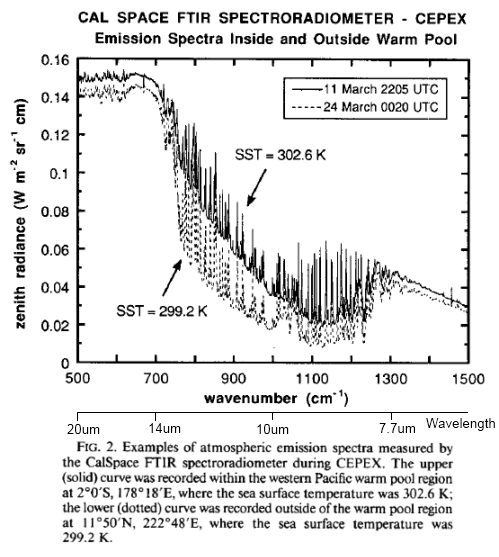
The radiation from the atmosphere doesn’t look too much like a “Planck curve”. Different heights in the atmosphere are responsible for radiating at different wavelengths – dependent on the concentration of water vapor, CO2, methane, and other trace gases.

Here is a typical DLR spectrum (note that the horizontal axis needs to be mentally reversed to match other graphs):

Pacific, Lubin (1995)

Pacific, Lubin (1995)

Figure 6

You can see more of these in The Amazing Case of Back Radiation – Part Two.

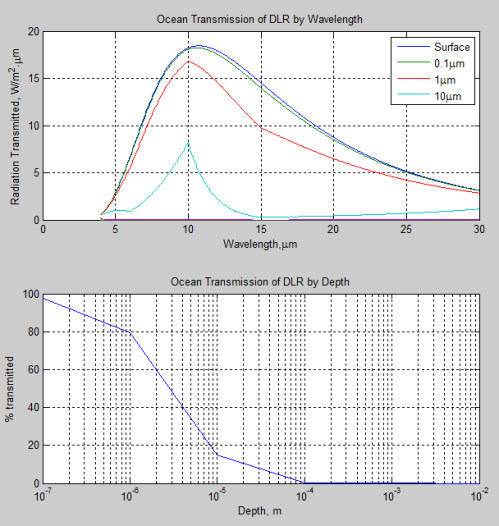
But for interest I took the case of an ideal blackbody at 0°C radiating to the surface and used the absorption coefficients from figure 1 to see how much radiation was transmitted through to different depths:

Figure 7

As you can see, most of the “back radiation” is absorbed in the first 10μm, and 20% is absorbed even in the first 1μm.

I could produce a more accurate calculation by using a spectrum like the Pacific spectrum in fig 6 and running that through the same calculations, but it wouldn’t change the results in any significant way.

So we can see that while around half the solar radiation is absorbed in the first meter and 80% in the first 10 meters, 90% of the DLR is absorbed in the first 10μm.

So now we need to ask what kind of result this implies.

Heating Surfaces and Conduction

When you heat the surface of a body that has a colder bulk temperature (or a colder temperature on the “other side” of the body) then heat flows through the body.

Conduction is driven by temperature differences. Once you establish a temperature difference you inevitably get heat transfer by conduction – for example, see Heat Transfer Basics – Part Zero.

The equation for heat transfer by conduction:

q = kA . ΔT/Δx

where k is the material property called conductivity, ΔT is the temperature difference, Δx is the distance between the two temperatures, and q is the heat transferred.

However, conduction is a very inefficient heat transfer mechanism through still water.

For still water, k ≈ 0.6 W/m.K (the ≈ symbol means “is approximately equal to”).

So, as a rough guide, if you had a temperature difference of 20°C across 50m, you would get heat conduction of 0.24 W/m². And with 20°C across 10m of water, you would only get heat conduction of 1.2 W/m².

However, the ocean surface is also turbulent for a variety of reasons, and in Part Two we will look at how that affects heat transfer via some simulations and a few papers. We will also look at the very important first law of thermodynamics and see what that implies for absorption of back radiation.

Update – Does Back-Radiation “Heat” the Ocean? – Part Two

Reference

Light Absorption in Sea Water, Wozniak & Dera, Atmospheric and Oceanographic Sciences Library (2007)

Notes

Note 1 – To avoid upsetting the purists, when we say “does back-radiation heat the ocean?” what we mean is, “does back-radiation affect the temperature of the ocean?”

Some people get upset if we use the term heat, and object that heat is the net of the two way process of energy exchange. It’s not too important for most of us. I only mention it to make it clear that if the colder atmosphere transfers energy to the ocean then more energy goes in the reverse direction.

It is a dull point.

Read Full Post »

Following discussions about absorption of radiation I thought some examples might help illustrate one simple, but often misunderstood, aspect of the subject.

Many people believe that radiation from a colder atmosphere cannot be absorbed by a warmer surface. Usually they are at a loss to explain exactly why – for good reason.

However, some have the vague idea that radiation from a colder atmosphere has different wavelengths compared with radiation from a warmer atmosphere. And, therefore, that’s probably it. End of story. Unfortunately for people with this idea, it’s not actually solved the problem at all..

The specific question I posed to one commenter some time ago was very specific:

If 10μm photons from a 10°C atmosphere are 80% absorbed by a 0°C surface, what is the ratio of 10μm photons from a -10°C atmosphere absorbed by that same surface?

It was eventually conceded that there would be no difference – 10μm photons from a -10°C will also be 80% absorbed. This material property of a surface is called absorptivity and is the proportion of radiation absorbed vs reflected at each wavelength.

Basic physics tells us that the energy of a 10μm photon is always that same, no matter what temperature source it has come from – see note 1.

Here’s an example of the reflectivity/absorptivity of many different materials just for interest:


Reflectivity vs wavelength for various surfaces, Incropera (2007)

Reflectivity vs wavelength for various surfaces, Incropera & DeWitt (2007)


Clearly materials have very different abilities to absorb /reflect different wavelength photons. Is this the explanation?

No.

The important point to understand is that even though radiation emitted from different temperature sources have different peak wavelengths, there is a large spread of wavelengths:

The peak wavelength of +10°C radiation is 10.2μm, while that of the -10°C radiation is 11.0μm – but, as you can see, both sources emit photons over a very similar range of wavelengths.

Scenarios

Let’s now take a look at the proportion of radiation absorbed from both of these sources.

First, with the case where the surface absorptivity is higher at shorter wavelengths – this should favor absorbing more energy from a hotter source and less from a colder source:

The top graph shows the absorptivity as a function of wavelength, and the bottom graph shows the consequent absorption of energy for the two cases.

Because absorptivity is higher at shorter wavelengths, there is a slight bias towards absorbing energy from the hotter +10°C source – but the effect is almost unnoticeable.

The actual numbers:

  • 43% of the -10°C radiation is absorbed
  • 46% of the +10°C radiation is absorbed

So let’s try something more ‘brutal’, with all of the energy from wavelengths shorter than 10.5μm absorbed and none from wavelengths longer than 10.5um absorbed (all reflected).

As you can see, the proportion absorbed of the energy from the hotter source vs colder source appears very similar. It is simply a result of the fact that +10°C and -10°C radiation have almost identical proportions of energy between any given wavelengths – the main difference is that radiation from +10°C has a higher total energy.

The actual numbers:

  • 22% of the -10°C is absorbed
  • 27% of the +10°C is absorbed

So – as is very obvious to most people already – there is no possible surface which can absorb a significant proportion of 10°C radiation and yet reflect all of the -10°C radiation.

And If There Was Such a Surface

Suppose that we could somehow construct a surface which absorbed a significant proportion of radiation from a +10°C source, and yet reflect almost all radiation from a -10°C source.

Well, that would just create a new problem. Because now, when our surface heats up to 11°C the radiation from the 10°C source would still be absorbed. And yet, the radiation is now from a colder source than the surface. Red alert for all the people who say this can’t happen.

Conclusion

The claim that radiation from a colder source is not absorbed by a warmer surface has no physical basis. People who claim it don’t understand one or all of these facts of basic physics:

a) Radiation incident on a surface has to be absorbed, reflected or transmitted through the surface. This last (transmitted) is not possible with a surface like the earth (it is relevant for something like a thin piece of glass or a body of gas), therefore radiation is either absorbed or reflected.

b) The material property of a surface which determines the proportion of radiation absorbed or reflected is called the absorptivity, and it is a function of wavelength of the incident photons. (See note 2)

c) The energy of any given photon is only dependent on its wavelength, not on the temperature of the source that emitted it.

d) Radiation emitted by the atmosphere has a spectrum of wavelengths and the difference between a -10°C emitter and a +10°C emitter (for example) is not very significant (total energy varies significantly, but not the proportion of energy between any two wavelengths). See note 3.

The only way that radiation from a colder source could not be absorbed by a warmer surface is for one of these basic principles to be wrong.

These have all been established for at least 100 years. But no one has really checked them out that thoroughly. Remember, it’s highly unlikely that you have just misunderstood the Second Law of Thermodynamics.

See also: The Real Second Law of Thermodynamics

Intelligent Materials and the Imaginary Second Law of Thermodynamics

The First Law of Thermodynamics Meets the Imaginary Second Law

The Amazing Case of “Back Radiation” – Part Three

and Amazing Things we Find in Textbooks – The Real Second Law of Thermodynamics

Note 1 – Already explained in a little more detail in The Amazing Case of “Back Radiation” – Part Three – the energy of a photon is only dependent on the wavelength of that photon:

Energy = hc/λ

where h = Planck’s constant = 6.6×10⁻³⁴ J.s, c = the speed of light = 3×10⁸ m/s and λ = wavelength.

Note 2 – Absorptivity/reflectivity is also a function of the direction of the incident radiation with some surfaces.

Note 3 – For those fascinated by actual numbers – the energy from a blackbody source at -10°C = 272 W/m² compared with that from a +10°C source = 364 W/m² – the colder source providing only 75% of the total energy of the warmer source. But take a look at the proportion of total energy in various wavelength ranges:

  • Between 8-10 μm  10.7% (-10°C)   12.2% (10°C)
  • Between 10-12 μm  11.9% (-10°C)   12.7% (10°C)
  • Between 12-14 μm  11.2% (-10°C)   12.4% (10°C)
  • Between 14-16 μm   9.8% (-10°C)     9.5% (10°C)

Read Full Post »

Many people often claim that the atmosphere cannot “heat” the earth’s surface and therefore the idea of the inappropriately-named “greenhouse” effect is scientifically impossible. The famous Second Law of Thermodynamics is invoked in support.

Let’s avoid a semantic argument about the correct or incorrect use of the word “heat”.

I claim that energy from the atmosphere is absorbed by the surface.

This absorbed energy has no magic properties. If the surface loses 100J of energy by other means and gains 100J of energy from the atmosphere then its temperature will stay constant. If the surface hasn’t lost or gained any energy by any other means, this 100J of energy from the atmosphere will increase the surface temperature.

I also claim that because the atmosphere is on average colder than the surface, more energy is transferred from the surface to the atmosphere compared with the reverse situation.

Let’s consider whether this violates the real second law of thermodynamics..

The Conceptual Problem

In Heat Transfer Basics – Part Zero a slightly off-topic discussion about the “greenhouse” effect began. One of our most valiant defenders of the imaginary second law of thermodynamics said:

An irradiated object can never reach a higher temperature than the source causing the radiation

I have demonstrated previously in The First Law of Thermodynamics Meets the Imaginary Second Law that a colder body can increase the temperature of a hotter body (compared with the scenario when the colder body was not there).

In that example, there was more than one source of energy. So, with this recent exchange in Heat Transfer Basics it dawned on me what the conceptual problem was. So this article is written for the many people who find themselves agreeing with the comment above. As a paraphrased restatement by the same commenter:

If the atmosphere is at -30°C then it can’t have any effect on the surface if the surface is above -30°C

Entropy Basics and The Special Case

Entropy is a difficult subject to understand. Heat and temperature are concepts we can understand quite easily. We all know what temperature is (in a non-precise way) and heat, although a little more abstract, is something most people can relate to.

Entropy appears to be an abstract concept with no real meaning – nothing you can get your hands around.

The second law of thermodynamics says:

Entropy of a “closed system” can never reduce

Before defining entropy, here is an important consequence of this second law:

Increasing entropy means that heat flows spontaneously from hotter to colder bodies and never in reverse

This fits everyone’s common experience.

  • Ice melts in a glass of water
  • A hot pan of water on the stove cools down to room temperature when the heat source is removed
  • Put a hold and cold body together and they tend to come to the same temperature, not move apart in temperature

And all of these are easier to visualize than a mathematical formula.

What is entropy?  I will keep the maths to an absolute minimum, but we have to introduce a tiny amount of maths just to define entropy.

For a body absorbing a tiny amount of heat, δQ (note that δ is a symbol which means “tiny change”), the change in entropy, δS, is given by:

δS = δQ / T, where T is absolute temperature (see note 1)

It’s not easy to visualize – but take a look at a simple example. Suppose that a tiny amount of heat, 1000 J, moves from a body at 1000K to a body at 500K:

Example 1

The net change in energy in the system is zero because 1000J leaves the first body and is absorbed by the second body. This is the first law of thermodynamics – energy cannot be created or destroyed.

However, there is a change in entropy.

The change in total entropy of the system = δS1 + δS2 = -1 + 2 = 1 J/K.

This strange value called “entropy” has increased.

Notice that if the energy flow of 1000J was from the 500K body to the 1000K body the change in entropy would be -1 J/K. This would be a reduction in entropy – forbidden by the real second law of thermodynamics. This would be a spontaneous flow of heat from the colder body to the hotter body.

Updated note Sep 30th – this example is intended to clarify the absolute basics.

Think of the example above like this – If, for some reason, in a closed system, this was the only movement of energy taking place, we could calculate the entropy change and it has increased.

The example is not meant to be an example of only one half of a radiative energy exchange. Just a very very simply example to show how entropy is calculated. It could be conductive heat transfer through a liquid that is totally opaque to radiation.

The Special Case

The simplest example demonstrating the second law of thermodynamics is with two bodies which are in a closed system.

Let’s say that we have a gas at 273K (Body 1) and a solid (Body 2) surrounded by the gas. The solid starts off much colder.

What is the maximum temperature that can be reached by the solid?

273K

Easy. In fact, depending on the starting temperature of the solid and the respective heat capacities of the gas and solid, the actual temperature that both end up (the same temperature eventually) might be a little lower or a lot lower.

But the temperature reached by the solid can never get to more than 273K. For the solid to get to a temperature higher than 273K the gas would have to cool down below 273K (otherwise energy would have been created). Heat does not spontaneously flow from a colder to a hotter body so this never happens.

This defining example is illuminating but no surprise to anyone.

It is important to note that this special case is not the second law of thermodynamics, it is an example that conforms to the second law of thermodynamics.

The second law of thermodynamics says that the entropy of a system cannot reduce. If we want to find out whether the second law of thermodynamics forbids some situation then we need to calculate the change in entropy – not use “insight” from this super-simple scenario.

So let’s consider some simple examples and see what happens to the entropy.

Simple Examples

What I want to demonstrate is that the standard picture in heat transfer textbooks doesn’t violate the second law of thermodynamics.

What is the standard picture?


From "Fundamentals of Heat and Mass Transfer, 6th edition", Incropera and DeWitt (2007)

From "Fundamentals of Heat and Mass Transfer, 6th edition", Incropera and DeWitt (2007)


This says that two bodies separated in space both emit radiation. And both absorb radiation from the other body (see note 2).

The challenging concept for some is the idea that radiation from the colder body is absorbed by the hotter body.

We start with Example 1 above, but this time we consider an exchange of radiation and see what happens to the entropy of that system.

Example 2

What I have introduced here is thermal radiation from Body 2 incident on Body 1. We will assume all of it is absorbed, and vice-versa.

According to the Stefan-Boltzmann equation, energy radiated is proportional to the 4th power of temperature. Given that Body 2 is half the temperature of Body 1 it will radiate at a factor of 24 = 2 x 2 x 2 x 2 = 16 times less. Therefore, if 1000J from Body 1 reaches Body 2, then 62J (1000/16) will be transmitted in the reverse direction. However, the exact value doesn’t matter for the purposes of this example.

So with our example above, what is the change in entropy?

Body 1 loses energy, which is negative entropy. Body 2 gains energy, which is positive entropy.

δS1 = -(1000-62)/1000 = -938 / 1000 = -0.94 J/k
δS2 =(1000-62)/500 = 938 / 500 = 1.88 J/K

Total entropy change = -0.94 + 1.88 = 0.94 J/K.

So even though energy from the colder body has been absorbed by the hotter body, the entropy of the system has increased. This is because more energy has moved in the opposite direction.

There is no violation of the second law of thermodynamics with this example.

Now let’s consider an example with values closer to what we encounter near the earth’s surface:

Example 3

This isn’t intended to be the complete surface – atmosphere system, just values that are more familiar.

Surface:        δS1 = -(390-301)/288 = -89 / 288 = -0.31 J/k
Atmosphere: δS2 = (390-301)/270 = 89 / 270 = 0.33 J/K

Total entropy change = -0.31 + 0.33 = 0.02 J/K.

So even though the temperatures of the two bodies are much closer together, when they exchange energy, total entropy still increases.

Energy from the colder atmosphere has been absorbed by the hotter surface and yet entropy of the system has still increased.

Now, the example above (example 3) is an exchange of a fixed amount of energy (in Joules, J). Suppose this is the amount of energy per second (Watts, W) or the amount of energy per second per square meter (W/m²).

If the atmosphere keeps absorbing more energy than it is emitting it will heat up. If the earth keeps emitting more energy than it absorbs, it will cool down.

If example 3 was the complete system, then the atmosphere would heat up and the earth would cool down until they were in thermal equilibrium. This doesn’t happen because the sun continually provides energy.

The Complete Climate System

The earth-atmosphere system is very complex. If we analyze a long term average scenario, like that painted by Kiehl and Trenberth there is an immediate problem in calculating the change in entropy:


From Kiehl & Trenberth (1997)

From Kiehl & Trenberth (1997)


[Note from Sep 28th – This section is wrong, thanks Nick Stokes for highlighting it and so delicately! Preserved in italics for entertainment value only..] If we consider the surface, for example, it absorbs 492 W/m² (δQ = 492 per second per square meter) and it loses 492 W/m² (δQ = -492 per second per square meter).

Net energy change = 0. Net entropy change = 0.

Why isn’t entropy increasing? We haven’t considered the whole system – the sun is generating all the energy to power the climate system. If we do consider the sun, it is emitting a huge amount of energy and, therefore, losing entropy. But the energy generation inside the sun creates more entropy – that is, unless the second law of thermodynamics is flawed.

[Now the rewritten bit]

Previous sections explained that calculations of entropy “removed” (negative entropy) are based on energy emitted divided by the temperature of the source. And calculations of entropy “produced” are based on energy absorbed divided by the temperature of the absorber. In a closed system we can add these up and we find that entropy always increases.

So the calculation in italics above is incorrect. Change in entropy at the surface is not zero.

Change in entropy at the surface is a large negative value, because we have to consider the source temperature of the energy.

So as Nick Stokes points out (in a comment below), we can draw a line around the whole climate system, including the emission of radiation by the sun (see example 4 just below). This calculation produces a large negative entropy, because it isn’t a closed system. This is explained by the fact that the production of solar energy creates an even larger amount of positive entropy.

Example 4

The Classic Energy Exchange by Radiation

I was in the university library recently and opened up a number of heat transfer textbooks. All of them had a similar picture to that from Incropera and DeWitt (above). And not a single one said, This doesn’t happen.

In any case, for someone to claim that an energy exchange violates the second law of thermodynamics they need to show there is a reduction in entropy of a closed system.

But one important point did occur to me when thinking about this subject. Let’s reconsider our commenter’s claim:

An irradiated object can never reach a higher temperature than the source causing the radiation

As I pointed out in the The Special Case section – this is true if this is the only source of energy. Yet the surface of the earth receives energy from both the sun and the atmosphere.

If the colder atmosphere cannot transfer energy to a warmer surface, and the second law of thermodynamics is the reason, the actual event that is forbidden is the emission of radiation by the colder atmosphere. When the colder atmosphere radiates energy it loses entropy.

After all, the entropy loss takes place when the atmosphere has given up its energy. Not when another body has absorbed the energy.

Our commenter has frequently agreed that the colder atmosphere does radiate. But he doesn’t believe that the surface can absorb it. He has never been able to explain what happens to the energy when it “reaches” the surface. Or why the surface doesn’t absorb it. Instead we have followed many enjoyable detours into attempts to undermine any of a number of fundamental physics laws in an attempt to defend “the imaginary second law of thermodynamics”.

Conclusion

Entropy is a conceptually difficult subject, but all of us can see the example in “the special case” and agree that the picture is correct.

However, the atmosphere – surface interaction is more complex than that simple case. The surface of the earth receives energy from the sun and the atmosphere.

As we have seen, in simple examples of radiant heat exchange between two bodies, entropy is still positive even when the hotter body absorbs energy from the colder body. This is because more energy flows from the hotter to the colder than the reverse.

To prove that the second law of thermodynamics has been violated someone needs to demonstrate that a system is reducing entropy. So we would expect to see an entropy calculation.

Turgid undergraduate books about heat transfer in university libraries all write that radiation emitted by a colder body is absorbed by a hotter body.

That is because the first law of thermodynamics is still true – energy cannot be created, destroyed, or magically lost.

Other Relevant Articles

The Amazing Case of “Back Radiation” – Part Three

The First Law of Thermodynamics Meets the Imaginary Second Law

Intelligent Materials and the Imaginary Second Law of Thermodynamics

Amazing Things we Find in Textbooks – The Real Second Law of Thermodynamics

Notes

Note 1 – There are more fundamental ways to define entropy, but it won’t help to see this kind of detail. And for the purists, the equation as shown relies on the temperature not changing as a result of the small transfer of energy.

If the temperature did change then the correct formula is to integrate:

ΔS = ∫Cp/T. dT (with the integral from T1 to T2) and the result,

ΔS = Cp log (T2/T1),   this is log to the base e.

Note 2 – This assumes there is some “view factor” between the two bodies – that is, some portion of the radiation emitted by one body can “hit” the other. Just pointing out the obvious, just in case..

Read Full Post »

In Part One we had a look at Ramanathan’s work (actually Raval and Ramanathan) attempting to measure the changes in outgoing longwave radiation vs surface temperature.

In Part Two (Part Zero perhaps) we looked at some basics on water vapor as well as some measurements. The subject of the non-linear effects of water vapor was raised.

Part One Responses attempted a fuller answer to various questions and objections about Part One

Water vapor feedback isn’t a simple subject.

First, a little more background.

Effectiveness of Water Vapor at Different Heights

Here are some model results of change in surface temperature for changes in specific humidity at different heights:

From Shine & Sinha (1991)

From Shine & Sinha (1991)

For newcomers, 200mbar is the top of the troposphere (lower atmosphere), and 1000mbar is the surface.

You can see that for a given increase in the mixing ratio of water vapor the most significant effect comes at the top of the troposphere.

The three temperatures: cool = 277K (4°C); average = 287K (14°C); and warm = 298K (23°C).

Now a similar calculation using changes in relative humidity:

From Shine & Sinha (1991)

From Shine & Sinha (1991)

The average no continuum shows the effect without the continuum absorption portion of the water vapor absorption. This is the frequency range between 800-1200 cm-1, (wavelength range 12-8μm) – often known as the “atmospheric window”. This portion of the spectral range is important in studies of increasing water vapor, something we will return to in later articles.

Here we can see that in warmer climates the lower troposphere has more effect for changes in relative humidity. And for average and cooler climates, changes in relative humidity are still more important in the lower troposphere, but the upper troposphere does become more significant.

(This paper, by Shine & Sinha, appears to have been inspired by Lindzen’s 1990 paper where he talked about the importance of upper tropospheric water vapor among other subjects).

So clearly the total water vapor in a vertical section through the atmosphere isn’t going to tell us enough (see note 1). We also need to know the vertical distribution of water vapor.

Here is a slightly different perspective from Spencer and Braswell (1997):

Spencer and Braswell (1997)

Spencer and Braswell (1997)

This paper took a slightly different approach.

  • Shine & Sinha looked at a 10% change in relative humidity – so for example, from 20% to 22% (20% x 110%)
  • Spencer & Braswell said, let’s take a 10% change as 20% to 30% (20% + 10%)

This isn’t an argument about how to evaluate the effect of water vapor – just how to illustrate a point. Spencer & Braswell are highlighting the solid line in the right hand graph, and showing Shine & Sinha’s approach as the dashed line.

In the end, both will get the same result if the water vapor changes from 20% to 30% (for example).

Boundary Layers and Deep Convection

Here’s a conceptual schematic from Sun and Lindzen 1993:

The bottom layer is the boundary layer. Over the ocean the source of water vapor in this boundary layer is the ocean itself. Therefore, we would assume that the relative humidity would be high and the specific humidity (the amount of water vapor) would be strongly dependent on temperature (see Part Two).

Higher temperatures drive stronger convection which creates high cloud levels. This is often called “deep convection” in the literature. These convective towers are generally only a small percentage of the surface area. So over most of the tropics, air is subsiding.

Here is a handy visualization from Held & Soden (2000):

Held and Soden (2000)

Held and Soden (2000)

The concept to be clear about is within the well-mixed boundary layer there is a strong connection between the surface temperature and the water vapor content. But above the boundary layer there is a disconnect. Why?

Because most of the air (by area) is subsiding (see note 2). This air has at one stage been convected high up in the atmosphere, has dried out and now is returning back to the surface.

Subsiding air in some parts of the tropics is extremely dry with a very low relative humidity. Remember the graphs in Part Two – air high up in the atmosphere can only hold 1/1,000th of the water vapor that can be held close to the surface. So air which is saturated when it is at the tropopause is – in relative terms – very dry when it returns to the surface.

Therefore, the theoretical connection between surface temperature and specific humidity becomes a challenging one above the boundary layer.

And the idea that relative humidity is conserved is also challenged.

Relationship between Specific Humidity and Local Temperature

Sun and Oort (1995) analyzed the humidity and temperature in the tropics (30°S to 30°N) at a number of heights over a long time period:

Sun and Oort (1995)

Sun and Oort (1995)

Note that the four graphs represent four different heights (pressures) in the atmosphere. And note as well that the temperatures plotted are the temperatures at that relevant height.

Their approach was to average the complete tropical domain (but not the complete globe) and, therefore, average out the ascending and descending portions of the atmosphere:

Through horizontal averaging, variations of water vapor and temperature that are related to the horizontal transport by the large-scale circulation will be largely removed, and thus the water vapor and temperature relationship obtained is more indicative of the property of moist convection, and is thus more relevant to the issue of water vapor feedback in global warming.

In analyzing the results, they said:

Overall, the variations of specific humidity correlate positively at all levels with the temperature variations at the same level. However, the strength of the correlation between specific humidity variations and the temperature variations at the same level appears to be strongly height dependent.

Sun & Oort (1995)

Sun & Oort (1995)

Early in the paper they explained that pre-1973 values of water vapor were more problematic than post-1973 and therefore much of the analysis would be presented with and without the earlier period. Hence, the two plots in the graph above.

Now they do something even more interesting and plot the results of changes in specific humidity (q) with temperature and compare with the curve for constant relative humidity:

Sun & Oort (1995)

Sun & Oort (1995)

The dashed line to the right is the curve of constant relative humidity. (For those still trying to keep up, if specific humidity was constant, the measured values would be a straight vertical line going through the zero).

The largest changes of water vapor with temperature occur in the boundary layer and the upper troposphere.

They note:

The water vapor in the region right above the tropical convective boundary layer has the weakest dependence on the local temperature.

And also that the results are consistent with the conceptual picture put forward by Sun and Lindzen (1993). Well, it is the same De-Zheng Sun..

Vertical Structure of Water Vapor Variations

How well can we correlate what happens at the surface with what happens in the “free troposphere” (the atmosphere above the boundary layer)?

If we want to understand temperature vertically through the atmosphere it correlates very well with the surface temperature. Probably not a surprise to anyone.

If we want to understand variations of specific humidity in the upper troposphere, we find (Sun & Oort find) that it doesn’t correlate very well with specific humidity in the boundary layer.

Sun & Oort (1995)

Sun & Oort (1995)

Take a look at (b) – this is the correlation of local temperature at any height with the surface temperature below. There is a strong correlation and no surprise.

Then look at (a) – this is the correlation of specific humidity at any height with the surface specific humidity. We can see that the correlation reduces the higher up we go.

This demonstrates that the vertical movement of water vapor is not an easy subject to understand.

Sun and Oort also comment on Raval and Ramanathan (1989), the source of the bulk of Clouds and Water Vapor – Part One:

Raval and Ramanathan (1989) were probably the first to use observational data to determine the nature of water vapor feedback in global warming. They examined the relationship between sea surface temperature and the infrared flux at the top of the atmosphere for clear sky conditions. They derived the relationship from the geographical variations..

However, whether the tropospheric water vapor content at all levels is positively correlated with the sea surface temperature is not clear. More importantly, the air must be subsiding in clear-sky regions. When there is a large-scale subsidence, the influence from the sea is restricted to a shallow boundary layer and the free tropospheric water vapor content and temperature are physically decoupled from the sea surface temperature underneath.

Thus, it may be questionable to attribute the relationships obtained in such a way to the properties of moist convection.

Conclusion

The subject of water vapor feedback is not a simple one.

In their analysis of long-term data, Sun and Oort found that water vapor variations with temperature in the tropical domain did not match constant relative humidity.

They also, like most papers, caution drawing too much from their results. They note problems in radiosonde data, and also that statistical relationships observed from inter-annual variability may not be the same as those due to global warming from increased “greenhouse” gases.

Articles in this Series

Part One – introducing some ideas from Ramanathan from ERBE 1985 – 1989 results

Part One – Responses – answering some questions about Part One

Part Two – some introductory ideas about water vapor including measurements

Part Four – discussion and results of a paper by Dessler et al using the latest AIRS and CERES data to calculate current atmospheric and water vapor feedback vs height and surface temperature

Part Five – Back of the envelope calcs from Pierrehumbert – focusing on a 1995 paper by Pierrehumbert to show some basics about circulation within the tropics and how the drier subsiding regions of the circulation contribute to cooling the tropics

Part Six – Nonlinearity and Dry Atmospheres – demonstrating that different distributions of water vapor yet with the same mean can result in different radiation to space, and how this is important for drier regions like the sub-tropics

Part Seven – Upper Tropospheric Models & Measurement – recent measurements from AIRS showing upper tropospheric water vapor increases with surface temperature

References

How Dry is the Tropical Free Troposphere? Implications for Global Warming Theory,
Spencer & Braswell, Bulletin of the American Meteorological Society (1997)

Humidity-Temperature Relationships in the Tropical Troposphere, Sun & Oort, Journal of Climate (1995)

Distribution of Tropical Tropospheric Water Vapor, Sun & Lindzen, Journal of Atmospheric Sciences (1993)

Sensitivity of the Earth’s Climate to height-dependent changes in the water vapor mixing ratio, Shine & Sinha, Nature (1991)

Some Coolness concerning Global Warming, Lindzen,Bulletin of the American Meteorological Society (1990)

Notes

Note 1 – The total amount of water vapor, TPW ( total precipitable water), is obviously something we want to know, but we don’t have enough information if we don’t know the distribution of this water vapor with height. It’s a shame, because TPW is the easiest value to measure via satellite.

Note 2 – Obviously the total mass of air is conserved. If small areas have rapidly rising air, larger areas will have have slower subsiding air.

Read Full Post »

« Newer Posts - Older Posts »