Feeds:
Posts
Comments

Archive for the ‘Debunking Flawed “Science”’ Category

Following discussions about absorption of radiation I thought some examples might help illustrate one simple, but often misunderstood, aspect of the subject.

Many people believe that radiation from a colder atmosphere cannot be absorbed by a warmer surface. Usually they are at a loss to explain exactly why – for good reason.

However, some have the vague idea that radiation from a colder atmosphere has different wavelengths compared with radiation from a warmer atmosphere. And, therefore, that’s probably it. End of story. Unfortunately for people with this idea, it’s not actually solved the problem at all..

The specific question I posed to one commenter some time ago was very specific:

If 10μm photons from a 10°C atmosphere are 80% absorbed by a 0°C surface, what is the ratio of 10μm photons from a -10°C atmosphere absorbed by that same surface?

It was eventually conceded that there would be no difference – 10μm photons from a -10°C will also be 80% absorbed. This material property of a surface is called absorptivity and is the proportion of radiation absorbed vs reflected at each wavelength.

Basic physics tells us that the energy of a 10μm photon is always that same, no matter what temperature source it has come from – see note 1.

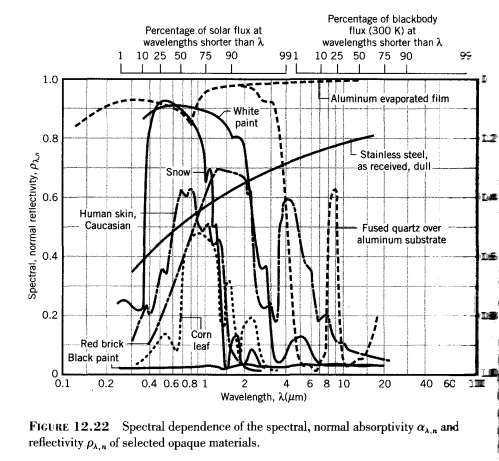
Here’s an example of the reflectivity/absorptivity of many different materials just for interest:


Reflectivity vs wavelength for various surfaces, Incropera (2007)

Reflectivity vs wavelength for various surfaces, Incropera & DeWitt (2007)


Clearly materials have very different abilities to absorb /reflect different wavelength photons. Is this the explanation?

No.

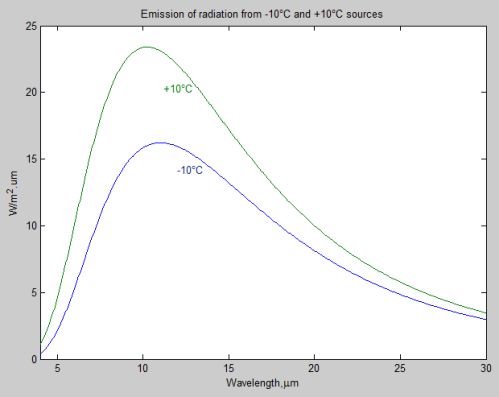
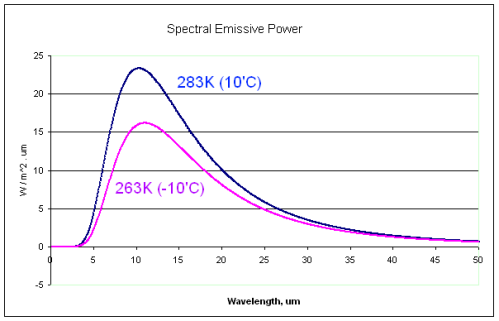
The important point to understand is that even though radiation emitted from different temperature sources have different peak wavelengths, there is a large spread of wavelengths:

The peak wavelength of +10°C radiation is 10.2μm, while that of the -10°C radiation is 11.0μm – but, as you can see, both sources emit photons over a very similar range of wavelengths.

Scenarios

Let’s now take a look at the proportion of radiation absorbed from both of these sources.

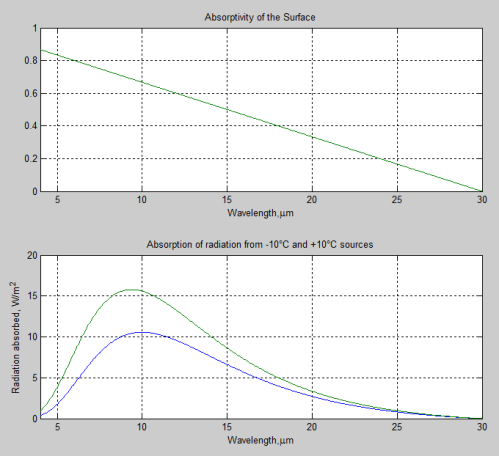
First, with the case where the surface absorptivity is higher at shorter wavelengths – this should favor absorbing more energy from a hotter source and less from a colder source:

The top graph shows the absorptivity as a function of wavelength, and the bottom graph shows the consequent absorption of energy for the two cases.

Because absorptivity is higher at shorter wavelengths, there is a slight bias towards absorbing energy from the hotter +10°C source – but the effect is almost unnoticeable.

The actual numbers:

  • 43% of the -10°C radiation is absorbed
  • 46% of the +10°C radiation is absorbed

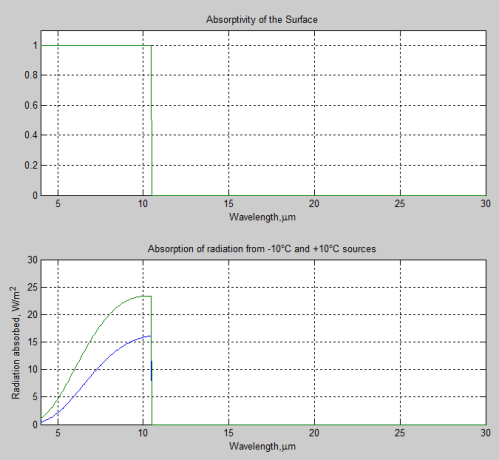
So let’s try something more ‘brutal’, with all of the energy from wavelengths shorter than 10.5μm absorbed and none from wavelengths longer than 10.5um absorbed (all reflected).

As you can see, the proportion absorbed of the energy from the hotter source vs colder source appears very similar. It is simply a result of the fact that +10°C and -10°C radiation have almost identical proportions of energy between any given wavelengths – the main difference is that radiation from +10°C has a higher total energy.

The actual numbers:

  • 22% of the -10°C is absorbed
  • 27% of the +10°C is absorbed

So – as is very obvious to most people already – there is no possible surface which can absorb a significant proportion of 10°C radiation and yet reflect all of the -10°C radiation.

And If There Was Such a Surface

Suppose that we could somehow construct a surface which absorbed a significant proportion of radiation from a +10°C source, and yet reflect almost all radiation from a -10°C source.

Well, that would just create a new problem. Because now, when our surface heats up to 11°C the radiation from the 10°C source would still be absorbed. And yet, the radiation is now from a colder source than the surface. Red alert for all the people who say this can’t happen.

Conclusion

The claim that radiation from a colder source is not absorbed by a warmer surface has no physical basis. People who claim it don’t understand one or all of these facts of basic physics:

a) Radiation incident on a surface has to be absorbed, reflected or transmitted through the surface. This last (transmitted) is not possible with a surface like the earth (it is relevant for something like a thin piece of glass or a body of gas), therefore radiation is either absorbed or reflected.

b) The material property of a surface which determines the proportion of radiation absorbed or reflected is called the absorptivity, and it is a function of wavelength of the incident photons. (See note 2)

c) The energy of any given photon is only dependent on its wavelength, not on the temperature of the source that emitted it.

d) Radiation emitted by the atmosphere has a spectrum of wavelengths and the difference between a -10°C emitter and a +10°C emitter (for example) is not very significant (total energy varies significantly, but not the proportion of energy between any two wavelengths). See note 3.

The only way that radiation from a colder source could not be absorbed by a warmer surface is for one of these basic principles to be wrong.

These have all been established for at least 100 years. But no one has really checked them out that thoroughly. Remember, it’s highly unlikely that you have just misunderstood the Second Law of Thermodynamics.

See also: The Real Second Law of Thermodynamics

Intelligent Materials and the Imaginary Second Law of Thermodynamics

The First Law of Thermodynamics Meets the Imaginary Second Law

The Amazing Case of “Back Radiation” – Part Three

and Amazing Things we Find in Textbooks – The Real Second Law of Thermodynamics

Note 1 – Already explained in a little more detail in The Amazing Case of “Back Radiation” – Part Three – the energy of a photon is only dependent on the wavelength of that photon:

Energy = hc/λ

where h = Planck’s constant = 6.6×10⁻³⁴ J.s, c = the speed of light = 3×10⁸ m/s and λ = wavelength.

Note 2 – Absorptivity/reflectivity is also a function of the direction of the incident radiation with some surfaces.

Note 3 – For those fascinated by actual numbers – the energy from a blackbody source at -10°C = 272 W/m² compared with that from a +10°C source = 364 W/m² – the colder source providing only 75% of the total energy of the warmer source. But take a look at the proportion of total energy in various wavelength ranges:

  • Between 8-10 μm  10.7% (-10°C)   12.2% (10°C)
  • Between 10-12 μm  11.9% (-10°C)   12.7% (10°C)
  • Between 12-14 μm  11.2% (-10°C)   12.4% (10°C)
  • Between 14-16 μm   9.8% (-10°C)     9.5% (10°C)

Read Full Post »

Many people often claim that the atmosphere cannot “heat” the earth’s surface and therefore the idea of the inappropriately-named “greenhouse” effect is scientifically impossible. The famous Second Law of Thermodynamics is invoked in support.

Let’s avoid a semantic argument about the correct or incorrect use of the word “heat”.

I claim that energy from the atmosphere is absorbed by the surface.

This absorbed energy has no magic properties. If the surface loses 100J of energy by other means and gains 100J of energy from the atmosphere then its temperature will stay constant. If the surface hasn’t lost or gained any energy by any other means, this 100J of energy from the atmosphere will increase the surface temperature.

I also claim that because the atmosphere is on average colder than the surface, more energy is transferred from the surface to the atmosphere compared with the reverse situation.

Let’s consider whether this violates the real second law of thermodynamics..

The Conceptual Problem

In Heat Transfer Basics – Part Zero a slightly off-topic discussion about the “greenhouse” effect began. One of our most valiant defenders of the imaginary second law of thermodynamics said:

An irradiated object can never reach a higher temperature than the source causing the radiation

I have demonstrated previously in The First Law of Thermodynamics Meets the Imaginary Second Law that a colder body can increase the temperature of a hotter body (compared with the scenario when the colder body was not there).

In that example, there was more than one source of energy. So, with this recent exchange in Heat Transfer Basics it dawned on me what the conceptual problem was. So this article is written for the many people who find themselves agreeing with the comment above. As a paraphrased restatement by the same commenter:

If the atmosphere is at -30°C then it can’t have any effect on the surface if the surface is above -30°C

Entropy Basics and The Special Case

Entropy is a difficult subject to understand. Heat and temperature are concepts we can understand quite easily. We all know what temperature is (in a non-precise way) and heat, although a little more abstract, is something most people can relate to.

Entropy appears to be an abstract concept with no real meaning – nothing you can get your hands around.

The second law of thermodynamics says:

Entropy of a “closed system” can never reduce

Before defining entropy, here is an important consequence of this second law:

Increasing entropy means that heat flows spontaneously from hotter to colder bodies and never in reverse

This fits everyone’s common experience.

  • Ice melts in a glass of water
  • A hot pan of water on the stove cools down to room temperature when the heat source is removed
  • Put a hold and cold body together and they tend to come to the same temperature, not move apart in temperature

And all of these are easier to visualize than a mathematical formula.

What is entropy?  I will keep the maths to an absolute minimum, but we have to introduce a tiny amount of maths just to define entropy.

For a body absorbing a tiny amount of heat, δQ (note that δ is a symbol which means “tiny change”), the change in entropy, δS, is given by:

δS = δQ / T, where T is absolute temperature (see note 1)

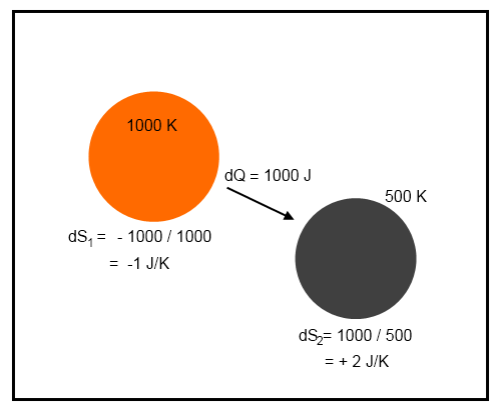
It’s not easy to visualize – but take a look at a simple example. Suppose that a tiny amount of heat, 1000 J, moves from a body at 1000K to a body at 500K:
Example 1

The net change in energy in the system is zero because 1000J leaves the first body and is absorbed by the second body. This is the first law of thermodynamics – energy cannot be created or destroyed.

However, there is a change in entropy.

The change in total entropy of the system = δS1 + δS2 = -1 + 2 = 1 J/K.

This strange value called “entropy” has increased.

Notice that if the energy flow of 1000J was from the 500K body to the 1000K body the change in entropy would be -1 J/K. This would be a reduction in entropy – forbidden by the real second law of thermodynamics. This would be a spontaneous flow of heat from the colder body to the hotter body.

Updated note Sep 30th – this example is intended to clarify the absolute basics.

Think of the example above like this – If, for some reason, in a closed system, this was the only movement of energy taking place, we could calculate the entropy change and it has increased.

The example is not meant to be an example of only one half of a radiative energy exchange. Just a very very simply example to show how entropy is calculated. It could be conductive heat transfer through a liquid that is totally opaque to radiation.

The Special Case

The simplest example demonstrating the second law of thermodynamics is with two bodies which are in a closed system.

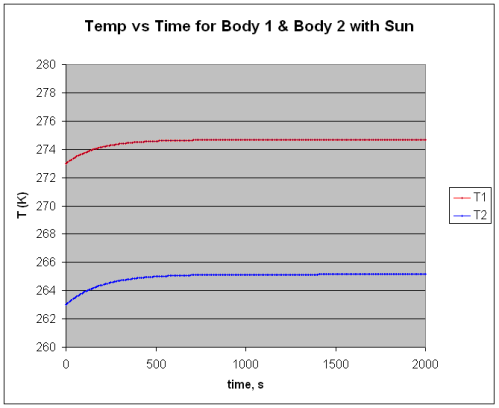
Let’s say that we have a gas at 273K (Body 1) and a solid (Body 2) surrounded by the gas. The solid starts off much colder.

What is the maximum temperature that can be reached by the solid?

273K

Easy. In fact, depending on the starting temperature of the solid and the respective heat capacities of the gas and solid, the actual temperature that both end up (the same temperature eventually) might be a little lower or a lot lower.

But the temperature reached by the solid can never get to more than 273K. For the solid to get to a temperature higher than 273K the gas would have to cool down below 273K (otherwise energy would have been created). Heat does not spontaneously flow from a colder to a hotter body so this never happens.

This defining example is illuminating but no surprise to anyone.

It is important to note that this special case is not the second law of thermodynamics, it is an example that conforms to the second law of thermodynamics.

The second law of thermodynamics says that the entropy of a system cannot reduce. If we want to find out whether the second law of thermodynamics forbids some situation then we need to calculate the change in entropy – not use “insight” from this super-simple scenario.

So let’s consider some simple examples and see what happens to the entropy.

Simple Examples

What I want to demonstrate is that the standard picture in heat transfer textbooks doesn’t violate the second law of thermodynamics.

What is the standard picture?
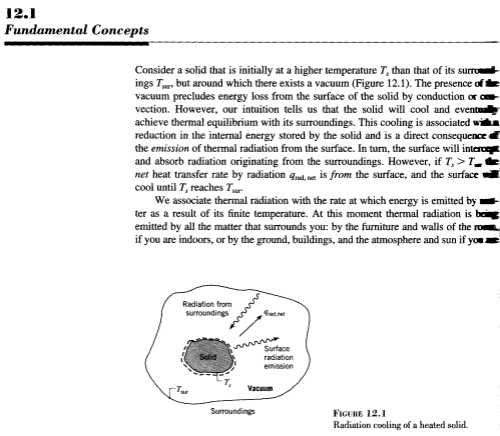
 

From "Fundamentals of Heat and Mass Transfer, 6th edition", Incropera and DeWitt (2007)

From "Fundamentals of Heat and Mass Transfer, 6th edition", Incropera and DeWitt (2007)


This says that two bodies separated in space both emit radiation. And both absorb radiation from the other body (see note 2).

The challenging concept for some is the idea that radiation from the colder body is absorbed by the hotter body.

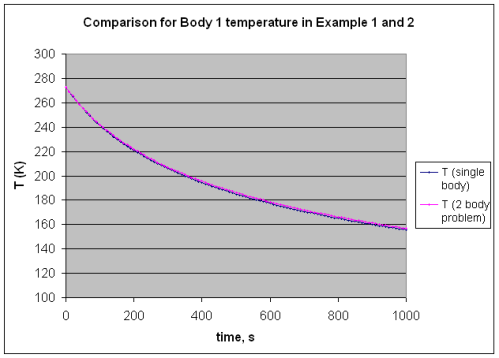
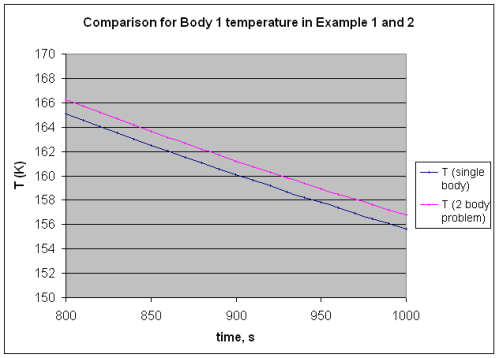
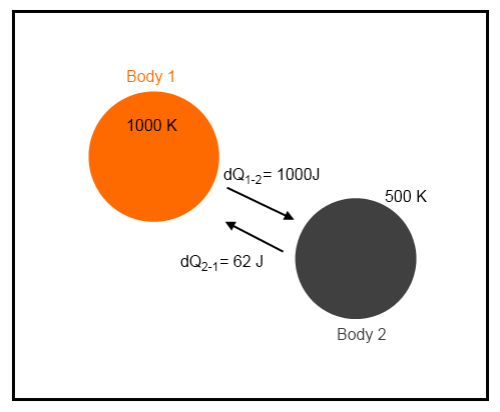
We start with Example 1 above, but this time we consider an exchange of radiation and see what happens to the entropy of that system.
Example 2

What I have introduced here is thermal radiation from Body 2 incident on Body 1. We will assume all of it is absorbed, and vice-versa.

According to the Stefan-Boltzmann equation, energy radiated is proportional to the 4th power of temperature. Given that Body 2 is half the temperature of Body 1 it will radiate at a factor of 24 = 2 x 2 x 2 x 2 = 16 times less. Therefore, if 1000J from Body 1 reaches Body 2, then 62J (1000/16) will be transmitted in the reverse direction. However, the exact value doesn’t matter for the purposes of this example.

So with our example above, what is the change in entropy?

Body 1 loses energy, which is negative entropy. Body 2 gains energy, which is positive entropy.

δS1 = -(1000-62)/1000 = -938 / 1000 = -0.94 J/k
δS2 =(1000-62)/500 = 938 / 500 = 1.88 J/K

Total entropy change = -0.94 + 1.88 = 0.94 J/K.

So even though energy from the colder body has been absorbed by the hotter body, the entropy of the system has increased. This is because more energy has moved in the opposite direction.

There is no violation of the second law of thermodynamics with this example.

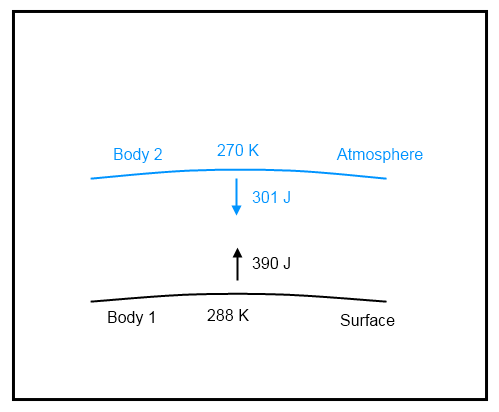
Now let’s consider an example with values closer to what we encounter near the earth’s surface:

Example 3

This isn’t intended to be the complete surface – atmosphere system, just values that are more familiar.

Surface:        δS1 = -(390-301)/288 = -89 / 288 = -0.31 J/k
Atmosphere: δS2 = (390-301)/270 = 89 / 270 = 0.33 J/K

Total entropy change = -0.31 + 0.33 = 0.02 J/K.

So even though the temperatures of the two bodies are much closer together, when they exchange energy, total entropy still increases.

Energy from the colder atmosphere has been absorbed by the hotter surface and yet entropy of the system has still increased.

Now, the example above (example 3) is an exchange of a fixed amount of energy (in Joules, J). Suppose this is the amount of energy per second (Watts, W) or the amount of energy per second per square meter (W/m²).

If the atmosphere keeps absorbing more energy than it is emitting it will heat up. If the earth keeps emitting more energy than it absorbs, it will cool down.

If example 3 was the complete system, then the atmosphere would heat up and the earth would cool down until they were in thermal equilibrium. This doesn’t happen because the sun continually provides energy.

The Complete Climate System

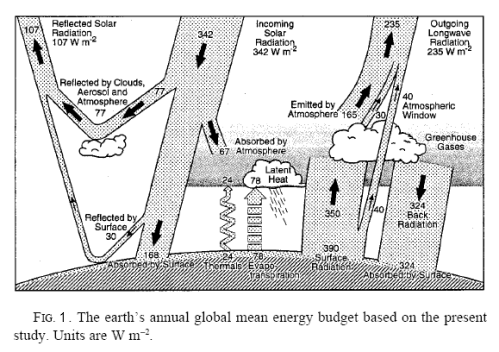
The earth-atmosphere system is very complex. If we analyze a long term average scenario, like that painted by Kiehl and Trenberth there is an immediate problem in calculating the change in entropy:
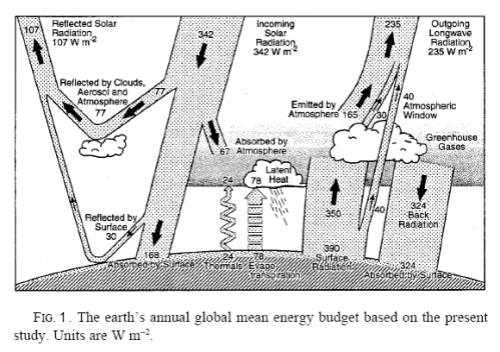
 

From Kiehl & Trenberth (1997)

From Kiehl & Trenberth (1997)


[Note from Sep 28th – This section is wrong, thanks Nick Stokes for highlighting it and so delicately! Preserved in italics for entertainment value only..] If we consider the surface, for example, it absorbs 492 W/m² (δQ = 492 per second per square meter) and it loses 492 W/m² (δQ = -492 per second per square meter).

Net energy change = 0. Net entropy change = 0.

Why isn’t entropy increasing? We haven’t considered the whole system – the sun is generating all the energy to power the climate system. If we do consider the sun, it is emitting a huge amount of energy and, therefore, losing entropy. But the energy generation inside the sun creates more entropy – that is, unless the second law of thermodynamics is flawed.

[Now the rewritten bit]

Previous sections explained that calculations of entropy “removed” (negative entropy) are based on energy emitted divided by the temperature of the source. And calculations of entropy “produced” are based on energy absorbed divided by the temperature of the absorber. In a closed system we can add these up and we find that entropy always increases.

So the calculation in italics above is incorrect. Change in entropy at the surface is not zero.

Change in entropy at the surface is a large negative value, because we have to consider the source temperature of the energy.

So as Nick Stokes points out (in a comment below), we can draw a line around the whole climate system, including the emission of radiation by the sun (see example 4 just below). This calculation produces a large negative entropy, because it isn’t a closed system. This is explained by the fact that the production of solar energy creates an even larger amount of positive entropy.
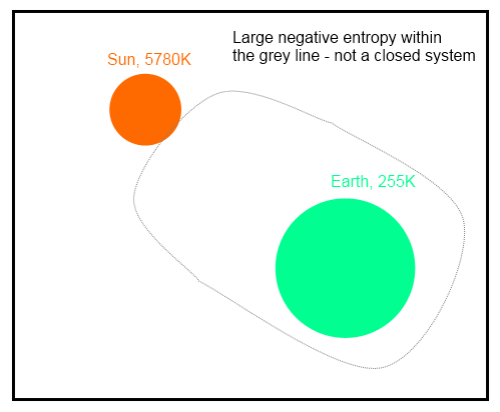
Example 4

The Classic Energy Exchange by Radiation

I was in the university library recently and opened up a number of heat transfer textbooks. All of them had a similar picture to that from Incropera and DeWitt (above). And not a single one said, This doesn’t happen.

In any case, for someone to claim that an energy exchange violates the second law of thermodynamics they need to show there is a reduction in entropy of a closed system.

But one important point did occur to me when thinking about this subject. Let’s reconsider our commenter’s claim:

An irradiated object can never reach a higher temperature than the source causing the radiation

As I pointed out in the The Special Case section – this is true if this is the only source of energy. Yet the surface of the earth receives energy from both the sun and the atmosphere.

If the colder atmosphere cannot transfer energy to a warmer surface, and the second law of thermodynamics is the reason, the actual event that is forbidden is the emission of radiation by the colder atmosphere. When the colder atmosphere radiates energy it loses entropy.

After all, the entropy loss takes place when the atmosphere has given up its energy. Not when another body has absorbed the energy.

Our commenter has frequently agreed that the colder atmosphere does radiate. But he doesn’t believe that the surface can absorb it. He has never been able to explain what happens to the energy when it “reaches” the surface. Or why the surface doesn’t absorb it. Instead we have followed many enjoyable detours into attempts to undermine any of a number of fundamental physics laws in an attempt to defend “the imaginary second law of thermodynamics”.

Conclusion

Entropy is a conceptually difficult subject, but all of us can see the example in “the special case” and agree that the picture is correct.

However, the atmosphere – surface interaction is more complex than that simple case. The surface of the earth receives energy from the sun and the atmosphere.

As we have seen, in simple examples of radiant heat exchange between two bodies, entropy is still positive even when the hotter body absorbs energy from the colder body. This is because more energy flows from the hotter to the colder than the reverse.

To prove that the second law of thermodynamics has been violated someone needs to demonstrate that a system is reducing entropy. So we would expect to see an entropy calculation.

Turgid undergraduate books about heat transfer in university libraries all write that radiation emitted by a colder body is absorbed by a hotter body.

That is because the first law of thermodynamics is still true – energy cannot be created, destroyed, or magically lost.

Other Relevant Articles

The Amazing Case of “Back Radiation” – Part Three

The First Law of Thermodynamics Meets the Imaginary Second Law

Intelligent Materials and the Imaginary Second Law of Thermodynamics

Amazing Things we Find in Textbooks – The Real Second Law of Thermodynamics

Notes

Note 1 – There are more fundamental ways to define entropy, but it won’t help to see this kind of detail. And for the purists, the equation as shown relies on the temperature not changing as a result of the small transfer of energy.

If the temperature did change then the correct formula is to integrate:

ΔS = ∫Cp/T. dT (with the integral from T1 to T2) and the result,

ΔS = Cp log (T2/T1),   this is log to the base e.

Note 2 – This assumes there is some “view factor” between the two bodies – that is, some portion of the radiation emitted by one body can “hit” the other. Just pointing out the obvious, just in case..

Read Full Post »
Someone on another blog reminded me about this paper – Cooling of Atmosphere due to CO2 Emission, by Chilingar, Khilyuk and Sorokhtin (2008).

It’s clearly impressed many people, but it’s not a good paper. It’s main strength is misdirection.

Traditional anthropogenic theory of currently observed global warming states that release of carbon dioxide into atmosphere (partially as a result of utilization of fossil fuels) leads to an increase in atmospheric temperature because the molecules of CO2 (and other greenhouse gases) absorb the infrared radiation from the Earth’s surface. This statement is based on the Arrhenius hypothesis, which was never verified (Arrhenius, 1896).

The proponents of this theory take into consideration only one component of heat transfer in atmosphere, i.e., radiation. Yet, in the dense Earth’s troposphere with the pressure pa > 0:2 atm, the heat from the Earth’s surface is mostly transferred by convection (Sorokhtin, 2001a). According to our estimates, convection accounts for 67%, water vapor condensation in troposphere accounts for 25%, and radiation accounts for about 8% of the total heat transfer from the Earth’s surface to troposphere. Thus, convection is the dominant process of heat transfer in troposphere, and all the theories of Earth’s atmospheric heating (or cooling) first of all must consider this process of heat (energy)– mass redistribution in atmosphere..

Emphasis added.

The highlighted statement from the 2nd paragraph is false. Open any atmospheric physics textbook and you will find a treatment of convection.

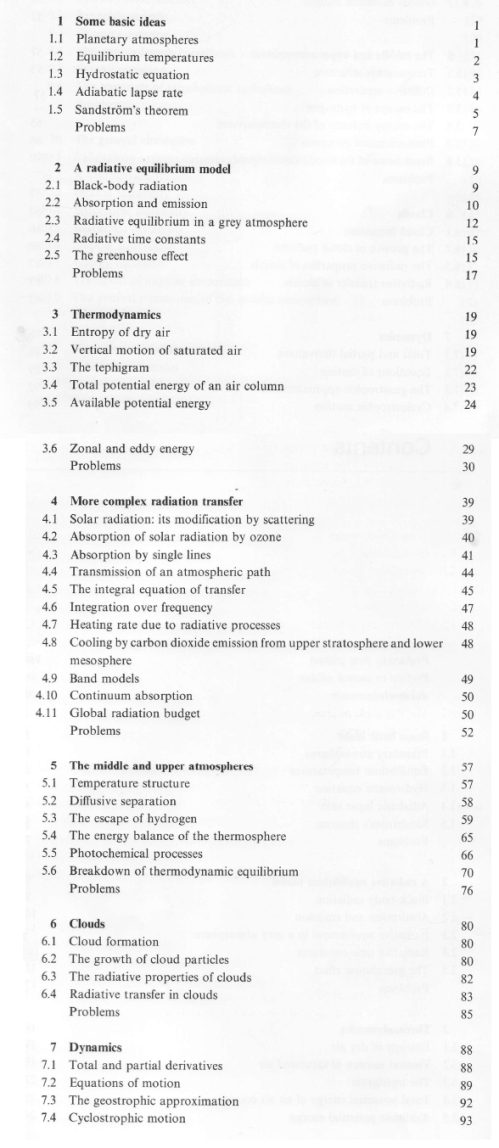
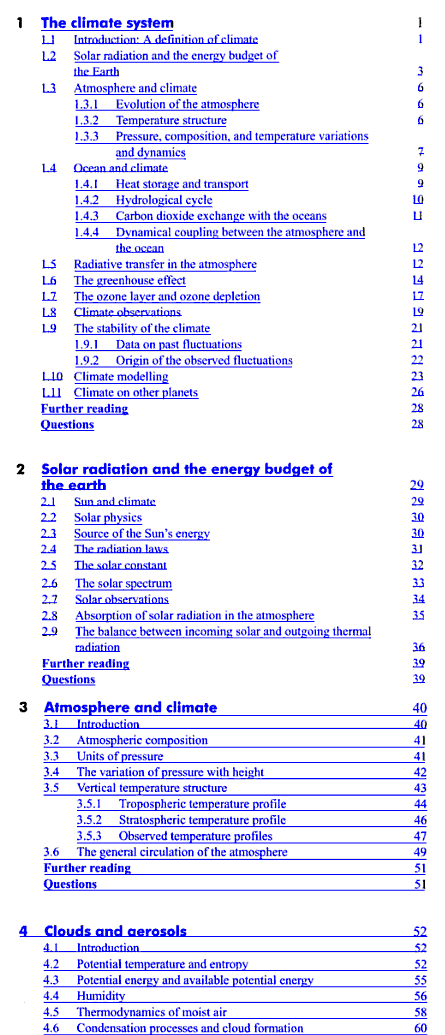
Here are the first two pages of contents from The Physics of Atmospheres, by John Houghton, 2nd ed, 1986, Cambridge University Press:

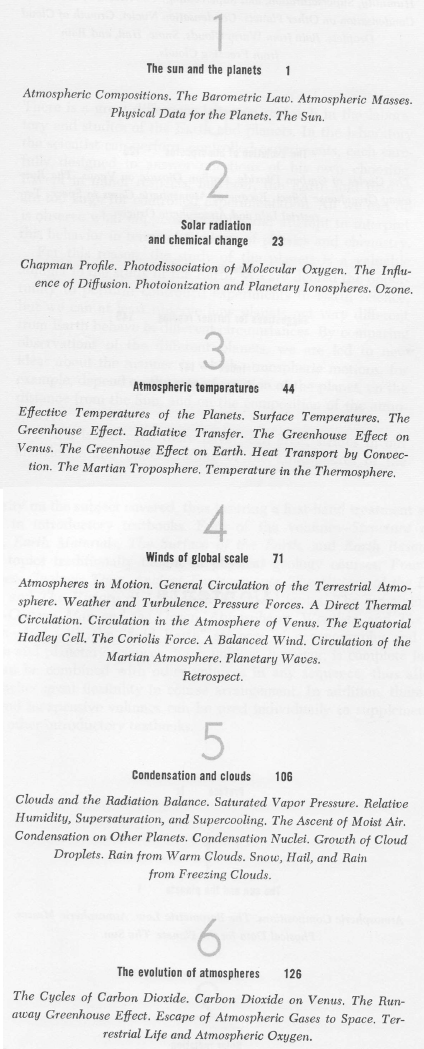
Here are the contents from Atmospheres, by Richard Goody (1972), Prentice-Hall Inc:

Here is the first part of the contents from Elementary Climate Physics, by Prof. F.W. Taylor (2005), Oxford University Press:

If readers would like citations and extracts from many papers to demonstrate the point further, just ask.

So the writers of this “paper” conclude:

Thus, convection is the dominant process of heat transfer in troposphere, and all the theories of Earth’s atmospheric heating (or cooling) first of all must consider this process of heat (energy)– mass redistribution in atmosphere

The dominant theories of atmospheric heating and cooling do consider this. If the paper provided some evidence that this is “not considered” we could address the evidence but instead they just go on to claim:

This physical system (multiple cells of air convection) acts in the Earth’s troposphere like a continuous surface cooler. The cooling effect by air convection can surpass considerably the warming effect of radiation.

For the easily impressed this might seem like something noteworthy. And yet this is the staple of every textbook and every paper reviewing the effect of the inappropriately-named “greenhouse” effect.

For example, Lindzen (1990):

It is worth noting that, in the absence of convection, pure greenhouse warming would lead to a globally averaged surface temperature of 72°C given current conditions. Our current average temperature, 15°C, is actually much closer to the blackbody temperature without any greenhouse warming than to the pure greenhouse result. The relative ineffectiveness of the greenhouse effect is due to convection which carries heat past the bulk of the water vapor (which has a scale height of about 2km)..

Or Ramanathan & Coakley (1978):

A comparison of the radiative equilibrium temperatures with the observed temperatures has indicated the extent to which the other atmospheric processes, such as convection, large-scale circulation, and condensation processes, influence the thermal energy balance of the system. In most planetary atmospheres, radiative equilibrium temperatures cannot be sustained in the lower regions of the atmosphere..

Convection aids radiation in transporting energy from the surface of the planet to the atmosphere. The vertical transport of heat by convection tends to minimize the magnitude of dθ/dz..

And so Chilingar et al move to the “greenhouse” effect:

Therefore, the present-day greenhouse effect is approximately equal to +33°C. The term “greenhouse effect” is confusing from the physical point of view and leads the general public astray.

And like G&T, they point out that a greenhouse works differently from the atmosphere without noting that greenhouses are not used by atmospheric physicists to prove the effect of radiatively-active gases in the atmosphere. Instead atmospheric physics uses the fundamental equations (the radiative transfer equations) which determine absorption and emission of radiation by water vapor, CO2, methane, and other trace gases.

Proof of Negative Feedback

Now Chilingar and his colleagues bring out the simple equation balancing the effective radiation temperature of the earth with the solar radiation absorbed. But then they make the curious comment:

The water vapor condensation in troposphere begets clouds, which to a considerable degree determine the reflective properties of the planet, i.e., its albedo A. The latter gives rise to a strong negative feedback between the surface temperature Ts and the temperature of “absolutely black body” Tbb, which is determined by the solar radiation S reaching the Earth’s surface at its distance from the Sun.

Indeed, any increase in surface temperature intensifies the water evaporation and increases the Earth’s cloudiness, which, in turn, increases the Earth’s albedo. As a result, the reflection of solar heat from the clouds into space increases and the heat influx to the Earth’s surface decreases and the average surface temperature decreases to the previous level. Strong negative feedback in any system leads to linear dependence of system’s output on its input.

Why curious?

Because they provide no evidence for the claim of negative feedback. No papers, no equations, no research..

It might be true, but for us skeptics, we like to see evidence.

Anthropogenic Imact on the Earth’s Climate – Tiny

In their piece de resistance they start with:

The adiabatic theory allows one to evaluate quantitatively the influence of anthropogenic emission of carbon dioxide on the Earth’s climate.

And continue:

To evaluate the effect of anthropogenic emission of carbon dioxide on global temperature, one can use the adiabatic model together with the sensitivity analysis (Sorokhtin, 2001; Khilyuk and Chilingar, 2003, 2004). At sea level, if the pressure is measured in atmospheres, then p = 1 atm and

āT ≈ T α Δp                     (12)

If, for example, the concentration of carbon dioxide in the atmosphere increases two times (from 0.035% to 0.07%), which is expected by the year of 2100, then the atmospheric pressure will increase by Δp =  1.48  10-4 atm (Sorokhtin, 2001). After substitution of T = 288 K,  α = 0.1905, and Δp = 1.48  10-4 atm into Eq. (13), one obtains ΔT = 0.00812 °C..

Thus, the increase in the surface temperature at sea level caused by doubling of the present-day CO2 concentration in the atmosphere will be less than 0.01 °C, which is negligible in comparison with natural temporal fluctuations of global temperature.

From these estimates, one can deduce a very important conclusion that even considerable increase in anthropogenic emission of carbon dioxide does not lead to noticeable temperature increase. Thus, the hypothesis of current global warming as a result of increased emission of carbon dioxide (greenhouse gases) into the atmosphere is not true.

Awesome. Who could argue with that. It is in a peer-reviewed paper and has a lot of equations. Climate scientists, shame on you for neglecting convection. CO2 has almost no effect on the earth’s temperature..

The Conjuring Trick

It’s all very well to produce some equations, but in the interests of accuracy it’s important to produce the correct ones.

The conjuring trick in this paper is discussing the movement of heat from the surface to the troposphere (lower atmosphere) without discussing how the surface AND atmosphere lose heat to space.

Suppose that heat was transferred from the surface to the troposphere 100% by convection.

What would it prove? It would certainly be quite a different climate but there would still be an important question to ask.

One important question for all students of climate science is:

How does the earth’s climate system (surface, troposphere, stratosphere) lose heat to space?

Solar radiation heats the earth. In equilibrium, the earth and the atmosphere radiate the same amount of heat out to space. Imbalances between solar heating and radiative cooling change the amount of heat in the climate system.

Convection (and conduction) cannot move heat into space, only radiation can do this.

Increasing the concentration of “greenhouse” gases like CO2 has an important effect unmentioned by Chilingar and his colleagues. This effect is explained in The Earth’s Energy Budget – Part Three.

The higher the concentration of “greenhouse” gases, the more optically thick the atmosphere, and therefore radiative cooling to space takes place from higher up in the atmosphere.

The higher up you go, the colder it gets. The explanation is somewhat involved, so check out the link and also the series: CO2 – An Insignificant Trace Gas?

The important point is that Chilingar and his colleagues don’t mention this. They don’t prove the fundamental equations wrong. They don’t comment..

Perhaps they don’t understand the subject. Who knows?

Conclusion

The paper demonstrates nothing about the effect of increased CO2 on the earth’s climate.

It doesn’t show a problem in established arguments, like from Manabe and Strickler (1964), Ramanathan and Coakley (1978) or any other paper. The authors of this 2008 paper just imagine the established science away.

Understanding how the earth and atmosphere cool to space via radiation is a critical component in understanding surface temperature changes.

See also: New Theory Proves AGW Wrong!

References

Cooling of Atmosphere Due to CO2 Emission, Chilingar et al, Energy Sources, Part A: Recovery, Utilization, and Environmental Effects (2008)

Some Coolness concerning Global Warming, Lindzen, Bulletin of American Meteorological Society (1990)

Climate Modeling through Radiative-Convective Models, Ramanathan and Coakley, Reviews of Geophysics and Space Physics (1978)


Read Full Post »

In Part One we looked at a thought experiment designed to make it easier to understand a basic principle – that inner surfaces of systems can have higher temperatures and therefore higher values of radiation than the outside of a system.

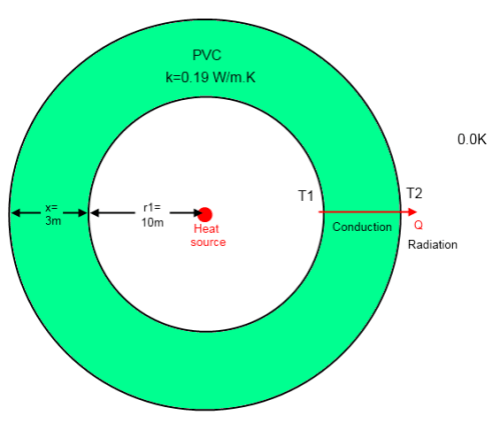
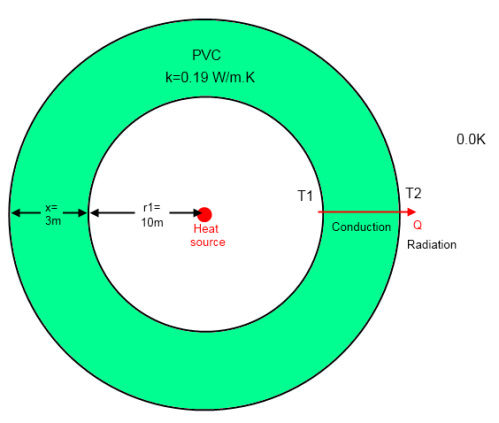
We looked at a PVC hollow sphere out in the vastness of space:

The only reason for creating that experiment in its unreal environment was to make the basic physics and the corresponding maths easier to follow.

In that example, with the heat source of 30,000 W, the final equilibrium values (with emissivity = 0.8) were:

T1 = 423 K and T2 = 133 K

In this case the outer wall radiates 30,000 W out into space and so the system is in equilibrium.

Yet the inner wall is radiating 1,824,900 W.

You can see the maths in Part One. From a few comments on this blog, and some comments I saw elsewhere, clearly many people still have problems with it.

That’s a good thing. It’s good because it means that the simple problem is doing its job. It is simple enough that almost everyone realizes the calculated temperatures are correct. It is simple enough that the maths can be followed. But it exposes an idea that many can’t accept – total radiation from a surface inside the system is much higher than the energy source.

The solution is quite simple.

One of the commenters, John N-G, pointed out:

Your point might be driven home more emphatically by noting that the inner surface absorbs only 23.8 W/m2 from the super-light-bulb, yet in the 3m-thick example it emits the afore-mentioned 1452 W/m2 (and also absorbs 1452 W/m2 of wall-emitted radiation).

The inner surface is also in energy balance.

We can consider the values as total energy per second (W), or as energy per second per unit area, (W/m2). We will stay with the total energy because these are the values we have already been working with.

  • Energy in = 30,000 W (from the energy source) + 1,824,900 W (from the inner surface surface)
  • Energy out = 30,000 W (conducted through the PVC wall to the outer surface) + 1,824,900 W (radiated from the inner surface)

No energy is created or destroyed in the system encompassed by the inner surface.

Dynamic Results

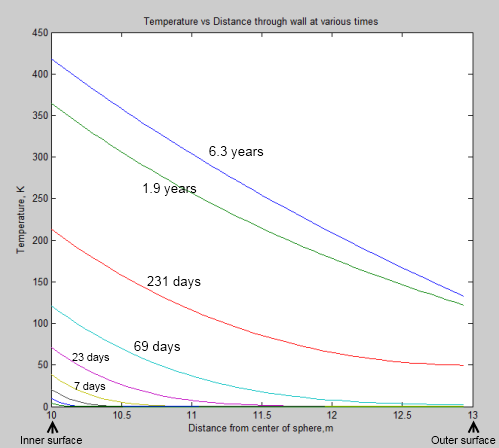
From some comments related to this and other articles, explaining how equilibrium is reached might help. Once again, the 1st law of thermodynamics is used to calculate the dynamic situation. If there is net energy added to an element of the system then its temperature increases.

The approach to the calculation is a simple numerical model, which divides the sphere wall radially (into 50 equal “slices”):

The inner wall receives 30,000 W. It radiates an amount dependent on temperature but also receives that same amount from the inner wall surface (therefore the net heat received is always = 30,000 W).

The outer wall radiates according to its temperature.

And for all of the “slices” of the wall in between the heat flow is according to the temperature differential (equation in Part One), and the heat gained is according to the simple equation:

dQ = mc.dT    – where dQ = change in energy, m = mass, c= specific heat capacity and dT = change in temperature

Spherical symmetry makes the calculation much easier than if it was a box.

Conclusion

If the first law of thermodynamics meant that no inner surface could radiate at a higher value than the outer surface of the system then everything would be at the same temperature.

In the PVC hollow sphere example the inner wall would have to be at 133K – the same as the outer wall. This would mean that no heat could flow from the inner wall to the outer wall – or that Fourier’s law was wrong. And lagging hot water pipes was also “a big con”.

We all know that is not the case – well, maybe not everyone has heard of Fourier, but everyone knows about insulation.

The reason why so many people think that Trenberth and Kiehl’s diagram is flawed is because of an incorrect understanding of the first law of thermodynamics.

If Trenberth and Kiehl’s diagram violates the first law of thermodynamics then so does my PVC sphere. There’s just the small matter of trying to explain how the inner surface would stay at 133K.

At least there is one Get Out of Jail Free card. As a commenter on another blog put it:

The atmosphere cannot both behave like a PVC blackbody and an ideal gas

Analogies prove nothing. But for those brave enough to consider that they might be wrong, I hope the PVC hollow sphere provides some illumination.

Update: Do Trenberth and Kiehl understand the First Law of Thermodynamics? Part Three – The Creation of Energy?

Read Full Post »

In Part One we took a look at what data was available for “back radiation”, better known as Downward Longwave Radiation, or DLR. And we saw that around many locations the typical DLR was in the order of 300 W/m2, and it didn’t decrease very much at night.

In Part Two we looked at several measured spectra of DLR which clearly demonstrated that this radiation is emitted by the atmosphere.

In this article we will consider what happens when this radiation reaches the ground. The reason we want to consider it is because so many people are confused about “back radiation” and have become convinced that either it doesn’t exist – covered in the previous two parts – or it can’t actually have any effect on the temperature of the earth’s surface.

The major reason that people give for thinking that DLR can’t affect the temperature is (a mistaken understanding of) the second law of thermodynamics, and they might say something like:

A colder atmosphere can’t heat a warmer surface

There are semantics which can confuse those less familiar with thermal radiation.

If we consider the specific terminology of heat we can all agree and say that heat flows from the warmer to the colder. In the case of radiation, this means that more is emitted by the hotter surface (and absorbed by the colder surface) than the reverse.

However, what many people have come to believe is that the colder surface can have no effect at all on the hotter surface. This is clearly wrong. And just to try and avoid upsetting the purists but without making the terminology too obscure I will say that the radiation from the colder surface can have an effect on the warmer surface and can change the temperature of the warmer surface.

Here is an example from a standard thermodynamics textbook:

From "Fundamentals of Heat and Mass Transfer, 6th edition", Incropera and DeWitt (2007)

From "Fundamentals of Heat and Mass Transfer, 6th edition", Incropera and DeWitt (2007)

Probably this diagram should be enough, but as the false ideas have become so entrenched let’s press on..

Note that this topic has been covered before in: Intelligent Materials and the Imaginary Second Law of Thermodynamics and The First Law of Thermodynamics Meets the Imaginary Second Law

The First Law of Thermodynamics

This law says that energy is conserved – it can’t be created or destroyed. What this means is that if a surface absorbs radiation it must have an effect on the temperature – compared with the situation where radiation was not absorbed.

There’s no alternative – energy can’t be absorbed and just disappear. However, as a technical note, energy can be absorbed into chemical bonds or phase changes of materials. So you can put heat into ice without changing the temperature, while the ice turns into water. Of course, energy is still not lost..

Therefore, if your current belief is that radiation from a colder atmosphere cannot “change the temperature” of the hotter surface then you have to believe that all of the radiation from the atmosphere is reflected.

Or, alternatively, you can believe that the first law of thermodynamics is flawed. Prove this and your flight to Sweden beckons..

Bouncers at the Door – or Quantum Mechanics and the Second Law of Thermodynamics

One commenter on an earlier post asked this question:

But if at the surface the temperature is higher than in the atmospheric source then might the molecules which might have absorbed such a photon be in fact unavailable because they have already moved to a higher energy configuration due to thermal collisions in the material which contains them?

Many people have some vague idea that this kind of approach is how the second law of thermodynamics works down at the molecular level.

It (the flawed theory) goes like this:

  1. the atmosphere emits “a photon”
  2. the photon reaches the surface of the earth
  3. because the temperature of the surface of the earth is higher the photon cannot be absorbed – therefore it gets “bounced”.

Except it’s not physics in any shape or form – it just sounds like it might be.

Let’s review a few basics. It’s important to grasp these basics because they will ensure that you can easily find the flaw in the many explanations of the imaginary second law of thermodynamics.

“They all look the same to me” – The Energy of a Photon

This part is very simple. The energy of a photon, E:

E = hν = hc/λ

where ν = frequency, λ = wavelength, c = speed of light, h = 6.6 ×10⁻³⁴ J.s (Planck’s constant).

You can find this in any basic textbook and even in Wikipedia. So, for example, the energy of a 10μm photon = 2 x 10⁻²⁰ J.

Notice that there is no dependence on the temperature of the source. Think of individual photons as anonymous – a 10μm photon from a 2,000K source has exactly the same energy as a 10μm photon from a 200K source.

No one can tell them apart.

Wavelength Dependence on the Temperature of the Source

Of course, radiation from different temperature sources do have significant differences – in aggregate. What most, or all, believers in the imaginary second law of thermodynamics haven’t appreciated is how similar different temperature Planck curves can be:

Blackbody radiation curves for -10'C (263K) and +10'C (283K)

Blackbody radiation curves for -10'C (263K) and +10'C (283K)

Notice the similarity between the 10°C and the -10°C radiation curves.

Alert readers who have pieced together these basics will already be able to see why the imaginary second law is not the real second law.

If a 0°C surface can absorb radiation from 10°C radiation, it must be able to absorb radiation from -10°C radiation. And yet this would violate the imaginary second law of thermodynamics.

What determines the ability of a surface to absorb or reflect radiation?

Absorptivity and Reflectivity of Surfaces

The reflectivity of a surface is a measurement of the fraction of incident radiation reflected. It’s very simple.

This material property has a wavelength dependence and (sometimes) a directional dependence. Here is a typical graph of a few materials:

Reflectivity vs wavelength for various surfaces, Incropera (2007)

Reflectivity vs wavelength for various surfaces, Incropera (2007)

As you can see, the variation of absorptivity/reflectivity with wavelength is very pronounced. Notice as well in this diagram from a standard textbook that there is no “source temperature” function. Of course, there can’t be, as we have already seen that the energy of a photon is only dependent on its wavelength.

Just to be clear – radiation incident on a surface (irradiation) can only be absorbed or reflected. (In the case of gases, or very thin surfaces, radiation can also be “transmitted” through to the other side of the material or gas).

Conclusion from Basic Physics

So from basic physics and basic material properties it should be clear that radiation from a colder surface cannot be all reflected while at the same time radiation from a warmer surface is absorbed.

And if any radiation is absorbed it must change the surface temperature and therefore violate the (imaginary) second law of thermodynamics.

You have to ditch something. I would recommend ditching the imaginary second law of thermodynamics. But you can choose – instead you could ditch the first law of thermodynamics, or the basic equation for the energy of a photon (make up your own), or invent some new surface properties.

While considering these choices, here’s another way to think about it..

If All the “Back Radiation” Was Reflected..

So let’s suppose you still think that all of the radiation from the atmosphere, all 300W/m2 of it, gets reflected.

That presents a problem even bigger than the tedious physics principles articulated above. Why is that?

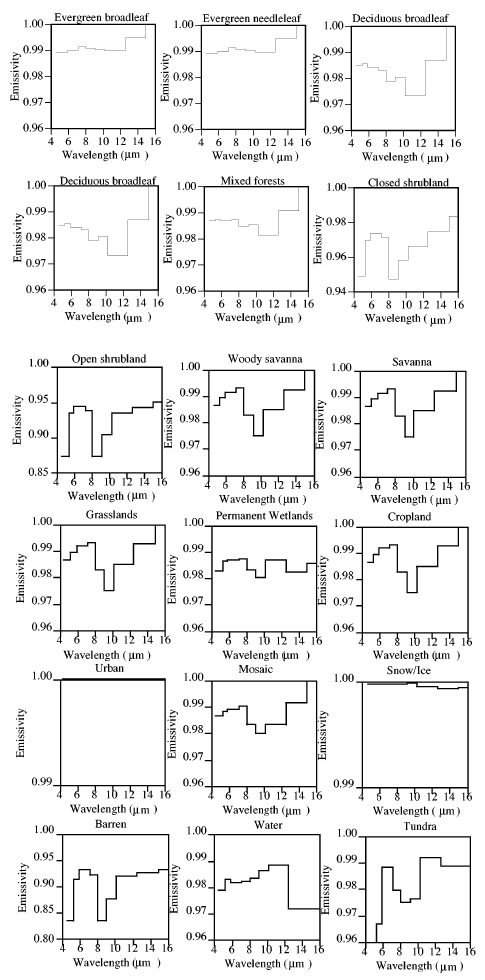
Well, let’s take the earth’s average surface temperature of around 15°C (288K) and the typical emissivity of various surface types:

Emissivity vs wavelength of various substances, Wilber (1999)

Emissivity vs wavelength of various substances, Wilber (1999)

As you can see, the emissivity is pretty close to 1. So for a temperature of 15°C the Planck curve will be pretty close to a blackbody, and the total surface emitted radiation (“flux”) is given by the Stefan-Boltzmann equation of σT4 – so in the typical surface case:

j = 390 W/m2

Now we have to add the reflected surface radiation of 300W/m2. So the upward radiation from the surface will be around 690 W/m2.

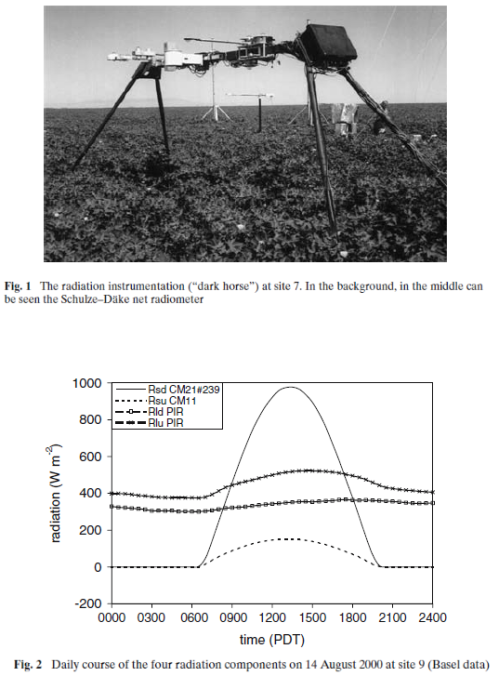
Here is one result from a very thorough experiment, The Energy Balance Experiment, EBEX 2000 (reference below):

Upward and downward radiation measurements, EBEX 2000, Kohsiek (2007)

Upward and downward radiation measurements, EBEX 2000, Kohsiek (2007)

The location was a cotton field of 800m × 1600m at coordinates 36°06’ N, 119°56’ W, approximately 20 km south-south-west of the town of Lemoore CA, USA. In this experiment, radiation measurements were taken at nine sites across the field along with wind and humidity measurements in an attempt to “close the energy budget” at the surface. Downward measurements were taken at a few of the sites (because the values wouldn’t change over a small distance) while upward measurements of both shortwave and longwave were taken at every site. Some sites measured the same value with two instruments from different manufacturers.

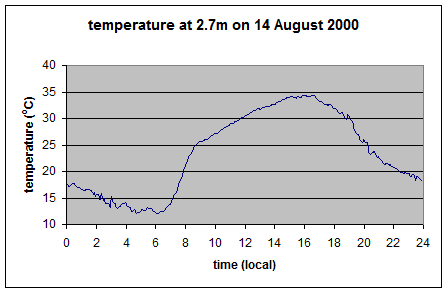
As you can see the upward longwave measurement is around 400-500 W/m2. The paper itself doesn’t record the temperature on that day, but typical August temperatures in that region peak above 35°C, leading to surface radiation values above 500 W/m2 – which is consistent with the measurements. [Update – the peak temperature measured at this location was 35°C on this day – thanks to Wim Kohsiek for providing this data along with the temperature graph for the day]

Temperature for 14 August 2000, from Wim Kohsiek, private communication

Temperature for 14 August 2000, from Wim Kohsiek, private communication

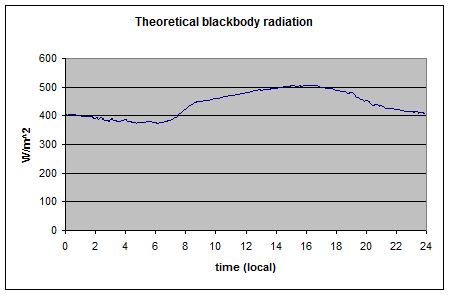
And so here it is the theoretical upward longwave radiation from the temperature graph (=σT4):

Calculated (theoretical) upward radiation, 14 August 2000

Calculated (theoretical) upward radiation, 14 August 2000

As you can see, this upward radiation calculation matches what was measured.

If the surface reflects all of the downward longwave radiation then the upward longwave measurement for these temperatures should be in the region of 700-800 W/m2.

There is a great opportunity for some enterprising people who still think that DLR is all reflected and not absorbed – buy a decent pyrgeometer and take some upward surface measurements to demonstrate that the whole science community is wrong and upward surface measurements really are 80% higher than everyone thinks. If you can afford an FT-IR to do a spectral analysis you will be able to prove your theory beyond a shadow of doubt – as the spectrum will have those characteristic CO2, O3 and water vapor peaks that were shown in DLR spectra in Part Two.

Conclusion

DLR is emitted by the atmosphere, reaches the surface and is absorbed by the surface. This absorption of energy changes the surface temperature.

The physics behind this are very basic and have been known for around 100 years.

Proving that the surface doesn’t absorb DLR should be a walk in the park for anyone with a small amount of cash. But only if it’s true.

The world we live in does absorb DLR and adding 300W/m2 to the surface energy budget is the reason why the surface temperatures are like they are.

Further reading – Do Trenberth and Kiehl understand the First Law of Thermodynamics?

Darwinian Selection – “Back Radiation”

References

The Energy Balance Experiment EBEX-2000. Part III: Behaviour and quality of the radiation measurements, Kohsiek et al, Boundary Layer Meteorology (2007)

Read Full Post »

Do Trenberth and Kiehl understand the First Law of Thermodynamics?

Yes

But many people claim that they don’t after reviewing their well-known diagram from their 1997 paper, Earth’s Annual Global Mean Energy Budget:

From Trenberth and Kiehl (1997)

From Trenberth and Kiehl (1997)

The “problem” is – how can the absorbed solar energy be 235W/m2 when the radiation from the surface is 390W/m2? Where is this energy coming from?

Clearly they have created energy and don’t understand basic physics!

There have been many comments to that effect on this blog and, of course, on many other blogs.

Instead of pointing out that many of these values can be easily measured and checked, we will turn to a simple experiment which might help the many who believe the answer to the title is “No“.

The Thought Experiment

Picture, for the practical among you, building some kind of simple heat chamber in your garage. A wooden or a plastic box, with a light bulb in the center. You want to test whether some new gizmo really works at the high temperatures claimed. Or you want to find the melting point of gold.

The principle is simple – the thicker the material and the higher the energy from the bulb – the hotter it will get inside the heat chamber.

As a method of simplifying the calculations, my chamber will be spherical (because it makes the maths easier than when it is a box) and we will place it in the vastness of space and assume that the ambient temperature is 0.0K. Again, this is just to make the maths simpler to understand.

The inner radius of the sphere is 10m, and the thickness of the wall is 3m. (In a followup comment or post I will show how the values change with x).

The material used for this experiment is PVC which has a thermal conductivity of 0.19 W/m.K – I’ll explain a little more about this parameter in a moment. Probably down at such low temperatures the thermal conductivity won’t be this value but it doesn’t matter too much. We will also assume that the emissivity = 0.8.

You can see on the diagram that the outer surface temperature is T2, the temperature inside the sphere is T1 and the “ambient” is 0K. We don’t yet know what T1 or T2 is, we want to find that out.

In the center, we have our super-light-bulb, which radiates 30,000W. It is mysteriously powered, perhaps it is a nuclear device, or just electric with such a thin power cord we can’t detect it – we don’t really care.

Now – the first law of thermodynamics – energy cannot be created or destroyed. So for our thought experiment, the system receives 30,000W. The “system” is the entire PVC sphere, and everything it encompasses, right to the outer surface. No other source of energy can be detected.

Start Your Engines

Now that we have turned on the energy source the inside of the sphere will heat up. It has to keep heating up until the energy flow out of the sphere is balanced by the energy being added inside the sphere.

How does heat flow out from the center of the sphere?

  • First, by conduction to the outer surface of the sphere
  • Second, by radiation from the outer surface of the sphere to the vastness of space

Both of these processes are governed by very simple equations which are shown in the maths section at the end. Here, I will just attempt to explain conceptually how the processes work.

We start with consideration of the complete system and after equilibrium is reached the energy gained will be equal to the energy lost.

Energy gained, q = 30,000W = Energy lost

(Note that we are considering energy per second). For a rigid stationary body in the vastness of space, the only mechanism for losing energy is radiating it. All bodies radiate according to their temperature and a property called emissivity. Using the Stefan-Boltzmann law, we can calculate that:

Outer surface temperature, T2 = 133K

With this temperature, at an emissivity of 0.8, the whole sphere is radiating away 30,000W.

Time Out

So at this point, surely everyone is in agreement. We have calculated the steady-state temperature of the outer surface of the sphere as 133K. We can see that the mysterious energy source of 30,000W is balanced by the outgoing 30,000W radiated away from the outer surface.

The first law of thermodynamics is still intact and no one has to fight about anything..

Systems check?

But What’s the Story Inside?

We also want to calculate T1, the temperature of the inner surface. This is also very easy to calculate. The only mechanism for transferring heat from the inner surface (where the energy source is located) to the outer surface is by conduction.

The maths is below but effectively heat is transferred through a wall when there is a temperature differential between two surfaces. The higher the differential, the more heat. And the property of the material that affects this process is called the thermal conductivity. When this value is high – like for a metal – heat is transferred very effectively. When this value is low – like for a plastic – heat is transferred much less efficiently.

Once the system is generating 30,000W internally the inner wall temperature will keep rising until 30,000W can flow through the wall and be radiated away from the outer surface.

If we use the simple maths to calculate the temperature differential we find that it is 290K.

That is, to get 30,000W to flow through a hollow sphere with inner radius 10m and outer radius 13m and conductivity of 0.19 W/m.K you need a temperature differential of 290K.

Which means that the inner surface is 423K.

Everyone still ok?

What is the Radiation Emitted from the Inner Surface?

With an emissivity of 0.8 and a surface temperature of 423K, the inner surface will be radiating at 1,452 W/m2.

So the total radiation from the inner surface will be 1,824,900W.

What??? You have created energy!!!

Before bringing out the slogans, find out which step is wrong. If you can’t find an incorrect step then perhaps you should consider the possibility that this system is not violating the first law of thermodynamics.

Well, perhaps everyone is comfortable with the idea that with sufficient insulation you can raise the inner temperature of a box or sphere to a very high value – without having to build a power station.

In any case, the system is not creating energy. Inner surfaces are receiving high amounts of radiation while also emitting high amounts of radiation – they are in balance.

And of course, this has nothing whatever to do with the earth’s climate system so everyone can rest easy..

Update – Do Trenberth and Kiehl understand the First Law of Thermodynamics? – Part Two

Do Trenberth and Kiehl understand the First Law of Thermodynamics? Part Three – The Creation of Energy?

And new article on the real basics – Heat Transfer Basics – Part Zero

Maths

The System

In equilibrium, the outer surface of the sphere has to radiate away all of the heat generated internally. This is the first law of thermodynamics.

The internal energy source,  q  = energy radiated from the outer surface

q = εσT24.4πr22 – the Stefan-Boltzmann equation for emitted energy per m2 x the surface area

where r2 = radius of the outer surface = 10 + 3 = 13

If q = 30,000W, r2 = 13m and ε = 0.8

T2 = q / (εσ.4πr22)1/4 and so T2 = 133K

If you recalculate back using the Stefan-Boltzmann law you will find that 133K with an emissivity of 0.8 radiates at 14.2 W/m2 (corrected-thanks to John N-G) and if you multiply that by the surface area of 4×3.14×132 = 2,124 m2 you find the emitted energy = 30,000W.

Conduction through the Sphere

The equation of heat conduction is very simple:

q = -kA . ΔT/Δx

This is for a planar wall. For a hollow sphere the equation is quite similar:

qr = -kA . dT/dr = – k (4πr2) . dT/dr and the important point is that qr is a constant, independent of r

After a small amount of maths we find that:

qr = 4πk . (T1 – T2) / (1/r1 – 1/r2)

So for the values of k = 0.19, r1 = 10, r2 = 13:

T1 – T2 = 290, therefore, T1 = 423K

Internal Radiation

Therefore, the radiated energy from the inner surface will be 1,452 W/m2 or a total of 1,824,900W (= εσT14.4πr12).

Read Full Post »
The surface of Venus is around 730K (457°C) – why is it so hot? Although there is still much to learn about Venus the basics have some simple explanations.

Energy Absorbed from the Sun

While earth is 150M km from the sun, Venus is only 108M km away, a ratio of 0.72.

The “solar constant” (as it has been historically called) at the earth is 1367 W/m², and, as energy intensity is proportional to the square of the distance away, or “r²”, the solar constant at Venus is 1367/(0.72²) = 2,636 W/m² – Venus is closer, so it receives more solar energy per m².

The earth has an average albedo of about 0.3, meaning that 30% of the solar radiation is reflected. This is by clouds, by aerosols in the atmosphere, and by the surface of the earth. (Watch out for “The Earth’s Energy Budget – Part Four – Albedo”). If Venus had the same albedo as the earth, the energy absorbed per m² of surface area would be, E = 2,636 * (1-0.3) / 4 = 461 W/m². [corrected – thanks to Bill Stoltzfus for pointing out my mistake]

For an explanation of why the value is divided by 4, see The Earth’s Energy Budget – Part One

This value equates to an “effective radiating temperature” of 300K (27°C). This is nothing like the surface of Venus. [corrected as well – thanks to Bill Stoltzfus for pointing out my mistake]

In any case, it turns out that Venus has a much higher albedo than the earth, with an albedo of 0.76 – meaning that 76% of the solar energy is reflected.

Redoing the calculation, E = 2,636 * (1-0.76) / 4 = 158 W/m² – which equates to an “effective radiating temperature” of 230K (-43°C). The same calculation for the earth gives 255K (-18°C) – see CO2 – An Insignificant Trace Gas? – Part One.

So in terms of a simple energy balance with the sun, Venus should be colder than the earth.

In the case of the earth, as laid out in the CO2 series, the reason the surface of the earth is so much warmer than predicted from simple energy balance is because various trace gases, including water vapor and CO2, absorb the upward radiation from the earth’s surface and reradiate it in all directions. As some of this is downward, the surface of the earth receives more energy than it would without these gases and so it is hotter. See CO2 – An Insignificant Trace Gas? Part Six – Visualization for some more insight into this.

So is Venus so much warmer at its surface because of the inappropriately-named “greenhouse” effect? Or is it for other reasons?

The Venusian Atmosphere

The atmosphere of Venus is quite unwelcoming for us earth-dwellers. The atmosphere is mostly CO2 (97%), with the balance made up mostly of nitrogen (N2), and trace amounts of water vapor and many other gases in minute quantities.

The mass of the Venusian atmosphere is around 100 times that of the earth, and consequently the pressure at the surface of Venus is much higher – at 92bar compared with 1bar for the earth.

Now some people say that the reason for the high temperature at the surface of Venus is because of the high atmospheric pressure and the depth of the atmosphere. For example, Steve Goddard on Wattsupwiththat and echoed by Lubos Motl. This explanation isn’t one that you can find in atmospheric physics text books.

A Quick Review of the Earth’s Surface

This is just to explain a few basics for some perspective.

From Trenberth and Kiehl (1997)

From Trenberth and Kiehl (1997)

There’s much of interest in this diagram from Earth’s Annual Global Mean Energy Budget by Trenberth and Kiehl (1997) but we’ll focus on a few key elements for the purposes of this article.

The surface of the earth receives an average of about 170 W/m² from solar energy (with an additional 70W/m² of solar radiation absorbed by the atmosphere). The earth’s surface also receives an average of 324 W/m² of radiation from the atmosphere. So in total the earth’s surface receives about 490 W/m² (annual global average).

Now the average radiation from the surface of the earth is 396 W/m² (or 390 W/m² in the diagram above, which is close enough for our purposes). Convection and conduction remove the balance of around 100W/m². If you take a look at Tropospheric Basics you can see more about the temperature profile in the troposphere (lower atmosphere) and why convection is a more effective re-distributor of heat within the troposphere.

The principal point is that the warming of the air from the surface radiation, conduction and convection causes the air to expand. Air that expands is less dense, and so this air rises, moving heat by convection.

The temperature profile, or lapse rate, from convection can be easily calculated, both for dry air and moist air. Dry air is just under 10°C/km, while moist air depends on the amount of water vapor, but can be as low as 4°C/km. (And the environmental lapse rate, or what we find in practice, is around 6.5°C/km).

So in the case of the earth’s surface, it would be radiating out 490W/m², but for the fact that conduction and convection remove some of this energy from the surface, and then convection redistributes this energy up into the atmosphere.

The Surface of Venus

Energy radiated from a surface is proportional to the 4th power of absolute temperature. This is known as the Stefan-Boltzmann law but visualizing the 4th power of something isn’t that easy. However, calculators are readily available and so if you punch the numbers in you will see that for a surface of T=730K with an emissivity close to a blackbody:

E = 16,100 W/m²   – compare this with the surface of earth (288K, 15°C) of around 390 W/m²

This is over 40x the energy radiated from the surface of the earth – for a temperature only 2.5x greater. That’s the real world, very non-linear.. (And note that if the emissivity is not equal to 1, the energy radiated is simply the value above multiplied by the emissivity).

So if we think about the top of atmosphere of Venus, it is radiating round about 158 W/m². This balances the absorbed solar radiation. And yet the surface is radiating 16,100 W/m² – does the high pressure of the Venusian atmosphere explain it?

No

Think about it like this. For the surface of Venus to be radiating at 16,100 W/m² it has to be receiving this energy from somewhere. It receives a maximum of 158 W/m² from the sun (if all of the solar energy absorbed is absorbed in the surface and nothing in the atmosphere).

The explanation from others about a temperature gradient between the surface and the tropopause (top of the tropopause or lower atmosphere) only explains anything when the surface heats the atmosphere from below. In that case the atmosphere heats up, expands and rises – moving energy via bulk movements of air.

Can the atmosphere create heat from pressure and transmit this heat to the surface?

In the case of the earth’s surface, the extra radiation to the earth’s surface (caused by the “greenhouse” effect) heats the atmosphere from beneath and causes convection – with a lapse rate (or temperature profile) of between 4 – 10 °C/km. And convection moves some of this heat from the surface up into the atmosphere. In the case of Venus the argument that relegates the role of the “greenhouse” effect and promotes the role of atmospheric pressure doesn’t have a heat transfer mechanism.

Picture the starting condition where the surface is very cold. What heats it up?

There are three ways of moving heat – radiation, convection and conduction. Conduction in gases is extremely low and anyway the top of the atmosphere is around 230K – if the surface starts off colder what causes heat to flow to the surface to create such a huge emission of radiation?

Convection needs to work by warming a gas from below. Where is this mechanism if the surface is not already heated by the “greenhouse” effect?

And radiation has been ruled out (as the main mechanism) in these arguments from Steve Goddard and others.

How Can the Surface Get so Hot? An Over-Simplified Climate Model

Let’s take a look at the ignored radiation and the super “greenhouse” effect.

How can a surface get so hot from “back-radiation”? Isn’t that just as crazy an idea?

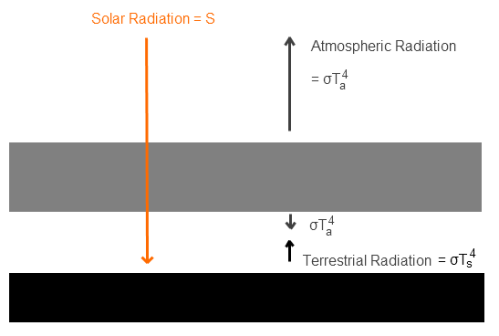
We will take a simple idea – as all models are at their start, just to demonstrate a point. There’s a little bit of maths, unfortunately, but possibly (if you haven’t seen this concept before), the concept might actually seem harder to grasp. Here’s a very simple (and not very realistic) model of a planetary surface and atmosphere (idea from Radiation and Climate from Vardavas and Taylor (2007)):

Simple climate model - atmosphere perfectly transparent to solar radiation, and totally opaque in the infra-red

Simple climate model - atmosphere perfectly transparent to solar radiation, and totally opaque in the infra-red

The surface receives radiation from the sun, S. In the case of Venus this value would be (averaged across the surface), S = 158 W/m².

Now the surface is at Ts and radiates to the atmosphere, which heats it up. The atmosphere is perfectly transparent to solar radiation, but totally opaque in the infra-red and all at one temperature, Ta. Therefore, the atmosphere radiates σTa4 upwards and σTa4 downwards.

Note that “totally opaque” means that no surface radiation makes it through this layer of the atmosphere. In this scenario we can calculate the surface radiation. If you are new to this kind of model, it is easiest to follow the small amount of maths against the graphic. First, using the simple energy balance at top of atmosphere, the outgoing radiation at the top of atmosphere equals the absorbed solar radiation averaged over the surface of the earth:

σTa4 = S         [equation 1] – this is the Stefan-Boltzmann law, where σ = 5.67 x 10⁻⁸

Second, the surface radiation balances the energy received at the surface – which is from the sun and the atmosphere:

S + σTa4 = σTs4 [equation 2]

Therefore, substituting [1] into [2], we get:

σTa4 + σTa4 = σTs4

2σTa4 = σTs4, or 2S = σTs4

and solving we find, Ts = (2S/σ)1/4

In the case of S = 158 W/m², Ts = 273K

Now effective temperature at the top of atmosphere is 230K, so an opaque atmosphere has increased the surface temperature significantly – but not to 730K. (Barton Paul Levenson has a model like this, commented on in CO2 – An Insignificant Trace Gas? Part Eight – Saturation)

Now with a very optically thick atmosphere, we simply add more and more layers to our model. The equations get slightly harder to solve, but each time we add a new totally opaque layer the temperature rises yet more.

For example, with 3 totally opaque layers the solution to a similar set of equations (with 4 equations and 4 unknowns) is:

Ts = (4S/σ)1/4, or Ts = 328K

It should be easy to see how the surface temperature gets extremely hot from radiation with many layers of opaque atmosphere (yet transparent to solar radiation).

So the Surface Temperature is Infinite, you Dummy!!

Well, if we can keep adding layers, and each one just increases the “back radiation” anyone can see that this can go on forever and the temperature will be infinite!

Obviously the model is wrong..

Not quite (well, if we could keep doing this, the model would be wrong). In the model above we have one totally opaque layer of atmosphere. But once we add multiple layers we are effectively dividing up the real atmosphere and saying that each layer is totally opaque. As we keep sub-dividing the atmosphere into more and more layers eventually they start to get optically thin and the radiation from the layer below will not be completely absorbed.

Radiation from CO2

All the above model does is demonstrate how the presence of significant radiatively absorbing gases can significantly increase the surface temperature. A 97% CO2 atmosphere is different from the model above for two reasons:

  • CO2 doesn’t absorb at all terrestrial wavelengths so it isn’t a perfect absorber
  • convection will moderate the surface temperature increase – once induced by radiation – as with the earth’s surface

So to calculate the effect of the CO2 atmosphere we have to solve the radiative transfer equations, which you can see in CO2 – An Insignificant Trace Gas? Part Three and Part Five (and the whole series).

These are fundamental equations of absorption and emission, but aren’t really solvable on a pocket calculator – despite so many people appearing to do just that in so many blogs.  Note as well that CO2 spectral lines broaden with pressure so that CO2 (and water vapor) become a much more effective absorber in the lower Venusian atmosphere than the earth’s.

And we have to consider that once we have very high temperatures at the surface, convection will begin to move heat more effectively. This essentially moderates the effect of radiation.

But for those who believe that high Venusian atmospheric pressure and the ideal gas laws cause the high 730K surface temperature – they have to explain how the heat is transferred to the surface so that it can radiate at 16,100 W/m².

Real Solutions

One early approach to using real atmospheric physics on this problem was by James Pollack (reference below) in 1969 who showed that that plausible amounts of water vapor and the very high levels of CO2 could explain the high temperatures – using the radiative transfer equations and a convective model.

Bullock and Grinspoon (reference below) did this more recent calculation of the temperature profile in the Venusian atmosphere:

And they note a few possible reasons for the divergence above 70km. The model produces this spectrum of outgoing radiation:

The Planck function for an “effective radiating temperature” of 232K is shown. Note that the much higher levels of flux (in comparison to the 232K curve) demonstrate that at lower wavelengths (higher wavenumbers) the atmosphere is less opaque. This tends to limit further temperature rises, as the presence of any “window” regions allows a higher surface temperature to radiate out efficiently to the atmosphere.

A Mental Model

One mental model for people new to the inappropriately-named “greenhouse” effect is to think about the sun as an internal heat source, and CO2 as some kind of insulator.

Picture an ambient temperature of 20°C and a surface which has a constant internal heat source. As you add more and more insulation around this surface the temperature will keep rising – as heat is less able to flow away from the surface. For a given insulation there will be an equilibrium temperature reached that we can calculate, and it will be a function of the properties of the insulation.

Even though the temperature might reach 100°C or 200°C doesn’t mean that energy is “created” in this model – and this is probably clear to everyone.

Whether or not mental models “work” doesn’t change the realities of physics, but of course everyone wants to understand a subject conceptually.

Conclusion

Venus follows the same physical laws as the earth, so explaining the high surface temperature should be possible, even though many details of the atmosphere of Venus are hidden from us.

Some people who have attempted to explain the high Venusian surface temperature have used the ideas about the relationships between pressure and temperature in ideal gases without the strong “greenhouse” effect of a 97% CO2 atmosphere.

However, these ideas seem to lack a heat transfer mechanism whereby the surface of Venus can radiate at 16,100 W/m². This is the missing element in ideas which eliminate or relegate the role of CO2. In contrast, high surface temperatures in very strongly absorbing atmospheres can be explained using the radiative effects. A simple model can demonstrate very high temperatures, but a thorough calculation does require solution of the radiative transfer equations.

Update – New articles – Convection, Venus, Thought Experiments and Tall Rooms Full of Gas – A Discussion

Venusian Mysteries – Part Two

Reference

A Nongray CO2-H2O Greenhouse Model of Venus, James Pollack, Icarus (1969)

The Recent Evolution of Climate on Venus, Mark Bullock and David Grinspoon, Icarus (2001)

Read Full Post »
On Lunar Madness and Physics Basics, one commenter asked a very good question in response to a badly phrased answer from me.

He originally asked:

You agree that if earth had 100% nitrogen atmosphere (a non greenhouse gas), the “average” temperature of earth would be different (I’m not entirely sure it wouldn’t be lower) from the 255 K blackbody radiation would suggest.

I got the meaning wrong and said “right, it would be 255K” and wasn’t very specific with what I meant, which was a mistake as the article in question had just explained everything wrong with averages..

He responded with an interesting example of a fictional Latvia, where Latvia got all the solar energy (somehow) and the rest of the world none, and showed that the average temperature of the earth was 0.5K or almost -273°C (and Latvia was quite steamy).

And after I had written a comment as long as a post I thought it was probably a subject that would be worth making a post out of..

“Nice example, and I guess as I’ve been explaining everything that’s wrong with averages I should have been more careful in my explanation.

We will consider a real earth with an albedo..”

Absorbed Solar Radiation

The absorbed solar radiation has an average of 239 W/m2. This is averaged over the surface of the earth, which is 5.1 x 10⁸ km2 = 5.10 x 10¹⁴ m2.

The incoming absorbed energy is therefore 1.2 x 10¹⁷ W.

Note: this average of 239 is a measured value of incoming – reflected solar radiation, divided by 4 for spatial geometry reasons, see The Earth’s Energy Budget – Part One. The total of 1.2 x 10¹⁷ W also equals the TSI of 1367 W/m2 x “disc area” of the earth x (1-albedo).

This is also currently the measured average outgoing longwave radiation (OLR) at the top of atmosphere, within instrument error.

The Hoovering

We’ll come to the energy-grabbing Latvia later (sorry Latvian’s wasn’t my idea).

It’s a typical earth in all other respects but a cosmic being has just “hoovered up” the trace gases like CO2, CH4, NO2 and turned water vapor into a non-absorbing gas. (If water vapor was also hoovered up the oceans and lakes would be a ready source of water vapor and within a month or two the atmosphere would have the same water vapor as before).

As a result radiation >4μm just goes right through it. That is the whole point about radiation – if nothing absorbs it, it keeps on going.

The radiation emitted from the earth just after the Hoover incident is 396 W/m2. Or, putting it another way, the total radiation emitted from the earth’s surface is 2.0 x 10¹⁷ W.

This total radiation is calculated by adding up the radiation from every square meter on the earth. And the average is simply the total divided by the area.

Note. In fact across a day and a year this value will change. Even year to year. So 2.0 x 10¹⁷ W is just the annual average across an appropriate time period. But it is appreciably higher than the absorbed solar 1.2 x 10¹⁷ W.

Energy Loss through Radiation and Climate Response

The net radiation loss from the planet starts at 0.8 x 10¹⁷ W = 2.0 x 10¹⁷ – 1.2 x 10¹⁷

Who knows what kind of climate response that would generate? And the time for the total response would also depend on how well-mixed the oceans were (because of their large heat capacity), but rather than trying to work out how long it will take, we can say that the earth will cool down over a period of time.

And no matter what happens to convection, lapse rates, and rainfall this cooling will continue. That’s because these aspects of the climate only distribute the heat. Nothing can stop the radiation loss from the surface because the atmosphere is no longer absorbing radiation. They might enhance or reduce the cooling by changing the surface temperature in some way – because radiation emitted by the surface is a function of temperature (proportional to T4). But while energy out > energy in, the climate system would be cooling.

Clouds and Ice Sheets

It’s possible (although unlikely) that all the clouds would disappear and in which case the net incoming – reflected radiation might increase, perhaps to 287 W/m2. (This value is chosen by measuring the current climate’s solar reflection of clouds, see Clouds and Water Vapor).

If that happened, total absorbed energy = 1.5 x 10¹⁷ W.

However, as the earth cools the ice sheets will increase and there’s no doubt that the albedo of the earth’s surface will increase so who knows what exactly would happen.

But it seems like the maximum absorbed solar radiation would at most go from 1.2 x 10¹⁷ W to 1.5 x 10¹⁷ W and more likely it would reduce below 1.2 x 10¹⁷ W.

A New Equilibrium

Eventually the outgoing radiation would approximately match the incoming radiation and temperature would settle around a value – this would take centuries of course, maybe 1000s of years..

And depending on the ice sheet extent and whether any clouds still existed the value of outgoing radiation might be around 1.0 – 1.5 x 10¹⁷ W. This upper value would depend on the ice sheets not growing and all the clouds disappearing which seems impossible, but it’s just for illustration.

Remember that nothing in all this time can stop the emitted radiation from the surface making it to space. So the only changes in the energy balance can come from changes to the earth’s albedo (affecting absorbed solar radiation).

And given that when objects emit more energy than they absorb they cool down, the earth will certainly cool. The atmosphere cannot emit any radiation so any atmospheric changes will only change the distribution of energy around the climate system.

What would the temperature of the earth be?

I have no idea.

But let’s pick the 1.2 x 10¹⁷ W as our average incoming less reflected solar energy, and so when “equilibrium” is reached the earth’s total surface radiation will be at this value. (Strictly speaking equilibrium is never truly the case, but we are considering the case where measured over a few decades the average outgoing radiation is 1.2×10¹⁷ W).

Uniform Temperature

Suppose that all around the world the temperature of the surface was identical. It can’t happen, but just to put a stake in the ground, so to speak.

Average outgoing radiation / surface area = 235 W/m2 – (that’s because I originally wrote down 1.2 x 10¹⁷ instead of 1.22 x 10¹⁷ and so the rounding error has caused a change from 239, but it doesn’t particularly matter, more a note for those in the “rounding police”).

And with a longwave emissivity close to 1 for most of the earth’s surface, this would be a temperature of 254K.

The Energy-Grabbing Latvians

As I mentioned before Latvians and Latvophiles, this wasn’t my idea. And anyway, it probably wasn’t your fault. I’ll adjust the commenter’s numbers slightly to account for the earth’s albedo.

In his example, mythical-Latvia has a surface area of 10,000 km2 = 1010 m2. And mythical-Latvia absorbs all of the energy with none left for the rest of the earth. The rest of the earth is at a temperature of 0K and Latvia is at a temperature of 5080K which means it radiates at 1.2 x 10⁷ W/m2. Therefore the radiation from the whole earth = 1.2×10¹⁷ W and so the earth is in equilibrium (with the solar radiation absorbed), but the average temperature of the whole earth = 5080 * 1010 / 5.1×1014 = 0.1K.

Frosty.

And our commenter has nicely demonstrated the same point as in Lunar Madness and Physics Basics – you can have the same radiation from a surface with totally different average temperatures.

The Maximum “Average” Temperature

So we have had two approaches to calculating our equilibrium hoovered atmosphere, one with a temperature of 254K (-19°) and one with a temperature of 0.1K (-273°C) – both quite unrealistic situations it should be noted.

What’s the maximum “average” temperature? As already noted, at the wavelengths the earth radiates at (>4μ) it is quite close to a blackbody.

In this case, the maximum “average” temperature can’t be higher than what is known as the “effective blackbody temperature”, Teff.

This value, Teff, is a common convention to denote the effective radiating temperature of a body. This is just the temperature-radiation conversion from the Stefan-Boltzmann equation, Teff = (E/σ)1/4 – the rewritten version of the more familiar, E = σT4. It simply converts the energy radiated into a temperature. So 235 W/m2 = 254K.

It doesn’t mean, as already explained, that Teff is the “average” temperature. The “average” temperature (arithmetic mean) can be quite different from Teff, demonstrating that average temperature is a troublesome value.

I created confusion using the concept of Teff in my comment in the earlier article. By saying the earth would be at 255K without a radiatively absorbing atmosphere I really meant that in that situation the earth’s surface would be radiating (averaged globally annually) 239 W/m2.

The Earth Without an Absorbing Atmosphere

With conventions out of the way – if the atmosphere didn’t absorb any terrestrial radiation the radiation from the surface would slowly fall from its current annual global average of 396 W/m2 to around 240 W/m2.

The climate would undergo dramatic changes of course and no one can say exactly what the equilibrium “effective blackbody radiating temperature” would be as we don’t know how much solar radiation would be reflected in this new climate. Clouds, ice – and aerosols – all play a part in reflecting the solar radiation from the atmosphere and the surface, and if these change the amount of energy absorbed changes.

But without an atmosphere that absorbs longwave radiation there is no way that the radiation from the surface can be greater than the radiation from the top of the atmosphere. And that means that eventually the emission of radiation from the surface would be approximately equal to the absorbed solar radiation.

Therefore, the value of global annual average radiation might be 290W/m2 (unlikely), or it might be less than 239W/m2 (more likely).

The world would be much colder.

With an annual surface radiation of 239W/m², the “average temperature” would be  -18°C or colder.

Read Full Post »
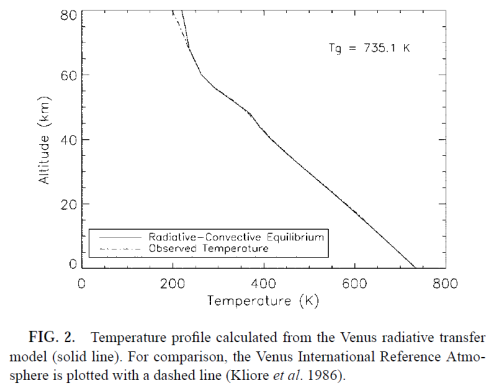
On a couple of unrelated articles on this blog, people have been asking questions about the moon. This is because a lot of people have read an article called A Greenhouse Effect on the Moon from www.ilovemycarbondioxide.com that makes some confused claims.

The article starts:

We’ve been told that the earth’s surface is quite a bit warmer than calculations predict. Theory has it that heat-trapping “greenhouse gases” account for a 33° Celsius disparity. But it turns out that our airless moon is also quite a bit warmer than predicted.

And finishes with:

The Earth is not “unusually” warm. It is the application of the predictive equation that is faulty. The ability of common substances to store heat makes a mockery of blackbody estimates. The belief that radiating trace gases explain why earth’s surface temperature deviates from a simple mathematical formula is based on deeply erroneous assumptions about theoretical vs. real bodies.

A long time ago a friend told me that the way the Bank of England trains people to spot counterfeit notes is to give them real notes to spend time getting used to the feel, texture, weight and so on. They don’t give them lots of counterfeits because it’s not as effective.

I have no idea if the story is true but I always thought that it was a useful concept for approaching any subject. Best to spend the time helping people understand the real theory – as all scientific “facts” are called – rather than spend 5% of the time on the real theory and introduce them to 19 flawed theories.

Therefore, most of this article will focus on building understanding of the basics rather than pointing out the many flaws in the article. We will look at the temperature of a moon-like body by way of very simple models.

These models are in Excel because it’s quick and easy.

The Model

The concept is very simple. This is an idealized moon-like surface for illustration.

For my moon-like body, we will consider one square meter of surface. This is because lateral heat flow within the surface will be extremely low and so we don’t want or need to build a GCM to solve this problem.

Solar radiation is absorbed by this surface and heats up. The surface has a definite heat capacity which we vary in the model to see how the results change.

The sun moves slowly through the sky so the amount of solar radiation incident on the surface varies over the course of the lunar “day”. The surface has an “absorptivity” for solar radiation – the proportion of solar radiation absorbed vs the proportion reflected.

When the sun is directly overhead the solar radiation incident is 1367 W/m2 and when the sun is on the horizon the solar radiation is zero – then for the whole “night” the radiation stays zero. Therefore, I’m considering the “equator”.

For reasons of laziness I set the lunar day to be 28 days, but the exact value doesn’t matter.

And the absorptivity was set to 0.9 (which means 90% of incident solar radiation is absorbed and 10% is reflected). Also the emissivity was set to the same value, but in this example it could be different. With different values similar results would occur but with different equilibrium temperatures. See Note 1.

The simple maths for the model is at the end of the post as many people don’t like seeing equations.

The Results

Now, if the surface had no heat capacity (or as mathematicians might say, “as the heat capacity tends to zero”) then the surface would instantaneously heat up until the radiation emitted matched the absorbed radiation.

So in that unrealistic case, the temperature would follow this curve:


Moon-like surface, zero heat capacity

Moon-like surface, zero heat capacity


So during the moon-like night, the surface drops immediately to absolute zero, and during the “day” the emission of radiation exactly matches the absorption. (For mathematically inclined readers this follows a cos θ relationship – see maths section at end).

Note that this isn’t like the earth or any real body. It’s just a useful thought experiment to show what would happen if the surface had no heat capacity.

Under this condition:

  • absorption of solar radiation = 391.7 W/m2 (averaged over many cycles)
  • emission of lunar radiation = 391.7 W/m2 (averaged over many cycles)
  • mean temperature = 169.3K
  • min temperature = 0K
  • max temperature = 394K

Energy in = energy out – so no surprises there.

Let’s start increasing the heat capacity and see what happens – per m2, 10,000J/K heat capacity:


Moon-like surface with 10,000 J/K heat capacity per m^2

Moon-like surface with 10,000 J/K heat capacity per m^2


  • absorption of solar radiation = 391.7 W/m2 (averaged over many cycles)
  • emission of lunar radiation = 391.7 W/m2 (averaged over many cycles)
  • mean temperature = 195.3K
  • min temperature = 38K
  • max temperature = 397K

Per m2, 50,000J/K heat capacity:


Moon-like surface with 50,000 J/K heat capacity

Moon-like surface with 50,000 J/K heat capacity per m^2


  • absorption of solar radiation = 391.7 W/m2 (averaged over many cycles)
  • emission of lunar radiation = 391.5 W/m2 (averaged over many cycles)
  • mean temperature = 211.3K
  • min temperature = 64K
  • max temperature = 394K

Per m2,  500,000J/K heat capacity:


Moon-like surface with heat capacity = 500,000 J/K per m^2

Moon-like surface with 500,000 J/K heat capacity per m^2


  • absorption of solar radiation = 391.7 W/m2 (averaged over many cycles)
  • emission of lunar radiation = 390.0 W/m2 (averaged over many cycles)
  • mean temperature = 247.7K
  • min temperature = 133K
  • max temperature = 393K

Per m2,  5,000,000J/K heat capacity:


Moon-like surface, 5,000,000 J/K per m^2

Moon-like surface, 5,000,000 J/K per m^2


  • absorption of solar radiation = 391.7 W/m2 (averaged over many cycles)
  • emission of lunar radiation = 391.7 W/m2 (averaged over many cycles)
  • mean temperature = 290.9K
  • min temperature = 247K
  • max temperature = 342K

Hopefully, for most people, the fact that the temperature range is reducing as heat capacity increases is reasonably intuitive. If you want to heat up a cupful of water it takes less time than heating a swimming pool. If you want to cool down both through the same surface area it will take longer for the swimming pool to cool down.

Summary of Results

Notice that in each case the average value of absorption = emission – to within 1%.

The 1% is just a result of imperfect starting conditions. If the chosen simulation starting temperature was exactly right, or there were enough “spin up” cycles to get into the steady state before the averaging was done then the absorption = emission exactly.

It’s probably not surprising to anyone that absorption = emission over a set number of cycles because otherwise the overall trend in temperature would be increasing or decreasing.

Next a plot of mean, min and max temperature as the heat capacity increases, note the log axis for heat capacity:

The reason for plotting the heat capacity on a “log” or logarithmic axis was because the heat capacity is increased by a an order of magnitude each time. Linear plots make the results of this kind of simulation less clear.

The mean temperature is simply the arithmetic average of temperature over every single time step. (All the numbers added up and divided by the number of results).

So the mean temperature does increase when the surface has an increased heat capacity!

It looks like the ilovemyco2 writers were correct and the whole greenhouse effect was just a result of heat capacity of the oceans and land.

Time for me to pack my bags and head off into the sunset..

But wait, hold on a minute..

There’s something very strange going on. The temperature is increasing, but the average emission of radiation has stayed exactly the same:

How can temperature increase without the radiation increasing? Radiation is emitted in proportion to the 4th power of temperature – for a blackbody (ε=1), E = σ . T4, where σ = 5.67×10⁻⁸

If the temperature goes up, radiation must go up as well. Is there something wrong with the model?

No. And for those who’ve read Why Global Mean Surface Temperature Should be Relegated, Or Mostly Ignored this example won’t be surprising.

Take 3 “temperatures”:  1, 10, 100.

Now we average them -> average = 111/3 = 37K

And calculate the energy radiated, E = 37 4 x 5.67×10-8 = 1,874,161 x 5.67×10-8 = 0.11 W/m2

Alright, let’s do it the other way. Let’s calculate the energy radiated for each temperature:

  • 14 x 5.67×10-8 = 1 x 5.67×10-8 = 5.67×10⁻⁸
  • 104 x 5.67×10-8 = 10,000 x 5.67×10-8 = 5.67×10⁻⁴
  • 1004 x 5.67×10-8 =100,000,000 x 5.67×10-8 = 5.67

And now average the energy radiated -> average = (5.6705670567/3) = 1.89 W/m2

One method gives 18x the other method – how can this be and which one is right?

Just for the many people would prefer to see the calculation without the Stefan-Boltzmann constant of 5.67×10^8 everywhere – in that case we compare 374 = 1,874,161 with the alternative method of (14 + 104 + 1004)/3 = 100,010,001/3= 33,336,667

Also (of course) a factor of 18 between the two methods of calculating the “average”.

There’s nothing surprising about this – average a series of numbers and raising the average to the 4th power will almost always give a different answer to first calculating the 4th power for each of a series of numbers and averaging the results.

Now the moon has some extreme temperature ranges in the examples shown and, therefore, the “mean” temperature changes significantly.

The earth by contrast, with less extreme temperatures has this result –

  • the “average” temperature = 15°C, and converting that to the “average” radiation = 390 W/m2
  • calculated the correct and painful way, the individually calculated values of radiation from each and every surface temperature around the globe every few hours over a year.. then averaged = 396 W/m2

Conclusion

So the reason that the moon – with a surface with a real heat capacity – appears to have a warmer climate “than predicted” is just a mathematical error. A trap for the unwary.

The right way to calculate a planet’s average radiation is to calculate it for each and every location and average the results. The wrong way is to calculate the average temperature and then convert that to a radiation. In the case of the earth’s surface, it’s not such a noticeable problem.

In the case of the moon, because of the wide variation in temperature, the incorrect method produces a large error.

So there’s no “lunar explanation” for the inappropriately-named “greenhouse” effect.

In the case of the earth there is anyway a huge difference from the moon. The solar radiation absorbed at the top of the earth’s atmosphere – about 240W/m2 is approximately balanced by the outgoing longwave radiation of the same amount. But the radiation from the surface of the earth of 396W/m2 is much larger than this top of atmosphere value of 240W/m2.

That’s the greenhouse effect.

But ilovemyco2 – hats off to you for enthralling and exciting so many people with a simple mathematical puzzle.

Maths in the Model

Ein = S . cosθ . α   – for -90° < θ < 90°

Ein = 0   otherwise

where Ein = energy absorbed by the surface in J/s, S = the solar irradiance in W/m2, θ = angle of the sun from the zenith, α = absorptivity of the surface at the solar radiation wavelengths.

Eout = ε . σ . T4

where Eout = energy radiated by the surface in J/s, ε = emissivity of the surface at the wavelengths it is radiating at, σ = 5.67 x 10⁻⁸, and T is the temperature in K (absolute temperature). This is the Stefan-Boltzmann equation.

and for each time step, Δt:

ΔT = (Ein – Eout)/C

where C = heat capacity of a 1m2 surface in J/K and ΔT is the change in temperature.

For people who like even more detail:

The assumption is that the conductivity of heat into the surface is very high with some kind of insulating layer below the “heat capacity” layer. This makes the calculation slightly easier to understand than using thermal diffusivity.

And the conductivity of heat laterally is very low to avoid considering thermal equalization between adjacent surfaces.

Neither of these assumptions has any significant effect on the “experiment”, or on the principles that it demonstrates.

Note 1

Emissivity and absorptivity are inherent properties of the material in question and are wavelength dependent. In the case of a surface like the earth, the surface receives solar radiation centered around 0.5μm and radiates out with wavelengths centered on 10μm. See, for example, The Sun and Max Planck Agree. So there is no reason to expect that absorptivity = emissivity (because we are considering the properties at different wavelengths).

Read Full Post »
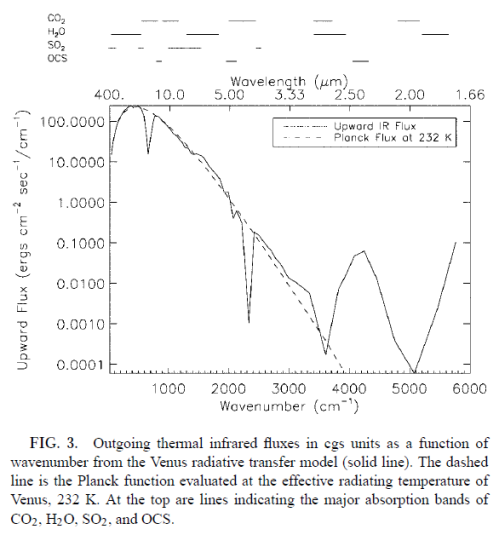
Very soon we will finally get to a post with an interesting subject like climate feedback..

But first, just a few basic examples, following on from the recent post: Intelligent Materials and the Imaginary Second Law of Thermodynamics, which in turn followed on from a few before that.

In the last post one of our frequent champions of the imaginary second law of thermodynamics acknowledged an important point. We had previously agreed that radiation from a colder body does reach a hotter body. The question was about whether the hotter body actually absorbed the energy from the colder body. Specifically, about the “absorptivity” of this hotter body for “irradiation” received from the colder body.

In the last post I provided a graphic to illustrate the emission of radiation from two bodies at slightly different temperatures:


Blackbody radiation curves for -10'C (263K) and +10'C (283K)

Blackbody radiation curves for -10'C (263K) and +10'C (283K)


With the important question being about whether a 0°C surface treats radiation from the +10°C body any differently from the radiation from the -10°C body.

Our “imaginary second law” champion did acknowledge that, for example, 10μm radiation from a -10°C body is treated no differently from 10μm radiation from a +10°C body. That is, the absorptivity, or proportion of radiation absorbed, is the same for any given wavelength regardless of the temperature of the source body.

Armed with this “consensus” we can examine a few further ideas.

We will see that the first law of thermodynamics is in conflict with the imaginary second law of thermodynamics

So it will be interesting to see how the champions of the imaginary second law respond.

Of course, it’s important to note that we only have one signed up to this “consensus” (about hotter bodies absorbing radiation from colder bodies). The imaginary second law movement isn’t a monolithic voting block. Others may not agree, as in Radiation Basics and the Imaginary Second Law of Thermodynamics where a new advocate championed the idea that the radiation from the colder body never reaches the hotter body, claiming that the radiation was cancelled out and the measurements of radiation reaching the hotter body were fraudulent. Well, interested parties can follow that fascinating story..

Example 1 – A Body in Space Left to Cool Down

Why space? Well, space is a vacuum and this simplifies our thought experiments because there is no conduction or convection of heat, and this only leaves radiation as the mechanism for the transfer of heat.

So in the first example, we consider a sphere which has a surface temperature of 273K (0°C) and no source of heat, which is left in space to cool down. Perhaps the sphere was previously heated up by a nearby star which has been “turned off”, perhaps it had its own source of heat. It’s not important.

The conductivity of this sphere is very high – so all points on and within the sphere are at the same temperature. This is just to avoid the complexities of heat conduction vs time within the sphere, which doesn’t add anything to our example.

The radius of the sphere = 10 m, so surface area = 1,256 m2. (A=4πr2). The sphere is a “blackbody” which means that it a perfect absorber of radiation (nothing reflected) and consequently a perfect emitter of radiation.

And the last point is simply to identify the heat capacity of the sphere – which is 1×10⁶ or 1,000,000 J/K.

The shape of the temperature curve is probably not surprising to anyone. Obviously the temperature will decrease – because the body is radiating heat with no incoming radiation to balance out the loss, and there is no internal source of heat.

Also you can see that the rate of change of temperature is reducing. This is because the body radiates according to the 4th power of temperature and as the temperature gets lower less heat is radiated each second.

At time infinity the temperature will be zero (or the background temperature of the universe).

Example 2 – Two Bodies Left in Space to Cool Down

The first example was probably uncontroversial. Now let’s look at two bodies in space in proximity to each other. In this example the starting point is the same for the first body (which goes by the exciting name of “Body 1”), and the second body (not to be outdone, known as “Body 2”) is identical except for the fact that it starts at a temperature of 263K (-10°C).

The distance between the center of the two bodies is only 30m – remember that the radius of each is 10m – so therefore there is only a 10m gap between the closest points. In fact, this creates a complexity that we will ignore in the calculation of incident radiation. See Note 1 at the end.

Body 1 radiates and a small amount of this radiation is incident on Body 2.

Body 2 radiates and a small amount of this radiation is incident on Body 1.

Now Body 2 is initially colder than Body 1 but at least from one “imaginary second law” advocate we have agreement that Body 1 will absorb this radiation (according to its absorptivity, which in this case = 1, i.e., 100% of incident radiation is absorbed).

See note 2 for the simple maths involved.

There’s probably nothing very surprising in this graph. T1 is the temperature of Body 1,T2 for Body 2.

So now, let’s take a look at the difference between the temperature curves for Body 1 in the first example, vs this second example where a colder body is in proximity:

and expanded in one section:

Probably not surprising for most people that in the presence of another body radiating, Body 1 has a slower decrease in temperature.

This is just a consequence of the first law of thermodynamics – the conservation of energy. Energy can’t just disappear.

We will see what the advocates of the imaginary second law have to say about this one.

Notice as well that the colder body is reducing the rate of heat loss from the hotter body but there is no perpetual motion machine. At time infinity they are both at absolute zero (or the background temperature of the universe).

Example 3 – One Body being Heated by a Sun

Now we come to the third example, and in this case Body 1 is being heated by a star. (Body 2 has exited stage left for this example).

The radiation from the star incident on Body 1 is about 1260W/m2, which, with a radius of 10m means a total incident radiation of 395,570W – all of which is absorbed by Body 1 of course because it is a blackbody.

Notice that the temperature doesn’t change – because the incident absorbed radiation is exactly balanced by the emission for a 273K body from its entire surface area.

Everyone can feel quite comfortable about this example.

Example 4 – One Body being Heated by a Sun, with a Second Colder Body in Proximity

The racy headline is fully justified in this exciting example.

This fourth and final example is like the last example but Body 2 is “wheeled out” all of a sudden and placed the same distance away from Body 1 as in the earlier example (30m between the centers of each sphere). Body 2 starts off “pre-cooled” to 263K.

Body 1 and Body 2 are close together with the sun radiating totally on Body 1 and on 86% of Body 2 – because Body 2 is partly in Body 1’s shadow. So the solar radiation on Body 2 = 340,718 W.

Let’s see what happens as the clock starts ticking:

Here is the vertical scale expanded:

Very interesting.

With only Body 1 basking in solar joy its surface temperature was 273K (0°C), but when Body 2 was wheeled in at a temperature of 263K (-10°C) we find that the surface temperature of Body 1 increases up to about 274.7K, a 1.7°C increase.

The presence of Body 2 at -10°C has increased the temperature of Body 1 from 0°C to almost 2°C

And in the process Body 2 has increased from -10°C to -8°C.

No surprises to most people – this is just a consequence of the first law of thermodynamics – energy can’t just vanish. So if radiation from a colder body is incident on a hotter body – and absorbed – it has to have an effect.

I can already hear the screaming of a few:

  • you have created energy
  • this violates the second law of thermodynamics
  • a colder body cannot heat a hotter body
  • this is perpetual motion“..

Well, more radiation from Body 1 is absorbed by Body 2 than the reverse. The net is from the hotter to the colder. This is why Body 2 has a higher increase in temperature. So the real second law of thermodynamics is preserved.

And if the sun turns off, both bodies will cool down to absolute zero (or the background temperature of the universe). So there is no perpetual motion machine.

The reason the temperature increased was because we changed the conditions – added another body radiating energy. And because we cannot create or destroy energy it has to have an effect. No energy has been created.

Now imagine the scenario that we arrive many years after the start – we see the sun and two bodies in a happy equilibrium. Someone points out that without the presence of the colder body (Body 2), Body 1 would actually be colder.

What an outrageous idea!

Conclusion

The principles involved in these examples are very simple:

  • the conservation of energy, also known as the first law of thermodynamics
  • the radiation of blackbodies according to the Stefan-Boltzmann equation
  • the absorption of incident radiation from Body 2 into Body 1 and vice-versa
  • the change in temperature according to dT=Q/mc

All the advocates of the imaginary second law of thermodynamics have to do now is demonstrate what steps are flawed in these examples.

Finally, shall we throw out the first law of thermodynamics or the imaginary second law of thermodynamics?

Update – New article – The Real Second Law of Thermodynamics

Note 1

When two bodies are separated by a very large gap (very large compared with their radii) the calculation of incident radiation is very simple – because the distance between any two points on the two spheres ≈ d.

When the gap becomes smaller the calculation becomes more challenging. This is because the two closest points are no longer separated by d but by d-2r (or more accurately d-2r ≠ d). So each “path” between the two bodies is somewhere between d-2r and d+2r. It’s not a difficult mathematical problem but it is a double integral that won’t add anything useful to the analysis.

If anyone is concerned that the analysis is somehow invalidated – we can simply repeat the same analysis with the two bodies separated by a great distance, we will see the same effect but with a smaller magnitude. Alternatively, we could perform the actual double integral to confirm the true and accurate figure. This is left as an exercise for the interested student..

Note 2

The calculations are each time step are very simple.

Energy radiated per second for Body 1, Eout1 = σT4A  – where A is the surface area, and T is the temperature of the body (this is for a blackbody where emissivity, ε =1). Likewise for Body 2.

Proportion of radiation from Body 1 incident on Body 2 = 0.028 (= πr2/4πd2, where r is the radius of the body and d is the distance between the centers of the bodies) – see note 1, not particularly accurate unless d>>r). Likewise for the radiation from Body 2 incident on Body 1.

Net energy change for Body 1 = -Eout1 + Eout2 * 0.028 + incident solar radiation
Likewise for Body 2.

Temperature change = net energy change / heat capacity

Note 3

If Body 1 and Body 2 started off much colder, even at absolute zero the same equilibrium conditions are reached.

Read Full Post »
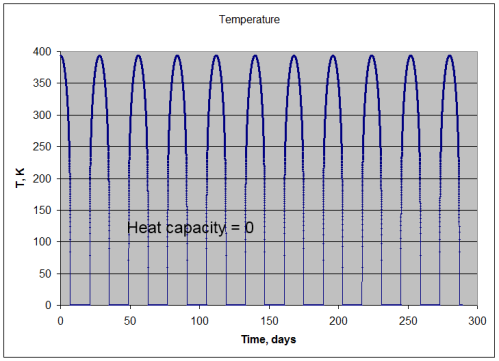
« Newer Posts - Older Posts »