Feeds:
Posts
Comments

In Part Two, we looked at the beginnings of a very simple 1-d model for examining how the atmosphere interacts with radiation from the surface.

Simplification aids understanding so the model has some fictious gases which absorb radiation – pCO2 (pretend CO2) and pH2O (pretend water vapor). We saw that as the concentrations of pCO2 were increased we stopped seeing a change in “top of atmosphere” (TOA) flux.

That is, the “greenhouse” effect became “saturated” as the pCO2 concentration was increased.

Of course, the model was flawed. The model only included absorption of radiation by the atmosphere, with no emission. There are other over-simplifications and progressively we will try and consider them.

Emission

Once the atmosphere can emit as well as absorb radiation the results change.

The model has been updated, and for these results is now at v3.1 (see note 5).

Here is a comparison of “no emission” vs “emission”. In each case 10 runs were carried out of different pCO2 concentrations. Each graph shows:

  • TOA spectral results for runs 1, 5 and 10
  • Surface spectral downward radiation (DLR or “back radiation) for the last run
  • Temperature profile for the last run
  • Summary graph of flux vs concentration changes for all 10 runs

No emission:
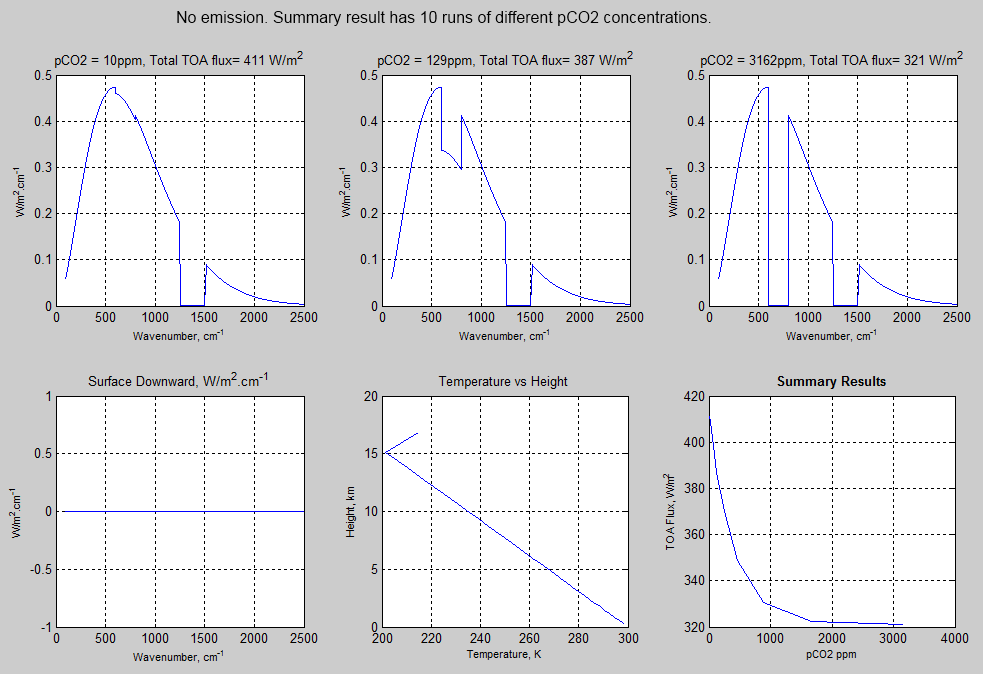
Figure 1 – Click for a larger view

Note that the surface downward radiation is zero. This is because the atmosphere doesn’t emit radiation in this model.

With emission:
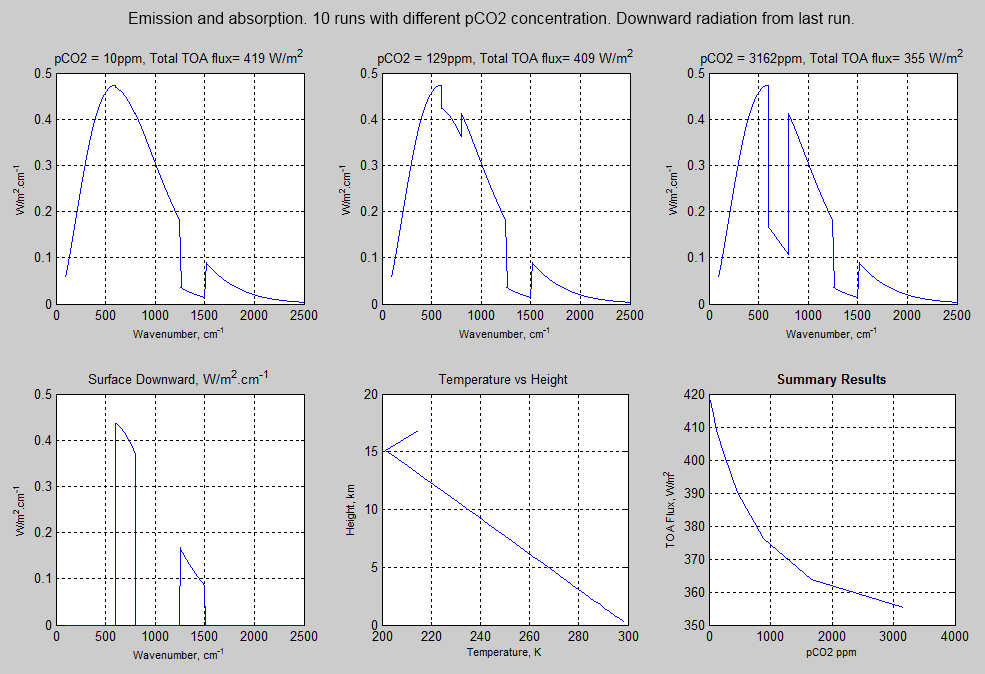
Figure 2 – Click for a larger image

If you compare the spectral results you can see that in the “no emission” case the “pretend water vapor” (pH2O) band of wavenumbers 1250-1500 cm-1 is in “saturation”, whereas in the “emission” case, it isn’t.

This is just the natural result of an atmosphere that re-emits – and of course, gases that absorb at a given wavelength also emit at that same wavelength. (See Planck, Stefan-Boltzmann, Kirchhoff and LTE).

And a comparison of the 10 runs between the two models:
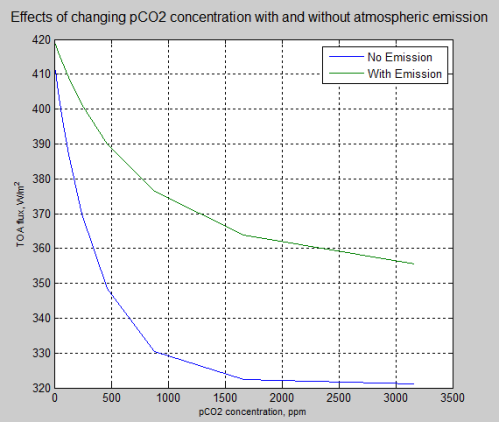
Figure 3

As the concentration of pCO2 increases the TOA flux reduces. Of course, we can see that this effect diminishes with more pCO2.

One interesting idea is to show these results as radiative forcing. (You can find a more formal definition of the term in CO2 – An Insignificant Trace Gas? Part Seven – The Boring Numbers – although here it is not calculated according to the strict definition of allowing stratospheric adjustment)

In essence radiative forcing is the change in TOA flux. When less flux escapes this is considered a positive radiative forcing. The reason is this: less flux radiated from the climate system means that less energy is leaving, which means the climate will heat (all other things being equal).

Here is the same graph expressed as radiative forcing:
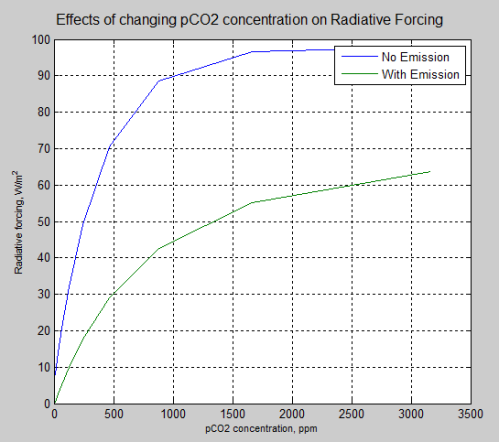
Figure 4

If you compare it with the IPCC graph in Part Two (or Part Seven of the CO2 series) you will see it has some similarities:
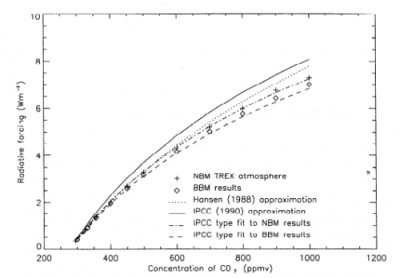
Figure 5

Note that the actual values of radiative forcing in this model are much higher – in part because we are comparing the results of a gas with made up properties and also because we are comparing the effect from ZERO concentration of the gas vs a very high concentration.

However, one point should be clear. Using the very simple Beer-Lambert law of absorption, and the very well-known (but not so simple) Planck law of emission we find that the “radiative forcing” for changing concentrations of one gas doesn’t look like the Beer-Lambert law of absorption..

Real World Complexity

The very simple model here – with emission – will eventually reach “saturation”.

The much more complex real-world “line by line” models eventually reach “saturation” but at much higher concentrations of CO2 than we expect to see in the climate.

This model is still a very simple model designed for education of the basics – and to allow inspection of the code.

The model has no overlaps between absorbing molecules and has no effects from the weaker lines at the edges of a band.

Reducing Emission and “The Greenhouse Effect”

As emission of radiation is reduced due to increases in absorbing gases, with all other things being equal, the planet must warm up. It must warm up until the emission of radiation again balances the absorbed radiation (note 1).

Another way to consider the effect is to think about where the radiation to space comes from in the atmosphere. As the opacity of the atmosphere increases the radiation to space must be from a higher altitude. See also The Earth’s Energy Budget – Part Three.

Higher altitudes are colder and so the radiation to space is a lower value. Less radiation from the climate means the climate warms.

As the climate warms, if the lapse rate (note 3) stays the same, eventually the radiation to space – from this higher altitude – will match the absorbed solar radiation. This is how increases in radiatively active gases (aka “greenhouse” gases) affect the surface temperature (see note 4).

The Model

The equations will be covered more thoroughly in a later article in this series.

The essence of the model is captured in this diagram for one “layer”:

Figure 6 – One layer from the model

The atmosphere is broken up into a number of layers. In these model runs this was set to 30 layers with a minimum pressure of 10,000 Pa (about 17km). The “boundary condition” for radiation from the surface was Planck law radiation from a surface of 300K (27°C) with an emissivity of 0.98. And the “boundary condition” for radiation from TOA was zero.

This is because we are considering “longwave radiation”. A further complication would be to consider an absorber (like CO2) which absorbs solar radiation, but this has not been done in this model. Absorbers of “shortwave” radiation trap energy in the atmosphere rather than allowing it to be absorbed at the surface. Therefore, they affect the “in planetary balance” but don’t significantly affect the total energy absorbed.

The transmissivity at each wavenumber for each layer was calculated. Absorptivity = 1- transmissivity (note 2).

So for each layer – and each wavenumber interval – the transmitted radiation (incident radiation x transmissivity) was calculated for each wavenumber. This was done separately for up and down radiation. The emitted radiation was calculated by the Planck formula and the emissivity (= absorptivity at that wavenumber).

The net energy absorbed as a result changed the temperature, and the model iterated through many time steps to find the final result.

With the very simple pCO2 and pH2O properties the number of timesteps made almost no difference to the TOA flux. The stratospheric temperature did vary, something for further investigation.

The wavenumber interval, dv = 5cm-1, was changed to see the results. Very small changes were observed as dv changed from 5cm-1 to 1cm-1. This is not surprising as the absorbing properties of these molecules is very simple.

Conclusion

The model is still very simple.

The changes in TOA fluxes are significantly different for the unrealistic “no emission” case vs the “emission” case. This is to be expected.

As concentration of pCO2 increases the TOA flux reduces but by progressively smaller amounts.

When we review the results as “radiative forcing” we find that even with this simple model they resemble the IPCC “logarithmic forcing result”.

There’s more to think about with real-world gases and absorption.

Hopefully this article helps people who are trying to understand the basics a little better.

And surely there must be mistakes in the code. Anyone who sees anything questionable, please comment. You will probably be correct.

People trying to do these calculations in their head, or with a pocket calculator, will be wrong. Unless they are mathematical savants. Playing the odds here.. when someone says (on this subject): “I can see that …” or “It’s clear that..” without a statement of the radiative transfer equations and boundary conditions plus their solutions to the problem – I expect that they haven’t understood the problem. And mathematical savants still need to explain to rest of us how they reached their results.

Other articles:

Part One – a bit of a re-introduction to the subject

Part Two – introducing a simple model, with molecules pH2O and pCO2 to demonstrate some basic effects in the atmosphere. This part – absorption only

Part Four – the effect of changing lapse rates (atmospheric temperature profile) and of overlapping the pH2O and pCO2 bands. Why surface radiation is not a mirror image of top of atmosphere radiation.

Part Five – a bit of a wrap up so far as well as an explanation of how the stratospheric temperature profile can affect “saturation”

Part Six – The Equations – the equations of radiative transfer including the plane parallel assumption and it’s nothing to do with blackbodies

Part Seven – changing the shape of the pCO2 band to see how it affects “saturation” – the wings of the band pick up the slack, in a manner of speaking

And Also –

Theory and Experiment – Atmospheric Radiation – real values of total flux and spectra compared with the theory.


Notes

Note 1: Simplifications aid understanding. But in the current “climate” where many assume that climate science doesn’t understand complexity it is worth explaining a little further. Words from others neatly describe the subject of “equilibrium”:

The dominant factor determining the surface temperature of a planet is the balance between the net incoming solar radiation and outgoing thermal infra-red radiation.

That is, radiative equilibrium can be assumed for most practical purposes, although strictly speaking it is never achieved, as time-dependent and non-radiative processes are always present..

I.M. Vardavas & Prof. F.W. Taylor, Radiation and Climate, Oxford University Press (2007)

Note 2: Scattering of solar radiation is important, but scattering of longwave (terrestrial radiation) is very small and can be neglected. Therefore, Absorption = 1 – Transmission.

Note 3: Lapse rate is the temperature change with altitude – typically a reduction of 6.5K per km. This is primarily governed by “adiabatic expansion” and is affected by the amount of water vapor in the atmosphere. See Venusian Mysteries and the following articles for more.

Note 4: The explanations here do not include the effects of feedback. Feedback is very important, but separating different effects is important for understanding.

Note 5: The model still has many simplifications. The Matlab code:

RTE v0.3.1

It is easier to read by downloading the word doc. But pasted here below for reference. The two functions called are already documented in Part Two (and have not changed).

Matlab has many great features, but they also mean that some aspects of the code might not be clear. Feel free to ask questions.

I already see that a comment doesn’t match the code. The time step, tstep=3600*3 is 3 hrs not 12 hrs, as the comment says. However, this doesn’t alter the results.

======= v 0.3.1 ================

% RTE = Radiative transfer equations in atmosphere

% Objective – allow progressively more complex applications

% to help people see what happens in practice in the atmosphere

% v0.2 allow iterations of one (or more) parameter to find the TOA flux vs

% changed parameter

% v0.3 add emissivity = absorptivity ; as a function of wavelength. Also

% means that downward and upward radiation must be solved, plus iterations

% to allow temperature to change to find stable solution. Use convective

% adjustment to the lapse rate

% v0.3.1 changes the method of defining the atmosphere layers for radiation

% calculations, to have roughly constant mass for each layer

% Define standard atmosphere against height

% zr = height, pr = pressure, Tr = temperature, rhor = density, all in SI units

Ts=300; % define surface temperature

ps=1.013e5; % define surface pressure

% nmv=2.079e25; % nmv x rho = total number of molecules per m^3, not yet

% used

maxzr=50e3; % height of atmosphere

numzr=2001; % number of points used to define real atmosphere

zr=linspace(0,maxzr,numzr); % height vector from sea level to maxzr

[pr Tr rhor ztropo] = define_atmos(zr,Ts,ps); % function to determine (or lookup) p, T & rho

% Consider atmosphere in a coarser resolution than used for calculating

% pressure, temperature etc

% z, p,T,rho; subset of values used for RTE calcs

numz=30; % number of layers to consider

minp=1e4; % top of atmosphere to consider in pressure (Pa)

% want to divide the atmosphere into equal pressure changes

dp=(pr(1)-minp)/(numz); % finds the pressure change for each height change

zi=zeros(1,numz); % zi = lookup vector to “select” heights, pressures etc

for i=1:numz % locate each value

zi(i)=find(pr<=(pr(1)-i*dp), 1); % gets the location in the vector where

% pressure is that value

end

% now create the vectors of coarser resolution atmosphere

z=zr(zi);   % height

p=pr(zi);   % pressure

T=Tr(zi);   % original temperature

rho=rhor(zi);  % density

for i=2:numz

dz(i)=z(i)-z(i-1); % precalculate thickness of each layer

end

% ============ Set various values =========================

lapse=6.5e-3; % environmental lapse rate in K/m ** note potential conflict with temp profile already determined

% currently = max lapse rate for convective adjustment, but not used to

% define initial temperature profile

ems=0.98; % emissivity of surface

cp=1000; % specific heat capacity of atmosphere, J/K.kg

convadj=true; % === SET TO true === for convective adjustment to lapse rate = lapse

emission=true; % ==== SET TO true ==== for the atmosphere to emit radiation

% work in wavenumber, cm^-1

dv=5;

v=100:dv:2500; % wavenumber (=50um – 4um)

numv=length(v);

rads=ems.*planckmv(v,Ts); % surface emissive spectral power vs wavenumber v

% ============== Introducing the molecules ==============================

% need % mixing in the atmosphere vs height, % capture cross section per

% number per frequency, pressure & temperature broadening function

nummol=2; % number of radiatively-active gases

mz=ones(nummol,numz); % initialize mixing ratios of the gases

% specific concentrations

% pH2O = pretend H2O

emax=17e-3; % max mixing ratio (surface) of 17g/kg

mz(1,:)=(ztropo-z).*emax./ztropo; % straight line reduction from surface to tropopause

mz(1,(mz(1,:)<0))=5e-6; % replace negative values with 5ppm, ie, for heights above tropopause

% pCO2 = pretend CO2

mz(2,:)=3.6e-4; % 360ppm

% absorption coefficients

k1=0.3; % arbitrary pick – in m2/kg while we use rho

k2=0.3; % likewise

a=zeros(nummol,length(v)); % initialize absorption coefficients

a(1,(v>=1250 & v<=1500))=k1;  % wavelength dependent absorption

a(2,(v>=600 & v<=800))=k2;    % ” ”

% === Scenario loop to change key parameter for which we want to see the effect

%

nres=10; % number of results to calculate

flux=zeros(1,nres); % TOA flux for each change in parameter

par=zeros(1,nres); % parameter we will alter

% this section has to be changed depending on the parameter being changed

% now = CO2 concentration

par=logspace(-5,-2.5,nres); % values vary from 10^-5 (10ppm) to 10^-2.5 (3200ppm)

% par=0.01; % kept for when only one value needed

% ================== Define plots required =======================

% last plot = summary but only if nres>1, ie if more than one scenario

% plot before (or last) = temperature profile, if plottemp=true

% plot before then = surface downward radiation

plottemp=true; % === SET TO true === if plot temperature profile at the end

plotdown=true; % ====SET TO true ==== if downward surface radiation required

if nres==1   % if only one scenario

plotix=1;  % only one scenario graph to plot

nplot=plottemp+plotdown+1;  % number of plots depends on what options chosen

else     % if more than one scenario, user needs to put values below for graphs to plot

plotix=[1 round(nres/2) nres]; % graphs to plot – “user” selectable

nplot=length(plotix)+plottemp+plotdown+1; % plot the “plotix” graphs plus the summary

% plus the temperature profile plus downward radiation, if required

end

% work out the location of subplots

if nplot==1

subr=1;subc=1;  % 1 row, 1 column

elseif nplot==2

subr=1;subc=2;  % 1 row, 2 columns

elseif nplot==3 || nplot==4

subr=2;subc=2;  % 2 rows, 2 columns

elseif nplot==5 || nplot==6

subr=2;subc=3;  % 2 rows, 3 columns

else

subr=3;subc=3; % 3 rows, 3 columns

end

for n=1:nres  % each complete run with a new parameter to try

% — the line below has to change depending on parameter chosen

mz(2,:)=par(n);

% First pre-calculate the transmissivity and absorptivity of each layer

% for each wavenumber. This doesn’t change now that depth of each

% layer, number of each absorber and absorption characteristics are

% fixed.

% n = scenario, i = layer, j = wavenumber, k = absorber

trans=zeros(numz,numv); abso=zeros(numz,numv); % pre-allocate space

for i=2:numz   % each layer

for j=1:numv   % each wavenumber interval

trans=1;  % initialize the amount of transmission within the wavenumber interval

for k=1:nummol  % each absorbing molecule

% for each absorber: exp(-density x mixing ratio x

% absorption coefficient x thickness of layer)

trans=trans*exp(-rho(i)*mz(k,i)*a(k,j)*dz(i)); % calculate transmission, = 1- absorption

end

tran(i,j)=trans;  % transmissivity = 0 – 1

abso(i,j)=(1-trans)*emission;  % absorptivity = emissivity = 1-transmissivity

% if emission=false, absorptivity=emissivity=0

end

end

% === Main loops to calculate TOA spectrum & flux =====

% now (v3) considering emission as well, have to find temperature stability

% first, we cycle around to confirm equilibrium temperature is reached

% second, we work through each layer

% third, through each wavenumber

% fourth, through each absorbing molecule

% currently calculating surface radiation absorption up to TOA AND

% downward radiation from TOA (at TOA = 0)

% has temperature changed loop.. not yet written

% not changing pressure and density with temperature changes – only

% minor variation

tstep=3600*3; % each time step in seconds = 12 hour

for h=1:100  % main iterations to achieve equilibrium

radu=zeros(numz,numv); % initialize upward intensity at each height and wavenumber

radd=zeros(numz,numv); % initialize downward intensity at each height and wavenumber

radu(1,:)=rads;  % upward surface radiation vs wavenumber

radd(end,:)=0;  % downward radiation at TOA vs wavenumber

% units of radu, radd are W/m^2.cm^-1, i.e., flux per wavenumber

% h = timestep, i = layer, j = wavenumber

% Upward (have to do upward, then downward)

Eabs=zeros(numz); % zero the absorbed energy before we start

for i=2:numz   % each layer

for j=1:numv   % each wavenumber interval

% first calculate how much of each monochromatic ray is

% transmitted to the next layer

radu(i,j)=radu(i-1,j)*tran(i,j);

% second, calculate how much is emitted at this wavelength,

% planck function at T(i) x emissivity (=absorptivity)

% this function is spectral emissive power (pi x intensity)

radu(i,j)=radu(i,j)+abso(i,j)*3.7418e-8.*v(j)^3/(exp(v(j)*1.4388/T(i))-1);

% Change in energy = dI(v) * dv (per second)

% accumulate through each wavenumber

Eabs(i)=Eabs(i)+(radu(i,j)-radu(i-1,j))*dv;

end  % each wavenumber interval

end  % each layer

% Downards (have to do upward, then downward)

for i=numz-1:-1:2   % each layer from the top down

for j=1:numv   % each wavenumber interval

% first, calculate how much of each monochromatic ray is

% transmitted to the next layer, note that the TOA value

% is set to zero at the start

radd(i,j)=radd(i+1,j)*tran(i,j);

% second, calculate how much is emitted at this wavelength,

radd(i,j)=radd(i,j)+abso(i,j)*3.7418e-8.*v(j)^3/(exp(v(j)*1.4388/T(i))-1);

% accumulate energy change per second

Eabs(i)=Eabs(i)+(radu(i,j)-radu(i-1,j))*dv;

end  % each wavenumber interval

dT=Eabs(i)*tstep/(cp*rho(i)*dz(i)); % change in temperature = dQ/heat capacity

T(i)=T(i)+dT; % calculate new temperature

% need a step to see how close to an equilibrium we are getting

% not yet implemented

end  % each layer

% now need convective adjustment

if convadj==true  % if convective adjustment chosen..

for i=2:numz  % go through each layer

if (T(i-1)-T(i))/dz(i)>lapse  % too cold, convection will readjust

T(i)=T(i-1)-(dz(i)*lapse); % adjust temperature

end

end

end

end   % iterations to find equilibrium temperature

flux(n)=sum(radu(end,:)*dv);   % calculate the TOA flux

% === Plotting specific results =======

% Decide if and where to plot

ploc=find(plotix==n);  % is this one of the results we want to plot?

if not(isempty(ploc))  % then plot. “Ploc” is the location within all the plots

subplot(subr,subc,ploc),plot(v,radu(end,:))  % plot wavenumber against TOA emissive power

xlabel(‘Wavenumber, cm^-^1′,’FontSize’,8)

ylabel(‘W/m^2.cm^-^1′,’FontSize’,8)

title([‘pCO2 = ‘ num2str(round(par(n)*1e6)) ‘ppm, Total TOA flux= ‘ num2str(round(flux(n))) ‘ W/m^2’])

grid on

end

end   % end of each run with changed parameter to see TOA effect

if plotdown==1  % plot downward surface radiation, if requested

plotloc=nplot-plottemp-(nres>1); % get subplot location

subplot(subr,subc,plotloc),plot(v,radd(2,:))  % plot wavenumber against downward emissive power

title(‘Surface Downward, W/m^2.cm^-^1’)

xlabel(‘Wavenumber, cm^-^1′,’FontSize’,8)

ylabel(‘W/m^2.cm^-^1′,’FontSize’,8)

grid on

end

if plottemp==1  % plot temperature profile vs height, if requested

plotloc=nplot-(nres>1); % get subplot location

subplot(subr,subc,plotloc),plot(T,z/1000)

title(‘Temperature vs Height’)

xlabel(‘Temperature, K’,’FontSize’,8)

ylabel(‘Height, km’,’FontSize’,8)

grid on

end

if nres>1 % produce summary plot – TOA flux vs changed parameter

subplot(subr,subc,nplot),plot(par*1e6,flux)

title(‘Summary Results’,’FontWeight’,’Bold’)

ylabel(‘TOA Flux, W/m^2′,’FontSize’,8)

xlabel(‘pCO2 ppm’,’FontSize’,8) % ==== change label for different scenarios =========

grid on

end
In Part One I said:

In the next part we will consider more advanced aspects of this subject.

However, although that is where we are heading, first I want to look at a very simple model and progressively increase its complexity. It may be illuminating.

The discussions on the Radiative Transfer Equations at the very informative blog of Judith Curry’s were very interesting. Many comments showed an appreciation for the very basics with a misunderstanding of how they fit together, for example:

IPCC declares that infrared absorption is proportional to the logarithm of GHG concentration. It is not. A logarithm might be fit to the actual curve over a small region, but it is not valid for calculations much beyond that region like IPCC’s projections. The physics governing gas absorption is the Beer-Lambert Law, which IPCC never mentions nor uses. The Beer-Lambert Law provides saturation as the gas concentration increases. IPCC’s logarithmic relation never saturates, but quickly gets silly, going out of bounds as it begins its growth to infinity.

There have also been many questions asked at this blog about the various aspects of radiation and atmosphere, so I thought some examples – via a model – might be beneficial.

The Model

The main purpose of this model is to demonstrate the effect of the basic absorption and emission processes on top of atmosphere fluxes. It is not designed to work out what troubles may lie ahead for the climate.

This model is designed to demonstrate some basic ideas about what are known as the radiative transfer equations – how radiation is absorbed and emitted as it travels from the surface to the top of atmosphere (and also from the top of atmosphere to the surface).

I aim to bridge a gap between the “blackbody shell” models and the line-by-line climate models – in a way that people can understand. Ambitious aims.

The advantage of this model should be that we can try different ideas. And the code is available for inspection.

Absorption and Beer-Lambert

The equation of absorption is known as the Beer-Lambert law – you can see more about it in CO2 – An Insignificant Trace Gas? Part Three.

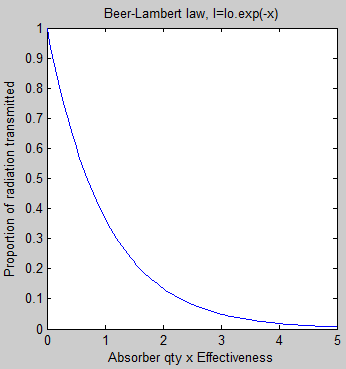
In essence the Beer-Lambert law demonstrates that absorption of radiation of any wavelength is dependent on the amount of the molecule in the path of the radiation & how effective it is at absorbing at that wavelength (note 1):

Figure 1 – Beer-Lambert Law

Simple Model – v0.2 – Saturation

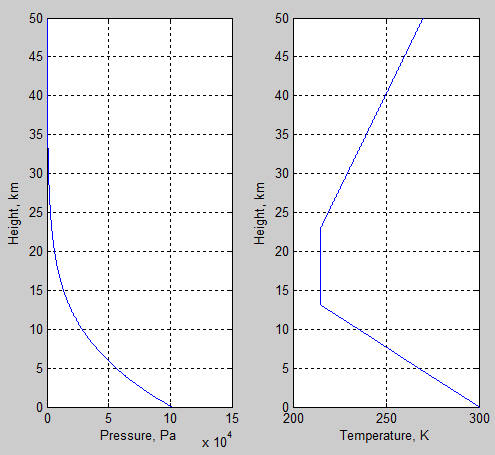
The simple model (v0.2) starts by creating an atmosphere. First of all, atmospheric temperatures, “created”, by definition. Second, using the temperatures plus the hydrostatic equation to calculate the pressure vs height. Third, the density (not shown) is derived.

The surface temperature is 300K.

Figure 2

In this first version of the model (v0.2), we introduce two radiatively-active molecules (=”greenhouse” gases):

  • pH2O – pretend H2O
  • pCO2 – pretend CO2

They have some vague relationship with the real molecules of similar names, but the model objective is simplicity, so of course, these molecules aren’t as complex as the real-life water vapor and CO2. And their absorption characteristics are in no way intended to be the same as the real molecules.

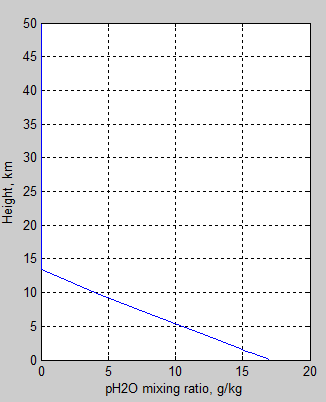
The mixing ratio of pH2O:

Figure 3 – water vapor mixing ratio

The pCO2 mixing ratio is constant with height, but the ppm value is varied from model run to model run.

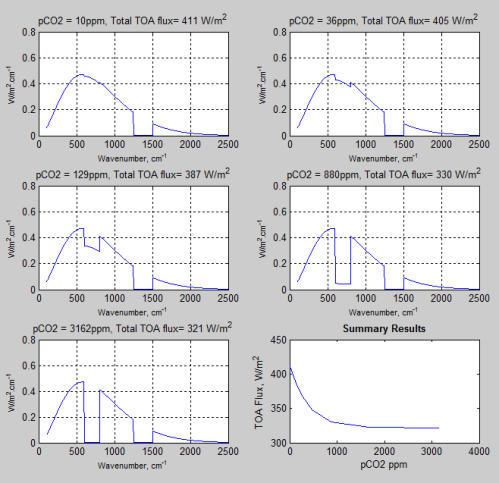
So onto our top of atmosphere results. I’ll refer to “top of atmosphere” as TOA from now on. These results are at 20km, a fairly arbitrary choice.

The results are shown against wavenumber, which is more usual in spectroscopy, but less easy to visualize than wavelength. Wavenumber = 10,000/wavelength (when wavelength is in μm and wavenumber is in cm-1.

  • 15 μm = 667 cm-1
  • 10 μm = 1,000 cm-1
  • 4 μm = 2,500 cm-1

The “notch” that starts to appear around 600-700 cm-1 is from pCO2 as we increase its concentration. The effect of pH2O is held constant. You can see the effect of pH2O as the “notch” around wavenumbers 1250-1500.

Note that the final graph summarizes the results – TOA Flux vs pCO2 concentration:

Figure 4

What we see is that eventually we reach a point where more pCO2 has no more effect – saturation!

We see that as the concentration keeps on increasing we get a reduction in the TOA flux down to a “saturated” value.

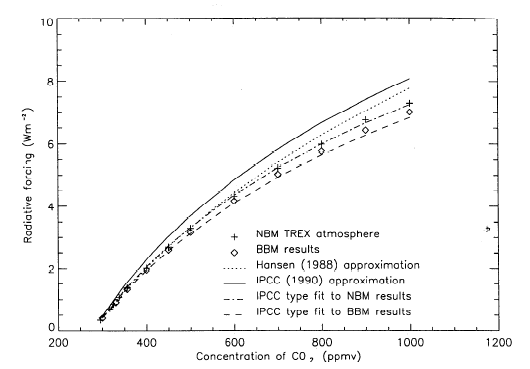
And when we plot the Summary Results we get something that looks very like the Beer-Lambert law of absorption! Nothing like the IPCC result shown in CO2 – An Insignificant Trace Gas? Part Seven – The Boring Numbers:

Radiative Forcing vs CO2 concentration, Myhre et al (1998)

Radiative Forcing vs CO2 concentration, Myhre et al (1998)

Figure 5

So, case closed then?

Flaws in the Model

This model is very simplistic. Most importantly, it only includes absorption of radiation and does not include emission.

Simplifications:

  • no emission from any layers in the atmosphere
  • no dependence of line width on pressure and temperature
  • no weaker “wings” of an absorption band
  • no overlapping of absorption (absorption by 2 molecules in the same band)

In fact, the model only represents the Beer Lambert law of absorption and therefore is incomplete. If the atmosphere is absorbing energy from radiation, where is this energy going?

The next step is to add emission.

Another important point is that the total number of people involved in creating, testing and checking this model = 1.

Surely there will be mistakes.. I welcome comments from sharp-eyed observers pointing out the mistakes.

Other articles:

Part One – a bit of a re-introduction to the subject

Part Three – the simple model extended to emission and absorption, showing what a difference an emitting atmosphere makes. Also very easy to see that the “IPCC logarithmic graph” is not at odds with the Beer-Lambert law.

Part Four – the effect of changing lapse rates (atmospheric temperature profile) and of overlapping the pH2O and pCO2 bands. Why surface radiation is not a mirror image of top of atmosphere radiation.

Part Five – a bit of a wrap up so far as well as an explanation of how the stratospheric temperature profile can affect “saturation”

Part Six – The Equations – the equations of radiative transfer including the plane parallel assumption and it’s nothing to do with blackbodies

Part Seven – changing the shape of the pCO2 band to see how it affects “saturation” – the wings of the band pick up the slack, in a manner of speaking

And Also –

Theory and Experiment – Atmospheric Radiation – real values of total flux and spectra compared with the theory.


Notes

Note 1 – The Beer-Lambert law is written in a number of slightly different forms. The transmission of incident monochromatic radiation is reduced like this:

I(λ) = I0(λ).exp(-σ(λ)nz)

where I(λ) = transmitted radiation of wavelength λ, I0(λ) = the incident radiation, σ(λ) = “capture cross section” at wavelength λ, n = number of absorbers per unit volume, z = length of path. And this equation relies on the number of absorbers remaining constant per unit volume. The equation can be written differently to deal with the case when the density of absorbers through the path changes.

Note 2 – If there was no radiatively-active atmosphere, then the top of atmosphere flux would be the same as the surface. With an emissivity of 0.98 and a temperature of 300K, the emission of radiation from the surface = 450 W/m².

It is actually calculated in the program by numerically integrating the spectrum of surface radiation, with a result of 447 W/m² (due to not integrating the waveform with enough precision at high wavelengths/low wavenumbers).

Note 3 – The Matlab program used to create this data:

RTE v0.2

and two functions called from RTE:

define_atmos

planckmv

==== RTE v0.2 =========

% RTE = Radiative transfer equations in atmosphere

% Objective – allow progressively more complex applications

% to help people see what happens in practice in the atmosphere

% v0.2 allow iterations of one (or more) parameter to find the TOA flux vs

% changed parameter

% Define standard atmosphere against height

% zr = height, pr = pressure, Tr = temperature, rhor = density, all in SI units

Ts=300; % define surface temperature

ps=1.013e5; % define surface pressure

nmv=2.079e25; % nmv x rho = total number of molecules per m^3

maxzr=50e3; % height of atmosphere

numzr=1000; % number of points used to define real atmosphere

zr=linspace(0,maxzr,numzr); % height vector from sea level to maxzr

[pr Tr rhor ztropo] = define_atmos(zr,Ts,ps); % function to determine (or lookup) p, T & rho

% Consider atmosphere in a coarser resolution than used for calculation

% z, p,T,rho; subset of values used for RTE calcs

numz=20; % number of layers to consider

maxz=20e3; % height of atmosphere to consider in meters

zi=round(logspace(0.3,log10(numzr),numz)); % zi = lookup vector to “select” heights, pressures etc

% approximately logarithmically as pressure is logarithmic

z=zr(zi);

p=pr(zi);

T=Tr(zi);

rho=rhor(zi);

% various values

lapse=6.5; % environmental lapse rate ** note potential conflict with temp profile already determined

% could be max lapse rate for convective adjustment

ems=0.98; % emissivity of surface

% work in wavenumber, cm^-1

dv=5;

v=100:dv:2500; % wavenumber (=50um – 4um)

numv=length(v);

rads=ems.*planckmv(v,Ts); % surface spectral intensity against frequency v

% ====== Introducing the molecules ============

% need % mixing in the atmosphere vs height, % capture cross section per

% number per frequency, pressure & temperature broadening function

nummol=2; % number of radiatively-active gases

mz=ones(nummol,numz); % initialize mixing ratios of the gases

% specific concentrations

% pH2O = pretend H2O

emax=17e-3; % max mixing ratio (surface) of 17g/kg

mz(1,:)=(ztropo-z).*emax./ztropo; % straight line reduction from surface to tropopause

mz(1,(mz(1,:)<0))=5e-6; % replace negative values with 5ppm, ie, for heights above tropopause

% pCO2 = pretend CO2

mz(2,:)=3.6e-4; % 360ppm

% absorption coefficients

k1=.3; % arbitrary pick – in m2/kg while we use rho

k2=.3; % likewise

a=zeros(nummol,length(v)); % initialize absorption coefficients

a(1,(v>=1250 & v<=1500))=k1;  % wavelength dependent absorption

a(2,(v>=600 & v<=800))=k2;

% === Loop to change key parameter for which we want to see the effect

%

nres=10; % number of results to calculate

flux=zeros(1,nres); % TOA flux for each change in parameter

par=zeros(1,nres); % parameter we will alter

plotix=[1 3 5 8 10]; % graphs to plot

nplot=length(plotix)+1; % plot the “plotix” graphs plus the summary

% work out the location of subplots

if nplot==1

subr=1;subc=1;  % 1 row, 1 column

elseif nplot==2

subr=2;subc=1;  % 2 rows, 1 columns

elseif nplot==3 || nplot==4

subr=2;subc=2;  % 2 rows, 2 columns

elseif nplot==5 || nplot==6

subr=3;subc=2;  % 3 rows, 2 columns

else

subr=3;subc=3; % 3 rows, 3 columns

end

% parameter values to try – this section has to be changed depending on the

% run

% CO2 concentration

par=logspace(-5,-2.5,nres);

for n=1:nres  % each complete run with a new parameter to try

% — this line below has to change depending on parameter chosen

mz(2,:)=par(n);

% === Main loops to calculate TOA spectrum & flux =====

% first we work through each layer

% then through each wavenumber

% currently calculating surface radiation absorption up to TOA

rad=zeros(numz,numv);

rad(1,:)=rads;  % surface radiation vs wavenumber

for i=2:numz   % each layer

for j=1:numv   % each wavenumber interval

abs=1;  % initialize the amount of absorption within the wavenumber interval

for k=1:nummol  % each absorbing molecule

% for each absorber: exp(-density x mixing ratio x

% absorption coefficient x thickness of layer)

abs=abs*exp(-rho(i)*mz(k,i)*a(k,j)*(z(i)-z(i-1))); % calculate absorption

end

rad(i,j)=rad(i-1,j)*abs; %

end

end

flux(n)=sum(rad(end,:)*dv);   % calculate the TOA flux

% decide if and where to plot

ploc=find(plotix==n);  % is this one of the results we want to plot?

if not(isempty(ploc))  % then plot. “Ploc” is the location within all the plots

subplot(subr,subc,ploc),plot(v,rad(end,:))  % plot wavenumber against TOA emissive power

xlabel(‘Wavenumber, cm^-^1′,’FontSize’,8)

ylabel(‘W/m^2.cm^-^1′,’FontSize’,8)

title([‘pCO2 = ‘ num2str(round(par(n)*1e6)) ‘ppm, Total TOA flux= ‘ num2str(round(flux(n))) ‘ W/m^2’])

grid on

end
end

% final plot – TOA flux vs changed parameter

subplot(subr,subc,nplot),plot(par*1e6,flux)

title(‘Summary Results’,’FontWeight’,’Bold’)

ylabel(‘TOA Flux, W/m^2’)

xlabel(‘pCO2 ppm’) % this x label is up for changing

====== end of RTE v0.2  =========

====== define_atmos ============

function [pr Tr rhor ztropo] = define_atmos(zr, Ts, ps)

% Calculate pressure, pr; temperature, Tr; density, rhor; from height, zr;

%  surface temperature, Ts; and surface pressure, ps

% By assuming a standard temperature profile to a fixed tropopause temp

% zr is a linear vector and starts at the surface

pr=zeros(1,length(zr)); % allocate space

Tr=zeros(1,length(zr)); % allocate space

rhor=zeros(1,length(zr)); % allocate space

% first calculate temperature profile

lapset=6.5/1000; % lapse rate in K/m

Ttropo=215; % temperature of tropopause

htropo=10000; % height of tropopause

Tstrato=270; % temperature of stratopause

zstrato=50000; % height of stratopause

ztropo=((Ts-Ttropo)/lapset); % height of bottom of tropopause in m

for i=1:length(zr)

if zr(i)<ztropo

Tr(i)=Ts-(zr(i)*lapset);  %  the troposphere

elseif (zr(i)>=ztropo && zr(i)<=(ztropo+htropo))

Tr(i)=Ttropo; % the tropopause

elseif (zr(i)>(ztropo+htropo) && zr(i)<zstrato)

Tr(i)=Ttropo+(zr(i)-(ztropo+htropo))*(Tstrato-Ttropo)/(zstrato-(ztropo+htropo)); % stratosphere

else

Tr(i)=Tstrato; % haven’t yet defined temperature above stratopause

% but this prevents an error condition

end
end
% pressure, p = ps * exp(-mg/R*integral(1/T)dz) from 0-z

mr=28.57e-3; % molar mass of air

R=8.31; % gas constant

g=9.8; % gravity constant

intzt=0; % sum the integral of dz/T in each iteration

dzr=zr(2)-zr(1); % dzr is linear so delta z is constant

pr(1)=ps; % surface condition

for i=2:length(zr)

intzt=intzt+(dzr/Tr(i));

pr(i)=ps*exp(-mr*g*intzt/R);

end
% density, rhor = mr.p/RT

rhor=mr.*pr./(R.*Tr);

end
======= end of define_atmos  =================
======= planckmv ==================

function ri = planckmv( v,t )

%  planck function for matrix of wavenumber, v (1/cm) and temp, t (K)

%  result in spectral emissive power (pi * intensity)

%  in W/(m^2.cm^-1)

%  from

http://pds-atmospheres.nmsu.edu/education_and_outreach/encyclopedia/planck_function.htm

[vv tt]= meshgrid(v,t);

ri =  3.7418e-8.*v.^3./(exp(vv.*1.4388./tt)-1);

end

============ end of planckmv =================

In the ensuing discussion on Does Back Radiation “Heat” the Ocean? – Part Four, the subject of the cool skin of the ocean surface came up a number of times.

It’s not a simple subject, but it’s an interesting one so I’m going to plough on with it anyway.

Introduction

The ocean surface is typically something like 0.1°C – 0.6°C cooler than the temperature just below the surface. And this “skin”, or ultra-thin region, is less than a 1mm thick.

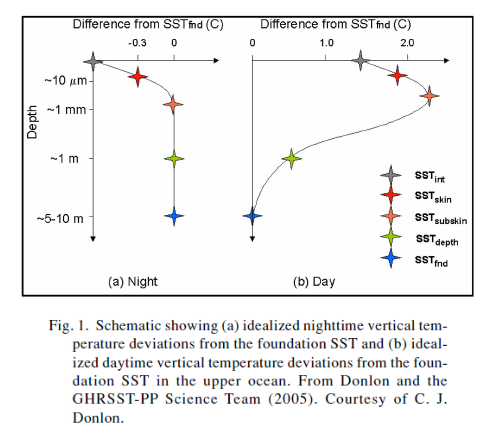
Here’s a diagram I posted in the comments of Does Back Radiation “Heat” the Ocean? – Part Three:

Kawai & Wada (2007)

from Kawai & Wada (2007)

Figure 1

There is a lot of interest in this subject because of the question: “When we say ‘sea surface temperature’ what do we actually mean?“.

As many climate scientists note in their papers, the relevant sea surface temperature for heat transfer between ocean and atmosphere is the very surface, the skin temperature.

In figure 1 you can see that during the day the temperature increases up to the surface and then, in the skin layer, reduces again. Note that the vertical axis is a logarithmic scale.

Then at night the temperature below the skin layer is mostly all at the same temperature (isothermal). This is because the surface cools rapidly at night, and therefore becomes cooler than the water below, so sinks. This diurnal mixing can also be seen in some graphs I posted in the comments of Does Back Radiation “Heat” the Ocean? – Part Four.

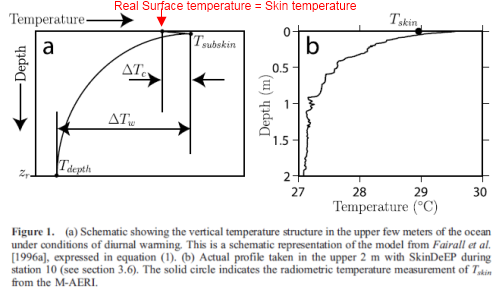
Before we look at the causes, here are a series of detailed measurements from Near-surface ocean temperature by Ward (2006):

Figure 2

Note: The red text and arrow is mine, to draw attention to the lower skin temperature. The measurements on the right were taken just before midday “local solar time”. I.e., just before the sun was highest in the sky.

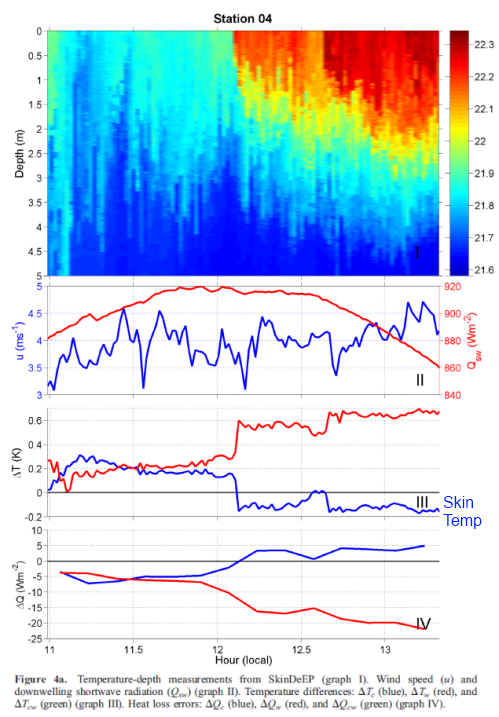
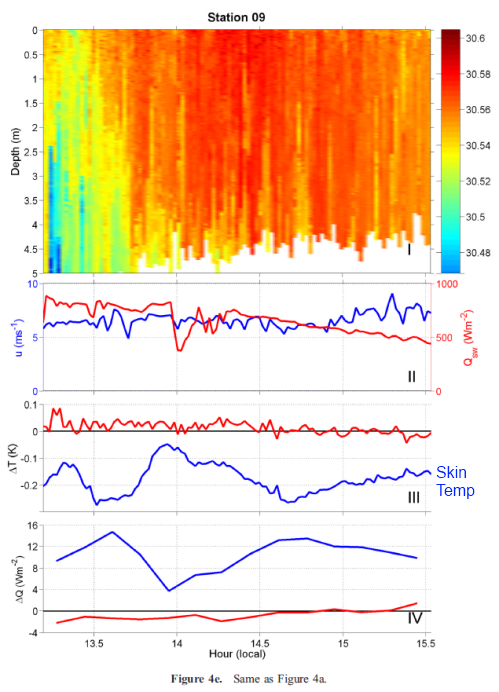
And in the measurements below I’ve made it a bit easier to pick out the skin temperature difference with blue text “Skin temp“. The blue value in each graph is what is identified as ΔTc in the schematic above. The time is shown as local solar time.

Figure 3

Figure 4

Figure 5

Figure 6

Figure 7

The measurements of the skin surface temperature were made by MAERI, a passive infrared radiometric interferometer. The accuracy of the derived SSTs from M-AERI is better than 0.05 K.

Below the skin, the high-resolution temperature measurements were measured by SkinDeEP, an autonomous vertical profiler. This includes the “sub-skin” measurement, from which the sea surface temperature was subtracted to calculate ΔTc (see figure 1).

The Theory

The existence of the temperature gradient is explained by the way heat is transferred: within the bulk waters, heat transfer occurs due to turbulence, but as the surface is approached, viscous forces dominate and molecular processes prevail. Because heat transfer by molecular conduction is less efficient than by turbulence, a strong temperature gradient is established across the boundary layer.

Ward & Minnett (2001)

Away from the interface the temperature gradient is quickly destroyed by turbulent mixing. Thus the cool-skin temperature change is confined to a region of thickness, which is referred to as the molecular sublayer.

Fairall et al (1996)

What do they mean?

Here’s an insight into what happens at fluid boundaries from an online textbook (thanks to Dan Hughes for letting me know about it) – this textbook is freely available online:

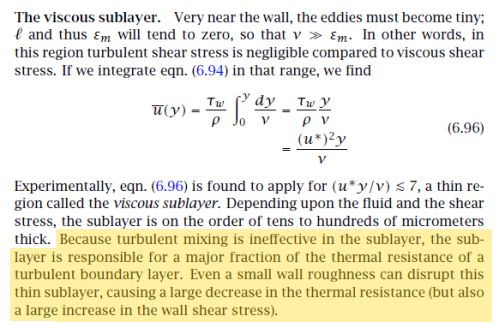
From "A Heat Transfer Textbook", by Prof Lienhard & Prof Lienhard (2008)

From "A Heat Transfer Textbook", by Prof Lienhard & Prof Lienhard (2008)

Figure 8

The idea behind turbulent mixing in fluids is that larger eddies “spawn” smaller eddies, which in turn spawn yet smaller eddies until you are up against an interface for that fluid (or until energy is dissipated by other effects).

In the atmosphere, for example, large scale turbulence moves energy across many 100’s of kilometers. A few tens of meters above the ground you might measure eddies of a few hundreds of meters in size, and in the last meter above the ground, eddies might be measured in cms or meters, if they exist at all. And by the time we measure the fluid flow 1mm from the ground there is almost no turbulence.

For some basic background over related terms, check out Heat Transfer Basics – Convection – Part One, with some examples of fluid flowing over flat plates, boundary layers, laminar flow and turbulent flow.

Therefore, very close to a boundary the turbulent effects effectively disappear, and heat transfer is carried out via conduction. Generally conduction is less effective than turbulence movement of fluids at heat transfer.

A Note on Very Basic Theory

The less effectively heat can move through a body, the higher the temperature differential needed to “drive” that heat through.

This is described by the equation for conductive heat transfer, which in (relatively) plain English says:

The heat flow in W/m² is proportional to the temperature difference across the body and the “conductivity” of the body, and is inversely proportional to the distance across the body

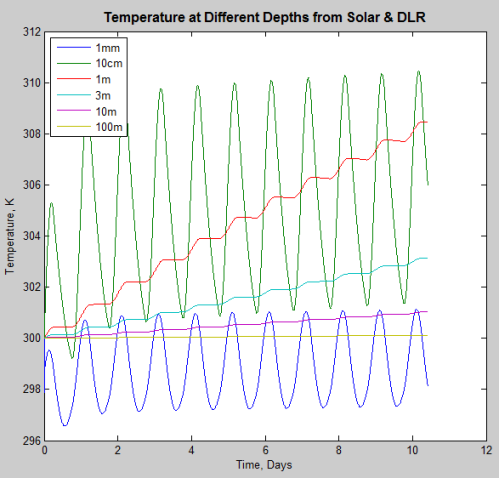
Now during the day a significant amount of heat moves up through the ocean to the surface. This is the solar radiation absorbed below the surface. Near the surface where turbulent mixing reduces in effectiveness we should expect to see a larger temperature gradient.

Taking the example of 1m down, if for some reason heat was not able to move effectively from 1m to the surface, then the absorbed solar radiation would keep heating the 1m depth and its temperature would keep rising. Eventually this temperature gradient would cause greater heat flow.

An example of a flawed model where heat was not able to move effectively was given in Does Back-Radiation “Heat” the Ocean? – Part Two:

A Flawed Model

Note how the 1m & 3m depth keep increasing in temperature. See that article for more explanation.

The Skin Layer in Detail

If the temperature increases closer to the surface, why does it “change direction” in the last millimeter?

In brief, the temperature generally rises in the last few meters as you get closer to the surface because hotter fluids rise. They rise because they are less dense.

So why doesn’t that continue to the very last micron?

The surface is where (almost) all of absorbed ocean energy is transferred to the atmosphere.

  • Radiation from the surface takes place from the top few microns.
  • Latent heat – evaporation of water into water vapor – is taken from the very top layer of the ocean.
  • Sensible heat is moved by conduction from the very surface into the atmosphere

And in general the ocean is moving heat into the atmosphere, rather than the reverse. The atmosphere is usually a few degrees cooler than the ocean surface.

Because turbulent motion is reduced the closer we get to the boundary with the atmosphere, this means that conduction is needed to transfer heat. This needs a temperature differential.

I could write it another way – because “needing a temperature differential” isn’t the same as “getting a temperature differential”.

If the heat flow up from below cannot get through to the surface, the energy will keep “piling up” and, therefore, keep increasing the temperature. Eventually the temperature will be high enough to “drive the heat” out to the surface.

The Simple 1-d Model

We saw a simple 1-d model in Does Back Radiation “Heat” the Ocean? – Part Four.

Just for the purposes of checking the theory relating to skin layers here is what I did to improve on it:

1. Increased the granularity of the model – with depths for each layer of: 100μm, 300μm, 1mm, 5mm, 20mm, 50mm, 200mm, 1m, 10m, 100m (note values are the lower edge of each layer).

2. Reduced the “turbulent conductivity” values as the surface was reached – instead of one “turbulent conductivity” value (used when the layer below was warmer than the layer above), these values were reduced closer to the surface, e.g. for the 100μm layer, kt=10; for the 300μm layer, kt=10; for the 1mm layer, kt=100; for the 5mm layer, kt=1000; for the 20mm layer, kt=100,000. Then the rest were 200,000 = 2×10⁵ – the standard value used in the earlier models.

3. Reduced the time step to 5ms. This is necessary to make the model work and of course does reduce the length of run significantly.

The results for a 30 day run showed the beginnings of a cooler skin. And the starting temperatures for the top layer down to the 20mm layer were the same. The values of kt were not “tuned” to make the model work, I just threw some values in to see what happened.

As a side note for those following the discussion from Part Four, the ocean temperature also increased for DLR increases with these changes.

Now I can run it for longer but the real issue is that the model is not anywhere near complex enough.

Further Reading on Complexity

There are some papers for people who want to follow this subject further. This is not a “literature review”, just some papers I found on the journey. The subject is not simple.

Free

Saunders, Peter M. (1967), The Temperature at the Ocean-Air InterfaceJ. Atmos. Sci.

Tu and Tsuang (2005), Cool-skin simulation by a one-column ocean model, Geophys. Res. Letters

Paywall

McAlister, E. D., and W. McLeish (1969), Heat Transfer in the Top Millimeter of the OceanJ. Geophys. Res.

Fairall et al, reference below

GA Wick, WJ Emery, LH Kantha & P Schlussel (1996), The behavior of the bulk-skin sea surface temperature difference under varying wind speed and heat fluxJournal of Physical Oceanography

Hartmut Grassl, (1976), The dependence of the measured cool skin of the ocean on wind stress and total heat flux, Boundary Layer Meteorology

Conclusion

The temperature profile of the top mm of the ocean is a challenging subject. Tu & Tsuang say:

Generally speaking, the structure of the viscous layer is known to be related to the molecular viscosity, surface winds, and air-sea flux exchanges. Both Saunders’ formulation [Saunders, 1967; Grassl, 1976; Fairall et al.,1996] and the renewal theory [Liu et al., 1979; Wick et al.,1996; Castro et al., 2003; Horrocks et al., 2003] have been developed and applied to study the cool-skin effect.

But the exact factors and processes determining the structure is still not well known.

However, despite the complexity, an understanding of the basics helps to give some insight into why the temperature profile is like it is.

I welcome commenters who can make the subject easier to understand. And also commenters who can explain the more complex elements of this subject.

References

A Heat Transfer Textbook, by Prof Lienhard & Prof Lienhard, Phlogiston Press, 3rd edition (2008)

Cool-skin and warm-layer effects on sea surface temperature, Fairall, Bradley, Godfrey, Wick, Edson & Young, Journal of Geophysical Research (1996)

Near-surface ocean temperature, Ward, Journal of Geophysical Research (2006)

An Autonomous Profiler for Near Surface Temperature Measurements, Ward & Minnett, Accepted for the Proceedings Gas Transfer at Water Surfaces 4th International Symposium (2000)

In Part One we saw how the ocean absorbed different wavelengths of radiation:

  • 50% of solar radiation is absorbed in the first meter, and 80% within 10 meters
  • 50% of “back radiation” (atmospheric radiation) is absorbed  in the first few microns (μm).

This is because absorption is a strong function of wavelength and atmospheric radiation is centered around 10μm, while solar radiation is centered around 0.5μm.

In Part Two we considered what would happen if back radiation only caused evaporation and removal of energy from the ocean surface via the latent heat. The ocean surface would become much colder than it obviously is. That is a very simple “first law of thermodynamics” problem. Then we looked at another model with only conductive heat transfer between different “layers” in the ocean. This caused various levels below the surface to heat to unphysical values. It is clear that turbulent heat transport takes place from lower in the ocean. Solar energy reaches down many meters heating the ocean from within – hotter water expands and so rises – moving heat by convection.

In Part Three we reviewed various experimental results showing how the temperature profile (vs depth) changes during the diurnal cycle (day-night-day) and with wind speed. This demonstrates very clearly how much mixing goes on in the ocean.

The Different Theories

This series of articles was inspired by the many people who think that increases in back radiation from the atmosphere will have no effect (or an unnoticeable effect) on the temperature of the ocean depths.

So far, no evidence has so far been brought forward for the idea that back radiation can’t “heat” the ocean (see note 1 at the end), other than the “it’s obvious” evidence. At least, I am unaware of any stronger arguments. Hopefully as a result of this article advocates can put forward their ideas in more detail in response.

I’ll summarize the different theories as I’ve understood them. Apologies to anyone who feels misrepresented – it’s quite possible I just haven’t heard your particular theory or your excellent way of explaining it.

Hypothesis A – Because the atmospheric radiation is completely absorbed in the first few microns it will cause evaporation of the surface layer, which takes away the energy from the back radiation as latent heat into the atmosphere. Therefore, more back-radiation will have zero effect on the ocean temperature.

Hypothesis B – Because the atmospheric radiation is completely absorbed in the first few microns it will be immediately radiated or convected back out to the atmosphere. Heat can’t flow downwards due to the buoyancy of hotter water. Therefore, if an increase in back radiation occurs (perhaps due to increases in inappropriately-named “greenhouse” gases) it will not “heat” the ocean = increase the temperature of the ocean below the surface.

For other, more basic objections about back radiation, see Note 2 (at the end).

I believe that Part Two showed that Hypothesis A was flawed.

I would like to propose a different hypothesis:

Hypothesis C – Heat transfer is driven by temperature differences. For example, conduction of heat is proportional to the temperature difference across the body that the heat is conducted through.

Solar radiation is absorbed from the surface through many meters of the ocean. This heats the ocean below the surface which causes “natural convection” – heated bodies expand and therefore rise. So solar energy has a tendency to be moved back to the surface (this was demonstrated in Part Two).

The more the surface temperature increases, the less temperature difference there will be to drive this natural convection. And, therefore, increases in surface temperature can affect the amount of heat stored in the ocean.

Clarification from St.Google: HypothesisA supposition or proposed explanation made on the basis of limited evidence as a starting point for further investigation

An Excellent Question

In Part Three, one commenter asked an excellent question:

Some questions from an interested amateur.
Back radiation causes more immediate evaporation and quicker reemission of LWR than does a similar amount of solar radiation.

Does that mean that the earth’s temperature should be more sensitive to a given solar forcing than it would be to an equal CO2 forcing?

What percentage CO2 forcing transfers energy to the oceans compared to space and the atmosphere?

How does this compare with solar forcing?

Is there a difference between the effect of the sun and the back radiation when they are of equal magnitude? This, of course, pre-supposes that Hypothesis C is correct and that back radiation has any effect at all on the temperature of the ocean below the surface.

So the point is this – even if Hypothesis C is correct, there may still be a difference between the response of the ocean temperatures below the surface – for back radiation compared with solar radiation.

So I set out to try and evaluate these two questions:

  1. Can increases in back radiation affect the temperature of the ocean below the surface? I.e., is Hypothesis C supported against B?
  2. For a given amount of energy, is there a difference between solar forcing and back radiation forcing?

And my approach was to use a model:

Oh no, a model! Clearly wrong then, and a result that can’t fool anyone..

For a bit of background generally on models, take a look at the Introduction in Models On – and Off – the Catwalk.

Here is one way to think about a model

The idea of a model is to carry out some calculations when doing them in your head is too difficult

A model helps us see the world a bit more clearly. At these point I’m not claiming anything other than they help us see the effect of the well-known and undisputed laws of heat transfer on the ocean a little bit more clearly.

Ocean Model

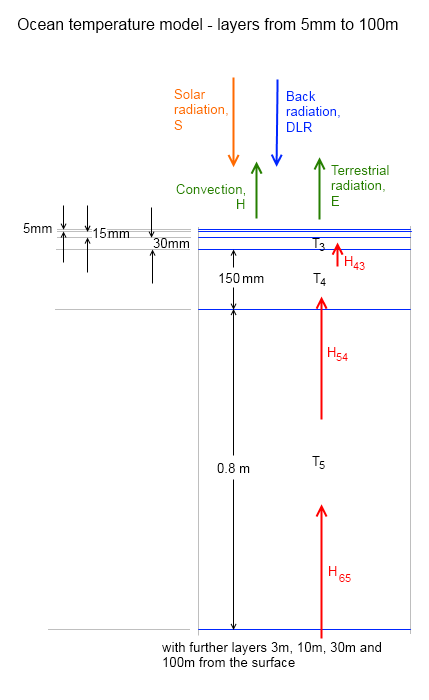
The ocean model under consideration is about a billion times less complex than a GCM. It is a 1-d model with heat flows by radiation, conduction and, in a very limited form, convection.

Here is a schematic of the model. I thought it would be good to show the layers to scale but that means the thicker layers can’t be shown (not without taking up a ridiculous amount of blank screen space) – so the full model, to scale, is 100x deeper than this:

Figure 1

To clarify – the top layer is at temperature, T1, the second layer at T2, even though these values aren’t shown.

The red arrows show conducted or convected heat. They could be in either direction, but the upwards is positive (just as a convention). Obviously, only a few of these are shown in the schematic – there is a heat flux between each layer.

1. Solar and back radiation are modeled as sine waves with the peak at midday. See the graph “Solar and Back Radiation” in Part Two for an example.

2. Convected heat is modeled with a simple formula:

H=h(T1-Tair), where Tair = air temperature, T1 = “surface” temperature, h = convection coefficient = 25 W/m².K.

Convected heat can be in either direction, depending on the surface and air temperature. The air temperature is assumed constant at 300K, something we will return to.

3. Radiation from the surface:

E = εσT4 – the well-known Stefan-Boltzmann equation, and ε = emissivity

For the purposes of this simple model ε = 1. So is absorptivity for back radiation, and for solar radiation. More on these assumptions later.

4. Heat flux between layers (e.g. H54 in the schematic) is calculated using the temperature values for the previous time step for the two adjacent layers then using the conducted heat formula: q” = k.(T5-T4)/d54, where k= conductivity, and d54 = distance between center of each layer 5 to the center of layer 4.

For still water, k = 0.6 W/m.K – a very low value as water is a poor conductor of heat.

In this model at the end of each time step, the program checks the temperature of each layer. If T5 > T4 for example, then the conductivity between these layers for the next time step is set to a much higher value to simulate convection. I used a value for stirred water that I found in a textbook: kt = 2 x 10⁵ W/m.K. What actually happens in practice is the hotter water rises taking the heat with it (convection). Using a high value of conductivity produces a similar result without any actual water motion.

For interest I did try lower values like 2 x 10³ W/m.K and the 1m layer, for example, ended up at a higher temperature than the layers above it. See the more detailed explanation in Part Two.

5. In Part Three I showed results from a number of field experiments which demonstrated that the ocean experiences mixing due to surface cooling at night, and due to high winds. The mixing due to surface cooling is automatically taken account of in this model (and we can see it in the results), but the mixing due to the winds “stirring” the ocean is not included. So we can consider the model as being “under light winds”. If we had a model which evaluated stronger winds it would only make any specific effects of back radiation less noticeable. So this is the “worst case” – or the “highlighting back radiation’s special nature” model.

Problems of Modeling

Some people will already know about the many issues with numerical models. A very common one is resolving small distances and short timescales.

If we want to know the result over many years we don’t really want to have the iterate the model through time steps of fractions of a second. In this model I do have to use very small time steps because the distance scales being considered range from extremely small to quite large – the ocean is divided into thin slabs of 5mm, 15mm.. through to a 70m slab.

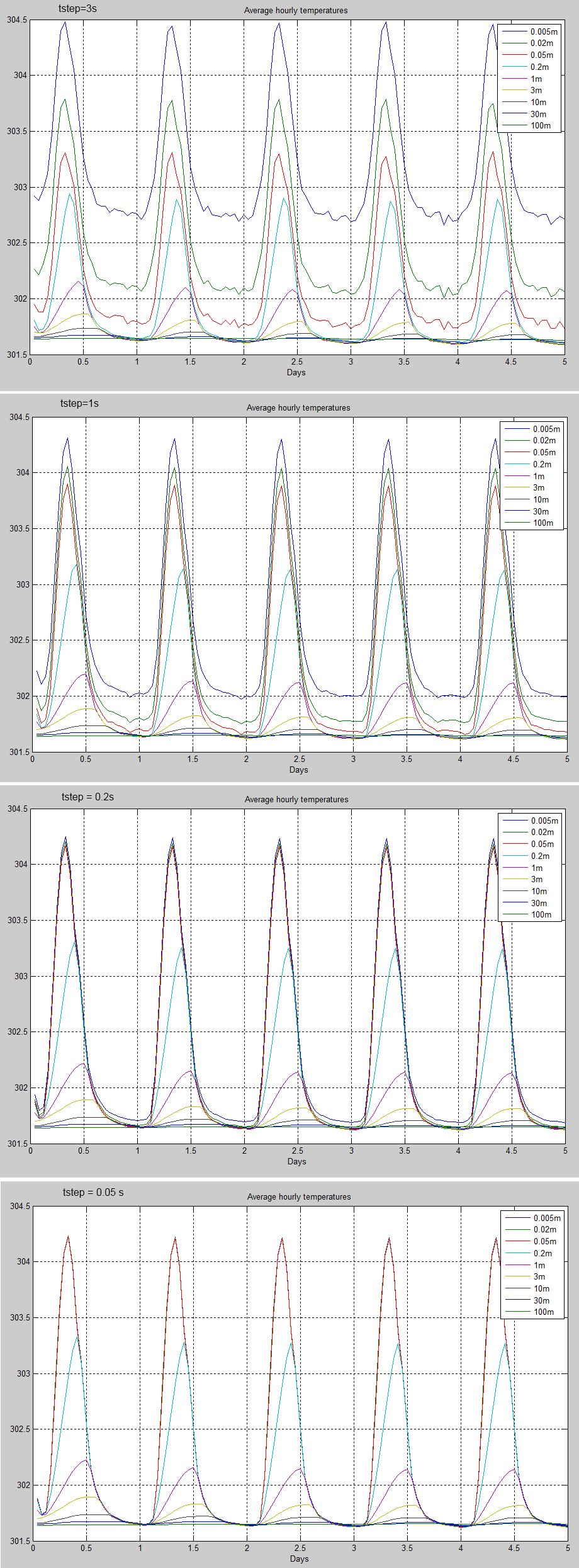
If I use a time step which is too long then too much heat gets transferred from the layers below the surface to the 5mm surface layer in the one time step, the model starts oscillating – and finally “loses the plot”. This is easy to see, but painful to deal with.

But I thought it might be interesting for people to see the results of the model over five days with different time steps. Instead of having the model totally “lose the plot” (=surface temperature goes to infinity), I put a cap on the amount of heat that could move in each time step for the purposes of this demonstration.

You can see four results with these time steps (tstep = time step, is marked on the top left of each graph):

  • 3 secs
  • 1 sec
  • 0.2 sec
  • 0.05 sec

Figure 2 – Click for a larger image

I played around with many other variables in the model to see what problems they caused..

The Tools

The model is written in Matlab and runs on a normal PC (Dell Vostro 1320 laptop).

To begin with there were 5 layers in the model (values are depth from the surface to the bottom edge of each layer):

  • 5 mm
  • 50 mm
  • 1 m
  • 10 m
  • 100 m

I ran this with a time step of 0.2 secs and ended up doing up to 15-year runs.

In the model runs I wanted to ensure that I had found a steady-state value, and also that the model conserved energy (first law of thermodynamics) once steady state was reached. So the model included a number of “house-keeping” tests so I could satisfy myself that the model didn’t have any obvious errors and that equilibrium temperatures were reached for each layer.

For 15 year runs, 5 layers and 0.2s time step the run would take about two and a half hours on the laptop.

I find that quite amazing – showing how good Matlab is. There are 31 million seconds in a year, so 15 years at 0.2 secs per step = 2.4 billion iterations. And each iteration involves looking up the solar and DLR value, calculating 7 heat flow calculations and 5 new temperatures. All in a couple of hours on a laptop.

Well, as we will see, because of the results I got I thought I would check for any changes if there were more layers in my model. So that’s why the 9-layer model (see the first diagram) was created. For this model I need an even shorter time step – 0.1 secs and so long model runs start to get painfully long..

Results

Case 1: The standard case was a peak solar radiation, S, of 600 W/m² and back radiation, DLR of 340 with a 50 W/m² variation day to night (i.e., max of 390 W/m², min of 290 W/m²).

Case 2a: Add 10 W/m² to the peak solar radiation, keep DLR the same. Case 2b – Add 31.41 W/m² to solar.

Case 3a: Keep solar radiation the same, add 3.14 W/m² to DLR. This is an equivalent amount of energy per day to case 2, see note 3. Case 3b – Add 10 W/m² to DLR.

Many people are probably asking, “Why isn’t case 3a – Add 10 W/m² to DLR?”

Solar radiation only occurs for 12 out of the 24 hours, while DLR occurs 24 hours of the day. And the solar value is the peak, while the DLR value is the average. It is a mathematical reason explained further in Note 3.

The important point is that for total energy absorbed in a day, case 2a and 3a are the same, and case 2b and 3b are the same.

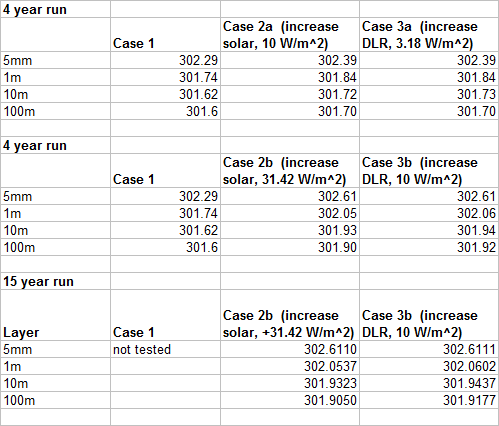
Let’s compare the average daily temperature in the top layer, 1m, 10m and 100m layer for the three cases (note: depths are from the surface to the bottom of each layer; and only 4 layers of the 5 were recorded):

Figure 3

The time step (tstep) = 0.2s.

The starting temperatures for each layer were the same in all cases.

Now because the 4 year runs recorded almost identical values for solar vs DLR forcing, and because the results had not quite stabilized, I then did the 15 year run and also recorded the temperature to the 4 decimal places shown. This isn’t because the results are this accurate – this is to see what differences, if any, exist between the two different scenarios.

The important results are:

  1. DLR increases cause temperature increases at all levels in the ocean
  2. Equivalent amounts of daily energy into the ocean from solar and DLR cause almost exactly the same temperature increase at each level of the ocean – even though the DLR is absorbed in the first few microns and the solar energy in the first few meters
  3. The slight difference in temperature may be a result of “real physics” or may be an artifact of the model

And perhaps 5 layers is not enough?

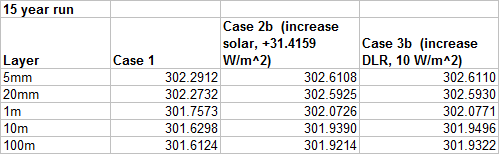
Therefore, I generated the 9-layer model, as shown in the first diagram in this article. The 15-year model runs on the 9-layer model produced these results:

Figure 4

The general results are similar to the 5-layer model.

The temperature changes have clearly stabilized, as the heat unaccounted for (inputs – outputs) on the last day = 41 J/m². Note that this is Joules, not Watts, and is over a 24 hour period. This small “unaccounted” heat is going into temperature increases of the top 100m of the ocean. (“Inputs – outputs” includes the heat being transferred from the model layers down into the ocean depths below 100m).

If we examine the difference in temperature for the bottom 30-100m deep level for case 2b vs 3b we see that the temperature difference after 15 years = 0.011°C. For a 70m thick layer, this equates to an energy difference = 3.2 x 10⁶ J, which, over 15 years, = 591 J/m².day = 0.0068 W/m². This is spectacularly tiny. It might be a model issue, or it might be a real “physics difference”.

In any case, the model has demonstrated that DLR increases vs solar increases cause almost exactly the same temperature changes in each layer being considered.

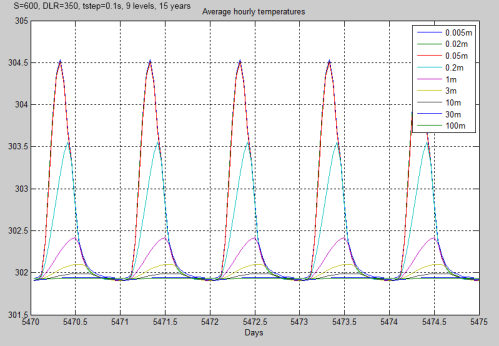
For interest here are the last 5 days of the model (average hourly temperatures for each level) for case 3b:

Figure 5

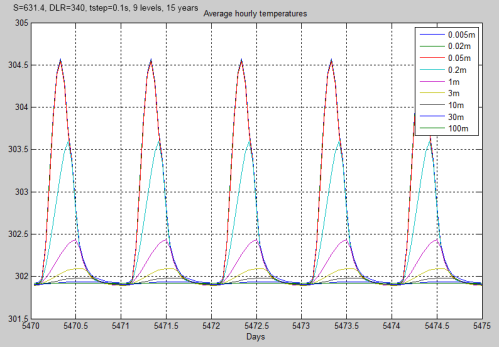
and for case 2b:

Figure 6

Pretty similar..

Results – Convection and Air Temperature

In the model results up until now the air temperature has been at 300K (27°C) and the surface temperature of the ocean has been only a few degrees higher.

The model doesn’t attempt to change the air temperature. And in the real world the atmosphere at the ocean surface and the surface temperature are usually within a few degrees.

But what happens in our model if real world situations cool the ocean surface more? For example, higher temperatures locally create large convective currents of rising hot air which “sucks in” cooler air from another area.

What would be the result? A higher “instantaneous” surface temperature from higher back radiation might be “swept away” into the atmosphere and “lost” from the model.. This might create a different final answer for back radiation compared with solar radiation.

It seemed to be worth checking out, so I reduced the air temperature to 285K (from 300K) and ran the model for one year from the original starting temperatures (just over 300K). The result was that the ocean temperature dropped significantly, demonstrating how closely the ocean surface and the atmosphere (at the ocean surface) are coupled.

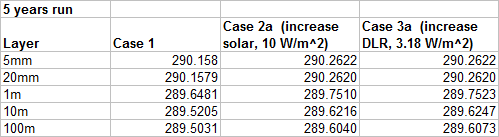
Using the end of the first year as a starting temperature, I ran the model for 5 years for case 1, 2a and 3a (each with the same starting temperature):

Figure 7

Once again we see that back radiation increases do change the temperatures of the ocean depths – and at almost identical values to the solar radiation changes.

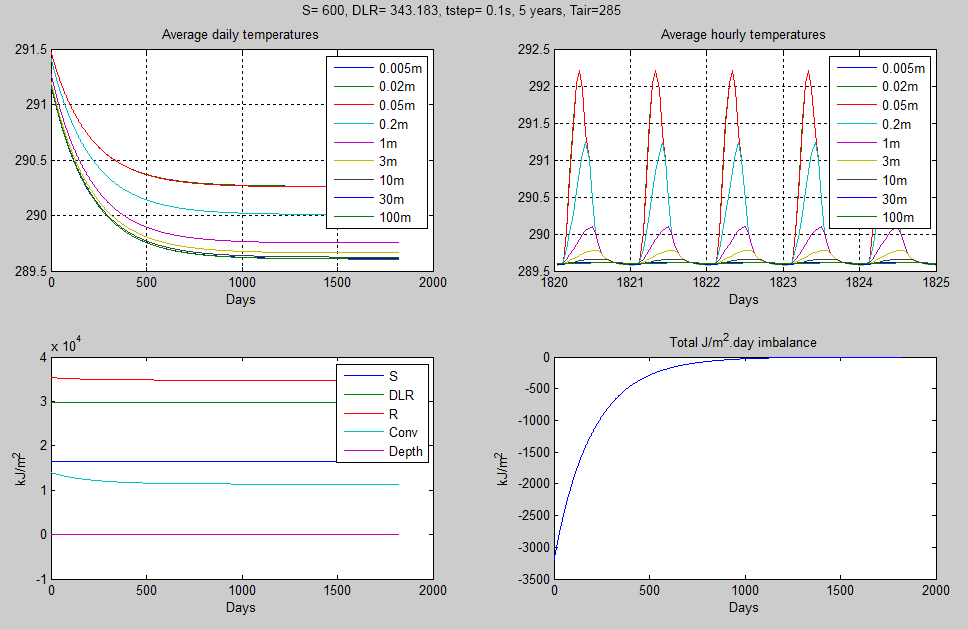
Here is a set of graphs for one of the 5-year model runs for this lower air temperature, also demonstrating how the lower air temperature pulls down the ocean surface temperature:

Figure 8 – Click for a larger image

The first graph shows how the average daily temperature changes over the full time period – making it easy to see equilibrium being reached. The second graph shows the hourly average temperature change for the last 5 days. The last graph shows the heat which is either absorbed or released within the ocean in temperature changes. As zero is reached it means the ocean is not heating up or cooling down.

Inaccuracies in the Model

We can write a lot on the all the inaccuracies in the model. It’s a very rudimentary model. In the real world the hotter tropical / sub-tropical oceans transfer heat to higher latitudes and to the poles. So does the atmosphere. A 1-d model is very unrealistic.

The emissivity and absorptivity of the ocean are set to 1, there are no ocean currents, the atmosphere doesn’t heat up and cool down with the ocean surface, the solar radiation value doesn’t change through the year, the top layer was 5mm not 1μm, the cooler skin layer was not modeled, a number of isothermal layers is unphysical compared with the real ocean of continuously varying temperatures..

However, what a nice simple model tells us is how energy only absorbed in the top few microns of the ocean can affect the temperature of the ocean much lower down.

It’s obvious“, I could say.

Conclusion

My model could be wrong – for example, just a mistake which means it doesn’t operate how I have described it. The many simplifications of the model might hide some real world physics effect which means that Hypothesis C is actually less likely than Hypothesis B.

However, if the model doesn’t contain mistakes, at least I have provided more support for Hypothesis C – that the back radiation absorbed in the very surface of the ocean can change the temperature of the ocean below, and demonstrated that Hypothesis B is less likely.

I look forward to advocates of Hypothesis B putting forward their best arguments.

Update – Code files saved here

Notes

Note 1 – To avoid upsetting the purists, when we say “does back-radiation heat the ocean?” what we mean is, “does back-radiation affect the temperature of the ocean?”

Some people get upset if we use the term heat, and object that heat is the net of the two way process of energy exchange. It’s not too important for most of us. I only mention it to make it clear that if the colder atmosphere transfers energy to the ocean then more energy goes in the reverse direction.

It is a dull point.

Note 2 – Some people think that back radiation can’t occur at all, and others think that it can’t affect the temperature of the surface for reasons that are a confused mangle of the second law of thermodynamics. See Science Roads Less Travelled and especially Amazing Things we Find in Textbooks – The Real Second Law The Real Second Law of Thermodynamics and The Three Body Problem. And for real measurements of back radiation, see The Amazing Case of “Back Radiation” -Part One.

Note 3 – If we change the peak solar radiation from 600 to 610, this is the peak value and only provides an increase for 12 out of 24 hours. By contrast, back radiation is a 24 hour a day value. How much do we have to change the average DLR value to provide an equivalent amount of energy over 24 hours?

If we integrate the solar radiation for the before and after cases we find the relationship between the value for the peak of the solar radiation and the average of the back radiation = π (3.14159). So if the DLR increase = 10, the peak solar increase to match = 10 x π = 31.4159; and if the solar peak increase = 10, the DLR increase to match = 10/π = 3.1831.

If anyone would like this demonstrated further please ask and I will update in the comments. I’m sure I could have made this easier to understand than I actually have (haven’t).

A while ago we looked at some basics in Heat Transfer Basics – Part Zero.

Equations aren’t popular but a few were included.

As a recap, there are three main mechanisms of heat transfer:

  • conduction
  • convection
  • radiation

In the climate system, conduction is generally negligible because gases and liquids like water don’t conduct heat well at all. (See note 2).

Convection is the transfer of heat by bulk motion of a fluid. Motion of fluids is very complex, which makes convection a difficult subject.

If the motion of the fluid arises from an external agent, for instance, a fan, a blower, the wind, or the motion of a heated object itself, which imparts the pressure to drive the flow, the process is termed forced convection.

If, on the other hand, no such externally induced flow exists and the flow arises “naturally” from the effect of a density difference, resulting from a temperature or concentration difference in a body force field such as gravity, the process is termed natural convection. The density difference gives rise to buoyancy forces due to which the flow is generated..

The main difference between natural and forced convection lies in the mechanism by which flow is generated.

From Heat Transfer Handbook: Volume 1, by Bejan & Kraus (2003).

The Boundary Layer

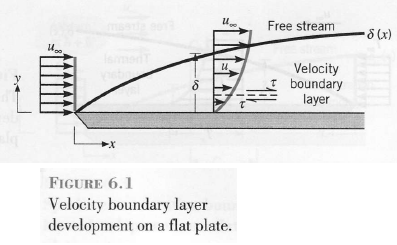
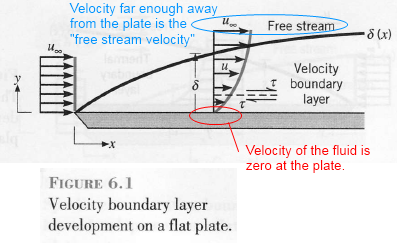
The first key to understanding heat transfer by convection is the boundary layer. A typical example is a fluid (e.g. air, water) forced over a flat plate:

From Incropera & DeWitt (2007)

From Incropera & DeWitt (2007)

This first graphic shows the velocity of the fluid. The parameter u is the velocity (u) at infinity (∞) – or in layman’s terms, the velocity of the fluid “a long way” from the surface of the plate.

Another way to think about u – it is the free flowing fluid velocity before the fluid comes into contact with the plate.

Take a look at the velocity profile:

At the plate the velocity is zero. This is because the fluid particles make contact with the surface. In the “next layer” the particles are slowed up by the boundary layer particles. As you go further and further out this effect of the stationary plate is more and more reduced, until finally there is no slowing down of the fluid.

The thick black curve, δ, is the boundary layer thickness. In practice this is usually taken to be the point where the velocity is 99% of its free flowing value. You can see that just at the point where the fluid starts to flow over the plate – the boundary layer is zero. Then the plate starts to slow the fluid down and so progressively the boundary layer thickens.

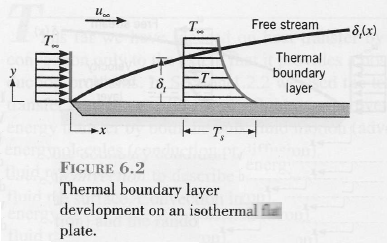
Here is the resulting temperature profile:

From Incropera & DeWitt (2007)

From Incropera & DeWitt (2007)

In this graphic T is the temperature of the “free flowing fluid” and Ts is the temperature of the flat plat which (in this case) is higher than the free flowing fluid temperature. Therefore, heat will transfer from the plate to the fluid.

The thermal boundary layer, δt, is defined in a similar way to the velocity boundary layer, but using temperature instead.

How does heat transfer from the plate to the fluid? At the surface the velocity of the fluid is zero and so there is no fluid motion.

At the surface, energy transfer only takes place by conduction (note 1).

In some cases we also expect to see mass transfer – for example, air over a water surface where water evaporates and water vapor gets carried away. (But not with air over a steel plate).

From Incropera & DeWitt (2007)

From Incropera & DeWitt (2007)

So a concentration boundary layer develops.

Newton’s Law of Cooling

Many people have come across this equation:

q” = h(Ts – T)

where q” = heat flux in W/m², h is the convection coefficient, and the two temperatures were defined above

The problem is determining the value of h.

It depends on a number of fluid properties:

  • density
  • viscosity
  • thermal conductivity
  • specific heat capacity

But also on:

  • surface geometry
  • flow conditions

Turbulence

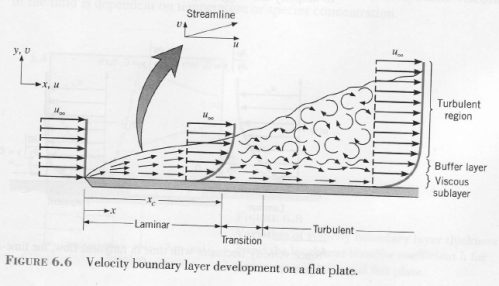
The earlier examples showed laminar flow. However, turbulent flow often develops:

Flow in the turbulent region is chaotic and characterized by random, three-dimensional motion of relatively large parcels of fluid.

Check out this very short video showing the transition from laminar to turbulent flow.

What determines whether flow is laminar or turbulent and how does flow become turbulent?

The transition from laminar to turbulent flow is ultimately due to triggering mechanisms, such as the interaction of unsteady flow structures that develop naturally within the fluid or small disturbances that exist within many typical boundary layers. These disturbances may originate from fluctuations in the free stream, or they may be induced by surface roughness or minute surface vibrations

from Incropera & DeWitt (2007).

Imagine treacle (=molasses) flowing over a plate. It’s hard to picture the flow becoming turbulent. That’s because treacle is very viscous. Viscosity is a measure of how much resistance there is to different speeds within the fluid – how much “internal resistance”.

Now picture water moving very slowly over a plate. Again it’s hard to picture the flow becoming turbulent. The reason in this case is because inertial forces are low. Inertial force is the force applied on other parts of the fluid by virtue of the fluid motion.

The higher the inertial forces the more likely fluid flow is to become turbulent. The higher the viscosity of the fluid the less likely the fluid flow is to become turbulent – because this viscosity damps out the random motion.

The ratio between the two is the important parameter. This is known as the Reynolds number.

Re = ρux / μ

where ρ = density, u = free stream velocity, x is the distance from the leading edge of the surface and μ = dynamic viscosity

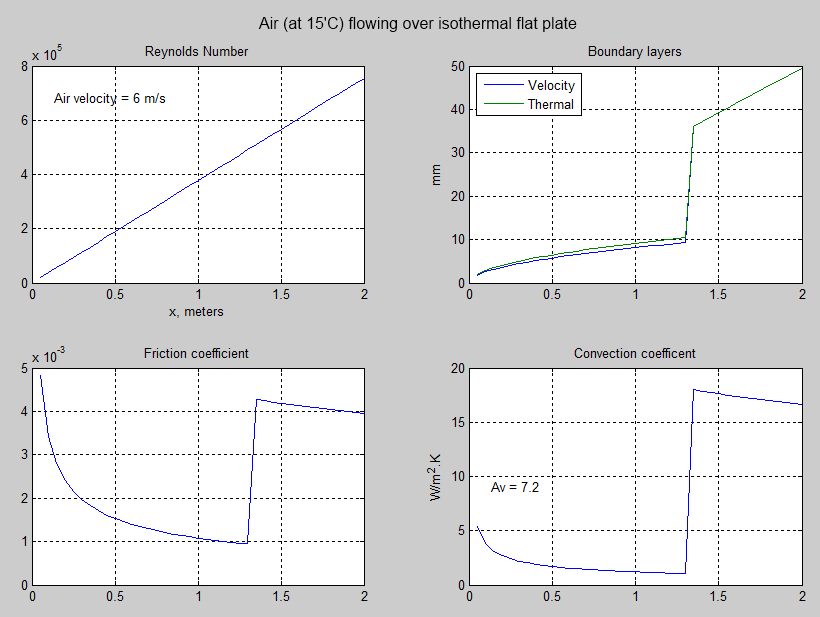
Once Re goes above around 5 x 10⁵ (500,000) flow becomes turbulent.

For air at 15°C and sea level, ρ=1.2kg/m³ and μ=1.8 x 10⁻⁵ kg/m.s

Solving this equation for these conditions, gives a threshold value of ux > 7.5 for turbulence.. This means that if the wind speed (in m/s) x the length of surface over which the wind flows (in m) is greater than 7.5 we will get turbulent flow.

For example, a slow wind speed of 1 m/s (2.2 miles / hour) over 7.5 meters of surface will produce turbulent flow. When you consider the wind blowing over many miles of open ocean you can see that the air flow will almost always be turbulent.

The great physicist and Nobel Laureate Richard Feynman called turbulence the most important unsolved problem of classical physics.

In a nutshell, it’s a little tricky. So how do we determine convection coefficients?

Empirical Measurements & Dimensionless Ratios

Calculation of the convection heat transfer coefficient, h, in the equation we saw earlier can only be done empirically. This means measurement.

However, there are a whole suite of similarity parameters which allow results from one situation to be used in “similar circumstances”.

It’s not an easy subject to understand “intuitively” because the demonstration of these similarity parameters (e.g., Reynolds, Prandtl, Nusselt and Sherwood numbers) relies upon first seeing the differential equations governing fluid flow and heat & mass transfer – and then the transformation of these equations into a dimensionless form.

As the simplest example, the Reynolds number tells us when flow becomes turbulent regardless of whether we are considering air, water or treacle.

And a result for one geometry can be re-used in a different scenario with similar geometries.

Therefore, many tables and standard empirical equations exist for standard geometries – e.g. fluid flow over cylinders, banks of pipes.

Here are some results for air flow over a flat isothermal plate (isothermal = all at the same temperature) – calculated using empirically-derived equations:

Click for a larger view

The 1st graph shows that the critical Reynolds number of 5×10⁵ is reached at 1.3m. The 2nd graph shows how the boundary layer grows under first laminar flow, then second under turbulent flow – see how it jumps up as turbulent flow starts. The 4th graph shows the local convection coefficient as a function of distance from the leading edge – as well as the average value across the 2m of flat plate.

Conclusion

Not much of a conclusion yet, but this article is already long enough. In the next article we will look at the experimental results of heat transfer from the ocean to the atmosphere.

Notes

Note 1 – Heat transfer by radiation might also take place depending on the materials in question.

Note 2 – Of course, as explained in the detailed section on convection, heat cannot be transferred across a boundary between a surface and a fluid by convection. Conduction is therefore important at the boundary between the earth’s surface and atmosphere.

I write this article as a placeholder to send people to – and as a request for information.

On another blog, there was a confused article posted about the earth’s energy balance. Within the article was this statement:

Earth is a grey body, because it has volume, a black body does not have volume, simply that is the end of “the controversy”.

As I said in my comment to the article:

I have seen similar inaccurate comments before but can’t fathom where they came from.

A followup comment to mine reinforced the point that I just don’t understand:

  • what many people believe about blackbodies, or
  • what many people believe conventional climate science believes about blackbodies (and why it’s supposed to be wrong)

So this is a request for clarification of “the problem”

I will post examples of changing temperature for a blackbody and a non-blackbody. But because of my lack of understanding of “the problem” I have no idea if these examples will highlight particular areas of disagreement, or are completely accepted by all.

Just before the examples:

My understanding, gained from dull textbooks on the subject of heat transfer and atmospheric physics:

The difference between a “grey body” and a “black body” is this:

1. A blackbody has an emissivity of 1. So energy radiated in W/m², E = εσT^4, where ε=1.
2. A non-blackbody has an emissivity >0 and <1. So energy radiated in W/m², E = εσT^4, where ε<1.

No other physical properties are related to this parameter called emissivity, or to the difference between “blackbodies” and “non-blackbodies“.

Unrelated parameters:

  • Mass
  • Specific heat capacity
  • Color
  • Thermal conductivity
  • Viscosity
  • Density

I could go on, but I’m sure the point is made.

So, onto the two examples.

Example 1 – A Blackbody

Let’s consider a body of mass, m = 1kg with specific heat capacity, cp = 1000 J/kg.K.
Therefore, heat capacity, C = 1000 J/K.
Surface area, A = 2 m².
Emissivity, ε = 1 (a blackbody).

Temperature (at time, t=0) = 300K
Background temperature = 0K (lost in the vastness of space, see note 1)

No external energy is supplied after time, t=0. The body is suddenly placed in the vastness of space. What happens to temperature over time?

The body radiates:

E = AεσT4 [1] Note, really we should write E(t) and T(t) to show that E and T are functions of time

Change in temperature with time:

dT/dt = E/C [2]

Here is the change in temperature with time:

Example 2 – A non-blackbody

Exactly the same as Example 1 – but ε = 0.6 (not a blackbody).

Here is a non-blackbody result:

You can see the form of the result is similar but the temperature drops more slowly – because it is emitting radiation more slowly.

Conclusion

The equations are the same for both examples. The other physical parameters are the same for both. The results are similar. There is nothing startlingly different about a solution with a blackbody and a body with an emissivity less than 1.

Well, that’s my take on it.

Blackbodies appear to be believed to have characteristics unknown in textbooks. I hope some people can explain their “issue” with blackbodies. Or what “the problem” really is.

Notes

Note 1: Yes, the background temperature of space is 2.7K, but using 0K just makes the maths easier for people to follow.

A long time ago I wrote the article The Dull Case of Emissivity and Average Temperatures and expected that would be the end of the interest in emissivity. But it is a gift that keeps on giving, with various people concerned that no one has really been interested in measuring surface emissivity properly.

Background

All solid and liquid surfaces emit thermal radiation according to the Stefan-Boltzmann formula:

E = εσT4

where ε=emissivity, a material property; σ = 5.67×10⁻⁸ ; T = temperature in Kelvin (absolute temperature)

and E is the flux in W/m²

More about this formula and background on the material properties in Planck, Stefan-Boltzmann, Kirchhoff and LTE.

The parameter called emissivity is the focus of this article. It is of special interest because to calculate the radiation from the earth’s surface we need to know only temperature and emissivity.

Emissivity is a value between 0 and 1. And is also depends on the wavelength of radiation (and in some surfaces like metals, also the direction). Because the wavelengths of radiation depend on temperature, emissivity also depends on temperature.

When emissivity = 1, the body is called a “blackbody”. It’s just the theoretical maximum that can be radiated. Some surfaces are very close to a blackbody and others are a long way off.

Note: I have seen many articles by keen budding science writers who have some strange ideas about “blackbodies”. The only difference between a blackbody and a non-blackbody is that the emissivity of a blackbody = 1, and the emissivity of a non-blackbody is less than 1. That’s it. Nothing else.

The wavelength dependence of emissivity is very important. If we take snow for example, it is highly reflective to solar (shortwave) radiation with as much as 80% of solar radiation being reflected. Solar radiation is centered around a wavelength of 0.5μm.

Yet snow is highly absorbing to terrestrial (longwave) radiation, which is centered around a wavelength of 10μm. The absorptivity and emissivity around freezing point is 0.99 – meaning that only 1% of incident longwave radiation would be reflected.

Let’s take a look at the Planck curve – the blackbody radiation curve – for surfaces at a few slightly different temperatures:

The emissivity (as a function of wavelength) simply modifies these curves.

Suppose, for example, that the emissivity of a surface was 0.99 across this entire wavelength range. In that case, a surface at 30°C would radiate like the light blue curve but at 99% of the values shown. If the emissivity varies across the wavelength range then you simply multiply the emissivity by the intensity at each wavelength to get the expected radiation.

Sometimes emissivity is quoted as an average for a given temperature – this takes into account the shape of the Planck curve shown in the graphs above.

Often, when emissivity is quoted as an overall value, the total flux has been measured for a given temperature and the emissivity is simply:

ε =  actual radiation measured / blackbody theoretical radiation at that temperature

[Fixed, thanks to DeWitt Payne for pointing out the mistake]

In practice the calculation is slightly more involved, see note 1.

It turns out that the emissivity of water and of the ocean surface is an involved subject.

And because of the importance of calculating the sea surface temperature from satellite measurements, the emissivity of the ocean in the “atmospheric window” (8-14 μm) has been the subject of many 100’s of papers (perhaps 1000’s). These somewhat overwhelm the papers on the less important subject of “general ocean emissivity”.

Measurements

Aside from climate, water itself is an obvious subject of study for spectroscopy.

For example, 29 years ago Miriam Sidran writing Broadband reflectance and emissivity of specular and rough water surfaces, begins:

The optical constants of water have been extensively studied because of their importance in science and technology. Applications include a) remote sensing of natural water surfaces, b) radiant energy transfer by atmospheric water droplets, and c) optical properties of diverse materials containing water, such as soils, leaves and aqueous solutions.

In this study, values of the complex index of refraction from six recent articles were averaged by visual inspection of the graphs, and the most representative values in the wavelength range of 0.200 μm to 5 cm were determined. These were used to find the directional polarized reflectance and emissivity of a specular surface and the Brewster or pseudo-Brewster angle as functions of wavelength.

The directional polarized reflectance and emissivity of wind-generated water waves were studied using the facet slope distribution function for a rough sea due to Cox and Munk [1954].

Applications to remote sensing of sea surface temperature and wave state are discussed, including effects of salinity.

Emphasis added. She also comments in her paper:

For any wavelength, the total emissivity, ε, is constant for all θ [angles] < 45° [from vertical]; this follows from Fig. 8 and Eq. (6a). It is important in remote sensing of thermal radiation from space, as discussed later..

The polarized emissivities are independent of surface roughness for θ < 25°, while for θ > 25°, the thermal radiation is partly depolarized by the roughness.

This means that when you look at the emission radiation from directly above (and close to directly above) the sea surface roughness doesn’t have an effect.

I thought some other comments might also be interesting:

The 8-14-μm spectral band is chosen for discussion here because (a) it is used in remote sensing and (b) the atmospheric transmittance, τ, in this band is a fairly well-known function of atmospheric moisture content. Water vapor is the chief radiation absorber in this band.

In Eqs. (2)-(4), n and k (and therefore A and B) are functions of salinity. However, the emissivity value, ε, computed for pure water differs from that of seawater by <0.5%.

When used in Eqs. (10), it causes an error of <0.20°C in retrieved Ts [surface temperature]. Since ε in this band lies between 0.96 and 0.995, approximation ε= 1 is routinely used in sea surface temperature retrieval. However, this has been shown to cause an error of -0.5 to -1.0°C for very dry atmospheres. For very moist atmospheres, the error is only ≈0.2°C.

One of the important graphs from her paper:

Click to view a larger image

Emissivity = 1 – Reflectance. The graph shows Reflectance vs Wavelength vs Angle of measurement.

I took the graph (coarse as it is) and extracted the emissivity vs wavelength function (using numerical techniques). I then calculated the blackbody radiation for a 15°C surface and the radiation from a water surface using the emissivity from the graph above for the same 15°C surface. Both were calculated from 1 μm to 100 μm:

The “unofficial” result, calculating the average emissivity from the ratio: ε = 0.96.

This result is valid for 0-30°C. But I suspect the actual value will be modified slightly by the solid angle calculations. That is, the total flux from the surface (the Stefan-Boltzmann equation) is the spectral intensity integrated over all wavelengths, and integrated over all solid angles. So the reduced emissivity closer to the horizon will affect this measurement.

Niclòs et al – 2005

One of the most interesting recent papers is In situ angular measurements of thermal infrared sea surface emissivity—validation of models, Niclòs et al (2005). Here is the abstract:

In this paper, sea surface emissivity (SSE) measurements obtained from thermal infrared radiance data are presented. These measurements were carried out from a fixed oilrig under open sea conditions in the Mediterranean Sea during the WInd and Salinity Experiment 2000 (WISE 2000).

The SSE retrieval methodology uses quasi-simultaneous measurements of the radiance coming from the sea surface and the downwelling sky radiance, in addition to the sea surface temperature (SST). The radiometric data were acquired by a CIMEL ELECTRONIQUE CE 312 radiometer, with four channels placed in the 8–14 μm region. The sea temperature was measured with high-precision thermal probes located on oceanographic buoys, which is not exactly equal to the required SST. A study of the skin effect during the radiometric measurements used in this work showed that a constant bulk–skin temperature difference of 0.05±0.06 K was present for wind speeds larger than 5 m/s. Our study is limited to these conditions.

Thus, SST used as a reference for SSE retrieval was obtained as the temperature measured by the contact thermometers placed on the buoys at 20-cm depth minus this bulk–skin temperature difference.

SSE was obtained under several observation angles and surface wind speed conditions, allowing us to study both the angular and the sea surface roughness dependence. Our results were compared with SSE models..

The introduction explains why specifically they are studying the dependence of emissivity on the angle of measurement – for reasons of accurate calculation of sea surface temperature:

The requirement of a maximum uncertainty of ±0.3 K in sea surface temperature (SST) as input to climate models and the use of high observation angles in the current space missions, such as the 55° for the forward view of the Advanced Along Track Scanning Radiometer (AATSR) (Llewellyn-Jones et al., 2001) on board ENVISAT, need a precise and reliable determination of sea surface emissivity (SSE) in the thermal infrared region (TIR), as well as analyses of its angular and spectral dependences.

The emission of a rough sea surface has been studied over the last years due to the importance of the SSE for accurate SST retrieval. A reference work for many subsequent studies has been the paper written by Cox and Munk (1954)..

The experimental setup:

From Niclos (2004)

From Niclos (2004)

The results (compared with one important model from Masuda et al 1988):

From Niclos (2004)

From Niclos (2004)

Click on the image for a larger graphic

This paper also goes on to compare the results with the model of Wu & Smith (1997) and indicates the Wu & Smith’s model is a little better.

The tabulated results, note that you can avoid the “eye chart effect” by clicking on the table:

Click on the image for a larger view

Note that the emissivities are in the 8-14μm range.

You can see that the emissivity when measured from close to vertical is 0.98 – 0.99 at two different wind speeds.

Konda et al – 1994

A slightly older paper which is not concerned with angular dependence of sea surface emissivity is by Konda, Imasato, Nishi and Toda (1994).

They comment on a few older papers:

Buettner and Kern (1965) estimated the sea surface emissivity to be 0.993 from an experiment using an emissivity box, but they disregarded the temperature difference across the cool skin.

Saunders (1967b, 1968) observed the plane sea surface irradiance from an  airplane and determined the reflectance. By determining the reflectance as the ratio of the differences in energy between the clear and the cloudy sky at different places, he calculated the emissivity to be 0.986. The process of separating the reflection from the surface irradiance, however, is not precise.

Mikhaylov and Zolotarev (1970) calculated the emissivity from the optical constant of the water and found the average in the infrared region was 0.9875.

The observation of Davies et al. (1971) was performed on Lake Ontario with a wave height less than 25 cm. They measured the surface emission isolated from sky radiation by an aluminum cone, and estimated the emissivity to be 0.972. The aluminum was assumed to act as a mirror in infrared region. In fact,aluminum does not work as a perfect mirror.

Masuda et al. (1988) computed the surface emissivity as a function of the zenith angle of observed radiation and wind speed. They computed the emissivity from the reflectance of a model sea surface consisting of many facets, and changed their slopes according to Gaussian distribution with respect to surface wind. The computed emissivity in 11 μm was 0.992 under no wind.

Each of these studies in trying to determine the value of emissivity, failed to distinguish surface emission from reflection and to evaluate the temperature difference across the cool skin. The summary of these studies are tabulated in Table 1.

The table summarizing some earlier work:

Konda (1994)

Konda (1994)

Konda and his co-workers took measurements over a one year period from a tower in Tanabe Bay, Japan.

They calculated from their results that the ocean emissivity was 0.984±0.004.

One of the challenges for Konda’s research and for Niclòs is the issue of sea surface temperature measurement itself. Here is a temperature profile which was shown in the comments of Does Back Radiation “Heat” the Ocean? – Part Three:

Kawai & Wada (2007)

Kawai & Wada (2007)

The point is the actual surface from which the radiation is emitted will usually be at a slightly different temperature from the bulk temperature (note the logarithmic scale of depth). This is the “cool skin” effect. This surface temperature effect is also moderated by winds and is very difficult to measure accurately in field conditions.

Smith et al – 1996

Another excellent paper which measured the emissivity of the ocean is by Smith et al (1996):

An important objective in satellite remote sensing is the global determination of sea surface temperature (SST). For such measurements to be useful to global climate research, an accuracy of ±0.3K or better over a length of 100km and a timescale of days to weeks must be attained. This criterion is determined by the size of the SST anomalies (≈1K) that can cause significant disturbance to the global atmospheric circulation patterns and the anticipated size of SST perturbations resulting from global climate change. This level of uncertainty is close to the theoretical limits of the atmospheric corrections..

It is also a challenge to demonstrate that such accuracies are being achieved, and conventional approaches, which compare the SST derived from drifting or moored buoys, generally produce results with a scatter of ±0.5 to 0.7K. This scatter cannot be explained solely by uncertainties in the buoy thermometers or the noise equivalent temperature difference of the AVHRR, as these are both on the order of 0.2K or less but are likely to be surface emissivity/reflectivity uncertainties, residual atmospheric effects, or result from the methods of comparison

Note that the primary focus of this research was to have accurate SST measurements from satellites.

From Smith et al (1996)

From Smith et al (1996)

The experimental work on the research vessel Pelican included a high spectral resolution Atmospheric Emitted Radiance Interferometer (AERI) which was configured to make spectral observations of the sea surface radiance at several view angles. Any measurement from the surface of course, is the sum of the emitted radiance from the surface as well as the reflected sky radiance.

Also measured:

  • ocean salinity
  • intake water temperature
  • surface air temperature
  • humidity
  • wind velocity
  • SST within the top 15cm of depth

There was also independent measurement of the radiative temperature of the sea surface at 10μm with a Heimann broadband radiation thermometer “window” radiometer. And radiosondes were launched from the ship roughly every 3 hours.

Additionally, various other instruments took measurements from a flight altitude of 20km. Satellite readings were also compared.

The AERI measured the spectral distribution of radiance from 3.3μm to 20μm at 4 angles. Upwards at 11.5° from zenith, and downwards at 36.5°, 56.5° and 73.5°.

There’s a lot of interesting discussion of the calculations in their paper. Remember that the primary aim is to enable satellite measurements to have the most accurate measurements of SST and satellites can only really “see” the surface through the “atmospheric window” from 8-12μm.

Here are the wavelength dependent emissivity results shown for the 3 viewing angles. You can see that at the lowest viewing angle of 36.5° the emissivity is 0.98 – 0.99 in the 8-12μm range.

From Smith et al (1996)

From Smith et al (1996)

Note that the wind speed doesn’t have any effect on emissivity at the more direct angle, but as the viewing angle moves to 73.5° the emissivity has dropped and high wind speeds change the emissivity considerably.

Henderson et al – 2003

Henderson et al (2003) is one of the many papers which consider the theoretical basis of how viewing angles change the emissivity and derive a model.

Just as an introduction, here is the theoretical variation in emissivity with measurement angle, versus “refractive index” as computed by the Fresnel equations:

The legend is refractive index from 1.20 to 1.35. Water, at visible wavelengths, has a refractive index of 1.33. This shows how the emissivity reduces once the viewing angle increases above 50° from the vertical.

The essence of the problem of sea surface roughness for large viewing angles is shown in the diagram below, where multiple reflections take place:

Henderson (2003)

Henderson (2003)

Henderson and his co-workers compare their results with the measured results of Smith et al (1996) and also comment that at zenith viewing angles the emissivity does not depend on the wind speed, but at larger angles from vertical it does.

A quick summary of their model:

We have developed a Monte Carlo ray-tracing model to compute the emissivity of computer-rendered, wind-roughened sea surfaces. The use of a ray-tracing method allows us to include both the reflected emission and shadowing and, furthermore, permits us to examine more closely how these processes control the radiative properties of the surface. The intensity of the radiation along a given ray path is quantified using Stokes vectors, and thus, polarization is explicitly included in the calculations as well.

Their model results compare well with the experimental results. Note that the approach of generating a mathematical model to calculate how emissivity changes with wind speed and, therefore, wave shape is not at all new.

Water retains its inherent properties of emissivity regardless of how it is moving or what shape it is. The theoretical challenge is handling the multiple reflections, absorptions, re-emissions that take place when the radiance from the water is measured at some angle from the vertical.

Conclusion

The best up to date measurements of ocean emissivity in the 8-14 μm range are 0.98 – 0.99. The 8-14 μm range is well-known because of the intense focus on sea surface temperature measurements from satellite.

From quite ancient data, the average emissivity of water across a very wide broadband range (1-100 μm) is 0.96 for water temperatures from 0-30°C.

The values from the ocean when measured close to the vertical are independent of wind speed and sea surface roughness. As the angle of measurement moves from the vertical around to the horizon the measured emissivity drops and the wind speed affects the measurement significantly.

These values have been extensively researched because the calculation of sea surface temperature from satellite measurements in the 8-14μm “atmospheric window” relies on the accurate knowledge of emissivity and any factors which affect it.

For climate models – I haven’t checked what values they use. I assume they use the best experimental values from the field. That’s an assumption. I’ve already read enough on ocean emissivity.

For energy balance models, like the Trenberth and Kiehl update, an emissivity of 1 doesn’t really affect their calculations. The reason, stated simply, is that the upwards surface radiation and the downward atmospheric radiation are quite close in magnitude. For example, the globally annually averaged values of both are 396 W/m² (upward surface) vs 340 W/m² (downward atmospheric).

Suppose the emissivity drops from 0.98 to 0.97 – what is the effect on upwards radiation through the atmosphere?

The upwards radiation has dropped by 4W/m², but the reflected atmospheric radiation has increased by 3.4W/m². The net upwards radiation through the atmosphere has reduced by only 0.6 W/m².

One of our commenters asked what value the IPCC uses. The answer is they don’t use a value at all because they summarize research from papers in the field.

Whether they do it well or badly is a subject of much controversy, but what is most important to understand is that the IPCC does not write papers, or perform GCM model runs, or do experiments – and that is why you see almost no equations in their many 1000’s of pages of discussion on climate science.

For those who don’t believe the “greenhouse” effect exists, take a look at Understanding Atmospheric Radiation and the “Greenhouse” Effect – Part One in the light of all the measured results for ocean emissivity.

On Another Note

It’s common to find claims on various blogs and in comments on blogs that climate science doesn’t do much actual research.

I haven’t found that to be true. I have found the opposite.

Whenever I have gone digging for a particular subject, whether it is the diurnal temperature variation in the sea surface, diapycnal & isopycnal eddy diffusivity, ocean emissivity, or the possible direction and magnitude of water vapor feedback, I have found a huge swathe of original research, of research building on other research, of research challenging other research, and detailed accounts of experimental methods, results and comparison with theory and models.

Just as an example, in the case of emissivity of sea surface, at the end of the article you can see the first 30 or so results pulled up from one journal – Remote Sensing of the Environment for the search phrase “emissivity sea surface”. The journal search engine found 348 articles (of course, not every one of them is actually about ocean emissivity measurements).

Perhaps it might turn out to be the best journal for this subject, but it’s still just one journal.

References

Broadband reflectance and emissivity of specular and rough water surfaces, Sidran, Applied Optics (1981)

In situ angular measurements of thermal infrared sea surface emissivity—validation of models, Niclòs, Valor, Caselles, Coll & Sànchez, Remote Sensing of Environment (2005)

Measurement of the Sea Surface Emissivity, Konda, Imasato, Nishi and Toda, Journal of Oceanography (1994)

Observations of the Infrared Radiative Properties of the Ocean—Implications for the Measurement of Sea Surface Temperature via Satellite Remote Sensing, Smith, Knuteson, Revercomb, Feltz, Nalli, Howell, Menzel, Brown, Brown, Minnett & McKeown, Bulletin of the American Meteorological Society (1996)

The polarized emissivity of a wind-roughened sea surface: A Monte Carlo model, Henderson, Theiler & Villeneuve, Remote Sensing of Environment (2003)

Notes

Note 1: The upward radiation from the surface is the sum of three contributions: (i) direct emission of the sea surface, which is attenuated by the absorption of the atmospheric layer between the sea surface and the instrument; (ii) reflection of the downwelling sky radiance on the sea, attenuated by the atmosphere; and (iii) the upwelling atmospheric radiance emitted in the observing direction.

So the measured radiance can be expressed as:

where the three terms on the right are each of the three contributions noted in the same order.

Note 2: 1/10th of the search results returned from one journal for the search term “emissivity sea surface”:

Remote Sensing of Environment - search results

Remote Sensing of Environment - search results

This first part considers some elementary points. In the next part we will consider more advanced aspects of this subject.

Since 1978 we have had satellites continuously measuring:

  • incoming solar radiation
  • reflected solar radiation
  • outgoing terrestrial radiation

To see how we can differentiate the solar and terrestrial radiation, take a look at The Sun and Max Planck Agree – Part Two.

Top of Atmosphere Satellite Measurements

The top of atmosphere (TOA) radiation from the climate system is usually known as outgoing longwave radiation, or OLR. “Longwave” is a climate convention for wavelength >4μm.

Here’s what the OLR looks like to the satellites. I thought it might be interesting for some people to see how the values change each month:

CERES OLR

All of this data comes from CERES – Clouds and the Earth’s Radiant Energy System. You can review this data for yourself here. How accurate is the data?

The uncertainty of an individual top-of-atmosphere OLR measurement is 5 W/m², while the uncertainty of average OLR over a 1°-latitude x 1°-longitude box, which contains many viewing angles, is ≈1.5 W/m²

from Dessler et al (2007) writing about the CERES data.

If we summarize this data into monthly global averages:

The average for 2009 is 239 W/m². This average includes days, nights and weekends. The average can be converted to the total energy emitted from the climate system over a year like this:

Total energy radiated by the climate system into space in one year = 239 x number of seconds in a year x area of the earth in meters squared

= 239 x 60 x 60 x 24 x 365 x 4 x 3.14 x (6.37 x 106

= 239 x 3.15 x 107 x 5.10 x 1014

ETOA= 3.8 x 1024 J

The reason for calculating the total energy in 2009 is because many people have realized that there is a problem with average temperatures and imagine that this problem is carried over to average radiation. Not true. We can take average radiation and convert it into total energy with no problem.

What about the radiation from the surface?

Surface Radiation

What do the satellite measurements say about surface radiation?

Nothing.

Well strictly speaking – they say a lot, but only once certain theories of radiative transfer are embraced.

To be more accurate, what satellite measurements OF surface radiation do we have?

None.

That’s because the atmosphere interacts with the radiation emitted from the surface. So any top-of-atmosphere measurements by satellite are not “unsullied surface measurements”.

There are temperature stations all around the world – not enough for some people, and not as well-located as they could be – but what about stations for measuring radiation upwards from the earth (and ocean) surface?

Thin on the ground, extremely thin.

Luckily, there is a very simple formula for radiation emitted from the surface of the earth:

E = εσT4

where σ is a constant = 5.67 x 10⁻⁸, ε = emissivity, a property of surface material, and T = temperature in K (absolute temperature)

This equation is called the Stefan-Boltzmann equation. More about it in Planck, Stefan-Boltzmann, Kirchhoff and LTE. It is a well-proven equation with 150 years of evidence behind it – and from all areas of engineering and physics. It is used in calculations for heat-exchangers and boilers, for example.

Still, many people when they find out that the radiation from the surface of the earth is calculated not measured are very suspicious. It’s good to be skeptical. Ask questions. But don’t assume it’s made up just because it’s calculated. Why trust thermometers? They actually rely on material properties as well..

Anyway, back to the emission of radiation from the surface. What about this parameter emissivity, ε?

Emissivity is a function of wavelength. This means it varies as the wavelength of radiation varies. Some examples, not all of them materials from the surface of the earth:

Reflectivity vs wavelength for various surfaces, Incropera (2007)

Reflectivity vs wavelength for various surfaces, Incropera (2007)

Note that reflectivity = 1 – emissivity in the graph above.

Without going into a lot of detail, all it means is that the measurement of emissivity needs to be for the appropriate temperature. See note 1.

If we measure emissivity of water one day, we find it is the same the next day and also in 589 days time. It is a material property which means that once measured, the only questions we have are:

a) what is the temperature of the surface
b) what is the material of the surface (so we can look up the measured emissivity for this temperature)

Generally the emissivity of the earth’s surface is very close to 1 (for “longwave” measurements).

Oceans, which cover 71% of the earth’s surface, have an emissivity of about 0.98 – 0.99.

The average temperature of the earth’s surface (including days, nights and all locations) is around 15°C (288K). Average temperature is a problematic value because radiation is not linearly dependent on temperature – it is dependent on the 4th power of temperature. See The Dull Case of Emissivity and Average Temperatures for an example of the problems in using “average temperature”.

Here is an example of measurement of upward surface radiation:

Upward and downward radiation measurements, EBEX 2000, Kohsiek (2007)

Upward and downward radiation measurements, EBEX 2000, Kohsiek (2007)

The line with the x’s is the measured surface upward radiation.

Here is the actual temperature:

Temperature for 14 August 2000, from Wim Kohsiek, private communication

Temperature for 14 August 2000, from Wim Kohsiek, private communication

And calculated emitted radiation:

Calculated (theoretical) upward radiation, 14 August 2000

Calculated (theoretical) upward radiation, 14 August 2000

Note how it matches the measured value. You can see this in more detail in The Amazing Case of “Back Radiation” – Part Three.

The theory about emitted radiation

E = εσT4

– is a solid theory, backed up over the last 150 years.

If we calculate the average radiation from the surface, globally annually averaged, we get a value around 390 W/m².

If we calculate the total surface radiation over one year, we get Esurf = 6.2 x 1024 J.

The Inappropriately-Named “Greenhouse” Effect

The surface radiates around 390 W/m². The climate system radiates around 239 W/m² to space:

How does this happen?

As I found with previous articles, many people’s instinctive response is “you’ve made a mistake”.

Usually those that just aren’t happy with this diagram solve the “dissonance” by concluding that there is something wrong with the averaging, or Stefan-Boltzmann’s law, or the measurement of emissivity around the planet.

Here’s the total energy for one year radiated from top of atmosphere and from the surface:

Remember that the top of atmosphere number is measured. Remember that the surface radiation is calculated, and relies on measurements of temperature, the material property called emissivity and an equation backed up by 150 years of experimental work across many fields.

This effect which we see has come, inappropriately, to be called the “greenhouse” effect. We could convert the effect to a temperature but there are more important things to move onto.

Before examining how this amazing effect takes place and what happens to all this energy – “Does it just pile up and eventually explode, no – so obviously you made a mistake”, and so on – I’ll leave one thought for interested students..

We have looked at the average radiation from surface and top of atmosphere (and also totaled that up).

Instead, we could take a look at some individual ocean locations where the temperature is well known. We have the CERES monthly averages on a 1° x 1° grid above.

Take a few ocean locations and find the average temperatures for each month.

Then calculate the surface radiation using the known emissivity of 0.99. Compare that to the top of atmosphere radiation from the CERES charts at the start of the article. Also calculate what value of ocean emissivity would actually be needed for surface radiation to equal the top of atmosphere radiation (so as to make the “greenhouse” effect disappear). Please report back in the comments.

The reason I chose the ocean for this exercise is because the emissivity is well known and measured so many times, because ocean surfaces don’t change temperature very much from day to night (because of the high heat capacity of water) and because oceans cover 71% of the earth’s surface. If ocean data verifies the “greenhouse” effect to you, then it’s pretty hard to find emissivity values of other surface types that would make the “greenhouse” effect disappear.

Interaction of Matter with a Radiation Field

Huh? Let’s choose a different heading..

What Happens to Radiation as it Travels Through the Atmosphere

If longwave radiation (remember this is the radiation emitted by the earth and climate system) was transparent to the various gases in the atmosphere the surface radiation would not change on its journey to the top of atmosphere. See The Hoover Incident for more on this and the consequences.

Instead at each height in the atmosphere there is absorption of some radiation. The detail gets pretty complicated because each gas absorbs at very selective wavelengths (see note 2).

The very fact that radiation can be absorbed by gases shows that you shouldn’t expect the radiation going into a layer of atmosphere to be the same value when it emerges the other side. Here’s a simple diagram (which also can be found in Theory and Experiment – Atmospheric Radiation):

If a proportion of the upward radiation is absorbed by the atmosphere so that less radiation emerged than entered (the red text and arrows) then isn’t this a first law of thermodynamics problem?

Well, being specific:

Energy In – Energy Out = Energy Retained in Heating the Layer

So if the temperature of that layer was not increasing or decreasing then:

Energy in = Energy out.

So surely, absorption of radiation with no continuous heating is a problem for the first law of thermodynamics?

Of course, energy transfer can also take place via convection. So it is theoretically possible that energy could be absorbed as radiation and leave via convection. But that isn’t really possible all through the climate as convection would need to transfer energy from high up in the atmosphere to the surface, whereas in general, convection transfers energy in the other direction – from the surface to higher up in the atmosphere.

So what happens and how does the first law of thermodynamics stay intact?

Very simple – every layer of atmosphere also radiates energy. This is shown as blue text and arrows in the diagram.

Each layer in the atmosphere does obey the first law of thermodynamics. But by the time we reach the top of atmosphere the upwards radiation has been significantly reduced – on average from 390 W/m² to 239 W/m².

Each layer in the atmosphere absorbs radiation from below (and above). The gases that absorb the energy share this energy via collisions with other gases (thermalization), so that all of the different gases are at the same temperature.

And the radiately-active gases (like water vapor and CO2) then radiate energy in all directions.

This last point is the key point. If the radiation was (somehow magically) only upwards then the “greenhouse” effect would not occur.

Digression – Up & Down or All Around?

You will often see explanations with “the layer then radiates both up and down” – and I think I have used this expression myself. Some people then respond:

Doesn’t it radiate in all directions? Looks like another climate science over-simplication..

This is a good point. Radiation from the atmosphere does go in all directions not just up and down.

In the radiative transfer equations this is taken into account. The simplified explanation just makes for an easier to understand point for beginners. See Vanishing Nets under Diffusivity Approximation for more about the calculation.

End of digression.

Radiation Through the Atmosphere

Solar radiation is mostly absorbed by the earth’s surface (because the atmosphere is mostly transparent to solar radiation). This heats the surface, which radiates upward. The typical radiation from the earth’s surface at 15°C measured just above it looks something like this:

The atmosphere absorbs this longwave radiation and consequently radiates in all directions. This is why, when we view the spectrum of the upward radiation at the top of atmosphere we see something like this:

From Atmospheric Radiation, Goody (1989)

From Atmospheric Radiation, Goody (1989)

Note the reversal of the x-axis direction.

The “missing bits” in the curve are the wavelengths where the radiatively active gases have absorbed and re-radiated. Some of the radiation is downward, which explains where the “missing radiation” goes.

At the surface we can measure this downward radiation from the atmosphere. See The Amazing Case of “Back Radiation” -Part One and the following two parts for more discussion of this.

But – as already stated – at each height in the atmosphere, energy fluxes are balanced:

Energy in = Energy out

Or – the difference between energy in and energy out results in increasing or decreasing temperature.

If you like, think of the atmosphere as a partial mirror reflecting a proportion of the radiation at a number of layers up through the atmosphere. It’s a mental picture that might help even though what actually happens is somewhat different.

See also Do Trenberth and Kiehl understand the First Law of Thermodynamics? Part Three – The Creation of Energy?

Convection

No explanation of radiation would be complete without people saying that this argument is falsified by the fact that convection hasn’t been discussed. Just to forestall that: Convection moves heat from the surface up into the atmosphere very effectively and cools the surface compared with the case if convection didn’t occur.

But – emission and absorption of radiation still takes place. Convection doesn’t change the absorption of radiation (unless it changes the concentration of various gases). But convection, by changing the temperature profile, does change emission.

As we will see in Part Two, absorption is a function of concentration of each gas; while emission is a function of concentration of each gas plus the temperature of that portion of the atmosphere.

Conclusion

The atmosphere interacts with the radiation from the surface and that’s why the surface radiation has been reduced by the time it leaves the climate system.

The satellites measure the value at the top of atmosphere very comprehensively.

For those convinced that there is no “greenhouse” effect, I recommend focusing on the emissivity measurements used in the calculation of emission from the surface.

The ocean has been measured at 0.98-0.99 and covers 71% of the surface of the earth but perhaps the average surface emissivity at terrestrial temperatures is only 0.61.. A measurement snafu..

In the next part we will consider in more detail how the different effects cause changes in the OLR.

Other articles:

Part Two – introducing a simple model, with molecules pH2O and pCO2 to demonstrate some basic effects in the atmosphere. This part – absorption only

Part Three – the simple model extended to emission and absorption, showing what a difference an emitting atmosphere makes. Also very easy to see that the “IPCC logarithmic graph” is not at odds with the Beer-Lambert law.

Part Four – the effect of changing lapse rates (atmospheric temperature profile) and of overlapping the pH2O and pCO2 bands. Why surface radiation is not a mirror image of top of atmosphere radiation.

Part Five – a bit of a wrap up so far as well as an explanation of how the stratospheric temperature profile can affect “saturation”

Part Six – The Equations – the equations of radiative transfer including the plane parallel assumption and it’s nothing to do with blackbodies

Part Seven – changing the shape of the pCO2 band to see how it affects “saturation” – the wings of the band pick up the slack, in a manner of speaking

And Also –

Theory and Experiment – Atmospheric Radiation – real values of total flux and spectra compared with the theory.


References

An analysis of the dependence of clear-sky top-of-atmosphere outgoing longwave radiation on atmospheric temperature and water vapor, Dessler et al, Journal of Geophysical Research (2008).

Notes

Note 1: Radiation from a surface at 15°C (288K) will have a peak radiation at 10μm with radiation following the Planck curve. The average emissivity for 288K needs to be the wavelength-dependent emissivity weighted appropriately for the corresponding Planck curve. This will be very similar for the emissivity for the same surface type at 300K or 270K but is likely be totally different for the emissivity for the surface at 3000K – not a situation we find on earth.

Note 2: The most common gases in the atmosphere, Nitrogen and Oxygen, don’t interact with longwave radiation. They don’t absorb or emit – at least, any interaction is many orders of magnitude lower than the various trace gases like water vapor, CO2, methane, NO2, etc. This is after taking into account their much higher concentration. See CO2 – An Insignificant Trace Gas? Part Two

Azimuth

I recently came across Azimuth – a fascinating blog by John Baez.

What prompted me to actually get around to writing a brief article was the latest article – This Week’s Finds (Week 307) –  about El Nino and its uncertain causes and comes with great graphics and interesting explanations.

A brief extract:

I finally broke that mental block when I read some stuff on William Kessler‘s website. He’s an expert on the El Niño phenomenon who works at the Pacific Marine Environmental Laboratory. One thing I like about his explanations is that he says what we do know about the El Niño, and also what we don’t know. We don’t know what triggers it!

In fact, Kessler says the El Niño would make a great research topic for a smart young scientist. In an email to me, which he has allowed me to quote, he said:

We understand lots of details but the big picture remains mysterious. And I enjoyed your interview with Tim Palmer because it brought out a lot of the sources of uncertainty in present-generation climate modeling. However, with El Niño, the mystery is beyond Tim’s discussion of the difficulties of climate modeling. We do not know whether the tropical climate system on El Niño timescales is stable (in which case El Niño needs an external trigger, of which there are many candidates) or unstable. In the 80s and 90s we developed simple “toy” models that convinced the community that the system was unstable and El Niño could be expected to arise naturally within the tropical climate system. Now that is in doubt, and we are faced with a fundamental uncertainty about the very nature of the beast. Since none of us old farts has any new ideas (I just came back from a conference that reviewed this stuff), this is a fruitful field for a smart young person.

So, I hope some smart young person reads this and dives into working on El Niño!

The first time I came across Azimuth was only Oct 15th – This Week’s Finds (Week 304)a discussion about the Younger Dryas, which starts:

About 10,800 BC, something dramatic happened.

The last glacial period seemed to be ending quite nicely, things had warmed up a lot — but then, suddenly, the temperature in Europe dropped about 7 °C! In Greenland, it dropped about twice that much. In England it got so cold that glaciers started forming! In the Netherlands, in winter, temperatures regularly fell below -20 °C. Throughout much of Europe trees retreated, replaced by alpine landscapes, and tundra. The climate was affected as far as Syria, where drought punished the ancient settlement of Abu Hurerya. But it doesn’t seem to have been a world-wide event.

This cold spell lasted for about 1300 years. And then, just as suddenly as it began, it ended! Around 9,500 BC, the temperature in Europe bounced back.

This episode is called the Younger Dryas, after a certain wildflower that enjoys cold weather, whose pollen is common in this period.

What caused the Younger Dryas? Could it happen again? An event like this could wreak havoc, so it’s important to know. Alas, as so often in science, the answer to these questions is “we’re not sure, but….”

I’m sure everyone who is fascinated by climate science will benefit from reading Azimuth.

With apologies to my many readers who understand the basics of heat transfer in the atmosphere and really want to hear more about feedback, uncertainty, real science..

Clearing up basic misconceptions is also necessary. It turns out that many people read this blog and comment on it elsewhere and a common claim about climate science generally (and about this site) is that climate science (and this site) doesn’t understand/ignores convection.

The Anti-World Where Convection Is Misunderstood

Suppose – for a minute – that convection was a totally misunderstood subject. Suppose basic results from convective heat transfer were ridiculed and many dodgy papers were written that claimed that convection moved 1/10 of the heat from the surface or 100x the heat from the surface. Suppose as well that everyone was pretty much “on the money” on radiation because it was taught from kindergarten up.

It would be a strange world – although no stranger than the one we live in where many champions of convection decry the sad state of climate science because it ignores convection, and anyway doesn’t understand radiation..

In this strange world, people like myself would open up shop writing about convection, picking up on misconceptions from readers and other blogs, and generally trying to explain what convection was all about.

No doubt, in that strange world, commenters and bloggers would decry the resulting over-emphasis on convection..

First Misconception – Radiation Results are All Wrong Because Convection Dominates

There are three mechanisms of heat transfer:

  • radiation
  • convection
  • conduction

Often in climate science, people add:

  • latent heat

In more general heat transfer this last one is often included within convection, which is the movement of heat by mass transfer. Although sometimes in general heat transfer, heat transfer via “phase change” of a substance is separately treated – it’s not important where “the lines are drawn”.

Update note from Dec 9th – I leave my poorly worded introduction above so that readers comments make sense. But I should have written

In fact in atmospheric physics we almost always see the breakdown like this:

-radiation
-latent heat
-sensible heat

Latent heat being the movement of heat via evaporation – convection – condensation. Sensible heat being the movement of heat via convection with no phase change. Conduction is actually also included in sensible heat, but is negligible in atmospheric physics.

Therefore when convection is written about it is both sensible and latent heat. That is, heat transfer in the atmosphere is via either convection or via radiation.

End of update note

Let’s look at conduction, safe from criticism because it is largely irrelevant as a form of heat transfer within the atmosphere. Conduction is also the easiest to understand and closest to people’s everyday knowledge.

The basic equation of heat conduction is:

q =- kA . ΔT/Δx

where ΔT is the temperature difference, Δx is the thickness of the material, A is the area, k is the conductivity (the property of the material) and q is the heat flow. (See Heat Transfer Basics – Part Zero for more on this subject).

Notice the terms in this equation:

  • the material property (k)
  • the thickness of the material (Δx)
  • the temperature difference (ΔT)
  • the area (A)

Where are the convective and the radiative terms?

Interestingly, conduction is independent of convection and radiation. This is a very important point to understand – but it is also easy to misunderstand if you aren’t used to this concept.

It doesn’t mean that we can calculate a change in equilibrium condition – or a dynamic result – only using one mechanism of heat transfer.

Let’s suppose we have a problem where we know the temperature at time = 0 for two surfaces. We know the heating conditions at both surfaces (for example,  zero heat input). We want to know how the temperature changes with time, and we want to know the final equilibrium condition.

The way this problem is solved is usually numerical. This means that we have to work out the heat flow from each mechanism (conduction, convection, radiation) for a small time step, calculate the resulting change in temperature, and then go through the next time step using the new temperatures.

For many people, this is probably a fuzzy concept and, unfortunately, I can’t think of an easy analogy that will crystallize it.

But what it means in simple terms is that each heat transfer mechanism works independently, but each affects the other mechanisms via the temperature change (if I come up with a useful analogy or example, I will post it as a comment).

So if, for example, convection has changed the temperature profile of the atmosphere to something that would not happen without convection – the calculation of conduction through the atmosphere is still:

q = -kA . ΔT/Δx

And likewise the more complex equation of radiative transfer (see Theory and Experiment – Atmospheric Radiation) will also rely on the temperature profile established from convection.

So – an ocean surface with an emissivity of 0.99 and a surface temperature of 15°C will still radiate 386 W/m², regardless of whether the convection + latent heat term = zero or 10 W/m² or 100 W/m² or 500 W/m².

Second Misconception – Atmospheric Physics Ignores Convection

This is a common claim. It’s simple to demonstrate that the claim is not true.

Let’s take a look at a few atmospheric physics text books.

From Elementary Climate Physics, Prof F.W. Taylor, Oxford University Press (2005):

Extract from Elementary Climate Physics, F.W. Taylor (2005)

Extract from Elementary Climate Physics, F.W. Taylor (2005)

From Handbook of Atmospheric Science, Hewitt & Jackson (2003):

From Handbook of Atmospheric Science, Hewitt and Jackson (2003)

From Handbook of Atmospheric Science, Hewitt and Jackson (2003)

From An introduction to atmospheric physics, David Andrews, Cambridge University Press (2000):

Davies, Atmospheric Physics

David Andrews, Atmospheric Physics (2000)

In fact, you will find some kind of derivation like this in almost every atmospheric physics textbook.

Also note that it is nothing new –  from Atmospheres, by R.M. Goody & J.C.G. Walker (1972):

Both convection and radiation are important in heat transfer in the troposphere.

Lindzen (1990) said:

The surface of the earth does not cool primarily by infrared radiation. It cools mainly through evaporation. Most of the evaporated moisture ends up in convective clouds.. where the moisture condenses into rain..

..It is worth noting that, in the absence of convection, pure greenhouse warming would lead to a globally averaged surface temperature of 72°C given current conditions

Note the important point that convection acts to reduce the surface temperature. If radiation was the dominant mechanism for heat transfer the surface temperature would be much higher.

Convection lowers the surface temperature. However, it only acts to reduce the effect of the inappropriately-named “greenhouse” gases. And convection can’t move heat into space, only radiation can do that, which is why radiation is extremely important.

The idea that climate science ignores or misunderstands convection is a myth. This is something you can easily demonstrate for yourself by checking the articles that claim it.

Where is their proof?

Do they cite atmospheric physics textbooks? Do they cite formative papers that explained the temperature profile in the lower atmosphere?

No. Ignorance is bliss..

Third Misconception – Convection is the Explanation for the “33°C Greenhouse Effect”

Perhaps in a later article I might explain this in more detail. It is already covered to some extent in On Missing the Point by Chilingar et al (2008).

As a sample of the basic misunderstanding involved in this claim, take a look at Politics and the Greenhouse Effect by Hans Jelbring, which includes a section Atmospheric Temperature Distribution in a Gravitational Field by William C. Gilbert.

If you read the first section by Jelbring (ignoring the snipes) it is nothing different from what you find in an atmospheric physics textbook. No one in atmospheric physics disputes the adiabatic lapse rate, or its derivation, or its total lack of dependence on radiation.

Clearly, however, Jelbring hasn’t got very far in atmospheric physics text books, otherwise he would know that his statement (updated Dec 9th with longer quotation on request):

T is proportional to P and P is known from observation to decrease with increasing altitude. It follows that the average T has to decrease with altitude. This decrease from the surface to the average infrared emission altitude around 4000 m is 33 oC. It will be about the same even if we increase greenhouse gases by 100%.

– was very incomplete. How is it possible not to know the most important point about the inappropriately-named “greenhouse” effect with a PhD in Climatology? Or even no PhD and just a slight interest in the field?

What determines the average emission altitude?

The “opacity” of the atmosphere. See The Earth’s Energy Budget – Part Three. Clearly Jelbring doesn’t know about it, otherwise he would have brought it up – and explained his theory of how doubling CO2 doesn’t change the opacity of the atmosphere – or the average altitude of radiative cooling to space.

Gilbert adds in his section:

I was immediately amazed at the paltry level of scientific competence that I found, especially in the basic areas of heat and mass transfer. Even the relatively simple analysis of atmospheric temperature distributions were misunderstood completely.

Where is Gilbert’s evidence for his amazing claim?

Gilbert also derives the equation for the lapse rate and comments:

It is remarkable that this very simple derivation is totally ignored in the field of Climate Science simply because it refutes the radiation heat transfer model as the dominant cause of the GE. Hence, that community is relying on an inadequate model to blame CO2 and innocent citizens for global warming in order to generate funding and to gain attention. If this is what“science” has become today, I, as a scientist, am ashamed.

I’m amazed. Hopefully, everyone reading this article is amazed.

The derivation of the lapse rate is in every single atmospheric physics textbook. And no one believes that radiative heat transfer determines the lapse rate.

And the important point – the Climate Science 101 point – is that the altitude of the radiative cooling to space is affected by the concentration of “greenhouse” gases.

Actually understanding a subject is a pre-requisite for “debunking” it.

Conclusion

Many people read blog articles and comments on blog articles and then repeat them elsewhere.

That doesn’t make them true.

Science is about what can be tested.

What would be a worthwhile “debunking” is for someone to take a well-established atmospheric physics textbook and point out all the mistakes. If they can find any.

It would be more valuable than just “making stuff up”.

References

Elementary Climate Physics, Prof F.W. Taylor, Oxford University Press (2005)

Handbook of Atmospheric Science, Hewitt & Jackson, Blackwell (2003)

An introduction to atmospheric physics, David Andrews, Cambridge University Press (2000)

Atmospheres, R.M. Goody & J.C.G. Walker, Prentice-Hall (1972)

Some Coolness Regarding Global Warming, Lindzen, Bulletin of the American Meteorological Society (1990)