Feeds:
Posts
Comments

This post tries to help visualizing, or understanding better, the greenhouse effect.

By the way, if you are new to this subject and think CO2 is an insignificant trace gas, then at least take a look at Part One.

I tried to think of a good analogy, something to bring it to life. But this is why the effect of these invisible trace gases is so difficult to visualize and so counter-intuitive.

The most challenging part is that energy flowing in – shortwave radiation from the sun – passes through these “greenhouse” gases like they don’t exist (although strictly speaking there is a small effect from CO2 in absorption of solar radiation). That’s because solar radiation is almost all in the 0.1-4μm band (see The Sun and Max Planck Agree – Part Two).

But energy flowing out from the earth’s surface is absorbed and re-radiated by these gases because the earth’s radiation is in the >4μm band. Again, you can see these effects more clearly if you take another look at part one.

If we try and find an analogy in everyday life nothing really fits this strange arrangement.

Upwards Longwave Radiation

So let’s try and look at it again and see if starts to make sense. Here is the earth’s longwave energy budget – considering first the energy radiated up:

Upward Longwave Radiation, Numbers from Kiehl & Trenberth

Upward Longwave Radiation, Numbers from Kiehl & Trenberth (1997)

Of course, the earth’s radiation from the surface depends on the actual temperature. This is the average upwards flux. And it also depends slightly on the factor called “emissivity” but that doesn’t have a big effect.

The value at the top of atmosphere (TOA) is what we measure by satellite – again that is the average for a clear sky. Cloudy skies produce a different (lower) number.

These values alone should be enough to tell us that something significant is happening to the longwave radiation. Where is it going? It is being absorbed and re-radiated. Some upwards – so it continues on its journey to the top of the atmosphere and out into space – and some back downwards to the earth’s surface. This downwards component adds to the shortwave radiation from the sun and helps to increase the surface temperature.

As a result the longwave radiation upwards from the earth’s surface is higher than the upwards value at the top of the atmosphere.

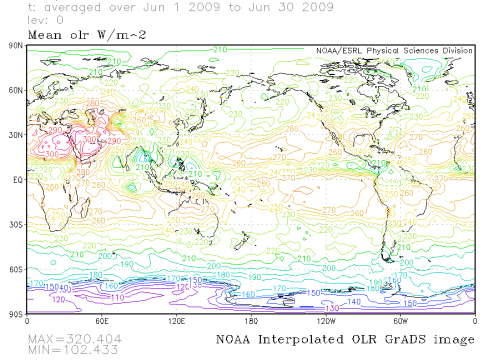
Here’s the measured values by satellite averaged over the whole of June 2009.

Measured Outgoing Longwave Radiation at the top of atmosphere, June 2009

Measured Outgoing Longwave Radiation at the top of atmosphere, June 2009

Of course, the hotter parts of the globe radiate out more longwave energy.

Downwards Longwave Radiation

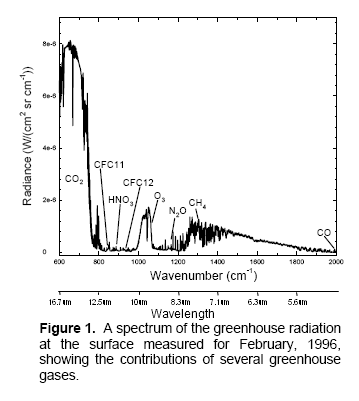
But what does it look like at the earth’s surface to an observer looking up – ie the downwards longwave radiation? If there was no greenhouse effect we should, of course, see zero longwave radiation.

Here are some recent measurements:

Downwards Longwave Radiation at the Earth's Surface, From Evans & Puckrin

Downwards Longwave Radiation at the Earth's Surface, From Evans & Puckrin (2006)

Note that the wavelengths have been added under “Wavenumber” (that convention of spectrum people) and so the graph runs from longer to shorter wavelength.

This is for a winter atmosphere in Canada.

Now what the scientists did was to run a detailed simulation of the expected downwards longwave radiation using the temperature, relative humidity and pressure profiles from radiosondes, as well as a detailed model of the absorption spectra of the various greenhouse gases:

Measured vs Simulated Downward Longwave Radiation at the Surface, Evans & Puckrin

Measured vs Simulated Downward Longwave Radiation at the Surface, Evans & Puckrin

What is interesting is seeing the actual values of longwave radiation at the earth’s surface and the comparison 1-d simulations for that particular profile. (See Part Five for a little more about 1-d simulations of the “radiative transfer equations”). The data and the mathematical model matches very well.

Is that surprising?

It shouldn’t be if you have worked your way through all the posts in this series. Calculating the radiative forcing from CO2 or any other gas is mathematically demanding but well-understood science. (That is a whole different challenge compared with modeling the whole climate 1 year or 10 years from now).

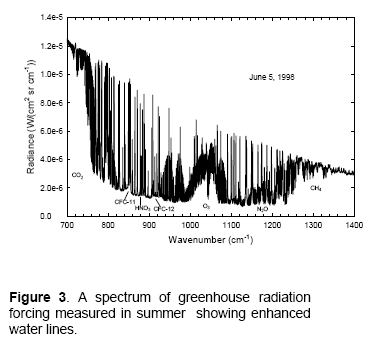
They did the same for a summer profile and reported in that case on the water vapor component:

Downwards Longwave Radiation at the Earth's Surface, Summer

Downwards Longwave Radiation at the Earth's Surface, Summer

As an interesting aside, it’s a lot harder to get the data for the downwards flux at the earth’s surface than it is for upwards flux at the top of atmosphere (OLR). Why?

Because a few satellites racing around can measure most of the radiation coming out from the earth. But to get the same coverage of the downwards radiation at the earth’s surface you would need thousands or millions of expensive measuring stations..

Conclusion

Measurements of longwave radiation at the earth’s surface help to visualize the “greenhouse” effect. For people doubting its existence this measured radiation might also help to convince them that it is a real effect!

If there was no “greenhouse” effect, there would be no longwave radiation downwards at the earth’s surface.

Calculations of the longwave radiation due to each gas match quite closely with the measured values. This won’t be surprising to people who have followed through this series. The physics of absorption and re-emission is a subject which has been extremely thoroughly studied for many decades, in fact back into the 19th century.

How climate responds to the “extra radiation” (radiative forcing is the standard term) from increases in some “greenhouse” gases is whole different story.

More in this series

Part Seven – The Boring Numbers – the values of “radiative forcing” from CO2 for current levels and doubling of CO2.

Part Eight – Saturation – explaining “saturation” in more detail

CO2 Can’t have that Effect Because.. – common “problems” or responses to the theory and evidence presented

AND much more about the downward radiation from the atmosphere – The Amazing Case of “Back-Radiation”Part Two, and Part Three

Reference

Measurements of the Radiative Surface Forcing of Climate, W.J.F. Evans & E. Puckrin, American Meteorological Society, 18th Conference on Climate Variability and Change (2006)

Recap

Part One of the series introduced the shortwave radiation from the sun, the balancing longwave radiation from the earth and the absorption of some of that longwave radiation by various “greenhouse” gases. The earth would be a cold place without the “greenhouse” gases.

Part Two discussed the factors that determine the relative importance of the various gases in the atmosphere.

Part Three and Four got a little more technical – an unfortunate necessity. Part Three introduced Radiative Transfer Equations including the Beer-Lambert Law of absorption. It also introduced the important missing element in many people’s understanding of the role of CO2 – re-emission of radiation as the atmosphere heats up.

Part Four brought in band models. These are equations which quite closely match the real absorption of CO2 (and the other greenhouse gases) as a function of wavelength. They aren’t strictly necessary to get to the final result, but they have an important benefit – they allow us to easily see how the absorption changes as the amount of gas increases. And they are widely used in climate models because they reduce the massive computation time that are otherwise involved in solving the Radiative Transfer Equations. The important outcome as far as CO2 is concerned – “saturation” can be technically described.

Solving the Equations

The equations of absorption and radiation in the atmosphere – the Radiative Transfer Equations – have been known for more than 60 years. Solving the equations is a little more tricky.

Like many real world problems, the radiative processes in the atmosphere can be mathematically described from 1st principles but not “analytically” solved. This simply means that numerical methods have to be used to find the solution.

There’s nothing unproven or “suspicious” about this approach. Every problem from stresses in bridges and buildings to heat dissipation in an electronic product uses this method.

The problem of the effect of greenhouse gases in the atmosphere is formulated with a 1-dimensional model. This is the simplest approach (after the “billiard ball” model we saw in part one). But like any model there are certain assumptions that have to be made – the boundary conditions. And over the last 40 years different scientists have approached the problem from slightly different directions, making comparisons not always easy.

Because the role of CO2 in the atmosphere is causing such concern the results of these models is consequently much more important. And so a lot of effort recently has gone into standardizing the approach. We’ll look at a few results, but first, for those who would like to visualize what modern methods of “numerical analysis” are about – a little digression.. (and for those who don’t, jump ahead to the Ramanathan.. subheading).

Digression on Numerical Methods

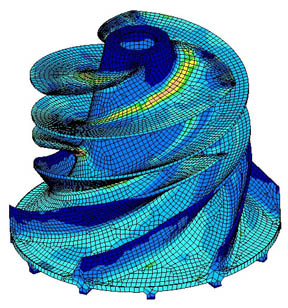
Stress analysis in an impeller

Stress analysis in an impeller

Here’s a visualization of “finite element analysis” of stresses in an impeller. See the “wire frame” look, as if the impeller has been created from lots of tiny pieces?

In this totally different application, the problem of calculating the mechanical stresses in the unit is that the “boundary conditions” – the strange shape – make solving the equations by the usual methods of re-arranging and substitution impossible. Instead what happens is the strange shape is turned into lots of little cubes. Now the equations for the stresses in each little cube are easy to calculate. So you end up with 1000’s of “simultaneous” equations. Each cube is next to another cube and so the stress on each common boundary is the same. The computer program uses some clever maths and lots of iterations to eventually find the solution to the 1000’s of equations that satisfy the “boundary conditions”.

In the case of the radiative transfer equations (RTE) we want to know the temperature profile up through the atmosphere. The atmosphere is divided into lots of thin slices. Each “slice” has some properties attached to it:

  • gases like water vapor, CO2, CH4 at various concentrations with known absorption characteristics for each wavelength
  • a temperature -unknown – this is what we want to find out
  • radiation flowing up and down through the “slice” at each wavelength – unknown  – we also want to find this out

And we have important boundary conditions – like the OLR (outgoing longwave radiation) at the top of the atmosphere. We know this is about 239 W/m2 (see The Earth’s Energy Budget – Part One). Using the boundary conditions, we solve the radiative transfer equations for each slice, and the computer program does this by creating lot of simultaneous equations (energy in each wavelength flowing between each slice is conserved).

Ramathan and Coakley, 1978

Why bring up an old paper? Partly to demonstrate some of the major issues and one interesting approach to solving them, but also to give a sense of history. A lot of people think that the concern over greenhouse gases is something new and perhaps all to do with the IPCC or Al Gore.

Back in 1978, V. Ramanathan and J.A. Coakley’s paper Climate Modeling through Radiative-Convective Models was published in Reviews of Geophysics and Space Physics.

It wasn’t the first to tackle the subject and points to the work done by Manabe and Strickler in 1964. By the way, V. Ramanathan is a bit of a trooper, having published 169 peer-reviewed papers in the field of atmospheric physics from 1972-2009..

I’m going to call the paper R&C – so R&C cover the detailed maths of course, but then discuss how to deal with the “problem” of convection.

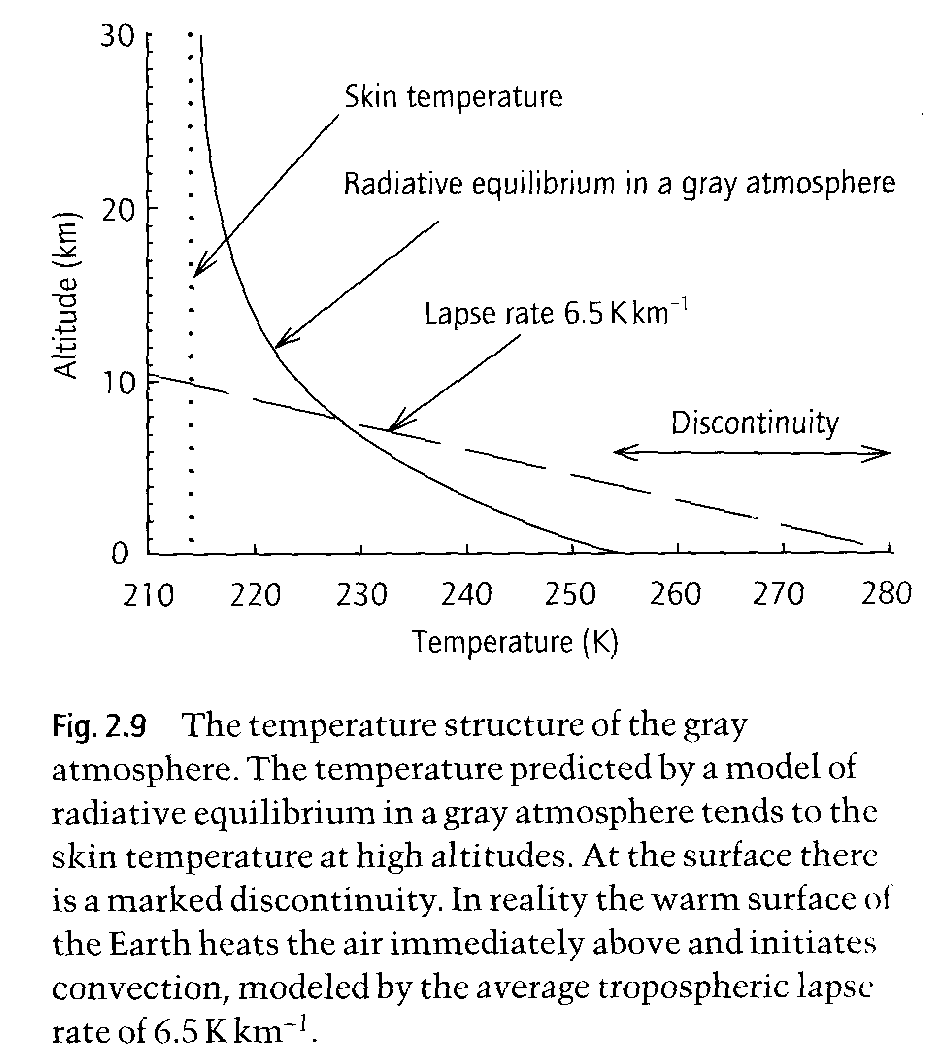
In the lower part of the atmosphere heat primarily moves through convection. Hot air rises – and consequently moves heat. Radiation also transfers heat but less effectively. The last section of Part Three introduced this concept with the “gray model”. Here was the image presented:

Radiative-equilibrium-Grey-model-Hugh-Coe

The Gray Model of Radiative Equilibrium, from "Handbook of Atmospheric Science" Hewitt and Jackson (2003)

Remember that each section of the atmosphere radiates energy according to its temperature. So when we are solving the equations that link each “slice” of the atmosphere we have to have a term for temperature.

But how do we include convection? If we don’t include it our analysis will be wrong but solving for convection is a very different kind of problem, related to fluid dynamics..

What R&C did was to approach the numerical solution by saying that if the energy transfer from radiation at any point in their vertical profile resulted in a temperature gradient less than that from convection then use the known temperature profile at that point. And if it was greater than the temperature gradient from convection then we don’t have to think about convection in this “slice” of the atmosphere.

By the way, the terminology around how temperature falls with height through the atmosphere is called “the lapse rate” and it is about 6.5K/km.

These assumptions in the two cases didn’t mean that absorption and re-radiation were ignored in the lower part of the atmosphere – not at all. But the equations can’t be solved without including temperature. The question is, do we solve the equations by calculating temperature – or do we use an “externally imposed” temperature profile?

There is lots to digest in the paper as it is a comprehensive review. The few of interest for this post:

Doubling CO2 from 300ppm to 600ppm

  • Longwave radiative forcing at the top of the troposphere – 3.9W/m2
  • Surface temperature increase 1.2°C
  • Result of change in radiative forcing when relative humidity stays constant (rather than absolute humidity staying constant) – surface temperature increase is doubled

(Note: this is not quite the “standardized” version of doubling considered today of 287ppm – 576ppm)

Relative Effect of CO2 and water vapor

This is under 1978 conditions of 330ppmv for CO2 and in a cloudy sky. Here they run the calculation with and without different gases and look at how much more outgoing longwave radiation there is, i.e. how much longwave radiation is absorbed by each gas. The problem is complicated by the fact that there is an overlap in various bands so there are combined effects.

  • Removing CO2 (and keeping water vapor) – 9% increase in outgoing flux
  • Removing water vapor (and keeping CO2) – 25% increase in outgoing flux

Everyone (= lots of people in lots of websites who probably know a lot more than me) says that this paper calculates the role of CO2 between 9% and 25% but that’s not how I read it. Perhaps I missed something.

Extract from Ramanathan & Coakley (1978)

Extract from Ramanathan & Coakley (1978) - Relative contribution of H2O, CO2 and O3

What it says to me is that overlap must be significant because if we take out water vapor it is only a 25% effect. And if we take out CO2 it is a 9% effect. (I have emailed the great V. Ramanathan to ask this question, but have not had a response so far.)

Therefore, guessing at the overlap effect, or more accurately, assigning the overlap equally between the two, water vapor has about 2.5 times the effect of CO2. As you will see in the next paper, this is about what our later results show.

So, more than 30 years ago, atmospheric physicists calculated some useful results which have been confirmed and refined by later scientists in the field.

Kiehl and Trenberth 1997

Earth’s Annual Global Mean Energy Budget by J.T.Kiehl and Kevin Trenberth was published in Bulletin of the American Meteorological Society in 1997. (The paper is currently available from this link)

The paper is very much worth a read in its own right as it reviews and updates the data at the time on the absorption and reflection of solar radiation and the emission and re-absorption of longwave radiation. (There is an updated paper – that free link currently works – in 2008 but it assumes the knowledge of the 1997 paper so the 1997 paper is the one to read).

This paper doesn’t assess the increase in radiative forcing or the consequent temperature change that might imply from the current levels of CO2, CH4 etc. Instead this paper is focused on separating out the different contributions to shortwave and longwave absorbed and reflected and so on.

What is interesting about this paper for our purposes in that they quantify the relative role of CO2 and water vapor in clear sky and cloudy sky conditions.

To do the calculation of absorption and re-emission of longwave radiation they used the US Standard Atmosphere 1976 for vertical profiles of temperature, water vapor and ozone. They assumed 353ppmv of CO2, 1.72ppmv of CH4 and 0.31 of N2O, all well mixed. Note that, like R&C, they assumed a temperature profile to carry out the calculations because convection dominates heat movement in the lower part of the atmosphere.

Two situations are considered in their calculations – clear sky and cloudy sky.

Let’s look at the clear sky results:

Upward Longwave Radiation, Numbers from Kiehl & Trenberth

Upward Longwave Radiation, Numbers from Kiehl & Trenberth (1997)

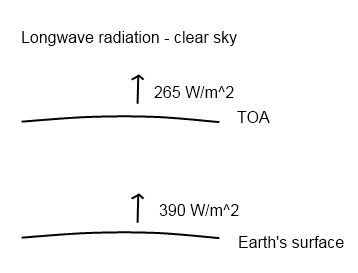
The radiation value from the earth’s surface matches the temperature of 288K (15°C) – you can see how temperature and radiation emitted are linked in the maths section at the end of CO2 – An Insignificant Trace Gas? Part One.

The value calculated initially at the top of atmosphere was 262 W/m2, the value was brought into line with the ERBE measured value of 265 W/m2 by a slight change to the water vapor profile, see Note 1 at the end.

Of course, the difference between the surface and top of atmosphere values is accounted for by absorption of long wave radiation by water vapor, CO2, etc. No surprise to those who have followed the series to this point.

By comparison the cloudy sky numbers were:

  • Surface – 390W/m2 (no surprise, the same 288K surface)
  • TOA – 235W/m2. More radiation is absorbed when clouds are present. See Note 2 at end.

Now onto the important question: of the 125W/m2 “clear sky greenhouse effect”, what is the relative contribution of each atmospheric absorber?

The only way to calculate this is to remove each gas in turn from the model and recalculate.

Clear Sky

  • Water vapor contributes 75W/m2 or 60% of the total
  • CO2 contributes 32W/m2 or 26% of the total

Cloudy Sky

  • Water vapor contributes 51W/m2 or 59% of the total
  • CO2 contributes 24W/m2 or 28% of the total

Note that significant longwave radiation is also absorbed by liquid water in clouds.

Conclusion

Using these three elements:

  • the well known equations of radiative transfer (basic physics)
  • the measured absorption profiles of each gas
  • the actual vertical profiles of temperature and concentrations of the various gases in the atmosphere

The equations can be solved in a 1-d vertical column through the atmosphere and the relative effects of different gases can be separated out and understood.

Additionally, the effect in “radiative forcing” of the current level of CO2 and of CO2 doubling (compared with pre-industrial levels) can be calculated.

This radiative forcing can be applied to work out the change in surface temperature – with “all other things being equal”.

“All other things being equal” is the way science progresses – you have find a way to separate out different phenomena and isolate their effects.

The temperature increase in the R&C paper of 1.2°C only tells us the kind of impact from this level of radiative forcing. Not what actually happens in practice, because in practice we have so many other factors affecting our climate. That doesn’t mean it isn’t a very valuable result.

Now the value of radiative forcing will be slightly changed if  “all other things are not equal” but if the concentration of water vapor, CO2, CH4, etc are similar to our model the changes will not be particularly significant. It is only really the actual temperature profile through the atmosphere that can change the results. This is affected by the real climate of 3d effects – colder or warmer air blowing in, for example. Overall, from comparing the results of 3-d models – ie the average results of lots of 1-d models, the values are not significantly changed – more on this in a later post.

We see that CO2 is around 25% of the “greenhouse” effect, with water vapor at around 60%.

Note that the calculation uses the “US Standard Atmosphere” – different water vapor concentrations will have a significant impact, but this is an “averaged” profile.

The only way to really determine the numbers is to run the RTE (radiative transfer equations) through a numerical analysis and then redo the calculations without each gas.

The two questions to ask if you see very different numbers is “under what conditions?” and more importantly “how did you calculate these numbers?” Hopefully, for everyone following the series it will be clear that you can’t just eyeball the spectral absorption and the average relative concentrations of the gases and tap it out on a calculator.

I thought it would be all over by Part Three, but CO2 is a gift that keeps on giving..

Updates:

CO2 – An Insignificant Trace Gas? Part Six – Visualization

CO2 – An Insignificant Trace Gas? Part Seven – The Boring Numbers

CO2 – An Insignificant Trace Gas? – Part Eight – Saturation

See also – Theory and Experiment – Atmospheric Radiation – demonstrating the accuracy of the radiative-convective model from experimental results

Notes and References

Note 1 – As Kiehl and Trenberth explain, there are some gaps in our knowledge in a few places of exactly how much energy is absorbed or reflected from different components under different conditions. One of the first points that they make is that the measurement of incoming shortwave and outgoing longwave (OLR) are still subject to some questions as to absolute values. For example, the difference between incoming solar and the ERBE measurement of OLR is 3W/m2. There are some questions over the OLR under clear sky conditions. But for the purposes of “balancing the budget” a few numbers are brought into line as the differences are still within instrument uncertainty.

Note 2 – I didn’t want to over-complicate this post. Cloudy sky conditions are more complex. Compared with clear skies clouds reflect lots of solar (shortwave) radiation, absorb slightly more solar radiation and also absorb more longwave radiation. Overall clouds cool our climate.

References

Climate Modeling through Radiative-Convective Models , V. Ramanathan and J.A. Coakley, Reviews of Geophysics and Space Physics (1978)

Earth’s Annual Global Mean Energy Budget , J.T.Kiehl and Kevin Trenberth, Bulletin of the American Meteorological Society (1997)

In the first post about CO2 I included a separate maths section which showed the energy budget for the earth and also derived how much energy we receive from the sun. A comment today reminded me that I should do a separate article about this topic. I’ve seen lots of comments on other blogs where people trip up over the basic numbers. It’s easy to get confused.

Don’t worry, there won’t be a lot of maths. This is to get you comfortable with some basics.

Energy from the Sun

It’s quite easy to derive how much energy we expect from the sun, but the good news is that since 1978 there have been satellites measuring it.

The solar “constant” is often written as S, so we’ll keep that convention. I put “constant” in quotes because it’s not really a constant, but that’s how it’s referred to. (And anyway, the changes year to year and decade to decade are very small – a subject for another post, another day).

The first important number, S = 1367 W/m2

Note the units – the amount of energy per second (the Watts) per unit area (the meters squared). By the way, sorry America, the science world moved on. We won’t convert it to ft2..

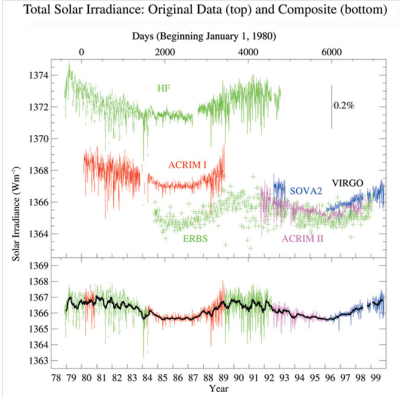
Just for illustration here’s the satellite measurements over 20 years:

Solar Radiation Received - measured by Satellites

Solar Radiation Received - measured by Satellites

For anyone a little confused, note that different satellites get different absolute measurements, it is the relative measurements that are more accurate.

Comparing Apples and Oranges? Surface Area vs Area of a Disc

The sun is really long way away from the earth – about 150M km (93M miles). We measure the incoming solar radiation at the top of the atmosphere in W/m2.

So how much total energy can be absorbed into the earth’s climate system from this solar radiation?

Solar radiation received against a "2d disc"

Solar radiation received against a "2d disc". From Elementary Climate Physics, Taylor (2005)

Hopefully the answer will become more obvious by looking at the image above. The solar radiation from a long way away strikes the effective 2d area that the earth cuts out.

A 2d area – or a flat disc – has area, A = πr2

Therefore, the total energy received by the earth = Sπr2

[Radius of the earth = 6.37 x 10⁶ m (6,370 km) so Energy per second from the sun = 174,226,942,644,300,000 W  also written as 1.74 x 10¹⁷ W]

It’s a really big number, so to make everything easier to visualize, climate scientists generally stay with W/m2, rather than numbers like 1.74 x 10¹⁷ W.

Now the real surface area of the earth is actually, Ae= 4πr2 (not πr2)

(Area of earth, Ae= 510M km2, or 5.1×10¹⁴m2)

Why isn’t the energy received by the sun = S x 4πr2?

Look back at the graphic – is the sun shining equally on every part of the earth every second, for all 24 hours of the day? It’s not. It’s shining onto one side of the earth. It’s night time for half the world at any given moment.

So think of it like this – the absolute maximum area receiving the sun’s energy on average can only be half of the surface area of the earth – 2πr2 (=4πr2/2)

But that’s not the end of the story. Picture someone where the sun is right down near the horizon. It’s still daytime but obviously that part of the earth is not receiving 1367W/m2 – they are receiving a lot less. In fact, the only spot on earth where someone receives 1367W/m2 is where the sun is directly overhead. So the effective area receiving the solar constant of 1367 W/m2 can’t even be as high as 2πr2.

So if the idea that solar radiation only strikes an effective area of πr2 is still causing you problems, this is the concept that might help you.

Linking Incoming Solar Radiation to the Earth’s Outgoing Radiation

The earth radiates out energy in a way that is linked to the surface temperature. In fact it is proportional to the fourth power of absolute temperature.

As we think about the earth radiating out energy, it might be clearer why we labored the point earlier about the area that the sun’s energy was received over.

Take a look at that graphic again. The energy from the sun hits an effective 2d disc with area = πr2.

The earth radiates out energy from its whole surface area = 4πr2.

So to be able to compare “apples and oranges”, when climate scientists talk about energy balance and the climate system they usually convert radiation from the sun into the effective radiation averaged across the complete surface of the earth.

This is simply 1367/4 = 342.

The second important number, incoming solar radiation at the top of atmosphere = 342 W/m2 (averaged across the whole surface of the earth).

Some energy is reflected but before we consider that note that this doesn’t mean that each square meter of the earth receives 342 W/m2 – it’s just the average. The equator receives more, the poles receive less.

Albedo

Not all of this 342 W/m2 is absorbed. The clouds, aerosols, snow and ice reflect a lot of radiation. Even water reflects a few percent. On average, about 30% of the solar radiation is reflected back out. A lot of slightly different numbers are used because it’s difficult to measure average albedo.

The third important number, solar radiation absorbed into the climate system = 239 W/m2

This is simply 342 * (100% – 30%). You see slightly different numbers like 236, 240 – all related to the challenges of accurate measurement of albedo.

Some of the radiation is absorbed in the atmosphere, and the rest into the land and oceans.

The Equation

Energy radiated out from the climate system must balance the energy received from the sun. This is energy balance. If it’s not true then the earth will be heating up or cooling down. Even with current concerns over global warming the imbalance is quite small. And so, as a starting point, we say that energy radiated out = energy absorbed from the sun.

Energy radiated from the earth, Ee = S (1- A) / 4  in W/m2

where A = albedo (as a number between 0 and 1, currently 0.3)

Conclusion

The solar constant, S = 1367 W/m2

The solar radiation at the top of atmosphere averaged over the whole surface of the earth = 342 W/m2

The solar radiation absorbed by the earth’s climate system = 239 W/m2 (about 28% into the atmosphere and 72% into the earth’s surface of land, oceans, ice, etc)

Therefore, the approximate radiation from the earth’s climate system at the top of atmosphere also equals 239 W/m2.

These numbers are useful to remember.

Update – new post The Earth’s Energy Budget – Part Two

Update – new post The Earth’s Energy Budget – Part Three

Recap

Part One opened up the topic and introduced the simple “billiard ball” or zero-dimensional analysis of the earth’s climate system. The sun radiates “shortwave” energy which is absorbed in the atmosphere and the earth’s surface. This heats up the earth’s climate system and it radiates out “longwave” energy.

The longwave energy gets significant absorption from water vapor, CO2 and methane (among other less important gases). This absorption heats up the atmosphere which re-radiates long wave energy both up and back down to the earth’s surface.

It is this re-radiation which keeps the earth’s surface at around +15°C instead of -18°C.

Part Two looked at why different gases absorb and radiate different proportions of energy – what the factors are that determine the relative importance of a “greenhouse” gas. Also why some gases like O2 and N2 absorb almost nothing in the longwave spectrum.

The Part Three introduced Radiative Transfer Equations and finished up with a look at what is called the gray model of the atmosphere. The gray model is useful for getting a conceptual understanding of how radiative transfer creates a temperature profile in the atmosphere.

However, part three didn’t finish up with enlightenment on the complete picture of CO2. The post was already long enough.

In this post we will look at “band models” and explain a little about saturation.

Band Models

Many decades ago when physicists had figured out the radiative transfer equations and filled up books with the precise and full derivations there was an obvious problem.

There was clearly no way to provide an analytical solution to how longwave radiation was absorbed and re-emitted through the atmosphere. Why? Because the actual absorption is a very complex and detailed function.

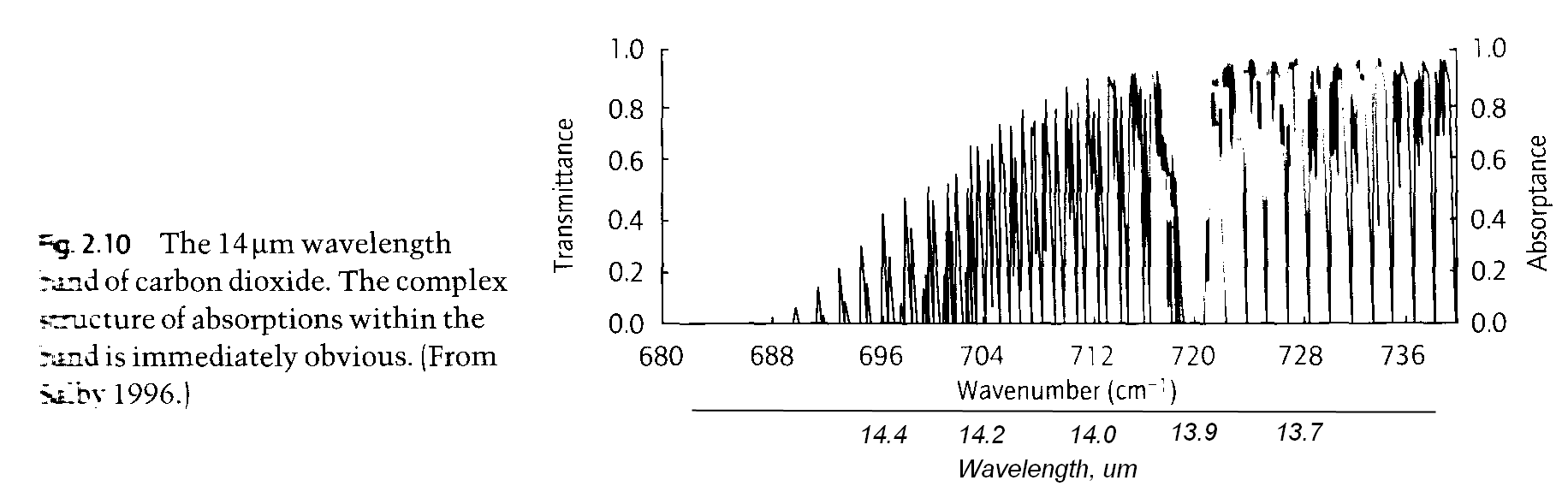
For example, as shown in an earlier post in the series, here is one part of the CO2 absorption spectrum:

CO2 spectral lines from one part of the 15um band

From "Handbook of Atmospheric Sciences", Hewitt & Jackson 2003

The precise structure of the absorption is also affected by pressure broadening as well as a couple of other factors.

So long before powerful computers were available to perform a full 1-d model through the earth’s atmosphere, various scientists started working out “parameterizations” of the bands.

What does this mean? Well, the idea is that instead of actually having to look up the absorption at each 0.01μm of the longwave spectrum, instead you could have an equation which roughly described the effect across one part of the band.

Goody in 1952 and Malkmus in 1967 proposed “narrow band” methods. Subsequently others proposed “wide band” methods. Later researchers analyzed and improved these band paramaterizations.

Without using these parameterizations, even today, with very powerful computers, it is weeks of computational time to calculate the 1-d radiative transfer function for the atmosphere for one profile.

It’s important to note that the parameterizations can be tested and checked. Kiehl and Ramanathan did a big study in 1983 and showed that many of the models were well within 10% error compared with the detailed line by line calculations.

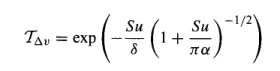
Here is one band model:

Random Band Model

Random Band Model

Looks ugly doesn’t it? But it makes the calculations a million times easier than the detailed spectral lines all the way from 4μm up to 30μm.

The first term, TΔν, is transmittance – it’s just how much radiation gets through the gas.

Transmittance = I/Io

Transmittance = I/Io

If you don’t mind a little maths – otherwise skip to the next section

Let’s explain the equation and what it means for saturation.

First of all what are the variables?

TΔν – is the transmittance in the spectral interval Δν. Transmittance is the fraction of radiation that passes through: 0 – no radiation gets through;  1 – all the radiation gets through.

S, α and δ are all part of the band model: S – average line strength; α – line width; δ – line spacing

u – the absorber amount in the path (this is the important one to keep an eye on)

By the definition of Transmittance,TΔν = e, where χ is optical thickness. It’s the Beer Lambert law that we already saw in part three.

An alternative way of writing this is χ = – log (TΔν) , that is, the optical thickness is the log of the transmittance

Well, even the tricky band model equation can be simplified..

If   Su/πα << 1 (this means if the expression on the left side is a lot less than 1 – which happens when there isn’t “very much” of the absorbing gas)

Then the above question can be simplified to:

TΔν = exp (-Su/δ)

This means the optical thickness of the path is directly proportional to the amount of gas, u

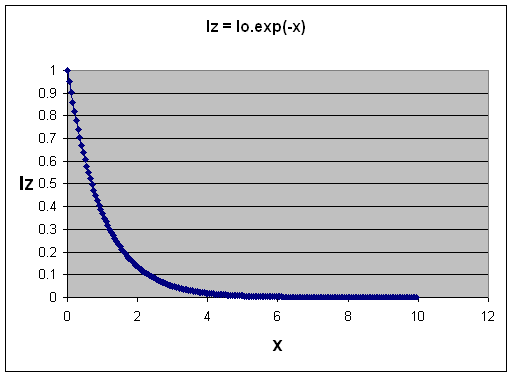
So in part three when we looked at the Beer-Lambert law we saw this shape of the curve:

Absorption of Radiation as "optical thickness" increases, Iz=I0.exp (-x)

Transmittance of Radiation as "optical thickness" increases

But we couldn’t properly evaluate the expression because the absorption variable was a complex function of wavelength.

What the band model allows us to do is to say that under one condition, the weak condition, the optical thickness is a linear function of absorber amount, and therefore that the amount of radiation getting through the atmosphere – the Transmittance – follows this form: e

And in another condition, if

If   Su/πα >> 1 (much greater than 1, which means there is “lots” of the absorbing gas)

Then the band model can be “simplified” to:

TΔν = exp (-(Su)1/2/( δ √(πα)) )

Ok, not too easy to immediately see what is going on? But S, δ and α are constants for a given absorbing gas..

So it is easy to see what is going on:

TΔν is proportional to exp (-u1/2), i.e., proportional to exp (-√u)

Or as optical thickness, χ =- log (TΔν),

Optical thickness, χ is proportional to √u

The optical thickness, in the strong condition, is proportional to the square root of the amount of the absorber.

“Saturation” and how Transmittance and Optical Thickness Depend on the Concentration of CO2

If you skipped the maths above, no one can blame you.

Recapping what we learnt there –

In the weak condition, if we double the concentration of CO2, the optical thickness doubles and in the strong condition if we increase the concentration of CO2 by a factor of 4, the optical thickness doubles

And what were the weak and strong conditions? They were mathematically defined, but keeping it non-technical: weak is “not much” CO2 and strong is “a lot” of CO2.

But we can say that in the case of CO2 (in the 15μm band) through the troposphere (lower part of the atmosphere) it is the strong condition. And so if CO2 doubled, the optical thickness would increase by √2 (=1.4).

Simple? Not exactly simple, but we made progress. Before, we couldn’t get any conceptual understanding of the problem because the absorption spectrum was lots of lines that prevented any analytical formula.

What we have achieved here is that we have used a well-proven band model and come up with two important conditions that allow us to define the technical meaning of saturation – and even better, to see how the increasing concentration of CO2 impacts the absorption side of the radiative transfer equations.

But it’s not over yet for “saturation”, widely misunderstood as it is.. Remember that absorption is just one half of the radiative transfer equations.

Before we finish up, optical thickness isn’t exactly an intuitive or common idea, and neither is e-√χ. So here is a idea of numerically how transmittance changes under the weak and strong conditions as the concentration increases. Remember that transmittance is nice and simple – it is just the proportion of radiation that gets through the absorbing gas.

Transmittance = I/Io

Transmittance = I/Io

Suppose our optical thickness, χ = 1.

T = 0.36        =exp(-1)

Under the weak condition, if we double our optical thickness, χ = 2;     T = 0.13    =exp(-2)

and double it again, χ = 4;     T = 0.017    =exp(-4)

Under the strong condition, double our optical thickness, χ = 2;     T = 0.24    =exp(-√2)=exp(-1.41)

and double it again, χ = 4;     T = 0.13      =exp(-√4) = exp(-2)

Note: these numbers are not meant to represent any specific real world condition. It just demonstrates the kind of change you get in the amount of radiation being transmitted as the gas concentration increases under the two different conditions. It helps you get an idea of e vs e-√χ. Assuming that a few people would want to know..

Conclusion

To carry out the full 1-d radiative transfer equations vertically through the atmosphere climate scientists usually make use of band models. They aren’t perfect but they have been well tested against the “line by line” (LBL) absorption spectra.

Because they provide a mathematical parameterization they also allow us to see conceptually what happens when the concentration of an important gas like CO2 is increased. We can calculate the transmittance or absorptance that takes place.

It helps us understand “saturation” – which we have done by looking at the “strong” and “weak” conditions for optical thickness.

This term “saturation” is widely misused and conveys the idea that CO2 has done all its work and adding more CO2 doesn’t make any difference. As we will see in a future part of this series, due to the fact that gases that heat up also radiate, adding more CO2 does increase the radiative forcing at the surface – even if CO2 could have no more effect through the lower part of the atmosphere.

Well, that’s to come. What we have looked at here is some more detail of exactly how transmittance and optical thickness increase as CO2 increases.

The next post will look at the 1-dimensional model results..

UpdatePart Five now published

Reference

CO2 Radiative Paramaterization Used in Climate Models: Comparison with Narrow Band Models and With Laboratory Data, J.T. Kiehl and V. Ramanathan (1983)

Recap

Part One of the series started with this statement:

If there’s one area that often seems to catch the imagination of many who call themselves “climate skeptics”, it’s the idea that CO2 at its low levels of concentration in the atmosphere can’t possibly cause the changes in temperature that have already occurred – and that are projected to occur in the future. Instead, the sun, that big bright hot thing in the sky (unless you live in England), is identified as the most likely cause of temperature changes.

And covered the “zero-dimensional” model of the sun and the earth. Also known as the “billiard ball” model. It was just a starting point to understand the very basics.

In Part Two we looked a little closer at why certain gases absorbed energy in certain bands and what the factors were that made them more, or less, effective “greenhouse” gases.

In this part, we are going to start looking at the “1-dimensional” model. I try and keep any maths as basic as possible and have separated out some maths for the keen students.

When you arrive at a new subject, the first time you see an analysis, or model, it can be confusing. After you’ve seen it and thought about it a few times it becomes more obvious and your acceptance of it grows – assuming it’s a good analysis.

So for people new to this, if at first it seems a bit daunting but you do want to understand it, don’t give up. Come back and take another look in a few days..

Models

If your background doesn’t include much science it’s worth understanding what a “model” is all about. Especially because many people have their doubts about GCM’s or “Global Climate Models”.

One of the ways that a model of a physics (or any science) problem is created is by starting from first principles, generating some equations and then finding out what the results of those equations are. Sometimes you can solve this set of equations “analytically” – which means the result is a formula that you can plot on a graph and analyze whichever way you like. Usually in the real world there isn’t an “analytical” solution to the problem and instead you have to resort to numerical analysis which means using some kind of computer package to calculate the answer.

The starting point of any real world problem is a basic model to get an understanding of the key “parameters” – or key “players” in the process. Then – whether you have an analytical solution or have to do a numerical analysis doesn’t really matter – you play around with the parameters and find out how the results change.

Additionally, you look at how closely the initial equations matched the actual situation you were modeling and that gives you an idea of whether the model will be a close fit or a very rudimentary one.

And you take some real-world measurements and see what kind of match you have.

Radiative Transfer

In the “zero dimensional” analysis we used a very important principle:

Energy into a system = Energy out of a system, unless the system is warming or cooling

The earth’s climate was considered like that for the simple model. And for the simple model we didn’t have to think about whether the earth was heating up, the actual temperature rise is so small year by year that it wouldn’t affect any of those results.

In looking at “radiative transfer” – or energy radiated through each layer of the atmosphere – this same important principle will be at the heart of it.

What we will do is break up the atmosphere into lots of very thin sections and analyze each section. The mathematical tools are there (calculus) to do that. The same kind of principles are applied, for example, when structural engineers work out forces in concrete beams – and in almost all physics and engineering problems.

And when we step back and try and re-analyze, again it will be on the basis of Energy in = Energy out

If you are new to ideas of radiation and absorption, go back and take a look at Part One – if you haven’t done so already.

In this first look I’ll keep the maths as light as possible and try and explain what it means. If following a little maths is what you want, there is some extra maths separated out.

First Step – Absorption

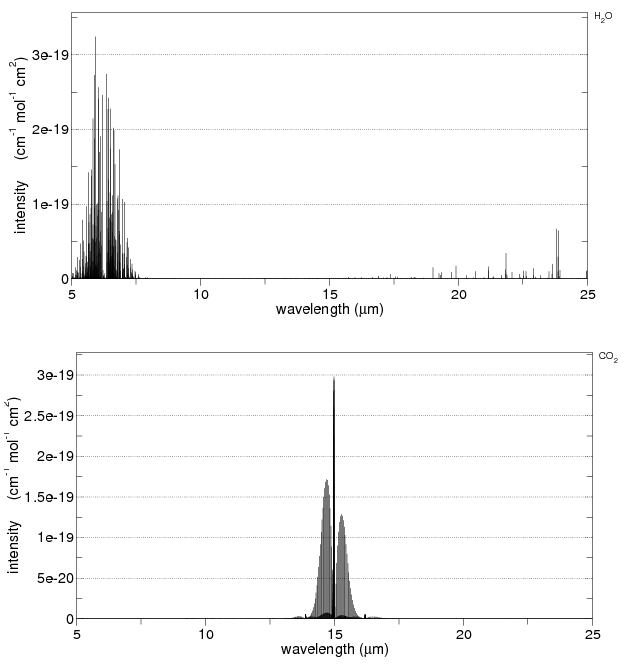
As we saw in part one, radiation absorbed by a gas is not constant across wavelengths. For example, here is CO2 and water vapor:
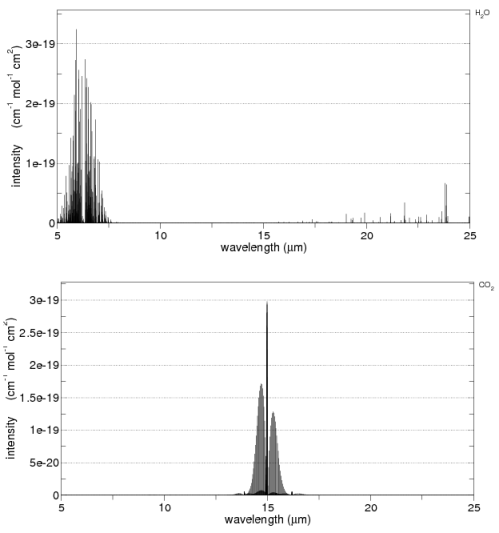
CO2 and water vapor absorption, by SpectraCalc from the HITRANS database

CO2 and water vapor absorption, by spectracalc.com from the HITRANS database

What we want to know is if we take radiation of a given wavelength which travels up through the atmosphere, how much of the radiation is absorbed?

We’ll define some parameters or “variables”.

I(λ) – The intensity, I, of radiation which is a function of wavelength, λ

I0(λ) –  is the initial or starting condition (the intensity at the earth’s surface).

z – the vertical height through the atmosphere

n – how much of an absorbing gas is present

σ(λ) – absorption cross-section at wavelength λ (this parameter is dependent on the gas we are considering, and identifies how effective it is at capturing a photon of radiation at that wavelength)

The result of a simple mathematical analysis produces an equation that says that as you:

  • increase the depth through the atmosphere that the radiation travels
  • or the concentration of the gas
  • or its “absorption cross-section”

Then more radiation is absorbed. Not too surprising!

When the concentration of the gas is independent of depth (or height) the mathematical result becomes:

Iz = I0(λ).exp(-nσ(λ)z) also written as Iz = I0(λ).e-nσ(λ)z

This is the Beer-Lambert Law. The assumption that the number of gas molecules is independent of depth isn’t actually correct in the real world, but this first simple approximation gets us started. We could write n(z) in the equation above to show that n was a function of depth through the atmosphere.

[In the above equation, e is the natural log value of 2.781 that comes up everywhere in natural processes. To make complex equations easier to read, it is a convention to write “e to the power of x” as “exp(x)”]

Here’s what the function looks like as “nσ(λ)z” increases – I called this term “x” here in this graph.
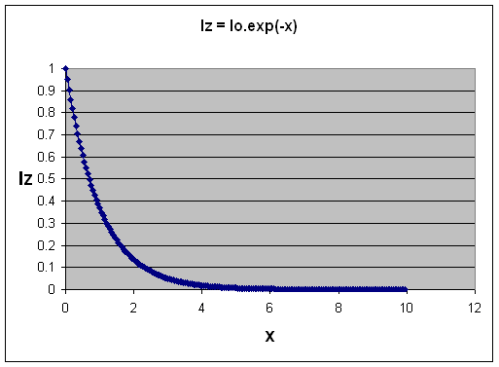
Typical form of many natural processes, Iz=I0.exp (-x)

Transmittance of Radiation as "optical thickness" (x) increases.

It’s not too hard to imagine now. Iz is the amount of radiation making it through the gas. Iz=1 means all of it got through, and Iz=0 means none of it got through.

As you increase vertical height through the gas, or the amount of the gas, or the absorption of the gas, then the amount of radiation that gets through decreases. And it doesn’t decrease linearly. You see this kind of shape of curve everywhere in nature including the radiation decay of uranium..

This result is not too surprising to most people. But it’s knowing only this part which has many confused, because the question comes – about CO2 – doesn’t it saturate?

Isn’t it true that as CO2 increases eventually it has no effect? And haven’t we already reached that point?

Excellent questions. Skip the maths derivation of this section if you aren’t interested to find out about our Second Step – Radiation

First Step – Absorption – Skip this, it’s the Maths

You can skip this if you don’t like maths.

The intensity of light of wavelength λ is I(λ). This light passes through a depth dz (“thin slice”) of an absorber with number concentration n, and absorption cross-section σ(λ), and so is reduced by an amount dI(λ) given by:

dI(λ) = -I(λ)nσ(λ)dz = I(λ)dχ                   [equation 1]

where χ is defined as optical depth. It’s just a convenient new variable that encapsulates the complete effect of that depth of atmosphere at that wavelength for that gas.

We integrate equation 1 to obtain the intensity of light transmitted a distance z through the absorber Iz(λ):

Iz(λ) = I0(λ) exp{-∫nσ(λ)dz}                 [equation 2]
[note the integral is from 0 to z – not able to get the webpage to display what I want here]

In the case where the concentration of the absorbing gas is independent of the depth through the atmosphere the above equation is simplified to the Beer Lambert Law

Iz = I0(λ).exp(-nσ(λ)z) also written as Iz = I0(λ).e-nσ(λ)z

Note that this assumption is not strictly true of the atmosphere in general – the closer to the surface the higher the pressure and, therefore, there is more of absorbing gases like CO2.

Second Step – Radiation

Once the atmosphere is absorbing radiation something has to happen.

The conceptual mistake that most people make who haven’t really understood radiative transfer is they think of it something like torchlight trying to shine through sand – once you have enough sand nothing gets through and that’s it.

But energy absorbed has to go somewhere and and in this case the energy goes into increased heat of that section of the atmosphere, as we saw in Part Two of this series.

In general, and especially true in the troposphere (the lower part of the atmosphere up to around 10km), the increased energy of a molecule of CO2 (or water vapor, CH4, etc) heats up the molecules around it – and that section of the atmosphere then radiates out energy, both up and down.

Let’s introduce a new variable, B = intensity of emitted radiation

The relationship between I (radiation absorbed) – and B (radiation emitted) – integrated across all wavelengths, all directions and all surfaces is linked through conservation of energy.

But these two parameters are not otherwise related. Making it more difficult to conceptually understand the problem.

I depends on the radiation from the ground, which in turn is dependent on the energy received from the sun and longwave radiation re-emitted back to the ground.

Whereas B is a function of the temperature of that “slice” of the atmosphere.

The equation that includes absorption and emission for this thin “slice” through the atmosphere becomes:

dI = -Inσdz + Bnσdz = (I – B)dχ  (where χ is defined as optical depth)

dI is “calculus” meaning the change in I, dz is the change in z and dχ is the change in χ, or optical thickness.

What does this mean? Well, if I could have just written down the “result” like I did in the section on absorption, I would have done, but because it has become more difficult, instead I have written down the equation linking B and I in the atmosphere..

What it does mean is that the more radiation that is absorbed in a given “slice”  of the atmosphere, the more it heats up and consequently the more that “slice” then re-emits radiation across a spectrum of wavelengths.

Solving the Equation to Find out what’s Going on

There are two concepts introduced above:

  • absorption, relatively easy to understand
  • emission, a little harder but linked to absorption by the concept “energy in = energy out”

From here there are two main approaches..

  1. One approach is called the grey model of radiative transfer, and it uses a big simplification to show how radiation moves energy through the atmosphere.
  2. The other approach is to really solve the equations using numerical analysis via computers.

The problem is that we have some equations but they aren’t simple. We saw the Beer-Lambert law of absorption links to the emission in a given section of the atmosphere, but we know that the absorption is not constant across wavelengths.

So we have to integrate these equations across wavelengths and through the atmosphere (to link radiation flowing through each “slice” of the atmosphere)

To really find the solutions – how much longwave radiation gets re-radiated back down to the earth’s surface as a result of CO2, water vapor and methane – we need a powerful computer with all of the detailed absorption bands of every gas, along with the profile of how much of each gas at each level in the atmosphere.

The good news is that they exist. But the bad news is that you can’t grab the equation and put it in excel and draw a graph – and find out the answer to that burning question that you had.. what about the role of CO2? and how does that compare with the role of water vapor?

And I still haven’t spelt out the saturation issue..

Finding out that the subject is more complex that it originally appeared is the first step to understanding this subject!

The important concept to grasp before we move on is that it is not just about absorption, it’s also about re-emission.

The Gray Model

The “gray” model is very useful because it allows us to produce a simple mathematical model of the temperature profile through the atmosphere. We can do this because instead of thinking about the absorption bands, instead we assume that the absorption across wavelengths is constant.

What? But that’s not true!

Well, we do it to get a conceptual idea of how energy moves through the atmosphere when absorption and re-emission dominate the process. We obviously don’t expect to find out the exact effect of any given gas. The gray model uses the equations we have already derived and adds the fact that the absorber varies in concentration as a function of pressure.
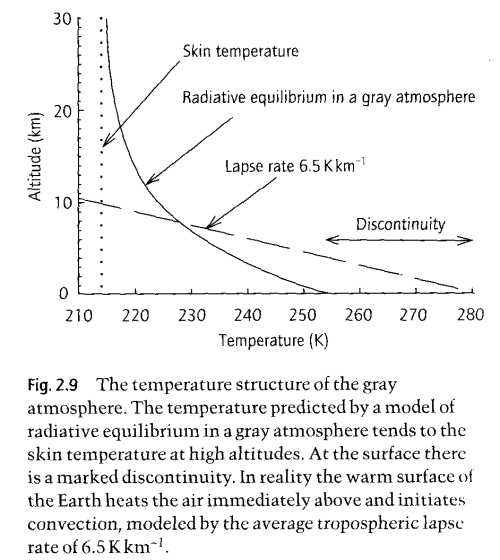
Radiative-equilibrium-Grey-model-Hugh-Coe

The Gray Model of Radiative Equilibrium, from "Handbook of Atmospheric Science" Hewitt and Jackson (2003)

The graph shown here is the result of developing the equations we have already seen, both for absorption and the link between absorption and re-emission.

The equations totally ignore convection! On the graph you can see the real “lapse rate”, which is the change in temperature with altitude. This is dominated by convection, not by radiation.

So how does the gray model help us?

It shows us how the temperature profile would look in an atmosphere with no convection and where there is significant and uniform absorption of longwave radiation.

Convection exists and is more significant than radiation in the troposphere – for moving energy around! Not for absorbing and re-emitting energy. The significance of the real “environmental lapse rate” of 6.5K/km is that it will change the re-emission profile. So it complicates the numerical analysis we need to do. It means that when the numerical analysis is done of the equations we have already derived, the real lapse rate is one more factor that has to be added to that 1-d analysis.

To get a conceptual feel for how that might change things – remember how the radiation spectrum changes with temperature – not a huge amount. So at each layer in the atmosphere the radiation spectrum using the real atmospheric temperature profile will be slightly different than using the “gray model”. But it can be taken into account.

Conclusion

This post has covered a lot of ground and not given you a nice tidy result. Sorry about that.

It’s an involved subject, and there’s no point jumping to the conclusion without explaining what the processes are. It is understanding the processes involved in radiative physics and the way in which the subject is approached that will help you understand the subject better.

And especially important, it will help you see the problems with a flawed approach. There are lots of these on the internet. There isn’t a nice tidy analytical expression which links radiative forcing to CO2 concentration, and which separates out CO2 from water vapor. But 1-d numerical models can generate reliable and believable results.

In Part Four, we will finally look at saturation, how it’s misunderstood, how much radiative forcing more CO2 will add (all other things being equal!) and how CO2 compares with water vapor.

So watch out for Part Four, and feel free to comment on this post or ask questions.

Update – Part Four is now online
If you’re not a veteran of the blogosphere wars about climate change but have followed recent events you are probably wondering what to believe.

First, what recent events (Jan 2010)?

The issues arising from the story in the UK Mail that the IPCC used “sexed-up” climate forecasts to put political pressure on world leaders:

Dr Murari Lal also said he was well aware the statement (about Himalayan glaciers melting by 2035), in the 2007 report by the Intergovernmental Panel on Climate Change (IPCC), did not rest on peer-reviewed scientific research.

In an interview with The Mail on Sunday, Dr Lal, the co-ordinating lead author of the report’s chapter on Asia, said: ‘It related to several countries in this region and their water sources. We thought that if we can highlight it, it will impact policy-makers and politicians and encourage them to take some concrete action.

Then there are a number of stories on a similar theme where the predictions of climate change catastrophe weren’t based on “peer-reviewed” literature but on reports from activist organizations, like the WWF. And the reports were written not by specialists in the field, but activists..

And these follow the “climategate” leak of November 2009 where emails from the CRU from prominent IPCC scientists like Phil Jones, Michael Mann, Keith Briffa and others show them in a poor light.

This blog is focused on the science but once you read stories like this you wonder how much of anything to believe.

  • For some, the science is settled, these are distractions by the right/big oil/energy companies and what is there to discuss?
  • For others, we knew all along that the IPCC is a green/marxist plot to take over world government, what is there to discuss?

If you are in one of those mindsets, this blog is probably the wrong place to come.

Be Skeptical

Being skeptical doesn’t mean not believing anything you hear. Being skeptical means asking for some evidence.

I see many individuals watching the recent events unfolding and saying:

See! CO2 can’t cause climate change. It’s all a scam.

Actually the two aren’t related. CO2 and the IPCC are not an indivisible unit!

It’s a challenge to keep a level head. To be a good skeptic means to realize that an organization can be flawed, corrupt even, but it doesn’t mean that all the people whose work it has drawn on have produced junk science.

When a government tries to convince its electorate that it has produced amazing economic results by stretching or inventing a few statistics, does this mean the statisticians working for that government are all corrupt, or even that the very science of statistics is clearly in error?

Most people wouldn’t come to that conclusion.

Politics and Science

But in climate science it’s that much harder because to understand the science itself takes some effort. The IPCC is a political body formed to get political momentum behind action to “prevent climate change”. Whereas climate science is mostly about physics and chemistry.

They are a long way apart.

For myself, I believe that the IPCC has been bringing the science of climate into disrepute for a long time, despite producing some excellent work.  It has claimed too much certainty about what the science can predict. Tenuous findings that might possibly show that a warmer world will lead to more problems are pressed into service. Findings against are ignored.

This causes a problem for anyone trying to find out the truth.

It’s tempting to dismiss anything that is in an IPCC report because of these obvious flaws – and they have been obvious for a long time. But even that would be a mistake. Much of what the IPCC produces is of a very high quality. They have a bias, so don’t take it all on faith..

The Easy Answer

Find a group of people you like and just believe them.

The Road Less Travelled

My own suggestion, for what it’s worth, is to put time into trying to get a better understanding of climate science. Then it is that much easier to separate fact from fiction. One idea – if you live near a university, you can visit their library and probably find a decent entry-level book or two about climate science basics.

Another idea – for around $40 you can purchase Elementary Climate Physics by Prof. F.W. Taylor – from http://www.bookdepository.co.uk/ – free shipping around the world. Amazing. And I don’t get paid for this advert either, not until I work out how to get adverts down the side of the blog. It’s an excellent book with some maths, but skip the maths and you will still learn 10x more than reading any blog including mine.

And, of course, visit blogs which focus on the science and ask a few questions.

Be prepared to change your mind.

Recap

Part One of the series started with this statement:

If there’s one area that often seems to catch the imagination of many who call themselves “climate skeptics”, it’s the idea that CO2 at its low levels of concentration in the atmosphere can’t possibly cause the changes in temperature that have already occurred – and that are projected to occur in the future. Instead, the sun, that big bright hot thing in the sky (unless you live in England), is identified as the most likely cause of temperature changes.

Part One looked mainly at the radiation balance – what the sun provides (lots of energy at shortwave) and what the earth radiates out (longwave). Then it showed how “greenhouses gases” – water vapor, CO2 and methane (plus some others)  – absorb longwave radiation and re-emit radiation both up out of the atmosphere and back down to the earth’s surface. And without this absorption of longwave radiation the earth would be 35°C cooler at its surface. The post concluded with:

CO2 and water vapor are very significant in the earth’s climate, otherwise it would be a very cold place.

What else can we conclude? Nothing really, this is just the starting point. It’s not a sophisticated model of the earth’s climate, it’s a “zero dimensional model”.. the model takes a very basic viewpoint and tries to establish the effect of the sun and the atmosphere on surface temperature. It doesn’t look at feedback and it’s very simplistic.

Two images to remember..

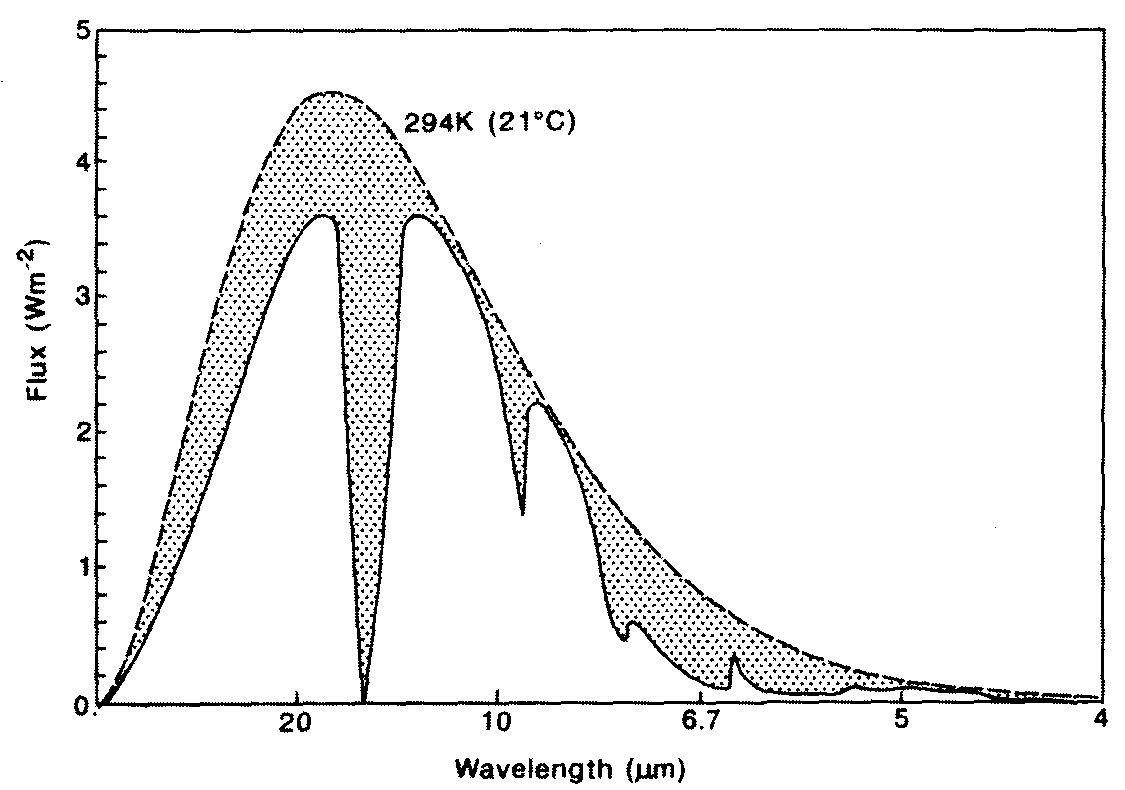
First, the sun’s radiated energy is mostly under 4μm in wavelength (shortwave), while the earth’s radiated energy is over 4μm (longwave), meaning that we can differentiate the two very easily:

Radiation vs Wavelength -Sun and Earth

Radiation vs Wavelength - Sun and Earth

Second, the aborption that we can easily measure in the earth’s longwave radiation from different molecules:

Radiation spectra from the earth with absorption

Radiation spectra from the earth showing absorption from atmospheric gases

Recap over.. This post was going to introduce the basic 1-d model of radiative transfer, but enough people asked questions about the absorption properties of gases that I thought it was was worth covering in more detail.. The 1-d model will have to wait until Part Three.

Why don’t the Atmospheric Gases Absorb Energy according to their Relative Volume?

Just because CO2 only consists of 0.04% of gases doesn’t mean it only contributes 0.04% of atmospheric absorption and re-emission of long wave radiation. Why is that?

Oxygen, O2, constitutes 21% of the atmophere and nitrogen, N2, constitutes 78%. Why aren’t they important “greenhouse” gases? Why are water vapor, CO2 and methane (CH4) the most important when they are present in such small amounts?

For reference, the three most important gases by volume are:

  • Water vapor – 0.4% averaged throughout the atmosphere, but actual value in any one place and time varies (See note 1 at end of article)
  • CO2               – 0.04% (380ppmv), well mixed (note: ppmv is parts per million by volume)
  • CH4               – 0.00018% (1.8ppmv), well mixed

Now there are three factors in determining the effect of longwave absorption:

  1. The amount of the gas by volume
  2. How much longwave energy is radiated from the earth at wavelengths that the gas absorbs
  3. The ability of the gas to absorb energy at a given wavelength

The first one is the simplest to understand. In fact, it’s knowing only this factor that causes so much confusion.

The second point is not immediately obvious, but should become clearer by reviewing the earth’s radiation spectrum:

Radiation vs Wavelength -Sun and Earth

Radiation vs Wavelength - Sun and Earth

Different amounts of energy are radiated at different wavelengths. For example, the amount of energy emitted between 10-11μm is eight times the amount of energy between 4-5μm (for radiation from a surface temperature of 15 °C or 288K).

CO2 has a wide absorption band centered around 15μm, which is where the long-wave radiation from the earth is at almost its highest level. By contrast, one of water vapor’s absorption lines is at 6.27μm – where the radiation is a slightly lower level (about 25% less) and more importantly, the other water vapor absorption lines are where the radiation is 5-10x lower intensity.

However, there is around 10x as much water vapor than CO2 in the atmosphere, which is why it is the most important greenhouse gas.

And Third, Why are Some Gases More Effective at Absorbing Longwave Energy?

Why aren’t O2 and N2 absorbers of longwave radiation?

Molecules with two identical atoms don’t change their symmetry when any rotation or vibration takes place. As a result they can’t move into different energy states.

But triatomic molecules like CO2, H2O and CH4 can bend as they vibrate. They can move into different energy states by changing their shape. Consequently they can absorb the energy from an incoming photon if its energy matches the new state.

And some molecules have many more energy states they can move into. This changes their absorption profile because their spectral breadth is effectively wider.

Here’s a graphic of one part of the actual CO2 absorption lines. Apologies for the poor quality scan..

CO2 spectral lines from one part of the 15um band

From "Handbook of Atmospheric Sciences", Hewitt & Jackson 2003

(Note that the x-axis is “Wavenumber, cm-1”. This is a convention for spectral people. Wavenumber is the number of wavelengths present in 1cm. I added the actual wavelength underneath.)

This shows the complexity of the subject once we look at the real detail. In practice, these individual discrete absorption lines “broaden” due to pressure broadening (collisions with other molecules) and Doppler broadening (as a result of the absorbing molecule moving in the same or opposite direction to the photon of light).

However, the important point to remember is that different molecules absorb at different frequencies and across different ranges of frequencies.

This third factor is the most important in determining the absorption properties of longwave radiation.

As an interesting comparison, molecule by molecule methane absorbs about 20x as much energy as CO2. But of course it is present in much smaller quantities.

Here are water vapor and CO2 across 5-25μm from the HITRANS database:

CO2 and water vapor absorption, by SpectraCalc from the HITRANS database

CO2 and water vapor absorption, by spectracalc.com from the HITRANS database

See Note 2 at the end of the article.

What about Oxygen?

A digression on oxygen.. It is important in the earth’s atmosphere because it absorbs UV, but when these high energy photons from the sun interact with O2 it breaks into O+O. Then a cycle takes place where O2 and O combine to form O3 (ozone), and later O3 breaks up again. By the time the sun’s energy has reached the lower part of the atmosphere (troposphere) all of the lower wavelength energy (most of the UV) has been filtered out.

O3 itself does absorb some longwave energy, at 9.6um, but because there is so little O3 in the troposphere it is not very significant.

What Happens when a Greenhouse Gas Absorbs Energy?

Once a gas molecule has absorbed radiation from the earth it has a lot more energy. But in the lower 100km of the atmosphere, the absorbed energy is transferred to kinetic energy by collisions between the absorbing molecules and others in the layer. Effectively, it heats up this layer of the atmosphere.

The layer itself will act as a blackbody and re-radiate infrared radiation. But it re-radiates in all directions, including back down to the earth’s surface. (If it only radiated up away from the earth there would be no “greenhouse” effect from this absorption).

Conclusion

We are still on the “zero dimensional model” – some call it the billiard ball model – of the radiative balance in the earth’s climate system.

A few different factors affect the absorption of the earth’s longwave radiation by various gases.

O2 barely absorbs any (see note 2 below), and neither does N2 (nitrogen). Among the other gases – the main greenhouse gases being water vapor, CO2 and methane – we see that each one has different properties – none of which can be determined by our intuition!

Different molecules can absorb energy in certain frequencies simply because of their ability to change shape and move to different energy states. The primary property that creates a strong “greenhouse” effect is to have a strong and wide absorption around a wavelength that the earth radiates. This is centered about 10μm (and isn’t symmetrical) so the further away from the peak energy the absorption occurs, the less relevant that absorption line becomes in the earth’s energy balance.

In the next part in the series, we will look at the 1-dimensional model and also what happens when absorption in a wavelength is saturated.

Note 1 – Water Vapor ppmv: After consulting numerous reference works, I couldn’t find one which gave the averaged water vapor throughout the atmosphere, or the troposphere. The actual source for the 0.4% was Wikipedia.

Because all the reference works danced around without actually giving a number I suspect it is “up in the air”. Here is one example:

Water vapor concentration is highly variable, ranging from over 20,000 ppmv (2%) in the lower tropospherical atmosphere to only a few ppmv in the stratosphere..

Atmospheric Science for Environmental Scientists (2009) Hewitt & Jackson

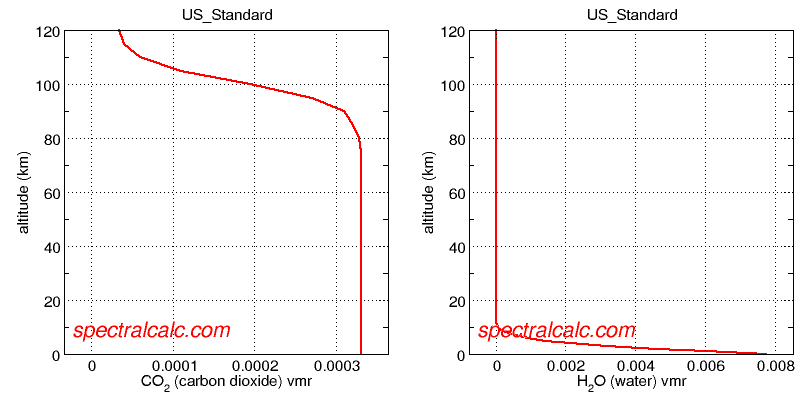
There is a great application, Spectral Calc for looking at atmospheric concentrations and absorption lines. Specifically http://spectralcalc.com/atmosphere_browser gives plots of atmospheric concentration and the data agrees with the Wikipedia number given in the body of this article:

CO2 and water vapor by volume

CO2 and water vapor by volume, from "Spectral Calculator" database

Averaging over the whole atmosphere, the concentration of water vapor does seem to be around 10x the CO2 value.

Note 2 – Optical Thickness: The spectral plots from the HITRANS database shown in the body of the article give the capture cross-section per mole (i.e. per “unit” of that gas, not per unit volume of the general atmosphere).

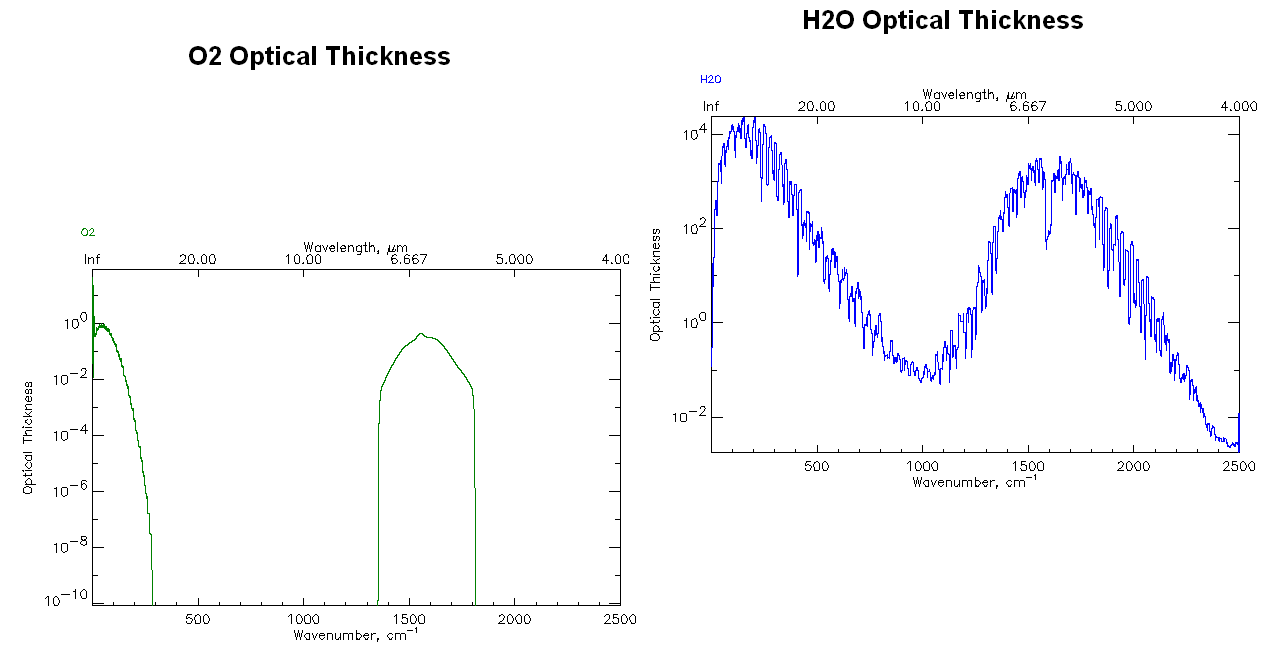
One commenter asked why another plot from a different website drawing on the same HITRANS database produced this:

Optical Thickness of O2 and water vapor

Optical Thickness of O2 and water vapor from http://www.atm.ox.ac.uk

Note that I’ve adjusted the plots so that similar values on the y-axes are aligned for both graphs. And note that the vertical axis is logarithmic.

His comment was that oxygen, O2, is only maybe 1000 times lower in absorption than water vapor (100 =1 vs 103 =1000) at 6.7μm and given that O2 is 20% of the atmosphere instead of 0.4%, O2 should be comparable to water vapor as a greenhouse gas.

But in fact, this graphical plot isn’t plotting the absorption by units of molecule – instead it is plotting Optical Thickness.

This is a handy variable which we will see more of in Part Three. Optical Thickness essentially takes the value of Intensity, which is per unit of molecules,  and “integrates” that value up through the entire height of the atmosphere.

As a result it gives the picture of the complete influence of that gas at different frequencies without having to work out the relative proportions of the gas at different heights in the atmosphere.

So the example above compares the complete absorption (in a simplistic model) through the whole atmosphere, giving O2 about 3000x less effect than water vapor at 6.7μm.

Update Part Three is now online
For newcomers to the climate debate it is often difficult to understand if global warming even exists. Controversy rages about temperature records, “adjustments” to individual stations, methods of creating the global databases like CRU and GISS and especially the problem of UHI.

UHI, or the urban heat island, refers to the problem that temperatures in cities are warmer than temperatures in nearby rural areas, not due to a real climatic effect, but due to concrete, asphalt, buildings and cars. There are also issues raised as to the actual location of many temperature stations, as Anthony Watts and his volunteer work demonstrated in the US.

First of all, everyone agrees that the UHI exists. The controversy rages about how large it is. The IPCC (2007) believes it is very low – 0.006°C per decade globally. This would mean that out of the 0.7°C temperature rise in the 20th century, the UHI was only 0.06°C or less than 10% – not particularly worth worrying about.

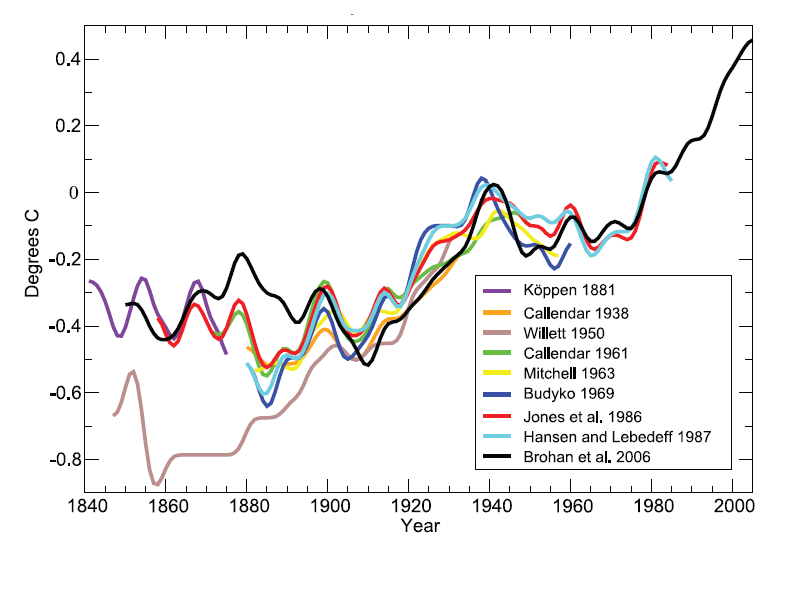
For those few not familiar with the mainstream temperature reconstruction of the last 150 years, here is the IPCC from 2007 (global reconstructions):

IPCC 2007 Global Temperature 1840-2000

IPCC 2007, Working Group 1, Historical Overview of Climate Change

New Research from Japan

Detection of urban warming in recent temperature trends in Japan by Fumiaki Fujibe was published in the International Journal of Climatology (2009). It is a very interesting paper which I’ll comment on in this post.

The abstract reads:

The contribution of urban effects on recent temperature trends in Japan was analysed using data at 561 stations for 27 years (March 1979–February 2006). Stations were categorized according to the population density of surrounding few kilometres. There is a warming trend of 0.3–0.4 °C/decade even for stations with low population density (<100 people per square kilometre), indicating that the recent temperature increase is largely contributed by background climatic change. On the other hand, anomalous warming trend is detected for stations with larger population density. Even for only weakly populated sites with population density of 100–300/km2, there is an anomalous trend of 0.03–0.05 °C/decade. This fact suggests that urban warming is detectable not only at large cities but also at slightly urbanized sites in Japan. Copyright, 2008 Royal Meteorological Society.

Why the last 27 years?

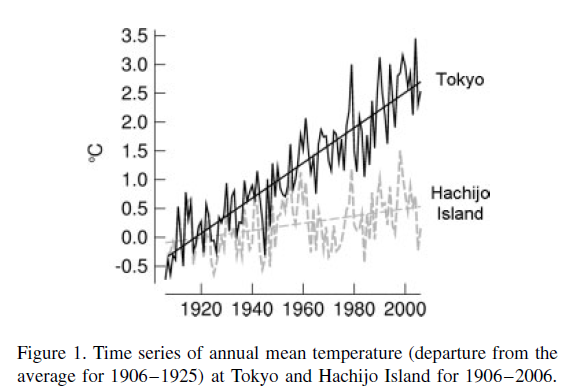
The author first compares the temperature over 100 years as measured in Tokyo in the central business district with that in Hachijo Island, 300km south.

Tokyo –               3.1°C rise over 100 years (1906-2006)
Hachijo Island –  0.6°C over the same period

Tokyo vs Hachijo Island, 100 years

This certainly indicates a problem, but to do a thorough study over the last 100 years is impossible because most temperature stations with a long history are in urban areas.

However, at the end of the 1970’s, the Automated Meteorological Data Acquisition System (AMeDAS) was deployed around Japan providing hourly temperature data at 800 stations. The temperature data from these are the basis for the paper. The 27 years coincides with the large temperature rise (see above) of around 0.3-0.4°C globally.

And the IPCC (2007) summarized the northern hemisphere land-based temperature measurements from 1979- 2005 as 0.3°C per decade.

How was Urbanization measured?

The degree of urbanization around each site was calculated from grid data of population and land use, because city populations often used as an index of urban size (Oke, 1973; Karl et al., 1988; Fujibe, 1995) might not be representative of the thermal environment of a site located outside the central area of a city.

What were the Results?

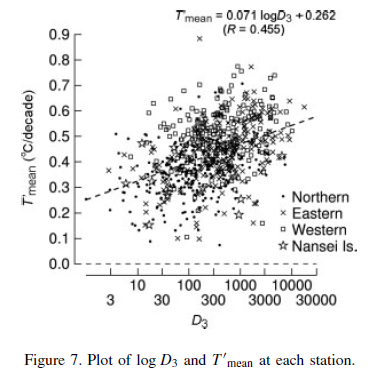
Temperature anomaly against population density, Japan

Mean temperature anomaly vs population density, Japan

The x-axis, D3, is a measure of population density. T’mean is the change in the mean temperature per decade.

Tmean is the average of all of the hourly temperature measurements, it is not the average of Tmax and Tmin.

Notice the large scatter – this shows why having a large sample is necessary. However, in spite of that, there is a clear trend which demonstrates the UHI effect.

There is large scatter among stations, indicating the dominance of local factors’ characteristic to each station. Nevertheless, there is a positive correlation of 0.455 (Tmean = 0.071 logD3 + 0.262 °C), which is significant at the 1% level, between logD3 and Tmean.

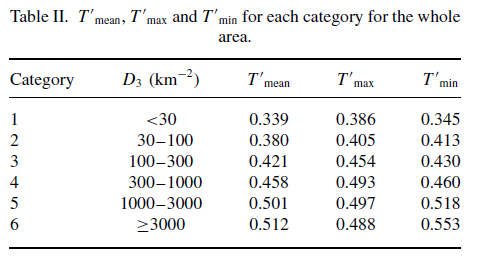
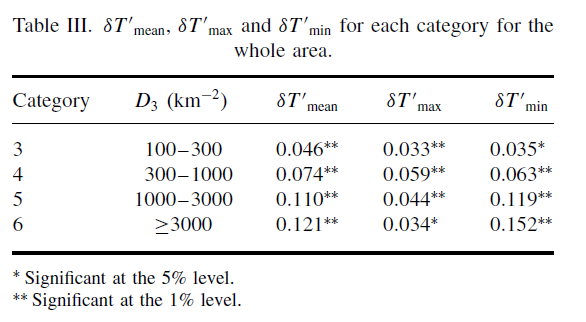
Here’s the data summarized with T’mean as well as the T’max and T’min values. Note that D3 is population per km2 around the point of temperature measurement, and remember that the temperature values are changes per decade:

The effect of UHI demonstrated in various population densities

The effect of UHI demonstrated in various population densities

Note that, as observed by many researchers in other regions, especially Roger Pielke Sr, the Tmin values are the most problematic – demonstrating the largest UHI effect. Average temperatures for land-based stations globally are currently calculated from the average of Tmax and Tmin, and in many areas globally it is the Tmin which has shown the largest anomalies. But back to our topic under discussion..

And for those confused about how the Tmean can be lower than the Tmin value in each population category, it is because we are measuring anomalies from decade to decade.

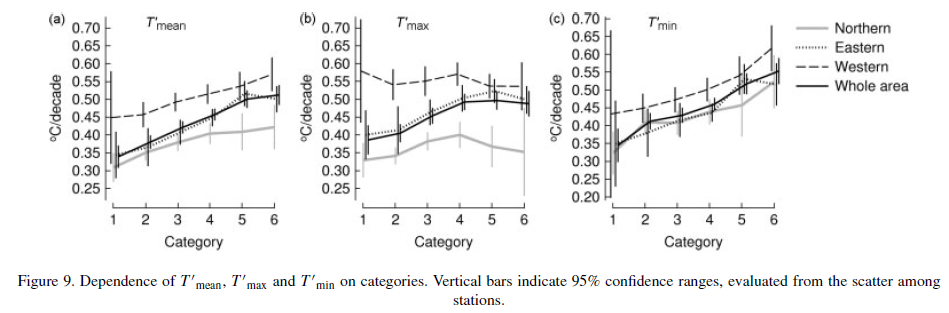
And the graphs showing the temperature anomalies by category (population density):

Dependence of Tmean, Tmax and Tmin on population density for different regions in Japan

Dependence of Tmean, Tmax and Tmin on population density for different regions in Japan

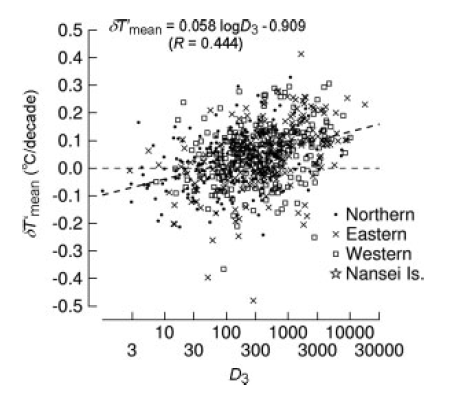
Quantifying the UHI value

Now the author carries out an interesting step:

As an index of net urban trend, the departure of T from its average for surrounding non-urban stations was used on the assumption that regional warming was locally uniform.

That is, he calculates the temperature deviation in each station in category 3-6 with the locally relevant category 1 and 2 (rural) stations. (There were not enough category 1 stations to do it with just category 1). The calculation takes into account how far away the “rural” stations are, so that more weight is given to closer stations.

Estimate of actual UHI by referencing the closest rural stations

Estimate of actual UHI by referencing the closest rural stations - again categorized by population density

And the relevant table:

Temperature delta from nearby rural areas vs population density

Temperature delta from nearby rural areas vs population density

Conclusion

Here’s what the author has to say:

On the one hand, it indicates the presence of warming trend over 0.3 °C/decade in Japan, even at non-urban stations. This fact confirms that recent rapid warming at Japanese cities is largely attributable to background temperature rise on the large scale, rather than the development of urban heat islands.

..However, the analysis has also revealed the presence of significant urban anomaly. The anomalous trend for the category 6, with population density over 3000 km−2 or urban surface coverage over 50%, is about 0.1 °C/decade..

..This value may be small in comparison to the background warming trend in the last few decades, but they can have substantial magnitude when compared with the centennial global trend, which is estimated to be 0.74°C/century for 1906–2005 (IPCC, 2007). It therefore requires careful analysis to avoid urban influences in evaluating long-term temperature changes.

So, in this very thorough study, in Japan at least, the temperature rise that has been measured over the last few decades is a solid result. The temperature increase from 1979 – 2006 has been around 0.3°C/decade

However, in the larger cities the actual measurement will be overstated by 25%.

And in a time of lower temperature rise, the UHI may be swamping the real signal.

The IPCC (2007) had this to say:

A number of recent studies indicate that effects of urbanisation and land use change on the land-based temperature record are negligible (0.006ºC per decade) as far as hemispheric- and continental-scale averages are concerned because the very real but local effects are avoided or accounted for in the data sets used.

So, on the surface at least, this paper indicates that the IPCC’s current position may be in need of modification.

I’m halfway through writing the 2nd post in the series CO2 – An Insignificant Trace Gas? – which is harder work than I expected and I came across a new video by John Coleman called Global Warming: The Other Side.

I only watched the first section which is 11 minutes long and promises in its writeup:

..we present the rebuttal to the bad science behind the global warming frenzy.. We show how that theory has failed to verify and has proven to be wrong.

http://www.kusi.com/weather/colemanscorner/81557272.html

The 1st video section claims to show the IPCC wrong but is actually a critique of one section of Al Gore’s movie, An Inconvenient Truth.

The presenter points out the well-known fact that in the ice-core record of the last million years CO2 increases lag temperature increases. And this appears to be the complete rebuttal of “CO2 causes temperature to increase”.

The IPCC has a whole chapter on the CO2 cycle in its TAR (Third Assessment Report) of 2001.

A short extract from chapter 3, page 203:
..Whatever the mechanisms involved, lags of up to 2,000 to 4,000 years in the drawdown of CO2 at the start of glacial periods suggests that the low CO2 concentrations during glacial periods amplify the climate change but do not initiate glaciations (Lorius and Oeschger, 1994; Fischer et al., 1999). Once established, the low CO2 concentration is likely to have enhanced global cooling (Hewitt and Mitchell, 1997)..

So the creator of this “documentary” hasn’t even bothered to check the IPCC report. They agree with him. And even more amazing, they put it in print!

If you are surprised by either of these points:

  • CO2 lags temperature changes in the last million years of temperature history
  • The IPCC doesn’t think this fact affects the theory of AGW (anthropogenic global warming)

Then read on a little further. I keep it simple.

The Oceans Store CO2

There is a lot of CO2 dissolved into the oceans.

“All other things being equal”, as the temperature of the oceans rises, CO2 is “out-gassed” – released into the atmosphere. As the temperature falls, more CO2 is dissolved in.

“All other things being equal” is the science way of conveying that the whole picture is very complex but if we concentrate on just two variables we can understand the relationship.

“All Other Things being Equal”

Just a note for those interested..

In the current environment, we (people) are increasing the amount of CO2 in the atmosphere. So, currently as ocean temperatures rise CO2 is not leaving the oceans, but in fact a proportion of the human-emitted CO2 (from power stations, cars, etc) is actually being dissolved into the ocean.

So in this instance temperature rises don’t cause the oceans to give up some of their CO2 because “all other things are not equal”.

Doesn’t the fact that CO2 lags temperature in the ice core record prove it doesn’t cause temperature changes?

It does prove that CO2 didn’t initiate those changes of direction in temperature. In fact the whole subject of why the climate has changed so much in the past is very complex and poorly understood, but let’s stay on topic.

Let’s suppose that there is an increase in solar radiation and so global temperatures increase. As a result the oceans will “out gas” CO2. We will see a record of CO2 changes following temperature changes.

But note that it tells us nothing about whether or not CO2 itself can increase temperatures.

[It might say something important about Al Gore’s movie.]

More than one factor affects temperature rise. There are lots of inter-related effects in the climate and the physics and chemistry of climate science are very complex.

Conclusion

Whether or not the IPCC is correct in its assessment that doubling CO2 in the atmosphere will lead to dire consequences from high temperature rises is not the subject of this post.

This post is about a subject that causes a lot of confusion.

I haven’t watched Al Gore’s movie but it appears he links past temperature rises with CO2 changes to demonstrate that CO2 increases are a clear and present danger. He relies on the ignorance of his audience. Or demonstrates his own.

“Skeptics” now arrive and claim to “debunk” the science of the IPCC by debunking Al Gore’s movie. They rely on the ignorance of their audience. Or demonstrate their own.

CO2 is certainly very important in our atmosphere despite being a “trace gas”. Physics and the properties of “trace gases” cannot be deduced from our life experiences. Have a read of CO2 – An Insignificant Trace Gas? Part One to understand more about this subject.

CO2 is both a cause and a consequence of temperature changes. That’s what makes climate science so fascinating.

In many debates on whether the earth has been cooling this decade we often hear

This decade is the warmest on record

(Note: reference is to the “naughties” decade).

This post isn’t about whether or not the temperature has gone up or down but just to draw attention to a subject that you would expect climate scientists and their marketing departments to handle better.

An Economic Analogy

Analogies don’t prove anything, but they can be useful illustrations, especially for those whose heads start to spin as soon as statistics are mentioned.

Suppose that the nineties were a roaring decade of economic progress, as measured by the GDP of industrialized nations (and ignoring all problems relating to what that all means). And suppose that the last half century with a few ups and downs had been one of strong economic progress.

Now suppose that around the start of the new millennium the industrialized nations fell into a mild recession and it dragged on for the best part of the decade. Towards the end of the decade a debate starts up amongst politicians about whether we are in recession or not.

There would be various statistics put forward, and of these the politicians out of power would favor the indicators that showed how bad things were. The politicians in power would favor the indicators that showed how good things were, or at least “the first signs of economic spring”.

Suppose in this debate some serious economists stood up and said,

But listen everyone, this decade has the highest GDP of any decade since records began.

What would we all think of these economists?

The progress that had taken the world to the start of the millennium would be the reason for the high GDP in the “naughties” decade. It doesn’t mean there isn’t a recession. In fact, it tells you almost nothing about the last few years. Why would these economists be bringing it up unless they didn’t understand “Economics 101”?

GDP and other measures of economic prosperity have a property that they share with the world’s temperature. The status at the end of this year depends in large part on the status at the end of last year.

In economics we can all see how this works. Prosperity is stored up year after year within the economic system. Even if some are spending like crazy others are making money as a result. When hard times come we don’t suddenly reappear, in economic terms, in 1935.

In climate it’s because the earth’s climate system stores energy. This is primarily the oceans and cryosphere (ice) but also includes the atmosphere.

Auto-Correlation for the total layman/woman who doesn’t want to hear about statistics

For those not statistically inclined, don’t worry this isn’t a technical treatment.

When various people analyze the temperature series for the last few decades they usually try and work out some kind of trend line and also other kinds of statistical treatments like “standard deviation”.

You can find lots of these on the web. I’m probably in a small minority but I don’t see the point of most of them. More on this at Is the climate more than weather? Is weather just noise?

However, for those who do see the point and carry out these analyses to prove or disprove that the world is warming or cooling in a “statistically significant” way, the more statistically inclined will be sure to mention one point. Because the temperature from year to year is related strongly to the immediate past – or in technical language “auto-correlated” – this changes the maths and widens the error bars.

Auto-correlation in layman’s terms is what I described in the economic analogy. Next year depends in large part on what happened last year.

Why mention this?

First, a slightly longer explanation of auto-correlation – skip that section if you are not interested..

Auto-Correlation in a little more detail

If you ever read anything about statistics you would have read about “the coin toss”.

I toss a coin – it’s 50/50 whether it comes up heads or tails. I have one here, flipping.. catching.. ok, trust me it’s heads.

Now I’m going to toss the coin again. What are the odds of heads or tails? Still 50/50. Ok, tossing.. heads again.

Now I’m going to toss the coin a 3rd time. At this point you check the coin and get it scientifically analyzed. Finally, much poorer, you hand me back the coin because it’s been independently verified as a “normal coin”. Ok so I toss the coin a 3rd time and it’s still 50/50 whether it lands heads or tails.

Many people who have never been introduced to statistics – like all the people who play roulette for real money that matters to them – have no concept of independent statistical events.

It’s a simple concept. What happened previously to the coin when I flipped it has absolutely no effect on a future toss of the coin. The coin has no memory. The law of averages doesn’t change the future. If I have tossed 10 heads in a row the next toss of this standard coin is no more likely to be tails than heads.

In statistics, the first kind of problems that are covered are ones where each event or each measurement are “independent”. Like the coin toss. This makes analysis of calculation of the mean (average) and standard deviation (how spread out the results are) quite simple.

Once a measurement or event is dependent in some way on the last reading (or an earlier reading) it gets much more complicated.

In technical language: Autocorrelation is the correlation of a signal with itself

If you want to assess a series of temperature measurements and work out a trend line and statistical significance of the results you need to take account of its auto-correlation.

What’s the Point?

What motivated this post was watching the behavior of some climate scientists, or at least their marketing departments. You can see them jump into many debates to point out that the error bars aren’t big enough on a particular graph, with a sad shake of their head as if to say “why aren’t people better at stats? why do we have to keep explaining the basics? you have to use an ARMA(1,1) process..

But the same people, in debates about current cooling or warming, keep repeating

This decade IS the warmest decade on record

as if they hadn’t heard the first thing about auto-correlation.

Statistically minded climate scientists, like our mythical economists earlier, should be the last people to make that statement. And they should be the first to be coughing slightly and putting up a hand when others make that point in the context of whether the current decade is warming or cooling.

Conclusion

Figuring out whether the current decade is cooling or warming isn’t as easy as it might seem and isn’t the subject of this post.

But next time someone tells you “This decade IS the warmest decade on record” – which means in the last 150 years, or a drop in the geological ocean – remember that it is true, but doesn’t actually answer the question of whether the last 10 years have seen warming or cooling.

And if they are someone who appears to know statistics, you have to wonder. Are they trying to fool you?

After all, if they know what auto-correlation is there’s no excuse.