On a couple of unrelated articles on this blog, people have been asking questions about the moon. This is because a lot of people have read an article called A Greenhouse Effect on the Moon from www.ilovemycarbondioxide.com that makes some confused claims.
The article starts:
We’ve been told that the earth’s surface is quite a bit warmer than calculations predict. Theory has it that heat-trapping “greenhouse gases” account for a 33° Celsius disparity. But it turns out that our airless moon is also quite a bit warmer than predicted.
And finishes with:
The Earth is not “unusually” warm. It is the application of the predictive equation that is faulty. The ability of common substances to store heat makes a mockery of blackbody estimates. The belief that radiating trace gases explain why earth’s surface temperature deviates from a simple mathematical formula is based on deeply erroneous assumptions about theoretical vs. real bodies.
A long time ago a friend told me that the way the Bank of England trains people to spot counterfeit notes is to give them real notes to spend time getting used to the feel, texture, weight and so on. They don’t give them lots of counterfeits because it’s not as effective.
I have no idea if the story is true but I always thought that it was a useful concept for approaching any subject. Best to spend the time helping people understand the real theory – as all scientific “facts” are called – rather than spend 5% of the time on the real theory and introduce them to 19 flawed theories.
Therefore, most of this article will focus on building understanding of the basics rather than pointing out the many flaws in the article. We will look at the temperature of a moon-like body by way of very simple models.
These models are in Excel because it’s quick and easy.
The Model
The concept is very simple. This is an idealized moon-like surface for illustration.
For my moon-like body, we will consider one square meter of surface. This is because lateral heat flow within the surface will be extremely low and so we don’t want or need to build a GCM to solve this problem.
Solar radiation is absorbed by this surface and heats up. The surface has a definite heat capacity which we vary in the model to see how the results change.
The sun moves slowly through the sky so the amount of solar radiation incident on the surface varies over the course of the lunar “day”. The surface has an “absorptivity” for solar radiation – the proportion of solar radiation absorbed vs the proportion reflected.
When the sun is directly overhead the solar radiation incident is 1367 W/m2 and when the sun is on the horizon the solar radiation is zero – then for the whole “night” the radiation stays zero. Therefore, I’m considering the “equator”.
For reasons of laziness I set the lunar day to be 28 days, but the exact value doesn’t matter.
And the absorptivity was set to 0.9 (which means 90% of incident solar radiation is absorbed and 10% is reflected). Also the emissivity was set to the same value, but in this example it could be different. With different values similar results would occur but with different equilibrium temperatures. See Note 1.
The simple maths for the model is at the end of the post as many people don’t like seeing equations.
The Results
Now, if the surface had no heat capacity (or as mathematicians might say, “as the heat capacity tends to zero”) then the surface would instantaneously heat up until the radiation emitted matched the absorbed radiation.
So in that unrealistic case, the temperature would follow this curve:
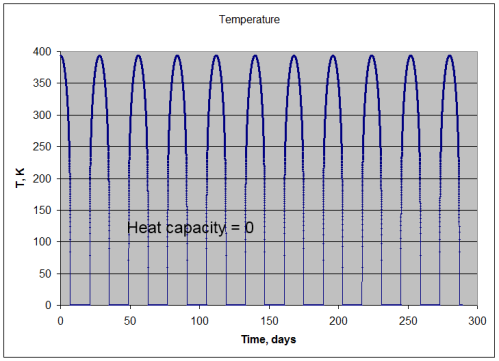
Moon-like surface, zero heat capacity
So during the moon-like night, the surface drops immediately to absolute zero, and during the “day” the emission of radiation exactly matches the absorption. (For mathematically inclined readers this follows a cos θ relationship – see maths section at end).
Note that this isn’t like the earth or any real body. It’s just a useful thought experiment to show what would happen if the surface had no heat capacity.
Under this condition:
- absorption of solar radiation = 391.7 W/m2 (averaged over many cycles)
- emission of lunar radiation = 391.7 W/m2 (averaged over many cycles)
- mean temperature = 169.3K
- min temperature = 0K
- max temperature = 394K
Energy in = energy out – so no surprises there.
Let’s start increasing the heat capacity and see what happens – per m2, 10,000J/K heat capacity:
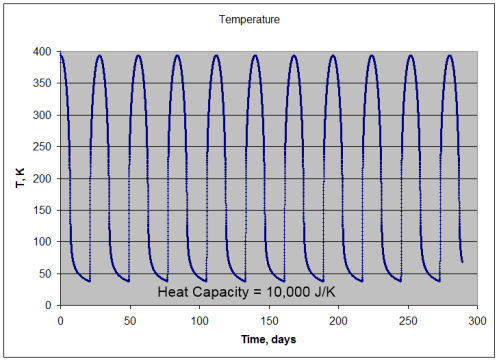
Moon-like surface with 10,000 J/K heat capacity per m^2
- absorption of solar radiation = 391.7 W/m2 (averaged over many cycles)
- emission of lunar radiation = 391.7 W/m2 (averaged over many cycles)
- mean temperature = 195.3K
- min temperature = 38K
- max temperature = 397K
Per m2, 50,000J/K heat capacity:
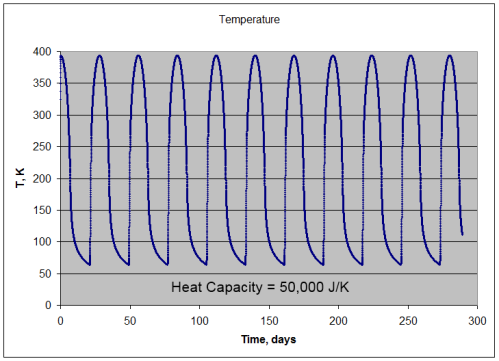
Moon-like surface with 50,000 J/K heat capacity per m^2
- absorption of solar radiation = 391.7 W/m2 (averaged over many cycles)
- emission of lunar radiation = 391.5 W/m2 (averaged over many cycles)
- mean temperature = 211.3K
- min temperature = 64K
- max temperature = 394K
Per m2, 500,000J/K heat capacity:
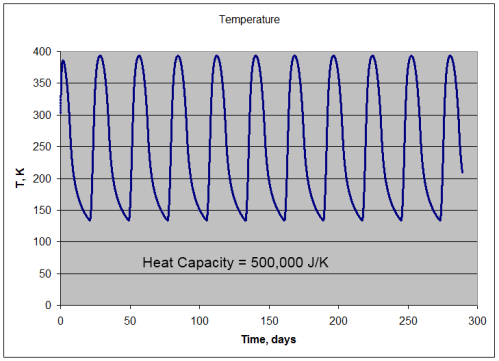
Moon-like surface with 500,000 J/K heat capacity per m^2
- absorption of solar radiation = 391.7 W/m2 (averaged over many cycles)
- emission of lunar radiation = 390.0 W/m2 (averaged over many cycles)
- mean temperature = 247.7K
- min temperature = 133K
- max temperature = 393K
Per m2, 5,000,000J/K heat capacity:
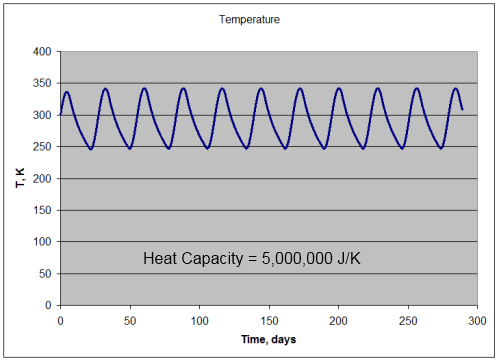
Moon-like surface, 5,000,000 J/K per m^2
- absorption of solar radiation = 391.7 W/m2 (averaged over many cycles)
- emission of lunar radiation = 391.7 W/m2 (averaged over many cycles)
- mean temperature = 290.9K
- min temperature = 247K
- max temperature = 342K
Hopefully, for most people, the fact that the temperature range is reducing as heat capacity increases is reasonably intuitive. If you want to heat up a cupful of water it takes less time than heating a swimming pool. If you want to cool down both through the same surface area it will take longer for the swimming pool to cool down.
Summary of Results
Notice that in each case the average value of absorption = emission – to within 1%.
The 1% is just a result of imperfect starting conditions. If the chosen simulation starting temperature was exactly right, or there were enough “spin up” cycles to get into the steady state before the averaging was done then the absorption = emission exactly.
It’s probably not surprising to anyone that absorption = emission over a set number of cycles because otherwise the overall trend in temperature would be increasing or decreasing.
Next a plot of mean, min and max temperature as the heat capacity increases, note the log axis for heat capacity:
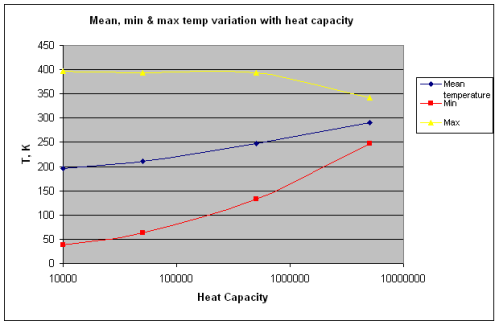
The reason for plotting the heat capacity on a “log” or logarithmic axis was because the heat capacity is increased by a an order of magnitude each time. Linear plots make the results of this kind of simulation less clear.
The mean temperature is simply the arithmetic average of temperature over every single time step. (All the numbers added up and divided by the number of results).
So the mean temperature does increase when the surface has an increased heat capacity!
It looks like the ilovemyco2 writers were correct and the whole greenhouse effect was just a result of heat capacity of the oceans and land.
Time for me to pack my bags and head off into the sunset..
But wait, hold on a minute..
There’s something very strange going on. The temperature is increasing, but the average emission of radiation has stayed exactly the same:
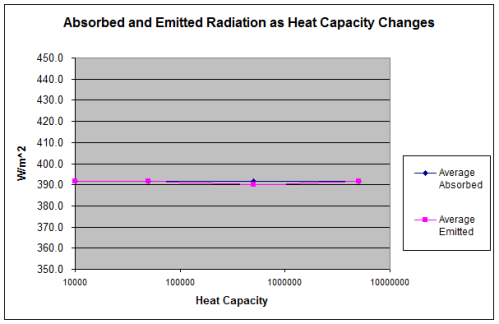
How can temperature increase without the radiation increasing? Radiation is emitted in proportion to the 4th power of temperature – for a blackbody (ε=1), E = σ . T4, where σ = 5.67×10⁻⁸
If the temperature goes up, radiation must go up as well. Is there something wrong with the model?
No. And for those who’ve read Why Global Mean Surface Temperature Should be Relegated, Or Mostly Ignored this example won’t be surprising.
Take 3 “temperatures”: 1, 10, 100.
Now we average them -> average = 111/3 = 37K
And calculate the energy radiated, E = 37 4 x 5.67×10-8 = 1,874,161 x 5.67×10-8 = 0.11 W/m2
Alright, let’s do it the other way. Let’s calculate the energy radiated for each temperature:
- 14 x 5.67×10-8 = 1 x 5.67×10-8 = 5.67×10⁻⁸
- 104 x 5.67×10-8 = 10,000 x 5.67×10-8 = 5.67×10⁻⁴
- 1004 x 5.67×10-8 =100,000,000 x 5.67×10-8 = 5.67
And now average the energy radiated -> average = (5.6705670567/3) = 1.89 W/m2
One method gives 18x the other method – how can this be and which one is right?
Just for the many people would prefer to see the calculation without the Stefan-Boltzmann constant of 5.67×10^8 everywhere – in that case we compare 374 = 1,874,161 with the alternative method of (14 + 104 + 1004)/3 = 100,010,001/3= 33,336,667
Also (of course) a factor of 18 between the two methods of calculating the “average”.
There’s nothing surprising about this – average a series of numbers and raising the average to the 4th power will almost always give a different answer to first calculating the 4th power for each of a series of numbers and averaging the results.
Now the moon has some extreme temperature ranges in the examples shown and, therefore, the “mean” temperature changes significantly.
The earth by contrast, with less extreme temperatures has this result –
- the “average” temperature = 15°C, and converting that to the “average” radiation = 390 W/m2
- calculated the correct and painful way, the individually calculated values of radiation from each and every surface temperature around the globe every few hours over a year.. then averaged = 396 W/m2
Conclusion
So the reason that the moon – with a surface with a real heat capacity – appears to have a warmer climate “than predicted” is just a mathematical error. A trap for the unwary.
The right way to calculate a planet’s average radiation is to calculate it for each and every location and average the results. The wrong way is to calculate the average temperature and then convert that to a radiation. In the case of the earth’s surface, it’s not such a noticeable problem.
In the case of the moon, because of the wide variation in temperature, the incorrect method produces a large error.
So there’s no “lunar explanation” for the inappropriately-named “greenhouse” effect.
In the case of the earth there is anyway a huge difference from the moon. The solar radiation absorbed at the top of the earth’s atmosphere – about 240W/m2 is approximately balanced by the outgoing longwave radiation of the same amount. But the radiation from the surface of the earth of 396W/m2 is much larger than this top of atmosphere value of 240W/m2.
That’s the greenhouse effect.
But ilovemyco2 – hats off to you for enthralling and exciting so many people with a simple mathematical puzzle.
Maths in the Model
Ein = S . cosθ . α – for -90° < θ < 90°
Ein = 0 otherwise
where Ein = energy absorbed by the surface in J/s, S = the solar irradiance in W/m2, θ = angle of the sun from the zenith, α = absorptivity of the surface at the solar radiation wavelengths.
Eout = ε . σ . T4
where Eout = energy radiated by the surface in J/s, ε = emissivity of the surface at the wavelengths it is radiating at, σ = 5.67 x 10⁻⁸, and T is the temperature in K (absolute temperature). This is the Stefan-Boltzmann equation.
and for each time step, Δt:
ΔT = (Ein – Eout)/C
where C = heat capacity of a 1m2 surface in J/K and ΔT is the change in temperature.
For people who like even more detail:
The assumption is that the conductivity of heat into the surface is very high with some kind of insulating layer below the “heat capacity” layer. This makes the calculation slightly easier to understand than using thermal diffusivity.
And the conductivity of heat laterally is very low to avoid considering thermal equalization between adjacent surfaces.
Neither of these assumptions has any significant effect on the “experiment”, or on the principles that it demonstrates.
Note 1
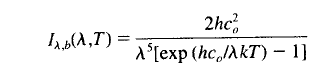
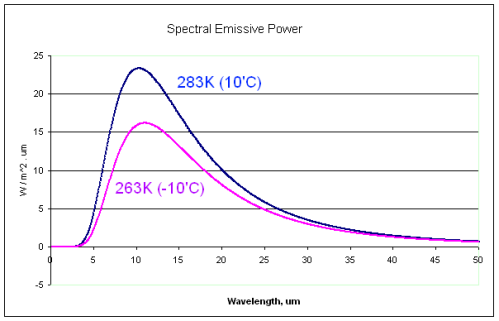
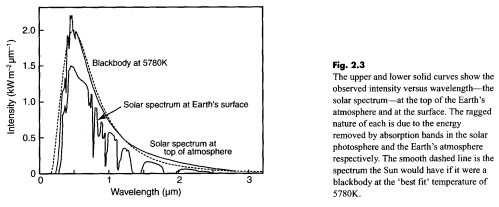
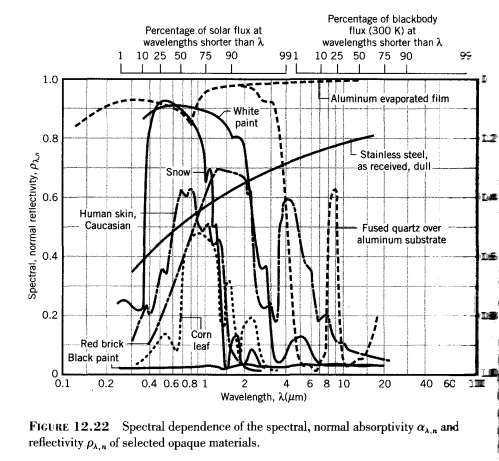
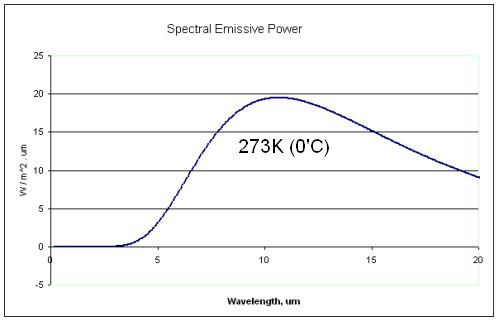
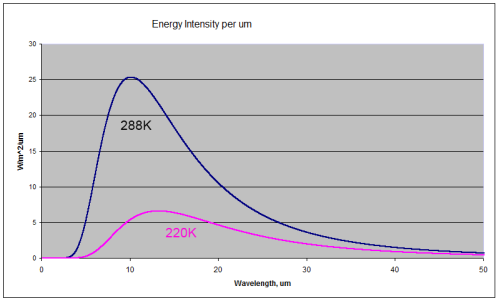
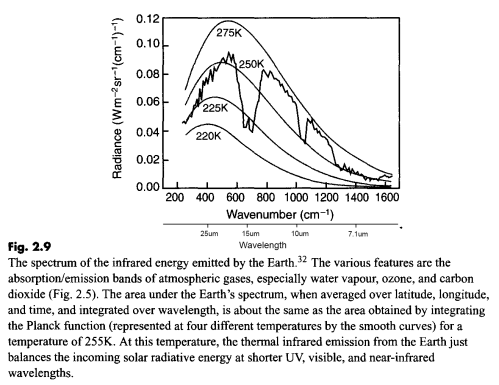
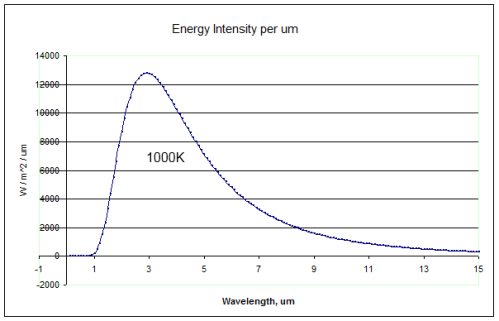
Emissivity and absorptivity are inherent properties of the material in question and are wavelength dependent. In the case of a surface like the earth, the surface receives solar radiation centered around 0.5μm and radiates out with wavelengths centered on 10μm. See, for example, The Sun and Max Planck Agree. So there is no reason to expect that absorptivity = emissivity (because we are considering the properties at different wavelengths).





 The Science of Doom
The Woody Guthrie award
Posted in Commentary on May 19, 2010| 16 Comments »
This is a very quick post to say thanks to John Cook of Skeptical Science for the recent “Woody Guthrie award for a thinking blogger” and especially the kind comments he made.
I’m proud to be the recipient and already in a panic about the next recipient, apparently it’s up to me to decide. It is especially a problem in this divided world we live in.
I’m very happy that many sides of the climate debate visit this blog and contribute and ask questions. I can only ask again what I ask in About This Blog:
Read Full Post »