Feeds:
Posts
Comments

In Part One I made the observation:

If the atmosphere has an invariant optical thickness then surely all molecules should be included?

Meaning all ‘radiatively-active’ gases. Then I cited some results from Collins (2006) on the ‘radiative forcing’ for other gases, and added:

..So if total optical thickness from CO2 and water vapor has stayed constant over 60 years then surely total optical thickness must have increased?

In response, Miskolczi supporter Miklos Zagoni said:

Optical thickness was calculated over 60 years for CO2 and water vapor and other 9 IR-active molecular species (O3, N2O, CH4, NO, SO2, NO2, CCl4, F11 and F12), and turned out to be strictly fluctuating around a theoretically predicted equilibrium value

I asked for more details (concentrations of each of these gases over time which were used for the calculations) which weren’t forthcoming.

Later Miskolczi supporter Ken Gregory said:

Only the H2O and CO2 gases were changed. Other minor GHG were held constant.

So, working with this data I thought it would be interesting to see what changes had taken place in optical thickness due to these minor “greenhouse” gases.

I should point out that there are substantial problems identified with Miskolczi’s theory and experimental work and this is a very minor issue – it is more of an interesting aside.

A little while ago I managed to recreate the CO2 transmittance in the atmosphere – as shown in Understanding Atmospheric Radiation and the “Greenhouse” Effect – Part Nine. This was done using the HITRAN database in a MATLAB model I created.

The question about changes in optical thickness over time from other gases was a good motivator to update my MATLAB model to bring in other molecules. It was something I wanted to do anyway.

Note that radiative forcing or (surface emission – OLR) is a much more useful value than total optical thickness (as explained in Part One).

Extracting the HITRAN data proved to be the most tedious and challenging part of the project. It turns out that the “minor gases” like CFC-11 and CFC-12 are stored in a totally different format from gases like CO2, N2O, CH4 etc. These minor gases have a dataset for each temperature and pressure, with different sizes of dataset at various temperature/pressures. Nothing mathematically or conceptually challenging, just very tedious.

Another challenge was working out what concentrations to use for 1948 – the start date that Miskolczi uses. From Collins (2006) it seemed that the main “greenhouse” gases to evaluate were N2O (nitrous oxide), CH4 (methane) plus CFC11 (CCl3F) and CFC12 (CCl2F2). There are other halocarbons to include but time is limited.

Here are the values used:

……………………1948                2008

CO2           311 ppmv     386 ppmv
N2O           289 ppbv      319 ppbv
CH4         1250 ppbv    1775 ppbv
CFC11           0               267 pptv
CFC12           0               535 pptv

The later CO2 value is from 2008 from Miskolczi’s spreadsheet while the other values are from 2005.

ppmv = parts per million by volume, ppbv = parts per billion (109) by volume, pptv = parts per trillion (1012) by volume.

Earlier values of N2O and CH4 are taken from various papers, I can provide citations if anyone is interested – but pre-1980 values are thin on the ground.

In any case, my calculations of total optical thickness are rudimentary and provided as a starting point.

The Model

I used a 5 layer model up to 200mbar, with a surface temperature of 289K. The diffusivity approximation was used to estimate total hemispherical transmittance (see Understanding Atmospheric Radiation and the “Greenhouse” Effect – Part Six – The Equations). The wavenumber step, Δν = 1 cm-1. The calculations were done from 100 cm to 2500 cm (4μm – 100 μm) and the “Planck weighted” transmittance (at 289K) was calculated. This transmittance was converted back to an optical thickness, which is the same approach that Miskolczi uses (see comment).

Water vapor was assumed to be 10g/kg at the surface with a straight line reduction (vs pressure) to zero at 200mbar. Previously I carried out calculations where water vapor was varied from 5g/kg to 15g/kg and the effect on the transmittance change due to other gases was quite small.

Water vapor absorption lines are included from the HITRAN database but the water vapor continuum is not. This is next in my wishlist to include.

Changes in Water Vapor

The model deliberately did not try to follow Miskolczi’s water vapor values. The point of this article is to demonstrate that if (and only if) CO2 optical thickness is canceled out by water vapor changes, then significant increases in optical thickness from other gases impact negatively on his hypothesis.

If his calculations show:

optical thickness (CO2 + water vapor) = constant

then this article demonstrates that:

optical thickness (CO2 + other gases + water vapor) = increasing

Many people might not realize that there are a number of water vapor datasets. The one Miskolczi uses is not the only one. Others show different trends.

Results

Note that water vapor is included, but at unchanged concentration.

  • The change in optical thickness, Δτ, for CO2 only changing = 0.0167
  • The change in optical thickness, Δτ, for CO2+N2O+CH4+CFC11+CFC12 = 0.0238

The % increase (over CO2) due to the nominated “minor gases” = is 43%.

The total optical thickness is not so important in this analysis. If the number of layers is changed, the total optical thickness changes, but percent changes due to “greenhouse” gas increases are roughly similar.

Conclusion

If (and only if) water vapor has canceled out CO2 increases, then the increase in optical thickness due to these other gases (methane, nitrous oxide plus halocarbons) has destroyed the idea that optical thickness can be considered to be constant.

Of course, my calculations are rudimentary. My model is much less exact than the HARTCODE model used by Miskoczi and it would be interesting to see his results reproduced in full with the correct concentrations of all of the GHGs from 1948 – 2008.

As I commented earlier – this is one of the least important of the criticisms of Ferenc Miskolczi’s papers.

Now I have updated the model I can produce results like these:


Other articles in the series

The Mystery of Tau – Miskolczi – introduction to some of the issues around the calculation of optical thickness of the atmosphere, by Miskolczi, from his 2010 paper in E&E

Part Two – Kirchhoff – why Kirchhoff’s law is wrongly invoked, as the author himself later acknowledged, from his 2007 paper

Part Three – Kinetic Energy – why kinetic energy cannot be equated with flux (radiation in W/m²), and how equation 7 is invented out of thin air (with interesting author comment)

Part Four – a minor digression into another error that seems to have crept into the Aa=Ed relationship

Part Five – Equation Soufflé – explaining why the “theory” in the 2007 paper is a complete dog’s breakfast


References

The HITRAN 2008 molecular spectroscopic database, by L.S. Rothman et al, Journal of Quantitative Spectroscopy & Radiative Transfer (2009)

Radiative forcing by well-mixed greenhouse gases: Estimates from climate models in the Intergovernmental Panel on Climate Change (IPCC) Fourth Assessment Report (AR4), Collins et al, JGR (2006)

In previous articles in this series we looked at a number of issues first in Miskolczi’s 2010 paper and then in the 2007 paper.

The author himself has shown up and commented on some of these points, although not all, and sadly decided that we are not too bright and a little bit too critical and better pastures await him elsewhere.

Encouraged by one of our commenters I pressed on into the paper: Greenhouse Effect in Semi-Transparent Planetary Atmospheres, Quarterly Journal of the Hungarian Meteorological Service (2007), and now everything is a lot clearer.

The 2007 paper by Ferenc Miskolczi is a soufflé of confusion piled on confusion. Sorry to be blunt. If I was writing a paper I would say “..some clarity is needed in important sections..” but many readers unfamiliar with the actual meaning of this phrase might think that some clarity was needed in important sections rather than the real truth that the paper is a shambles.

I’ll refer to this paper as M2007. And to the equations in M2007 with an M prefix – so, for example, equation 15 will be [M15].

Some background is needed so first we need to take a look at something called The Semi-Gray Model. Regular readers will find a lot of this to be familiar ground, but it is necessary as there are always many new readers.

The SGM – Semi-Grey Model or Schwarzschild Grey Model

I’ll introduce this by quoting from an excellent paper referenced by M2007. This is a 1995 paper by Weaver and the great Ramanathan (free link in References):

Simple models of complex systems have great heuristic value, in that their results illustrate fundamental principles without being obscured by details. In particular, there exists a long history of simple climate models. Of these, radiative and radiative-convective equilibrium models have received great attention..

One of the simplest radiative equilibrium models involves the assumption of a so-called grey atmosphere, where the absorption coefficient is assumed to be independent of wavelength. This was first discussed by Schwarzschild [1906] in the context of stellar interiors. The grey gas model was adapted to studies of the Earth by assuming the atmosphere to be transparent to solar radiation and grey for thermal radiation. We will refer to this latter class as semigrey models.

And in the abstract they say:

Radiative equilibrium solutions are the starting point in our attempt to understand how the atmospheric composition governs the surface and atmospheric temperatures, and the greenhouse effect. The Schwarzschild analytical grey gas model (SGM) was the workhorse of such attempts. However, the solution suffered from serious deficiencies when applied to Earth’s atmosphere and were abandoned about 3 decades ago in favor of more sophisticated computer models..

[Emphasis added]

And they go on to present a slightly improved SGM as a useful illustrative tool.

Some clarity on a bit of terminology for new readers – a blackbody is a perfect emitter and absorber of radiation. In practice there are no blackbodies but some bodies come very close. A blackbody has an emissivity = 1 and absorptivity = 1.

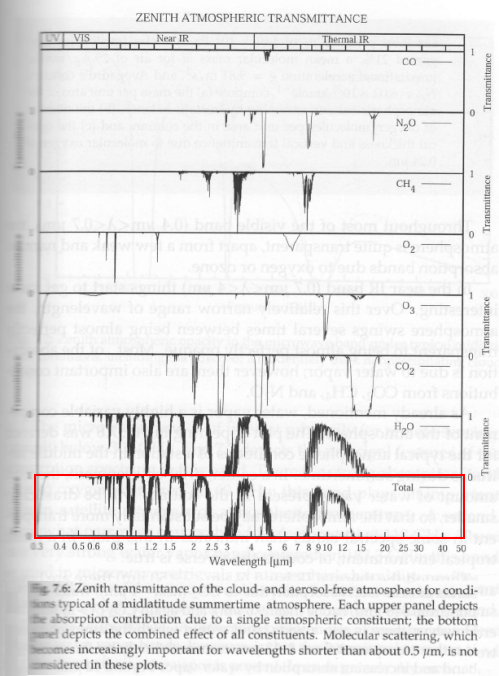
In our atmosphere, the gases which absorb and emit significant radiation have very wavelength dependent properties, e.g.:
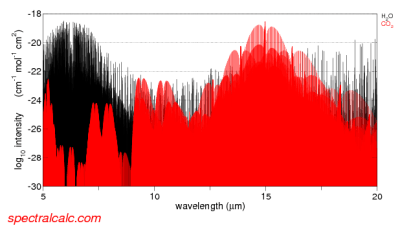
From spectralcalc.com

Figure 1

So the emissivity and absorptivity vary hugely from one wavelength to the next (note 1). However, as an educational tool, we can calculate the results for a grey atmosphere – this means that the emissivity is assumed to be constant across all wavelengths.

The term semi-grey means that the atmosphere is considered transparent for shortwave = solar wavelengths (<4 μm) and constant but not zero for longwave = terrestrial wavelengths (>4 μm).

Constructing the SGM

This model is very simple – and is not used to really calculate anything of significance for our climate. See Understanding Atmospheric Radiation and the “Greenhouse” Effect – Part Six – The Equations for the real equations.

We assume that the atmosphere is in radiative equilibrium – that is, convection does not exist and so only radiation moves heat around.

Here is a graphic showing the main elements of the model:
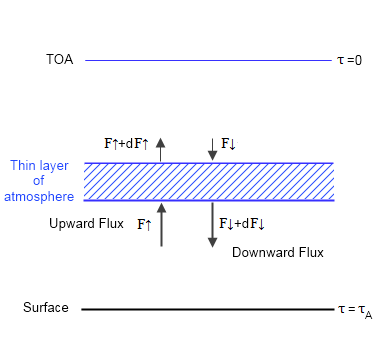
Figure 2

Once each layer in the atmosphere is in equilibrium, there is no heating or cooling – this is the definition of equilibrium. This means energy into the layer = energy out of the layer. So we can use simple calculus to write some equations of radiative transfer.

We define the TOA (top of atmosphere) to be where optical thickness, τ=0, and it increases through the atmosphere to reach a maximum of τ=τA at the surface. This is conventional.

We also know two boundary conditions, because at TOA (top of atmosphere) the downward longwave flux, F↓(τ=0) = 0 and the upwards longwave flux, F↑(τ=0) = F0, where F0 = absorbed solar radiation ≈ 240 W/m². This is because energy leaving the planet must be balanced by energy being absorbed by the planet from the sun.

We also have to consider the fact that energy is not just going directly up and down but is going up and down at every angle. We can deal with this via the dffusivity approximation which sums up the contributions from every angle and tells us that if we use τ*= τ . 5/3  (where τ is defined in the vertical direction) we get the complete contribution from all of the different directions. (Note 2). For those following M2007 I have used τ* to be his τ with a ˜ on top, and τ to be his τ with a ¯ on top.

With these conditions we can get a solution for the SGM (see derivation in the comments):

B(τ) = F0/2π . (τ+1)   [1]   cf eqn [M15]

where B is the spectrally integrated Planck function, and remember F0 is a constant.

And also:

F↑(τ) = F0/2 . (τ+2)    [2]

F↓(τ) = F0/2 . τ    [3]

A quick graphic might explain this a little more (with an arbitrary total optical thickness, τA* = 3):
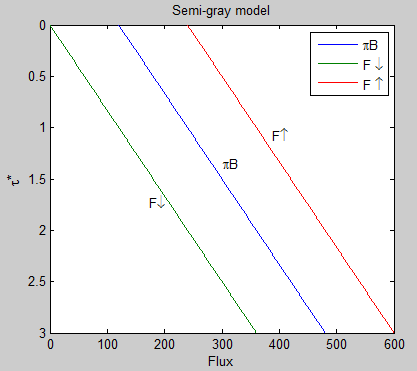
Figure 3

Notice that the upward longwave flux at TOA is 240 W/m² – this balances the absorbed solar radiation. And the downward longwave flux at TOA is zero, because there is no atmosphere above from which to radiate. This graph also demonstrates that the difference between F↑ and F↓ is a constant as we move through the atmosphere, meaning that the heating rate is zero. The increase in downward flux, F↓, is matched by the decrease in upward flux, F↑.

It’s a very simple model.

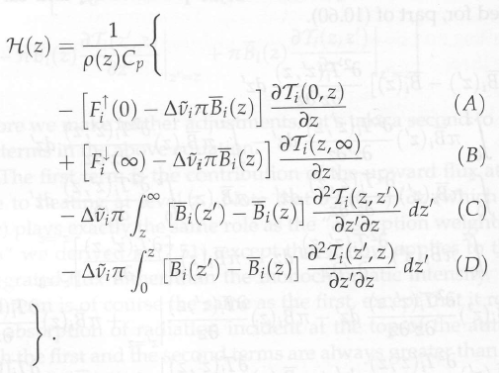
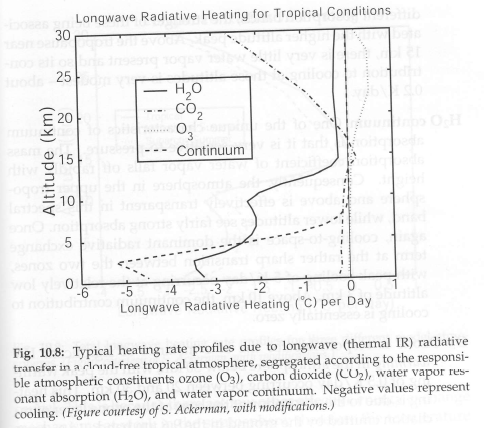
By contrast, here are the heating/cooling rates from a comprehensive (= “standard”) radiative-convective model, plotted against height instead of optical thickness.

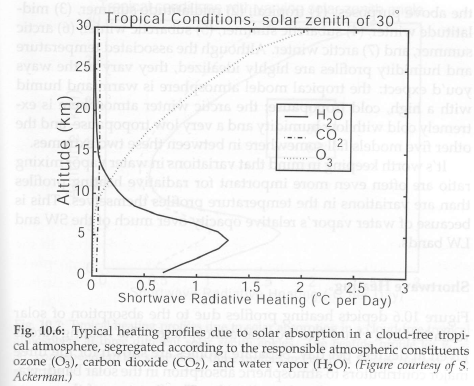
Heating from solar radiation, because the atmosphere is not completely transparent to solar radiation:

From Grant Petty (2006)

Figure 4

Cooling rates due to various “greenhouse” gases:
From Petty (2006)

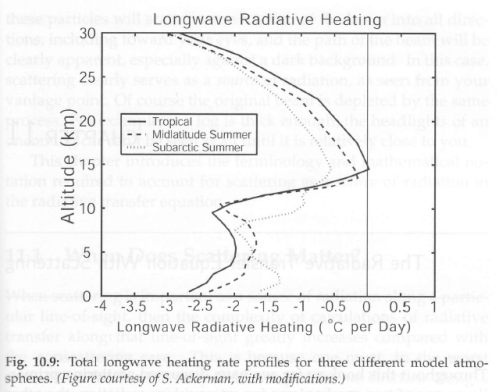
Figure 5

And the heating and cooling rates won’t match up because convection moves heat from the surface up into the atmosphere.

Note that if we plotted the heating rate vs altitude for the SGM it would be a vertical line on 0.0°C/day.

Let’s take a look at the atmospheric temperature profile implied by the semi-grey model:
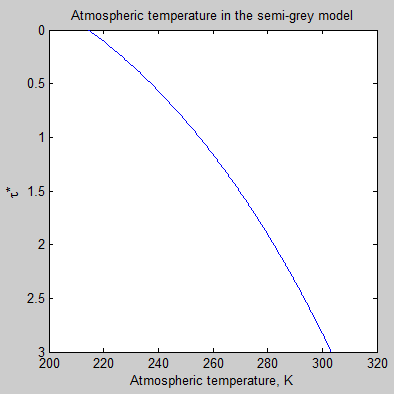
Figure 6

Now a lot of readers are probably wondering what the τ really means, or more specifically, what the graph looks like as a function of height in the atmosphere. In this model it very much depends on the concentration of the absorbing gas and its absorption coefficient. Remember it is a fictitious (or “idealized”) atmosphere. But if we assume that the gas is well-mixed (like CO2 for example, but totally unlike water vapor), and the fact that pressure increases with depth then we can produce a graph vs height:
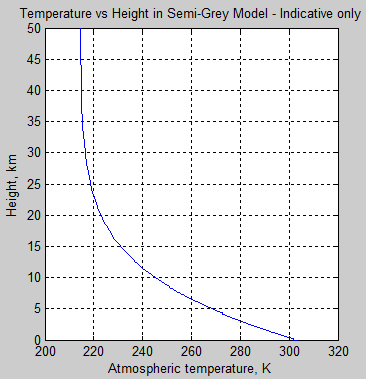
Figure 7

Important note – the values chosen here are not intended to represent our climate system. 

Figure 6 & 7, along with figure 3, are just to help readers “see” what a semi-grey model looks like. If we increase the total optical depth of the atmosphere the atmospheric temperature at the surface increases.

Note as well that once the temperature reduction vs height is too large a value, the atmosphere will become unstable to convection. E.g. for a typical adiabatic lapse rate of 6.5 K/km, if the radiative equilibrium implies a lapse rate > 6.5 K/km then convection will move heat to reduce the lapse rate.

Curious Comments on the SGM

Some comments from M2007:

p 11:

Note, that in obtaining B0 , the fact of the semi-infinite integration domain over the optical depth in the formal solution is widely used. For finite or optically thin atmosphere Eq. (15) is not valid. In other words, this equation does not contain the necessary boundary condition parameters for the finite atmosphere problem.

The B0 he is referring to is the constant in [M15]. This constant is H/2π – where H = F0 (absorbed solar radiation) in my earlier notation. This constant B0 later takes on magical properties.

p 12:

Eq. (15) assumes that at the lower boundary the total flux optical depth is infinite. Therefore, in cases, where a significant amount of surface transmitted radiative flux is present in the OLR , Eqs. (16) and (17) are inherently incorrect. In stellar atmospheres, where, within a relatively short distance from the surface of a star the optical depth grows tremendously, this could be a reasonable assumption, and Eq. (15) has great practical value in astrophysical applications. The semi-infinite solution is useful, because there is no need to specify any explicit lower boundary temperature or radiative flux parameter (Eddington, 1916).

[Emphasis added]

The equations can easily be derived without any requirement for the total optical depth being infinite. There is no semi-infinite assumption in the derivation. Whether or not some early derivations included it, I cannot say. But you can find the SGM derivation in many introductions to atmospheric physics and no assumption of infinite optical thickness exists.

When considering the clear-sky greenhouse effect in the Earth’s atmosphere or in optically thin planetary atmospheres, Eq. (16) is physically meaningless, since we know that the OLR is dependent on the surface temperature, which conflicts with the semi-infinite assumption that τA =∞..

..There were several attempts to resolve the above deficiencies by developing simple semi-empirical spectral models, see for example Weaver and Ramanathan (1995), but the fundamental theoretical problem was never resolved..

This is the reason why scientists have problems with a mysterious surface temperature discontinuity and unphysical solutions, as in Lorenz and McKay (2003). To accommodate the finite flux optical depth of the atmosphere and the existence of the transmitted radiative flux from the surface, the proper equations must be derived.

The deficiencies noted include the result in the semi-gray model of a surface air temperature less than the ground temperature. If you read Weaver and Ramanathan (1995) you can see that this isn’t an attempt to solve some “fundamental problem“, but simply an attempt to make a simple model slightly more useful without getting too complex.

The mysterious surface temperature discontinuity exists because the model is not “full bottle”. The model does not include any convection. This discontinuity is not a mystery and is not crying out for a solution. The solution exists. It is called the radiative-convective model and has been around for over 40 years.

Miskolczi makes some further comments on this, which I encourage people to read in the actual paper.

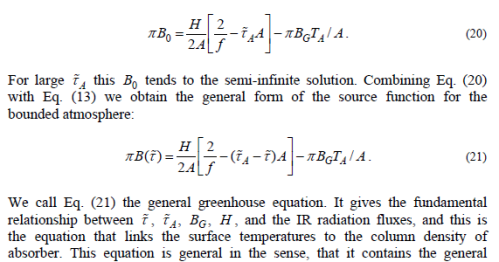
We now move into Appendix B to develop the equations further. The results from the appendix are the equations M20 and M21 on page 14.

Making Equation Soufflé

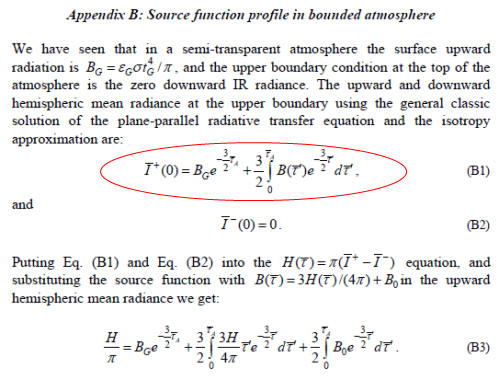
The highlighted equation is the general solution to the Schwzarschild equation. It is developed in Understanding Atmospheric Radiation and the “Greenhouse” Effect – Part Six – The Equations – the equation reproduced here from that article with explanation:

Iλ(0) = Iλm)em + ∫ Bλ(T)e 

The intensity at the top of atmosphere equals..

The surface radiation attenuated by the transmittance of the atmosphere, plus..

The sum of all the contributions of atmospheric radiation – each contribution attenuated by the transmittance from that location to the top of atmosphere

For those wanting to understand the maths a little bit, the 3/2 factor that appears everywhere in Miskolczi’s equation B1 is the diffusivity approximation already mentioned (and see note 2) where we need to sum the radiances over all directions to get flux.

Now this equation is the complete equation of radiative transfer. If we combine it with a simple convective model it is very effective at calculating the flux and spectral intensity through the atmosphere – see Theory and Experiment – Atmospheric Radiation.

So equation B1 in M2007 cannot be solved analytically. This means we have to solve it numerically. This is “simple” in concept but computationally expensive because in the HITRAN database there are 2.7 million individual absorption lines, each one with a different absorption coefficient and a different line width.

However, it can be solved and that is what everyone does. Once you have the database of absorption coefficients and the temperature profile of the atmosphere you can calculate the solution. And band models exist to speed up the process.

And now the rabbit..

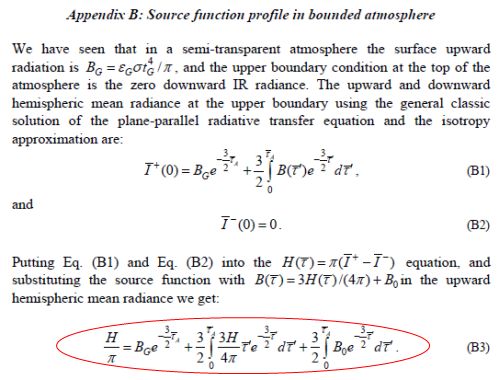
The author now takes the equation for the “source function” (B) from the simple model and inserts it into the “complete” solution.

The “source function” in the complete solution can already be calculated – that’s the whole point of the equation B1. But now instead, the source function from the simple model is inserted in its place. This equation assumes that the atmosphere has no convection, has no variation in emissivity with wavelength, has no solar absorption in the atmosphere, and where the heating rate at each level in the atmosphere = zero.
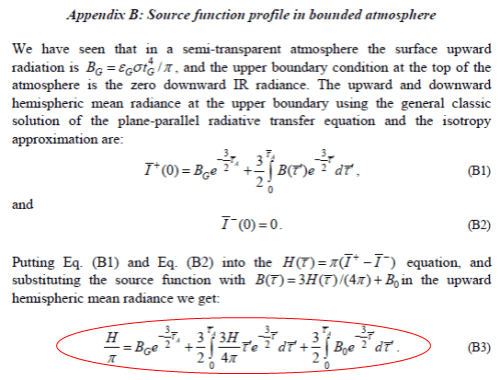
The origin of equation B3 is the equation you see above it:

B(τ) = 3H(τ)/4π + B0   [M13]

Actually, if you check equation M13 on p.11 it is:

B(τ) = 3H.τ/4π + B0   [M13]

This appears to be one of the sources of confusion for Miskolczi, for later comment.

Equation M13 is derived for zero heating rates throughout the atmosphere, and therefore constant H. With this simple assumption – and only for this simple assumption – the equation M13 is a valid solution to “the source function”, ie the atmospheric temperature and radiance.

If you have the complete solution you get one result. If you have the simple model you get a different result. If you take the result from one and stick it in the other how can you expect to get an accurate outcome?

If you want to see how various atmospheric factors are affected by changing τ, then just change τ in the general equation and see what happens. You have to do this via numerical analysis but it can easily be done..

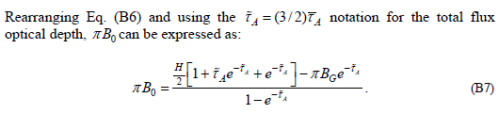
As we continue on working through the appendix, B6 has a sign error in the 2nd term on the right hand side, which is fixed by B7.
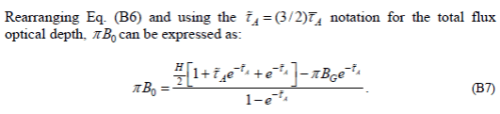
This B0 is the constant in the semi-gray solution. The constant appears because we had a differential equation that we integrated. And the value of the constant was obtained via the boundary condition: upward flux from the climate system must balance solar radiation.

So we know what B0 is.. and we know it is a constant..

Yet now the author differentiates the constant with respect to τ. If you differentiate a constant it is always zero. Yet the explanation is something that sounds like it might be thermodynamics, but isn’t:
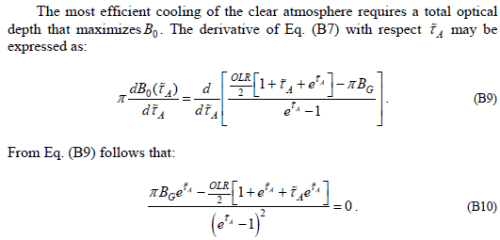
If someone wants to explain what thermodynamic principle create the first statement – I would be delighted. Without any explanation it is a jumble of words that doesn’t represent any thermodynamic principle.

Anyway B0 is a constant and is equal to approximately 240 W/m². Therefore, if we differentiate it, yes the value dB0/dτ=0.

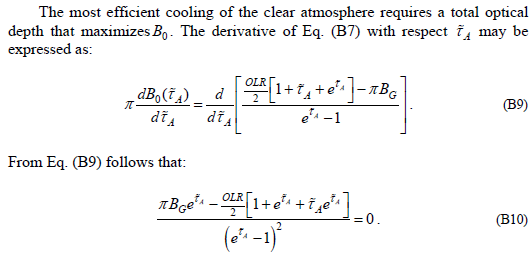
Unfortunately, the result in B10 is wrong.

If we differentiate a variable we can’t assume it is a constant. The variable in question is BG. This is the “source function” for the ground, which gives us the radiance and surface temperature. Clearly the surface temperature is a function of many factors especially including optical thickness. Of course, if somewhere else we have proven that BG is a constant then dBG/dτ=0.

It has to be proven.

[And thanks to DeWitt Payne for originally highlighting this issue with BG, as well as explaining my calculus mistakes in an email].

A quick digression on basic calculus for the many readers who don’t like maths – just so you can see what I am getting at.. (you are the ones who should read it)

Digression

We will consider just the last term in equation [B9]. This term = BG/(eτ-1). I have dropped the π from the term to make it simpler to read what is happening.

Generally, if you differentiate two terms multiplied together, this is what happens:

d(fg)/dx = g.df/dx + f.dg/dx   [4]

This assumes that f and g are both functions of x. If, for example, f is not a function of x, then df/dx=0 (this just means that f does not change as x changes). And so the result reduces to d(fg)/dx = f.dg/dx.

So, using [4] :

d/dτ [BG/(eτ-1)] = [1/(eτ-1)] . dBG/dτ + BG . d [1/(eτ-1)]/dτ  [5]

We can look up:

d [1/(eτ-1)]/dτ = -eτ/(eτ-1)²  [6]

So substituting [6] into [5], last term in [B9]:

= [1/(eτ-1)] . dBG/dτ – eτ.BG /(eτ-1)²   [7]

You can see the 2nd half of this expression as the first term in [B10], multiplied by π of course.

But the term for how the surface radiance changes with optical thickness of the atmosphere has vanished.

end of digression

Soufflé Continued

So the equation should read:

Where the red text is my correction (see eqn 7 in the digression).

Perhaps the idea is that if we assume that surface temperature doesn’t change with optical thickness then we can prove that surface temperature doesn’t change with optical thickness.

This (flawed) equation is now used to prove B11:

Well, we can see that B11 isn’t true. In fact, even apart from the missing term in B10, the equation has been derived by combining two equations which were derived under different conditions.

As we head back into the body of the paper from the appendix, equations B7 and B8 are rewritten as equations [M20] and [M21].
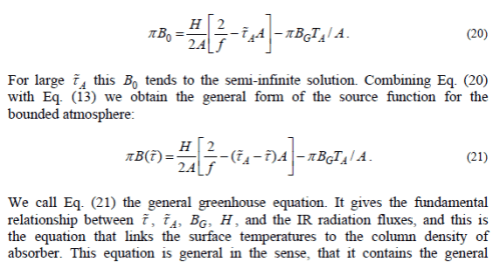
Miskolczi adds:

We could not find any references to the above equations in the meteorological literature or in basic astrophysical monographs, however, the importance of this equation is obvious and its application in modeling the greenhouse effect in planetary atmospheres may have far reaching consequences.

Readers who have made it this far might realize why he is the first with this derivation.

Continuing on, more statements are made which reveal some of the author’s confusion with one part of his derivation. The SGM model is derived by integrating a simple differential equation, which produces a constant. The boundary conditions tell us the constant.

Equation [M13] is written:

B(τ) = 3H/4π + B0   [M13]

Then [M14] is written:

H(τ) = π (I+ – I-)    [M14]

So now H is a function of optical depth in the atmosphere?

In [M15]:

B(τ*) = H (1 + τ*)/2π    [M15]

Refer to my equation 1 and you will see they are the same. The only way this equation can be derived is with H as a constant, because the atmosphere is in radiative equilibrium. If H isn’t constant you have a different equation – M13 and 15 are no longer valid.

..The fact that the new B0 (skin temperature) changes with the surface temperature and total optical depth, can seriously alter the convective flux estimates of previous radiative-convective model computations. Mathematical details on obtaining equations 20 and 21 are summarized in appendix B.

Miskolczi has confused himself (and his readers).

Conclusion

There is an equation of radiative transfer and it is equation B1 in the appendix of M2007. This equation is successfully used to calculate flux and spectral intensity in the atmosphere.

There is a very simple equation of radiative transfer which is used to illustrate the subject at a basic level and it is called the semi-grey model (or the Schwarzschild grey model). With the last few decades of ever increasing computing power the simple models have less and less practical use, although they still have educational value.

Miskolczi has inserted the simple result into the general model, which means, at best, it can only be applied to a “grey” atmosphere in radiative equilibrium, and at worst he has just created an equation soufflé.

The constant in the simple model has become a variable. Without any proof, or re-derivation of the simple model.

One of the important variables in the simple model has become a constant and therefore vanished from an equation where it should still reside.

Many flawed thermodynamic concepts are presented in the paper, some of which we have already seen in earlier articles.

M2007 tells us that Ed=Aa due to Kirchhoff’s law. (See Part Two). His 2010 paper revised this claim as to due to Prevost.. However, the author himself recently stated:

I think I was the first who showed the Aa~=Ed relationship with reasonable quantitative accuracy.

And doesn’t understand why I think it is important to differentiate between fundamental thermodynamic identities and approximate experimental results in the theory section of a paper. “My experiments back up my experiments..”

M2007 introduces equation [M7] with:

In Eq. (6) SU − (F0 + P0 ) and ED − EU represent two flux terms of equal magnitude, propagating into opposite directions, while using the same F0 and P0 as energy sources. The first term heats the atmosphere and the second term maintains the surface energy balance. The principle of conservation of energy dictates that:
SU − (F0) + ED − EU = F0 = OLR

Note the pseudo-thermodynamic explanation. The author himself recently said:

Eq. 7 simply states, that the sum of the Su-OLR and Ed-Eu terms – in ideal greenhause case – must be equal to Fo. I assume that the complex dynamics of the system may support this assumption, and will explain the Su=3OLR/2 (global average) observed relationship.

[Emphasis added]

And later entertainingly commented:

You are right, I should have told that, and in my new article I shall pay more attantion to the full explanations. However, some scientists figured it out without any problem.

Party people who got the joke right off the bat..

M07 also introduces the idea that kinetic energy can be equated with the flux from the atmosphere to space. See Part Three. Introductory books on statistical thermodynamics tell us that flux is proportional to the 4th power of temperature, while kinetic energy is linearly proportional to temperature. We have no comment from the author on this basic contradiction.

This pattern indicates an obvious problem.

In summary – this paper does not contain a theory. Just because someone writes lots of equations down in attempt to back up some experimental work, it is not theory.

If the author has some experimental work and no theory, that is what he should present – look what I have found, I have a few ideas but can someone help develop a theory to explain these results.

Obviously the author believes he does have a theory. But it’s just equation soufflé.

Other Articles in the Series:

The Mystery of Tau – Miskolczi – introduction to some of the issues around the calculation of optical thickness of the atmosphere, by Miskolczi, from his 2010 paper in E&E

Part Two – Kirchhoff – why Kirchhoff’s law is wrongly invoked, as the author himself later acknowledged, from his 2007 paper

Part Three – Kinetic Energy – why kinetic energy cannot be equated with flux (radiation in W/m²), and how equation 7 is invented out of thin air (with interesting author comment)

Part Four – a minor digression into another error that seems to have crept into the Aa=Ed relationship

Part Six – Minor GHG’s – a less important aspect, but demonstrating the change in optical thickness due to the neglected gases N2O, CH4, CFC11 and CFC12.

Further reading:

New Theory Proves AGW Wrong! – a guide to the steady stream of new “disproofs” of the “greenhouse” effect or of AGW. And why you can usually only be a fan of – at most – one of these theories.

References

Greenhouse Effect in Semi-Transparent Planetary Atmospheres, Miskolczi, Quarterly Journal of the Hungarian Meteorological Service (2007)

Deductions from a simple climate model: factors governing surface temperature and atmospheric thermal structure, Weaver & Ramanathan, JGR (1995)

Notes

Note 1 – emissivity = absorptivity for the same wavelength or range of wavelengths

Note 2 – this diffusivity approximation is explained further in Understanding Atmospheric Radiation and the “Greenhouse” Effect – Part Six – The Equations. In M2007 he uses a different factor, τ* = τ . 3/2 – this differences are not large but they exist. The problems in M2007 are so great that finding the changes that result from using different values of τ* is not really interesting.

In Part Two we looked at the claimed relationship ED=AA in Miskolczi’s 2007 paper.

  • Ed = downward atmospheric radiation absorbed by the surface
  • Aa = surface radiation absorbed in the atmosphere

I showed that they could not be exactly equal. Ferenc Miskolczi himself has just joined the discussion and confirmed:

I think I was the first who showed the AA≈ED relationship with reasonable quantitative accuracy.

That is, there is not a theoretical basis for equating AA=ED as an identity.

There is a world of difference between demonstrating a thermodynamic identity and an approximate experimental relationship. In the latter situation, it is customary to make some assessment of how close the values are and the determining factors in the relationship.

But in reviewing the 2007 paper again I noticed something very interesting:

From Miskolczi (2007)

Figure 1

Now the point I made in Part Two was that AA ≠ ED because the atmosphere is a little bit cooler than the surface – at the average height of emission of the atmosphere. So we would expect ED to be a a little less than AA.

Please review the full explanation in Part Two to understand this point.

Now take a look at the graph above. The straight line drawn on is the relationship ED=AA.

The black circles are for an assumption that the surface emissivity, εG = 1. (This is reasonably close to the actual emissivity of the surface, which varies with surface type. The oceans, for example, have an emissivity around 0.96).

In these calculated results you can see that Downwards Emittance, ED is a little less than AA. In fact, it looks to be about 5% less on average. (And note that is  ED = Absorbed Downwards Emittance)

Of course in practice, εG < 1. What happens then?

Well, in the graph above, with εG = 0.96 the points appear to lie very close to the line of ED=AA.

I think there is a calculation error in Miskolczi’s paper – and if this is true it is quite fundamental. Let me explain..

Here is the graphic for explaining Miskolczi’s terms:

From Miskolczi (2007)

Figure 2

When the surface is a blackbody (εG =1), SU = SG  – that is, the upwards radiation from the surface = the emitted radiation from the ground.

The terms and equations in his 2007 are derived with reference to the surface emitting as a blackbody.

When εG < 1, some care is needed in rewriting the equations. It looks like this care has not been taken and the open circles in his Fig 2 (my figure 1) closely matching the ED=AA line are an artifact of incorrectly rewriting the equations when ε< 1.

That’s how it looks anyway.

Here is my graphic for the terms needed for this problem:

Figure 3

As much as possible I have reused Miskolczi’s terms. Because the surface is not a blackbody, the downward radiation emitted by the atmosphere is not completely absorbed. So I created the term EDA for the emission of radiation by the atmosphere. Then some of this, Er, is reflected and added to SG to create the total upward surface radiation, SU.

Note as well that the relationship emissivity = absorptivity is only true for the same wavelengths. See note 4 in Part Two.

Some Maths

Now for some necessary maths – it is very simple. All we are doing is balancing energy to calculate the two terms we need. (Updated note – some of the equations are approximations – the real equation for emission of radiation is a complex term needing all of the data, code and a powerful computer – but the approximate result should indicate that there is an issue in the paper that needs addressing – see comment). 

And the objective is to get a formula for the ratio ED/AA – if ED=AA, this ratio = 1. And remember that in Figure 1, the relationship ED/AA=1 is shown as the straight line.

First, instead of having the term for atmospheric temperature, let’s replace it with:

TA = TS – ΔT      [1]

where ΔT represents the idea of a small change in temperature.

Second, the emitted atmospheric downward radiation comes from the Stefan-Boltzmann law:

EDA = εAσ(TS – ΔT)4      [2]

Third, downward atmospheric radiation absorbed by the surface:

ED = εGEDA      [3]

Fourth, the upward surface radiation is the emitted radiation plus the reflected atmospheric radiation. Emitted radiation is from the Stefan-Boltzmann law:

SU = εGσTS4 + (1-εG) EDA    [4]

Fifth, the absorbed surface radiation is the upward surface radiation multiplied by the absorptivity of the atmosphere (= emissivity at similar temperatures):

AA = εASU      [5]

So if we put [2] -> [3], we get:

ED = εGεAσ(TS – ΔT)4    [6]

And if we put [4] -> [5], we get:

AA = εGεAσTS4 + EDεA(1-εG)/εG   [7]

We are almost there. Remember that we wanted to find the ratio ED/AA. Unfortunately, the AA term includes ED and we can’t eliminate it (unless I missed something).

So let’s create the ratio and see what happens. This is equation 6 divided by equation 7 and we can eliminate εA that appears in each term:

ED/AA = [ εGσ(TS – ΔT)4 ] / [ εGσTS4 + ED(1-εG)/εG ]    [8]

And just to make it possibly a little clearer, we will divide top and bottom by εG and color code each part:

ED/AA = [ σ(TS – ΔT)4 ] / [ σTS4 + ED(1-εG)/εG2 ]      [8a]

And so the ratio = blackbody radiation at the atmospheric temperature divided by

( blackbody surface radiation plus a factor of downward atmospheric radiation that increases as εreduces )

We didn’t make a blackbody assumption, it is just that most of the emissivity terms canceled out.

What Does the Maths Mean?

Take a look at the green term – if εG = 1 this term is zero (1-1=0) and the equation simplifies down to:

ED/AA = (TS – ΔT)4  /  TS4

Which is very simple. If ΔT = 0 then ED/AA = 1.

Let’s plot ED vs AA for a few different values of ΔT and for TS = 288K:

Figure 4

Compare this with figure 1 (Miskolczi’s fig 2).

Note: I could have just cited the ratios of ED/AA, which – in this graph – are constant for each value of ΔT.

And we can easily see that as ΔT →0, ED/AA →1. This is “obvious” from the maths for people more comfortable with equations.

That’s the simplest stuff out of the way. Now we want to see what happens when εG < 1. This is the interesting part, and when you see the graph, please note that the axes are not the same as figure 4. In figure 4, the graph is of ED vs AA, but now we will plot the ratio of ED/AA as other factors change.

Take a look back at equation 8a. To calculate the ratio we need a value of Ed, which we don’t have. So I use some typical values from Miskolczi – and it’s clear that the value of Ed chosen doesn’t affect the conclusion.

Figure 5

You can see that when  εG = 1 the ratio is almost at 0.99. This is the slope of the top line (ΔT=1) in figure 4.

But as surface emissivity reduces, ED/AA reduces

This is clear from equation 8a – as εG  reduces below 1, the second term in the denominator of equation 8a increases from zero. As this increases, the ratio must reduce.

In Miskolczi’s graph, as εG changed from 1.0 → 0.96 the calculated ratio increased. I believe this is impossible.

Here is another version with a different value of ΔT:

Figure 6

Conclusion

Perhaps I made a mistake in the maths. It’s pretty simple – and out there in the open, so surely someone can quickly spot the mistake.

Of course I wouldn’t have published the article if I thought it had a mistake..

On conceptual grounds we can see that as the emissivity of the surface reduces, it absorbs less energy from the atmosphere and reflects more radiation back to the atmosphere.

This must reduce the value of ED and increase the value of AA. This reduces the ratio ED/AA.

In Miskolczi’s 2007 paper he shows that as emissivity is reduced from a blackbody to a more realistic value for the surface, the ratio goes in the other direction.

If my equations are correct then the equations of energy balance (for his paper) cannot have been correctly written for the case εG <1.

This one should be simple to clear up.

Update May 31st – Ken Gregory, a Miskolczi supporter appears to agree – and calculates ED/AA=0.94 for a real world surface emissivity.

Other articles in the series

The Mystery of Tau – Miskolczi – introduction to some of the issues around the calculation of optical thickness of the atmosphere, by Miskolczi, from his 2010 paper in E&E

Part Two – Kirchhoff – why Kirchhoff’s law is wrongly invoked, as the author himself later acknowledged, from his 2007 paper

Part Three – Kinetic Energy – why kinetic energy cannot be equated with flux (radiation in W/m²), and how equation 7 is invented out of thin air (with interesting author comment)

Part Five – Equation Soufflé – explaining why the “theory” in the 2007 paper is a complete dog’s breakfast

Part Six – Minor GHG’s – a less important aspect, but demonstrating the change in optical thickness due to the neglected gases N2O, CH4, CFC11 and CFC12.

One question that has intrigued me for a while – how much of the transmittance (and change in transmittance) from CO2 in the atmosphere is caused by weak lines, and how much is caused by the “far wings” of individual lines.

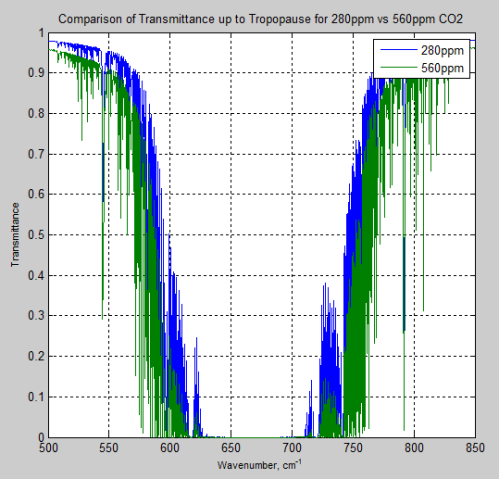
Take a look back at Part Nine. Here is the calculated change in transmittance from the surface to the tropopause for a doubling of CO2 from pre-industrial levels:

Figure 1

We can see that there is significant change outside of the central range of wavenumbers. (For reference, 667 cm-1 = 15 μm).

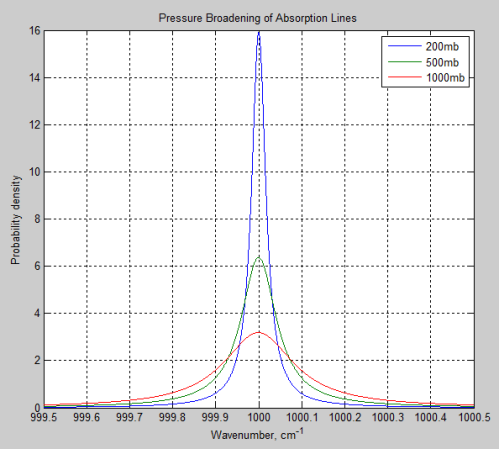
Here is another of the graphics – showing how an individual line absorbs across a range of wavenumbers:

Figure 2

There are many lines in the HITRAN database for CO2 (over 300,000 lines), many of them weak.

So back to my original question – is it the “wings” = line broadening, of the individual lines, or the weaker lines that have the biggest effect? And how do we quantify it?

The Curve of Growth

The Curve of Growth is about the change in transmittance with an increase in path length (specifically the increase in number of absorbing molecules in the path).

The reason the problem is not so simple is because each line has a line shape that absorbs across a range of wavelengths.

We know that transmittance, t=e – this is the Beer-Lambert law. The spreading out of the line means that the reduction in transmittance as the path increases isn’t as strong as predicted by a simple application of the Beer-Lambert law.

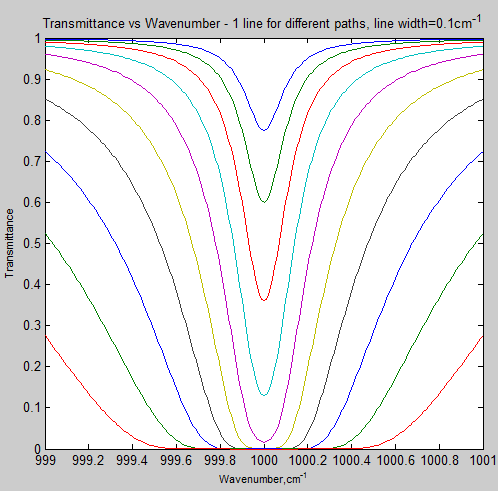
Here is a calculation of this for a typical tropospheric condition (note 1) – for one isolated absorption line with its line center at 1000 cm-1:

Figure 3

Each curve represents a doubling of the number of absorbing molecules in the path. So, if this was at constant density, each curve represents a doubling of the path length.

What does this graph show?

At the line center, an increase in the path length soon causes saturation. But out in the “wings” of the absorption line the reduction in transmittance changes much more slowly.

With some maths we can show that for very small paths (note 2), the absorptance is linearly proportional to the number of absorbers in the path.

And with some more maths we can show that for very large paths (note 2), the absorptance increases as the square root of the number of absorbers in the path.

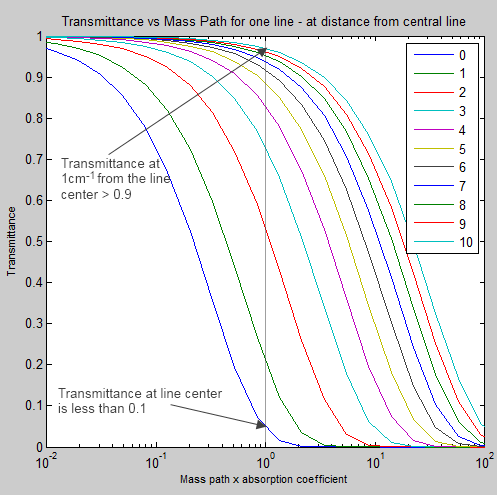
Here is another way to view the “curve of growth”. I haven’t seen it shown this way before:

Figure 4

This is the same scenario, but this time the x-axis (bottom axis) has the effective path length, while each curve represents a different distance from the line center. The legend is showing the distance from the line center compared with the “line width”. So “10” = 1 cm-1 from the line center, while “0” is the line center.

Notice the difference at a mass path x absorption coefficient = 100 (=1) where the line center has a transmittance of 0.05 while at 1 cm-1 distance from the line center the line has a transmittance of 0.97.

What happens when we look at the effect of the whole line?

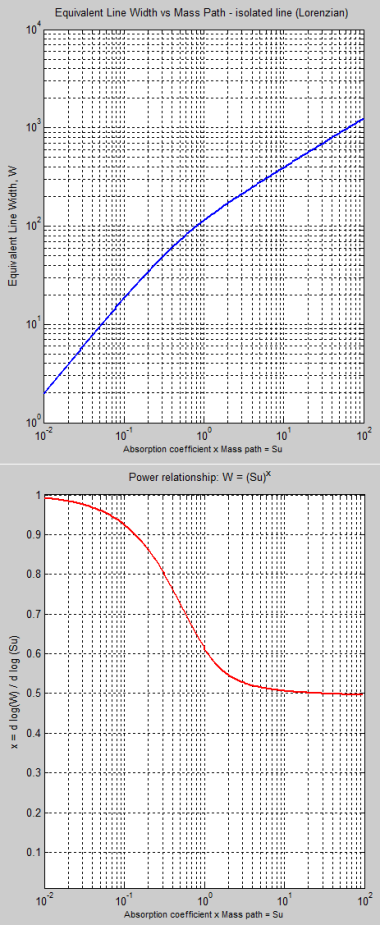
Here is a curve of the equivalent line width, W as the path increases. This equivalent line width is just the total effect across enough bandwidth to take into account the effects of the far wings of the line (note 3):

Figure 5

The 2nd graph is the important one. This shows the power relationship between W and Su, as Su increases – where Su = absorption coefficient x mass of molecules in the path. S is the absorption coefficient, and u is the mass.

For a given line, S is a constant, and so an increase in Su means an increase in the number of molecules in the path.

So if we believe that W = (Su)x, how do we determine x?

We can do it by taking the log of both sides: log(W)=x.log(Su), so by calculating the slope of this log relationship we can see how this value, x, changes.

The 2nd graph shows:

  • at very small paths, the line strength is proportional to Su – because x = 1
  • at very large paths, the line strength is proportional to √(Su) – because x = 0.5

This is simply backing up by numerical calculation the earlier claim: “With some maths we can show..

So if you want to understand “the curve of growth” you need to understand that at very small optical thickness the “equivalent line” grows in linear proportion to the mass of molecules in the path, and with very large optical thickness the “equivalent line” grows in proportion to the square root.

And probably the easiest way to see it conceptually is to take another look at Figure 3.

Line Wings in Practice

So back to my original question. Is it the weak lines or the wings of the strong lines that has the effect?

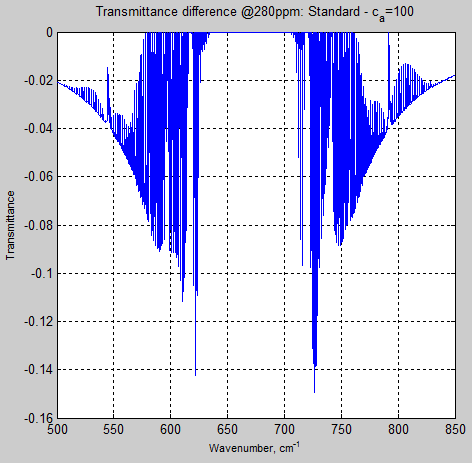
The first step is to calculate the effect of the line wings. I took the MATLAB program developed for Part Nine and made a few changes. The original program had simply applied the equation for line shape out to the edge of the region under consideration. In this version I added a new factor, ca, which “chopped” the line shape. The factor ca limits the line shape for each line to the line center, v0 ± (ca * line width).

The line width is a parameter in the HITRAN database and is a measure of the shape of the line, approximately the value where the strength has fallen to half the peak value.

The original program was run for two values of atmospheric CO2: 280ppm (pre-industrial); and 560ppm (doubling of CO2) – with 15 layers and a calculation every 0.01 cm-1 across the band of 500 cm-1 – 850 cm-1. These are called the “Standard” results. And for these, and all following simulations, we are only considering the main isotopologue of CO2, which accounts for over 98% of atmospheric CO2.

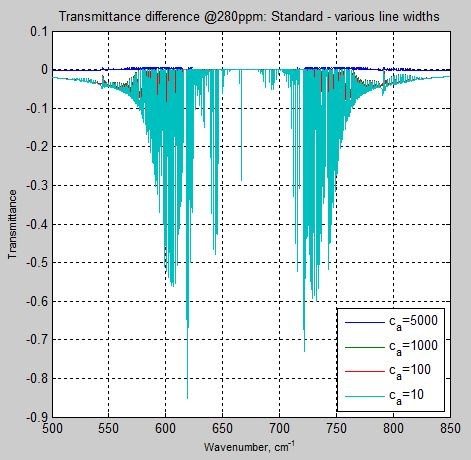
Then the revised program was run for a number of values of ca: 5000, 1000, 100 & 10.

Given that the typical line width is 0.05 – 0.1 cm-1 this means that each line is considered between two extremes: across 250-500 cm-1 down to only 0.5 – 1 cm-1.

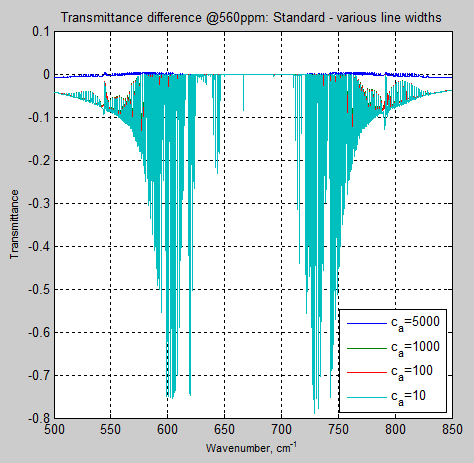
As expected, with ca = 5000, the difference between that and the Standard is almost nil. And as ca is reduced the differences increase:

Figure 6

By the time ca = 100, the differences are noticeable, and at ca = 10, the differences in some parts of the band are huge. The above result (figure 6) is dominated by the ca=10 result so here is ca=100 separately:

Figure 7

So this demonstrates that even when the line shape is “limited” to 100x the line width, there is still a noticeable effect in the transmittance calculation for the troposphere.

For completeness, here is the same comparison at figure 6, but for 560ppm:

Figure 8

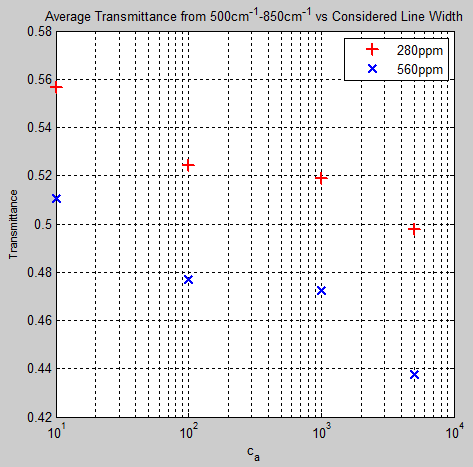
Across this band, the standard case at 280ppm: t = 0.4980, and at 560ppm, t = 0.437.

Here is how the mean transmittance changes as we crop the line shape. Cropping the line shape means that we make the atmosphere more transparent.

Figure 9

We can see from figure 9 that the change in transmittance from 280 – 560 ppm is of a similar magnitude at each artificial “cropping” of the line shape.

Weak Lines

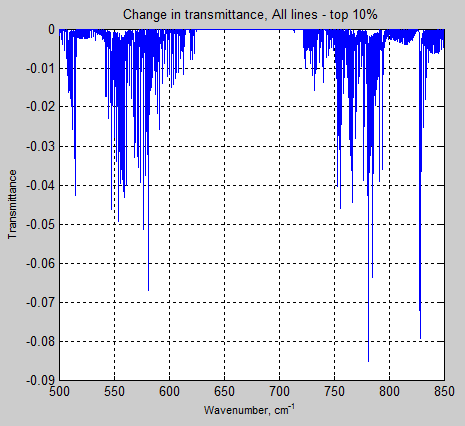
So let’s take a look at the effect of weak lines. For this case I used the same MATLAB program developed for Part Nine but with a user-defined selection of lines. For example, the top 10% of lines by strength.

Here is the transmittance change @ 280ppm through the troposphere, for all lines (standard) less the transmittance of the strongest 10% of lines:

Figure 10

And here is the graph of all lines – the strongest 1%:

Figure 11

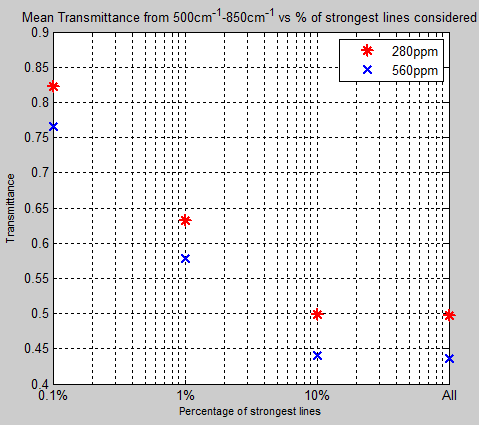
And here is the mean transmittance for both 280ppm and 560ppm as only the strongest lines are considered:

Figure 12

It’s clear that the weakest 90% of lines have virtually no effect on the transmittance of the atmosphere. There are a lot of very weak lines in the HITRAN database.

The calculated transmittance for 100% of the lines at 280ppm = 0.4974 and for the top 10% = 0.4994 – meaning that the top 10% of lines account for 99.6% of the transmittance.

At 560ppm the top 10% of lines account for 99.3%.

Conclusion

Some of this analysis is of curiosity value only.

However, it is very useful to understand the “curve of growth” – and to realize how absorptance increases as the mass in the path increases.

And it’s at least interesting to see how the “far wings” of the individual lines have such an effect on the transmittance through the atmosphere. Even “cropping” the effect at 100x the line width has a significant effect on the atmospheric transmittance.

And for the question posed at the beginning, both the weak lines and the far wings of individual lines have an effect on the total atmospheric transmittance.

Many people have appreciated the massive absorption at the peak of the CO2 band (around 15 μm). But as we have seen in earlier parts of this series (and as shown in Figure 1), it is towards the “edges” of the band where the largest changes take place as CO2 concentration increases.

Remember as well that total transmittance is not really a complete picture of radiative transfer in the atmosphere. The atmosphere also emits radiation, and so the temperature profile of the atmosphere is just as important for seeing the whole picture.

Other articles in the series:

Part One – a bit of a re-introduction to the subject.

Part Two – introducing a simple model, with molecules pH2O and pCO2 to demonstrate some basic effects in the atmosphere. This part – absorption only.

Part Three – the simple model extended to emission and absorption, showing what a difference an emitting atmosphere makes. Also very easy to see that the “IPCC logarithmic graph” is not at odds with the Beer-Lambert law.

Part Four – the effect of changing lapse rates (atmospheric temperature profile) and of overlapping the pH2O and pCO2 bands. Why surface radiation is not a mirror image of top of atmosphere radiation.

Part Five – a bit of a wrap up so far as well as an explanation of how the stratospheric temperature profile can affect “saturation”

Part Six – The Equations – the equations of radiative transfer including the plane parallel assumption and it’s nothing to do with blackbodies

Part Seven – changing the shape of the pCO2 band to see how it affects “saturation” – the wings of the band pick up the slack, in a manner of speaking

Part Eight – interesting actual absorption values of CO2 in the atmosphere from Grant Petty’s book

Part Nine – calculations of CO2 transmittance vs wavelength in the atmosphere using the 300,000 absorption lines from the HITRAN database

Part Ten – spectral measurements of radiation from the surface looking up, and from 20km up looking down, in a variety of locations, along with explanations of the characteristics

Part Eleven – Heating Rates – the heating and cooling effect of different “greenhouse” gases at different heights in the atmosphere

Part Twelve – The Curve of Growth – how absorptance increases as path length (or mass of molecules in the path) increases, and how much effect is from the “far wings” of the individual CO2 lines compared with the weaker CO2 lines

And Also –

Theory and Experiment – Atmospheric Radiation – real values of total flux and spectra compared with the theory.

References

The HITRAN 2008 molecular spectroscopic database, by L.S. Rothman et al, Journal of Quantitative Spectroscopy & Radiative Transfer (2009)

Notes

Note 1 – As you can see in Part Nine, the line shape differs as the pressure reduces.

Note 2 – Technically speaking, for “very small paths” we are really considering the case where optical thickness, τ <<1 (very much less than 1). And for “very large paths” we are considering the case where optical thickness,  τ>>1 (very much greater than 1).

Note 3 – For a line strength = W, if we want to calculate absorptance, a = 1 – t, where t= transmittance, across any given band, Δv, the calculation is very simple:

a = 1-t = W / Δv

In Part One we looked at the calculation of total atmospheric optical thickness.

In Part Two we looked at the claim that the surface and atmosphere exchanged exactly equal amounts of energy by radiation. A thermodynamics revolution if it is true, as the atmosphere is slightly colder than the surface. This claim is not necessary to calculate optical thickness but is a foundation for Miskolczi’s theory about why optical thickness should be constant.

In this article we will look at another part of Miskolczi’s foundational theory from his 2007 paper, Greenhouse Effect in Semi-Transparent Planetary Atmospheres, Quarterly Journal of the Hungarian Meteorological Service.

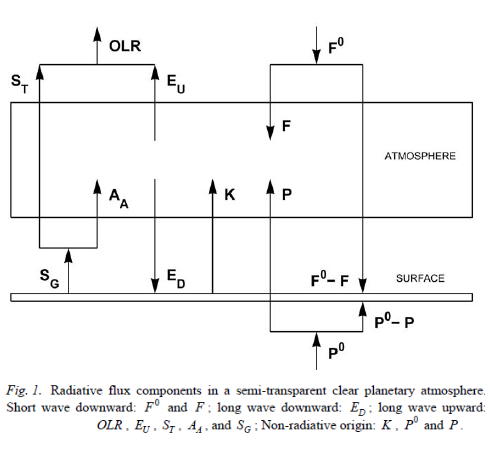
For reference of the terms he uses, the diagram from the 2007 paper:

From Miskolczi (2007)

Figure 1

On pages 6-7, we find this claim:

Regarding the origin, EU is more closely related to the total internal kinetic energy of the atmosphere, which – according to the virial theorem – in hydrostatic equilibrium balances the total gravitational potential energy. To identify EU as the total internal kinetic energy of the atmosphere, the EU = SU / 2 equation must hold.

Many people have puzzled over the introduction of the virial theorem (note 1), which relates total kinetic energy of the atmosphere to total potential energy of the atmosphere. Generally, there is a relationship between potential energy and kinetic energy of an atmosphere so I don’t propose to question it, we will accept it as a given.

By the way, on the diagram SU = SG, i.e. SU = upwards radiation from the surface. And EU = upwards radiation from the atmosphere (cooling to space).

Kinetic Energy of a Gas

For people who don’t like seeing equations, skip to the statement in bold at the end of this section.

Here is the equation of an ideal gas:

pV = nkT (also written as pV = NRT)   [1]

where p = pressure, V = volume, n = number of molecules, k = 1.38 x 10⁻²³ J/K = Boltzmann’s constant, T = temperature in K

This equation was worked out via experimental results a long time ago. Our atmosphere is a very close approximation to an ideal gas.

If we now take a thought experiment of some molecules “bouncing around” inside a container we can derive an equation for the pressure on a wall in terms of the velocities of the molecules:

pV = Nm<vx²>     [2]

where m = mass of a molecule, <vx²> = average of vx², where vx = velocity in the x direction

Combining [1] and [2] we get:

kT = m<vx²>, or

m<vx²>/2 = kT/2     [3]

The same considerations apply to the y and z direction, so

m<v²>/2 = 3KT/2      [4]

This equation tells us the temperature of a gas is equal to the average kinetic energy of molecules in that gas divided by a constant.

For beginners, the kinetic energy of a body is given by mv²/2 = mass x velocity squared divided by two.

So temperature of a gas is a direct measure of the kinetic energy.

The Kinetic Error

So where on earth does this identity come from?

..To identify EU as the total internal kinetic energy of the atmosphere..

EU is the upwards radiation from the atmosphere to space.

To calculate this value, you need to solve the radiative transfer equations, shown in Understanding Atmospheric Radiation and the “Greenhouse” Effect – Part Six – The Equations. These equations have no “analytic” solution but are readily solvable using numerical methods.

However, there is no doubt at all about this:

EU ≠ 3kTA/2   [5]

where TA = temperature of the atmosphere

that is, EU ≠ kinetic energy of the atmosphere

As an example of the form we might expect, if we had a very opaque atmosphere (in longwave), then EU = σTA4 (the Stefan-Boltzmann equation for thermal radiation). As the emissivity of the atmosphere reduces then the equation won’t stay exactly proportional to the 4th power of temperature. But it can never be linearly proportional to temperature.

A Mystery Equation

Many people have puzzled over the equations in Miskolczi’s 2007 paper.

On p6:

The direct consequences of the Kirchhoff law are the next two equations:
EU = F + K + P    (M5)
SU − (F0 + P0 ) = ED − EU   (M6)

Note that I have added a prefix to the equation numbers to identify they as Miskolczi’s. As previously commented, the P term (geothermal energy) is so small that it is not worth including. We will set it to zero and eliminate it, to make it a little easier to see the problems. Anyone wondering if this can be done – just set F’ = F0 + P0 and replace F0 with F’ in the following equations.

So:

EU = F + K    (M5a)
SU − F0 = ED − EU   (M6a)

Please review figure 1 for explanation of the terms.

If we accept the premise that AA = ED then these equations are correct (the premise is not correct, as shown in Part Two).

M5a is simple to see. Taking the incorrect premise that surface radiation absorbed in the atmosphere is completely re-emitted to the surface: therefore, the upward radiation from the atmosphere, EU must be supplied by the only other terms shown in the diagram – convective energy plus solar radiation absorbed by the atmosphere.

What about equation M6a? Physically, what is the downward energy emitted by the atmosphere minus the upward energy emitted by the atmosphere? What is the surface upward radiation minus the total solar radiation?

Well, doesn’t matter if we can’t figure out what these terms might mean. Instead we will just do some maths, using the fact that the surface energy must balance and the atmospheric energy must balance.

First let’s write down the atmospheric energy balance:

AA + K + F = EU + ED   [10]   –  I’m jumping the numbering to my equation 10 to avoid referencing confusion

This just says that Surface radiation absorbed in the atmosphere + convection from the surface to the atmosphere + absorbed solar radiation in the atmosphere = energy radiated by the atmosphere from the top and bottom.

Given the (incorrect) premise that AA = ED, we can rewrite equation 10:

K + F = EU    [10a]

We can see that this matches M5a, which is correct, as already stated.

So first, let’s write down the surface energy balance:

F0 – F + ED = SU + K    [11]

This just says that Solar radiation absorbed at the surface + downward atmospheric radiation = surface upward radiation + convection from the surface to the atmosphere.

Please review Figure 1 to confirm this equation.

Now let’s rewrite equation 11:

SU – F0 = ED – F – K    [11a]

and inserting eq 10a, we get:

SU – F0 = ED -EU    [11b]

Which agrees with M6a.

And as an aside only for people who have spent too long staring at these equations – re-arrange the terms in 11b:

Su – Ed = F0 – Eu; The left side is surface radiation – absorbed surface radiation in the atmosphere (accepting the flawed premise) = transmitted radiation. The right side is total absorbed solar radiation – upward emitted atmospheric radiation. As solar radiation is balanced by OLR, the right side is OLR – upward emitted atmospheric radiation = transmitted radiation.

Now, let’s see the mystery step :

In Eq. (6) SU − (F0 + P0 ) and ED − EU represent two flux terms of equal magnitude, propagating into opposite directions, while using the same F0 and P0 as energy sources. The first term heats the atmosphere and the second term maintains the surface energy balance. The principle of conservation of energy dictates that:
SU − (F0) + ED − EU = F0 = OLR   (M7)  

This equation M7 makes no sense. Note that again I have removed the tiny P0 term.

Let’s take [11b], already demonstrated (by accepting the premise) and add (ED -EU) to both sides:

SU – F0 + (ED – EU) = ED – EU+ (ED -EU) = 2(ED -EU)   [12]

So now the left side of eq 12 matches the left side of M7.

The M7 equation can only be correct if the right side of eq 12 matches the right side of M7:

2(ED -EU) = F0      [13] – to be confirmed or denied

In concept, this claim is that downward radiation from the atmosphere minus upward radiation from the atmosphere = half the total planetary absorbed solar radiation.

I can’t see where this has been demonstrated.

It is not apparent from energy balance considerations – we wrote down those two equations in [10] and [11].

We can say that energy into the climate system = energy out, therefore:

F0 = OLR = EU + ST    [14]   (atmospheric upward radiation plus transmitted radiation through the atmosphere)

Which doesn’t move us any closer to the demonstration we are looking for.

Perhaps someone from the large fan club can prove equation 7. So many people have embraced Miskolczi’s conclusion that there must be a lot of people who understand this step.

Conclusion

I’m confused about equation 7 of Miskolczi.

Running with the odds, I expect that no one will be able to prove it and instead I will be encouraged to take it on faith. However, I’m prepared to accept that someone might be able to prove that it is true (with the caveat about accepting the premise already discussed).

The more important point is equating the kinetic energy of the atmosphere with the upward atmospheric radiation.

It’s a revolutionary claim.

But as it comes with no evidence or derivation and would overturn lots of thermodynamics the obvious conclusion is that it is not true.

To demonstrate it is true takes more than a claim. Currently, it just looks like confusion on the part of the author.

Perhaps the author should write a whole paper devoted to explaining how the upwards atmospheric flux can be equated with the kinetic energy – along with dealing with the inevitable consequences for current thermodynamics.

Update 31st May: The author confirmed in the ensuing discussion that equation 7 was not developed from theoretical considerations.

Other Articles in the Series:

The Mystery of Tau – Miskolczi – introduction to some of the issues around the calculation of optical thickness of the atmosphere, by Miskolczi, from his 2010 paper in E&E

Part Two – Kirchhoff – why Kirchhoff’s law is wrongly invoked, as the author himself later acknowledged, from his 2007 paper

Part Four – a minor digression into another error that seems to have crept into the Aa=Ed relationship

Part Five – Equation Soufflé – explaining why the “theory” in the 2007 paper is a complete dog’s breakfast

Part Six – Minor GHG’s – a less important aspect, but demonstrating the change in optical thickness due to the neglected gases N2O, CH4, CFC11 and CFC12.

Further Reading:

New Theory Proves AGW Wrong! – a guide to the steady stream of new “disproofs” of the “greenhouse” effect or of AGW. And why you can usually only be a fan of – at most – one of these theories.

References

Greenhouse Effect in Semi-Transparent Planetary Atmospheres, Miskolczi, Quarterly Journal of the Hungarian Meteorological Service (2007)

Notes

Note 1 – A good paper on the virial theorem is on arXivThe Virial Theorem and Planetary Atmospheres, Victor Toth (2010)

In Part One we looked at the usefulness of “tau” = optical thickness of the atmosphere.

Miskolczi  has done a calculation (under cloudless skies) of the total optical thickness of the atmosphere. The reason he is apparently the first to have done this in a paper is explained in Part One.

The 2010 paper referenced the 2007 paper, Greenhouse Effect in Semi-Transparent Planetary Atmospheres, Quarterly Journal of the Hungarian Meteorological Service.

The 2010 paper suggested an elementary flaw, but referenced the 2007 paper. The 2007 paper backed up the approach with the same apparently flawed claim.

The flaw that I will explain doesn’t affect the calculation of optical thickness, τ. But it does appear to affect the theoretical basis for why optical thickness should be a constant.

First, the graphic explaining the terms is here:

From Miskolczi (2007)

Figure 1

The 2010 paper said:

One of the first and most interesting discoveries was the relationship between the absorbed surface radiation and the downward atmospheric emittance. According to Ref. 4, for each radiosonde ascent the
ED = AA = SU – ST = SU(1− exp(−τA)) = SU(1− TA ) = SU.A             (5)
relationships are closely satisfied. The concept of radiative exchange was the discovery of Prevost [17]. It will be convenient here to define the term radiative exchange equilibrium between two specified regions of space (or bodies) as meaning that for the two regions (or bodies) A and B, the rate of flow of radiation emitted by A and absorbed by B is equal to the rate of flow the other way, regardless of other forms of transport that may be occurring.

Ref. 4 is the 2007 paper, which said:

According to the Kirchhoff law, two systems in thermal equilibrium exchange energy by absorption and emission in equal amounts, therefore, the thermal energy of either system can not be changed. In case the atmosphere is in thermal equilibrium with the surface, we may write that..

What is “thermal equilibrium“?

It is when two bodies are in a closed system and have reached equilibrium. This means they are at the same temperature and no radiation can enter or leave the system. In this condition, energy emitted from body A and absorbed by body B = energy emitted from body B and absorbed by body A.

Kirchhoff showed this radiative exchange must be equal under the restrictive condition of thermal equilibrium. And he didn’t show it for any other condition. (Note 2).

However, the earth’s surface and the atmosphere are not in thermal equilibrium. And, therefore, energy exchanged between the surface and the atmosphere via radiation is not proven to be equal.

Dr. Roy Spencer has a good explanation of the fallacy and the real situation on his blog. One alleged Miskolczi  supporter took him to task for misinterpreting something – here:

With respect, Dr Spencer, it is not reasonable, indeed it verges on the mischievous, to write an allegation that Miskolczi means that radiative exchange is independent of temperature. Miskolczi means no such thing. To make such an allegation is to ignore the fact that Miskolczi uses the proper laws of physics in his calculations. Of course radiative exchange depends on temperature, and of course Miskolczi is fully aware of that.

and here:

..Planck uses the term for a system in thermodynamic equilibrium, and the present system is far from thermodynamic equilibrium, but the definition of the term still carries over..

I couldn’t tell whether the claimed “misinterpretation” by Spencer was of the real law or the Miskolczi interpretation. And this article will demonstrate that the proper laws of physics have been ignored.

And I have no idea whether the Miskolczi supporter represented the real Miskolczi. However, a person of the same name is noted by Miskolczi for his valuable comments in producing the 2010 paper.

Generally when people claim to overturn decades of research in a field you expect them to take a bit of time to explain why everyone else got it wrong, but apparently Dr. Spencer was deliberately misinterpreting something.. and that “something” is very clear only to Miskolczi supporters.

After all, the premise in the referenced 2007 paper was:

According to the Kirchhoff law, two systems in thermal equilibrium exchange energy by absorption and emission in equal amounts, therefore, the thermal energy of either system can not be changed. In case the atmosphere is in thermal equilibrium with the surface, we may write that..

Emphasis added.

So if the atmosphere is not in thermal equilibrium with the surface, we can’t write the above statement.

And as a result the whole paper falls down. Perhaps there are other gems which stand independently of this flaw and I look forward to a future paper from the author when he explains some new insights which don’t rely on thermodynamic equilibrium being applied to a world without thermodynamic equilibrium.

Thermodynamic Equilibrium and the Second Law of Thermodynamics

If you put two bodies, A & B, at two different temperatures, TA and TB, into a closed system then over time they will reach the same temperature.

Let’s suppose that TA > TB. Therefore, A will radiate more energy towards B than the reverse. These bodies will reach equilibrium when TA = TB (note 1).

At this time, and not before, we can say that ” ..two systems in thermal equilibrium exchange energy by absorption and emission in equal amounts”. (Note 2).

Obviously, before equilibrium is reached more energy is flowing from A to B than the reverse.

Non-Equilibrium

Let’s consider a case like the sun and the earth. The earth absorbs around 240 W/m² from the sun. The sun absorbs a lot less from the earth.

Let’s just say it is a lot less than 1 W/m². Someone with a calculator and a few minutes spare can do the sums and write the result in the comments.

No one (including of course the author of the paper) would suggest that the sun and earth exchange equal amounts of radiation.

However, they are in the condition of “radiative exchange”.

The Earth’s Surface and the Atmosphere

The earth’s surface and the bottom of the atmosphere are at similar temperatures. Why is this?

It is temperature difference that drives heat flow. The larger the temperature difference the greater the heat flow (all other things remaining equal). So any closed system tends towards thermal equilibrium. If the earth and the atmosphere were left in a closed system, eventually both would be at the same temperature.

However, in the real world where the climate system is open to radiation, the sun is the source of energy that prevents thermal equilibrium being reached.

The bottom millimeter of the atmosphere will usually be at the same temperature as the earth’s surface directly below. If the bottom millimeter is stationary then it will be warmed by conduction until it reaches almost the surface temperature. But 10 meters up the temperature will probably reduce just a little. At 1 km above the surface the temperature will be between 4 K and 10 K cooler than the surface.

Note: Turbulent heat exchange near the surface is very complex. This doesn’t mean that there is confusion about the average temperature profile vs height through the atmosphere. On average, temperature reduces with height in a reasonably predictable manner.

Energy Exchanges between the Earth’s Surface and the Atmosphere

According to Miskolczi:

AA = ED   [4]

Referring to the diagram, AA is energy absorbed by the atmosphere from the surface, and ED is energy radiated from the atmosphere to the surface.

Why should this equality hold?

The energy from the surface to the atmosphere = AA+ K (note 3), where K is convection.

The energy absorbed in total by the atmosphere = AA + K + F, where F is absorbed solar radiation in the atmosphere.

The energy emitted by the atmosphere = ED + EU , where EU is the energy radiated from the top of the atmosphere.

Therefore, using the First Law of Thermodynamics for the atmosphere:

AA + K + F = ED + EU + energy retained

i.e., energy absorbed = energy lost – energy retained

No other equality relating to the atmospheric fluxes can be deduced from the fundamental laws of thermodynamics.

In general, because the atmosphere and the earth’s surface are very close in temperature, AA will be very close to ED.

It is important to understand that absorptivity for longwave radiation will be equal to emissivity for longwave radiation (see Planck, Stefan-Boltzmann, Kirchhoff and LTE), therefore, if the surface and the atmosphere are at the same temperature then the exchange of radiation will be equal.

Where does the atmosphere radiate from, on average? Well, not from the bottom meter. It depends on the emissivity of the atmosphere. This varies with the amount of water vapor in the atmosphere.

The atmospheric temperature reduces with height- by an average of around 6.5 K/km – and unless the atmospheric radiation was from the bottom few meters, the radiation from the atmosphere to the surface must be lower than the radiation absorbed from the surface by the atmosphere.

If radiation was emitted from an average of 100 m above the surface then the effective temperature of atmospheric radiation would be 0.7 K below the surface temperature. If radiation was emitted from an average of 200 m above the surface then the effective temperature of atmospheric radiation would be 1.3 K below the surface temperature.

Mathematical Proof

For people still thinking about this subject, a simple mathematical proof.

Temperature of the atmosphere, from the average height of emission, Ta

Temperature of the surface, Ts

Emissivity of the atmosphere = εa

Absorptivity of the atmosphere for surface radiation = αa

If Ta is similar to Ts then εa ≈ αa (note 4).

(In the paper, the emissivity (and therefore absorptivity) of the earth’s surface is assumed = 1).

Surface radiation absorbed by the atmosphere, AA = αaσTs4 .

Atmospheric radiation absorbed by the surface, ED = εaσTa4 .

Therefore, unless Ta = Ts, AA ≠ ED .

If Roy Spencer’s experience is anything to go by, I may now be accused of deliberately misunderstanding something.

Well, words can be confused – even though they seem plain enough in the extract shown. But the paper also asserts the mathematical identity:

AA = ED   [4]

I have demonstrated that:

AA ≠ ED   [4]

I don’t think there is much to be misunderstood.

Two bodies at different temperatures will NOT exchange exactly equal amounts of radiation. It is impossible unless the current laws of thermodynamics are wrong.

As a more technical side note.. because εa ≈ αa and not necessarily an exact equality, it is possible for the proposed equation to be asserted in the following way:

AA = ED if, and only if, the following identity is always true, αa(Ts)σTs4 = εa(Ta)σTa4 .

Therefore:

Ts/Ta = (εa(Ta)/αa(Ts))1/4  [Equation B]

– must always be true for equation 4 of Miskolczi (2007) to be correct. Or must be true over whatever time period and surface area his identity is claimed to be true.

Another quote from the 2007 paper:

The popular explanation of the greenhouse effect as the result of the LW atmospheric absorption of the surface radiation and the surface heating by the atmospheric downward radiation is incorrect, since the involved flux terms (AA and ED) are always equal.

Emphasis added.

Note in Equation B that I have made explicit the dependence of emissivity on the temperature of the atmosphere at that time, and the dependence of absorptivity on the temperature of the surface.

Emissivity vs wavelength is a material property and doesn’t change with temperature. But because the emission wavelengths change with temperature the calculation of εa(Ta) is the measured value of εa at each wavelength weighted by the Planck function at Ta.

It is left as an exercise for the interested student to prove that this identity, Equation B, cannot always be correct.

The “Almost” Identity

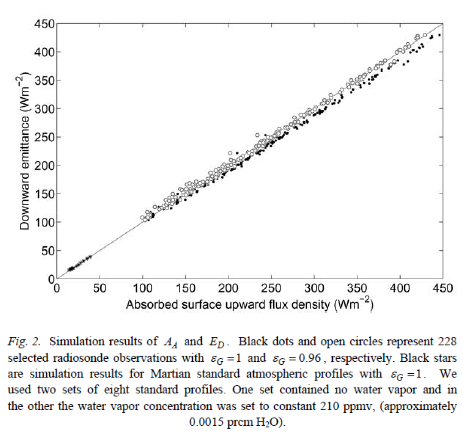
In Fig. 2 we present large scale simulation results of AA and ED for two measured diverse planetary atmospheric profile sets. Details of the simulation exercise above were reported in Miskolczi and Mlynczak (2004). This figure is a proof that the Kirchhoff law is in effect in real atmospheres. The direct consequences of the Kirchhoff law are the next two equations:

EU = F + K + P (5)
SU − (F0 + P0 ) = ED − EU (6)

The physical interpretations of these two equations may fundamentally change the general concept of greenhouse theories.

From Miskolczi (2007)

Figure 2

This is not a proof of Kirchhoff’s law, which is already proven and is not a law that radiative exchanges are equal when temperatures are not equal.

Instead, this is a demonstration that the atmosphere and earth’s surface are very close in temperature.

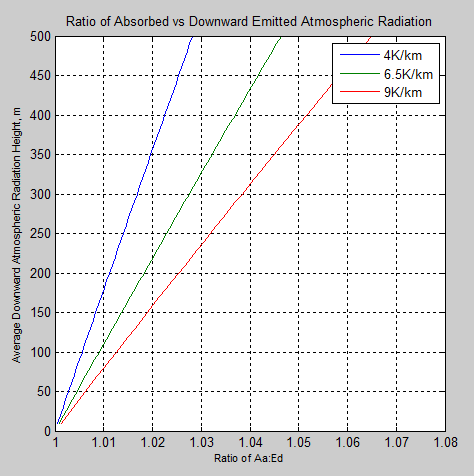
Here is a simple calculation of the ratio of AA:ED for different downward emitting heights (note 5), and lapse rates (temperature profile of the atmosphere):

Figure 3

Essentially this graph is calculated from the formula in the maths section and a calculation of the atmospheric temperature, Ta, from the height of average downward radiation and the lapse rate.

Oh No He’s Not Claiming This is Based on Kirchoff..

Reading the claims by the supporters of Miskolczi at Roy Spencer’s blog, you read that:

  1. Miskolczi is not claiming that AA = ED by asserting (incorrectly) Kirchhoff’s law
  2. Miskolczi is claiming that AA = ED by experimental fact

So the supporters claim.

Read the paper, that’s my recommendation. The 2010 paper references the 2007 paper for equation 4. The 2007 paper says (see larger citation above):

..This figure is a proof that the Kirchhoff law is in effect in real atmospheres..

In fact, this is the important point:

Anyone who didn’t believe that it was a necessary consequence of Kirchhoff would be writing the equations in the maths section above (which come from well-proven radiation theory) and realizing that it is impossible for AA = ED.

And they wouldn’t be claiming that it demonstrated Kirchhoff’s law. (After all, Kirchhoff’s law is well-proven and foundational thermodynamics).

However, it is certain that on average ED < AA but very close to AA.

Hence the Atmospheric Window Cooling to Space Thing

From time to time, Miskolczi fans have appeared on this blog and written interesting comments. Why the continued fascination with the exact amount of radiation transmitted from the surface through the atmospheric window?

I have no idea whether this point is of interest to anyone else..

One of the comments highlighted the particular claim and intrigued me.

Yes, indeed, that’s right: Simpson discovered the atmospheric window in 1928. It was not till the work of Miskolczi in 2004 and 2007 that it was discovered that practically all the radiative cooling of the land-sea surface is by radiation direct to space.

Apart from the (unintentional?) humor inherent in the Messianic-style claim, the reason why this claim is a foundational point for Miskolczi-ism  is now clear to me.

If exactly all of the radiation absorbed by the atmosphere is re-radiated to the surface and absorbed by the surface (AA = ED) then these points follow for certain:

  1. radiation emitted by the atmosphere to space = convective heat from the surface into the atmosphere + solar radiation absorbed by the atmosphere
  2. total radiative cooling to space = radiation transmitted through the atmospheric window + convective heat plus solar radiation absorbed by the atmosphere

A curiosity only.

Changing the Fundamental View of the World

Miskolczi claims:

The physical interpretations of these two equations may fundamentally change the general concept of greenhouse theories.

He is being too modest.

If it turns out that AA = ED then it will overturn general radiative theory as well.

Or demonstrate that the atmosphere is much more opaque than has currently been calculated (for all of the downward atmospheric radiation to take place from within a few tens of meters of the surface).

This in turn will require the overturning of some parts of general radiative theory, or at least, a few decades of spectroscopic experiments, which consequently will surely require the overturning of..

Conclusion

How is it possible to claim that AA = ED and not work through the basic consequences (e.g., the equations in the maths section above) to deal with the inevitable questions on thermodynamics basics?

Why claim that it has fundamentally changed the the general concept of the inappropriately-named “greenhouse” theory when it – if true – has overturned generally accepted radiation theory?

  • Perhaps α(λ) ≠ ε(λ) and Kirchhoff’s law is wrong? This is a possible consequence. (In words, the equation says that absorptivity at wavelength λ is not equal to emissivity at wavelength λ, see note 4).
  • Or perhaps the well-proven Stefan-Boltzmann law is wrong? This is another possible consequence.

Interested observers might wonder about the size of the error bars in Figure 2. (And for newcomers, the values in Figure 2 are not measured values of radiation, they are calculated absorption and emission).

As already suggested, perhaps there are useful gems somewhere in the 40 pages of the 2007 paper, but when someone is so clear about a foundational point for their paper that is so at odds with foundational thermodynamic theory and the author doesn’t think to deal with that.. well, it doesn’t generate hope.

Update 31st May – the author comments in the ensuing discussion that Aa=Ed is an “experimental” conclusion. In Part Four I show that the “approximate equality” must be an error for real (non-black) surfaces, and Ken Gregory, armed with the Miskolczi spreadsheet, later confirms this.

Other Articles in the Series:

The Mystery of Tau – Miskolczi – introduction to some of the issues around the calculation of optical thickness of the atmosphere, by Miskolczi, from his 2010 paper in E&E

Part Three – Kinetic Energy – why kinetic energy cannot be equated with flux (radiation in W/m²), and how equation 7 is invented out of thin air (with interesting author comment)

Part Four – a minor digression into another error that seems to have crept into the Aa=Ed relationship

Part Five – Equation Soufflé – explaining why the “theory” in the 2007 paper is a complete dog’s breakfast

Part Six – Minor GHG’s – a less important aspect, but demonstrating the change in optical thickness due to the neglected gases N2O, CH4, CFC11 and CFC12.

Further Reading:

New Theory Proves AGW Wrong! – a guide to the steady stream of new “disproofs” of the “greenhouse” effect or of AGW. And why you can usually only be a fan of – at most – one of these theories.

References

Greenhouse Effect in Semi-Transparent Planetary Atmospheres, Miskolczi , Quarterly Journal of the Hungarian Meteorological Service (2007)

The Stable Stationary Value of the Earth’s Global Average Atmospheric Planck-Weighted Greenhouse-Gas Optical Thickness, Miskolczi, Energy & Environment(2010)

The Theory of Heat Radiation, Max Planck, P. Blakiston’s Son & Co (1914) : a translation of Waermestrahlung (1913) by Max Planck.

Notes

Note 1 – Of course, in reality equilibrium is never actually reached. As the two temperatures approach each other, the difference in energy exchanged is continually reduced. However, at some point the two temperatures will be indistinguishable. Perhaps when the temperature difference is less than 0.1°C, or when it is less than 0.0000001°C..

Therefore, it is conventional to talk about “reaching equilibrium” and no one in thermodynamics is confused about the reality of the above point.

Note 2 – Max Planck introduces thermodynamic equilibrium:

Note 3 – Geothermal energy is included in the diagram (P0). Given that it is less than 0.1 W/m² – below the noise level of most instruments measuring other fluxes in the climate – there is little point in cluttering up the equations here with this parameter.

Note 4 – Emissivity and absorptivity are wavelength dependent parameters. For example, snow is highly reflective for solar radiation but highly absorbing (and therefore emitting) for terrestrial radiation.

At the same wavelength, emissivity = absorptivity. This is the result of Kirchhoff’s law.

If the temperature of the source radiation for which we need to know the absorptivity is different from the temperature of the emitting body then we cannot assume that emissivity = absorptivity.

However, when the temperature of source body for the radiation being absorbed is within a few Kelvin of the emitting body then to a quite accurate assumption, absorptivity = emissivity.

For example, the radiation from a source of 288K is centered on 10.06 μm, while for 287 K it is centered on 10.10 μm. Around this temperature, the central wavelength decreases by about 0.035 μm for each 1 K change in temperature.

An example of when it is a totally incorrect assumption is for solar radiation absorbed by the earth. The solar radiation is from a source of about 5800 K and centered on 0.5 μm, whereas the terrestrial radiation is from a source of around 288 K and centered on 10 μm. Therefore, to assume that the absorptivity of the earth’s surface for solar radiation is equal to the emissivity of the earth’s surface is a huge mistake.

This would be the same as saying that absorptivity at 0.5 μm = emissivity at 10 μm. And, therefore, totally wrong.

Note 5: What exactly is meant by average emitting height? Emitted radiation varies as the 4th power of temperature and as a function of emissivity, which itself is a very non-linear function of quantity of absorbers. Average emitting height is more of a conceptual approach to illustrate the problem.

Many people have requested an analysis of Miskolczi’s theories.

I start with his more recent paper:  The Stable Stationary Value of the Earth’s Global Average Atmospheric Planck-Weighted Greenhouse-Gas Optical Thickness, Energy & Environment (2010).

It’s an interesting paper and clearly Miskolczi has put a lot of time and effort into it. I recommend people read the paper for themselves, and the link above provides free access.

The essence of the claim is that the optical thickness of the earth’s atmosphere is a constant – at least over the last 60 years – where water vapor cancels out any change from CO2. So if more CO2 increases the optical thickness, then the optical thickness from water vapor will reduce.

In his paper he make this statement:

Unfortunately no computational results of EU, ST, A, TA and τA can be found in the literature, and therefore our main purpose is to give realistic estimates of their global mean values, and investigate their dependence on the atmospheric CO2 concentration.

Among the terms noted in this quote, τA is the optical thickness of the atmosphere.

As we delve into the paper, hopefully the reasons why this value isn’t calculated in any papers will become clear. In fact, the first question people should be asking themselves is this:

If the result is of significant importance why has no one else calculated this parameter before?

There are thousands of papers about radiative transfer, CO2 and water vapor.

Why has no one (apparently) published their calculations of the globally averaged optical thickness of the atmosphere and how it has changed over time?

There is a reason..

What is Optical Thickness?

You can find a more complete explanation of optical thickness in Understanding Atmospheric Radiation and the “Greenhouse” Effect – Part Six – The Equations, which I definitely recommend reading even though it has many equations. (Actually, because it has many equations..)

Because optical thickness isn’t an obvious parameter, let’s start with a simpler property called transmittance.

Transmittance is the proportion of radiation which is transmitted through a body (in this case, the atmosphere). We will use the letter “t” to refer to it.

t has a value between 0 and 1. Slightly more formally, we can write 0 ≤ t≤ 1.

For t = 1, the body is totally transparent to incident radiation.

For t = 0, the body is totally opaque and absorbs all incident radiation.

For non-scattering atmospheres (note 1), absorptance, a = 1- t, which means that whatever is not absorbed gets transmitted. This is simple enough, and everyone would expect this from the First Law of Thermodynamics.

Now for optical thickness. We will use τ for this parameter. τ is the Greek letter “tau”.

The Beer-Lambert law says that the transmittance of a beam of radiation:

t = exp(-τ)

The “exp” is a mathematical convention for “e to the power of”. So this can alternatively be written as:

t = e

Which means that when τ = 1, t = 0.36;   when τ = 2, t = 0.14; and when τ = 10, t = 0.000045.

Optical thickness is tedious to calculate because the properties of each gas vary strongly with wavelength.

In brief, for each molecule at each wavelength, the total optical thickness is equal to the total number of molecules in the path x the absorption coefficient (which is a function of wavelength).

So optical thickness is a very handy parameter. Calculating it does take some work and a pre-requisite is a database of all the spectroscopic values for each molecule – as well as knowing the total amount of each gas in the path we want to calculate.

Absorption and Emission

The atmosphere absorbs and also emits.

Absorption, as we have just seen, is a function of the total amount of each gas (in a path) as well as the properties of each gas.

And, in case it is not obvious, the total radiation absorbed is also a function of the intensity of radiation travelling through the body that we want to calculate. This is because absorption = incident radiation x absorptance.

What about emission?

Emission of radiation is a function of the temperature of the atmosphere, as well as its emissivity, ε. This parameter emissivity is equal to the absorptivity or absorptance, of a body at any given wavelength – or across a range of wavelengths. This is known as Kirchhoff’s law.

Emission = ε . σT4 in W/m², where T is the temperature of the atmosphere at that point.

If we want to calculate the radiative transfer through the atmosphere we need both terms.

Here is a simple example of why. Readers who followed the series Understanding Atmospheric Radiation and the “Greenhouse” Effect will remember that I introduced a simple atmosphere with two molecules, pCO2 and pH2O. These had a passing resemblance to the real molecules, but had properties that were much simpler, for the purposes of demonstrating some important aspects of how radiation interacts with the atmosphere.

This following example has three scenarios. Each scenario has the same total amount of water vapor through the atmosphere, but a different profile vs height. These are shown in the graph:

Figure 1

The bottom graph shows the top of atmosphere (TOA) flux from each of the three scenarios.

If we calculated the total transmittance through the atmosphere it would be the same in each scenario (update: correction – see Ken Gregory’s point below). Because the optical thickness is the same. The optical thickness is the same because the total number of pH2O molecules in the path is the same.

Yet the TOA flux is very different.

This is because where the atmosphere emits from is very important in calculations of flux. For example, in the case of the 3rd scenario, the TOA flux is lower because more of the water vapor is at colder temperatures, and less is at hotter temperatures.

From Understanding Atmospheric Radiation and the “Greenhouse” Effect – Part Six – The Equations:

dIλ/dτ = Iλ – Bλ(T)     [12]

which is also known as Schwarzschild’s Equation – and is the fundamental description of changes in radiation as it passes through an absorbing (and non-scattering) atmosphere. Bλ(T) = the Planck function, which is a function of temperature. And the subscript λ in each term identifies the wavelength dependence of this equation.

For the mathematically minded, it will be clear reviewing the above equation that total optical thickness tells you less than you need. As the location of optical thickness varies, if temperature varies (which it does in the atmosphere) then you can get different results for the same optical thickness.

That is, the simulations above demonstrate what is clear, and easily provable, from the form of the fundamental equation.

This is why papers on total optical thickness of the atmosphere over time are hard to come by. It is of curiosity value only.

What About Methane, Nitrous Oxide and Halocarbons?

The total optical thickness of the atmosphere is not just determined by water vapor and CO2. If the atmosphere has an invariant optical thickness then surely all molecules should be included?

According to WM Collins and his co-authors (2006):

The increased concentrations of CO2, CH4, and N2O between 1750 and 1998 have produced forcings of +1.48, +0.48, and +0.15 W m, respectively [IPCC, 2001]. The introduction of halocarbons in the mid-20th century has contributed an additional +0.34 Wm for a total forcing by WMGHGs of +2.45Wm with a 15% margin of uncertainty.

I’m sure someone with enough determination can find some results for the changes in the radiative forcing from CH4 and N2O between 1950 and 2010. But this at least demonstrates that there is some significant absorption characteristics for other molecules. After all, halocarbons have added a quarter of the longer term CO2 increase in radiative forcing from CO2 (from 1750 to the present day) in just half a century.

So if total optical thickness from CO2 and water vapor has stayed constant over 60 years then surely total optical thickness must have increased?

This is not mentioned in the paper and seems to be a major blow to the not-particularly-useful result calculated.

Update, 31st May: Ken Gregory, a Miskolczi supporter armed with the spreadsheet of calculations, says that minor gases were kept constant. So Part Six demonstrates my basic calculations of optical thickness changes due to CO2 and some minor gases.

Cloudy Thinking

Miskolczi says:

In all calculations of A, TA, tA, and of the radiative flux components, the presence or absence of clouds was ignored; the calculations refer only to the greenhouse gas components of the atmosphere registered in the radiosonde data; we call this the quasi-all-sky protocol. It is assumed, however, that the atmospheric vertical thermal and water vapor structures are implicitly affected by the actual cloud cover, and that the atmosphere is at a stable steady state of cloud cover.

Assumed but not demonstrated.

Clouds have a huge impact on the radiative (and convective) heat transfers in the atmosphere. From Clouds and Water Vapor – Part One:

Clouds reflect solar radiation by 48 W/m² but reduce the outgoing longwave radiation (OLR) by 30 W/m², therefore the average net effect of clouds – over this period at least – is to cool the climate by 18 W/m².

Are they constant?

Here is a snapshot from Vardavas & Taylor (2007):

From Vardavas & Taylor (2007)

Figure 2

Another important point – given the non-linearity of the equations of radiative transfer, even if the cloud cover stayed at a constant global percentage but the geographical distribution changed, the optical thickness of the atmosphere cannot be assumed constant.

Here are some values of cloud emissivity from Hartmann (1994):

From Hartmann (1994)

Figure 3

Just for some perspective, as emissivity reaches 0.8, τ =  1.6; with emissivity = 0.9, τ = 2.3. And Miskolczi calculates the global average optical thickness of the atmosphere – without clouds – at 1.87.

At the end of his paper, Miskolczi concludes:

Apparently, the global average cloud cover must not have a dramatic effect on the global average clear-sky optical thickness..

I can’t understand, from the paper, where this confidence comes from.

Conclusion

There is more in the paper, including some very suspect assumptions about radiative exchange. However, six out of the 19 references in the paper are to Miskolczi himself and the fundamental equations brought up for energy balance (where radiative exchange is referenced) rely on his more lengthy 2007 paper, Greenhouse effect in semi-transparent planetary atmospheres.

I will try to read this paper before commenting on these energy balance equations.

However, the key points are:

  • optical thickness of the total atmosphere is not a very useful number
  • the useful headline number has to be changes in TOA flux, or radiative forcing, or some value which expresses the overall radiative balance of the climate system (update: see this comment for the correct measure)
  • optical thickness calculated as constant over 60 years for CO2 and water vapor appears to prove that total optical thickness is not constant due to increases in other well-mixed “greenhouse” gases
  • clouds are not included in the calculation, but surely overwhelm the optical thickness calculations and cannot be assumed to be constant

Other Articles in the Series:

Part Two – Kirchhoff – why Kirchhoff’s law is wrongly invoked, as the author himself later acknowledged, from his 2007 paper

Part Three – Kinetic Energy – why kinetic energy cannot be equated with flux (radiation in W/m²), and how equation 7 is invented out of thin air (with interesting author comment)

Part Four – a minor digression into another error that seems to have crept into the Aa=Ed relationship

Part Five – Equation Soufflé – explaining why the “theory” in the 2007 paper is a complete dog’s breakfast

Part Six – Minor GHG’s – a less important aspect, but demonstrating the change in optical thickness due to the neglected gases N2O, CH4, CFC11 and CFC12.

Further Reading:

New Theory Proves AGW Wrong! – a guide to the steady stream of new “disproofs” of the “greenhouse” effect or of AGW. And why you can usually only be a fan of – at most – one of these theories.

References

The Stable Stationary Value of the Earth’s Global Average Atmospheric Planck-Weighted Greenhouse-Gas Optical Thickness, Miskolczi, Energy & Environment (2010)

Radiative forcing by well-mixed greenhouse gases: Estimates from climate models in the Intergovernmental Panel on Climate Change (IPCC) Fourth Assessment Report (AR4), Collins et al, JGR (2006)

Radiation and Climate, Vardavas & Taylor, Oxford University Press (2007)

Global Physical Climatology, Hartmann, Academic Press (1994) – reviewed here

Notes

Note 1 – For longwave radiation (>4 μm), scattering is negligible in the atmosphere.

The subject of atmospheric heating rates is one which is worth spending time on.

What is a heating rate?

To see the usefulness of a heating rate let’s consider the per capita income of a country.

Per capita income compares the ratio of total $ to the total population. If we compare the total income of China to the total income of Laos we don’t have a useful comparison. If we compare the per capita income of China to the per capita income of Laos.. well, who knows whether we have a meaningful comparison – but at least we have something more useful. Something more relevant.

Energy absorbed in a layer of the atmosphere causes heating at a certain rate. Energy lost from a layer of the atmosphere causes cooling at a certain rate.

Heating rates tell us something different from total energy lost or gained. Suppose a 1m layer of the atmosphere gains 1,000 J/m², what will the temperature change be?

The specific heat capacity of the atmosphere at constant pressure is 1005 J/(K.kg) – which means it takes just over 1,000 J to lift the temperature of 1 kg of the atmosphere by 1K (=1°C).

However, the atmospheric density decreases with height:

Figure 1

At the surface, where pressure = 1000 mbar, the density = 1.2 kg/m³.

So 1,000 J/m² lifts the temperature of a 1m layer of the atmosphere at the surface by 0.83 K (calculated by ΔT=1,000/[1.2 x 1005]) .

At the top of the stratosphere, near 50km where the pressure = 1 mbar, the density = 0.0016 kg/m³.

Here, 1,000 J/m² lifts the temperature of a 1 m layer of the atmosphere by 620 K (calculated by ΔT=1,000/[0.0016 x 1005]).

So it’s a bit like sharing out the total income of China among the residents of Laos.

That’s why heating rates are useful – they relate the amount of energy with the amount of atmosphere.

More CO2 equals More Absorption but More CO2 equals More Emission

One of the confusing aspects in atmospheric radiation comes as people start to consider the fact that the atmosphere emits as well as absorbs.

So more radiatively-active gases (=”greenhouse” gases) causes more absorption? Or more emission? Or doesn’t one just balance out the other and so there is no change?

There are legitimate questions to ask.

The only way to answer these questions is to solve the Schwarzschild equation – see Understanding Atmospheric Radiation and the “Greenhouse” Effect – Part Six – The Equations.

What we will do is first of all review the heating/cooling rates vs altitude and try and understand some features qualititively.

Here is the right way to think about the problem:

Absorption at any given wavelength depends on:

  • the quantity of gases that absorb at that wavelength
  • the effectiveness of each gas at absorbing at that wavelength
  • the “amount” of radiation travelling through that part of the atmosphere (note 1).

Emission at any wavelength depends on:

  • the quantity of gases that absorb at that wavelength (and therefore emit at the same wavelength)
  • the effectiveness of each gas at absorbing (and therefore emitting) at that wavelength
  •  the temperature of the gas

In the case of shortwave (=solar radiation) the atmosphere absorbs but does not emit. This is because the atmosphere is not hot enough to radiate significantly below 4 μm, see The Sun and Max Planck Agree – Part Two.

In the case of longwave (= terrestrial / atmospheric radiation) absorption is from radiation from above and below. But usually the radiation from below is a lot higher than from above. This is because the earth’s surface emits close to blackbody radiation (the surface has a very high emissivity over all wavelengths), and the atmosphere (which doesn’t emit as a blackbody) is hotter closer to the surface.

Doesn’t a Heating or Cooling Rate Mean that the Atmosphere is Heating up or Cooling Down?

No.

The sun heats the atmosphere (a heating rate), but the atmosphere radiates to space (a cooling rate), and also convection moves heat through the troposphere.

We can still have a heating rate, a cooling rate and convective heat transfer while the atmosphere is in approximate energy balance (=not changing in temperature). If the temperature of one part of the atmosphere is not changing then these will sum to zero.

So heating rates vs height give us insight into the strength of these effects, and we can break the effects up between the responsible gases (water vapor, CO2, ozone, etc).

Heating Rates

From the always excellent Grant Petty, A First Course in Atmospheric Radiation, the solar heating of the atmosphere, for a standardized tropical atmosphere:

From Petty (2006)

Figure 2 – Solar heating

If we showed total energy absorbed at each height in the atmosphere, then the troposphere would overwhelm the stratosphere (upper atmosphere). But because we are showing energy absorbed in proportion to the density of the atmosphere, the upper atmosphere appears more important.

We see that ozone causes the highest heating rate in the stratosphere, whereas water vapor causes the highest heating rate in the troposphere, and CO2 has a very small effect.

The water vapor heating rate is – of course – concentrated in the bottom few km of the atmosphere because water vapor is concentrated here.

Most of the absorbed solar radiation is absorbed by the earth’s surface. The surface absorption is not shown in this graph. In turn, the surface heats the atmosphere primarily through convection. The convective heat transfer is also not shown. 

Now let’s look at longwave heating (cooling) rates for a few different regions:

From Petty (2006)

Figure 3

We see that the heating rates are mostly negative, meaning that these are really cooling rates. Most of the atmosphere is cooling via longwave radiation. However, one small part of the atmosphere experiences a heating rate due to longwave radiation – the tropical tropopause.

Why?

The tropopause is the coldest part of the atmosphere – the top of the troposphere and bottom of the stratosphere. And the coldest part of the atmosphere radiates less than it absorbs.

Let’s see the breakdown of cooling rates by individual gases:

From Petty (2006)

Figure 4

We see that water vapor has a peak longwave cooling at around 3 km and another maximum at 10 km. The lower peak is caused by the “continuum” – also shown separately on the graph – which we will return to shortly.

Ozone shows a heating rate in the stratosphere below 30km. If we had the graph extend up to the top of the stratosphere, around 50km, we would see ozone with a cooling to space higher up.

We also see that CO2 has a very small cooling effect until we get into the stratosphere. Generally, each layer experiences a very small heating/cooling effect from CO2 because CO2 has a such a strong absorption that energy is absorbed from layers very close by – which are at very similar temperatures. The tropopause is the coldest part of the atmosphere so absorbs a little more radiation via CO2 than it emits – consequently a small heating effect.

As we get up into the stratosphere we see a progressively stronger cooling to space from CO2. In part, this is because of the reduction in pressure broadening at lower pressures = higher altitudes (see Understanding Atmospheric Radiation and the “Greenhouse” Effect – Part Nine). This effect causes the absorptivity of CO2 to reduce at higher altitudes meaning that the radiation from the layer below can “get through” to space.

The Continuum

Water vapor has an unusual absorption profile. In the so-called “atmospheric window” of 8-12 μm where there are no strong absorption bands from any atmospheric molecule (apart from ozone at 9.6 μm), water vapor still absorbs. Here the absorption coefficient is proportional to the atmospheric pressure.

In general, the more we have of a particular gas, the more absorption. This is expressed in the Beer-Lambert law.

But for other gases, the absorption coefficient is a constant for a given wavelength – not proportional to pressure. In the Beer-Lambert law we multiply the mass of absorbing molecules in the path by the absorption coefficient to find the optical thickness (note 2). 

For the water vapor continuum the absorption coefficient is proportional to pressure. And absorptivity is a function of the absorption coefficient and the total mass in the path (which is proportional to pressure). Therefore, total absorption in the continuum band is a very strong function of pressure.

Water vapor concentration is concentrated at lower levels in the atmosphere so the total absorption due to the water vapor continuum falls off very quickly with height.

This is why the lower peak cooling rate occurs. The absorption by water vapor due to the continuum above 3 km is very small – so around 3km the atmosphere (in these wavelengths) can very effectively cool to space. Other bands of water vapor absorb more strongly, so effective cooling to space doesn’t really begin until the concentration of water vapor drops to very low values. Hence the second peak at 10 km.

Stratospheric Cooling

A long time we had a look at Stratospheric Cooling. This strange phenonemon is expected from more CO2 in the atmosphere. All other things being equal, the troposphere will warm and the stratosphere will cool.

Radiative-convective models predict this. Once you’ve got to grips with basic radiation in the atmosphere, it is easy to see why the troposphere will warm.

But why will the stratosphere cool?

Some will look at Figure 4 and say “ah ha“. More CO2 will move the CO2 line over the left and so that’s why the stratosphere will cool.

As a cautionary note, the heating rate at level z is equal to:

From Petty (2006)

Figure 5

Where among other terms, the italicized “T” is the band-averaged transmittance between z and z’, and the integrals are (obviously to the mathematicians) for each “level” (note 3) between the surface and z, or between the top of atmosphere (∞) and z..

If we went through this equation we would find that there are competing terms – terms which represent absorption of energy from other parts of the atmosphere (heating), and terms which represent emission of energy from this layer (cooling). Increasing CO2 increases absorption in the stratosphere. Increasing CO2 increases emission from the stratosphere.

Given that radiative-convective models predict stratospheric cooling we can say confidently that more CO2 will move the cooling curve in figure 4 to the left in the stratosphere (note 4). So emission will be higher than absorption.

However, we haven’t developed an intuitive understanding of why. At least, I haven’t.

To develop an intuitive understanding I would need the solution of these equations for a variety of conditions, and after playing around with changed parameters and reviewing results it would all start to make sense. That’s what I would hope.

But that’s just me. Others can perhaps just see it all dance out of the equations in a flash (think – the crazy one in The Hangover in the casino). Or out of the fundamental physics.

Conclusion

Heating rates help give insight into how the atmosphere absorbs and emits radiation from different “greenhouse” gases at different levels.

Generally the peak cooling rates for each band occur when that band “thins out” enough in the layers above to allow significant radiation to space, rather than just to the level immediately above.

Convection is the most important mechanism for moving heat in the troposphere (but not the stratosphere).

This article hasn’t considered convection at all – which just demonstrates the ongoing plot to hide the importance of convection. Once people realize how important convection is, radiative heating and radiative cooling to space will be.. the same.

Other articles in the series:

Part One – a bit of a re-introduction to the subject.

Part Two – introducing a simple model, with molecules pH2O and pCO2 to demonstrate some basic effects in the atmosphere. This part – absorption only.

Part Three – the simple model extended to emission and absorption, showing what a difference an emitting atmosphere makes. Also very easy to see that the “IPCC logarithmic graph” is not at odds with the Beer-Lambert law.

Part Four – the effect of changing lapse rates (atmospheric temperature profile) and of overlapping the pH2O and pCO2 bands. Why surface radiation is not a mirror image of top of atmosphere radiation.

Part Five – a bit of a wrap up so far as well as an explanation of how the stratospheric temperature profile can affect “saturation”

Part Six – The Equations – the equations of radiative transfer including the plane parallel assumption and it’s nothing to do with blackbodies

Part Seven – changing the shape of the pCO2 band to see how it affects “saturation” – the wings of the band pick up the slack, in a manner of speaking

Part Eight – interesting actual absorption values of CO2 in the atmosphere from Grant Petty’s book

Part Nine – calculations of CO2 transmittance vs wavelength in the atmosphere using the 300,000 absorption lines from the HITRAN database

Part Ten – spectral measurements of radiation from the surface looking up, and from 20km up looking down, in a variety of locations, along with explanations of the characteristics

Part Eleven – Heating Rates – the heating and cooling effect of different “greenhouse” gases at different heights in the atmosphere

Part Twelve – The Curve of Growth – how absorptance increases as path length (or mass of molecules in the path) increases, and how much effect is from the “far wings” of the individual CO2 lines compared with the weaker CO2 lines

And Also –

Theory and Experiment – Atmospheric Radiation – real values of total flux and spectra compared with the theory.

Notes

Note 1 – Absorptivity is a different parameter from absorption. Absorptivity is the proportion of radiation absorbed and is dependent on the number of molecules of different radiatively-active gases. Absorption is the total amount of energy absorbed and so depends on the intensity of radiation passing through that part of the atmosphere and the absorptivity.

Note 2 – The Beer-Lambert law can be expressed in a number of different ways. Essentially the units for the amount of the gas (e.g. number of molecules, mass) in the radiation path has to match the units for the absorption coefficient. The same result is obtained.

Note 3 – There are no discrete “layers” in the atmosphere. This is a convenient term for explaining the physics in plainer English (as with many other inexact and non-formal explanations). All the properties of the atmosphere we are considering have continuous change with pressure and, therefore, with height.

Note 4 – The derivation of the equations for heating rates comes from the same equations which are used in radiative-convective models.

In Part One we saw how a very simple energy balance model with some very basic assumptions provided some insight into how the surface and atmospheric temperatures are determined.

We assumed that the atmosphere was transparent to solar radiation (radiation less than 4 μm), that the atmosphere was totally opaque to terrestrial radiation (greater than 4 μm), and that the atmosphere was isothermal (all at one temperature).

All of these assumptions are incorrect.

We derived an average surface temperature of 303K – instead of the realistic 288K – from this simple energy balance model.

In this article we will look at a very basic model to estimate the temperature of the stratosphere. If you aren’t clear about the troposphere/stratosphere, take a look at Tropospheric Basics. For caveats and explanations about simple models, and about radiation and emissivity, please check Part One.

In the troposphere, heat transfer is dominated by convection. The atmosphere transitions to what we call the stratosphere when convection ceases because radiation becomes more effective for moving energy. The atmosphere progressively thins out the higher we go – and as a necessary consequence it becomes optically thinner (note 1). This also implies that the temperature in the stratosphere will not vary significantly with height because radiation can transfer energy across large distances.

In practice, absorption of solar radiation by ozone means that the stratospheric temperature increases with height. However, in this simple model we want to make huge assumptions just to see what results we get, and in this model we continue to assume (incorrectly) that the atmosphere is totally transparent to solar radiation.

Here is an extract from Elementary Climate Physics by Prof. F.W. Taylor.

It is another very simple model:

Figure 1

Note there there is a correction (in red) to the diagram (his fig 3.5). Even Professors of Physics make mistakes (or their editors do).

If you followed the method of calculation in Part One then this won’t be too difficult.

We know that the earth/troposphere emits to space at an “effective radiating temperature” of 255K. This term effective radiating temperature causes a lot of confusion. It is convenient shorthand for the temperature at which a blackbody would be to radiate that flux. It doesn’t mean that blackbodies exist – perish the thought. And it doesn’t mean that anyone is assuming that the atmosphere is radiating as a blackbody.

What it means is that the earth/atmosphere emits 239 W/m² to space. We call that an “effective radiating temperature” of 255K. It’s not meant to upset anyone. If we wanted we could just call it 239 W/m². We will do that later just to see the effect.

And following Part One, with the assumption of an optically thick surface/troposphere (read about “optically thick” in that article), we have the emission of surface radiation:

E = σTE4

where TE is the average emitting temperature of the surface/troposphere (as if it was a blackbody)

And if we make some assumptions about the optical properties of the stratosphere we might find some approximate answers that are interesting.
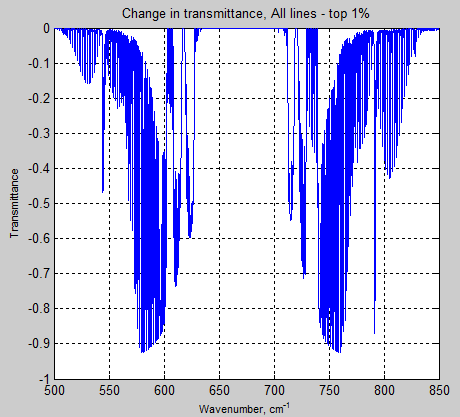
We assume (incorrectly) that the stratosphere is an isothermal layer at temperature, Ts. We assume that the stratosphere is optically thin so that the emission from the surface/troposphere is approximately equal to the emission to space.

The stratosphere has an emissivity, ε, which is very small.

From Kirchhoff’s law, emissivity = absorptivity for the same wavelength ranges. We will come back to review this assumption a little later, but for now note that if the surface/troposphere and the stratosphere are at similar temperatures then this assumption:

absorptivity of stratosphere for surface/troposphere radiation = emissivity of stratosphere

– is approximately correct.

Therefore, from energy balance considerations, the energy absorbed by the stratosphere must be the energy emitted by the stratosphere. So, from figure 1:

εσTE4 = 2εσTs4

therefore:

Ts = TE / 21/4 = 215 K

Now, surprisingly enough for such simple assumptions, this is a reasonable value for the temperature at the bottom of the stratosphere.

Without “Effective Radiating Temperatures”

Let’s redo the calculations – this time using the actual flux to space from the surface/troposphere instead of the “effective radiating temperature”.

The surface/troposphere radiates (globally annually averaged) 239 W/m². The stratosphere absorbs a small fraction of this, determined by absorptivity = emissivity = ε:

ε x 239 = 2εσTs4

therefore:

Ts = (239/σ)1/4 / 21/4 = 215 K

The value is the same as previously calculated, no surprise to anyone who has got to grips with this subject.

Using Kirchhoff

Earlier we used the fact that absorptivity = emissivity for the stratosphere, because of Kirchhoff’s law.

It is very important to understand how to use this law correctly. An excellent example of how not to use it was done by Martin Herztberg in his paper, Earth’s Radiative Equilibrium in the Solar Irradiance, Energy & Environment (2009).

Let me paint a picture with some graphs.

First, the wavelength dependence of blackbody radiation for three different temperatures. Remember that blackbody radiation is just a “perfect emitter”, or the “gold standard” of radiation. Real bodies cannot radiate at a higher intensity at any wavelength, although many come close.

The solar radiation has been normalized to the value at the earth’s surface (because it’s a long way from the sun to the earth – check out The Sun and Max Planck Agree – Part Two):

Figure 2

Now, the transmittance for the atmosphere as a function of wavelength. For 4μm and longer wavelengths, absorptance = 1 – transmittance. For shorter wavelengths, especially below 0.5 μm, scattering becomes significant, which means that absorptance = 1 – transmittance – reflectance.

In any case, what should be clear is that absorptance is a strong function of wavelength. See the red marked graph at the bottom:

From Petty (2006)

Figure 3

At any given wavelength, absorptance = emissivity.

So let’s consider the case of a 255 K atmosphere absorbing solar radiation.

The solar radiation is the blue curve in figure 2 – so to calculate how the atmosphere/surface absorbs this radiation we can use the absorptivity (≈ 1 – transmissivity) between 0-5 μm.

The surface/troposphere radiates according to the green curve. We need to multiply this curve by the emissivity = absorptivity at these wavelengths.

So although absorptivity (at a given wavelength) = emissivity (at a given wavelength), it isn’t much use if the source of the incident radiation is at very different wavelengths from the emission. Which is why Martin Herztberg hasn’t passed the competency test in this field. A “rookie mistake”.

You should be able to see from figure 2 that although the surface/troposphere and stratosphere are at different temperatures, an average absorptivity value for absorbing radiation at 255 K will be quite similar to the emissivity value for emitting radiation at 215K.

If we wanted accurate results we would need to use the absorptivity at the relevant wavelength and the emissivity at the relevant wavelength. We also would not assume that the stratosphere was isothermal, or that it was perfectly transparent to solar radiation.

By the way, here are some temperature measurements of the stratosphere in one location:

Figure 4

Conclusion

Calculating the temperature of the stratosphere is a difficult problem. However, as in many fields of scientific endeavor, we can make a very simple model and see how the results compare with reality (and the results of more complex models).

In the example here we make some very simple assumptions and find a result for the stratospheric temperature which is not too far off the mark. However, the only reason for producing (reproducing) this model was to help newcomers to the field gain a conceptual feel for the basics of energy balance and radiative transfer.

By the way, as explained in Part One, no one in climate science believes that the assumptions for this model are correct. Everyone knows that the atmosphere is not a blackbody (perfectly opaque) for all wavelengths greater than 4 μm, and is not perfectly transparent for all wavelengths less than 4 μm.

Notes

Note 1: Optical thickness is proportional to the number of absorbers (molecules that absorb radiation) in the path. So as the atmosphere thins out the density reduces and, therefore, the optical thickness must also reduce. You can read more about the equations of optical thickness in Understanding Atmospheric Radiation and the “Greenhouse” Effect – Part Six – The Equations

Most good textbooks introduce simple models to help the student gain a conceptual understanding.

In Elementary Climate Physics, Prof. F.W. Taylor does the same.

Now the atmosphere is mostly transparent to solar radiation (shortwave) which is centered around 0.5 μm, and quite opaque to terrestrial radiation (longwave) which is centered around 10 μm. Note that absorptivity is very wavelength dependent, especially for radiatively-active gases.

So in this first model, which is very common in introductory books on atmospheric physics, three things are assumed – and none of them are true:

  • the atmosphere is isothermal – a slab of atmosphere all at the same temperature
  • the atmosphere is completely transparent to solar radiation
  • the atmosphere is completely opaque to terrestrial radiation

From Elementary Climate Physics, F.W. Taylor

Figure 1

As many people know, climate scientists introduce things that are not true in climate science books because either they have no idea what they are talking about, or because they are trying to deceive their readers.

Surprisingly, despite the incompetence and mendacity of these awful people the model is quite illuminating.
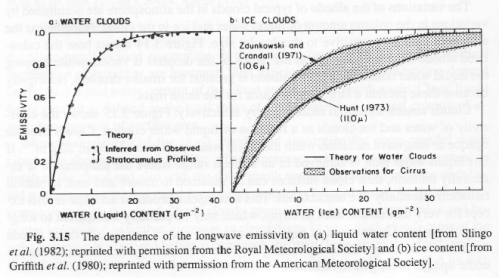
How do we calculate the surface temperature?

With apologies for the lengthy explanation that follows – necessary because of the confusion frequently spread on this subject. To grasp the essence of the simple model you don’t need to follow every point here.
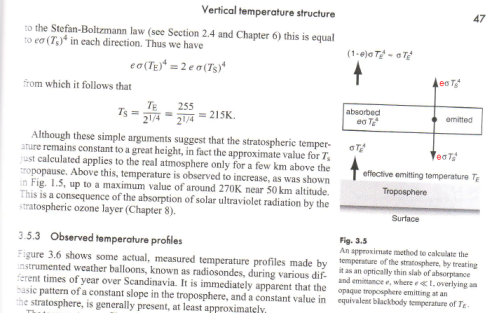
When a body is a perfect absorber of radiation it is also a perfect emitter. If this is true at all wavelengths, the body is called a blackbody. In practice, no real bodies, or bodies of gases, are blackbodies but many come close. Especially, many come very close at certain wavelengths or bands of wavelengths.

If a layer of atmosphere has an optical thickness = 10 across a band, then its emissivity in that band = 1.0000.

This means, in this band it is.. still not actually a blackbody because its emissivity has not really reached 1, it is actually = 0.9999546. And if the optical thickness = 20 across a band, then its emissivity in that band = 0.9999999979 – still not a blackbody. For all practical purposes we can say it is a blackbody at these wavelengths because within the limits of accuracy we need, emissivity = 0.9999546 is the same as saying emissivity = 1. Nothing special or magical happens in the equations of heat transfer when we transition from 0.99 to 1.00. And assuming 0.9999546 = 1 introduces a 0.005% error.

The equation for the emission of thermal radiation is Planck’s law which describes how the intensity varies with wavelength for a perfect emitter (i.e., a blackbody), e.g.:

Figure 2

For any real surface (or body of gas) this Planck curve is multiplied by the emissivity curve (vs wavelength) to get the actual thermal emission vs wavelength.

To calculate the flux (W/m²) we can instead use the Stefan-Boltzmann equation (which is just the integral of the Planck curve over all wavelengths):

E = εσT4

where E = energy emitted in W/m², ε = emissivity, σ = 5.67 x 10⁻⁸, T = surface temperature

Because ε is a function of wavelength, and because increasing temperatures shift the emission to shorter wavelengths we need to use the value of emissivity for the temperature in question.

Notice, in figure 2, that the emission is very low below 4 μm.

Now, for our incorrect assumption that the atmosphere is completely opaque for all wavelengths greater than 4 μm (longwave) then the equation for emission from the atmosphere will be:

E = εσT4, and as ε=1 at these wavelengths,

E = σT4

Now we have that out of the way..

Energy Balance

The (incorrectly assumed) optically thick atmosphere emits radiation to the surface at σTa4 and out to space at σTa4 (where Ta is the temperature of the atmosphere). The radiation from the earth’s surface is (incorrectly assumed) completely absorbed by the atmosphere.

In equilibrium, as the general rule:

Ein = Eout

Therefore, the absorbed solar radiation = energy emitted to space from the atmosphere.

Absorbed solar radiation = (1-0.3) x S/4, where S = solar constant of 1367 W/m². The “0.3” is the reflected radiation due to the albedo of the earth and climate system. So only 70% of solar radiation is actually absorbed on average. The term 1/4 appears because solar radiation is not directly overhead all points on the globe at all times. For the detailed explanation see The Earth’s Energy Budget – Part One.

Therefore, for the energy balance of the whole climate system:

(1-0.3) x S/4 = σTa4 [1]

And for the surface energy balance, where Ts= surface temperature (and refer to figure 1):

(1-0.3) x S/4 + σTa4 = σTs4 [2]

So, [1] -> [2]

2σTa4 = σTs4

Re-arranging, we get:   Ts = 21/4.Ta [3]

And from [1], Ta = (239/5.67 x 10-8)1/4 = 255 K

Therefore, Ts = 303 K

So we have a solution to the problem for our simple model with three totally incorrect assumptions. Compare the calculated value with the observed 288 K average surface temperature.

Conclusion

As Taylor says:

This calculated greenhouse enhancement of 48 K is rather larger than the observed 33 K, not surprisingly in the light of the simplicity of the model.

This model helps us see how temperature of the atmosphere and the surface are related under the simplest of assumptions.

In practice, the atmosphere is not completely opaque to terrestrial radiation and therefore, does not emit like a blackbody. The atmosphere is not completely transparent to solar radiation, and therefore, the atmosphere is also warmed directly by the sun. The atmosphere is not isothermal and, therefore, emits differently to the surface compared with its emission to space.

And everyone in climate science knows this. Real climate models are slightly more sophisticated.

When you read examples like this and like the “multiple shell” model, they are for illumination and education. Simple models teach beginners more than complex models. Who can understand a GCM if they can’t understand this model?

When you read people writing that climate science assumes the atmosphere radiates as a blackbody you know they didn’t make much progress in their elementary climate science textbook. That is if they even picked one up.

Further reading:

Understanding Atmospheric Radiation and the “Greenhouse” Effect – Part Six – The Equations – the actual equations of radiative transfer (no blackbodies or Stefan-Boltzmann equations to be seen)

CO2 – An Insignificant Trace Gas? Part Five – the radiative-convective model with a couple of solutions

The Amazing Case of “Back Radiation” -Part One – for measurements of radiation from the atmosphere