Feeds:
Posts
Comments

This could have been included in the Earth’s Energy Budget series, but it deserved a post of its own.

First of all, what is “back-radiation” ? It’s the radiation emitted by the atmosphere which is incident on the earth’s surface. It is also more correctly known as downward longwave radiation – or DLR

What’s amazing about back-radiation is how many different ways people arrive at the conclusion it doesn’t exist or doesn’t have any effect on the temperature at the earth’s surface.

If you want to look at the top of the atmosphere (often abbreviated as “TOA”) the measurements are there in abundance. This is because (since the late 1970’s) satellites have been making continual daily measurements of incoming solar, reflected solar, and outgoing longwave.

However, if you want to look at the surface, the values are much “thinner on the ground” because satellites can’t measure these values (see note 1). There are lots of thermometers around the world taking hourly and daily measurements of temperature but instruments to measure radiation accurately are much more expensive. So this parameter has the least number of measurements.

This doesn’t mean that the fact of “back-radiation” is in any doubt, there are just less measurement locations.

For example, if you asked for data on the salinity of the ocean 20km north of Tangiers on 4th July 2004 you might not be able to get the data. But no one doubts that salt was present in the ocean on that day, and probably in the region of 25-35 parts per thousand. That’s because every time you measure the salinity of the ocean you get similar values. But it is always possible that 20km off the coast of Tangiers, every Wednesday after 4pm, that all the salt goes missing for half an hour.. it’s just very unlikely.

What DLR Measurements Exist?

Hundreds, or maybe even thousands, of researchers over the decades have taken measurements of DLR (along with other values) for various projects and written up the results in papers. You can see an example from a text book in Sensible Heat, Latent Heat and Radiation.

What about more consistent onging measurements?

The Global Energy Balance Archive contains quality-checked monthly means of surface energy fluxes. The data has been extracted from many sources including periodicals, data reports and unpublished manuscripts. The second table below shows the total amount of data stored for different types of measurements:

From "Radiation and Climate" by Vardavas & Taylor (2007)

From "Radiation and Climate" by Vardavas & Taylor (2007)

You can see that DLR measurements in the GEBA archive are vastly outnumbered by incoming solar radiation measurements. The BSRN (baseline surface radiation network) was established by the World Climate Research Programme (WCRP) as part of GEWEX (Global Energy and Water Cycle Experiment) in the early 1990’s:

The data are of primary importance in supporting the validation and confirmation of satellite and computer model estimates of these quantities. At a small number of stations (currently about 40) in contrasting climatic zones, covering a latitude range from 80°N to 90°S (see station maps ), solar and atmospheric radiation is measured with instruments of the highest available accuracy and with high time resolution (1 to 3 minutes).

Twenty of these stations (according to Vardavas & Taylor) include measurements of downwards longwave radiation (DLR) at the surface. BSRN stations have to follow specific observational and calibration procedures, resulting in standardized data of very high accuracy:

  • Direct SW  – accuracy 1% (2 W/m2)
  • Diffuse radiation – 4% (5 W/m2)
  • Downward longwave radiation, DLR – 5% (10 W/m2)
  • Upward longwave radiation – 5% (10 W/m2)

Radiosonde data exists for 16 of the stations (radiosondes measure the temperature and humidity profile up through the atmosphere).

Click for a larger image

A slightly earlier list of stations from 2007:

From "Radiation and Atmosphere" by Vardavas & Taylor (2007)

From "Radiation and Atmosphere" by Vardavas & Taylor (2007)

Solar Radiation and Atmospheric Radiation

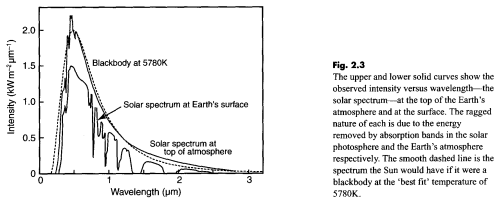
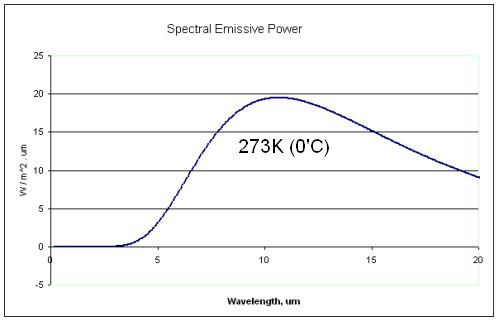
Regular readers of this blog will be clear about the difference between solar and “terrestrial” radiation. Solar radiation has its peak value around 0.5μm, while radiation from the surface of the earth or from the atmosphere has its peak value around 10μm and there is very little crossover. For more details on this basic topic, see The Sun and Max Planck Agree

.

Radiation vs Wavelength -Sun and Earth

Radiation vs Wavelength - Sun and Earth

What this means is that solar radiation and terrestrial/atmospheric radiation can be easily distinguished. Conventionally, climate science uses “shortwave” to refer to solar radiation – for radiation with a wavelength of less than 4μm – and “longwave” to refer to terrestrial or atmospheric radiation – for wavelengths of greater than 4μm.

This is very handy. We can measure radiation in the wavelengths > 4μm even during the day and know that the source of this radiation is the surface (if we are measuring upward radiation from the surface) or the atmosphere (if we are measuring downward radiation at the surface). Of course, if we measure radiation at night then there’s no possibility of confusion anyway.

Papers

Here are a few extracts from papers with some sample data.

Downward longwave radiation estimates for clear and all-sky conditions in the Sertãozinho region of São Paulo, Brazil by Kruk et al (2010):

Atmospheric longwave radiation is the surface radiation budget component most rarely available in climatological stations due to the cost of the longwave measuring instruments, the pyrgeometers, compared with the cost of pyranometers, which measure the shortwave radiation. Consequently, the estimate of longwave radiation for no-pyrgeometer places is often done through the most easily measured atmospheric variables, such as air temperature and air moisture. Several parameterization schemes have been developed to estimate downward longwave radiation for clear-sky and cloudy conditions, but none has been adopted for generalized use.

Their paper isn’t about establishing whether or not atmospheric radiation exists. No one in the field doubts it, any more than anyone doubts the existence of ocean salinity. This paper is about establishing a better model for calculating DLR – as expensive instruments are not going to cover the globe any time soon. However, their results are useful to see.

The data was measured every 10 min from 20 July 2003 to 18 January 2004 at a micrometeorological tower installed in a sugarcane plantation. (The experiment ended when someone stole the equipment). This article isn’t about their longwave radiation model – it’s just about showing some DLR measurements:

In another paper, Wild and co-workers (2001) calculated some long term measurements from GEBA: Data from GEBA for selected=

This paper also wasn’t about verifying the existence of “back-radiation” – it was assessing the ability of GCMs to correctly calculate it. So you can note the long term average values of DLR for some European stations and one Japanese station. The authors also showed the average value across the stations under consideration:

And station by station month by month (the solid lines are the measurements):

Wild (2001)

Wild (2001)

Click on the image for a larger view

In another paper, Morcrette (2002) produced a comparison of observed and modeled values of DLR for April-May 1999 in 24 stations (the columns headed Obs are the measured values):
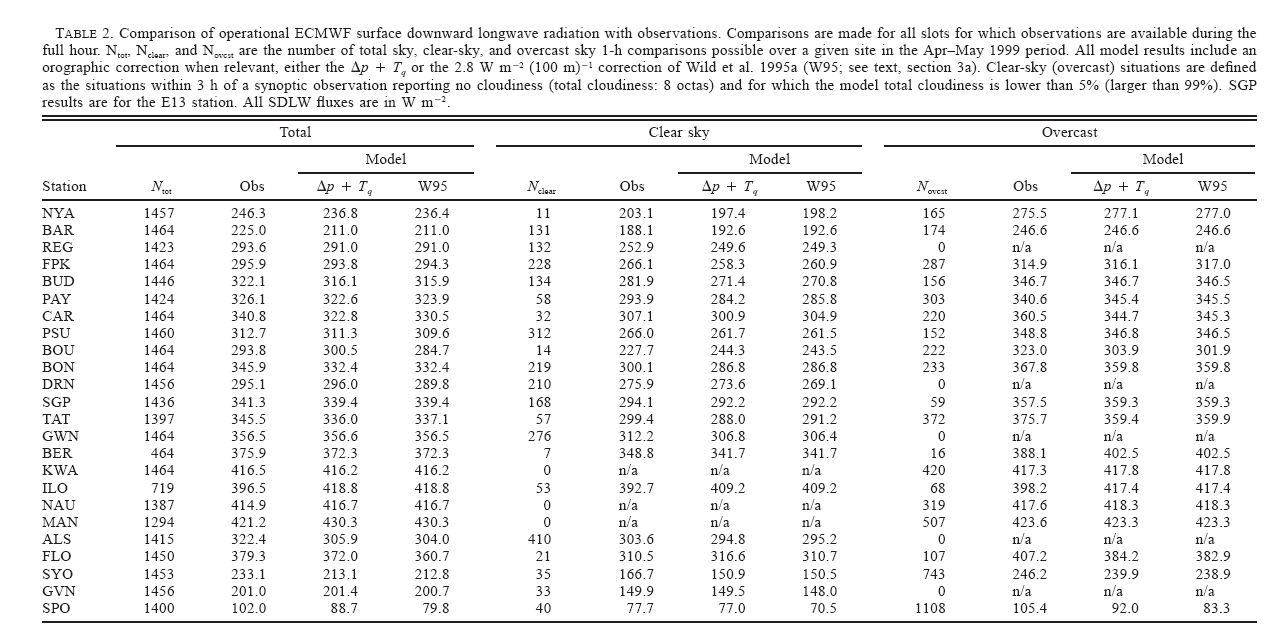
Morcrette (2002)

Morcrette (2002)

Click for a larger view

Once again, the paper wasn’t about the existence of DLR, but about the comparison between observed and modeled data. Here’s the station list with the key:

Click for a larger view

BSRN data

Here is a 2-week extract of DLR for Billings, Oklahoma from the BSRN archives. This is BSRN station no. 28, Latitude: 36.605000, Longitude: -97.516000, Elevation: 317.0 m, Surface type: grass; Topography type: flat, rural.

Data from the BSRN network, courtesy of the World Radiation Monitoring Center

Data from the BSRN network, courtesy of the World Radiation Monitoring Center

And 3 days shown in more detail:

Data from the BSRN network, courtesy of the World Radiation Monitoring Center

Data from the BSRN network, courtesy of the World Radiation Monitoring Center

Note that the time is UTC so “midday” in local time will be around 19:00 (someone good at converting time zones in October can tell me exactly).

Notice that DLR does not drop significantly overnight. This is because of the heat capacity of the atmosphere – it cools down, but not as quickly as the ground.

DLR is a function of the temperature of the atmosphere and of the concentration of gases which absorb and emit radiation – like water vapor, CO2, NO2 and so on.

We will look at this some more in a followup article, along with the many questions – and questionable ideas – that people have about “back-radiation”.

Update: The Amazing Case of “Back-Radiation” – Part Two

The Amazing Case of “Back Radiation” – Part Three

Darwinian Selection – “Back Radiation”

Notes

Note 1 – Satellites can measure some things about the surface. Upward radiation from the surface is mostly absorbed by the atmosphere, but the “atmospheric window” (8-12μm) is “quite transparent” and so satellite measurements can be used to calculate surface temperature – using standard radiation transfer equations for the atmosphere. However, satellites cannot measure the downward radiation at the surface.

References

Radiation and Climate, I.M. Vardavas & F.W. Taylor, International Series of Monographs on Physics – 138 by Oxford Science Publications (2007)

Downward longwave radiation estimates for clear and all-sky conditions in the Sertãozinho region of São Paulo, Brazil, Kruk et al, Theoretical Applied Climatology (2010)

Evaluation of Downward Longwave Radiation in General Circulation Models, Wild et al, Journal of Climate (2001)

The Surface Downward Longwave Radiation in the ECMWF Forecast System, Morcrette, Journal of Climate (2002)

This article follows:

  • Part One – which explained a few basics in energy received and absorbed, and gave a few useful “numbers” to remember
  • Part Two – which explained energy balance a little more
  • Part Three – which explained how the earth radiated away energy and how more “greenhouse” gases might change that

What is albedo? Albedo, in the context of the earth, is the ratio of reflected solar radiation to incident solar radiation. Generally the approximate value of 30% is given. This means that 0.3 or 30% of solar radiation is reflected and therefore 0.7 or 70% is absorbed.

Until the first satellites started measuring reflected solar radiation in the late 1970’s, albedo could only be estimated. Now we have real measurements, but reflected solar radiation is one of the more challenging measurements that satellites make. The main reason for this is reflected solar radiation takes place over all angles, making it much harder for satellites to measure compared with, say, the outgoing longwave radiation.

Reflected solar radiation is one of the major elements in the earth’s radiation budget.

Over the 20th century, global temperatures increased by around 0.7°C. Increases in CO2, methane and other “greenhouse” gases have a demonstrable “radiative forcing”, but changes in planetary albedo cannot be ruled out as also having a significant effect on global temperatures. For example, if the albedo had reduced from 31% to 30% this would produce an increase in radiative forcing (prior to any feedbacks) of 3.4W/m2 – of similar magnitude to the calculated (pre-feedback) effects from “greenhouse” gases.
Average global variation in albedo (top) and reflected solar radiation (bottom)

from Hatzianastassiou (2004)

from Hatzianastassiou (2004)

(click on the image for a larger picture)

(click on the image for a larger picture)

The first measurements of albedo were from Nimbus-7 in 1979, and the best quality measurements were from ERBE from November 1984 to February 1990. There is a dataset of measurements from 1979 to 1993 but not from the same instruments, and then significant gaps in the 1990s until more accurate instruments (e.g. CERES) began measurements. Satellite data of reflected solar radiation from latitudes above 70° is often not available. And comparisons between different ERB datasets show differences of comparable magnitude to the radiative forcing from changes in “greenhouse” gases.

Therefore, to obtain averages or time series over more than a decade requires some kind of calculation. Most of the data in this article is from Hatzianastassiou et al (2004) – currently available here.

The mean monthly shortwave (SW) radiation budget at the top of atmosphere (TOA) was computed on 2.5 longitude-latitude resolution for the 14-year period from 1984 to 1997, using a radiative transfer model with long-term climatological data from the International Satellite Cloud Climatology Project (ISCCP-D2)..

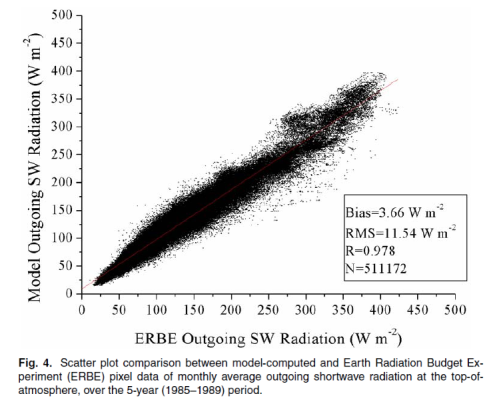
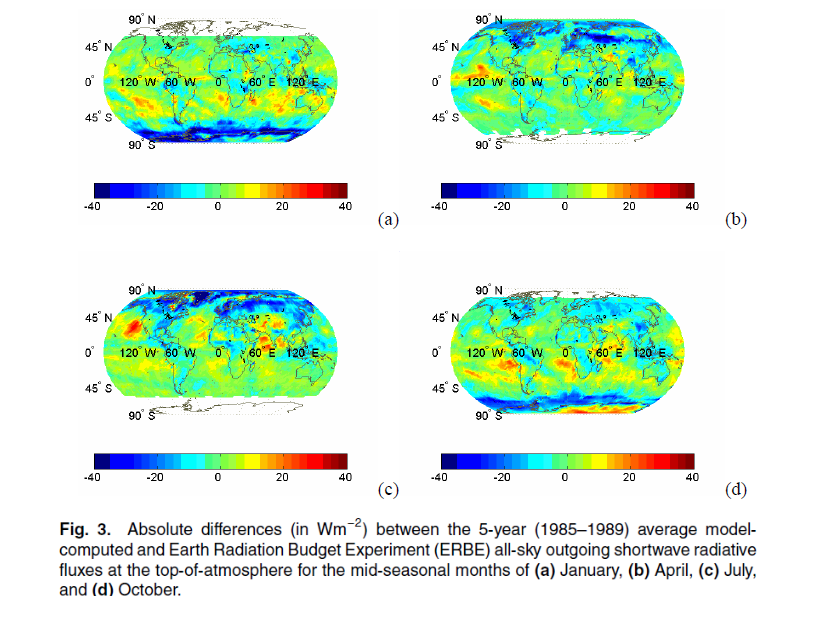
The model was checked against the best data:

The model radiative fluxes at TOA were validated against Earth Radiation Budget Experiment (ERBE) S4 scanner satellite data (1985–1989).

The results were within 1% of ERBE data, which is within the error estimates of the instrument. (See “Model Comparison” at the end of the article).

It is important to understand that using a model doesn’t mean that a GCM produced (predicted) this data. Instead all available data was used to calculate the reflected solar radiation from known properties of clouds, aerosols and so on. However, it also means that the results aren’t perfect, just an improvement on a mixture of incomplete datasets.

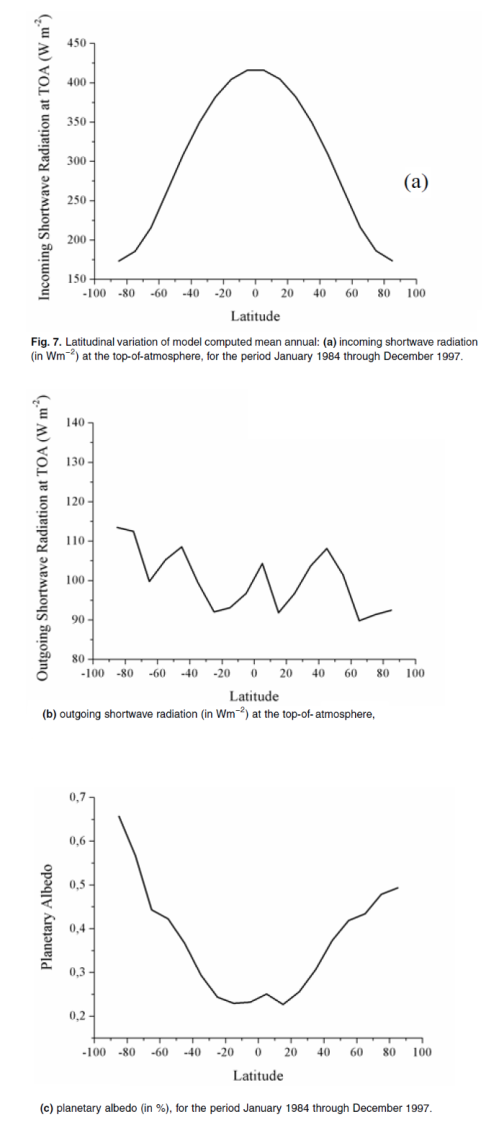
Here is the latitudinal variation of incident solar radiation – note that the long-term annual global average is around 342 W/m2 – followed by “outgoing” or reflected solar radiation, then albedo:

Shortwave received and reflected plus albedo, Hatzianastassiou (2004)

Shortwave received and reflected plus albedo, Hatzianastassiou (2004)

The causes of reflected solar radiation are clouds, certain types of aerosols in the atmosphere and different surface types.

The high albedo near the poles is of course due to snow and ice. Lower albedo nearer the equator is in part due to the low reflectivity of the ocean, especially when the sun is high in the sky.

Typical values of albedo for different surfaces (from Linacre & Geerts, 1997)

  • Snow                                     80%
  • Dry sand in the desert        40%
  • Water,  sun at 10°              38%  (sun close to horizon)
  • Grassland                            22%
  • Rainforest                           13%
  • Wet soil                               10%
  • Water, sun at 25°               9%
  • Water, sun at 45°               6%
  • Water, sun at 90°                3.5%  (sun directly overhead)

Here is the data on reflected solar radiation and albedo as a time-series for the whole planet:

Time series changes in solar radiation and albedo, Hatzianastassiou (2004)

Time series changes in solar radiation and albedo, Hatzianastassiou (2004)

(click on the image for a larger picture)

Over the time period in question:

The 14-year (1984–1997) model results, indicate that Earth reflects back to space 101.2Wm-2 out of the received 341.5Wm-2, involving a long-term planetary albedo equal to 29.6%.

The incident solar radiation has a wider range for the southern hemisphere – this is because the earth is closer to the sun (perihelion) in Dec/Jan, which is the southern hemisphere summer.

And notice the fascinating point that the calculations show the albedo reducing over this period:

The decrease of OSR [outgoing solar radiation] by 2.3Wm-2 over the 14-year period 1984–1997, is very important and needs to be further examined in detail. The decreasing trend in global OSR can be also seen in Fig. 5c, where the mean global planetary albedo, Rp, is found to have decreased by 0.6% from January 1984 through December 1997.

The main cause identified was a decrease in cloudiness in tropical and sub-tropical areas.

Model Comparison

For those interested, some ERBE data vs model:

(click on the image for a larger picture)

Reference

Long-term global distribution of earth’s shortwave radiation budget at the top of atmosphere, N. Hatzianastassiou et al, Atmos. Chem. Phys. Discuss (2004)

A long and interesting discussion followed Venusian Mysteries. One commenter posed an excellent thought experiment:

Consider Venus with its existing atmosphere, and put a totally opaque enclosure (to incoming Solar radiation) around the entire planet at the average location of present outgoing long wave radiation. Use a surface with the same albedo as present Venus for the enclosure.

What would happen to the planetary surface temperature over a reasonably long time?

For this case, NO Solar incoming radiation reaches the surface. I contend that the surface temperature will be about the same as present.

Now assume the gas temperature and distribution are initially different from present levels, but no gases are condensed other than those that form the present clouds. I contend the temperature will go to about the present distribution and level. The only reason for this not to not match exactly the same as the actual atmosphere would be due to the fact that for the atmosphere, outgoing radiation actually leaves from a finite gas thickness, but the present version is a surface.

With further clarification:

Assume the surface has a black body emissivity for the long wave outgoing radiation. Also assume it is a thin but good conducting material.

And also answered that the opaque enclosure radiates in both directions (both outgoing to space and to the surface of the planet).

The First Simple Model

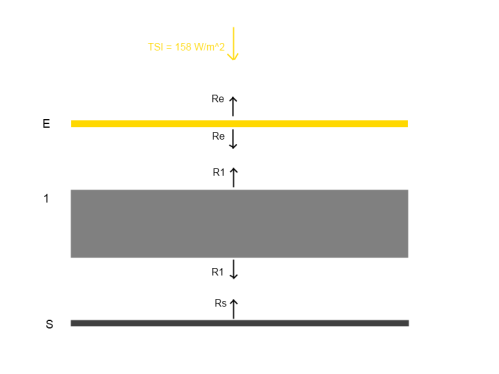
Here’s a very simple radiative balance below. The “opaque enclosure” is E, and the surface is S. This has one layer of opaque atmosphere,1, to get us started:

The gaps in the diagram are simply to enable us to see the radiation values from each layer more easily – they don’t represent any kind of physical discontinuity.

I started with a many layer model of the atmosphere – as described a little in Venusian Mysteries.

As a result of the solution to the equations, it made sense to explain a one layer model of the atmosphere first. I started by assuming that the initial conditions were that the enclosure and surface were initially very cold to see what happens.

Because E is a “thin but good conducting layer” we assume that E is “isothermal” – all at the same temperature. And because it is thin we assume that it heats up quickly when irradiated by solar energy – i.e., its heat capacity is low so it doesn’t take long to reach equilibrium.

Because gases have very low conductivity, and because radiation from the inside surface of the “opaque layer” is taking place, we assume that radiation to the surface is “much greater” than conductivity.

In this simple (unrealistic) one layer model, we also assume that the atmosphere is isothermal (all at one temperature). This is just to get us started. We can add a many layer model later, where each layer is isothermal, but each layer is at a different temperature from the ones above and below.

A Little Maths

Reviewing the diagram above, assuming that radiation is the only heat transfer mechanism, and assuming that the solar radiation is equally spread (note 1 at end):

TSI + R1 = 2RE [1]

2R1 = RS + RE [2]

RS = R1 [3]

So:

[3] -> [2]   2RS = RS + RE, or RS = RE [4]

[4], [3] -> [1]   TSI + RS = 2RS, or TSI = RS

And so, in equilibrium (after every layer has heated up to steady state):

RS = R1 = RE = TSI

That is, each layer radiates the same as every other, and at the same value as the solar irradiance of 158 W/m2 (absorbed solar radiation).

Which means that the enclosure layer will reach an equilibrium temperature of 229K – and this will also be the equilibrium planetary surface temperature.

If these are the equilibrium temperatures what will drive conduction or convection of heat? Nothing. With the surface, the atmosphere and the “enclosure layer” of our thought experiment, all at the same temperature there will be no convection or conduction.

The Many Layer Model

The example above can be extended to many layers of opaque atmosphere. I checked out a 3-atmospheric layer model and the same results are obtained. (It’s tedious writing down the 5 equations and showing the substitutions to solve, especially as wordpress doesn’t do subscripts easily).

But the more realistic many-layer models solve exactly the same way. So with an outer atmospheric layer absorbing the solar radiation and then heating up and radiating in to the surface (and out to space), we find that the surface is no hotter than the outer atmospheric layer.

Compare this with the many layer model in the original article (under How Can the Surface Get so Hot? An Over-Simplified Climate Model), where, because the surface was heated by solar irradiance, the surface could become much hotter due to “backradiation” from the many layers above.

Then, in that model, as a result of the high surface temperatures, convection was initiated which moderated the high temperatures.

In this model, radiation can’t create those conditions – at least from a cold starting condition.

[Note added, 25th June – This model is aimed at demonstrating that radiative effects through an opaque atmosphere are totally different when the solar radiation is received at the outer layer of the atmosphere compared with at the surface. The “isothermal” model of the atmosphere (=the atmosphere all at the same temperature) is just for the purposes of constructing this radiation model – and as Leonard Weinstein points out, his thought experiment explicitly stated that the atmospheric temperature varies. In a “many layer” model with low conductivity (as found in gases) the radiation model would still be valid, even though the temperature varies from night to day and at different latitudes. Therefore, another mechanism of significant heat transfer is required to get the surface temperature of “thought experiment Venus” (TEV) to the temperature of actual Venus.

So in normal Venus we have a mechanism – radiation – for driving the temperature so high. But in TEV we need another mechanism.]

What about the Real World Effects?

In practice, one half of the atmosphere is heated during the day while the other half cools, and vice-versa for the night. This doesn’t affect conduction which has a tiny effect.

Does this create a stronger heating through to the surface and initiate some convective activities? How about if we started with a hot surface (from volcanic activity), would we reach a different equilibrium effect?

In both of these cases, there is no explanation for why any convective lapse rate would be maintained – unless a high source of internal heat from something like volcanic activity was maintained.

If we started with a hot initial condition (but no ongoing source of heat) instead of a cold initial condition, convection would simply move heat up to the top of the atmosphere until the same steady state condition was reached – where each layer was at the same temperature.

Convection is the bulk movement of heat as gases or liquids carry heat from one location to another. But something needs to drive convection. In the case of the earth’s atmosphere it is the relatively high surface temperature (from radiation) heating gases which expand and so are less dense. Gases that are less dense rise – and so heat is moved more effectively from the surface than can be achieved by radiation.

When heating the atmosphere from the top – with the vacuum of space above – there is no explanation for high temperatures in layers below.

In the case of the real Venus we at least saw what a totally opaque atmosphere could achieve. In the case of this thought experiment we see a totally different result.

Perhaps someone can produce a more comprehensive model which shows how the surface could radiate at 16,000 W/m2 in this thought experiment. I doubt that it can be done.

Note 1: If we assume that the solar radiation is equally spread across all surface elements, we get the result in the 1-layer or many-layer model. Strictly speaking this is not the case – as the solar radiation only heats one side of the planet at any one time, and that somewhat unequally. Is this a good approximation? Yes, if the heat capacity of the atmosphere is sufficiently high.

If the heat capacity is lower we simply get a relatively hotter surface temperature during “the day” and a relatively colder surface temperature during “the night”. No mechanism for Venusian surface temperatures.

UpdateNew article – Convection, Venus, Thought Experiments and Tall Rooms Full of Gas – A Discussion

The surface of Venus is around 730K (457°C) – why is it so hot? Although there is still much to learn about Venus the basics have some simple explanations.

Energy Absorbed from the Sun

While earth is 150M km from the sun, Venus is only 108M km away, a ratio of 0.72.

The “solar constant” (as it has been historically called) at the earth is 1367 W/m², and, as energy intensity is proportional to the square of the distance away, or “r²”, the solar constant at Venus is 1367/(0.72²) = 2,636 W/m² – Venus is closer, so it receives more solar energy per m².

The earth has an average albedo of about 0.3, meaning that 30% of the solar radiation is reflected. This is by clouds, by aerosols in the atmosphere, and by the surface of the earth. (Watch out for “The Earth’s Energy Budget – Part Four – Albedo”). If Venus had the same albedo as the earth, the energy absorbed per m² of surface area would be, E = 2,636 * (1-0.3) / 4 = 461 W/m². [corrected – thanks to Bill Stoltzfus for pointing out my mistake]

For an explanation of why the value is divided by 4, see The Earth’s Energy Budget – Part One

This value equates to an “effective radiating temperature” of 300K (27°C). This is nothing like the surface of Venus. [corrected as well – thanks to Bill Stoltzfus for pointing out my mistake]

In any case, it turns out that Venus has a much higher albedo than the earth, with an albedo of 0.76 – meaning that 76% of the solar energy is reflected.

Redoing the calculation, E = 2,636 * (1-0.76) / 4 = 158 W/m² – which equates to an “effective radiating temperature” of 230K (-43°C). The same calculation for the earth gives 255K (-18°C) – see CO2 – An Insignificant Trace Gas? – Part One.

So in terms of a simple energy balance with the sun, Venus should be colder than the earth.

In the case of the earth, as laid out in the CO2 series, the reason the surface of the earth is so much warmer than predicted from simple energy balance is because various trace gases, including water vapor and CO2, absorb the upward radiation from the earth’s surface and reradiate it in all directions. As some of this is downward, the surface of the earth receives more energy than it would without these gases and so it is hotter. See CO2 – An Insignificant Trace Gas? Part Six – Visualization for some more insight into this.

So is Venus so much warmer at its surface because of the inappropriately-named “greenhouse” effect? Or is it for other reasons?

The Venusian Atmosphere

The atmosphere of Venus is quite unwelcoming for us earth-dwellers. The atmosphere is mostly CO2 (97%), with the balance made up mostly of nitrogen (N2), and trace amounts of water vapor and many other gases in minute quantities.

The mass of the Venusian atmosphere is around 100 times that of the earth, and consequently the pressure at the surface of Venus is much higher – at 92bar compared with 1bar for the earth.

Now some people say that the reason for the high temperature at the surface of Venus is because of the high atmospheric pressure and the depth of the atmosphere. For example, Steve Goddard on Wattsupwiththat and echoed by Lubos Motl. This explanation isn’t one that you can find in atmospheric physics text books.

A Quick Review of the Earth’s Surface

This is just to explain a few basics for some perspective.

From Trenberth and Kiehl (1997)

From Trenberth and Kiehl (1997)

There’s much of interest in this diagram from Earth’s Annual Global Mean Energy Budget by Trenberth and Kiehl (1997) but we’ll focus on a few key elements for the purposes of this article.

The surface of the earth receives an average of about 170 W/m² from solar energy (with an additional 70W/m² of solar radiation absorbed by the atmosphere). The earth’s surface also receives an average of 324 W/m² of radiation from the atmosphere. So in total the earth’s surface receives about 490 W/m² (annual global average).

Now the average radiation from the surface of the earth is 396 W/m² (or 390 W/m² in the diagram above, which is close enough for our purposes). Convection and conduction remove the balance of around 100W/m². If you take a look at Tropospheric Basics you can see more about the temperature profile in the troposphere (lower atmosphere) and why convection is a more effective re-distributor of heat within the troposphere.

The principal point is that the warming of the air from the surface radiation, conduction and convection causes the air to expand. Air that expands is less dense, and so this air rises, moving heat by convection.

The temperature profile, or lapse rate, from convection can be easily calculated, both for dry air and moist air. Dry air is just under 10°C/km, while moist air depends on the amount of water vapor, but can be as low as 4°C/km. (And the environmental lapse rate, or what we find in practice, is around 6.5°C/km).

So in the case of the earth’s surface, it would be radiating out 490W/m², but for the fact that conduction and convection remove some of this energy from the surface, and then convection redistributes this energy up into the atmosphere.

The Surface of Venus

Energy radiated from a surface is proportional to the 4th power of absolute temperature. This is known as the Stefan-Boltzmann law but visualizing the 4th power of something isn’t that easy. However, calculators are readily available and so if you punch the numbers in you will see that for a surface of T=730K with an emissivity close to a blackbody:

E = 16,100 W/m²   – compare this with the surface of earth (288K, 15°C) of around 390 W/m²

This is over 40x the energy radiated from the surface of the earth – for a temperature only 2.5x greater. That’s the real world, very non-linear.. (And note that if the emissivity is not equal to 1, the energy radiated is simply the value above multiplied by the emissivity).

So if we think about the top of atmosphere of Venus, it is radiating round about 158 W/m². This balances the absorbed solar radiation. And yet the surface is radiating 16,100 W/m² – does the high pressure of the Venusian atmosphere explain it?

No

Think about it like this. For the surface of Venus to be radiating at 16,100 W/m² it has to be receiving this energy from somewhere. It receives a maximum of 158 W/m² from the sun (if all of the solar energy absorbed is absorbed in the surface and nothing in the atmosphere).

The explanation from others about a temperature gradient between the surface and the tropopause (top of the tropopause or lower atmosphere) only explains anything when the surface heats the atmosphere from below. In that case the atmosphere heats up, expands and rises – moving energy via bulk movements of air.

Can the atmosphere create heat from pressure and transmit this heat to the surface?

In the case of the earth’s surface, the extra radiation to the earth’s surface (caused by the “greenhouse” effect) heats the atmosphere from beneath and causes convection – with a lapse rate (or temperature profile) of between 4 – 10 °C/km. And convection moves some of this heat from the surface up into the atmosphere. In the case of Venus the argument that relegates the role of the “greenhouse” effect and promotes the role of atmospheric pressure doesn’t have a heat transfer mechanism.

Picture the starting condition where the surface is very cold. What heats it up?

There are three ways of moving heat – radiation, convection and conduction. Conduction in gases is extremely low and anyway the top of the atmosphere is around 230K – if the surface starts off colder what causes heat to flow to the surface to create such a huge emission of radiation?

Convection needs to work by warming a gas from below. Where is this mechanism if the surface is not already heated by the “greenhouse” effect?

And radiation has been ruled out (as the main mechanism) in these arguments from Steve Goddard and others.

How Can the Surface Get so Hot? An Over-Simplified Climate Model

Let’s take a look at the ignored radiation and the super “greenhouse” effect.

How can a surface get so hot from “back-radiation”? Isn’t that just as crazy an idea?

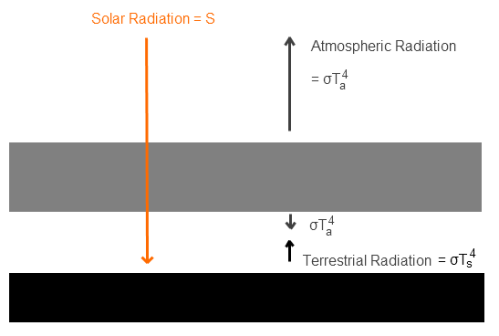
We will take a simple idea – as all models are at their start, just to demonstrate a point. There’s a little bit of maths, unfortunately, but possibly (if you haven’t seen this concept before), the concept might actually seem harder to grasp. Here’s a very simple (and not very realistic) model of a planetary surface and atmosphere (idea from Radiation and Climate from Vardavas and Taylor (2007)):

Simple climate model - atmosphere perfectly transparent to solar radiation, and totally opaque in the infra-red

Simple climate model - atmosphere perfectly transparent to solar radiation, and totally opaque in the infra-red

The surface receives radiation from the sun, S. In the case of Venus this value would be (averaged across the surface), S = 158 W/m².

Now the surface is at Ts and radiates to the atmosphere, which heats it up. The atmosphere is perfectly transparent to solar radiation, but totally opaque in the infra-red and all at one temperature, Ta. Therefore, the atmosphere radiates σTa4 upwards and σTa4 downwards.

Note that “totally opaque” means that no surface radiation makes it through this layer of the atmosphere. In this scenario we can calculate the surface radiation. If you are new to this kind of model, it is easiest to follow the small amount of maths against the graphic. First, using the simple energy balance at top of atmosphere, the outgoing radiation at the top of atmosphere equals the absorbed solar radiation averaged over the surface of the earth:

σTa4 = S         [equation 1] – this is the Stefan-Boltzmann law, where σ = 5.67 x 10⁻⁸

Second, the surface radiation balances the energy received at the surface – which is from the sun and the atmosphere:

S + σTa4 = σTs4 [equation 2]

Therefore, substituting [1] into [2], we get:

σTa4 + σTa4 = σTs4

2σTa4 = σTs4, or 2S = σTs4

and solving we find, Ts = (2S/σ)1/4

In the case of S = 158 W/m², Ts = 273K

Now effective temperature at the top of atmosphere is 230K, so an opaque atmosphere has increased the surface temperature significantly – but not to 730K. (Barton Paul Levenson has a model like this, commented on in CO2 – An Insignificant Trace Gas? Part Eight – Saturation)

Now with a very optically thick atmosphere, we simply add more and more layers to our model. The equations get slightly harder to solve, but each time we add a new totally opaque layer the temperature rises yet more.

For example, with 3 totally opaque layers the solution to a similar set of equations (with 4 equations and 4 unknowns) is:

Ts = (4S/σ)1/4, or Ts = 328K

It should be easy to see how the surface temperature gets extremely hot from radiation with many layers of opaque atmosphere (yet transparent to solar radiation).

So the Surface Temperature is Infinite, you Dummy!!

Well, if we can keep adding layers, and each one just increases the “back radiation” anyone can see that this can go on forever and the temperature will be infinite!

Obviously the model is wrong..

Not quite (well, if we could keep doing this, the model would be wrong). In the model above we have one totally opaque layer of atmosphere. But once we add multiple layers we are effectively dividing up the real atmosphere and saying that each layer is totally opaque. As we keep sub-dividing the atmosphere into more and more layers eventually they start to get optically thin and the radiation from the layer below will not be completely absorbed.

Radiation from CO2

All the above model does is demonstrate how the presence of significant radiatively absorbing gases can significantly increase the surface temperature. A 97% CO2 atmosphere is different from the model above for two reasons:

  • CO2 doesn’t absorb at all terrestrial wavelengths so it isn’t a perfect absorber
  • convection will moderate the surface temperature increase – once induced by radiation – as with the earth’s surface

So to calculate the effect of the CO2 atmosphere we have to solve the radiative transfer equations, which you can see in CO2 – An Insignificant Trace Gas? Part Three and Part Five (and the whole series).

These are fundamental equations of absorption and emission, but aren’t really solvable on a pocket calculator – despite so many people appearing to do just that in so many blogs.  Note as well that CO2 spectral lines broaden with pressure so that CO2 (and water vapor) become a much more effective absorber in the lower Venusian atmosphere than the earth’s.

And we have to consider that once we have very high temperatures at the surface, convection will begin to move heat more effectively. This essentially moderates the effect of radiation.

But for those who believe that high Venusian atmospheric pressure and the ideal gas laws cause the high 730K surface temperature – they have to explain how the heat is transferred to the surface so that it can radiate at 16,100 W/m².

Real Solutions

One early approach to using real atmospheric physics on this problem was by James Pollack (reference below) in 1969 who showed that that plausible amounts of water vapor and the very high levels of CO2 could explain the high temperatures – using the radiative transfer equations and a convective model.

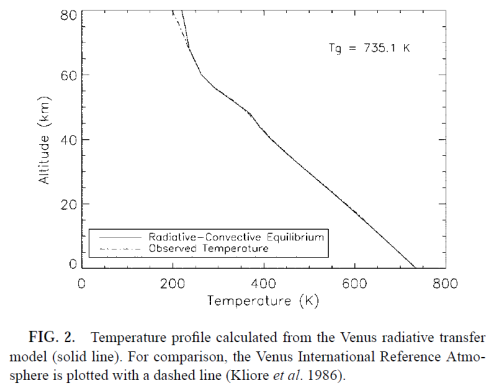
Bullock and Grinspoon (reference below) did this more recent calculation of the temperature profile in the Venusian atmosphere:

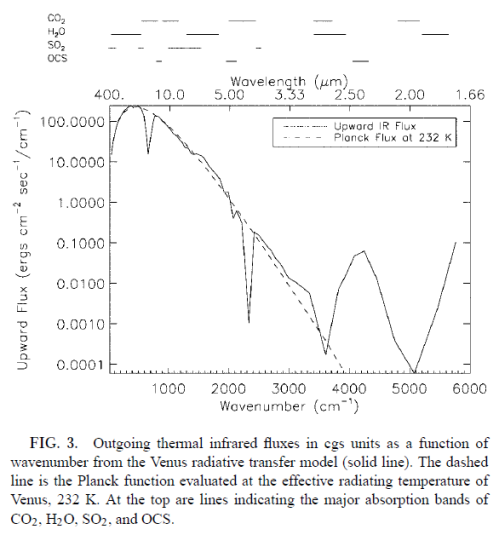
And they note a few possible reasons for the divergence above 70km. The model produces this spectrum of outgoing radiation:

The Planck function for an “effective radiating temperature” of 232K is shown. Note that the much higher levels of flux (in comparison to the 232K curve) demonstrate that at lower wavelengths (higher wavenumbers) the atmosphere is less opaque. This tends to limit further temperature rises, as the presence of any “window” regions allows a higher surface temperature to radiate out efficiently to the atmosphere.

A Mental Model

One mental model for people new to the inappropriately-named “greenhouse” effect is to think about the sun as an internal heat source, and CO2 as some kind of insulator.

Picture an ambient temperature of 20°C and a surface which has a constant internal heat source. As you add more and more insulation around this surface the temperature will keep rising – as heat is less able to flow away from the surface. For a given insulation there will be an equilibrium temperature reached that we can calculate, and it will be a function of the properties of the insulation.

Even though the temperature might reach 100°C or 200°C doesn’t mean that energy is “created” in this model – and this is probably clear to everyone.

Whether or not mental models “work” doesn’t change the realities of physics, but of course everyone wants to understand a subject conceptually.

Conclusion

Venus follows the same physical laws as the earth, so explaining the high surface temperature should be possible, even though many details of the atmosphere of Venus are hidden from us.

Some people who have attempted to explain the high Venusian surface temperature have used the ideas about the relationships between pressure and temperature in ideal gases without the strong “greenhouse” effect of a 97% CO2 atmosphere.

However, these ideas seem to lack a heat transfer mechanism whereby the surface of Venus can radiate at 16,100 W/m². This is the missing element in ideas which eliminate or relegate the role of CO2. In contrast, high surface temperatures in very strongly absorbing atmospheres can be explained using the radiative effects. A simple model can demonstrate very high temperatures, but a thorough calculation does require solution of the radiative transfer equations.

Update – New articles – Convection, Venus, Thought Experiments and Tall Rooms Full of Gas – A Discussion

Venusian Mysteries – Part Two

Reference

A Nongray CO2-H2O Greenhouse Model of Venus, James Pollack, Icarus (1969)

The Recent Evolution of Climate on Venus, Mark Bullock and David Grinspoon, Icarus (2001)

On Lunar Madness and Physics Basics, one commenter asked a very good question in response to a badly phrased answer from me.

He originally asked:

You agree that if earth had 100% nitrogen atmosphere (a non greenhouse gas), the “average” temperature of earth would be different (I’m not entirely sure it wouldn’t be lower) from the 255 K blackbody radiation would suggest.

I got the meaning wrong and said “right, it would be 255K” and wasn’t very specific with what I meant, which was a mistake as the article in question had just explained everything wrong with averages..

He responded with an interesting example of a fictional Latvia, where Latvia got all the solar energy (somehow) and the rest of the world none, and showed that the average temperature of the earth was 0.5K or almost -273°C (and Latvia was quite steamy).

And after I had written a comment as long as a post I thought it was probably a subject that would be worth making a post out of..

“Nice example, and I guess as I’ve been explaining everything that’s wrong with averages I should have been more careful in my explanation.

We will consider a real earth with an albedo..”

Absorbed Solar Radiation

The absorbed solar radiation has an average of 239 W/m2. This is averaged over the surface of the earth, which is 5.1 x 10⁸ km2 = 5.10 x 10¹⁴ m2.

The incoming absorbed energy is therefore 1.2 x 10¹⁷ W.

Note: this average of 239 is a measured value of incoming – reflected solar radiation, divided by 4 for spatial geometry reasons, see The Earth’s Energy Budget – Part One. The total of 1.2 x 10¹⁷ W also equals the TSI of 1367 W/m2 x “disc area” of the earth x (1-albedo).

This is also currently the measured average outgoing longwave radiation (OLR) at the top of atmosphere, within instrument error.

The Hoovering

We’ll come to the energy-grabbing Latvia later (sorry Latvian’s wasn’t my idea).

It’s a typical earth in all other respects but a cosmic being has just “hoovered up” the trace gases like CO2, CH4, NO2 and turned water vapor into a non-absorbing gas. (If water vapor was also hoovered up the oceans and lakes would be a ready source of water vapor and within a month or two the atmosphere would have the same water vapor as before).

As a result radiation >4μm just goes right through it. That is the whole point about radiation – if nothing absorbs it, it keeps on going.

The radiation emitted from the earth just after the Hoover incident is 396 W/m2. Or, putting it another way, the total radiation emitted from the earth’s surface is 2.0 x 10¹⁷ W.

This total radiation is calculated by adding up the radiation from every square meter on the earth. And the average is simply the total divided by the area.

Note. In fact across a day and a year this value will change. Even year to year. So 2.0 x 10¹⁷ W is just the annual average across an appropriate time period. But it is appreciably higher than the absorbed solar 1.2 x 10¹⁷ W.

Energy Loss through Radiation and Climate Response

The net radiation loss from the planet starts at 0.8 x 10¹⁷ W = 2.0 x 10¹⁷ – 1.2 x 10¹⁷

Who knows what kind of climate response that would generate? And the time for the total response would also depend on how well-mixed the oceans were (because of their large heat capacity), but rather than trying to work out how long it will take, we can say that the earth will cool down over a period of time.

And no matter what happens to convection, lapse rates, and rainfall this cooling will continue. That’s because these aspects of the climate only distribute the heat. Nothing can stop the radiation loss from the surface because the atmosphere is no longer absorbing radiation. They might enhance or reduce the cooling by changing the surface temperature in some way – because radiation emitted by the surface is a function of temperature (proportional to T4). But while energy out > energy in, the climate system would be cooling.

Clouds and Ice Sheets

It’s possible (although unlikely) that all the clouds would disappear and in which case the net incoming – reflected radiation might increase, perhaps to 287 W/m2. (This value is chosen by measuring the current climate’s solar reflection of clouds, see Clouds and Water Vapor).

If that happened, total absorbed energy = 1.5 x 10¹⁷ W.

However, as the earth cools the ice sheets will increase and there’s no doubt that the albedo of the earth’s surface will increase so who knows what exactly would happen.

But it seems like the maximum absorbed solar radiation would at most go from 1.2 x 10¹⁷ W to 1.5 x 10¹⁷ W and more likely it would reduce below 1.2 x 10¹⁷ W.

A New Equilibrium

Eventually the outgoing radiation would approximately match the incoming radiation and temperature would settle around a value – this would take centuries of course, maybe 1000s of years..

And depending on the ice sheet extent and whether any clouds still existed the value of outgoing radiation might be around 1.0 – 1.5 x 10¹⁷ W. This upper value would depend on the ice sheets not growing and all the clouds disappearing which seems impossible, but it’s just for illustration.

Remember that nothing in all this time can stop the emitted radiation from the surface making it to space. So the only changes in the energy balance can come from changes to the earth’s albedo (affecting absorbed solar radiation).

And given that when objects emit more energy than they absorb they cool down, the earth will certainly cool. The atmosphere cannot emit any radiation so any atmospheric changes will only change the distribution of energy around the climate system.

What would the temperature of the earth be?

I have no idea.

But let’s pick the 1.2 x 10¹⁷ W as our average incoming less reflected solar energy, and so when “equilibrium” is reached the earth’s total surface radiation will be at this value. (Strictly speaking equilibrium is never truly the case, but we are considering the case where measured over a few decades the average outgoing radiation is 1.2×10¹⁷ W).

Uniform Temperature

Suppose that all around the world the temperature of the surface was identical. It can’t happen, but just to put a stake in the ground, so to speak.

Average outgoing radiation / surface area = 235 W/m2 – (that’s because I originally wrote down 1.2 x 10¹⁷ instead of 1.22 x 10¹⁷ and so the rounding error has caused a change from 239, but it doesn’t particularly matter, more a note for those in the “rounding police”).

And with a longwave emissivity close to 1 for most of the earth’s surface, this would be a temperature of 254K.

The Energy-Grabbing Latvians

As I mentioned before Latvians and Latvophiles, this wasn’t my idea. And anyway, it probably wasn’t your fault. I’ll adjust the commenter’s numbers slightly to account for the earth’s albedo.

In his example, mythical-Latvia has a surface area of 10,000 km2 = 1010 m2. And mythical-Latvia absorbs all of the energy with none left for the rest of the earth. The rest of the earth is at a temperature of 0K and Latvia is at a temperature of 5080K which means it radiates at 1.2 x 10⁷ W/m2. Therefore the radiation from the whole earth = 1.2×10¹⁷ W and so the earth is in equilibrium (with the solar radiation absorbed), but the average temperature of the whole earth = 5080 * 1010 / 5.1×1014 = 0.1K.

Frosty.

And our commenter has nicely demonstrated the same point as in Lunar Madness and Physics Basics – you can have the same radiation from a surface with totally different average temperatures.

The Maximum “Average” Temperature

So we have had two approaches to calculating our equilibrium hoovered atmosphere, one with a temperature of 254K (-19°) and one with a temperature of 0.1K (-273°C) – both quite unrealistic situations it should be noted.

What’s the maximum “average” temperature? As already noted, at the wavelengths the earth radiates at (>4μ) it is quite close to a blackbody.

In this case, the maximum “average” temperature can’t be higher than what is known as the “effective blackbody temperature”, Teff.

This value, Teff, is a common convention to denote the effective radiating temperature of a body. This is just the temperature-radiation conversion from the Stefan-Boltzmann equation, Teff = (E/σ)1/4 – the rewritten version of the more familiar, E = σT4. It simply converts the energy radiated into a temperature. So 235 W/m2 = 254K.

It doesn’t mean, as already explained, that Teff is the “average” temperature. The “average” temperature (arithmetic mean) can be quite different from Teff, demonstrating that average temperature is a troublesome value.

I created confusion using the concept of Teff in my comment in the earlier article. By saying the earth would be at 255K without a radiatively absorbing atmosphere I really meant that in that situation the earth’s surface would be radiating (averaged globally annually) 239 W/m2.

The Earth Without an Absorbing Atmosphere

With conventions out of the way – if the atmosphere didn’t absorb any terrestrial radiation the radiation from the surface would slowly fall from its current annual global average of 396 W/m2 to around 240 W/m2.

The climate would undergo dramatic changes of course and no one can say exactly what the equilibrium “effective blackbody radiating temperature” would be as we don’t know how much solar radiation would be reflected in this new climate. Clouds, ice – and aerosols – all play a part in reflecting the solar radiation from the atmosphere and the surface, and if these change the amount of energy absorbed changes.

But without an atmosphere that absorbs longwave radiation there is no way that the radiation from the surface can be greater than the radiation from the top of the atmosphere. And that means that eventually the emission of radiation from the surface would be approximately equal to the absorbed solar radiation.

Therefore, the value of global annual average radiation might be 290W/m2 (unlikely), or it might be less than 239W/m2 (more likely).

The world would be much colder.

With an annual surface radiation of 239W/m², the “average temperature” would be  -18°C or colder.

On a couple of unrelated articles on this blog, people have been asking questions about the moon. This is because a lot of people have read an article called A Greenhouse Effect on the Moon from www.ilovemycarbondioxide.com that makes some confused claims.

The article starts:

We’ve been told that the earth’s surface is quite a bit warmer than calculations predict. Theory has it that heat-trapping “greenhouse gases” account for a 33° Celsius disparity. But it turns out that our airless moon is also quite a bit warmer than predicted.

And finishes with:

The Earth is not “unusually” warm. It is the application of the predictive equation that is faulty. The ability of common substances to store heat makes a mockery of blackbody estimates. The belief that radiating trace gases explain why earth’s surface temperature deviates from a simple mathematical formula is based on deeply erroneous assumptions about theoretical vs. real bodies.

A long time ago a friend told me that the way the Bank of England trains people to spot counterfeit notes is to give them real notes to spend time getting used to the feel, texture, weight and so on. They don’t give them lots of counterfeits because it’s not as effective.

I have no idea if the story is true but I always thought that it was a useful concept for approaching any subject. Best to spend the time helping people understand the real theory – as all scientific “facts” are called – rather than spend 5% of the time on the real theory and introduce them to 19 flawed theories.

Therefore, most of this article will focus on building understanding of the basics rather than pointing out the many flaws in the article. We will look at the temperature of a moon-like body by way of very simple models.

These models are in Excel because it’s quick and easy.

The Model

The concept is very simple. This is an idealized moon-like surface for illustration.

For my moon-like body, we will consider one square meter of surface. This is because lateral heat flow within the surface will be extremely low and so we don’t want or need to build a GCM to solve this problem.

Solar radiation is absorbed by this surface and heats up. The surface has a definite heat capacity which we vary in the model to see how the results change.

The sun moves slowly through the sky so the amount of solar radiation incident on the surface varies over the course of the lunar “day”. The surface has an “absorptivity” for solar radiation – the proportion of solar radiation absorbed vs the proportion reflected.

When the sun is directly overhead the solar radiation incident is 1367 W/m2 and when the sun is on the horizon the solar radiation is zero – then for the whole “night” the radiation stays zero. Therefore, I’m considering the “equator”.

For reasons of laziness I set the lunar day to be 28 days, but the exact value doesn’t matter.

And the absorptivity was set to 0.9 (which means 90% of incident solar radiation is absorbed and 10% is reflected). Also the emissivity was set to the same value, but in this example it could be different. With different values similar results would occur but with different equilibrium temperatures. See Note 1.

The simple maths for the model is at the end of the post as many people don’t like seeing equations.

The Results

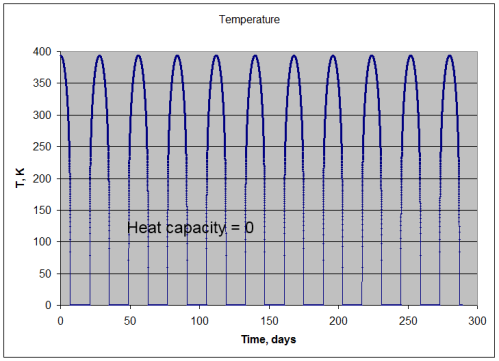
Now, if the surface had no heat capacity (or as mathematicians might say, “as the heat capacity tends to zero”) then the surface would instantaneously heat up until the radiation emitted matched the absorbed radiation.

So in that unrealistic case, the temperature would follow this curve:


Moon-like surface, zero heat capacity

Moon-like surface, zero heat capacity


So during the moon-like night, the surface drops immediately to absolute zero, and during the “day” the emission of radiation exactly matches the absorption. (For mathematically inclined readers this follows a cos θ relationship – see maths section at end).

Note that this isn’t like the earth or any real body. It’s just a useful thought experiment to show what would happen if the surface had no heat capacity.

Under this condition:

  • absorption of solar radiation = 391.7 W/m2 (averaged over many cycles)
  • emission of lunar radiation = 391.7 W/m2 (averaged over many cycles)
  • mean temperature = 169.3K
  • min temperature = 0K
  • max temperature = 394K

Energy in = energy out – so no surprises there.

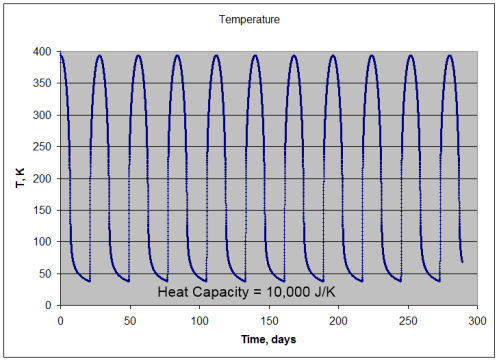
Let’s start increasing the heat capacity and see what happens – per m2, 10,000J/K heat capacity:


Moon-like surface with 10,000 J/K heat capacity per m^2

Moon-like surface with 10,000 J/K heat capacity per m^2


  • absorption of solar radiation = 391.7 W/m2 (averaged over many cycles)
  • emission of lunar radiation = 391.7 W/m2 (averaged over many cycles)
  • mean temperature = 195.3K
  • min temperature = 38K
  • max temperature = 397K

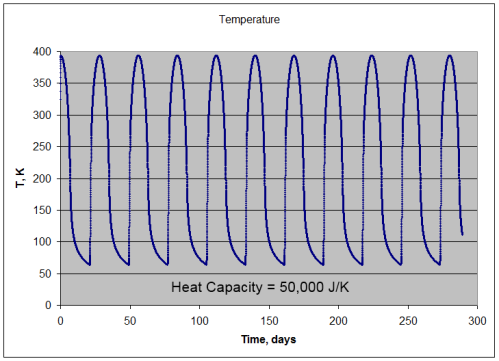
Per m2, 50,000J/K heat capacity:


Moon-like surface with 50,000 J/K heat capacity

Moon-like surface with 50,000 J/K heat capacity per m^2


  • absorption of solar radiation = 391.7 W/m2 (averaged over many cycles)
  • emission of lunar radiation = 391.5 W/m2 (averaged over many cycles)
  • mean temperature = 211.3K
  • min temperature = 64K
  • max temperature = 394K

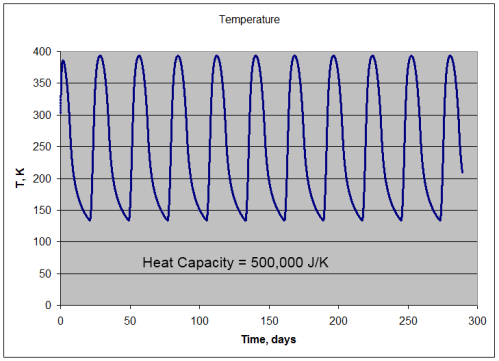
Per m2,  500,000J/K heat capacity:


Moon-like surface with heat capacity = 500,000 J/K per m^2

Moon-like surface with 500,000 J/K heat capacity per m^2


  • absorption of solar radiation = 391.7 W/m2 (averaged over many cycles)
  • emission of lunar radiation = 390.0 W/m2 (averaged over many cycles)
  • mean temperature = 247.7K
  • min temperature = 133K
  • max temperature = 393K

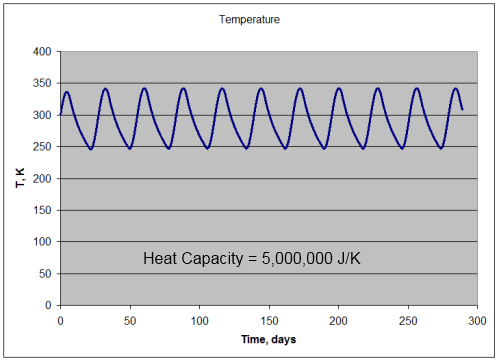
Per m2,  5,000,000J/K heat capacity:


Moon-like surface, 5,000,000 J/K per m^2

Moon-like surface, 5,000,000 J/K per m^2


  • absorption of solar radiation = 391.7 W/m2 (averaged over many cycles)
  • emission of lunar radiation = 391.7 W/m2 (averaged over many cycles)
  • mean temperature = 290.9K
  • min temperature = 247K
  • max temperature = 342K

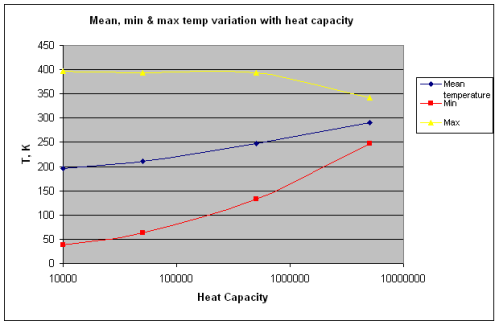
Hopefully, for most people, the fact that the temperature range is reducing as heat capacity increases is reasonably intuitive. If you want to heat up a cupful of water it takes less time than heating a swimming pool. If you want to cool down both through the same surface area it will take longer for the swimming pool to cool down.

Summary of Results

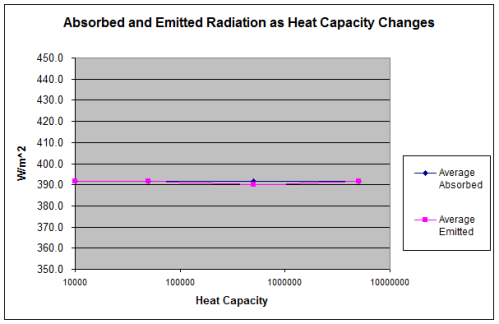
Notice that in each case the average value of absorption = emission – to within 1%.

The 1% is just a result of imperfect starting conditions. If the chosen simulation starting temperature was exactly right, or there were enough “spin up” cycles to get into the steady state before the averaging was done then the absorption = emission exactly.

It’s probably not surprising to anyone that absorption = emission over a set number of cycles because otherwise the overall trend in temperature would be increasing or decreasing.

Next a plot of mean, min and max temperature as the heat capacity increases, note the log axis for heat capacity:

The reason for plotting the heat capacity on a “log” or logarithmic axis was because the heat capacity is increased by a an order of magnitude each time. Linear plots make the results of this kind of simulation less clear.

The mean temperature is simply the arithmetic average of temperature over every single time step. (All the numbers added up and divided by the number of results).

So the mean temperature does increase when the surface has an increased heat capacity!

It looks like the ilovemyco2 writers were correct and the whole greenhouse effect was just a result of heat capacity of the oceans and land.

Time for me to pack my bags and head off into the sunset..

But wait, hold on a minute..

There’s something very strange going on. The temperature is increasing, but the average emission of radiation has stayed exactly the same:

How can temperature increase without the radiation increasing? Radiation is emitted in proportion to the 4th power of temperature – for a blackbody (ε=1), E = σ . T4, where σ = 5.67×10⁻⁸

If the temperature goes up, radiation must go up as well. Is there something wrong with the model?

No. And for those who’ve read Why Global Mean Surface Temperature Should be Relegated, Or Mostly Ignored this example won’t be surprising.

Take 3 “temperatures”:  1, 10, 100.

Now we average them -> average = 111/3 = 37K

And calculate the energy radiated, E = 37 4 x 5.67×10-8 = 1,874,161 x 5.67×10-8 = 0.11 W/m2

Alright, let’s do it the other way. Let’s calculate the energy radiated for each temperature:

  • 14 x 5.67×10-8 = 1 x 5.67×10-8 = 5.67×10⁻⁸
  • 104 x 5.67×10-8 = 10,000 x 5.67×10-8 = 5.67×10⁻⁴
  • 1004 x 5.67×10-8 =100,000,000 x 5.67×10-8 = 5.67

And now average the energy radiated -> average = (5.6705670567/3) = 1.89 W/m2

One method gives 18x the other method – how can this be and which one is right?

Just for the many people would prefer to see the calculation without the Stefan-Boltzmann constant of 5.67×10^8 everywhere – in that case we compare 374 = 1,874,161 with the alternative method of (14 + 104 + 1004)/3 = 100,010,001/3= 33,336,667

Also (of course) a factor of 18 between the two methods of calculating the “average”.

There’s nothing surprising about this – average a series of numbers and raising the average to the 4th power will almost always give a different answer to first calculating the 4th power for each of a series of numbers and averaging the results.

Now the moon has some extreme temperature ranges in the examples shown and, therefore, the “mean” temperature changes significantly.

The earth by contrast, with less extreme temperatures has this result –

  • the “average” temperature = 15°C, and converting that to the “average” radiation = 390 W/m2
  • calculated the correct and painful way, the individually calculated values of radiation from each and every surface temperature around the globe every few hours over a year.. then averaged = 396 W/m2

Conclusion

So the reason that the moon – with a surface with a real heat capacity – appears to have a warmer climate “than predicted” is just a mathematical error. A trap for the unwary.

The right way to calculate a planet’s average radiation is to calculate it for each and every location and average the results. The wrong way is to calculate the average temperature and then convert that to a radiation. In the case of the earth’s surface, it’s not such a noticeable problem.

In the case of the moon, because of the wide variation in temperature, the incorrect method produces a large error.

So there’s no “lunar explanation” for the inappropriately-named “greenhouse” effect.

In the case of the earth there is anyway a huge difference from the moon. The solar radiation absorbed at the top of the earth’s atmosphere – about 240W/m2 is approximately balanced by the outgoing longwave radiation of the same amount. But the radiation from the surface of the earth of 396W/m2 is much larger than this top of atmosphere value of 240W/m2.

That’s the greenhouse effect.

But ilovemyco2 – hats off to you for enthralling and exciting so many people with a simple mathematical puzzle.

Maths in the Model

Ein = S . cosθ . α   – for -90° < θ < 90°

Ein = 0   otherwise

where Ein = energy absorbed by the surface in J/s, S = the solar irradiance in W/m2, θ = angle of the sun from the zenith, α = absorptivity of the surface at the solar radiation wavelengths.

Eout = ε . σ . T4

where Eout = energy radiated by the surface in J/s, ε = emissivity of the surface at the wavelengths it is radiating at, σ = 5.67 x 10⁻⁸, and T is the temperature in K (absolute temperature). This is the Stefan-Boltzmann equation.

and for each time step, Δt:

ΔT = (Ein – Eout)/C

where C = heat capacity of a 1m2 surface in J/K and ΔT is the change in temperature.

For people who like even more detail:

The assumption is that the conductivity of heat into the surface is very high with some kind of insulating layer below the “heat capacity” layer. This makes the calculation slightly easier to understand than using thermal diffusivity.

And the conductivity of heat laterally is very low to avoid considering thermal equalization between adjacent surfaces.

Neither of these assumptions has any significant effect on the “experiment”, or on the principles that it demonstrates.

Note 1

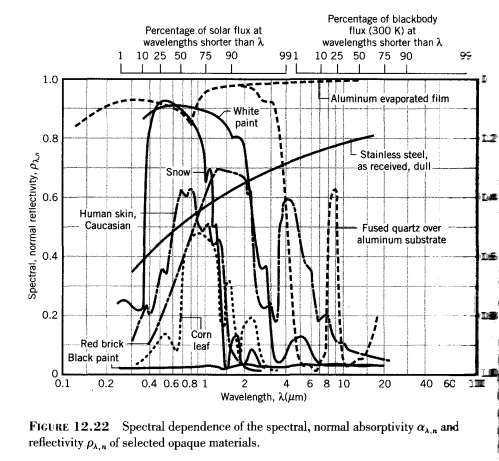
Emissivity and absorptivity are inherent properties of the material in question and are wavelength dependent. In the case of a surface like the earth, the surface receives solar radiation centered around 0.5μm and radiates out with wavelengths centered on 10μm. See, for example, The Sun and Max Planck Agree. So there is no reason to expect that absorptivity = emissivity (because we are considering the properties at different wavelengths).

Checkout the more comprehensive: The Sun and Max Planck Agree – Part Two

For regular readers of this blog, this post adds nothing new. Think of it as placeholder – a link to send people to when they ask about this basic subject.

A very handy aspect of climate science is that we can easily differentiate between solar (from the sun) radiation and terrestrial (from the earth) radiation. We can do this because emission of radiation changes with wavelength and depends on the temperature of the body radiating:


Radiation vs Wavelength -Sun and Earth

Radiation vs Wavelength - Sun and Earth


Picture the scene, if you will.

The climate science enthusiast explains that the sun heats the atmosphere and the surface of the earth – both land and sea. And everyone agrees. Of course some solar radiation is reflected and no one disputes it.

The climate science enthusiast explains that the earth, when heated up by the sun, emits thermal radiation which is upward radiation (of course). And everyone agrees.

The climate science enthusiast explains that the atmosphere absorbs some terrestrial radiation, heats up and emits thermal radiation in all directions – some of it downward. Many are not so sure.

You are mixing up solar radiation with this ‘back-radiation’ from the atmosphere. Please provide data from night-time only.

This has been a theme on many other blogs and in many comments on Science of Doom so it’s worth pulling together the basics.

Max Planck and Blackbody Radiation

Max Planck was awarded the Nobel Prize in 1918 for his contributions to science, including this gem about radiation:


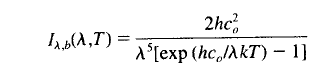
Spectral Intensity, Max Planck

Spectral Intensity, Max Planck


This equation describes the spectral intensity of a “blackbody” as a function of temperature (absolute temperature) and wavelength.

The values of h, k and c0 are constants. T is absolute temperature and λ is wavelength.

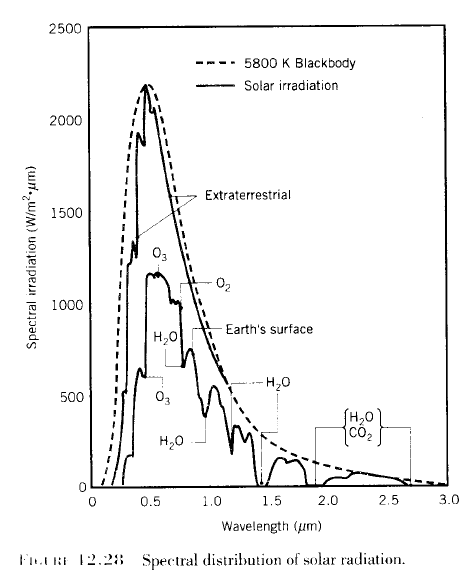
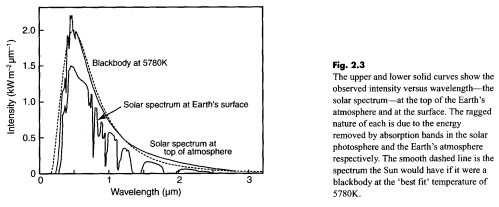
If we plot the result of this equation for a temperature of 5780K – the sun – we get a graph which looks remarkably like the radiation we actually measure from the sun outside the atmosphere.

That’s a good thing, and Max won’t have to hand back his Nobel prize:


Solar Radiation and the Blackbody Curve for 5780K, Incropera (2007)

Solar Radiation and the Blackbody Curve for 5800K, Incropera (2007)


This is from Incropera and DeWitt – for those suspicious of everything produced by climate science, a work untouched by climate scientists – which goes by the enthralling name of Fundamentals of Heat and Mass Transfer and is now in its sixth edition.

From climate science itself, from Professor F.W. Taylor of Oxford University, from Elementary Climate Physics (2005):


Solar Radiation, top of atmosphere and at earth's surface, Taylor (2005)

Solar Radiation, top of atmosphere and at earth's surface, Taylor (2005)


Much the same. And it gives us confidence that Max Planck was right. In which case we can calculate some key parameters about the radiation from the sun and from the earth.

Solar vs Terrestrial Radiation

Solar radiation at 5780K has a few interesting properties which are easily calculated using the equation above. You can put the equation into excel and work it out for yourself.

Or you can use spectralcalc.com to do the heavy lifting. With spectralcalc just select a temperature and at the bottom select an “Upper limit” and “Lower limit” of wavelength. This will calculate the spectral intensity between these two wavelengths using Planck’s equation. Don’t forget to make sure you divide this Band Radiance by the Radiance, and not the Radiant emittance (check the units to make sure you are comparing like with like).

Some important results from Max and from the sun..

As a proportion of total solar irradiance:

  • Total energy from 0 – 0.75μm                54%   – all energy up to infra-red
  • Total energy from 0.39μm – 0.75μm      43%   – visible light only
  • Total energy from 0 – 4μm                   99%   – all “shortwave”
  • Total energy from 4-infinity                       1%   – all “longwave”
  • Total energy from 13μm-infinity              0.03% – major 15μm CO2 band and above

Terminology:

  • >0.75μm is infra-red (slightly different conventions exist about the maximum value for visible light, but nothing substantial)
  • 0-4μm is “shortwave” – a climate science convention referring to solar radiation
  • 4μm-infinity is “longwave“- a climate science convention referring to terrestrial radiation

For various temperatures of the earth’s surface, the proportion of its radiation which is in the “longwave” band (4μm and above):

  • 15°C (288K) – 99.9%
  • -50°C (223K) – 99.99%
  • 50°C (323K) – 99.6%

The last important point to consider is that sometimes people get confused about the relative magnitude of solar and terrestrial radiation – for example, with the first graph in the post the solar radiation is much higher than the terrestrial radiation. But this is because the solar radiation in that example is the value close to the surface of the sun. But the earth only receives about one two-billionth of the solar radiation due to its distance from the sun.

Overall, and on average, the solar energy into the atmosphere is of a similar magnitude to the terrestrial radiation out of the atmosphere. (Otherwise the earth would heat up or cool down very quickly).

But in any one location on any given day it is possible for the solar radiation to vary from zero (night-time) to potentially over 1000 W/m2 (sun overhead on a cloudless sky). The absolute maximum is the total solar irradiance of 1367 W/m2 – this would be the case if the sun was directly overhead and the atmosphere reflected or absorbed nothing, which is never the case, but let’s consider this condition to get an idea of the maximum possible solar radiation in the longwave.

With the sun directly overhead and no atmospheric reflection or absorption we would have:

  • 13.7 W/m2 > 4μm
  • 4.1 W/m2 > 6μm
  • 0.4 W/m2 > 13μm
  • 0.25 W/m2 in the CO2 band of 13μm – 17μm

Conclusion

Well, hopefully everyone can see that even though the radiation spectrum by wavelength for any radiating body extends to infinity, the amount of solar radiation which is >4μm is 1% and the amount of terrestrial, or longwave, radiation which is <4μm is much less than 1%.

  • This means, if we measure radiation with a wavelength of >4μm it is not from the sun, even if it is daytime (to a 96 – 99% accuracy).
  • And if we measure radiation with a wavelength of >13μm it is not from the sun, even if it is daytime (to greater than 99.9% accuracy).

That is, unless Max Planck and the sun are wrong.

If you think this explanation or conclusions are wrong in any way then stay on this post and ask questions or explain what is wrong with it. Because if this basic element is confusing it will be difficult to make any progress in understanding climate science.

Update – followup article – The Sun and Max Planck Agree – Part Two

In the CO2 series we looked at the effect of CO2 without climate feedbacks. The “answer” to the doubling of CO2 was a “radiative forcing” of 3.7W/m^2 and an increase in surface temperature of about 1°C.

What about feedbacks?

There are many ways to introduce this problem. We’ll start with the great Ramanathan, who is always worth reading. This article discusses the ideas in the chapter The Radiative Forcing due to Clouds and Water Vapor (by Ramanathan and Inamdar) from Frontiers of Climate Modeling by Kiehl and Ramanathan (2006). Note that the link allows you to download the chapter. Well worth reading.

And if you have questions about whether CO2 can influence temperature or whether the inappropriately-named “greenhouse” effect exists, take a look at the CO2 series (and ask questions there).

Preamble

Various papers from the 60’s onwards that attempted to model the change in radiative flux and surface temperature (as a result of changes in CO2 concentrations) usually solved the problem using (at least) two scenarios:

  • constant absolute humidity
  • constant relative humidity

The reason is that absolute humidity is less realistic than relative humidity – and the concept of relative humidity leads to positive feedback. Why positive feedback? Higher concentrations of CO2 lead to increased radiative forcing and so the surface and tropospheric temperature increases. As a result – under constant relative humidity – the amount of water vapor in the troposphere increases. Water vapor is a greenhouse gas and so further increases “radiative forcing”.

One of the questions that come to people’s minds is whether this leads to thermal runaway. The answer, when considering the “extra” effect from water vapor is no, and this is because there are also negative feedbacks in the system, especially the fact that radiation (a negative feedback) increases as the 4th power of absolute temperature.

But enough of trying to think about the complete solution before we have even begun. Let’s take the time to understand the thinking behind the problem.

Cloudy Skies

Clouds are one of the toughest problems in climate science, and as a result, many models and experiments differentiate between cloudy and clear skies.

The ERBE experiments clarified the main effects from clouds.

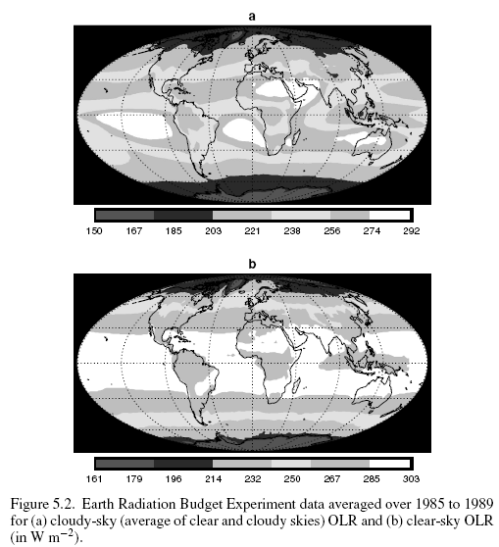
Here is OLR (outgoing longwave radiation) under clear and cloudy (=all skies) averaged over 1985-1989:

ERBE OLR for clear and cloudy skies, 1985-1989

ERBE OLR for clear and cloudy skies, 1985-1989

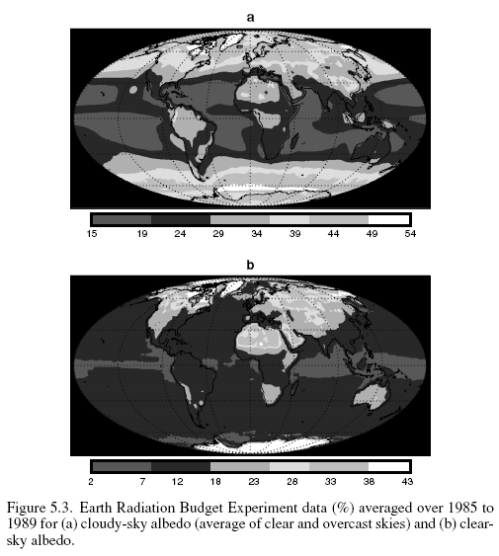
Here is the albedo (%), or % of solar radiation reflected:

Albedo, or reflected solar radiation %, from ERBE, 1985-1989

ERBE albedo = reflected solar radiation % for clear and cloud skies, 1985-1989

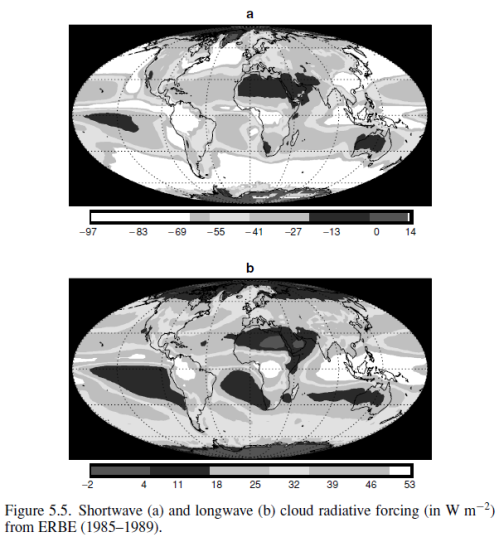
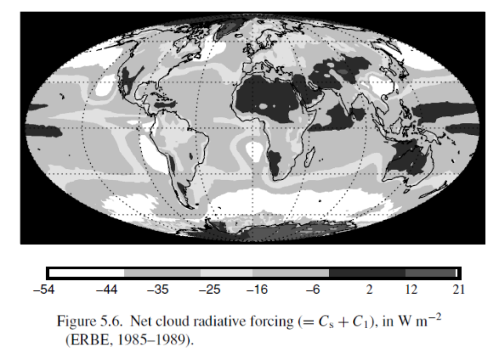
Clouds reflect solar radiation by 48 W/m2 but reduce the outgoing longwave radiation (OLR) by 30 W/m2, therefore the average net effect of clouds – over this period at least – is to cool the climate by 18 W/m2. Note that these values are the global annual average.

Here are the net shortwave (solar reflection) and net OLR effects from clouds over the whole period:

and the two effects combined:

The “Greenhouse” Effect and Water Vapor

I’ll try and keep any maths to a minimum, but a few definitions are needed.. if you don’t like seeing equations the explanations in the text mean you haven’t missed anything essential.

We will call the “greenhouse” effect of the atmosphere and clouds, G, and the average OLR (outgoing longwave radiation), F:

F = σTs4 – G

The first term on the right-hand side of the equation, σTs4, is just the radiation from the earth’s surface at a temperature of Ts (the Stefan-Boltzmann equation). So the radiation from the earth’s surface less the “greenhouse” effect is the amount of radiation that escapes to space.

G is made up of the clear sky “greenhouse” effect, Gclear, and the (longwave) effect of clouds, Gcloud.

Now as we move from the hotter equator to the colder poles we would expect Gclear to reduce simply because the surface radiation is much reduced – a 30°C surface emits 480 W/m2 and a 0°C surface emits 315 W/m2. A large proportion of the changes in the “greenhouse” effect, Gclear, are simply due to changes in surface temperature.

Therefore, we introduce a normalized “greenhouse” effect, gclear:

gclear = Gclear / σTs4

This parameter simply expresses the ratio between the clear sky “greenhouse” effect and the surface radiation. The variations in this normalized value reflect changes in atmospheric humidity and lapse rates (the temperature profile up through the atmosphere). See especially CO2 – An Insignificant Trace Gas? Part Five for a little more illumination on this.

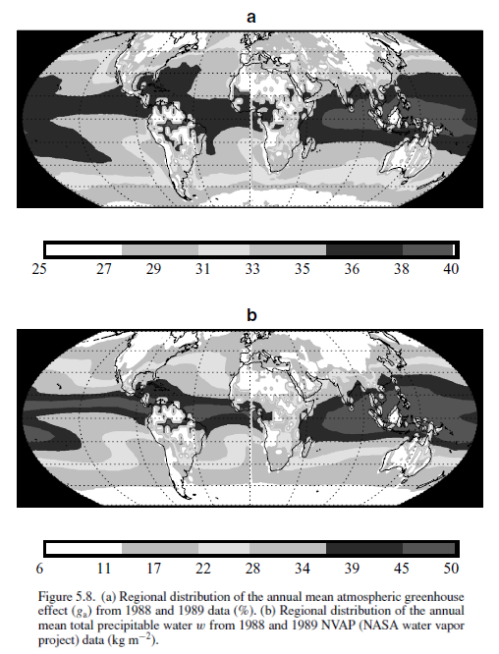
The global average value for Gclear = 131 W/m2 and for gclear = 0.33 – i.e., the atmosphere reduces the radiation escaping to space by 33%.

Here is how gclear varies around the world (top graphic) compared with water vapor around the world (bottom graphic):

It should be clear from these graphics that observed variations in the normalized “greenhouse” effect are largely due to changes in water vapor. [Note – change of notation from the graphics – ga in the graphic is gclear in my text]

Water vapor decreases from equator to pole due to temperature (lower temperatures mean lower absolute humidity), and increases over ocean compared with land (because of the availability of water to evaporate).

Feedback

If we can see that the “greenhouse” effect is strongly influenced by water vapor, we want to know how water vapor changes in response to surface and tropospheric temperature changes.

To make sense of this section it’s helpful to follow some maths. However, I recognize that many people would rather skip any maths so this is in the last section for reference.

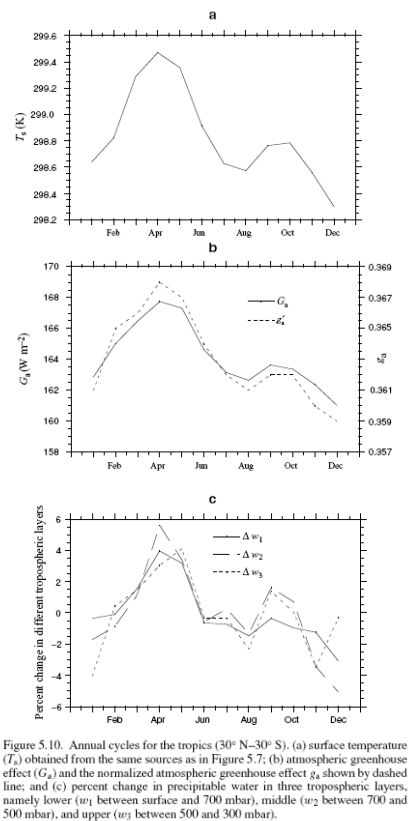
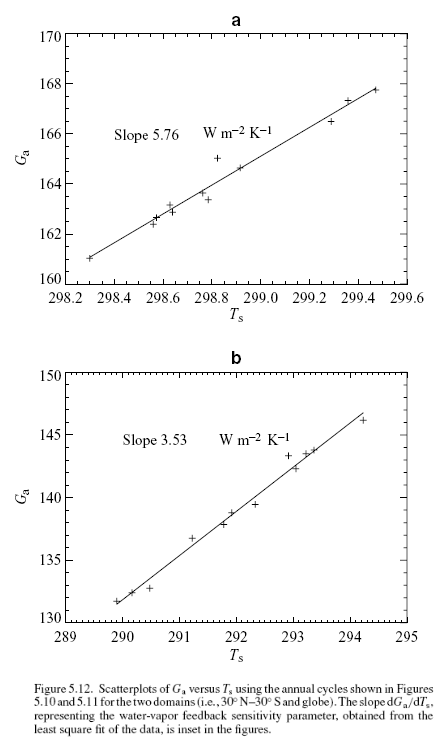
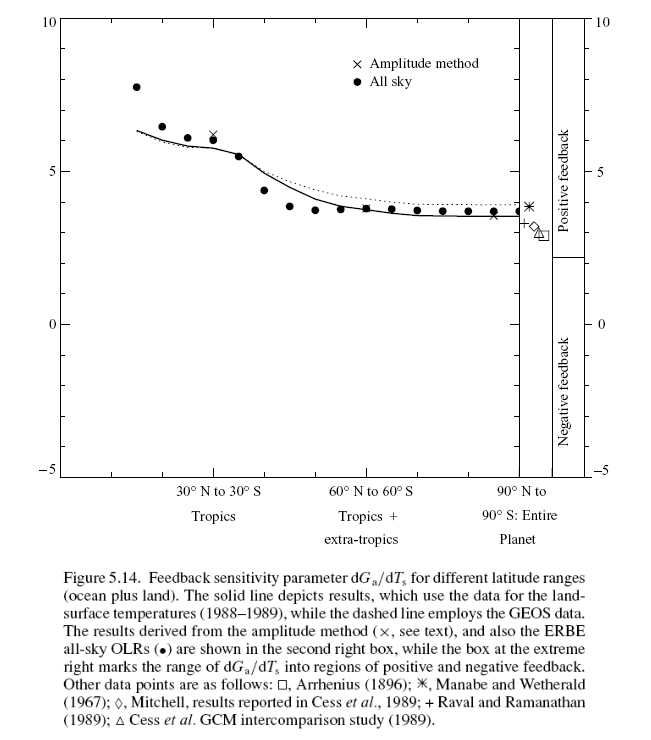
Here are the results from ERBE for: the tropics (30°N – 30°S) with surface temperature; the “greenhouse” effect + the normalized version; and the change in water vapor in different vertical sections of the atmosphere:

Ramanathan says:

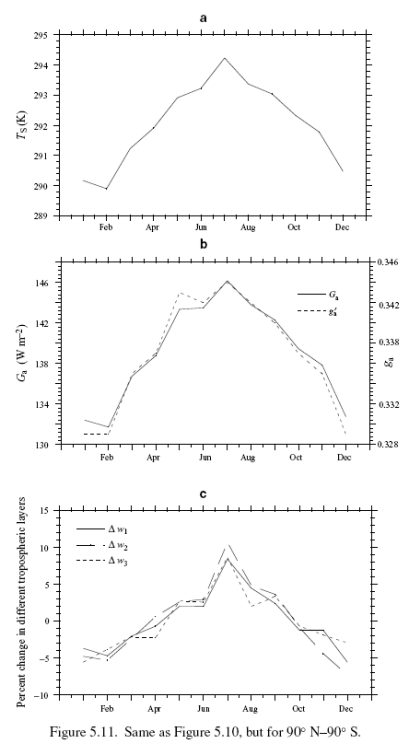
For the tropics, Ts peaks in March/April, while for 90°N–90°S, Ts peaks in July. We can qualitatively interpret the phase of the annual cycle as follows. The tropical annual cycle is dominated by the coupled ocean–atmosphere system and as a result, the temperature response lags behind the forcing by a maximum of about three months (π/2); thus, with the solar insolation peaking in December 21, the temperature peaks in late March as shown in Figure 10.

Now the whole globe as a comparison:

Ramanathan again:

The extra-tropical and global annual cycle is most likely dominated by the hemispherical asymmetry in the land fraction. During the northern-hemisphere summer (June, July, and August), the large land masses warm rapidly (with about a one month lag) which dominates the hemispherical and global mean response; however, during the southern-hemisphere summer, the relatively smaller fraction of land prevents a corresponding response. Thus, the globe is warmest during June/July and is coldest during December/January.

What can we make of the correlation? Correlation doesn’t equal causation.

The best fit is a phase lag of less than a month which implies that water vapor and gclear are not driving Ts – because the feedback in that case would require more than one month. The converse, that Ts is driving water vapor and gclear, is much more likely because convective time scales are very short.

Of course, this is a deduction from a limited time period.

One of the key relationships in understanding feedback is the change in Gclear with Ts (mathematically we write this as dGclear/dTs – which means “the rate of change with Gclear as Ts varies “).

For reasons briefly outlined in the maths section, if dGclear / dTs > 2.2 it implies positive feedback from the climate.

When the data is plotted from the ERBE data we can see that in the tropics the value is the highest, much greater than 2.2, and when the whole globe is included the value reduces significantly. However, the value for the whole globe still implies positive feedback.

In this last graph we see the feedback value for progressively wider latitude ranges – so on the left we are only looking at the tropics, while over on the right (90°N to 90°S) we are looking at the entire planet. This helps to see the contribution from the tropics progressively outweighed by the rest of the plant – so the important point is that without the strong effect from the tropics the feedback might well have moved to negative.

The feedback doesn’t change between clear sky and all sky, implying that the cloud feedback doesn’t impact the climate system feedback (on these timescales).

Ramanathan comments:

However, our results do not necessarily confirm the positive feedback resulting from the fixed relative humidity models for global warming, for the present results are based on annual cycle. We need additional tests with decadal time-scale data for a rigorous test. Nevertheless, the analysis confirms that water vapor has a positive feedback effect for global-scale changes on seasonal to inter-annual time scales.

He also comments on other work (including Lindzen) that finds different results for the relative important of water vapor in different vertical sections of the troposphere.

Hopefully, we will get the opportunity to consider these in future articles.

Articles in this Series

Part One – Responses – answering some questions about Part One

Part Two – some introductory ideas about water vapor including measurements

Part Three – effects of water vapor at different heights (non-linearity issues), problems of the 3d motion of air in the water vapor problem and some calculations over a few decades

Part Four – discussion and results of a paper by Dessler et al using the latest AIRS and CERES data to calculate current atmospheric and water vapor feedback vs height and surface temperature

Part Five – Back of the envelope calcs from Pierrehumbert – focusing on a 1995 paper by Pierrehumbert to show some basics about circulation within the tropics and how the drier subsiding regions of the circulation contribute to cooling the tropics

Part Six – Nonlinearity and Dry Atmospheres – demonstrating that different distributions of water vapor yet with the same mean can result in different radiation to space, and how this is important for drier regions like the sub-tropics

Part Seven – Upper Tropospheric Models & Measurement – recent measurements from AIRS showing upper tropospheric water vapor increases with surface temperature

Conclusion

This is a big subject which has lots of different perspectives, and only one is developed here. Therefore, I hope that this is the first of many articles on the subject.

It should be helpful to see the approach and one way of interpreting the data. There is a theoretical framework behind the concepts, which can be seen in Ramanathan’s paper from 1981: The Role of Ocean-Atmosphere Interaction in the CO2 Climate Problem. (You can find a free copy online). It’s quite involved but perhaps some of the concepts from this paper will be in one of the next posts in this series.

Maths

I’ll follow the notations from the chapter reasonably closely. But I think they are confusing so I have changed a few of them.

And if you do want to understand the maths it’s definitely worth taking a look at the more detailed explanations in the chapter to understand this beyond the surface.

F = OLR (outgoing longwave radiation)

F = Fclear (1-f) + f.Fcloudy, where f is the fraction of clouds, and Fclear is the clear sky OLR

F = σTs4 – G                [1], where G is the “greenhouse” effect

and G = Gclear + Gcloud [2]

Now the main feedback parameter is dF/dTs, so:

dF/dTs = 4σTs3 – dG/dTs = 4σTs3 – (dGclear/dTs + dGcloud/dTs)           [3]

Note that 4σTs3 = 5.5 Wm-2K-1 (at T=289K)

Background:  dGclear/dTs is affected by water vapor and lapse rate and dGcloud/dTs is affected by cloud feedback and lapse rate

Now dGclear/dTs = 4σTs3 – dFclear/dTs [4]

now for Ts changing with no lapse rate feedback and no water vapor feedback, dFclear/dTs = 3.3 Wm-2K-1 (from Ramanathan 1981, see ref above in conclusion).

Therefore, if there is positive feedback dFclear/dTs < 3.3 Wm-2K-1 and if negative feedback dFclear/dTs > 3.3 Wm-2K-1 – because a lower value of F (OLR) means a higher value of G (greenhouse effect)

And from [4], if dGclear/dTs > 5.5 – 3.3 = 2.2 then there is positive feedback.

Very soon we will finally get to a post with an interesting subject like climate feedback..

But first, just a few basic examples, following on from the recent post: Intelligent Materials and the Imaginary Second Law of Thermodynamics, which in turn followed on from a few before that.

In the last post one of our frequent champions of the imaginary second law of thermodynamics acknowledged an important point. We had previously agreed that radiation from a colder body does reach a hotter body. The question was about whether the hotter body actually absorbed the energy from the colder body. Specifically, about the “absorptivity” of this hotter body for “irradiation” received from the colder body.

In the last post I provided a graphic to illustrate the emission of radiation from two bodies at slightly different temperatures:


Blackbody radiation curves for -10'C (263K) and +10'C (283K)

Blackbody radiation curves for -10'C (263K) and +10'C (283K)


With the important question being about whether a 0°C surface treats radiation from the +10°C body any differently from the radiation from the -10°C body.

Our “imaginary second law” champion did acknowledge that, for example, 10μm radiation from a -10°C body is treated no differently from 10μm radiation from a +10°C body. That is, the absorptivity, or proportion of radiation absorbed, is the same for any given wavelength regardless of the temperature of the source body.

Armed with this “consensus” we can examine a few further ideas.

We will see that the first law of thermodynamics is in conflict with the imaginary second law of thermodynamics

So it will be interesting to see how the champions of the imaginary second law respond.

Of course, it’s important to note that we only have one signed up to this “consensus” (about hotter bodies absorbing radiation from colder bodies). The imaginary second law movement isn’t a monolithic voting block. Others may not agree, as in Radiation Basics and the Imaginary Second Law of Thermodynamics where a new advocate championed the idea that the radiation from the colder body never reaches the hotter body, claiming that the radiation was cancelled out and the measurements of radiation reaching the hotter body were fraudulent. Well, interested parties can follow that fascinating story..

Example 1 – A Body in Space Left to Cool Down

Why space? Well, space is a vacuum and this simplifies our thought experiments because there is no conduction or convection of heat, and this only leaves radiation as the mechanism for the transfer of heat.

So in the first example, we consider a sphere which has a surface temperature of 273K (0°C) and no source of heat, which is left in space to cool down. Perhaps the sphere was previously heated up by a nearby star which has been “turned off”, perhaps it had its own source of heat. It’s not important.

The conductivity of this sphere is very high – so all points on and within the sphere are at the same temperature. This is just to avoid the complexities of heat conduction vs time within the sphere, which doesn’t add anything to our example.

The radius of the sphere = 10 m, so surface area = 1,256 m2. (A=4πr2). The sphere is a “blackbody” which means that it a perfect absorber of radiation (nothing reflected) and consequently a perfect emitter of radiation.

And the last point is simply to identify the heat capacity of the sphere – which is 1×10⁶ or 1,000,000 J/K.

The shape of the temperature curve is probably not surprising to anyone. Obviously the temperature will decrease – because the body is radiating heat with no incoming radiation to balance out the loss, and there is no internal source of heat.

Also you can see that the rate of change of temperature is reducing. This is because the body radiates according to the 4th power of temperature and as the temperature gets lower less heat is radiated each second.

At time infinity the temperature will be zero (or the background temperature of the universe).

Example 2 – Two Bodies Left in Space to Cool Down

The first example was probably uncontroversial. Now let’s look at two bodies in space in proximity to each other. In this example the starting point is the same for the first body (which goes by the exciting name of “Body 1”), and the second body (not to be outdone, known as “Body 2”) is identical except for the fact that it starts at a temperature of 263K (-10°C).

The distance between the center of the two bodies is only 30m – remember that the radius of each is 10m – so therefore there is only a 10m gap between the closest points. In fact, this creates a complexity that we will ignore in the calculation of incident radiation. See Note 1 at the end.

Body 1 radiates and a small amount of this radiation is incident on Body 2.

Body 2 radiates and a small amount of this radiation is incident on Body 1.

Now Body 2 is initially colder than Body 1 but at least from one “imaginary second law” advocate we have agreement that Body 1 will absorb this radiation (according to its absorptivity, which in this case = 1, i.e., 100% of incident radiation is absorbed).

See note 2 for the simple maths involved.

There’s probably nothing very surprising in this graph. T1 is the temperature of Body 1,T2 for Body 2.

So now, let’s take a look at the difference between the temperature curves for Body 1 in the first example, vs this second example where a colder body is in proximity:

and expanded in one section:

Probably not surprising for most people that in the presence of another body radiating, Body 1 has a slower decrease in temperature.

This is just a consequence of the first law of thermodynamics – the conservation of energy. Energy can’t just disappear.

We will see what the advocates of the imaginary second law have to say about this one.

Notice as well that the colder body is reducing the rate of heat loss from the hotter body but there is no perpetual motion machine. At time infinity they are both at absolute zero (or the background temperature of the universe).

Example 3 – One Body being Heated by a Sun

Now we come to the third example, and in this case Body 1 is being heated by a star. (Body 2 has exited stage left for this example).

The radiation from the star incident on Body 1 is about 1260W/m2, which, with a radius of 10m means a total incident radiation of 395,570W – all of which is absorbed by Body 1 of course because it is a blackbody.

Notice that the temperature doesn’t change – because the incident absorbed radiation is exactly balanced by the emission for a 273K body from its entire surface area.

Everyone can feel quite comfortable about this example.

Example 4 – One Body being Heated by a Sun, with a Second Colder Body in Proximity

The racy headline is fully justified in this exciting example.

This fourth and final example is like the last example but Body 2 is “wheeled out” all of a sudden and placed the same distance away from Body 1 as in the earlier example (30m between the centers of each sphere). Body 2 starts off “pre-cooled” to 263K.

Body 1 and Body 2 are close together with the sun radiating totally on Body 1 and on 86% of Body 2 – because Body 2 is partly in Body 1’s shadow. So the solar radiation on Body 2 = 340,718 W.

Let’s see what happens as the clock starts ticking:

Here is the vertical scale expanded:

Very interesting.

With only Body 1 basking in solar joy its surface temperature was 273K (0°C), but when Body 2 was wheeled in at a temperature of 263K (-10°C) we find that the surface temperature of Body 1 increases up to about 274.7K, a 1.7°C increase.

The presence of Body 2 at -10°C has increased the temperature of Body 1 from 0°C to almost 2°C

And in the process Body 2 has increased from -10°C to -8°C.

No surprises to most people – this is just a consequence of the first law of thermodynamics – energy can’t just vanish. So if radiation from a colder body is incident on a hotter body – and absorbed – it has to have an effect.

I can already hear the screaming of a few:

  • you have created energy
  • this violates the second law of thermodynamics
  • a colder body cannot heat a hotter body
  • this is perpetual motion“..

Well, more radiation from Body 1 is absorbed by Body 2 than the reverse. The net is from the hotter to the colder. This is why Body 2 has a higher increase in temperature. So the real second law of thermodynamics is preserved.

And if the sun turns off, both bodies will cool down to absolute zero (or the background temperature of the universe). So there is no perpetual motion machine.

The reason the temperature increased was because we changed the conditions – added another body radiating energy. And because we cannot create or destroy energy it has to have an effect. No energy has been created.

Now imagine the scenario that we arrive many years after the start – we see the sun and two bodies in a happy equilibrium. Someone points out that without the presence of the colder body (Body 2), Body 1 would actually be colder.

What an outrageous idea!

Conclusion

The principles involved in these examples are very simple:

  • the conservation of energy, also known as the first law of thermodynamics
  • the radiation of blackbodies according to the Stefan-Boltzmann equation
  • the absorption of incident radiation from Body 2 into Body 1 and vice-versa
  • the change in temperature according to dT=Q/mc

All the advocates of the imaginary second law of thermodynamics have to do now is demonstrate what steps are flawed in these examples.

Finally, shall we throw out the first law of thermodynamics or the imaginary second law of thermodynamics?

Update – New article – The Real Second Law of Thermodynamics

Note 1

When two bodies are separated by a very large gap (very large compared with their radii) the calculation of incident radiation is very simple – because the distance between any two points on the two spheres ≈ d.

When the gap becomes smaller the calculation becomes more challenging. This is because the two closest points are no longer separated by d but by d-2r (or more accurately d-2r ≠ d). So each “path” between the two bodies is somewhere between d-2r and d+2r. It’s not a difficult mathematical problem but it is a double integral that won’t add anything useful to the analysis.

If anyone is concerned that the analysis is somehow invalidated – we can simply repeat the same analysis with the two bodies separated by a great distance, we will see the same effect but with a smaller magnitude. Alternatively, we could perform the actual double integral to confirm the true and accurate figure. This is left as an exercise for the interested student..

Note 2

The calculations are each time step are very simple.

Energy radiated per second for Body 1, Eout1 = σT4A  – where A is the surface area, and T is the temperature of the body (this is for a blackbody where emissivity, ε =1). Likewise for Body 2.

Proportion of radiation from Body 1 incident on Body 2 = 0.028 (= πr2/4πd2, where r is the radius of the body and d is the distance between the centers of the bodies) – see note 1, not particularly accurate unless d>>r). Likewise for the radiation from Body 2 incident on Body 1.

Net energy change for Body 1 = -Eout1 + Eout2 * 0.028 + incident solar radiation
Likewise for Body 2.

Temperature change = net energy change / heat capacity

Note 3

If Body 1 and Body 2 started off much colder, even at absolute zero the same equilibrium conditions are reached.

In Radiation Basics and the Imaginary Second Law of Thermodynamics I covered a fair amount of ground because it started in answer to another question/point from a commenter.

We all agree that the net effect of radiation between hot and colder bodies is that heat flows from the hotter to the colder body, but many people have become convinced that this means radiation from a colder body has no effect on a hotter body.

After explaining a few basics about emission and absorption, I concluded:

Therefore, there is no room in this theory for the crazy idea that colder bodies have no effect on hotter bodies. To demonstrate the opposite, the interested student would have to find a flaw in one of the two basic elements of thermodynamics described above.

And just a note, there’s no point reciting a mantra (e.g., “The second law says this doesn’t happen”) upon reading this.

Instead, be constructive. Explain what happens to the emitting body and the absorbing body with reference to these elementary thermodynamics theories.

One of our regular commenters has finally explained what happens.

This was a great day of joy because in three other articles on this blog (The Imaginary Second Law of Thermodynamics, How Much Work Can One Molecule Do? and On the Miseducation of the Uninformed by Gerlich and Tscheuschner (2009)) and one on another blog the subject has been much discussed.

I have asked many many times:

What happens to radiation from the colder body when it “reaches” the hotter body?

But I had never been given an answer – until now. (Note: the general consensus from the imaginary second law advocates – as much as I can determine – is that the colder body does emit radiation so at least there is agreement on the first step).

Finally, the answer is revealed:

Back to thermodynamics and electromagnetic radiation.
Scienceofdoom and others think that the hot surface has no option but to absorb a photon from the cold surface.
I think a lot of this radiation is in fact scattered from the hot surface and is not absorbed.

“A Lot” is Not Absorbed?

Before we dive into the fascinating topic of absorptivity and absorption, I hope people don’t think I am being pedantic for drawing attention to the fact that one of our most prominent advocates of the theory (the Imaginary Second Law) has actually failed to support it.

Science is about detail.

If no radiation from the colder body is absorbed by the hotter body then the imaginary second law stands. That is, if any radiation emitted by a colder body “reaches” the hotter body and is absorbed by the hotter body then the colder body has transferred energy to the hotter body.

The colder body has had “an effect”.

It’s hard to be certain about the imaginary second law of thermodynamics because I can’t find it in a text book. In fact, on another note, it has been a day of double joy, because another imaginary second law advocate stepped up to the plate when presented with this from a thermodynamics textbook:


From "Fundamentals of Heat and Mass Transfer, 6th edition", Incropera and DeWitt (2007)

From "Fundamentals of Heat and Mass Transfer, 6th edition", Incropera and DeWitt (2007)


And said:

It is absolutely in error.

Which was wonderful to hear because up until now everyone else had simply ignored the question as to whether Incropera and DeWitt didn’t understand the basics of radiation (for reasons that are all too easy to imagine).

But I digress.

I can’t be 100% certain what the imaginary second law of thermodynamics teaches but it has appeared up until now – from the comments by many advocates – that colder bodies have no effect on hotter bodies.

How can it be that the first time someone explains what happens to the incident radiation they agree, at least in principle, with the rest of the world? We (the rest of the world) all think that cold bodies have an effect on hotter bodies.

Perhaps more advocates can comment and vote on this idea..

[Stop press – after writing this a newer entrant to the field has promoted a new idea but this one can wait until another day]

Absorptivity and Absorption

There are a few basic concepts in traditional thermodynamics that are worth explaining, even though they might appear a little tedious.

I was already thinking about writing an article on this after I had earlier explained:

According to Kirchoff’s law, emissivity = absorptivity for a given substance at the same wavelength (and for some surfaces direction needs to be defined also).

And the same commenter responded:

You have a particularly naive view of heat transfer.

When a green plant absorbs some em radiation to make starch does it simultaneously emit the same radiation?

You have not grasped the fact that if the absorption of 4um radiation was exactly balanced by the emission of 4um radiation the net effect would be zero.

Which would shoot a massive hole in the case for AGW.

I prefer to think of my understanding of physics as traditional rather than naive. So, a few basics need explaining so that readers can judge for themselves.

Just a comment, as well, for new people looking into this subject. The basics often seem a little dull, but hopefully I can persuade a few to dig deep and work hard to get the very basics clear. I can promise unrelenting joy down the track as you realize that you understand more than most other people who had jumped ahead and are now writing confused comments.. (assuming this will give you unrelenting joy).

Let’s look at snow in sunlight and use it to “shed light” on a dull subject.

First of all, there are two important factors involved in the absorption of radiation:

  • the radiation incident on the snow (i.e., the radiation value as a function of wavelength)
  • the absorptivity – the property of the snow (as a function of wavelength) which determines how much radiation is absorbed and how much is reflected

We will focus on the snow being heated by sunlight and ignore terrestrial radiation – even though the material will also be heated by terrestrial radiation. This is because we aren’t trying to work out a complete energy balance for this particular material, just illustrating the important points.

Solar radiation has a spectrum which looks something like this:


Solar radiation at top of atmosphere and the earth's surface, Taylor (2005)

Solar radiation at top of atmosphere and the earth's surface, Taylor (2005)


This shows how the radiation incident on the snow varies with wavelength. The actual amplitude is dependent on the time of day, the latitude, the amount of clouds, and so on.

The important point is that radiation from the sun peaks at a wavelength of around 0.5μm and above 2μm is much reduced (91% of solar radiation is below 2μm). Therefore, to find out how much radiation the material actually absorbs we need to know the absorptivity at these wavelengths.

Here are some examples of reflectivity and absorptivity of various materials across quite a wide spectral range:


Reflectivity vs wavelength for various surfaces, Incropera (2007)

Reflectivity vs wavelength for various surfaces, Incropera (2007)


The scale on the left is reflectivity and on the right (harder to see) is absorptivity from 1.0 at the bottom up to 0.0 at the top.  Absorptivity = 1-reflectivity.

Absorptivity is a function of wavelength and is the proportion of incident radiation at that wavelength which is absorbed.

Absorptivity is an inherent property of that material

Let’s take snow as an example. Sunlight on snow will be mostly reflected and not absorbed. That’s because the incident sunlight is mostly between 0.2μm to 2μm – and if you check the reflectivity/absorptivity graph above you will see that the absorptivity is quite low (and reflectivity quite high).

Snow has a high albedo for sunlight – around 60% – 80% is reflected, meaning only 20%-40% is absorbed.

Now let’s consider the snow at a temperature of 0°C (273K). How much thermal radiation does it emit?

If it was a blackbody, it would emit radiation as the Planck function at 273K:


Blackbody radiation at 273K (0'C)

Blackbody radiation at 273K (0'C)


The first thing you notice is that the snow is radiating at completely different wavelengths to the solar radiation. The solar radiation is mostly between 0.2μm to 2.0μm, while the snow is radiating between 5μm and 50μm.

So we need to know the emissivity between these wavelengths to work out the actual emission of radiation from the snow. Emissivity is a value between 0 and 1 which says how close to a blackbody the material is at that wavelength. Emissivity is equal to absorptivity – see the next section – so we can just look up the absorptivity instead.

In the graph from Incropera the absorptivity of snow at higher wavelengths is not shown. But it’s clear that it has changed a lot (and in fact absorptivity is very high – and reflectivity very low – at these higher wavelengths, which climate scientists call “longwave”).

Kirchhoff’s Law

Kirchoff’s law says that emissivity = absorptivity as a function of wavelength – and sometimes direction. That is, these two intrinsic properties of any material have the same value at any wavelength. (The derivation of this formula isn’t something that will be discussed here).

Kirchoff didn’t say that emission = absorption

That’s because emissivity is not the same as emission. And absorptivity is not the same as absorption.

Of course, if a body is only gaining and losing energy by radiation (i.e., no conduction or convection), and the body is not heating up or cooling down then absorption will equal emission. This is due to the first law of thermodynamics or conservation of energy.

But if absorption increases, the body will heat up until the new value of emission balances the increase in absorption. However, the absorption might be in one wavelength range and the emission in a totally different one.

It’s not so difficult to understand, but it does require that you grasp hold of the basics.

So (digressing) back to our commenter, it’s clear that his “reasons” for ditching Kirchhoff’s law weren’t because Kirchhoff was wrong..

And Kirchhoff’s law is very strong. It would need a monumental effort to overturn this part of thermodynamics basics. Reasonable people might expect that if over-turning Kirchhoff’s law is necessary to support the imaginary second law of thermodynamics, then this might imply that the imaginary law is, well, imaginary..

However, even stranger concepts are necessary to support the imaginary second law.

Would Sir like to Absorb this Radiation? No? Very Good Sir, I’ll take it Back.

Now that we have covered a few basics, perhaps some points might start to make sense.

And perhaps this comment might seem a little flawed:

Back to thermodynamics and electromagnetic radiation.
Scienceofdoom and others think that the hot surface has no option but to absorb a photon from the cold surface.
I think a lot of this radiation is in fact scattered from the hot surface and is not absorbed.

Let’s examine the idea that radiation from the cold surface is “not absorbed”, and see it in its comedic glory.

Consider a surface of 0°C (273K).

And now consider one body at 10°C radiating towards this 0°C surface. According to the imaginary second law advocates the radiation from the 10°C body is accepted.

Now consider a similar scenario but the 10°C body has been replaced with a
-10°C body. According to the imaginary second law advocates the radiation from the colder -10°C body is not accepted. And according to its strongest advocate, “it is scattered and not absorbed“.

Here is the comparison spectrum for the two radiating bodies:


Blackbody radiation curves for -10'C (263K) and +10'C (283K)

Blackbody radiation curves for -10'C (263K) and +10'C (283K)


Notice the very similar radiation curves.

And remember that absorptivity is simply a function of the material receiving the radiation.

And ask yourself, how can the 0°C surface reflect the 10μm radiation from the colder -10°C body, and yet absorb 10μm radiation from the hotter +10°C body?

If the absorptivity at 10μm is 0.9 then it will accept 90% of the radiation at this wavelength from a +10°C body and 90% of the radiation at this wavelength from a -10°C body. It can’t check the menu and “send it back”.

Likewise for each wavelength in question.

[By the way, the fact that the body at -10°C emits radiation that is absorbed by the 0°C surface doesn’t mean that the real second law of thermodynamics is violated. Simple, the 0°C surface is also radiating, and at a higher intensity than the -10°C surface. The net is from the hotter to the colder.]

Conclusion

It took many many requests to finally hear the explanation as to why radiation from a colder body has no effect on a hotter body.

It’s not an explanation that will stand the test of time – except for the wrong reasons. It requires the advocate to believe amazing things about materials. Perhaps that’s why it took so long to get the answer.

Yet more ridiculous ideas have recently been proposed. All in the cause of supporting the imaginary second law of thermodynamics. (These need considering in another post).

Just a digression on the perpetual motion machine (because I don’t want to write a whole post on it). For some reason, perhaps the Gerlich and Tscheuschner miseducation, many confused people think that the absorption and re-emission of longwave radiation by the atmosphere constitutes a perpetual motion machine – and therefore this proves the inappropriately-named “greenhouse” effect can’t exist! Well, we all agree that there is no perpetual motion machine.

But why would the atmosphere radiating towards the earth constitute “perpetual motion”?

Think for a minute before answering, if you claim this.

Right now the earth is around the same temperature it was 100 years ago and also 1000 years ago. Is that a perpetual motion machine – a machine that can’t exist? No. The sun warms the earth. And the sun is powered by internal reactions.

Ok. So if the sun turns off what happens? The earth cools down.

For people who think that the earth’s surface is radiating towards the colder atmosphere, and the colder atmosphere is radiating less energy back towards the earth, and the earth is absorbing this radiation.. we expect the same thing to happen when the sun turns off. The earth will cool down. Just a little slower.

No perpetual motion machine.

Well, the second law of thermodynamics is quite a basic one but misunderstood by many who think they are supporting it.

For newcomers to this debate the approach I have taken is to take a specific example and ask the advocates of their theory how specific well-understood physical properties can possibly support their argument. Mostly I get no response.

I have finally had two answers. One is considered here and it’s hard to understand how anyone can believe it.

See the followup article – The First Law of Thermodynamics Meets the Imaginary Second Law

And the later article – The Real Second Law of Thermodynamics