Many people are confused about science basics when it comes to the inappropriately-named “greenhouse” effect.
This can be easily demonstrated in many blogs around the internet where commenters, and even blog owners, embrace multiple theories that contradict each other but are somehow against the “greenhouse” effect.
Recently a new paper: Scrutinizing the atmospheric greenhouse effect and its climatic impact by Gerhard Kramm & Ralph Dlugi was published in the journal Natural Science.
Because of their favorable comments about Gerlich & Tscheuschner and the fact that they are sort of against something called the “greenhouse” effect I thought it might be useful for many readers to find out what was actually in the paper and what Kramm & Dlugi actually do believe about the “greenhouse” effect.
Much of the comments on blogs about the “greenhouse” effect are centered around the idea that this effect cannot be true because it would somehow violate the second law of thermodynamics. If there was a scientific idea in Gerlich & Tscheuschner, this was probably the main one. Or at least the most celebrated.
So it might surprise readers who haven’t opened up this paper that the authors are thoroughly 100% with mainstream climate science (and heat transfer basics) on this topic.
It didn’t surprise me because before reading this paper I read another paper by Kramm – A case study on wintertime inversions in Interior Alaska with WRF, Mölders & Kramm, Atmospheric Research (2010).
This 2010 paper is very interesting and evaluates models vs observations of the temperature inversions that take place in polar climates (where the temperature at the ground in wintertime is cooler than the atmosphere above). Nothing revolutionary (as with 99.99% of papers) and so of course the model used includes a radiation scheme from CAM3 (=Community Atmospheric Model) that is well used in standard climate science modeling.
Here is an important equation from Kramm & Dlugi’s recent paper for the energy balance at the earth’s surface.
Lots of blogs “against the greenhouse effect” don’t believe this equation:
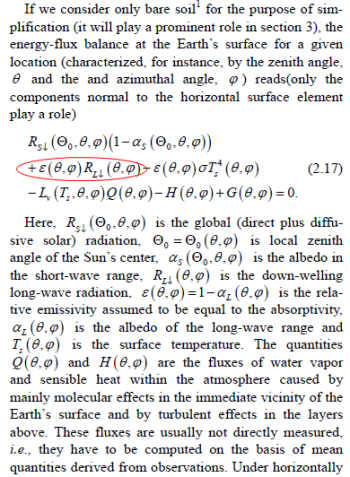
Figure 1
The highlighted term is the downward radiation from the atmosphere multiplied by the absorptivity of the earth’s surface (its ability to absorb the radiation). This downward radiation (DLR) has also become known as “back radiation”.
In simple terms, the energy balance of Kramm & Dlugi adds up the absorbed portions of the solar radiation and atmospheric longwave radiation and equates them to the emitted longwave radiation plus the latent and sensible heat.
So the temperature of the surface is determined by solar radiation and “back radiation” and both are treated equally. It is also determined of course by the latent and sensible heat flux. (And see note 1).
As so many people on blogs around the internet believe this idea violates the second law of thermodynamics I thought it would be helpful to these readers to let them know to put Kramm & Dlugi 2011 on their “wrong about the 2nd law” list.
Of course, many people “against the greenhouse thing” also – or alternatively – believe that “back radiation” is negligible. Yet Kramm & Dlugi reproduce the standard diagram from Trenberth, Fasullo & Kiehl (2009) and don’t make any claim about “back radiation” being different in value from this paper.
“Back radiation” is real, measurable and affects the temperature of the surface – clearly Kramm & Dlugi are AGW wolves in sheeps’ clothing!
I look forward to the forthcoming rebuttal by Gerlich & Tscheuschner.
In the followup article, Kramm & Dlugi On Dodging the “Greenhouse” Bullet, I will attempt to point out the actual items of consequence from their paper.
Further reading – Understanding Atmospheric Radiation and the “Greenhouse” Effect – Part One and New Theory Proves AGW Wrong!
Note 1 – The surface energy balance isn’t what ultimately determines the surface temperature. The actual inappropriately-named “greenhouse” effect is determined by:
- the effective emission height to space of outgoing longwave radiation which is determined by the opacity of the atmosphere (for example, due to increases in CO2 or water vapor)
- the temperature difference between the surface and the effective emission height which is determined by the lapse rate


 The Science of Doom
SoD.
Perhaps I’m mistaken but you seem to have asked your readers to examine this new paper but without providing a link.
So here it is (again?).
http://www.scirp.org/journal/PaperInformation.aspx?paperID=9233
Thanks, I have updated the article.
SoD
It would be helpful if the term “backradiation” was dropped.
Its unfortunate that the term is used even in the most up to date K&T energy budget diagram.
As you have confirmed in the past, the 333W/m2 flow contains energy contributions that have no origin in radiation from the Earth surface.
You indicated that the term downwelling long wavelength radiation is a more accurate description.
G&T have always said that colder objects radiate to warmer surfaces.
The idea that G&T thought otherwise stems from the deeply flawed Halpern et al paper.
What G&T dispute is the magnitude of such radiation and calling iall 333W/m2 backradiation gives them proof that their concerns are justified.
Bryan:
I got this idea about G&T from reading the G&T paper.
Can you identify where in the paper On Falsification Of The Atmospheric CO2 Greenhouse Effects they clarify:
a) that colder objects radiate to warmer surfaces
b) their views on the magnitude of this downward longwave radiation
SoD
There are several diagrams of objects radiating to one another.
For example Pages 17,20.
Radiation from the colder Earth in all directions including to the warmer Sun.
And different ways to calculate this radiation are all over the near 100pages
Comment on page 41 that atmospheric radiation is “only directed downward is rather obscure.”
Point 9 of page 91 and so on.
That someone reading G&T can come to the firm conclusion that they said that colder objects cannot radiate to warmer surfaces is very hard for me to understand.
Certainly nowhere in their paper have they said this.
Two way radiative transfer is standard physics which G&T certainly know.
One reason perhaps for non physicists to get confused by their writing is their correct insistence that heat cannot move spontaneously from a colder to a hotter surface.
If someone is confused about the difference between heat and radiation they can perhaps be left with the wrong impression.
Their paper was written for a Physics Journal where this is a point that should not have to be explained.
Joel Shore one of the authors now admits that they got their terminology mixed up on this very point.
G&T say very little about backradiation in their paper.
In their reply paper G&T comment some more on backradiation saying that they doubted the magnitude claimed for it.
Until 1879, Stefan was only the term of “thermal radiation” from warm to cool. When they had penetrated deeper into the laws of radiation, it became clear that the simple term “heat radiation” specifically the “net heat radiation” is. For the two components had to be invented new terms, which is a “back radiation” (from cool to warm), the other part (from warm to cool) has no generally accepted names.
Jochen Ebel,
Some people are terribly concerned that if the term “back radiation” is used the reality of the climate system might be lost.
The reality being that some of the radiation emitted by the atmosphere has been absorbed directly from the sun, whereas the balance has been absorbed from the earth’s surface (after previously being absorbed from the sun or from the atmosphere).
And so, if we call it “back radiation” then it might imply something that isn’t quite accurate to some people who don’t understand the subject and that would be upsetting for everyone.
Or something.
That is, it might imply the atmosphere is only radiating energy directly received from the earth’s surface, hence “back..”, rather than some from the sun and some from the atmosphere. And this is all part of the master plan of climate scientists to mislead people who will never read a textbook on atmospheric physics.
Or something.
I’m not sure whether I prefer the term downward longwave radiation (DLR) because it conveys a little more or because that was the term I first read in textbooks and papers.
They might be “terribly concerned”, but the concern still seems misplaced to me. After all: the other way to address it is to bring up a point that needs to be mentioned anyway: that the atmosphere absorbs very little radiated energy from the sun, since the incoming radiation is peaked in the yellow (didn’t you give a figure of less than 1% longwave?). It is only because that incoming energy is re-radiated from the earth’s surface at a much longer wavelength that we get GHG absorption in the atmosphere at all.
I am sure it is not news to you that people often miss this point: for energy coming in from the sun, the atmosphere is transparent. For energy going out to space, it is FAR from transparent. That is what makes the “greenhouse effect” possible in the first place.
Matt J says
” that the atmosphere absorbs very little radiated energy from the sun, since the incoming radiation is peaked in the yellow ”
I think you should look at the KT2008 energy budget diagram.
For every two Joules absorbed by surface one Joule is absorbed by atmosphere.
After albedo reflection the atmosphere absorbs a fraction 78/161 = 48% of the Earth surface absorption
Bryan, I think for your fraction you mean 78/239 = 33%.
SoD says
“Bryan, I think for your fraction you mean 78/239 = 33%.”
No I stand by my calculation based on KT2008
Amount absorbed by atmosphere/amount absorbed by earth surface
= 78/161 = 48%
Or to put it in English for every two Joules absorbed by Earth surface one Joule is absorbed by the atmosphere.
SoD
You asked:
“Can you identify where in the paper On Falsification Of The Atmospheric CO2 Greenhouse Effects they clarify:
a) that colder objects radiate to warmer surfaces
b) their views on the magnitude of this downward longwave radiation”
Let me quote the G & T paper (page 339):
The renowned German climatologist Rahmstorf has claimed that the greenhouse effect does not contradict the second law of thermodynamics:
“Some ‘sceptics’ state that the greenhouse effect cannot work since (according
to the second law of thermodynamics) no radiative energy can be
transferred from a colder body (the atmosphere) to a warmer one (the surface). However, the second law is not violated by the greenhouse effect,
of course, since, during the radiative exchange, in both directions the net
energy flows from the warmth to the cold.”
Then, G & T argued:
“Rahmstorf’s reference to the second law of thermodynamics is plainly wrong. The second law is a statement about heat, not about energy. Furthermore, the author introduces an obscure notion of “net energy flow.” The relevant quantity is the “net heat flow,” which, of course, is the sum of the upward and the downward heat flow within a fixed system, here the atmospheric system. It is inadmissible to apply the second law for the upward and downward heat separately redefining the thermodynamic system on the fly.”
All results of global energy budgets that can be found in the respective literature document that G & T are right. The so-called net radiation in the infrared range (IR) is directed upward, on global average, i.e., considerably more IR radiation is emitted by the Earth’s surface than by the atmosphere in downward.direction. Note that IR radiation is isotropically emitted.
In the 2nd law of thermodynamics the term
– 1/T^2 R grad(T) >= 0
occurs in the entropy source function. Here, R is the radiation flux, T is the abs. temperature, and grad means the gradient usually expressed by the del operator. The term is greater than or equal to zero. IR radiation must fulfill this condition. In case of solar radiation it is not so simple because one can focus solar radiation with an ice lens to burn, for instance, wooden material.
In subsection 3.5 of the G & T paper the basics of the transfer of IR radiation is considered. These basics are correct. If the source function in the radiative transfer equation is considered and expressed by the Planck function as justified by the papers of Einstein (1917) and Milne (1928) then the emission of IR radiation will depend on the temperature of the radiating gases like water vapor, carbon dioxide, ozone, and nitrous oxide.
In Fall 2007 I got a copy of the arXiv-version of the G & T paper. Prof. Dr. Akasofu asked me to express my opinion on this paper. I read it during the next couple of months and eventually started to defend it especially on dot.earth of the NYT. I know this paper well and I have the impression that most blogger who criticized it have never read this paper or are not well familiar with textbook knowledge.
If, as your post clearly implies, you think “1/T^2 R grad(T) >= 0” is “a term of the 2nd law of thermodynamics”, then you are the one who needs to review textbook thermodynamics.
If that is not what you really believe, then you really need to learn how to write. For that is what your post strictly implies.
As SoD has already shown, the G&T paper is full of severe methodological errors that in turn imply that the authors either do not know thermodynamics (especially of radiated energy) or are simply being dishonest.
SoD,
I strongly disagree that the greenhouse effect is inappropriately named. The confusion about this apparently results from believing that Wood in 1909 was correct and that the IR transparency of glazing of an horticultural greenhouse makes no difference to the internal temperature. This is simply wrong. As someone else put it, it might be approximately true for a greenhouse with very thin walls in a very windy climate. It is not true for a well insulated greenhouse.
Abbot doubted the validity of Wood’s results in 1909 and recent attempts to do similar experiments by Vaughan Pratt, Nasif Nahle and myself all show that a box painted black on the inside, covered with an LW (> 4μm wavelength) IR transparent window and oriented so that the bottom surface is normal to incoming solar radiation has a lower internal temperature than a similar box with an IR opaque window such as 2+mm thick glass, acrylic or polycarbonate. Note that Nahle’s experiment appears to give the same result as Wood, but his LW transparent windowed box has more insulation, ~1″ fiberglass, than his LW opaque windowed boxes which were only covered with Al foil. He shows later that the fiberglass insulation increases the box temperature by 10 C compared to a box covered only with Al foil.
The IR transparent windowed box also cools faster and reaches a lower internal temperature than a similar box with a glass window when exposed to a clear, cold night sky. The size of the effect is dependent on how well the boxes are insulated. A planetary atmosphere is effectively perfectly insulated from non-radiative heat loss. The basic physics are otherwise identical. Lowering emissivity, whether by using LW IR opaque windows in a greenhouse or adding IR absorbing gases to the atmosphere has exactly the same result, higher temperature.
The absorptivity of air is negligible in the Wood test. For heat transport (including the radiant heat transfer), a temperature difference is required (second law of thermodynamics). Since the convection in the interior is not stopped, the proportion of radiative transfer for the thermal equilibrium is negligible. Since the radiation transport is negligible, the fraction of absorption in air are even more. The lack of the Wood experiment shows itself in the use of only a thermometer. How will so the temperature difference measured in the test chamber?
But nevertheless, the term for both greenhouse is fit . The temperature increase inside the Wood experiment follows from the thermal resistance of the envelope, in the case of the atmosphere from the resistance of the radiant heat transfer in the air.
Not true. The absorptivity of air is not relevant. It’s the absorptivity of the window that’s important. Polyethylene film is nearly transparent for radiation with wavelengths greater than 4 μm while glass is nearly opaque. What you seem to be neglecting is that the glass window will be at a lower temperature than the radiating surfaces of the box. It must then radiate less and the temperature inside must go up. Radiative transfer is only negligible if the temperature difference between the inside of the box and the outside is small, i.e. really bad insulation.
But a simple wall has significant thermal insulating properties because of the stagnant film of air on each side. So in the absence of wind, the thermal resistivity of an uninsulated cardboard box is about 1 in imperial units ( R value ) or 0.18 K/(W/m²) in SI units. Even that is sufficient to produce a temperature difference inside the box of nearly 2 C between a box covered with polyethylene film window and a box covered with a glass window. With really good insulation (>6 inches of fiberglass batting), the internal temperature is about 80 C higher than ambient and the temperature difference between a box with an LW IR transparent window and a box with a glass window is >10C. ( http://i165.photobucket.com/albums/u43/gplracerx/heavilyinsulatedplasticboxes.jpg , channel 1 is ambient air, channel 2 is the polyethylene film windowed box and channel 3 is the glass windowed box ). That doesn’t look negligible to me. With multiple layers of LW IR opaque windows, the temperature goes up even more ( http://i165.photobucket.com/albums/u43/gplracerx/multilayerbox1.jpg )
This experiment is very similar to the toy model of a single slab gray atmosphere. The toy model is normally used in the limit of perfect thermal insulation, but it can be expanded to include finite heat loss to the surroundings and to the slab by conduction/convection and the numbers work out quite well.
DeWitt Payne
It looks like you have spent a lot of time on this project.
It would be a pity if you did not do a full write up with apparatus, diagrams, method, result and conclusion.
Until you do that you cannot expect us to “take your word for it”.
Your result contradicts Wood Nasif Nahle and this extensive project spread over a number of years .
It gives massive support for the conclusions of the famous Woods experiment.
Basically the project was to find if it made any sense to add Infra Red absorbers to polyethylene plastic for use in agricultural plastic greenhouses.
Polyethylene is IR transparent like the Rocksalt used in Woods Experiment.
The addition of IR absorbers to the plastic made it equivalent to “glass”
The results of the study show that( Page2 )
…”IR blocking films may occasionally raise night temperatures” (by less than 1.5C) “the trend does not seem to be consistent over time”
Click to access penn_state_plastic_study.pdf
Bryan,
I’ve already told you why the Penn State study is irrelevant. But I’ll do it again. The Penn State experiment was mainly looking at crop yields. Temperature is only one variable for crop yield. They were using high tunnel greenhouses, which means open ended, approximately hemispherical tunnels over moist ground. That is in no way comparable to Wood who used boxes with insulated walls.
It is no more and no less ‘my word’ than Nahle, Pratt, Roy Spencer or even Wood’s results. I’ve posted actual experimental data. I’ve posted pictures of the apparatus. In fact, you have far more details of all of the recent experiments than you do of Wood. I’ve even pointed specifically to the details of Nahle’s experiment that confirm they support the conclusion that Wood was wrong. Did you ever look at that? You could do the experiment yourself. All you need is some glue, a utility knife, a ruler, some half inch thick foam art board, black paint, aluminum foil, some food cling wrap, a piece of glass or plastic and a couple of thermometers. But you won’t because you might then have to admit that you were wrong about something.
Wood’s papers were contradicted at the time:
From Vaughan Pratt
For anyone else reading this, I think it would make a good Science Fair project.
DeWitt Payne says
“The Penn State experiment was mainly looking at crop yields. Temperature is only one variable for crop yield.”
Yes but Wood Nasif Nahle and yourself are also measuring temperatures so it is highly relevant.
I am only commenting on the measured temperatures.
Its beginning to sound like we will never see a proper write up of your experiments and that would be a pity.
If I had a full write up I would like to repeat your experiment.
Saying that one bit is like Wood and another bit like Nasif Nahle or Vaughan Pratt is just not good enough.
I’m thinking that the real test would be two identical boxes at night except that one has 6mm IR absorbing polyethylene and the other 6mm clear polyethylene
Bryan,
I’m nowhere near done and we’ve just had Christmas and New Years. Patience.
6mm is way too thick. Even unmodified polyethylene would be IR opaque at that thickness. 0.5 mil polyethylene only transmits about 90% of the incident thermal IR. You can tell because the apparent temperature of an object measured with an IR thermometer is lower when viewed through polyethylene film. Window glass is only 2.4 mm thick.
But I can do something very similar. I have some 1 mil ( 25.4 μm ) thick polyester film that absorbs much more strongly in the IR than polyethylene. That’s also very close to the thickness of the polyethylene film I’m using. I’ve done a quick and dirty experiment with polyethylene film and glass windowed boxes and the film covered box cools much faster to lower temperature than the glass covered box. For a single layer in the absence of wind, the thermal resistivity of the barrier, unless it’s something like aerogel, doesn’t make much difference. They’ve gutted the article on R value at Wikipedia or I’d reference it.
DeWitt Payne
I’m glad you are going to do a full write up.
It would seem a pity after all your efforts and it could be easily dismissed by critics.
The rigidity of 6mm polyethylene is a bonus and the two boxes being identical except for IR absorbing material eliminates unnecessary variables.
I note what you say about
“6mm is way too thick. Even unmodified polyethylene would be IR opaque at that thickness.”
I will look into this, but since all that is required is a differential between the two polyethylene types, it might still be possible.
Gerhard Kramm
On another thread SoD and I were exchanging views on your excellent new paper.
One thing about the equation2.17 that I would seek clarification on is the definition of Rs.
Do you mean the total incoming solar radiation?
To mention diffusive radiation here perhaps creates uncertainty coupled with the fact that Rs is then perhaps due to be corrected for reflection by albedo of around 0.3.
Gerhard Kramm,
Thanks for stopping by.
When I read the G&T paper I could see three choices for their obscurantist approach to explanation:
1) They didn’t understand atmospheric radiation despite their wonderful ability to perform double integrals and their ability to cite (but not solve) the radiative transfer equations – i.e., they didn’t believe the atmosphere radiated to the surface (or it couldn’t be calculated because it was too complicated – who would know after their amazing comments about all the things they claim are impossible to calculate even though they actually are in practice?)
2) They believed the atmosphere radiated to the surface but the energy disappeared, or was absorbed without affecting the surface temperature.
3) They actually believed that the presence of a radiatively-active atmosphere affected the surface temperature of the earth but were having a huge joke by pretending they didn’t.
Item 2 would mean they didn’t believe the first law of thermodynamics and I thought that was by far the least likely.
Item 3 is actually what I really thought but who would take the time to write such a paper knowing how many hundreds of thousands – or millions it would confuse? Not their problem if the readers haven’t studied physics? No, it seemed more charitable to assume good motives yet confused understanding.
So I was left with item 1.
Whether or not they intended it they have definitely assisted in convincing a large part of the internet world who don’t understand radiative heat transfer that:
i) cool objects don’t radiate towards hot objects, and/or
ii) hot objects can’t absorb the radiation from cool objects,
iii) if i) and ii) were possibly correct it couldn’t affect the temperature of the hotter object.
But nowhere in their paper have they clarified that cool objects radiate towards hotter objects, nor have they clarified that this energy is absorbed, nor have they clarified that the absorbed energy changes the internal energy of the hotter object.
Of course, these points are implied in the equations of radiative heat transfer – which is why I have to write articles like The Three Body Problem and especially Amazing Things we Find in Textbooks – The Real Second Law of Thermodynamics – and just check out the responses by the most enthusiastic advocate of G&T on that article and the many previous ones. See what great work they have done.
No doubt they will say “not our problem“. Up to them if they want to have a laugh. I appreciate a good joke, but I’d be ashamed if I had written a paper like that.
SoD
The dry adiabatic lapse rate formula is derived with no reference to radiation.
Hydrostatic equilibrium is the condition for the derivation of the formula.
In fact it does not even assume convection is taking place.
The still air atmosphere is called the neutral atmosphere.
It is often quite stable particularly at night.
So how then do we have a temperature profile given by?
DALR = -9.8K/km
It would appear then that a significant means of heat transfer is by diffusion for the neutral atmosphere.
So where is the radiation in the neutral atmosphere?
We need to remember the fact that the heat capacity of a gas(Cp) contains a lot of thermodynamics.
Many treat it as a constant and leave it at that but that is an gross oversimplification.
For instance the formula for the dry adiabatic lapse rate is given as
DALR = -g/Cp
Yet a moments consideration will tell you that the air contains CO2 with all its radiative properties.
These radiative properties are included in the bulk quantity Cp
If we examine how Cp changes with temperature for two different gases the point will become clearer.
A range of 250K to 350K will cover most atmospheric situations.
For Nitrogen (N2) the values vary by 0.2% i.e. almost constant
For CO2 the values vary by 13.1%
Why does CO2 change so much?
Because other degrees of freedom besides translational become possible for CO2 as the temperature changes.
These extra degrees of freedom correspond to the 4um and 15um thermal em wavelengths
Point being that if accurate values of Cp are used as the temperature changes then all the radiative effect are included!
IPCC advocates on the other hand want to deal separately with radiation forgetting that it has already been included in Cp.
This leads to double counting and the absurd greenhouse effect.
For air with a trace of CO2 the radiative effects are very small so there is a linear decrease in temperature with increasing altitude.
The DALR would be almost constant at -9.8K/km.
If the Earths atmosphere was 100% composed of CO2 then at;
300K …………..DALR = -11.6K/km
250K …………..DALR = -12.4K/km
So no longer a linear relationship as Cp is no longer constant but varies significantly with temperature.
For the adiabatic lapse rate:
This only occurs if the temperature gradient would be greater than the lapse rate without vertical circulation. This “bigger” is the drive for the vertical circulation. This vertical circulation reduced the temperature gradient due to convective heat transport to the adiabatic value. In fact, the observed lapse rate due to heat transfer and radiation differs somewhat from the ideal lapse rate, but this difference is very small because of the high mobility of the air.
Sorry so late with this, but radiation is implicit in the value chosen for surface temperature in the adiabatic lapse rate calculation.
The radiative properties (or radiation) is included (or implicit) in the bulk quantity Cp for an IR active gas at a particular temperature
Bryan,
You’ve missed the point again. Yes Cp does depend on T. But Tsurface is determined by the magnitude of the absorbed incoming radiative flux at the top of the atmosphere and the environmental lapse rate. If the Earth’s orbit were at a radius of 1.1 AU, it would be colder. If it were at 0.9 AU, it would be warmer.
Energy of electromagnetic radiation is not “implicit in Cp of atmospheric gases”. Electromagnetic radiation in equilibrium with its local environment has its own heat capacity but it’s very small (about 0.00000007 J/m3/K at the temperature of the lower atmosphere). Furthermore that energy is not significantly influenced by the properties of the gas except that interaction is needed to maintain even approximately the local thermodynamic equilibrium.
The radiative effects have thus nothing to do with Cp, they are important for the transfer of heat from one point in the atmosphere to another, for heat transfer between the surface and the atmosphere, and most importantly from the atmosphere to the space.
Cp of CO2 does vary with temperature, because the vibrational modes are discrete and get more important with increasing temperature, but this again has nothing to do with the role these vibrational modes have in interaction with radiation. They would influence Cp equally even if they would not interact with IR at all. Their influence on Cp is totally due to excitation and de-excitation of these modes through molecular collisions, radiation has no significant role in that.
De Witt Payne and Eli Rabett
Who says a volume of gas can only be heated by radiation?
Only radiation junkies I suppose!
Pekka Pirilä
“Their influence on Cp is totally due to excitation and de-excitation of these modes through molecular collisions, radiation has no significant role in that.”
Of course the vibrational modes can be excited/de-excited by collision but also by absorption/emission of (for instance) 15um radiation.
You appear to be saying that for CO2, radiation has no role in that!
Bryan,
The vibrational modes are essential for radiative processes, but the radiative processes have very little influence on the vibrational modes. Something like 99.99% of all excitations and de-excitations are due to collisions in troposphere. In addition radiation is usually not far from balance and thus even the minuscule role that it has in all transitions influences the balance even less.
Radiative transfers have a much more important role near the top of stratosphere and beyond, because collisions are so much more rare in the rarefied gas of those altitudes,
Pekka Pirilä
I don’t disagree with much that you say however it is not the full story.
Take a mole of CO2 (to make sure of macro events) and place it in an IR transparent enclosure at STP, surrounded by a vacuum in space at approximately zero Kelvin.
Then measure the emitted IR as the temperature drops.
I’m pretty sure that the IR readings would drop in a predictable and repeatable way.
So the IR radiational activity in an IR active gas at a particular temperature is implicit and inextricably linked to the bulk thermodynamic quantity Cp of the gas.
Bryan,
The emission from a small volume of gas that contains no other emitters of IR than CO2 is proportional to the CO2 concentration and the strength of emission depends on the temperature according to Planck’s formula. When the gas cools its emission decreases.
Nothing in the above is directly related to Cp.
I don’t claim that there isn’t any connection, but it’s rather roundabout. The connection comes from the fact that Planck’s formula contains a factor that’s proportional to the number of molecules in the excited state. That same number influences also Cp as the vibrational modes do increase significantly Cp only when their occupation level is not very low. The contribution of a vibrational mode to specific heat is proportional to the dependence of the occupation level on temperature, and that dependence is bound to be small as long as the whole level remains small.
Pekka,
Oh? The rate of temperature decrease depends on the heat capacity of the gas and the rate of energy loss. That would seem to be directly related to Cp. OTOH, Bryan’s example is irrelevant to the real atmosphere where, on average, there is little heating and cooling and the contribution from CO2 to the total heat capacity of a volume of the atmosphere is miniscule.
Bryan,
So there is some other significant source of energy to the Earth system than solar radiation? That would be news. You did read that I specified the absorbed solar radiation at the TOA, didn’t you? The only other source of energy that I know of would be geothermal from radioactive decay in the Earth’s core. That’s a very tiny fraction of the total.
Pekka,
I’ve discussed this at length with Bryan before. It didn’t seem to help. The symmetric stretch mode of CO2, for example, is not radiatively active because it doesn’t change the dipole moment. Of course at 300 K, it doesn’t contribute much to the heat capacity of CO2 either.
DeWitt,
I tried to state clearly that the rate of temperature decrease is affected by the power of energy loss and that this power is influenced by concentrations and (molecular) emissivities as well as the temperature.
The other factor, heat capacity or Cp, is basically a property of the substance (molecule in case of gas) and also influenced by the temperature.
The rate of temperature decrease is, of course, equal to net energy loss divided by the heat capacity.
—–
One more comment on why I referred to a small volume in one of the above messages. That was to restrict the comment to situations where absorption is always weak and no saturation of absorption occurs. Large enough isothermal volumes of gas are always black bodies but “large enough” is really huge for radiatively inactive gases like N2, and huge means here something much, much larger than the thickness of the Earth atmosphere. With the constitution of the Earth atmosphere the full thickness of the atmosphere would be almost enough, but the Earth atmosphere is not isothermal. At the center of the 15 µm peak a layer of 100 m is almost fully opaque and isothermal enough, but that applies only to that particular wavelength.
Pekka,
At the peak absorption for CO2 at 667.5 cm-1, 1 m is sufficient for transmittance nearly equal to zero at a volumetric mixing ratio of 0.00039 at 1013.25 mbar and a temperature of 296 K. For 100m, there is still observable structure in the band but the transmittance is less than 0.2 from ~650-680 cm-1 and zero from 666.5-670 cm-1 ( http://www.spectralcalc.com , you can do this sort of calculation for free.) For a 1 cm path length, the transmittance at the peak is about 0.96.
Indeed. Collision Induced Absorption is really weak for diatomic molecules. It does appear to be significant for water molecules. Although, as I remember, the attribution of the water vapor continuum absorption to CIA is still controversial.
SoD says
” i.e., they didn’t believe the atmosphere radiated to the surface”
Can you find even one passage is the G&T paper to support this absurd accusation?
If you cant criticize the actual paper don’t invent opinions for G&T ,
G&T’s publisher should be even more ashamed. A paper full of so much misinformation should never have been published in a “peer reviewed” journal. It does great damage to the credibilities not ust of the publisher, but of the reviewers, and even of the peer review process itself.
Matt J.
please write a comment on this paper of Gerlich and Tscheuschner (2009) if you are convinced that it is so bad. However, do me a favor and present a much better comment than that of Halpern et al. (2010). This comment is, indeed, so bad that iI will never understand why it was published. By the way, the 2009 version of Halpern et al. was rejected by the IJMPB. Eventually it was accepted, but the number of mistakes was nearly the same. The question is: Why?
Best regards
Gerhard
Maybe because the German editor was in bed with G&T and it took an appeal to the editorial board to go around the lad?
My take on the comment publication is rather Machiavellian.
Several of the Halpern et al crew had made disparaging attacks on IJMPB journal itself.
Impact factor and so on.
So what better than to publish the ‘comment ‘ paper (mistakes included) to let the World know of the quality of the critics.
Well, Eli hears that the original paper was submitted to Wolfgang whatever his name who Kramm canned it, and it took an appeal to the entire editorial board to get the thing published. Just saying. (PS G&Ts “reply” was even worse than the original) so no, you would be wrong.
SoD
G & T presented the formal solution of the radiative transfer equation for monochromatic intensity (see their Eq. (62)). This solution is independent of the form of the source function. To my best knowledge, this solution was first presented by Chandrasekhar.
This source function usually contains both emission and multiple scattering, i.e., scattering of radiation into the path of the pencil of radiation. In case of IR radiation the latter plays only a role if small ice crystals are considered. Thus, in case of IR radiation the source function is substituted by the Planck function (strictly spoken by the Kirchhoff-Planck function). Even though single scattering and multiple scattering are negligible in such a case, the formal solution can only be finally solved numerically because the distribution of temperature and various traces species have to be considered.
Furthermore, the formal solution has to be formulated in such a sense that the boundary conditions at the bottom and the top of the atmosphere can be addressed. In case of the approximation for the so-called plane-parallel atmosphere it results in two solutions for the upward and the downward directed intensities (e.g., Liou, 2002).
Moreover, the integrations over all frequencies (alternatively wavelengths) have to be performed to obtain the total intensities,and in a further step, the radiative fluxes, There are several ways to perform these integrations because gases emit and absorb only in bands or even in lines (see Petty Grant’s comment or his book on radiation), where also line broadening has to be considered. Unfortunately, there are also overlapping effects.
Nevertheless, to predict the temperature change with respect to time, not the magnitude of the radiative flux is important, but the divergence of the radiative flux. A lot of bloggers do not understand this.
Best regards
Gerhard
The radiation transport equation is only superficially a calculation of the radiation at a given temperature. If only radiant heat transfer, the radiative transfer equation yields a reversed to a temperature profile.
The surface boundary condition is incorrect. The two boundary conditions are:
– Infrared radiation from space = 0
– Radiation into space = absorbed solar radiation.
The temperature at the surface then occurs so that the two conditions are met. If the adiabatic limit would be exceeded at a hypothetical quiescent atmosphere, then outcome convection. Therefore is necessary, inclusion of the convection into the solution of the temperature profile.
In steady state, the divergence of the radiation flux is zero. But the temperature profile is stationary so, that the divergence of radiation flux at this temperature profile is zero. The reversal of cause and effect is just to mislead.
Jochen Ebel:
The first boundary condition is correct and allows calculation of the downward radiation through the atmosphere.
But the second boundary condition you cite is not correct.
Across the long term globally radiation into space = absorbed solar radiation, assuming no heating or cooling of the climate.
But for a given location and time this is not even close to accurate and so the boundary condition for upward radiation is the emission of thermal radiation from the surface.
If the temperature profile of the atmosphere is accurately known this provides the required information to calculate the solution.
If the temperature profile of the atmosphere is not known then a convective model provides a useful estimate.
I don’t understand what you are saying here. What reversal of cause and effect?
I can’t see anything wrong with Gerhard Kramm’s statement above.
Professor Kramm: Thanks for taking the time to comment at this site. Your paper (and the G&T papers which preceded it) tell us that many commonplace descriptions of the greenhouse effect are flawed or inaccurate, at least partially because averaging over the surface of a whole planet or moon introduces large errors. Your information about the temperature of the moon’s surface was startling. It’s obvious that this retired PdD chemist reads in many places is over-simplified or wrong.
Your paper tells us things that are wrong, but doesn’t tell us what is right. Calculus was flawed until a proper definition for limits was created centuries after Newton. There [apparently] are still controversies over how to interpret the meaning of wave functions in quantum mechanics. Both calculus and quantum mechanics give/gave useful results despite these problems. Is the convention explanation for the greenhouse effect “useful” despite the problems you describe?
I’d like to propose a thought experiment that might clarify whether the greenhouse effect is useful a useful concept. Suppose GHG molecules could sense the direction of the earth’s gravitation field and always emitted photons “away” from the earth. (Same emission rate, same anisotropy of emission except for changing sign of the vertical component of those that would normally head downward, maintain the same probability and anisotropy of absorption, leave the number and location of water molecule unchanged.) This would eliminate downward long wavelength radiation from the atmosphere to the surface of the earth – the essence of the greenhouse effect* – but minimally change little else. 1) What would happen to the temperature of the surface of the earth? 2) If there were a change in surface temperature, does the magnitude of this change depend on the total number of GHG molecules in the atmosphere?
* I think the essence of the greenhouse effect is that GHG molecules obstruct (by absorption, emission and scattering) the NET outward flux of radiation from the earth (more than they obstruct the downward flux from the sun).
SOD wrote about G&T: “But nowhere in their paper have they clarified that cool objects radiate towards hotter objects, nor have they clarified that this energy is absorbed, nor have they clarified that the absorbed energy changes the internal energy of the hotter object.”
The internal energy [of the surface of the earth] won’t change if an increase in convection removes it. In 1D models of radiative-convective equilibrium (not necessarily the real world), convection has reduced the steepness of the lapse rate to the maximum compatible with stability. Under these equilibrium circumstances, DLR won’t raise surface temperatures above the temperature determined by the lapse rate, the altitude of the critical emission level and incoming solar radiation reaching the surface and lower atmosphere. The greenhouse effect would only operate where convection is not needed to prevent development of an unstable lapse rate.
Unfortunately, I have can’t to express this concept in the context of the 2LoT.
I clarified this a little more in point iii) of my comment of January 5, 2012 at 8:50 am.
Extract: “..1J absorbed from a colder body has exactly the same effect on internal energy as 1J absorbed from a hotter body – there is absolutely no distinction. Radiation absorbed from cool bodies by hotter bodies slows down the rate of heat loss from the hotter body because more radiation is transferred in the other direction.“
Your statement – “Lowering emissivity, whether by using LW IR opaque windows in a greenhouse or adding IR absorbing gases to the atmosphere has exactly the same result, higher temperature.” – holds only in case of constant gas pressure wiithin the volume considered.
However,this condition does not apply for the Earth´s atmosphere..Therefore no “back radiation” could be generated by absorbing/emitting gases.
Back radiation – as observed – is being emitted from water, ice or other aerosols exclusively.
“holds only in the case of constant gas pressure” — why would this be the case? How can you exclude, for example, that the temperature rise still occurs even when the pressure is not constant because, for example, the volume does NOT also rise by enough to offset the increased heat and pressure?
Matt 3.
Sorry, I should not have used the word pressure but “gas density”, which reduces to zero with increasing altitude thus creating an Anisotrophy of the mean free paa of radiation interacting witth absorbing/emitting gases.
As a result radiation emitted at the Earth´s surface keeps its general direction into space. LW radiation towards the surface however is being returned into space or will be absorbed in liquid or solid matter.
This phenomena, not being recognized, leeds to the present misinterpretation of spectra and the actual back radiation caused by liquid and solid matter alone.
u. Wolff:
Take a look at The Amazing Case of “Back Radiation” – Part Two where you can see the spectra of DLR or “back radiation”.
Radiation from the atmosphere depends on the amount of each type of radiatively-active gas, the temperature profile through the atmosphere, and the strength of each spectral line of each gas. And of course the Planck function.
Your statement claiming that no back radiation can be generated by absorbing/emitting gases in the Earth’s atmosphere is incorrect. It does not follow from your preceding statements.
You can see the equations of radiative transfer – absorption and emission – in Atmospheric Radiation and the “Greenhouse” Effect – Part Six.
SoD. The spectral measurements are misinterpreted.
My previous statement adresses the Anisotrophy of the mean free path of relevant LW radiation as a consequence of the gas density reduction towards space,
Therefore LW radiation emitted at the earth´s surface and reacting with absorbing gases will keep its general direction towards space if not scattered into water, ice or other aerosols.
The direction of respective LW radiation emitted by water, ice and other aerosols towards the earth´s surface and interacting with absorbing gases against increasing gas density will be reveversed.
These effects – well known in nuclear technology – are neglected as well as the influence of particle size of liquid and solid matter on the energy fluxes including the Earth´s albedo.
Therefrore your recomendation lacks relevancy.
u. Wolff:
Are you saying gases like CO2, water vapor and methane at atmospheric temperatures (210-300K) don’t emit longwave radiation?
But these gases do absorb longwave radiation?
How is the spectra of DLR for Antarctica misinterpreted? That big peak at 15um matching the emission spectra of CO2 for that temperature.
u. Wolff:
SoD stated :. “Are you saying gases like CO2, water vapor and methane at atmospheric temperatures (210-300K) don’t emit longwave radiation?
But these gases do absorb longwave radiation?
How is the spectra of DLR for Antarctica misinterpreted? That big peak at 15um matching the emission spectra of CO2 for that temperature.”
The reply:The gases CO2, water vapor and methane absorb and emit longwave radiation!
The spectra of DLR for Antarstica are misinterpeted, ignoring the strong influenze of the Anisotrophy of the mean free path on the direction of radiation flow in the atmosphere.
In an attempt to underständ “that big peak at 15um” you have to recognize
that outgoing radiation of that wavelength is (nearly completely) beiong absorbed in solid and liquid matter, whereas radiation emitted by that matter towards the Earth´s surface will be “back radiated” towards space.
.
I think there is an easier way to see this without ploughing through all the details of radiative transfer. That is: Wolff’s argument proves only that the “general direction” of radiative flow is outward to space. But that is not as much as he thinks it is. By no means does it prove the total flow is outwards. So we can still say that the general direction if outwards, but some does flow back. That would be the “back radiation”.
Now where this simpler explanation runs into trouble is: some people give figures for this back radiation that is even higher than energy coming in! This, though, is simply poor exposition going all the way back to Trenberth’s famous diagram, which really does make it look like more energy is being radiated from the sky back to earth than coming in from the Sun, and is an aspect of his diagram I have never seen explained well.
Matt J. says
“Trenberth’s famous diagram, which really does make it look like more energy is being radiated from the sky back to earth than coming in from the Sun”
Strangely enough this aspect does not concern me.
There are many physical oscillating systems like;
A tuned parallel LC circuit
Or more simply a child on a swing
Where the make up energy from the supply is a lot less than the energy circulating in the system.
What is required is storage mechanisms within the system.
Page 982 of the Kramm & Dlugi paper shows such a viable system.
Does a greenhouse gas model do the same?
DeWitt Payne
Your statement – “Lowering emissivity, whether by using LW IR opaque windows in a greenhouse or adding IR absorbing gases to the atmosphere has exactly the same result, higher temperature.” – holds only in case of constant gas pressure wiithin the volume considered.
However,this condition does not apply for the Earth´s atmosphere..Therefore no “back radiation” could be generated by absorbing/emitting gases.
Back radiation – as observed – is being emitted from water, ice or other aerosols exclusively.
If downwelling IR radiation were being emitted by solids or liquids in the atmosphere, then it would not have the structure observed for clear sky radiation. That structure can be reproduced with high precision using line-by-line radiative transfer models like LBLRTM and with good precision with moderate resolution band models like MODTRAN. The spectra of cloudy skies has the Planck spectrum. The spectra of clear skies does not.
[…] Comments « Kramm & Dlugi On Illuminating the Confusion of the Unclear […]
SOD
Sorry if this is a bit off topic
1 if the atmosphere of a planet were 100% non-GHG would there be radiation from the conductively warmed atmosphere? I know that BB radiation would be emitted from the planet surface, but not intercepted by the atmosphere and therefore lost directly to space.
Do ALL bodies above 0K radiate? therefore does e.g. O2 / N2 radiate?
2 Why is the DALR so important to every body in this discussion as it only refers to an artificial situation where a parcel of air moved between gravity generated pressure differences (with no interchange of energy). When the parcel is static there is nothing to maintain the temp difference and thermal mixing will occur leading to uniform temperature with altitude – (if this were not the case free energy could be extracted from the column!). Also, to maintain number of molecules at each altitude what goes up must come down! So energy transfer is minimal (zero).
Surely the only relevant lapse rate is the environmental lapse rate (a very variable -6.5K/km). This is used to explain why a mountain top is cooler than a valley (by claiming the proximity of the temperature source (the ground) is more distant at the top). This does not reference pressure differences in the literature I have seen. But what happens with a vast plateau at 1km altitude – will this be 6.5K cooler than the sea level land? If so why?
thefordprefect:
1. Negligible radiation from the conductively-warmed atmosphere from O2 and N2.
You can see the comparison of the strength of the spectral lines for different gases at The Amazing Case of “Back Radiation” – Part Two under the subheading Properties of Gases – Absorption and Emission. Perhaps someone somewhere has worked out what a column of an N2/O2 atmosphere at current temperatures would emit. Maybe 1 mW/m2? I’m guessing.
2. The DALR is one piece of the puzzle. Equally important is the moist adiabatic lapse rate, which is variable depending on the amount of moisture and the temperature.
The relevant lapse rate is – as you say – the actual lapse rate. But the theory around dry and moist adiabatic lapse rate is what helps explain the environmental lapse rate.
The vast plateau at 1km altitude – will it be 6.5K cooler than sea level ? – sounds like the kind of question that could occupy a discussion panel for a long time. It depends on all kinds of factors.
thefordprefect:
If higher temperature molecules move up and lower temperature molecules move down you have conservation of mass. And you have conservation of energy.
But you don’t have constant energy vs height.
In fact, what happens when convection takes place – say with a heated plate at the bottom of a water tank – is that warmer water moves up and colder water moves down.
This redistributes energy.
Here is a nice page with video link showing an experiment on this topic. There are other great videos via links at the top of this page. It accompanies the excellent Marshall & Plumb (2008) textbook.
Thanks for that …. BUT!!
at 10k metres the temp is set by the lapse rate and the temp at 0m
so a parcel of air moving from 0 to 10km will loose thermal energy and gain potential enregy ending up at the same temp as the other stuff at 10km
an in reverse from 10km to 0m so unless you assume that the parcel is heated without heating the other parcels no heat will be transported..
I assumed that if a 100% insulated row of air were suddenly turned to a column of air then the lower air would be compressed and heated and the upper rarified air would cool to maintain energy balance.( low air high T but low potential energy; high air low T but high potential energy) This would give the adiabatic lapse rate. But then will not the air mix to eventually give a uniform temperature? But then you have medium temp with high potential energy and medium temp with low potential energy. Thi9s seems wrong?
Also I know you have said that N2 and O2 do not emit radiation but what is the difference between a gas and a solid when it comes tho blackbody radiation. – Most books talk about all matter above 0K emitting BBradiation. So why not non GHGs. I KNOW that no narrow emissions from non-GHGs will occur – non is captured and none is emitted. But non GHGs can be warm, they are matter, so do the not radiate over the usual BB spectrum?
I just cannot find and definitive statement that says gasses do not have a black body radiation!
of interest:
Click to access 03_abs_emiss_ref.pdf
The physics of atmospheres By John Theodore Houghton
preview:
http://books.google.co.uk/books?id=K9wGHim2DXwC&printsec=frontcover&dq=%22The+physics+of+atmospheres+By+John+Theodore+Houghton%22&hl=en&sa=X&ei=eeEHT9LGMseo8QPrlayJCA&ved=0CDUQuwUwAA#v=onepage&q=%22The%20physics%20of%20atmospheres%20By%20John%20Theodore%20Houghton%22&f=false
thefordprefect:
My point (about movement of fluids of different temperatures) was to clear up something that can cause confusion.
If the environmental lapse rate matches the adiabatic lapse rate for the parcel of air then you are (kind of) correct.
There is always potential for confusion with the sign of lapse rates and what “greater than”, “less than” means in this context, so I will first work by way of example.
If the environmental temperature drops by 6K/km and the adiabatic lapse rate is a reduction of 10K/km then the atmosphere is stable to convection. This means that a parcel displaced vertically will have a restoring force back to its original location. This is true right up to the point where the environmental temperature drops by 10K/km. So convection won’t happen. So the question about movement of energy is not relevant.
If the lapse rate of the parcel is greater than the lapse rate of the environment (e.g., lapse rate of the parcel is -4K/km due to the moisture content and temperature while environmental lapse rate is -6K/km) then convection takes place because a displaced parcel experiences a continued force in the direction of motion.
In this case the change in temperature of the parcel is, by definition, not the same as the change in temperature of the environment and so energy has moved location. (The vertical profile of energy has changed).
Does this make sense?
thefordprefect:
Many people have asked the same or similar question so I will try and write an article about it soon.
But in brief, pending my article, liquids and solids are quite different but don’t anyway emit as a blackbody (emissivity = 1 over all wavelengths). Instead solids and liquids tend to have continuous emission of radiation with non-unity emissivity.
Gases are different. They have lines of absorption and emission at specific energies. These lines are broadened by “natural line broadening” due to the uncertainty principle, and more importantly by Doppler and Pressure (collisional) broadening. See Understanding Atmospheric Radiation and the “Greenhouse” Effect – Part Nine for a little on the energy changes for absorption/emission and the broadening mechanisms.
Here’s a little thought.
(using broad band radiation to indicate a coloured form of black body radiation)
Most people say broad band radiation occurs from all “stuff” above 0K temperature. But what is the difference between solid and gaseous stuff. E.G. take solid CO2. I would assume this gives broadband radiation as the temp is above 0K and it is a solid. This heats a bit and sublimates to CO2 gas. Now all of a sudden it only radiates at certain frequencies – why? Is the total radiation the same in gas/solid cases.
Liquid nitrogen is similar. I assume BBradiation when a liquid(?) but then on turning to gas NO radiation will be emitted.
Just does not sound logical – but then I’m no physicist!
TFP,
To get IR emission you need a resonant frequency in the force fields linking atoms. Solids and liquids have complex interacting forces between molecules. Gases don’t. It comes down to the oscillations excited on discrete collisions. Symmetric diatomic molecules have only one mode, stretching, and its frequency is not in the IR range. They are too stiff. Polyatomic noledules have bending modes etc.
Nick,
It’s not that the frequency of the stretch mode is too high for diatomic molecules, the key is the symmetry. You need a change in the dipole moment with the stretch. You don’t get that with symmetric molecules, at least for the electric dipole moment. In fact, the vibrational level of nitrogen is quite close to the asymmetric stretch vibrational level of CO2 at 2349 cm-1 needed for a CO2 laser at ~10 μm. That’s why N2 is part of the gas mixture for CO2 lasers. The laser transition is either to the second bending level which gives a laser wavelength of 9.4 μm or to the first symmetric stretch level at 1388 cm-1 which gives a laser wavelength of 10.4 μm.
CO has bands at 1948 – 2028 cm-1, 2028 – 2218 cm-1 and 2218 – 2278 cm-1 which puts it barely in the thermal IR. NO has bands at 1700 – 1770 cm-1 and 1770 – 1977 cm-1
Gerhard Kramm:
I would really appreciate it if you can confirm that the points made above, reproduced here below (in reverse), are correct.
You will assist the multitudes of confused people who read blogs but not textbooks and have become convinced that by definition atmospheric radiation either does not exist or cannot affect the surface temperature of the earth.
I am trying to avoid very formal statements and equations because this just confuses a lot of people.
————
i) cool objects do radiate towards hot objects
ii) hot objects can and do absorb the radiation from cool objects (Note 1)
iii) radiation absorbed from cooler objects by hotter objects affects the internal energy of the body, and therefore, usually the temperature. 1J absorbed from a colder body has exactly the same effect on internal energy as 1J absorbed from a hotter body – there is absolutely no distinction. Radiation absorbed from cool bodies by hotter bodies slows down the rate of heat loss from the hotter body because more radiation is transferred in the other direction.
Note 1: The proportion of radiation absorbed is a function of the absorptivity of the receiving body and of the geometry (the view factor).
And absorptivity is a material property which depends on wavelength and direction.
scienceofdoom on January 5, 2012 at 8:22 am
The first and second boundary condition are given non-local (the first, however, already), but globally. This places even on Kramm fixed Page 992: “We share Fortak’s [31] argument that the outgoing emission of infrared radiation only serves to maintain the radiative equilibrium at the TOA (see Eq.4.1).“
„If the temperature profile of the atmosphere is accurately known this provides the required information to calculate the solution.” The solutions cause themselves mutually. The integral of the change of the energy fluxes must be zero. Especially without further energy flows are only for the radiation fluxes must be the integral over all wavelengths and angles zero.
“If not the temperature profile of the atmosphere is known then a convective model provides a useful estimate.” It’s not enough, because the change in the tropopause from a pure convective model is not visible.
“I do not understand what you are saying here. What reversal of cause and effect?” By changing the concentration of greenhouse gases is at first the divergence is not zero, but only by changing the temperature profile, it comes back to the divergence is zero. The zero point of divergence is likely to believe that there can be no change in temperature, or words to warming are wrong. For even in places with radiative equilibrium occurs at a higher concentration of greenhouse gases to cool.
u. Wolff,
Apparently you don’t understand the physics of absorption and emission of radiation by molecular gases. I highly recommend Grant Petty’s book “A First Course in Atmospheric Radiation”. It’s available from the publisher http://www.sundogpublishing.com/shop/a-first-course-in-atmospheric-radiation-2nd-ed/
A photon that is absorbed does not retain its direction. It’s absorbed. It no longer exists. When an excited molecule, which is almost never the same as the absorbing molecule, emits, the emission direction is completely random. It’s (almost) equally likely to be upward to space or downward to the surface. Almost, because the geometry is spherical so upward is very slightly more probable than downward. The reason that it is almost never the same molecule that emits is because collisional energy transfer is several orders of magnitude more likely than radiative energy transfer for an excited molecule. This condition is called local thermal equilibrium and is required for Kirchhoff’s Law (emissivity = absorptivity) to be applicable. It’s valid to at least 30 km altitude for most gases and even higher for CO2 (> 90 km).
Dewitt Payne,
Apparently you don´t understand the facts, I referred to:
A multitude of emissions is called isotrop, if all angles are equally probable. This applies more or less to the LW emission of molecules we are talking about here.
Wiithin the Atmosphere the average distance to the next absorbing molecule is increasing with decreasing gas density (towards space), it is decreasing mith increasing gas density (towards the Earth´surface)
Therefore the mean free pass of “photons” becomes anisotropic,
As a result the direction of radiation (or energy) flow will behave according to my previous explanation:
LW radiation emitted from the Earth´surface will pass these absorbing gases, whereas LW radiation towards the suirface will be “back radiated” towards space.
This behaviour is well known at least in Physics applied in the field of nuclear technology. Therefore the “CO2-water vapor-green-house effect” should be filed under “—-“! [Moderator’s note – Please read The Etiquette]
Why will it pass those absorbing molecules? Does the Beer-Lambert Law not apply to the atmosphere?
For clear sky US 1976 standard atmosphere, only about 15% of the radiation leaving the surface is transmitted directly to space. The rest is absorbed. In the frequency range 640-690 cm-1 effectively 100% is absorbed by CO2 molecules within 300 m. That means looking up in that frequency range, the atmosphere is effectively a black body at very close to the temperature of the surface. And that’s just for CO2. Most of the absorption and emission is caused by water vapor. At 15 C and 75% relative humidity, water vapor absorbs 100% of radiation in the range 0-400 cm-1 and 100% of LW radiation with frequencies greater than 1400 cm-1 and a lot of what’s in between. And that’s just for a path length of 500 m. Add in CO2, methane, nitrous oxide and the other ghg’s and quite a bit of the energy emitted by the surface is absorbed within 500 m of the surface. Since absorptivity = emissivity at local thermal equilibrium, the atmosphere will appear to be a black body at those frequencies and emit according to the Planck function. That radiation will reach the surface for the same reason as the radiation from the surface is absorbed.
You can hand wave all you want about anisotropy, but it isn’t relevant over that short of a distance. Yes, it does mean there will be a net flow of radiation outward, but most of that radiation will originate at altitudes much higher than the surface. At 667 cm-1, the effective emission altitude to space is greater than 30 km. At the surface looking up , it’s ~20 cm.
@ DeWitt Payne January 5, 2012 at 3:10 pm
DeWitt Payne times have you estimated temperature difference, when about 300 W / m² should be transferred between two black bodies? Between the window and the absorber area see Gerlich (http://arxiv.org/abs/0707.1161 page 30 table 9). The car interior is a kind of Wood-chamber. The convection inside the measuring chamber plays the main role.
Convection and conduction play a role in the interior of the car because the body is opaque to LW IR and the windows are nearly opaque. But not the sole role. The interior surface that absorbs the solar radiation will be hotter than the air in the car. That surface will radiate and that radiation will be absorbed by the interior surfaces not directly exposed. So those surface will be warmer than they would be if convection were the only means of heat transfer inside the car. Most of the convection will occur as the interior of the car is warming. There won’t be much interior convection when steady state is reached. The exterior of the car also radiates according to its temperature, which will be higher than the ambient temperature. If the windows were LW IR transparent, the interior of the car would still be hotter than ambient, but lower than a similar car with LW IR opaque windows because some of the radiation from the interior surfaces will be transmitted outside the car rather than being absorbed by the windows.
Think about a home oven with a window in the door. Do you really think that if the window were transparent in the thermal IR but still had the same thermal resistivity as an IR opaque window that it would require the same amount of power to maintain a steady temperature as an oven with a window that is LW IR opaque?
Let us assume that the incident on the absorber solar radiation would be 300W / m² and the inner surface of the car would 30°C (303K) – then would then in steady state, the absorber surface assume a temperature of 342K (69°C) when the radiation only after a page is done (other side insulated). The incident radiation in the sun is even higher (approximately 700W / m²). Since the temperature of the absorber would have 380K (107 ° C) reach. If the bodies are not perfect black, the temperatures are even higher.
These temperatures are not nearly reached. Since there is no magic, lower temperatures are possible only with a high proportion of non-radiative heat transfer. Because poorly heat-conducting materials are used, the non-radiative heat transfer within the chamber can be done mainly by convection.
Jochen Ebel,
Sure they are if the insulation is good enough and even higher if there are multiple layers of IR absorbing material. Direct normal solar insolation at local noon is more like 1000 W/m² than 700.
See this graph from a box with heavily insulated walls and three layers of IR absorbing windows: http://i165.photobucket.com/albums/u43/gplracerx/multilayerbox1.jpg
Temperatures are in degrees C measured with exposed bead type K thermocouples
Channel 1 ambient air
Channel 2 bottom surface perpendicular to incident solar radiation
Channel 4 2.4mm glass ~3 inches above and parallel to the bottom surface
Channel 5 2mm clear polycarbonate ~3 inches above and parallel to the glass window
Channel 6 2mm clear acrylic ~3 inches above and parallel to the polycarbonate
That experiment didn’t run long enough to reach steady state. A later experiment had a bottom surface temperature greater than 170 C.
This graph is for boxes with a single layer window with heavily insulated walls:
In this case, the box temperature is the air temperature ~1 inch above the bottom surface with that surface oriented perpendicular to incident solar radiation. The temperature of the bottom surface would be higher.
Channel 1 ambient air
Channel 2 0.8 mil polyethylene shrink wrap windowed box air temperature
Channel 3 2.4mm glass windowed box air temperature.
DeWitt Payne,
Apparently it is You, who is missing the point:
The spatiol distribution directions of emissions of “potons) are more or less isotgropic. /The space angle of 360 degree.)
Not so the distribution of distances to next absorptions in the atmosphere, where the gas density varies between a maximum to zero.
Therefore the probality for radiation emitted at the surface to return to its origin is essentially zero.
The same holds for the probality for any radiation being emitted by liquid or solid matter in the atmosphere to reach the surface of the earth against increasing gas density.
Ignoring this effect in the construction of the CO2-water vapor-greenhouse-effekt removes its foundation. Back radiation does not origin from gas atoms!
Therefore the recommended literature is of rather limited use.
Correction:
DeWitt Payne,
Apparently it is You, who is missing the point:
The spatial distribution of directions of emitted “potons” is more or less isotropic. /into the space angle of 360 degree.)
Not so the distribution of distances to next absorptions in the atmosphere where the gas density varies between a maximum to zero.
Therefore the probality for radiation emitted at the surface to return to its origin is essentially zero.
The same holds for the probality for any radiation being emitted by liquid or solid matter in the atmosphere to reach the surface of the earth against increasing gas density.
Ignoring this effect in the construction of the CO2-water vapor-greenhouse-effekt removes its foundation. Back radiation does not origin from gas atoms!
Therefore the recommended literature is of rather limited use.
Therefore the probality for radiation emitted at the surface to return to its origin is essentially zero.
That’s correct, but for the wrong reason. Reflection or scattering of LW IR radiation by anything in the atmosphere can usually be neglected. Small ice crystals in cirrus clouds do have some reflectivity in the LW IR, though.
Are you seriously arguing that none of the radiation emitted by CO2 molecules a few cm above the surface can reach said surface? The mean free path of CO2 at the peak emission of 667 cm-1 is on the order of 20 cm at 390 ppmv and 1013hPa. All the rest of the radiation in the band has a much longer mean free path. Atmospheric pressure simply doesn’t drop fast enough for your hypothesis to be true. Approximately 90% of the radiation from the atmosphere seen by the surface originates within 500 m of the surface. At that point the pressure has only dropped about 5%.
So the fact that an inexpensive handheld IR thermometer ( Actron CP7876 for example ) pointed at a cloud covered sky reads about the same temperature as the surface (or at all) while the apparent temperature of a clear sky for the same surface temperature is much lower is just some sort of magical artifact? Or the fact that the reading from an IR thermometer straight upwards can be correlated with column total precipitable water ( http://journals.ametsoc.org/doi/pdf/10.1175/2011BAMS3215.1 ) is also caused by something other than the emission of IR radiation by water vapor in the air above the thermometer?
Get a clue!
DeWitt Paine,
“Therefore the probality for radiation emitted at the surface to return to its origin is essentially zero.”
“The same holds for the probality for any radiation being emitted by liquid or solid matter in the atmosphere to reach the surface of the earth against increasing gas density.”
“LW radiation emitted from the Earth´surface will pass these absorbing gases, whereas LW radiation towards the suirface will be “back radiated” towards space.”
Please recognize the following facts:
1. , The mean free path is increasing with altitude from a minimum value at the highest gas density towards “infinty” when the gas density is approaching zero..
2. Visible clouds are not transparent for LW radiation discussed here. (1 kg of water or ice contained in 10 000 kg air over one square meter of the surface have an absorbing surface between 3 – 3000 square meter depending on particle diameters varying between 1 – 0,01 mm)
3. Absorbing gases “back radiate” only distinct wave lengths. Therefore your instrument will register a big fraction of the LW radiation emitted by liquoid and solid matter in the atmosphere. Such gases act as selective filters.
4. The probabilty for “photons” to be “back radiated” to the surface folowing an interaction with absorbing gases decaqys strongly with increasing altitude. Morning fog ist more efficient by ordes of magnitude !!
5. Consider that the intgeraction of solar radtiaon with ilquid and solid matter in clouds and at ocean surfaces is mainly determining the Earth´s albedo, The interaction with LW radiation ist considerably mor efficient. I recommend a look into “geometrical Optics”.
6. As a consequence of the anisotrpy of the mean free pass of “photons” belonging to the “reactable” fraction of LW radiation emtitted at the surface, of the earth these photons are “forwarded” towards space, The bigger fraction is being “scattered” into liquid and solid matter. Als long as these effects are being ignored, the numenbers you quoted lack justification.
SOD: When criticizing G&T and now Kramm for some aspects of their papers, we should realize that it would be nearly impossible to get any aspect of their work on the greenhouse effect published – even if it were mostly correct – in the same journals as your favorite papers by Ramanathan. A successful scientific journal really can’t stand up to the threat that prominent scientists might promote a boycott of their journal and the Climategate emails certainly show that such boycotts were threatened and editors have resigned after skeptical papers were published. Perhaps (probably?) I exaggerate, but it would be unreasonable to deny that skeptics could BELIEVE that this is the situation they face.
What Kramm (and possible G&T) appear to have done is slip their ideas into journals that publish articles of general interest to the physics community. Reading Kramm carefully, I found only about a couple of paragraphs in the main text that directly contradict the IPCC consensus. Kramm didn’t need 25 pages and Milankovitch cycles to present controversial ideas about the greenhouse effect, but they wouldn’t get published in a general-interest journal without most of it. Even worse, the more completely they describe what and why they disagree with the consensus, the more likely the article will be found to be diverted to a specialist journal and die from “gatekeeping”. I hated every moment of struggling through all the extraneous material to try to understand a few vague dense passages contradicting the consensus, but perhaps it was necessary
IMO, this strategy makes for lousy publications and risks inadequate review and revision of the most important content. But this is the only way I’ll learn that observations of the Moon’s mean surface temperature don’t agree with the methods I understand for calculating the earth’s surface temperature without GHGs. Unfortunately, when I reread the Hoovering Incident post so I can blame SOD for the fallacies I picked up somewhere, I find caveats about unrealistic models and no mention of the infamous 33 degK. You do amazing work for a … [picture Kramm holding his nose] … “blogger”.
Frank
Four times I have tried to publish critical remarks concerning the “main stream story” of IPCC in highly accepted so called scioentific “Climate Journals”.-
Four times the articles had been rejected. – When an “”adviser” to the editor flattly stated: “The article of Mr, Wolff must not be published in “….”, – I gave up and published in “Energiewirtschaftliche Tagesfragen” instead :thus at least least forwarding some information in common language to the public domain.
May be the quality of my remarks did not meet the “high standards” of “the CO2 protagonists”, but the readers of my renmarks signalled agreement..
Apparently a scientific discussion of the !atmospheric green house effect” did not take place until today!
By the way, I believe one could well define such effect caused by liquid and solkid matter in the atmosphere leaving the “absorbing gases”.as silent spectators.
“May be the quality of my remarks did not meet the “high standards” of “the CO2 protagonists”, but the readers of my renmarks signalled agreement..”
Newflash: even flat-earth faddists can find “readers of their remarks who signal agreement”. That you found some readers who agree with you means exactly nothing.
BTW: I am not seeing much agreement here with your idea that only non-gases can cause back radiation. Can you take the hint? “Essentially zero” does not mean “actually zero”. Especially not when you have to allow the chance for this “essentially zero” quantity to grow as you integrate over the entire relevant volume — which you do not do.
SoD, Matt J., DeWitt Payne
Physics is observation using mathematical models to correlate data:
The globe is continuously separated from space by visible clouds on about 60 to 70% of its surface. Liquid and solid matter make clouds intransparent for LW radiation emitting continuously LW radiation towards space and surface.(Even air passing the 5% fraction of deserts contains such matter with rather small particle size but having a huge surface area.)
This change of state of water and energy loss create the Tropopause and strongly influence Temperatures and its distributions in Crust and atmosphere.
Interactions of “absorbing gases” with LW radiation fluxes below “clouds” have therefore no potential to change temperatures at the surface of the crust – accepting or ignoring “forward scattering” does not make any difference.
There exist no data from observation which could put the above findings into question.
There is also no indication in climate history that the reduction of CO2 concentration from 25% down to 0,04% at present ever did have any detectable influence on temperatures at the crust´s surface. (During 3 billion years water temperaatures in the oceans stayed between -2 and +30 degC with constant ground temperatures close to +4 degC)
The Model of the “atmospheric green house effect” based on absorbing gases is ignoring these observations, and is not grounded on relevant evidence,
Therefore it is about time to file “another fairy tail” under the subject “Scientific Errors:”
However, apparently “disputing” is the real goal!!
u. Wolff,
I’m not surprised that mainstream journals refused to publish your work.
Indeed. We observe that the molecular gases like CO2 and water vapor absorb and emit radiation with a line structure (water vapor also has significant continuum absorption/emission) at wavelengths in the thermal IR range from 4-100 μm. The wavelengths and line strengths of these transitions can be calculated ab initio as well as accurately measured in the lab and in the field. We also have a mathematical model of radiative transfer in the atmosphere through molecular gases. It’s called the Schwarzchild-Milne equation. That equation can be solved numerically using the vertical temperature and pressure profile of the atmosphere and the partial pressure profiles of the molecular gases. The solution is a spectrum. That spectrum closely matches the observed spectrum from a clear sky.
Yes, ~60% of the surface is covered by clouds at any given time, but 40% isn’t. Also, there is absorption and emission in the atmosphere above the cloud tops that influences how much of the radiation from the cloud tops reaches space. Spectra can also be taken at high altitude and from orbit. Those spectra show structure different from the Planck curve and consistent with molecular absorption and emission even for the cloud covered surface and can also be calculated with good precision and accuracy.
DeWitt Payne,
all articles published in “mainstream journals”includong the IPCC reports ignore the fact, that “at least” 60 to 70 % of the globe are being seperated from space by liquid and solid matter continuously.
This indisputable observation alone puts all claims with respect to the green house effect as speculated to be caused by absorbing gases “ad absurdum”.
Thereore I can fully understand, why “mainstream journals” have to reject my articles and also your reaction concerning my remarks.
My finding is that,realisingf the existance of liquid and solid matter in the atmosphere strongly improves the understanding of observations including spectra.
Absorbing gases as “line absorbers and emitters” may effect spectra, but not at all temperatures of the Earth´crust.
That’s simply wrong. In Fasulo, Kiehl and Trenberth 2009 (http://www.cgd.ucar.edu/cas/Trenberth/trenberth.papers/TFK_bams09.pdf ) including the appendix and references, the word cloud (clouds, cloudiness, CloudSat, etc.) occurs 50 times. And that’s just one article. Lots of the references were about the effects of clouds. I’d agree that Miskolczi ignores clouds when he calculates τ, but then his papers aren’t published in mainstream journals either. The only way you could be this obtuse is to purposely ignore the relevant literature.
u. Wolff, continuing his/her absurd theme so far presented:
If by “ignore the fact” you mean “don’t share your view of clouds and believe that spectra like this one from Antarctica:
is caused by clouds and not primarily by CO2, despite the fact that the emission spectrum of water is very different and this spectrum is also calculated to be almost exactly the same using these “flawed” concepts of climate science.”
– then you are probably correct.
The journals and the atmospheric physicists of the last 50 years don’t share your views.
For other readers – obviously climate science does pay a lot of attention to clouds and the climate impact of clouds and it is a key area of current research.
Journal of Geophysical Research – Atmospheres, just as one example, published 210 articles in 2011 with clouds in the abstract and 91 with clouds in the title.
E.g.
Retrievals of cloud optical depth and effective radius from Thin-Cloud Rotating Shadowband Radiometer measurements
Effects of cloud microphysics on monsoon convective system and its formation environments over the South China Sea: A two‐dimensional cloud‐resolving modeling study
Factors influencing the microphysics and radiative properties of liquid‐dominated Arctic clouds: Insight from observations of aerosol and clouds during ISDAC
On the effect of dust particles on global cloud condensation nuclei and cloud droplet number
Evaluation of cloud‐resolving model intercomparison simulations using TWP‐ICE observations: Precipitation and cloud structure
An assessment of differences between cloud effective particle radius retrievals for marine water clouds from three MODIS spectral bands
The cloud radiative effects of International Satellite Cloud Climatology Project weather states
Toward an Earth Clouds, Aerosols and Radiation Explore (EarthCARE) thermal flux determination: Evaluation using Clouds and the Earth’s Radiant Energy System (CERES) true along‐track data
Cloud radar Doppler spectra in drizzling stratiform clouds: 2. Observations and microphysical modeling of drizzle evolution
Representation of Arctic mixed‐phase clouds and the Wegener‐Bergeron‐Findeisen process in climate models: Perspectives from a cloud‐resolving study
-etc-
Journal of Climate published 26 articles with cloud in the title in 2011 and 93 with it in the abstract:
Response of upper clouds in global warming experiments obtained using a global nonhydrostatic model with explicit cloud processes
Probability Density Functions of Liquid Water Path and Total Water Content of Marine Boundary Layer Clouds: Implications for Cloud Parameterization
Sensitivity of Hadley Circulation to Physical Parameters and Resolution through Changing Upper-Tropospheric Ice Clouds Using a Global Cloud-System Resolving Model
The Distribution of Cloud Horizontal Sizes
Variations in Cloud Cover and Cloud Types over the Ocean from Surface Observations, 1954–2008
Assessing Simulated Clouds and Radiative Fluxes Using Properties of Clouds Whose Tops are Exposed to Space
Computing and Partitioning Cloud Feedbacks using Cloud Property Histograms. Part II: Attribution to Changes in Cloud Amount, Altitude, and Optical Depth
Boundary Layer and Cloud Structure Controls on Tropical Low Cloud Cover Using A-Train Satellite Data and ECMWF Analyses
An Estimate of Low-Cloud Feedbacks from Variations of Cloud Radiative and Physical Properties with Sea Surface Temperature on Interannual Time Scales
Time Scales of Variability of the Tropical Atmosphere Derived from Cloud-Defined Weather States
A Three-Year Climatology of Cloud-Top Phase over the Southern Ocean and North Pacific
Intensification of Precipitation Extremes with Warming in a Cloud-Resolving Model
Examination of POLDER/PARASOL and MODIS/Aqua Cloud Fractions and Properties Representativeness
Major Characteristics of Southern Ocean Cloud Regimes and Their Effects on the Energy Budget
Moist Thermodynamics of the Madden–Julian Oscillation in a Cloud-Resolving Simulation
Relationship of Lower Troposphere Cloud Cover and Cosmic Rays: An Updated Perspective
On the Relationship between Thermodynamic Structure and Cloud Top, and its Climate Significance in the Arctic
Reproducibility by climate models of cloud radiative forcing associated with tropical convection
Longwave 3D Benchmarks for Inhomogeneous Clouds and Comparisons with Approximate Methods
Observed Increase of TTL Temperature and Water Vapor in Polluted Clouds over Asia
-etc-
But I can see why you might have trouble getting your articles published.
SoD, DeWitt Payne
<<<< u. Wolff, continuing his absurd theme so far presented:
..all articles published in “mainstream journals”includong the IPCC reports ignore the fact, that “at least” 60 to 70 % of the globe are being seperated from space by liquid and solid matter continuously..
If by “ignore the fact” you mean “don’t share your view of clouds and believe that spectra like this one from Antarctica: ………is caused by clouds and not primarily by CO2, despite the fact that the emission spectrum of water is very different and this spectrum is also calculated to be almost exactly the same using these “flawed” concepts of climate science.”
– then you are probably correct.
<<<>>
If you would please differenciate between “wheather forcast for several days – which is excellkent physics , the statistics of wheather data attempting to better understand the past (called climate science) – which is excellent scientifical work – and those “Fortune Tellers” claiming to be able to predict (the statistic of) “climate changes.
Adressing the latter group, you are hitting exactly my point !
This list of articles you present confirms my remark concerning the im portance to properly consider liqud and solid matter in the atmosphere.
Only if the dominating influence of such matter on radiation fluxes is being neglected,- what is done – it becomes possible to claim that absorbing gases do contribute (detectably) to temperatures establishing in the crust of the earth. (This is 79 % Oceans with nearly constant temperature distributions and varying volumes only since 3 billion years, 25% humid land areas and 5 to 6 % deserts.)
The content of water und aerosols and its distribution in the atmosphere both are and will be in the future unknown. Fasulo, Kiehl and Trenberth state explicity that “clouds”introduce the biggest uncvertaunty to their attempt to find an energy balance for the Earth. This is underlined also with the multitude of articles you present also) trying to adress local phenomena concerning clouds.
This lack of data makes it impossible to calulate any spectrum at any point where it is measured also. Therefore conclusions drawn from calculations using oversimlified models are meaningless.
Please rekognize the following numbers giving an impression the total surface of water or ice in 10 000 kg of air above one square meter of ground acting and interacting:
The average yearly presipitation is about 1000 mm/m^2. With an average lifetime of droplets from start of condensation until reaching the surface between 3 to 4 days the air columm contains 10 kg of water. The surface of this water depend on the particle diameter d. (Small particals are invisible and have a long “lifeteime”):
Already very big particals with d = 10 mm reach 3 m^2 of surface, with d = 0,01 already 3000 m^2 and in case of very small diameter (carried over deserrt areas) only 10 g of water ore ice in 10 000 kg air can reach 3 m^2.
My Question: Does any of the calculations of spectra you refer to include the respective absorption/emission of LW radiation in the air clumns above ground including forward scattering at absorbing gases?
SoD,
PS. I would like to recommend you to have a look at the macroscopic cross section of CO2 as compared to liquid and solid matter for LW radiation within the volumes of the Tropopause.
You may find respective literature in the field of “Nuclear Technology”, subject “shielding”. (My experimental expirience: says: Water absorbs very efficiently, whereas “absorbing gases” don´t show any detectable effect!)
Thanks for that. I needed a good laugh today.
Water is a very effective shield for neutrons. But we’re not talking about energetic neutrons here, or at least I don’t think so.
DeWitt Payne,
Thanks for that information concerning neutrons, which is very helpful for all people following a business career of fun with nuclear power.
However, one might believe that both, a very thin layer of water or a tiny droplet do absorb LW radiation, which is arriving at its surface, completey and convert it into oscillation energy of molecules, that is to say into heat. Arriving radiation recognizes for the landing prosedure the projection of this matter on a plain area as “cross section”.(Not landing strip!)
Totally independent of this energy conversion business, internal forces squeeze LW radiation out of the liquid or solid matter as long as the temperature exceeds 0 K.The molecule can do that only if the “photon” hits its (microscopic) cross section. The total fraction of LW radiation absorbed than depends on the gas density, on the (macroscopic) cross section. (Such absorption rate can be determined using LASER.)
The energy absorbed will be converted into kinetic enrgy of that absorbing molecule and may remain there from here to eternity, if not forces induced from collision squeeze an emission of radiation in form of a “phpton” out of that very excited moecule, This photon usually looks like a twin brother or sister of the originally absorbed one..
Isn´t that really funny?
The emitted photon frequency will depend on the rotational state of the excited molecule and which vibrational mode is excited. The rotational state of the excited molecule can either go up or down one level or stay the same. It has no direct relation to the frequency of any absorbed photon other than absorbed photons must also have the correct frequency to be absorbed. A 1460 cm-1 photon, for example, is extremely unlikely to be absorbed or emitted by a CO2 molecule because there are very few, very weak absorption lines near that frequency. At a path length of 1,000m, 1 atm of pure CO2 at 296 K would absorb only 0.045% of incident radiation.
The frequency will also vary according to Doppler and pressure broadening. In the lower atmosphere, pressure broadening dominates. Lots of molecules are in an excited state at any given time. For the bending vibration mode of CO2, ~3% are in the excited state at a temperature of 300K. However, only a small fraction of those molecules emit radiation. The rest are de-excited by collision with other gas molecules before they can emit. The amount of radiation emitted from a given volume of gas has no immediate relation to the amount of radiation absorbed. In the absence of absorbed radiation, emission would cause the volume of gas to cool.
SoD
“u. Wolff, continuing his…absurd theme so far presented….:
The journals and the atmospheric physicists of the last 50 years don’t share your views.”
Summarizing in brief what is beeing adressed as being “absurd”:
Absorbing gases can neather “back radiate” nor reduce the size of an “atmospheric window” for LW radiation (within the limits of sensivity of instrumentation available) becaujse of “forward scattering”.
The atmospheric window is closed to nearly 100 % by liqid and solid matter.
Such matter becomes visible only in clouds, when part of visible solar radiation is being scattered or reflected into space mainly because of the phenomenon of “total reflection” well known from Geometrical Optics.
A comparison of likely quantities and particlke sizes of water, ice and other aerosols within the atmosphere make it highly probable, that this matter blocks the way into space with “blue sky” also and even above the small fraction of desert areas. Therefore interaction of absorbing gases cannot influence enrgy fluxes neather at the surface of the crust nor at liquid and solid matter within the atmosphere.
The use of average values for global surface temperature and other data attempting to determine changes of such surface temperatures using analytical models is absurd. So is an “atmospheric greenhous effect caused by absorbing gases”. Instead liquid and solid matter are creating such effect.
Regard the of following observations:
The average temperature of ocean waters is constant with the exception of its saisonal variation of about 0,5 degC The measured variation of the CO2 concentration in the atmosphere together with the temperature dependence of its soluability in water allow such estimate. The variation of energy input following the uneven distribution of oceans between north and south.explains the finding.
At the land fractions of the crust the daily swing of surface temperatures increases with decceasing humidity (vegetation) since.temperatures follow the heat input according to the time constant of the matter which is absorbing solar radiation.
There is no indication in climate history that the reduction of CO2 concentration from 25% down to 0,04% at present ever did have any detectable influence on temperatures at the crust´s surface.
Since millions of years the distribution of water temperaatures in the oceans ranges between -2 and +30 degC with constant ground temperatures close to +4 degC. Only the quantities of water and ice and spatial distributions have varied during history
More facts and arguments attempting to explain the “real” world had to be published outside the “mainstream journals”.
DeWitt Payne, explainig details:
“The emitted photon frequency will depend on the rotational state of the excited molecule and which vibrational mode is excited. The rotational state of the excited molecule can either go up or down one level or stay the same. It has no direct relation to the frequency of any absorbed photon other than absorbed photons must also have the correct frequency to be absorbed. A 1460 cm-1 photon, for example, is extremely unlikely to be absorbed or emitted by a CO2 molecule because there are very few, very weak absorption lines near that frequency. At a path length of 1,000m, 1 atm of pure CO2 at 296 K would absorb only 0.045% of incident radiation.
The frequency will also vary according to Doppler and pressure broadening. In the lower atmosphere, pressure broadening dominates. Lots of molecules are in an excited state at any given time. For the bending vibration mode of CO2, ~3% are in the excited state at a temperature of 300K. However, only a small fraction of those molecules emit radiation. The rest are de-excited by collision with other gas molecules before they can emit. The amount of radiation emitted from a given volume of gas has no immediate relation to the amount of radiation absorbed. In the absence of absorbed radiation, emission would cause the volume of gas to cool.”
Summary:
Whereas liquid and solid matter is emitting LW radiation continuously, molecules of three or more atomic gases max – if excited – eventually emit a single photon after having properly collided with other molecules, (Didn´t I mention thar already?)
Conclusion:
That is one of the reasons, why it could not be the interaction of “absorbing.gases” producing something which is called “atmospheric greenhouse effect”,by ” Academic Fortune Tellers” – but solid and liquid matter.
Other shortcomings of their story presented in “mainstream journals” are explained not only by Kramm, Dlugy; Gerlich, Tscheuschner, Svensmark but a series of other scientists in papers, being systematically ignored by “The Mainstream”..
on January 9, 2012 at 2:22 pm | Reply
SOD, thefordperfect: SOD wrote above:
“But in brief, pending my article, liquids and solids are quite different but don’t anyway emit as a blackbody (emissivity = 1 over all wavelengths). Instead solids and liquids tend to have continuous emission of radiation with non-unity emissivity.
Gases are different. They have lines of absorption and emission at specific energies. These lines are broadened by “natural line broadening” due to the uncertainty principle, and more importantly by Doppler and Pressure (collisional) broadening.”
I’d be careful about suggesting solids and liquids are fundamentally different from gases in their interactions with radiation. Like optically-thin layers of gas, the emissivity of thin films of solids also depends on their thickness. For example:
Click to access pigeat5.pdf
The Schwartzschild eqn probably applies to electromagnetic radiation moving through any substance; gas, liquid or solid. When electromagnetic radiation has passed far enough through a homogeneous medium that it is no longer changing with distance (dI/dz = 0), what comes out is blackbody radiation (B(lamba,T)) at wavelengths where the absorption cross-section is non-zero and presumably zero intensity at wavelengths where the absorption coefficient is zero. The distance needed to produce a blackbody spectrum is simply much shorter for solids and liquids than for gases, thus we usually think solids and liquids emit blackbody radiation with emissivity that is independent of their thickness. The gaps in the blackbody spectrum for solids and liquids presumably cause emissivity to be less than unity, but I don’t understand why the approximation that emissivity is constant for solid and liquids works as well as it does.
Vibrational and electronic absorption spectra are broadened by some of the same factors as gases. The vibrating atoms are in close contact with other vibrating atoms and translating molecules (liquids) which broadens their energy levels. This appears analogous to pressure broadening for gases. In the hundreds of liquid and solid phase IR spectra I’ve seen, I’ve never seen the splitting caused by changes in rotational energy level resolved, but I’m sure splitting is present. Electronic transitions (visible and UV) are usually very broad because of superimposed vibrational and rotational changes plus broadening from environmental factors, but in the proper environment they probably can be resolved to individual lines for each rotational and vibrational change.
I made a quick search trying to find absorption spectra for solid, liquid and gaseous CO2 or water, but didn’t find anything. They would be illuminating.
Correction to the above: Where the absorption cross-section is zero, materials should be transparent and emit whatever light is coming from behind without change. Looking down at the surface of the earth, this would be the 2.7 degK blackbody radiation filing the universe from the big bang, which seems absurd. Which leaves some questions:
Is the absorption cross-section ever zero?
What phenomena produces emissivity less than one? Does some other physics (scattering?) modify gaps?
Angle dependence of emissivity?
I would say the angular dependence of emissivity is related to reflectivity. Since the sum of absorptivity, transmissivity and reflectivity must equal one, for an opaque solid, absorptivity/emissivity goes down as reflectivity goes up.
u. Wolff,
If excited? There are always some molecules in the exited state at atmospheric temperatures. It’s required by the Maxwell-Boltzmann distribution. A vertical column of the atmosphere from the surface contains the equivalent of 3 m3 of pure CO2 at a pressure of 1 atmosphere and a temperature of 273.2 K. That’s 5.9 kg/m2 of surface area or 8E25 molecules/m2. That means the atmosphere has an absorptivity of very nearly 1.0 in the bending mode band near 667 cm-1. To an observer on the ground, that’s opaque and emission in that frequency range looks like a black body with a temperature close to the surface temperature. From space looking down, the atmosphere becomes opaque in that frequency range near the tropopause, which is much colder than the surface or where the atmospheric emission is from water vapor, which has a scale height about 1/4 that of a non-condensable (at atmospheric temperature and pressure) gas like CO2. That’s why the IR emission spectrum of the Earth from the surface looking up and from 20 km looking down looks like this: http://i165.photobucket.com/albums/u43/gplracerx/PettyFig8-2.jpg Figure 8.2 from Grant Petty, A First Course in Atmospheric Radiation, 2nd edition.
Note the line structure of much of the spectrum. You don’t get that sort of line resolution in the IR from solids or liquids, only gases.
Or to quote from an article of mine:
And that’s just for a 2 mm thick layer of the atmosphere at surface temperature and pressure. The Einstein A21 coefficient for the transition is 1.542/sec and the fraction of molecules in the excited state is 0.039. Emission from a solid or liquid only comes from less than 1 μm below the surface, so the number of emitting molecules in a cubic meter of gas and from a solid with a surface area of 1 square meter isn’t all that different.
DeWitt Payne wrote:,
<>>>
Starting from this point one has to consider, that these “5 kg of CO2” withiin the column of 10 000 kg of air above 1 m^2 of surface area usually are being mixed with water, ice and other aerosols. From precipitation and estimated lifetime of particles this will be a local quantity around an average value of about 10 kg,
The surface area of this matter depends on the particle size. Its order of magnistude can be estimated to be 1000 m^2.as compared to 3 m^2 “cross section” of CO2.
Therefore (radiation) energy flows will be dominated by interactions with liquid and solid matter, In addion “forward scattering” has to be accounted for.
CO2 – acting as a selective filter – will strongly influence spectra, as being observed..
These facts explain the reasoon, why the interpretation of spectra trying to justify the existance of an “CO2 green house effect” simply is false.
Scattering in the atmosphere by aerosols an particles is a well studied, if not entirely well understood field. Chapters 11, 12 and 13 in Grant Petty, A First Course in Atmospheric Radiation, 2nd edition deal with radiative transfer with scattering.
Show me that with your theory you can reproduce the observed emission spectrum of a sky with no obvious clouds. I’m getting very bored with your hand waving explanations. How about something quantitative?
DeWitt Payne wrote:
“I would say the angular dependence of emissivity is related to reflectivity. Since the sum of absorptivity, transmissivity and reflectivity must equal one, for an opaque solid, absorptivity/emissivity goes down as reflectivity goes up.”
If reflection is the usual cause of emissivity being less than unity, then the absorption coefficient can be non-zero at all wavelengths. Metals. which have very low emissivity and high reflectivity, have free electrons that interact with the electric field of radiation and reflect it. Feynman’s book, QED discusses the interference created when a photon is reflected by the front and back surfaces of glass. It’s later discussed in the context of photons scattering off of electrons. Maybe reflection and the converse phenomena of non-unity emission coefficients are derived from the scattering term that is often omitted from the Schwartzschild eqn.
DeWitt Payne wrote:
<<>>
You misunderstood my remark:
In favour of simplicity I called absorpion/emission at “absorbing gases” scattering because the process is isotropic and frequencies are not changed signifcantly.
Particals absorb any LW radiation and convert it into heat while emittiing LW radiation with spectrum and intensity depending on temperature and emissivity (= 0,99 for water and ice).
I did get already “very bored” looking at your calculational model including the conclusions. Therefore I tried to draw your attention to the fact, that the “transparent blue sky” is an illusion, I did do this quantitatively as far as possible concerning particles, whose existance you had ignored. It is my understanding that – according to “Etiquette”- it would be your duty to correct your !theory”.
However, being a phxsicist I could not even consider to use such mathematical model since – in addition to other shortcomings – experimental data required are not abailabe, neither on the spectrum of emission at the crust´s surface,nor on the spatial distribution of particles within the atmosphere.
I strongly recommend you to consider, that it is liqid und solid matter in the atmosphere producing an effect, which on could call “atmospheric green house effect”. But that would require to forget the “mainstream” jokes.
DeWitt Payne wrote,
“Scattering in the atmosphere by aerosols an particles is a well studied, if not entirely well understood field. Chapters 11, 12 and 13 in Grant Petty, A First Course in Atmospheric Radiation, 2nd edition deal with radiative transfer with scattering.
Show me that with your theory you can reproduce the observed emission spectrum of a sky with no obvious clouds. I’m getting very bored with your hand waving explanations. How about something quantitative?”
You misunderstood my remark:
In favour of simplicity I called absorpion/emission at “absorbing gases” scattering because the process is isotropic and frequencies are not changed signifcantly.
Particals absorb any LW radiation and convert it into heat while emittiing LW radiation with spectrum and intensity depending on temperature and emissivity (= 0,99 for water and ice).
I did get already “very bored” looking at your calculational model including the conclusions. Therefore I tried to draw your attention to the fact, that the “transparent blue sky” is an illusion, I did do this quantitatively as far as possible concerning particles, whose existance you had ignored. It is my understanding that – according to “Etiquette”- it would be your duty to correct your !theory”.
However, being a phxsicist I could not even consider to use such mathematical model since – in addition to other shortcomings – experimental data required are not abailabe, neither on the spectrum of emission at the crust´s surface,nor on the spatial distribution of particles within the atmosphere.
I strongly recommend you to consider, that it is liqid und solid matter in the atmosphere producing an effect, which on could call “atmospheric green house effect”. But that would require to forget the “mainstream” jokes.
SoD,
Scanning this platform, I found in “Understanding Atmospheric Radiation and the “Greenhouse” Effect – Part One” the following “key statement”:
“Each layer in the atmosphere absorbs radiation from below (and above). The gases that absorb the energy share this energy via collisions with other gases (thermalization), so that all of the different gases are at the same temperature.
And the radiately-active gases (like water vapor and CO2) then radiate energy in all directions”.
This statement is correct, however it is incomplete and therefore misleading and creating confusion in science and also a strong negative impact on thje efficient utilisation of ressources within the human community..
Ignoring the impact of liquid and solid matter within the atmoshere on energy fluxes means hiding the fact that this matter thereby alters and includes any potentioal influence of said gases on the enthalpy of the Earth´s crust (to any detectable extent).
Said gases function as “selective filter” for outgoing LW radiation having a strong influence on the spectrum of outgoing radiation only.
This statement summerazis my contribution to this post not leaving room for critics concerning the conclusions drawm by Kramm & Dlugi with the exception that this article does not adress the role of the “changes of state” of water.
In future I will just add it to the penultimate section:
“No explanation of radiation would be complete without people saying that this argument is falsified by the fact that convection hasn’t been discussed. Just to forestall that: Convection moves heat from the surface up into the atmosphere very effectively and cools the surface compared with the case if convection didn’t occur.”
I can update this along with a complete list of all other factors pertaining to climate science as not mentioning all of these factors in an educational article on one subject clearly indicates the author is denying the existence of all these other effects.
You have still to explain the Antarctic spectrum which is totally unlike the spectrum of water.
I pointed you to it on January 5, 2012 at 3:09 am and you simply said:
And after citing your view of the world you finished up with:
This is a claim, not a proof.
The paper, which is also cited in that article, shows that the calculations (which use the radiative transfer equations) match the measurements.
If you continue to ignore the burden on you to defend your amazing claim and explain why theory as described in climate science matches measurement, don’t be surprised if I ignore you.
SoD,
Therefore the temperature difference between matter emitting energy into space and the crust would have to increase, if the energy flux from convection,(including heat of condensation and sublimation of water) is reducing.
The size of such temperature difference depends strongly on quantity, shape, distribution and lifetime of liquid and solid matter in the atmosphere.
I believe that any “atmospheric window” left open by this matter is very small thus creating something, which I would call “atmospheric greenhouse” effect.
Concerning my understanding of the “Antartic spectrum” here the following remarks:
The HITRAN data quantify the absorption “cross section” of absorbing gases. Such absorbing molecules – being excited following absorption – would emit radiation into the space angle of 360 deg,, Radiation is being diverted into the waalls of the apparatus.
The same happens to radiation passing a mixture of water vapour, CO2 and liqud/solid matter in the atmosphere. Radiation of certain frequencies will be diverted, absorbed by solid/liqid matter and therefore will be missing at the exit of radiation.
Guessing the spectrum of the “entering” radiation properly and using HITRAN data, the calculation of spectra et the exit matching measured spectra should not be a big deal..
Unfortunately such spectra don´t provide informnation on energy fluxes.
SoD writes:
You have still to explain the Antarctic spectrum which is totally unlike the spectrum of water.
“I pointed you to it on January 5, 2012 at 3:09 am and you simply said:
SoD. The spectral measurements are misinterpreted..
And after citing your view of the world you finished up with:
..Therefore your recomendation lacks relevancy.
This is a claim, not a proof.
The paper, which is also cited in that article, shows that the calculations (which use the radiative transfer equations) match the measurements.
If you continue to ignore the burden on you to defend your amazing claim and explain why theory as described in climate science matches measurement, don’t be surprised if I ignore you.”
Sorry, that my brief statements were causing a misunderstanding.
My “claim” has been and continues to be that proof for the existance of an atmospheric green hous effect caused ba “absorbing gases” is still missing.
Abilities to calculate local spectra do not alter this situation. Therefore imy remark, that the list of articals treating spextra lacks relevancy concerning the missing proof..
:
To my opinion, the arguments of Mr.Wolff are right. Lambert-Beer´s Law treading all optical phenomena – also absorption, emitting and scattering of radiation – along a given path. If one increases the concentration e.g. CO2 the path will be correspondingly reduced. This path for practical total absorption at the present concentration of CO2 will be about 300m. So the small peak of CO2 in the Antarctic spectrum can’t result from the earth surface radiation but either from the sun IR radiation and/or by collision with other molecules in high altitudes.
B. Stadler,
That’s a jumble of words with little correspondence to physics theory or measurement.
If one increases the concentration, e.g., CO2, the emission will be correspondingly increased.
This is because molecules that absorb also emit.
The path at what wavelength?
At 15 μm 95% is absorbed in 1m. By contrast, at 17.4 μm only 20% is absorbed in a path through the whole troposphere. Just as one example.
You can see the transmittance profile across the whole spectrum of absorption in figure 15 of Understanding Atmospheric Radiation and the “Greenhouse” Effect – Part Nine
The small peak in the Antarctic spectrum is from the atmosphere not from the surface radiation. This is because it is measured by an instrument pointing up at the sky.
When you say “..from the sun IR radiation..” in reference to a measured peak at 15 μm you helpfully indicate that you have not understood the subject at all.
Have you done the calculation of solar intensity at 15 μm?
Here is mine, the linear graph for the sun overhead with an albedo of 30%:
Note the big bump at 15 μm..
The log graph:
See the big 15 μm bump..
And the close resemblance to the Antarctic spectrum, where, in any case, the sun is nowhere to be seen:
So first, calculate the azimuth angle of the sun at 75’S on May 1st and secondly, calculate the resulting spectral intensity at 15 μm / 667 cm-1.
You will find it is incredibly tiny, and a lot lower than the measured spectrum.
That’s why opinions are of so little interest on this blog.
Instead, theory and experiment.
SoD, B. Stadler,
At first thanks for accepting the arguments concerning: “The atmospheric Greenhouse Effect” as being caused by liquid and solid matter within the atmosphere not leaving room for any detectable participation of CO2 and water vapour.
Second, Stadler quotes – “.If one increases the concentration e.g. CO2 the path will be correspondingly reduced” –
This is trivial because the mean free path for any radiation between emission and absorption depends simply on the density of gas molecules having an absorptivity for that very wave length. For CO2 and water vapour the mean free path has a minimum at the crusts surface and increases to “infinity” with icreasing altitude.
The “cross section” (beeing a prcticable measure for the specific absorptivity) is different for different wave lengths of passing radiation. Therefore in gases of given density the mean free path for radiation (photons) depends on the wave length also.
Spectra (measured or calculated) do not allow conclusions concerning energy fluxes. Therefore the use of “The Antarctic spectrum” is nothing but a “straw” used in discussion to hide the nonexistance of any detectable influence of CO2 and water vapour on temperatures of the earths crust.
To SoD & U. Wolff
From the earth at a certain surface temperature you will have in a given spectral range a limited amount of energy flux. If you increase the content of CO2 you can’t increase the amount of radiation energy. if one has saturation. In the satellite spectrum you only. can see a single relative (unresolved) sharp line, no excessive side bands You should consult the work of Heinz Hug (May 2007) about measured spectra of CO2 (Die Klimakatastrophe – ein spektroskopisches Artefakt?) and his commends.
When observing from space, the peak in the center of the CO2 band comes from the stratosphere. That’s because, unlike the troposphere, temperature increases with altitude in the stratosphere. The stratosphere is also optically thin. Go to the Archer MODTRAN site: http://forecast.uchicago.edu/Projects/modtran.html , set the sensor altitude for 30 km looking up. Calculate the spectrum. You will see the spectrum for CO2 and ozone. There will be a big spike in the center of the CO2 band from the principal emission lines at 667 cm-1. Now set the sensor for 17km (at the tropopause) looking down. There is no spike and the trough is very deep. If you want something that looks more like the Antarctic, select subarctic Winter as the locality.
To Dewitt Payne, Stadler
“Now set the sensor for 17km (at the tropopause) looking down. There is no spike and the trough is very deep. If you want something that looks more like the Antarctic, select subarctic Winter as the locality.”
Here the explanation again:
In “HITRAN” CO2 molecules – being excited following absorption – would emit radiation into the space angle of 360 deg,, Radiation is than being diverted into the walls of the device contributing massive to the extinction..
The same happens to radiation passing a mixture of water vapour, CO2 and liqud/solid matter in the atmosphere. Radiation of certain frequencies will be diverted, absorbed by solid/liqid matter and therefore will be forming a very deep ttrough- of radiation in an altitude of 17 km above ground.
It may be a very interesting subject, discussing spectra in volumes into which the energy supply is being provided by energy fluxes in parallel to the surface almost completely. However, the orchestra playing the “Atmospheric Greenhouse Effect caused by liquid and solid matter melody” is located around the equator!
B. Stadler:
The atmosphere radiating towards the earth (the thing being measured as the DLR in Antarctica) does have a maximum spectral intensity.
This is defined by Planck’s law. Therefore, for a given temperature of the atmosphere the spectral intensity has a maximum that we can calculate.
We find that emission of thermal radiation never exceeds Planck’s law, which is why it is called “Planck’s law” and not “Planck’s idea that got disproved”.
So, back to the topic at hand, for any radiatively-active gas, as we keep increasing the concentration, eventually the emissivity at a given wavelength (in the vicinity of a spectral line of that radiatively-active gas) will get very close to 1.00.
[Emissivity(λ) = 1 – e-τ(λ), where τ(λ) = optical thickness at wavelength λ ]
So you are kind of correct “you can’t increase the amount of radiation energy” but that is well known and doesn’t disprove what I have already explained. It is consistent with what I have already explained.
And so now it is time for you to provide some kind of calculation that demonstrates whatever hypothesis you would like to propose.
I have put forward a calculation. I have even shown most of the derivation, which comes from fundamental physics and has been well-known and accepted for 60 years – Atmospheric Radiation and the “Greenhouse” Effect – Part Six. And the authors of the paper from which the Antarctic DLR spectrum comes have shown a calculation using the theory that matches the experimental result.
So please, state your theory and be specific. Take a long long look at the article already cited and explain which of the formulas you do not accept. Explain which ones are wrong and why they are wrong. Write down and explain your formulas.
Or, using the formulas accepted for 60 years in physics, show how it is that you can get the correct DLR spectrum.
Don’t write down the opinions that you have because they are not interesting. Science is not about opinions.
And as a special service, here is the maximum spectral intensity possible from a number of given temperatures (220K through to 300K), as a function of wavenumber and in the exact same units as the spectrum from Antarctica:
And compare with Antarctica:
Surprisingly, the emission of radiation from the atmosphere is less than – but not a lot less than – the maximum possible in the vicinity of 650 cm-1 for typical atmospheric temperatures in Antarctica in May.
And just to really help, here is the solar spectrum in this wavenumber region, if the Sun was exactly overhead (which is quite unusual in Antartica in May) and no solar radiation was reflected by the atmosphere – with the same range as the first graph just to make it crystal clear:
And in with a more useful range just so the values can be seen:
And lastly, as I’m sure you want to check all of this for yourself, you can see the equation for “maximum spectral intensity”, aka Planck’s law, as a function of wavenumber here.
And yet more.
Here is the CO2 and water vapor absorption by wavenumber for the same 500 cm-1 – 1700 cm-1 range. (Absorption also tells us about emission because absorptivity=emissivity at the same wavenumber).
Eli takes it you used the 10 cm cell? (water vapor continuum and absorption on rotational lines)
However, being late to the party, and having looked at G&T last night, Kramm’s claims depend on defining thermal radiation as not heat which, as they say is nonsense. For example from G&T
“Fig. 32. A machine which transfers heat from a low temperature reservoir (e.g., stratosphere) to a high temperature reservoir (e.g., atmosphere) without external work applied, cannot exist — even if it is radiatively coupled to an environment, to which it is radiatively balanced. A modern climate model is supposed to be such a variant of a perpetuum mobile of the second kind.”
Denying that a thermally sourced radiative exchange between two bodies is an exchange of heat, well, you got a Humpty Dumpty problem bucky.
Eli Rabett says
“Kramm’s claims depend on defining thermal radiation as not heat which, as they say is nonsense. ”
You should take this issue up with Joel Shore who admits that saying thermal radiation is heat was a mistake.
In the given circumstance heat has the possibility to be changed into work for instance;
Two plates radiating to each other.
If radiative fluxes only are possible then Heat is the net flux and had to be absorbed.
The net flux from higher to lower temperature can be turned into work and is an example of heat transfer.
The radiative exchange from the colder to hotter plate is incapable of being turned into work and so cannot be described as heat
Nah, if you cannot exchange heat by thermal radiation (radiation from a body at temperature T) then the whole sun heats the earth think goes blooey. You might also talk to Chris Essex about that.
And a question for the interested readers to test themselves with – why isn’t the atmospheric emission in the 600-700 cm-1 range exactly the same shape as the profile from spectralcalc.com?
Here’s a clue – optical thickness is linearly proportional to the number of absorbing molecules, but emissivity = 1-eτ (where τ = optical thickness)..
SoD,
if I understand the topic of this discussion correctly, it is adressing the question of an existance or nonexistance of an “Atmospheric Greenhous effect” proposed to be caused by an interaction of absorbing gases with LW radiation emitted from the surface of the earths crust and therefore directing discussion to energy fluxes.
Howeveer the discussion is being diverted towards disputing spectra only:
The existance of CO2 within the atmosphere is well known from the performance of the flora . Changes of its concentration are continuously measured not only in “Mauna Loa”. Emission/absorption of CO2 is well known.
Therefore the spectrum you refer to indicates, that there exist some CO2 also in the air above the instrument.
Experimenal evidence on the intensity of the signal you refer to is missing. Is it microW, mW, W or kW per square meter?
As long as you don´t provide such experimental evidence I have to ignore any conclusions drawn from such spectra concerning energy fluxes or “greenhouse effects”.
Your first comment on this post was on January 4, 2012 at 10:24 pm:
Now you say:
So having questioned whether back radiation can be generated by absorbing gases, and my having answered it, you now point out that this is diverting the subject “off topic”.
Well done.
Congratulations on not interacting with any evidence. Just ignore all comments with experimental evidence and pretend they don’t exist.
I have provided the measured spectrum from FT-IT instruments. These instruments point up at the sky and measure the radiation coming down from the atmosphere.
I refer you – and readers who have missed it – to my comment from January 11, 2012 at 10:55 am. Not much point repeating it.
I will revert back to ignoring your statements.
SoD,
I find many words but I don´t find an answer to my key question required in order to start to consider your presentation and conclusions concerning ospectra:
“Experimenal evidence on the intensity of the signal you refer to is missing. Is it microW, mW, W or kW per square meter?”
Since this answer is missing it is quite logical on your side now to state:
“I will revert back to ignoring your statements.”
This is clearly the only possibility to stick to the famous “fairy tail” of an “Atmospheric Greenhouse Effect said to be caused by “Backradiation” of absorbing gases,
Congratulation, Therewith You remain fully in line with your collegues in IPCC,
Your citation of my statements needs a little correction:
In my pointing to the fact that CO2 is emitting into the space angle of 360,degree,any physisist would realize without any difficulty that “back radiation” has to produce a signal at the altitude of emission of LW radiation.
There is now chance however, that this tiny effect could alter the mein direction of radiation flow into space following the deccrease of densityof absorbinggases wit increasing altitude. You did not adress this argument!
What the hell, look at Fig.1 here, which shows exactly what you claim has not been shown. Problem is your particular mole has been whacked so many times that patience runs thin. There is a cottage industry taking such spectra.
To SoD
SoD quotes:
“Here’s a clue – optical thickness is linearly proportional to the number of absorbing molecules, but emissivity = 1-e^τ (where τ = optical thickness).”.
Please regard the remark of Nick Stokes:
“To get IR emission you need a resonant frequency in the force fields linking atoms. Solids and liquids have complex interacting forces between molecules. Gases don’t. It comes down to the oscillations excited on discrete collisions. Symmetric diatomic molecules have only one mode, stretching, and its frequency is not in the IR range. They are too stiff. Polyatomic molecules have bending modes etc.”
Evidently the emissivity of each individual molecule of said gases within a vacuum is equal to zero. Only interaction with other molecules (absorbing or not absorbing) can cause emission.
Therefore your “clue” lacks a physics basis.
By the way, isn´t often “ignoring statements” the basis for ignorance?
Are you familiar with Avogadro’s number? We’re not talking about vacuum here. At 101325Pa and 273.15K (STP) there are 2.7E19 molecules per cubic centimeter. At a pressure of 1Pa there are still 2.7E14 molecules per cubic centimeter. Collisional activation is not a problem in the atmosphere. In fact it’s required for local thermodynamic equilibrium (LTE) and therefore Kirchhoff’s Law, to apply.
Your idea that the atmospheric emission is cause by liquid and solid aerosols is ludicrous. We have satellites that measure those aerosols (MODIS, e.g.) and over vast stretches of the ocean, the aerosol optical depth, when there are no clouds, is extremely low.
Since your mind is made up and you aren’t interested in actually learning something, but only want to pontificate about subjects you clearly don’t understand, I see no point in further conversation.
To DeWitt Payne,
Sorry, but unfortunately you missed the point.
First :SoD presented (what is really a funny “clue”):
“Here’s a clue – optical thickness is linearly proportional to the number of absorbing molecules, but emissivity = 1-e^τ (where τ = optical thickness).”
Keeping the absorptivity and the “optical thickness” constant, the emissivity is increasing if adding an increasing number of non absorbing molecules. Therefore this “clue” is better to be placed into science fiction. (In order to avoid questions: This happens because an increasing number of collissions will reduce the time span during which molecules max stax in an excited state,) molecules.)
Second: The interaction of liquid and solid matter with LW Radiation in the atmosphere is being ignored wirhin the construct used to claim that absorbing gases would cause an armospheric greenhous effect.
Evidently you are ignoring my remarks concerning the relation between quantity of water, particle size and its reulting total absorbing/emitting surface.interfering with LW radiation within the atmosphere.
May be you did not even realize yet that (using data presented by Kiehl&Tremberth) a coverage of 60% of the surface by clouds is being “backradiating” abut 20 % of solar radiation into space. (You could easily fimd the explanation for this well known phenomenon big fraction of the earths albed by loking into a book explaining geometrical optics.)
Therefore I would not dare to recommend selling neither your umbrella nor any raincoat.
DeWitt Payne, Correction
Sorry, but unfortunately you missed the point.
First :SoD presented (what is really a funny “clue”):
“Here’s a clue – optical thickness is linearly proportional to the number of absorbing molecules, but emissivity = 1-e^τ (where τ = optical thickness).”
Keeping the absorptivity and the “optical thickness” constant, the emissivity is increasing if adding an increasing number of non absorbing molecules. Therefore this “clue” is better to be placed into science fiction. (In order to avoid questions: This happens because an increasing number of collissions will reduce the time span during which molecules may keep its excited state,)
Second: The interaction of liquid and solid matter with LW Radiation in the atmosphere is being ignored wirhin the construct used to claim that absorbing gases would cause an armospheric greenhouse effect.
Evidently you are ignoring my remarks concerning the relation between quantity of water, particle size and its reulting total absorbing/emitting surface.interfering with LW radiation within the atmosphere.
May be you did not even realize yet that (using data presented by Kiehl&Tremberth) a coverage of 60% of the earths surface is “backradiating” about 20 % of solar radiation into space. (You could easily find the explanation for this well known phenomenon by loking into a book explaining geometrical optics.)
Therefore I would not dare to recommend you selling neither your umbrella nor any raincoat.
Eli Rabett
“Eli takes it you used the 10 cm cell? (water vapor continuum and absorption on rotational lines)
However, being late to the party, and having looked at G&T last night, Kramm’s claims depend on defining thermal radiation as not heat which, as they say is nonsense. For example from G&T
“Fig. 32. A machine which transfers heat from a low temperature reservoir (e.g., stratosphere) to a high temperature reservoir (e.g., atmosphere) without external work applied, cannot exist — even if it is radiatively coupled to an environment, to which it is radiatively balanced. A modern climate model is supposed to be such a variant of a perpetuum mobile of the second kind.”
Denying that a thermally sourced radiative exchange between two bodies is an exchange of heat, well, you got a Humpty Dumpty problem bucky”
“Heat” tranferred from “cold” to “hot” matter by LW radioation,does not change neither the enthalpy nor the temperature of absorbing “hot” matter. Its ability to supply work remains unchanged Thats all!. What´s the problem?
on January 27, 2012 at 12:18 am
Define heat and explain why it is different from other forms of energy.
Heat is energy in transit and always is directed spontaneously from a higher temperature body to a lower temperature body.
Take for example the two plates in your paper .
They both radiate to one another
They both exchange energy
But heat (in your case, net radiative flux) only goes from higher to lower temperature.
Heat has the capacity to do work (turn into another energy form) in the given situation between the source and temperature sink.
A thermodynamics chapter including the Carnot Cycle only makes sense if you use this definition of heat.
If for instance you think radiation is heat and say heat then moves from the lower temperature object to the higher temperature object you are ( perhaps inadvertently) contradicting the second law of thermodynamics.
Other energy forms can be interchanged readily with almost 100% efficiency and are governed by the first law.
Heat cannot be changed into other forms with the same ease.
As well as the first law it also has to comply with the second law.
The Carnot Cycle section will explain it in much more detail.
If the heat is “directed” what Maxwell’s demon is doing the “directing”. You quickly get into second law problems if you impose a direction. The two plates radiate in ALL directions and that has important implications that you have missed.
Now tell Eli how you are going to extract work with 100% efficiency from two finite plates at two different temperatures.
Eli Rabett says
“The two plates radiate in ALL directions and that has important implications that you have missed.
Now tell Eli how you are going to extract work with 100% efficiency from two finite plates at two different temperatures.”
You obviously did not look at the Carnot cycle as I suggested.
You still seem to be confused about the definitions of heat and EM radiation.
The efficiency of a Carnot Engine which is the most efficient way of transferring heat (between a source and a sink ) to another form (such as electrical) is given by the formula
Efficiency = 1 – Tc/Th
Tc = Temperature of sink
Th = Temperature of source
Ex.
If Th = 600K and Tc =300K the efficiency would be 50% so in fact you will never get 100% conversion of thermal energy into another form.
If you were a student in Professor Gerlichs class and you said that Heat can flow spontaneously from a cold to a hot object I would imagine he would ‘go ballistic’.
Eli Rabett
“What the hell, look at Fig.1 here, which shows exactly what you claim has not been shown. Problem is your particular mole has been whacked so many times that patience runs thin. There is a cottage industry taking such spectra.”
Why don´t you use the sprectrum of the radiaton arriving from the moon to establish youre room heating? – A spectrum does not contain any information on the intensity of the signal! – You may well continue to ignore such triviality! My patience is well trained from experience communicating with people.
Why don´t you answer my question? Is it micoW, mW, W or kW what has been backratiated incited measurement of spectrum in the Antartica?
You were pointed at a spectrum of the emission from the atmosphere as measured from the surface. The equipment used MEASURED the intensity of the emission in W per square meter per sterradian per wavenumber. There are many such measurements that have been made. This is EXACTLY what you claimed has not been done.
One can also look at the absorption through the atmosphere using the moon surface as an IR source. J. Notholt, R. Neuber, O. Schrems, T.v.Clarmann,
Stratospheric trace gas concentrations in the Arctic polar night derived by FTIR-spectroscopy with the moon as IR light source,
Geophys. Res. Letters, 20, 2059-2062, 1993.
u. Wolff,
It’s good to see some interest. Of course, you should be able to do an order of magnitude calculation yourself from the FT-IR measurement. Just a numerical integration.
Have a read of the article that referenced this graph, that I pointed you towards on January 5, 2012 at 3:09 am – The Amazing Case of “Back Radiation” – Part Two:
Walden, Warren and Murcray, Measurements of the downward longwave radiation spectrum over the Antarctic plateau and comparisons with a line-by-line radiative transfer model for clear skies, JGR (1998):
u. Wolf: By letting the conversation be turned towards the radiation coming down from the clear sky in Antarctica in winter, you are falling into a trap. This is one location on the planet that is easy to show agreement between theory and observation – low humidity (no water dimers) and no clouds. It is harder to get agreement almost everywhere else on the planet, although there is sensible agreement between theory and observation almost everywhere the skies are clear.
You were correct earlier to focus on “liquid and solid” in the atmosphere, by which I assume you mean clouds made of water droplets and ice. Clouds are heterogeneous and constantly changing. The optical properties of some clouds are well understood (thick clouds with liquid water tend to emit blackbody radiation in the IR) and some have been studied intently by observation (but probably aren’t well understood). However, the real problem lies in predicting where clouds will form and what there optical properties will be at that location. Marine boundary layer clouds are currently a particular problem. Climate models even disagree about the sign of cloud feedback. In Antarctica, the experimenters sent a radiosonde up to measure the temperature humidity profile of the atmosphere before calculating the theoretical spectrum. AOGCM’s don’t have this luxury; they must predict what will be there before they calculate OLR and DLR.
Frank,
A trap?
In fact, a test of basic physics principles.
Which is why this particular spectrum is so useful. Instead of people in the blue corner agreeing that they disagree with people in the red corner..
..we find out what approach someone has to the basic physics of radiative transfer in the atmosphere.
Surely the essence of the scientific method is finding a way to prove or disprove a theory by stripping out all of the complications that make it too difficult to prove. And then, having repeated the experimental work to demonstrate the truth of a falsifiable theory finally science accepts the theory and uses it as a basic building block for more complex theory.
This particular paper wasn’t written to draw “skeptics” attention away from the role of water vapor, liquid water and ice in the atmosphere and present some happy story that saves “skeptics” from realizing the complexity inherent in climate.
Why was this investigation done and the paper written?
But it does have an extra value for our purpose. Those claiming that atmospheric physicists are wrong in the basics of radiative transfer (like u. Wolff) have to explain why theory and experiment match so closely.
SoD,
lets assume on May 1, 1992 the air above 1 square meter of ground would have contained only 0,1 kg of ice in form of particles having a diamter around 0,01 mm and being mixed with the 10 000 kg of air. Such particles are invisible against the blue sky, (which was actually dark during the experiment you are referring to. – A big fraction of water vapour carried into the polar regions is freezing around other aerosols especially during winter time. Experimental evidence is being produced via snow fall also.)
The absorbing/emitting surface of such solid matter would be around 30 m^2. The “atmospheric window” would therefore be closed to nearly 100%.
Now let´s calculate a little assuming an emissivity of 0.99 for ice:
A downward radiation of 76 W/m^2 – as measured – would result, if the temperature of the emitting surface of ice would be around – 72 deg.C, 192 K.
The surface temperature of 207 K at the icy ground – as measured – would have to emit an upward radiation with an intensity of 103 W/m^2.
These facts are the reason for my question concerning the missing quantification of an influence of CO2 on these two energy fluxes.
By the way, discussion “ad personam” is not practice in science und to me not even proper “etiquette” in bloggs. (Only ignoring can create ignorance!).
The spectrum of ice is a blob. There are no sharp absorption/emission lines such as are seen in these spectra. If the emission were from ice particles the spectrum would have appeared as continua.
Further, blue is ~ 450 nm, while the IR emission spectra are between 5000 and 50,000 nm so the blue sky has nothing to do with the case.
Stop throwing nonsense against the wall in the vain hope that something will stick. You clearly do not know anything about what you are going on about and have only succeeded in making yourself look foolish.
Walden, et.al. is available on-line at http://www.atmos.washington.edu/~sgw/PAPERS/1998_Walden.pdf
The imbalance between downward radiation in the winter and upward radiation from the surface is balanced (mostly) by transfer from the atmosphere. For this to happen, the atmosphere must be warmer than the surface. That’s known as a temperature inversion and it extends to well above the surface over the Antarctic Plateau and over the Arctic sea ice in local winter. In Walden, et.al., the temperature of the atmosphere increases by 29C at an altitude of between 3.5 and 4 km above sea level before starting to decrease again. The altitude of the surface is 2.9 km. Most of the temperature increase is in the first 100m above the surface.
DeWitt Payne,
please realize:
1. The “imbalance” equals 28 W/m^2 in winter, 34 W/m^2 in spring and 70 W/m^2 in summer.
2. It is the permanent energy flux from equator to polar regions in parallel to the surface prenventing surface temperatures to drop down to 30 to 40 K in winter, when only the heatflux out of the interior of the planet would be available.
3. It is this horizontal energy flux creating an inversion between surface and Tropopause where matter is emitting LW radiation into space and back towards the crust with a surface doubling that of the crust.
Neither your ideas of what happens nor the article in the link give any quotation to what extent CO2 could contribute to the magnitude of upward and downward radiation fluxes between surface and Tropopause.
u. Wolff on January 27, 2012 at 1:39 pm:
I find irony and satire get me through the day. The blog rules permit it (I wrote them):
So when people arrive at the blog with the “I know stuff” attitude and “60 years of physics is wrong”, yet are unwilling to engage with why 60 years of physics thinks its right, then I confess I find myself unable to resist making fun of them.
You can think of it as a character flaw if you like. I agree that part is not science. But it helps me keep going with this blog. It’s the gasoline that I run on when no science is presented by readers.
Back onto science..
I have provided a spectrum, a flux, the location and made the outrageous claim that the radiative transfer equations correctly calculate the spectrum. All nicely demonstrated in a paper that you can read for yourself.
These are shown together in the graph that I keep producing. (There are 100’s of such graphs around).
– Why do you think they match?
– Why do you think there is a big peak around 600-700 cm-1?
On January 4, 2012 at 10:29 pm you said:
You have to prove that. You haven’t proven it. You haven’t even tried as far as I can tell. Instead, you wave your hands..
The emissivity of water and ice does not have a spectral peak around 600-700 cm-1. This constitutes evidence against your theory. Would you like to find out the emissivity of water and ice? Do you know what it looks like?
You can see the reflectance in Emissivity of the Ocean:
This is why I have starting making fun of your crazy claims. And someone who claims such knowledge and yet can’t even convert a graph of spectral intensity to flux (to within an order of magnitude)? It can’t be real.
Someone who claims so confidently that back radiation is being emitted from water and not CO2 when the spectral characteristics match CO2 but are totally different from water – are you having a laugh?
Feel free to ignore evidence presented and I will mostly ignore you and occasionally surface to mock your confident claims.
As already requested, if you care about science, if you are interested in science, start by explaining what is wrong with the radiative transfer equations (see Part Six – The Equations and why it is that the theory matches the evidence (as already shown in the Antarctic DLR spectrum).
Remember, 60 years of physics confirms the radiative transfer equations. Decades of research by thousands of researchers confirms the spectroscopy of absorption/emission lines of gases.
You are arguing against proven physics.
And to avoid a “back radiation” bias, it is important to understand that the real atmospheric greenhouse effect is caused by the reduction of outgoing longwave radiation (OLR).
A proof that back radiation can be “saturated” while increasing a “greenhouse” gas can still reduce OLR can be found in Understanding Atmospheric Radiation and the “Greenhouse” Effect – Part Four.
SoD confirmes:
“You can even be insulting in an amusing/satirical kind of way.”
I am goin to start trying this just with a starter on saturday morning, (More to follow later):
Once upon a time there have been living people – calling themselves scientists – claiming the earth to be flat even after sailors told them,that the flag on top of an approaching vessel would always be the first thing to be seen.
There are presently living people recognizing that a mass flow of air arriving from warm ocean areas provides an energy flow of 70 W/m^2 to polar ground, They are absolutely shure that it does not deliver 1 to 10 ppm of ice into that column of air also. Are they perhaps “snow blinded”?
.
Frank
“u. Wolff: By letting the conversation be turned towards the radiation coming down from the clear sky in Antarctica in winter, you are falling into a trap. This is one location on the planet that is easy to show agreement between theory and observation – low humidity (no water dimers) and no clouds. It is harder to get agreement almost everywhere else on the planet, although there is sensible agreement between theory and observation almost everywhere the skies are clear.”
Unfortunately it is not just me falling into this CO2 trap, being quite costly for many people.
These “favourable conditions” for mathematiícal speculation using unavoidably oversimplified models exist – if at all – only on about 5 % of the planets surface. Weatherforcast demonstrates the existing limitations daily.
The planet is just a little disturbance within the radiation field of the sun, the system being far too complex and even the correlation between enthalpy and temperature happens not to be unique.
U. Wolff wrote: “These “favourable conditions” for mathematiícal speculation using unavoidably oversimplified models exist – if at all – only on about 5 % of the planets surface. Weatherforcast demonstrates the existing limitations daily.”
We aren’t talking about mathematical speculation in Antarctica. We are talking about principles of physics and data about the interaction between radiation and the constituent gases of the atmosphere. This information was obtained from well-controlled, reproducible laboratory experiments. Such experiments are the foundation of science. SOD has shown you evidence that this science correctly predicts the spectrum of DLR and OLR coming from clear sky with a KNOWN temperature and humidity profile.
If “mathematical speculation” means AOGCM’s, they are an entirely different subject. Before an AOGCM can correctly predict the DLR and OLR coming from clear sky, the model needs to have correctly predicted the temperature and humidity of the atmosphere. To accomplish that, it must properly deal with clouds, convection, precipitation and other phenomena. To the extent that such models are “mathematical speculation”, they don’t fail because they do a poor job modeling the interactions between LWR and clear skies; they fail because about half of the sky is cloudy and poorly understood. When you were talking about the interaction of LWR with “liquid and solid” in the atmosphere, I assumed you were talking about clouds.
Stainforth (Nature (2005) 433, 403-406) randomly varied the parameters controlling clouds and precipitation in the Hadley GCM within the range of values established by laboratory experiments and produced hundreds of different realistic models with climate sensitivity for 2XCO2 ranging from less than 2 degK to greater than 11 degK.
Click to access nature_first_results.pdf
SoD wrote:
“Back onto science..
I have provided a spectrum, a flux, the location and made the outrageous claim that the radiative transfer equations correctly calculate the spectrum. All nicely demonstrated in a paper that you can read for yourself.
These are shown together in the graph that I keep producing. (There are 100′s of such graphs around).
– Why do you think they match?
– Why do you think there is a big peak around 600-700 cm-1?
On January 4, 2012 at 10:29 pm you said:
Back radiation – as observed – is being emitted from water, ice or other aerosols exclusively.
You have to prove that. You haven’t proven it. You haven’t even tried as far as I can tell. Instead, you wave your hands.”.
My claim goes a lttle further than concerning “backradiation” or “LW radiation reaching the earths crust” only, what ever you prefer:
“Liquid and solid matter within the atmosphere are creating the phenomenon whichn is called “amosheric greenhoouse effect”.
:
Here a repitition of whatever “proof” can be presented:
The specific emissivity of water or ice surfaces is identical for such matter if located at the surface of the crust or in form of particles of different size wihtin the atmosphere.
The latter is emitting LW radiation towards space and crust with an intensity dependent on its temperure. It is recieving energy fluxes from the crust in form of heat of´condensation/sublimation, convection, conduction and via absorption of LW radiation.
Whenever the projection of such matter in the atmosphere covers a spherical surface completely, the atmospheric window for LW radiation is being.closed,
Experimenal proof for the existance of such state would have to generate data on quantities, sizes and spatial distribution as a function of time for the total globe. That is impossible. (Realize that individual and especially thinly distributed and or small particals of water are not or not easily visible.)
However, as pointed out already, precipitation, coverage and lifetime of visible clouds, growth time of particals, relation between quantity, particel size and acting surface make it highly probale, that any remaining open window must be very small.
As a consequence of this situation, the differences between the time dependent local temperatures distributions in matter within the atmosphere and at the crusts surface are defining the atmospheric greenhouse effect” as being observed.
Any interaction of CO2, water vapor and other absorbing gases would not alter temperatures to any detectable extent.
Remain famous Spectra at points in time at even untypical locations:
You “have provided a spectrum, a flux, the location and made the outrageous claim that the radiative transfer equations correctly calculate the spectrum.”
I never expressed any doubt that the “transfer equations (havibg used it quite often) can correctly calculate the spectrum” if data are available (the topic of this post). However the atmospheric greenhouse effect is produced by energy fluxes not by sectra.
Therefore It is exclusively your obligation to show and to give proof on what effect absorbing gases would create in 95 % of the real world on our water planet earth.
Using your words, the simple “hand waving” statement that the above calculation agrees with some measurement does not do the job .
SOD replied to my comments about a trap:
“A trap? In fact, a test of basic physics principles.”
Commenter Wolff was complaining about ignoring “interaction between LWR and liquid and solid in the atmosphere” (clouds with water droplets or ice, I presume). To some extent, he’s right: About half of the sky is cloudy and the simple physics of homogeneous gases is replaced with something far more complicated. I did a quick search to see what you have written about cloud feedback and the physics of clouds. I found a four-part series on water vapor and clouds, but it’s mostly about water vapor, not clouds. (Perhaps I missed some other posts.) Your Antarctic spectrum switched his focus from clouds – a subject where there is significant uncertainty and I’d like to learn more – to clear skies in Antarctica – the simplest LWR-atmosphere interaction on the planet. Understanding clear skies in the Antarctic can tell us that there is some AGW in GW. More than any other topic, however, clouds are likely to tell us whether AGW will turn out to be CAGW. For scientists, the only
Of course, the clear Antarctic sky is a test of basic physical principles. It may be difficult to have a sensible discussion about clouds with anyone who won’t acknowledge that basic physics works well for the simplest location on the atmosphere.
SoD,
“Back to science”.
Concluding in an “amusing kind of way” – the “chain of proof” in favour of an “Atmospherig greenhouse effect caused by absorbing gases” makes me remember the following story:
Once upon a time Indians had been asking their Chief:
“What is the next winter going to look like?” —
Being a politicial scientist he responded spontaneously: —
“”It´s going to be very, very cold!”
Immidiately they started collecting wood. – However, Observing them working he felt a ittle inconvenient and went into the big city in order to consult with the famous “Atmospheric Scientist”:
“What is the next winter going to look like?” — The delighting answer:
“”It´s going to be very, very cold!” —
“By the way, would you mind to tell me know why this is goinbg to happen?” –
“The Indians are collecting wood like hell!”
Frank,
u. Wolff’s “complaint” was that CO2 has no impact on “back radiation” and that water and ice are the entire cause of “back radiation”.
In fact, the original complaint was: “Therefore no “back radiation” could be generated by absorbing/emitting gases.“.
A strong claim which is easily falsified.
You are correct and have missed nothing. I have written almost nothing about clouds.
This is exactly my point. This was the reason for raising the Antarctic spectrum. It is a test, not a trap.
SOD: After seeing how this conversation has evolved, I regret jumping inwithout fully understanding what had been said earlier. Wolff (apparently accidentally) reminded me that complete knowledge of the clear sky has little utility unless combined with a decent understanding of the cloudy sky. Perhaps some day you’ll tackle this subject.
Frank,
Everyone is free to chose the location to study basic physics. Antarticwa is perhaps not the most convenient place:
CO2 is emitting LW radiation having a known spectrum, the gas concentration has its maximum close to the surface. Therefore at any place around the globe one can pick up this signal. You will find this remark in my comments here.
Discussing liquid and solid matter must not be limited to clouds. Clouds become visible only, when the particle size and density of such matter starts contributing to the albedo. (60 of cloud coverage reflects 20 % of solar radiation only but is intransparent for LW radiation).
The surface of each particle of ice and droplet of water is continuously absorbing and emittig LW radiation.
Liquid and solid matter in the atmosphere present in blue skies even over locations at high elevation in desert areas is one reason for putting Hubble into space. 1 kg of water in form of particles of 0,01 mm diameter have a surface area of 300 m^2.
SoD,
“u. Wolff’s “complaint” was that CO2 has no impact on “back radiation” and that water and ice are the entire cause of “back radiation”.
In fact, the original complaint was: “Therefore no “back radiation” could be generated by absorbing/emitting gases.“.
A strong claim which is easily falsified.”
I have been and I am adressing energy fluxes influencing signifcantly or at least detectably tempertures of matter in crust and atmosphere.
Therefore I have to continue to defend both statements:
Whereever a coverage with liqid or solid matter exists, the energy flux of back radiation is being generted from that emission of LW radiation. Any variation of interactions with absorbing gases cannot have an influence on the magnitude of that flux.
According to my observations and estimates this situation holds at least for about 95 % of the crusts surface where “back radiation generated by absorbing gases does not influence downward energy flux.
Before you could falsify this “complaint” you would have to start investigating the occurance, shape and distribution of such solid and liquid matter but not in visible clouds onlly!!
Concerning the rest of 5% of polar regions and deserts you should perhaps consider at least, that
1. its contribution to energy fluxes influencing the enthalpy of the system is rather small and
2. in an attempt to calculate the magnirudes of outgoing and backradiated energy fluxes the vertical distribution of densities of absorbing gases must not be neglected forreasons exlained elsewhere in this post.
Wolff, if what you say has any validity please explain the sharp spectral structure in the OBSERVED emission spectra. Hint: liquids and solids such as you describe do not have such sharp lines.
To Eli Rabett,
as I pointed out elswhere in this post this peek you refer to is a signal stemming from emission of CO2.
Its impact on “backradiation” to the crust of the earth I explained in my response to SoD on January 29, 2012 at 12:51 pm.
Concerning your demand to “Define heat and explain why it is different from other forms of energy” you may read the explanation Bryan has provided kindly.
Come back with further questions If nescessary.
[…] also produced by Kramm & Dlugi, who think the greenhouse effect is some unproven […]
Frank, SoD
“SOD: After seeing how this conversation has evolved, I regret jumping inwithout fully understanding what had been said earlier. Wolff (apparently accidentally) reminded me that complete knowledge of the clear sky has little utility unless combined with a decent understanding of the cloudy sky. Perhaps some day you’ll tackle this subject.”
That is a great idea to be distributed and forwarded to IPCC also quickly !!!
When I made a part time side step into the fairy tails concernimg CO2 and tempertures five years ago trying to understand clouds had been the initiator. (“Accidentily” I did understand commercial condensers and fog chambers fairly well already)
SoD,
““Blah blah blah” vs Equations…… also produced by Kramm & Dlugi, who think the greenhouse effect is some unproven […]”
energy flux into earth = solar energy fluy – reflected fraction
erngy balance of earth = energy flux into earth – outgoing ffux into space
earths enthalpy = Integral of enerngy balance over time.
Uncfortunately Important data required to solve these equations are hidden in clouds thus making respective mathematical models to “comforters” not giving any milk in “proving that absorbing gases are creating an atmospheric greenhouse effect.
Are not Kramm & Dlugy adressing just this case of the missing data even without entering into resulting limitations of models?
You and Bryan are missing a lot. If the heat is “directed” from a hotter to a lower temperature plate what Maxwell’s demon is doing the “directing”. You quickly get into second law problems if you impose a direction. The two plates radiate in ALL directions and that has important implications that you have both missed.
Now tell Eli how you are going to extract work with 100% efficiency from two plates at two different temperatures radiating thermal energy. (Hint: Solar cells require a cold heat bath, which, as the sun radiation field is effectively 6000K, is not too hard to find, but is still needed)
[…] also produced by Kramm & Dlugi, who think the greenhouse effect is some unproven […]
To Eli Rabett,
I used Uranium for theses plates, put them into plain water and let the steam drive a turbine, using the antarctic winter as the cold end! The efficiency of this machine had been quite high even with CO2 backradiating!
It is still limited by the second law because you have constructed half a steam engine.
Eli Rabett,
Didn´t you know that 5000 years have passed already with an atmospheric steam engine driving vessels upstream in Egypt?
oh my godness, what´s the pain with u. wolff.
But, don´t cry, don´t waste time, it is worst than you imagine at all.
In some German Blogs the same Wolff told us, that no water vapor exists below 0°C (32F) ….:-)
“Much of the comments on blogs about the “greenhouse” effect are centered around the idea that this effect cannot be true because it would somehow violate the second law of thermodynamics. If there was a scientific idea in Gerlich & Tscheuschner, this was probably the main one. Or at least the most celebrated.
So it might surprise readers who haven’t opened up this paper that the authors are thoroughly 100% with mainstream climate science (and heat transfer basics) on this topic.”
“Lots of blogs “against the greenhouse effect” don’t believe this equation:
Figure 1
The highlighted term is the downward radiation from the atmosphere multiplied by the absorptivity of the earth’s surface (its ability to absorb the radiation). This downward radiation (DLR) has also become known as “back radiation”.”
Thanks, I knew abour G&T’s paper bunt not this one yet.
Now I’ve read it, I’m sorry to say that your argument above is plainly wrong.
Just re-read, page 22 (992) :
“(…) the outgoing infrared radiation at the TOA, OLR, balances the energy input into the reservoir of total potential energy. Thus, the “cycle” of the long-wave radiation between that Earth’s surface and the atmosphere does not contribute to the heating of the system as already pointed out by Fortak [31]. We share Fortak’s [31] argument that the outgoing emission of infrared radiation only serves to maintain the radiative equilibrium at the TOA”.
Obviously, the 2nd principle is bout heat transfer, not about any particular / isolated flux in the system.
But their point is not about trying and deny the existence of downwelling IR – it’s not clear if you made the distiction, on this aspect, between those author and “Lots of blogs” -, it’s about the whole radiative “secondary” “cycle” which involves so-called GHGs – i.e. downwelling and uppwelling IR altogether.
And their point is precisely that this “cyle” has no heating effect on the system. ZERO, non existing effect as far as warming we’re supposed to be talking about the temperature… of the Earth’s surface.
The surface, yes. Maybe it’s not useless to make this precision: if one admits that this “cyle” has no heating effect on the whole [“surface”-atmosphere] system, what would clearly seems to me a violation of the 2nd principle would be that one then tries and reconciles this with “mainstream climate science”, additionaly stating that this could be because the same process heats the hot surface while it cools the cold atmosphere…
Clearly, they wrote is then what equivalent to saying that the purpoted greenhouse effect simply doesn’t exist in the real world. Which statement obviously not contradicts G&T while it entirely contradicts your own statement that “the authors are thoroughly 100% with mainstream climate science (and heat transfer basics) on this topic.”
Samedi,
In my next article on this subject – Kramm & Dlugi On Dodging the “Greenhouse” Bullet I reviewed the whole paper.
This article has one simple aim – to demonstrate that on a specific point, believed by a large contingent of “against the greenhouse effect” people, Kramm and Dlugi are with mainstream climate science (and mainstream physics and mainstream heat transfer theory).
That is the energy balance at the surface is determined by the absorbed DLR as much as by the absorbed solar radiation.
Do you agree that Kramm & Dlugi demonstrate this with their equation?
Then, moving onto the next article – which of course I encourage you to read – I do look at the items of substance. Kramm himself shows up and makes a few comments, which is wonderful.
You can see the simple clarity of the greenhouse effect once we remove all the arguments about averaging temperatures:
I ask Kramm to state his opinion on that one point, and pressed him again.
On this key point he didn’t reply.
Just to make it clear, I wrote a new article contrasting G&T vs Kramm & Dlugi.
Sorry the insertion of that bit of sentence : “it’s not clear if you made the distiction, on this aspect, between those author and “Lots of blogs” ” was at the bad place…
Anyway, the point was precisely that their statement is about a net – real yet non existing – effect, so [what] they wrote is […] equivalent to saying that the purpoted greenhouse effect simply doesn’t exist in the real world.
By the way, it’s also amazing that you failed to notice that they are at odds with the maintream “science”, particularly when they confirm that the famous 33 degres gap is totaly meaningless and simply derives from a series of absurdities, in both physical and mathematical terms.
Samedi,
I didn’t fail to notice at all. I wrote two articles. The second article – Kramm & Dlugi On Dodging the “Greenhouse” Bullet addresses their main points.
Let’s say the “33’C gap” is meaningless because averaging surface temperature and then calculating a radiative equivalent is meaningless.
Let’s agree that point.
So now, instead, please address the main point. Compare the total annual emission of radiation from the climate system with the total annual emission of radiation from the surface.
I don’t expect you to answer. After all, Gerhard Kramm did not answer.
I find that “amazing”. You should find that “amazing”. Please let me know what you think..
Samedi,
First: how could the 33C gap be meaningless, when it has a very clear meaning as the difference between the effective radiative temperature of the Earth system as whole and the surface. Kramm and Dlugi seem to agree that the OLR radiation has the power of 238 W/m^2 that corresponds to a black body of 255K. To me it’s extremely meaningful that the average surface temperature is higher by 33C. Difficult to imagine anything that would be more meaningful.
That the average surface temperature is higher than the effective radiative temperature is totally true to the greenhouse effect. Thus the conclusion of Kramm and Dlugi:
is pure nonsense. Perhaps it cannot be “proved” by exactly that, but so what, when we know that it’s true and absolutely essential for all present life on the Earth.
Otherwise their paper seems to be yet another paper that looks at highly simplified descriptions of the GHE and observes that they are not correct full descriptions. Why do they care to spend so much effort in telling that trivial fact, when no-one has ever claimed or implied that such descriptions would be complete and quantitatively even close to correct.
+1 on the last paragraph
nitpick;
33°C is the minimum temperature difference because it assumes a sphere with an isothermal surface. By Holder’s Inequality, the actual temperature increase is greater than 33°C for a sphere with non-uniform temperature. However, because the Earth rotates rapidly and the surface has high heat capacity, the actual temperature increase from the greenhouse effect is only about one or two degrees greater.
Pekka Pirilä,
there are plenty of reasons why one should expect that “the effective radiative temperature of the Earth system as whole” (your words) and “the surface” (something at the surface) are very different…
Let’s just take the most obvious one: simply, “the effective radiative temperature of the Earth system as whole” can only be what you (think you) mesure where the Earth as a whole directly emits radiation to Space. However (even in Trenberth’s diamgrams) it’s obvious that most of this radiation is not emitted from the surface but from somewhere in the atmosphere. So how on Earth could you conclude that this “effective (radiative) temperature” should be that of the surface (in the absence of whatever): by definition, it’s not…
In short, if you let away the fact that an average temperature of whatever never makes any physical (nor even mathematical) sense out of the context of precise conventions, if you drop the Earth’s rotation, the fact that 71% of its surface is covered by water, which weird thing has the second highest heat capacity of any other sustances, and so many other things, this famous reasonning you adopt simply describes what one would expect if the Earth had no atmosphere: then you could say that the surface is where the radiation is emitted to Space. It’s as simple as that.
Do you also need me explain that, just due to the gravitation and perfect gases laws, one should a priori find that observing a much higher temperature for “near surface air” than kilometers high seems normal?
DeWitt Payne also evoqued the mathematical absurdity of this gap calculation. I guess you’ve also told about reverting calculation of an aritmetic mean and fourth power – see G&T’s paper.
Drop it, this is just ridiculous (“meaningless” is the word you’d expect in polite academic papers…)
Curiously, your second point now asks “Why do they care to spend so much effort in telling that trivial fact, when no-one has ever claimed or implied that such descriptions would be complete and quantitatively even close to correct”. So what’s the point?… One the one hand, if you swallow the 33° story you swallow the whole; one the other hand, what’s that you think so many others don’t swallow?…
Now I really like your second point (+1 in this sense only…), cause it’s directly leeds to the big big issue – it’s all about the amazing, infinite, consequences of reverting the burden of proof.
So you say they focus on “highly simplified descriptions of the GHE”, which distracts people while… While what? While they should try and falisify THE ONE REAL greenhouse theory? If you find it somewhere, please let me know… Sincerly, we all try and find it…
The only “unifed theory” for that is the story for kids which every body is supposed to anderstand but which we well no is nonsense. And it seems to me that the higher you get in that curious “field” (maze) the less people agree on anything…
Why do you think the modelers, when it comes to quantifying the GHE, need to use “observed” past temperatures for calibration (selected ones, of course) (then assume a very long lifetime for the atmospheric CO2 if they want a large “sensitivity”)?
How are the upwelling long wave radiation and other heat fluxes measured? Why all these discussions about the GHE or its amplitude if it was that simple?
But it’s worse. Basically, if you look closely, you’ll see that the official question itself admits that you’ll never be able to quantify this thing you think you’re talking about… One – common – way to explain that is that climate models will never predict the weather anywhere anytime.
Another way, which I find more straigthforeward (and certainly much more usefull for people who are still stucked to the 33 degres gap story) is to say that no real expert modeler actually ever pretended that the surface temperature coming out of his computer game is supposed to describe neither any measurable “near surface” temperature anywhere anytime in the real world, nor any conventional average.
So if you want to forget those “basic issues” above (like if you could do that) and directly swich to “pleasant details”, do you know this one? Pielke Sr and lots of others wrote it after Pielke Sr was pushed to resignation from the purpoted “reconcilation” comitee on the missing “hot spot” stuff…:
Click to access r-321.pdf
Their general, frankly inconvenient conclusion: “the surface temperature is inadequate to determine changes in the heat content of the Earth’s climate system” (the best one, or rather the only not to far from available metric for that being the ocean heat content). Woops…
😉
The radiant flux densities in W/m2; are measured with pyrgeometers, pyranometers and IR spectrophotometers among other instruments on the ground, in the air and on satellites. Those measurements are in good agreement with radiative transfer calculations.
But the average person knows very little about radiant flux density. That person does have some understanding of temperature. That’s why the emphasis on temperature. Also, there are a lot more weather stations measuring temperature than there are stations measuring radiant fluxes. There are only seven stations in the SURFRAD network measuring radiant fluxes 24/7 in the contiguous 48 states.
You also can’t get away with not answering SoD’s question by claiming that the total flux from the surface and from the top of the atmosphere don’t exist. That’s pure sophistry.
DeWitt Payne,
where have you seen me “claiming that the total flux from the surface and from the top of the atmosphere don’t exist” ?
Of course I’ve never written such nonsense…
(In this message I was answering Pikka, not SoD – if you please.)
“… in good agreement with radiative transfer calculations” of what?
Don’t make people confuse “radiative transfer calculations” and “GHE”-based models. Radiative transfer theories ar a serious thing, you can check it in labs.
As for GHE-based models, for a start GHE-based GCMs show huge divergences between each other, so which one fits what?
Now everybody can fit any result using any theory if he knows what he has to find.
DeWitt
You say
“…..measured with pyrgeometers, … Those measurements are in good agreement with radiative transfer calculations.”
You know fine well that the pyrgeometer is calibrated using the radiative transfer equations.
It therefore cannot be used to verify the equations.
Serious users of these instruments are well aware of the circular reasoning problem
Even more unsettling for the greenhouse theory is this new paper and lecture.
He backs up many of the criticisms that G&T make in their paper.
For instance that the Planck and Boltzmann constants are not universal.
There is a extensive discussion on the nature of blackbody radiation and its very limited range of applicability.
I think you will enjoy the lecture even if you don’t agree with all its content .
http://hockeyschtick.blogspot.co.uk/2014/05/new-paper-questions-basic-physics.html
Bryan,
I know no such thing and neither do you. Pyrgeometers are calibrated using the integrated form of the Planck equation, known as the Stefan-Boltzmann equation. FT-IR spectrophotometers for determining the spectrum of atmospheric emission are calibrated using the Planck equation. You can’t possibly be questioning the validity of the Planck equation, can you? In fact, the AERI FT-IR spectrophotometer has two cavity radiators attached, one at ambient temperature and one at elevated temperature, to correct for any possible drift.
Your linked paper is a classic straw man. No one who knows anything about molecular emission says that total emission must follow the Stefan-Boltzmann equation to temperatures far beyond the range of temperature in the Earth’s atmosphere. Molecular emission follows the Planck equation for the specific wavelengths where emission happens. For an absorbing/emitting medium the intensity of radiation at a given frequency ν follows the Schwarzchild equation:
I don’t see the Stefan-Boltzmann constant σ anywhere in that.
I noticed that the first figure in the post doesn’t have a scale for temperature. There’s a good reason for that. The temperature scale is relevant to things like gas or coal fired boilers and goes to well above 2000 C. See this figure for example. The temperature scale is Rankine, which is absolute temperature in degrees F.+ 459.67. That makes 500°R = 40.33 °F = 4.63 °C = 277.78K. Full scale of 5000 °R = 2778K. The relevant curve in my linked image for the atmosphere, PCO2L = 3, is off the top of this chart, but the shape doesn’t change significantly. The emittance axis is logarithmic. I suspect that in the graph in your link it is linear. Over the temperature range of interest to atmospheric emission, the effective emittance for CO2 is nearly constant at about 0.22.
Bryan,
Here’s a more relevant graph of CO2 emittance.
This was calculated using MODTRAN, 1976 US Standard Atmosphere, 0 km looking up. All concentrations and scale factors were set at zero except for CO2, which was 400 ppmv or 0 ppmv. The surface temperature was varied from 273.2 K to 308.2 K in 5 K steps. The downward IR flux at 0 ppmv CO2 was subtracted from the total flux at 400 ppmv CO2 to eliminate emission from components whose concentration could not be altered. The emittance was calculated as the ratio of the net downward IR flux divided by the black body flux calculated from the Stefan-Boltzmann equation with an emissivity of one. The blue line was using the surface temperature. The red line was calculated using a temperature offset of -13.222 K. The offset was calculated by minimizing the standard deviation of the emittance for the different temperatures. A negative offset was expected and found as the average temperature of the atmosphere is lower than the temperature of the surface.
The logical conclusion is that for surface temperatures in the range covering most of the Earth’s surface, the emittance is, in fact, constant at constant CO2 concentration.
By the way, saying that because a pyrgeometer is calibrated assuming that the Stefan-Boltzmann equation is correct, it can’t be used to validate the S-B equation is exactly like saying that since a single pan balance is calibrated by assuming F=ma, it can’t be used to validate F=ma. Neither equation needs validating at this point.
sienceofdoom,
not only I’d like to give an answer whenever I can, but first I’m honored that you gave me one… (a fortiori if the discussion had been finished months ago).
Now I just have a feeling that we should have found a better start for discussion… – maybe after reading your other articles (I promise)… As you’ve said, the aim of this article was essentiallay about contradicting certain amalgam, so this was a “negetive” approach in this sense, and mine was essentially about contradict this particular argument, so it was as “negative”. Of course, it’s also my fault… Problem is, if you let me use this picture, we can talk for ever about the ennemies of my ennemies rather than about my friends or, worse, do so and always be tempted to conclude that we’ve kind of demonstrated they’re my friends.
To me the approach is not just a detail, here, and its marked tendency to be “negative” is not an accident: as I’ve just written to Pekka Pirilä, the GHE stuff, at least the associate debate, is all about the amazing, infinite, consequences of reverting the burden of proof. See what I mean?
Not that I feel so competent (I’m just a mechanical engineering who has spent the biggest part of his spare time for 9 years on the climate subject), I fear one particular consequence of such a crazy (reverted burden of proof) situation is that one will often be forced to enter very complex bits of theory, finally finding very few people to agree on whatever (but often to state that nobody contradicts their own views), so that one could even ask if anybody understand what’s supposed to be at the top… Good scientific theories are often difficult to understand, but they won’t change at each “initiation” level. Smells like a sect (scientism), that’s what I still strongly feel. So please help convince me there is actually some kind of “unified theory” here, if that’s what you really think, that’s the main point.
The first big question is: not only where are the proofs, but who says this “theory” can even find a proof one day? For a start, what do some of the terms mean? And second, who says that you can make the link between any calculated mean “near surface” temperature from any climate model and any clear derivation from instrumental data?
So OK I’d like to “Compare the total annual emission of radiation from the climate system with the total annual emission of radiation from the surface”, but I’m far from convinced that it leads you to anything close to a measurable temperature anywhere on the surface… So could you provide a rather clear explaination of that link (of course, I’ll read it in another article if you think you’ve done that already).
First I don’t have a clue about what you mean by “the total annual emission of radiation from the climate system”. Emitted from where, to where ? Are you simply talking about the radiation to space?
Second, if that’s what you mean, I still don’t see the point. Basically, if the surface emits more radiation than “the climate system”, either I’m really stupid or it simply means that the surface is hotter than “the climate system”… so what? Even if you drop the averaging issue, obviously, as as I’ve just written to Pekka Pirilä, “there are plenty of reasons why one should expect that “the effective radiative temperature of the Earth system as whole” (…) and “the surface” (something at the surface) are very different…” and this difference doesn’t meen anyting about “GHE”.
Third, even if I admitted whatever “GHE”, I still don’t see how on Earth you could correlate the calculated “mean temperature” near the surface with any instrumental result, there are simply too many factors that completely “disturb” the measurements (not just heat island effect but also wind and humidity, and that’s only for one given point). See Pielke Sr et al (2007a) – the link is indicated in my answer to Pekka Pirilä.
Finally, I guess everyboby equiped with the minimum knowledge in that field undertsands that the question itself is somehow absurd, because we’re supposed to speak about some possible heat transfer from the atmosphere to the surface while we know that this cannot be observed at any given moment on “the surface” in terms of temperatures variations, whatever averaging convention we put, simply because nothing is linear here – for example, “the surface” means a few dozens of cm of ground here and km of water or ice there, and you know how many calories are involved in evaporation, condensation, sublimation processes – and also because no single place ever shows equilibrium state (even if the global budget, i.e. at the Earth/Space boundary, was null).
Given that mess, maybe the first question should be: who asks scientists for an answer to such a question? Just read bits of Maurice Strong’s biography (even on Wikipedia it’s appaling….) or the list of contributers and directors of the WWF, an of the Club of Rome. Then search if this quotation is a fake: “This is the way we are setting the scene for mankind’s encounter with the planet. (…) In searching for a new enemy to unite us, we came up with the idea that pollution, the threat of global warming, water shortages, famine and the like would fit the bill.” (The First Global Revolution: a report from the Council of the Club of Rome). Or see what the Rockefeller Brother Funds says it’ proud about: http://www.rbf.org/sites/default/files/SustainableDevelopmentProgramReview.pdf
Samedi,
For a simple overview of the “greenhouse” effect, see my recent article: The “Greenhouse” Effect Explained in Simple Terms.
Let me pick up on one part of your response and try to explain a few simple points:
Yes I am talking about the total emission from the climate system to space. This is OLR – outgoing longwave radiation. I’ll use OLR from now.
The “greenhouse” effect describes the phenomenon that the surface temperature of the planet is higher than it would be without the “greenhouse” gases.
The reason for my highlighting total emission of radiation in a year is a simplification to remove any confusion about the effect of averaging temperatures.
It’s clear to anyone in the field that if you average a set of temperatures from around the planet and calculate the emission of radiation from that “mean temperature” you will get a different result than if you simply average the emission of radiation from around the planet.
<T>4 ≠ <T4>
So for the purposes of simplicity I highlight the “greenhouse” effect by instead of averaging something, simply calculating the total energy radiated from the surface of the planet and the total OLR over the time period of 1 year.
Interestingly, this does demonstrate the “greenhouse” effect.
Why?
Well, if the atmosphere did not interact with any radiation from the planetary surface then the total OLR over one year would still = 3.8 x 1024 J – because it must roughly balance the absorbed solar radiation. But now this OLR must come from the surface. So emitted radiation from the earth’s surface = 3.8 x 1024 J.
Currently, with radiatively-active gases in the atmosphere (“GHGs”), this surface emitted value is greater than 5.7 x 1024 J.
The only way to lower this value is for the surface to cool a lot.
Now, I have not commented on a simplification of the above story – as the climate would cool there would be changes to cloud cover and of course more ice. So there would be a change in the albedo which means the absorbed solar radiation would change (probably reduced). Therefore, the story is not simple.
But there is no way to have a planet with similar surface temperatures to now if the surface emits only 3.8 x 1024 J in a year.
And this is why Gerhard Kramm never answered that question.
—-
In addition to the main Kramm & Dlugi article I made this comment:
As another way of explaining the effect of GHGs – The Hoover Incident.
As a parody example I wrote: The Rotational Effect.
Samedi,
I didn’t really answer to the comment you directed to me, because the only reasonable way of addressing would have been to start from the basics. SoD has now referred to his other post (and there are many more from earlier years on this site). He has also explained, how the GHE manifests itself in the total fluxes.
My argument was essentially the same but expressed in terms of temperatures. I mentioned the effective radiative temperature, which has an exact connection to the total OLR flux to space. The effective radiative temperature is just the temperature of a black body of the size of Earth that emits as much IR as the total OLR of the Earth is. In absence of IR absorption and emission in the atmosphere the effective radiative temperature would close to the average surface temperature of the Earth.
It’s easy to determine the average surface temperature of the Earth with an accuracy of a couple of degrees. Thus it’s easy to compare that to the effective radiative temperature with such an accuracy. When the difference is about 33 C, the uncertainty of a few degrees is not essential. Thus there are two simple ways of determining with an accuracy of better than 10%, how large the GHE effect is on the present Earth. Telling, what the temperature of the Earth would be without GHGs is dependent on additional assumptions concerning the albedo. Therefore I prefer looking at the strength of the GHE on the present Earth.
SoD, Pekka Pirilä,
I’ve got presents for Christmas every year, which definitely demonstrates the existence of Santa Clauss. Are you kiding? If you like to wrap simple things in technical langage, that’s called syllogism.
(To which Pekka Pirilä adds: well, my boy, you need to restart from the basics: hmm, first, you need to understand that ghosts wear white robes… I’m quite sure this changes everyting, but you just cannot proove ghosts exist and, whats even more problematic, you cannot demonstrate they don’t, and this is exactly why such stuff is not science, as you certainly know. So please try and be serious.)
Nice from you to provide simplified exposés, SoD (as I’ve told you, it’s been 9 years), but even the most complicated explanation will never prevent very simple ways to detect what will remain a wrong theory until further, valid, explanation. A very basic method is to show that parts of an exposé are simply wrong statements. This wouldn’t proof the whole theory you think you speak about is wrong, just that if such a thing exist and if it’s valid, then you certainly don’t undertand it. Cause I must say you’ve done badly up to know.
Once again, if “the surface” is hotter than the “mean place” from where the radiation leaves the Earth-atmosphere system to go directly into space, it’s absolutely no surprise the radiative flux from the former is higher than that from the latter… This is tautological. Dear. Anybody would wait the hotter body to emit more radiation than the colder.
And of course this fact itself tells you absolutely nothing about any cause, just that one body is hotter than another one.
“The “greenhouse” effect describes the phenomenon that the surface temperature of the planet is higher than it would be without the “greenhouse” gases.” (SoD)
This one of course is just tautology.
The simple fact that pressurized air gets warmer could be a reason why the near surface air is generally hotter than the air kilometers above… So of course you don’t need any radiative transfer to get some lapse rate in the troposphere, and I guess you don’t need me to know that… The question is, why then do you serve me an explanation which seems to completely drop such a simple fact?
Of course you can have plenty of other factors involved – why focus on one alone?
Anyway, at this point the only reasonnable conclusion is to say that this temperature difference you’re talking about is the general effect of the atmophere – in the troposphere, and out of “temperature reversions” conditions (let’s drop the averaging issues for the moment, as well as non-linearities and the premice of steady-state conditions here and there).
So I hope you can agree on that: stating that this situation can only be the radiative effect of certain (trace) gases would not be just gesswork, but a mere lie. How would so intelligence people go into not only syllogism but also abstraction of already know phenomena?
Of course I don’t think you’re that stupid or dishonnest. But sorry to say that, if I only take the bits you’ve told me, here, I could exactly draw this conclusion. Just re-read your own words…
SoD,
incidentaly, it’s not clear at all what you mean by “this OLR must come from the surface”, but I’m quite sure it can be misleading.
Conservation of energy is physically sounded; let’s say conservation of heat, here, is too; but conservation of radiative flux is most generally not (out of vaccum). Saying that “GH” gases emit radiation to space is one thing (true); suggesting that the heat they transfer only come from radiative source is another.
Honestly, I haven’t check those 3.8 x 10^24 J in a year – no reason not to trust you on that. And if I correctly understand, that’s the amplitude of the incoming solar radiation (ISR). But where? As I’ve seen your original bit of article where I suppose you’ve first mention those 3.8 x 10^24 J, I don’t know if this amount already accounts for (substracts): 1) the atmosphere+clouds albedo; 2) the surface albedo and; 3) the direct absorbtion of part of the ISR by the atmosphere. Anyway, in Trenberth’s famous “0D” diagram, you can see that, for an ISR of 341 W/m²:
– 161 W/m² is absorbed by “the surface”, and 78 W/m² is absorbed by the atmosphere (while 102 W/m² is reflected by the clouds an atmosphere (79 W/m²) and by “the surface” (23 W/m²)). So, according to this diagram, nearly 33% of that part of the ISR which is absorbed by the Earth-atmosphere system is directly absorbed by the atmosphere, so in that sense, obviously it would be wrong to state that “this OLR must come from the surface”;
– 97 W/m² out of the surface is by convection, latent heat, etc. Of course, this means that whatever the part of the OLR which comes from the surface, this heat transfer is not entirely of radiative part.
Of course I’m not saying those two things go against the “GHE conjecture”… Just that your descriptions seem a bit strange, or at least confused.
Samedi,
The only way the climate system stays in balance with the sun and deep space is by radiation exchange.
In the case of no radiatively-actives gases (no “GHGs”), the climate system must still emit the same OLR.
Correct or not?
Therefore, seeing as all of the radiation to space is coming from the surface the surface radiation = OLR.
And so all the other points follow.
This is just, the first law of thermodynamics for a body called “the climate system” given that the only heat transfer mechanism from the sun to “the climate system” is radiation and from “the climate system” to deep space is radiation.
This is saying nothing about the transfer of heat by other means within the climate system.
Samedi,
If you think that greenhouse effect is fantasy, you’ll really get a kick out of quantum mechanics. Quantum entanglement would be a fun place to start. The physicist that proved that it existed thought he was going to prove that it didn’t. Einstein referred to it as “spooky action at a distance.” Radiative transfer is child’s play by comparison.
DeWitt
“Pyrgeometers are calibrated using the integrated form of the Planck equation, known as the Stefan-Boltzmann equation.”
The readings used by the instrument will then implicitly include the equation.
Thats all fine.
But you cannot then say the instrument readings validate the equation.
If any part of the applicability of the equation is inappropriately applied you will never find out by using the instrument.
To make it even clearer if a gross mistake was made in the use of the equation the instrument would continue to faithfully give consistent false readings.
What is needed is some independent means of checking that the readings are reliable.
You example of F = ma is a case in point.
There are independent ways of measuring force by its effects .
Electrostatic, current balance and so on
There are independent ways of measuring mass eg balance and inertial balance.On a larger scale mass energy equivalence
There are independent ways of measuring acceleration-strobe photographs GPS
Thus F = ma can be confirmed by several independent methods.
Bryan,
The basic theory of emission and absorption of radiation has been confirmed by innumerable laboratory measurements. There’s no need to validate them any more using pyrgeometers. With a pyrgeometer it’s necessary to verify that the device works correctly, and to calibrate it to improve the accuracy of the readings.
When that’s done it can be used to measure downwelling radiation.
It’s that simple.
Pekka
Read from 8.2 on
“These improvements may prove marginal compared with
calibration uncertainties. Figure 4 is from a shipboard test
of instruments from two manufacturers, whose calibration
references were presumably both traceable to the WRR. Yet
during clear-sky periods the two types group separately, by
40–60Wm−2 in the morning;”
eprints.whiterose.ac.uk/…/Weller-OS-4-247-2008-1_with_coversheet.pdf
These pyrgeometer which some claim measures directly downwelling radiation have a very troubled existance.
Plagued with errors for their entire lifetime (50 years) which I would say render them useless.
If someone then says that this is then proof of the magnitude of DLR radiation then who are they trying to fool?
Instead of smugly saying all the radiative transfer are beyond reproach why don’t you wonder why the climate models don’t work.
Why don’t you read what Dr. Pierre-Marie Robitaille says about these laws of radiation.
He has made big advances in the field of NMR scanners.
The wavelength of interest in this field is similar to climate science at around 10um
http://hockeyschtick.blogspot.co.uk/2014/05/new-paper-questions-basic-physics.html
He has been recently getting a lot of traction and was a speaker at a recent APS meeting.
The video is worth watching
Bryan,
Pyrgeometers are not essential at all for understanding of atmospheric radiation. They provide just only one additional relatively simple tool for measuring the overall intensity of DWLR at surface.
That they must be used with proper care changes nothing.
Bryan,
Because, as I pointed out above and to which you haven’t replied, the paper is only useful for lining birdcages or wrapping fish guts for disposal.
You only appear to appeal to the authority of people who confirm your prejudices, e.g. Wood and Robitaille. There are many more scientists with equally good or better credentials that rely successfully on these laws of radiation every day. They even write textbooks on the subject.
FT-IR spectrophotometers provide independent confirmation of the results of pyrgeometer readings. I notice you always neglect to comment on that.
By the way, if surfaces at the same temperature do not emit and absorb radiation with a Planck spectrum without changing their heat content, how does a cavity radiator/hohlraum work?
Bryan: I read your quote. Did you read mine? Yours comes from a comment about the difficulties of using some pyrgeometers in difficult field conditions at sea. Mine comes from the author’s SUMMARY of their work – which explained that these difficulties have been overcome by using the right pyrgeometers in the right setting.
If you put a thermometer in bright sunlight, it won’t properly measure surface air temperature (at 2 m). Two different types of thermometers properly calibrated in the laboratory can give different readings in bright sunlight. This doesn’t mean all thermometers don’t work. For accurate 2m surface air temperature, you need to use thermometers under the right conditions – in a well-ventilated shelter that allows its to equilibrate with air without being directly warmed by radiation from the sun. If you stick some pyrgeometers on a rocking buoy where they are constantly sprayed with salt water and subjected to varying amounts of sunlight and wind, it can be difficult to get a reliable reading. However, with the right experimental set-up, the authors claim their data is good to +/-10 W/m2 under most operating conditions. They obviously would have no problem in detecting the presence or absence of 300+ W/m2 of DLR predicted by radiation transfer calculations. Even if the error were still +/-50 W/m2, they still could detect the existence DLR.
Repeatedly claiming that a paper says a problem exists when the authors say they have overcome the problem reminds me of the behavior of too many activist climate scientists.
You said: “Robitaille disputes Planck’s Law and S-B from experimental results and considers that these laws are not universal but only true of graphite and similar materials”. However, we already knew that. Real solids have an emissivity less than 1. Robitaille is mostly questioning the prediction that a highly reflective cavity at equilibrium will be filled with blackbody radiation. Climate science is concerned mostly with the behavior of light in the atmosphere. Since gases don’t have a surface, reflection is not an issue.
You claim that Robitaille now shows that: “The radiative flux from gases is not directly proportional to temperature^4”. But climate scientists knew this long before Robitaille. Climate scientists use the Schwarzschild eqn. – NOT THE S-B eqn – to calculate changes in radiative flux as SWR and LWR pass through the atmosphere. The Schwarzschild eqn has terms for the concentration of GHGs and their absorption cross-section at various wavelengths (which can be effectively zero). These terms aren’t even found in the Planck equation! Planck’s Law applies to ideal blackbodies, not gases.
Both Schwarzschild and Planck use the Planck function, B(lamba,T) which is derived by applying the Boltzmann distribution to radiation in equilibrium with quantized oscillators – the quantized vibrational and rotational energy levels of gases. Robitaille raised questions about which “quantized oscillators” in hot black cavities emit of visible photons. He didn’t question well-characterized systems like gases.
Planck’s Law IS sometimes – often misleadingly IMO – applied to “optically thick” slab atmospheres, which (like blackbodies) are idealized constructions that rarely exist. If those slabs emit blackbody radiation, they need to be thick and dense enough and the absorption cross-sections need to be big enough at ALL wavelengths that emission and absorption reach a temperature-dependent equilibrium before leaving the slab. Such optically thick slabs have nothing in common with the the optically THIN layers of atmosphere that are used when applying the Schwarzschild eqn to the earth’s atmosphere.
Frank
Nowhere in the summary did I find evidence to support your view that:
‘.After cleaning off the salt water the pyrgeometers worked just fine.’
Instead they decided not to use the use the useless pile of junk and commented
“Nevertheless, there is a continuing need to investigate the
performance of some existing sensors (e.g. calibration and
comparability of radiometers remains a challenge) ”
So climate science does not use Stephan Boltzmann equation for atmospheric radiation.
News to me!
News also to Halpern et al who used layers of atmosphere radiating SB radiation in their comment paper.
Perhaps Halpern et al know nothing about climate science
DeWitt.
Its not the theories of Dr. Pierre-Marie Robitaille that are interesting but his reports that many of pillars of radiative transfer as interpreted by some climate scientists are falsified by experimental results.
The boundary conditions governing the use of some equations have been overlooked.
Several of the constraints he mentioned echo the paper by Gerlich & Tscheuschner
Since they are theoretical physicists their work would be to test theories against recent experimental work and background assumptions.
Its interesting that some proponents of AGW prefer to shut their eyes and keep repeating the dogma.
This would be fine if reality corresponded to AGW theory but its not.
The global temperature pause of nearly 20 years despite increasing atmospheric CO2
The failure of climate radiative transfer theory to make any kind of decent attempt to measure ‘backradiation.
The recent paper (2008) I linked to above in a reply to Pekka shows differences of 40 to 60W/m2 when pointed to the same object.
This is after 50 years of tweaking to get it right.
My efforts here should not be viewed as hostile but rather as helpful to get climate science out of the by providing an alternative viewpoint.
However Kuhn would not be optimistic that this is likely to succeed.
Bryan,
What are you talking about in the above? I haven’t seen anything that would fit the description.
Similarly. What’s the basis for that statement.
The paper of Robitaille discussed only one issue, the dependence of the radiative properties of a cavity on the material of its walls. Even if he would be correct on that (he’s not) that would not affect anything else.
For any new readers only, I pick up two points from Byran.
First:
In fact, quite the opposite, two decades of high quality measurements from the baseline surface radiation network (BSRN). See The Amazing Case of “Back-Radiation”.
And many many measurements of the actual spectrum of back radiation using FTIRs and comparisons with the radiative transfer equations. I provide some examples in The Amazing Case of “Back Radiation” – Part Two.
Second:
In Does the surface temperature change with “back radiation”? Kramm vs Gerlich I pointed out that other heroes of Bryan, Kramm & Dlugi, have demonstrated that when back radiation increases the surface temperature must increase.
Bryan helpfully agreed with this until the penny dropped and he changed the subject.
So for new readers wondering if Bryan is onto something I simply point out there is back radiation, it is absorbed by the surface and given the first law of thermodynamics it doesn’t disappear.
Kramm & Dlugi believe this. Bryan vacillates between the impossibility of back radiation doing anything and the back radiation being zero. He can’t decide which one is correct.
Notice that if there is any backradiation, Bryan’s heros G&T are completely wrong, unless the first law of thermodynamics is flawed. So just supposing pyrgeometers are “inaccurate”, and instead of the 300 W/m2 it’s 150 W/m2.. what then?
It’s a conundrum. And as other readers pointed out to Bryan, how is the surface temperature so high if the absorbed solar radiation is only 160 W/m2?
Bryan can’t answer this question either.
You’d think it should be very easy for Bryan or G&T to put together a few simple thermodynamics concepts into a coherent framework. Unfortunately, Bryan can’t decide whether the first law of thermodynamics is wrong or 5-3=5.
Pekka says
“The paper of Robitaille discussed only one issue, the dependence of the radiative properties of a cavity on the material of its walls. Even if he would be correct on that (he’s not) that would not affect anything else.”
If Robitaille is correct in that experiments have shown that cavity radiation depends on the nature of the cavity material then Kirchoff’s Law Stefan Boltzmann Law and Planck’s equation loses universality.
Then different versions would be required for each material.
SoD says
“In fact, quite the opposite, two decades of high quality measurements from the baseline surface radiation network”
Well I linked a 2008 paper which noted that two pyrgeometers had differences of 40 to 60W/m2 when pointed to same conditions.
What use is such a instrument?
The pyrgeometer is often quoted by AGW advocates as proof of the magnitude of ‘back radiation’
Its pretty obvious that theres something wrong!
Unfortunately I will not be able to reply till Monday.
Have a good weekend.
Many of the arguments of Robitaille fail, because he’s not looking at fully closed cavities. When the cavity is not fully closed, the materials do have an effect. Then a cavity made of almost totally black materials is better, while a cavity made of polished silver is disturbed much more by a hole in the enclosure. A fully closed cavity is useless as it’s not possible to look inside. Therefore all cavities used to produce black body radiation must have a hole, and are therefore dependent on the material.
There are other problems with the paper, but this simple observation makes many of his statements moot.
I only note that Bryan is particularly entranced by this paper because he wants to get hold of anything that might help his desperate cause. Is the work of 100 years with the pyrgeometer all flawed because one person wrote one paper on a set of measurements? Has Bryan presented a review based on the 1000s of papers that calibrate and verify this instrument?
Instead, I just point out that Bryan has yet to face up to the fact that if there is any back radiation, it must change the temperature of the surface.
Let’s suppose that all pyrgeometers are out by 50%. Ok, what is the result?
150 W/m2 is absorbed by the ground from the colder atmosphere.
But how is the ground hot enough to emit 390 W/m2 when it only absorbs about 170 W/m2 from the sun and loses considerable heat to the atmosphere from convection?
If the ground absorbs zero as Bryan has learnt from G&T then there is a huge problem. If the ground absorbs 150 W/m2 then there is half the problem solved but unfortunately Bryan’s advocacy of G&T for the last 4 years or so is proven wrong.
Not much point discussing the accuracy of pyrgeometers with someone who can’t add up or understand the first law of thermodynamics.
Bryan: Why is it that when I look up your links, I find they rarely say what you claim they do? Or say the opposite of what you claim
The paper on pyrgeometers you cite comes from scientists who want to be able to measure DLR in the field from buoys and ships to within +/-10 W/m2. The instruments need to work in the presence of waves and salt spray. No surprisingly, some instruments don’t work well under these conditions. However, in their summary they conclude:
“Progress in the mid-range of conditions (wind speeds ∼3 to 25 m s−1) can be gauged by the success of buoy and ship- board systems that are achieving accuracies of 10 W m−2 in daily and longer averages of net heat flux (Weller et al., 2004; Colbo and Weller, 2008).”
So Bryan says he doesn’t trust pyrgeometers, but the people who know them best say we can! For anyone who wants to check, this link (but not Bryan’s broken link) leads to the article: http://www.ocean-sci.net/4/247/2008/os-4-247-2008.pdf
Professor Robitaille is concerned with radiation emitted by hot cavities made of materials that are reflective. However, climate science doesn’t deal with radiation in hot cavities, it deals mostly with radiation in the air – where surface reflection is not an issue. Robitaille does say his work impacts the Planck’s Law and its integrated counterpart, the Stephan-Boltzmann equation, but we already knew about that problem: that’s why we use W = eoT^4 for real materials instead of W = oT^4. Robitaille says the nature of the transition responsible for emitting visible photons from hot cavities is unknown, but we know that the thermal IR relevant to climate is emitted from changing vibrational and rotational states. Furthermore, almost no theory is required to apply the Schwarzschild eqn to radiation fluxes through the atmosphere – all the absorptions have been well characterized in the lab. As best I can tell, no matter where Robitaille’s work leads, those numbers and calculations won’t change. (Since we usually assume that the cross-section for emission is equal to the cross-section for absorption, it was good to hear Robitaille say that absorptivity still equals emissivity.)
Frank
I’m not responsible for your inability to read but here to help you is the passage from 8.2 of the link
” Figure 4 is from a shipboard test
of instruments from two manufacturers, whose calibration
references were presumably both traceable to the WRR. Yet
during clear-sky periods the two types group separately, by
40–60Wm−2 in the morning; rather less but in the same
sense in the afternoon. The diurnal change in this difference
may be due partly to the difficulty referred to above,
of leveling instruments aboard ship, but in the context of
our 10Wm−2 goal such a systematic discrepancy is unacceptable.
An early description of the WRR (Frohlich, 1991)
noted that it “guarantees the worldwide homogeneity of radiation
measurements within 0.1% precision”, a prediction
which seems to be “more honour’d in the breach than the
observance” (Shakespeare, 1603).”
If you think thats acceptable better write to the authors..
Thanks for restoring the broken link.
If you want to know about pyrgeometers read the Tallbloke link I gave earlier.
You say
“Professor Robitaille is concerned with radiation emitted by hot cavities made of materials that are reflective.”
Thats not what I took from his video and papers.
Kirchhoff’s Law arose from considerations of cavity radiation and he generalised this to include all cavities of whatever material.
This Law is central to the development of Planck’s Equation and the Stephan Boltzmann Equation.
Robitaille disputes this from experimental results and considers that these laws are not universal but only true of graphite and similar materials.
Radiative flux of gases is not directly proportional to temperature^4.
SoD,
in short, I would certainly agree with the result… if the question has made any sense.
First, my excuses: maybe it’s because I’m not native-English speaking, I’ve clearly missed your point up to know, sorry (at least for the last exchange, when the question was directly addressed to me)… I guess you’re also tired of repeating, so maybe the exposé has gone shorter by now, perhaps a bit too short.
So this is the famous “thought experiment” in which you imagine you remove all radiatively active gases from the atmosphere – while keeping the “rest” of the atmosphere, and also such other “details” like the oceans. And then you say that, in this imaginary situation the OLR would forcibly come from the surface. Because, obviously, in such conditions the surface would be the only place able to radiate, then the only one which could “communicate with” outer space.
Of course this thought experiment seems very interesting, I’d say even entirely necessary at first glance and long after that, and a priori there’s no doubt it’s highly relevant for our subject. Anyway, I assure you that I’ll try my best to (re)consider it seriously.
But also be sure you won’t force me to follow anything but rigorous paths. You may also agree if I say thought experiments should always treated with very great caution, for the same reason that, by definition, thought experiment is an oxymoron (contradiction between the terms), i.e. one actually cannot experiment in imaginary conditions. I’m pretty sorry I just cannot admit in the first place a result which by definition cannot by observed.
But that’s worse. It’s also very clear to me that the biggest mistake would be to focus on the result alone and forget questioning the question itself. Here indeed, if I did this crazy blind jump, I’d obviously reach the same conclusion you “draw”: only the radiative absorption-emission of certain trace gases in the atmosphere can explain that the surface is that hot.
First, I’d really like to bring you back to the garden glass greenhouse… for a particular point, which I assure has nothing to do with playing with terms or (re-)discuss what you perfectly know. Basically, the point is precisely about justifying why you – somehow with reason – ask people to consider this “thought experiment”.
Recently I told my daughter about Wood’s experiment, and I was very happily surprised when she (12 years old) “almost by herself” quickly fell on this so relevant remark: in the initial – wrong, radiative – glasshouse explanation, what was the “experimental reference”? Sorry I don’t know the English words for this, but a “raw” translation from French should be “a witness”. When you want to demonstrate that a given phenomena occurs, in which situation a given factor has a given effect, you know you always need to compare two situations: one involving the factor and one not, which is the “witness”. So in the case of the garden glass greenhouse, when people once argued about some radiative effect in a given situation, what was compared to what? We have the radiatively-selective glass in one case, but what exactly is the embodiment for the “witness” case?
Surely you’ll agree when I say this is exactly the question Wood must have asked himself when he compared the “final” situation not only to one with “open doors” but also with one involving an almost perfectly transparent glass. I’ll come back to your question in a minute, but only after I’ve explained the point.
As you also maybe well understand, the first above cited candidate as a “witness”, the one with “open doors”, has something with which one may feel uncomfortable, because it happens that you need the glass to experiment the postulated radiative phenomenon but also that the glass itself acts as an obstacle to convection… and you just can’t do anything about it. Even if you open all the other panes, obviously you cannot remove this one. In other words, with this device you simply cannot observe the radiative phenomenon you want to observe out of the convective context you’d precisely like to get rid off for the purpose of your experiment. (Besides, you know that in those conditions your radiative effect is barely detectable, and that’s without the fact that, in presence of convection, it’s pretty hard to get the stable conditions you need for measurements).
As for the comparison with the second “witness”, you also certainly know the conclusion clearly seems to be the reverse of that that was expected. Which reminds us that the ISR also has a big part in the IR domain but, worse, let us, by elimination… with the dubious “open door” embodiment as a “witness”. I just cannot believe that this situation doesn’t hit some of the people who have ever seriously considered it. Now let’s go back to your question.
So on the one hand, it’s very encouraging that you ask this question, of course, because it precisely shows that you care about the unavoidable necessity of finding a “witness”, and that’s the first condition to respect in any demonstration. Now, on the other hand, the big question is: what exactly is that “witness” you present, and does it fit the bill?
I’m sorry to say it doesn’t quite. Why?
The direct answer is: because you simply cannot postulate that you can remove ONLY the “GHGs” in the atmosphere and keep the “rest”…
For a start, if you keep the “rest” of the atmosphere, but also – remember – the oceans and, more generally, the water on the surface, in particular, how then could you have no water vapour in the atmosphere (then those “GHGs” you wanted to get rid of, by hypothesis)?
Interestingly, the only way to reconcile (to be close to reconciling) things is to postulate that the surface temperature is so low (everywhere) that water on the surface only exists in solid form. But this would mean that: 1) you’d have added a second postulate from the back door; 2) that you’d have had this agent acting in the first place; 3) and, what’s even more troubling, if possible, it happens that this “silent postulate” is just what you wanted to demonstrate! So you get one variable treated, simultaneously as a result and as an input which you fix (to which value you fix a limit) in the first place.
So you start by saying that the absence of “GHGs” in the atmosphere would forcibly yield a much colder surface, that this single parameter would lead to this situation, but if you care a bit about properly defining the very question you ask yourself, then you cannot help involving the surface temperature as an input. Because that’s only if you already constrain that same parameter which was first supposed to be your result, that you can hope not only that you find the result you want but also that your question simply makes any sense… I’m not joking, my friend, this wrong, wrong, wrong.
Of course you can always go on hoping that such a trick would not have disturbed the theory, you’ve got the freezing temperature both as a result and as an input but this situation is not by itself inconsistent. Besides, one can always argue that I haven’t demonstrated anything there, i.e. that I’ve not proved that the GHE doesn’t exist. But of course it’s you that pretend that whatever phenomenon exists and acts in the real world; as for me, I will have proven the only thing that was asked, falsified the only thing that was testable: your bit of a demonstration is plainly wrong, and even before comparing imaginary results, your own question doesn’t make sense. You can try anytime; I won’t forget that science requires testable, falsifiable theories, and that it’s you and “warmists” folk who bear the burden of proof.
But you seem both honest and polite, maybe we can try and go on. Just never forget who pretends to demonstrate what.
As a maybe-not-just-that-subsidiary piece to the reasoning above, I wonder if you can have, for a long time, the Earth surface frozen without huge volcanic eruptions bringing H20 and CO2 all kinds of “forbidden constituents” (even CFCs) in the atmosphere, together with heat… One of the other “silent postulates” of yours is that, without the Sun (and with or without atmosphere and oceans), the Earth would have no heat to send to space. However, not only it would, because its core is also a heat source, but the colder the surface, the bigger the temperature gradient (in amplitude) from he core to surface, and also the bigger the need for increasing instabilities (lava plumes up) to compensate for the two slow convection down there.
You may think I’m confusing orders, in terms of fluxes and/or timescales. Problem with “warmists” is that they always think geology is far behind us, which objection certainly make sense most of the times, but they also forget it, in particular, when they’re forced to do the last thing they can do: find the “witness” or, rather, try and formulate what it could be.
There are maybe other ways to express this vague and possibly vain attempt to “catch ghosts catchers”…
For example, I would generally not be surprised if that what reveals as “marginal” factors in the real world tend to become much more involved, precisely when you go into “extreme situation” (imaginary or not).
So in particular I’m not comfortable when one figures out such an “asymptotic” condition while going on dropping the fact that radiative emissivity of N2 and O2 is not actually zero. By though experiment… I could even suggest that, while those “non GH” gases would get very hot – see, I too can introduce back door factors –, maybe they would eventually make it sending enough heat to space. Which could also mean that, without H2O, CO2, O3, etc, the surface could well be very hot… As everybody knows, “GHGs” emits radiation, which first could somehow mean that their presence cools the atmosphere (but it seems that “warmers” usually tend to believe that “GHGs” themselves are only heated by radiations, which is a curious postulate in the presence of convection, latent heat transfer, etc.) Of course you cannot also remove O2 and N2, because it would mean you remove the whole atmosphere, which would contradict your initial description of the problem.
Also, with your “thought experiment” you kind of make us forget the heat in the atmosphere, but I ask you: in this imaginary situation – without “GHGs” but with an atmosphere anyway – what would be the temperature gradient in the atmosphere?
On the one hand, the absence of “radiative interaction” of course wouldn’t mean impossibility of heat transfer from the surface to the atmosphere, because of possible convection, latent heat transfer, even conduction. On the other hand, the atmosphere could only be heated by the surface because, by hypothesis, it could not be heat via radiation, then not by the Sun. But the atmosphere itself could not loose heat, because it couldn’t radiate to space, by hypothesis, and because the surface would be hotter than the atmosphere… so that – let’s dream a little – finally, one would perhaps expect the atmosphere to show a uniform temperature, which would also be the temperature of the surface. There would be no more need for convection or latent heat transport in the atmosphere. Nice… But I have a question there: what about the gravitational effect, what about the pressure gradient then? Of course, you’ll have a pressure gradient. Then you’ll have a temperature gradient. Then you’ll have heat exchange with the surface. But it can still only be a net flux towards the atmosphere… So where does that heat go from there (from the atmosphere)? Runaway?
Once again, I’m not trying to demonstrate anything “positively” there… I do not care much – in the context – to be completely wrong in that bit of landscape I’ve just painted, and you don’t need me to remind you once again why… You want to go on?
Samedi,
The main problem I see in your texts is that you try to invent all the theory by yourself. You seem to assume that the questions you pose have not been considered before by scientists. They have actually already decades ago tried to estimate, how much heat comes from the Earth interior, they have considered the emission and absorption of IR by O2 and N2. Those studies of past decades have shown that all the effects mentioned above are very weak, so weak that leaving them out changes almost nothing, but they all have been considered. Line-by-line calculations of emission and absorption of IR might in some cases even include effects of O2 and N2 as both gases are included in the HITRAN database of emission/absorption lines.
Comparison with the imagined case of Earth without GHGs is plagued by the arbitrariness in defining the state. Most importantly we should ask, whether ice and oceans should exist. Even the case where water is left, but all CO2 taken away causes difficulties, because determining the extent of ice/snow cover affects the outcome strongly.
The difficulties of defining the point of comparison of an Earth without GHGs or without CO2 make me prefer the comparison of the actual surface temperatures with the amount of IR emission from the Earth to the space. The IR intensity of OLR is much less than the emission from the actual surface. This difference can be stated in terms of energy fluxes as SoD has done in his comments, or in terms of temperatures as I have done in an earlier comment about the meaning of 33C. These comparisons tell that GHG is real and essential in making the Earth hospitable for the life of the present type.
It’s difficult to answer much that you write as that requires jumping in the middle of theories, while understanding the theories requires starting from the basics that you have skipped. This site contains much of the required material, but not in the order or in the form most suitable for first steps of learning. Some other sites might be better in that, but I cannot propose any particular one.
Pekka Pirilä,
nice try.
Coupled creep-corrosion-thermal-mechanical fatigue remains a very fuzzy domain in the field of theoretical research, far too complex for 99,9% of the engineers, yet you won’t find scientists over there claiming that they’ve found the one unified theory explaining the general phenomenon. While you’ll find plenty of managers advertising their company makes marvelous use of FEA calculations, which is no surprise, of course.
The only applied studies I’ve found up to now on turbochargers (let’s drop numerous issues related to the relevance of BC in stress calculations when one deals with very unsteady and turbulent cases) happen not to include radiation at all, so I myself pretend – in short – that the calculations yield outer skin temperatures some 100°C too high in many important places, so it’s somehow funny to read them say that their fatigue results nicely correlate with their theory. To which Pekka Pirilä will surely reply my intention is to invent the theory (or whatever theory) by myself…
I sincerly don’t care if you think I or someone else is an idiot or an ignorant (who doesn’t?) or thinks is a magician – yesterday it was rather accurate mean temperature definiton (lol), now it’s HITRAN (wow), thanks; tomorrow, I guess it will be stochastic resonances saving the reversed reconstructed temp-CO2 causation in ice (now that poor Shakun’s data torture has been so severly received); maybe the day after tomorrow we’ll also “see” closures in convective oceanic motions leading to semi-eratic El-Ninos, and you’ll assure me THEY quite well know how to do that…
However I care if you say I’m a liar, because, then, no honnest discussion is possible. However I clearly said – several times by now, and last time in the last parapgraph of the message you’re supposed to be replying to – that I certainly don’t advocate any theory, just answer to people who themselves pretend to have touched a holy valid theory, which is entrely different.
What I do pretend is that I’m still waiting for a valid explanation of the purpoted phenomena, a fortiori, one were you won’t see one or several steps of the reasonning fail uppon checks of their own internal logic.
I’m not sure your answer will help convince anybody apart from belivers, because mere authority arguments is just the paroxism of what the others are fed up with in this matter. What they only see is believers invoquing the name of more famous believers but never make it as far as providing a valid presentation of that theory they advocate and pretend they undertsand.
SoD asked a question, and you’re certainly intelligent enough – and even “sceptic” enough – to have understood how important the point is, that dealing with the case of the “witness experiment” is everything but incidental (to this respect, no matter if you felt free to invent any bit of theory by yourself, what matters is only that you agree on the possibilty of falsification).
I did the best thing I could do consider the question. I understand you were not pleased by my answer, because I pretend to have shown the question itself is flawed… Feel free to contradicts this one, whatever complex your demonstration will be the only thing that matters is its validity.
Pekka Pirilä,
so in short, my answer above was: you’d rather avoid distracting people, particularly when the discussion was on a central issue.
Of course my intention in turn is not to disturb people by focusing on a small bit of secondary development but, seing how many precautions I’ve taken to put things into context, I’m a bit puzzled by your reply about N2/O2.
I precisely said that those components are (very) feably-active in terms of radiation in the current context but suggested that they could behave very differently in a much different one, namely in the context of “SoD’s thought experiment”, that is, if they were no H2O, CO2, O3, etc. in the atmosphere, and god knows what mean surface temperature. You answer that “all the effects mentioned above are very weak” according to “studies of past decades”…
Same thing for the Earth core/mantle, as both an heat source and potentialy a huge source of H2O and CO2. So SoD’s question, if sounded, obviously projects us in “geological” times… but you enjoin me to answer it as if it was not.
It’s enough that warmers results are always drowned in the natural “noise”, you want to bring back the noise even in the imaginary context where the question had precisely tried to get rid of… Sure you won’t help answer the question.
I’m sure there are still plenty of nice concepts which you can name. I suggest you’d rather start with the basic logics. Or how about having a rest?
Samedi,
Loschmidt was wrong and Maxwell and Boltzmann were right. There is no separate gravito-thermal effect. If you could construct a perfectly insulated column of gas in a gravitational field, thought experiment again, It would eventually be isothermal (after a very, very long time). There would be no turbulence because turbulence is dissipative and requires a constant flow of energy, ruled out by the perfect insulation, and no temperature gradient. If the gas was a mixture, each component would have different scale factor based on its atomic or molecular weight, much like what exists above the turbopause at ~100 km in the Earth’s atmosphere because diffusion would be the only method of transport. A temperature gradient exists in the troposphere because there is convection and radiation from the surface to the atmosphere and from the atmosphere to space. The temperature decreases with altitude because the atmosphere is more transparent to incident solar radiation than to emitted long wavelength IR. The reverse is true in the stratosphere, which is why the temperature increases with altitude.
But even if there was a temperature gradient, say the adiabatic lapse rate, you won’t have significant heat transport from the surface to the atmosphere because the atmosphere in contact with the surface will be at the same temperature as the surface. Without radiation to cool the atmosphere and drive convection, you only have conduction by diffusion, which is really slow with a temperature gradient of 10 K/km or 0.1 K/m. At 20°C, the thermal conductivity of air is 0.0257 W/m K. That would give you a flux of 0.00257 W/m². And that would stop when the atmosphere was isothermal and the temperature gradient was zero. This is why meteorologists ignore conduction within the atmosphere.
The lapse rate alone does not define the surface temperature, only the temperature gradient, Skydragon Slayers to the contrary.
Thought experiments have a long successful history in Physics. See for example Schrödinger’s cat and Maxwell’s demon.
Pekka Pirilä,
now please go back to the core of my answer to SOD’s question:
“what exactly is that “witness” you present, and does it fit the bill?
I’m sorry to say it doesn’t quite. Why?
The direct answer is: because you simply cannot postulate that you can remove ONLY the “GHGs” in the atmosphere and keep the “rest”…
For a start, if you keep the “rest” of the atmosphere, but also – remember – the oceans and, more generally, the water on the surface, in particular, how then could you have no water vapour in the atmosphere (then those “GHGs” you wanted to get rid of, by hypothesis)?
Interestingly, the only way to reconcile (to be close to reconciling) things is to postulate that the surface temperature is so low (everywhere) that water on the surface only exists in solid form. But this would mean that: 1) you’d have added a second postulate from the back door; 2) that you’d have had this agent acting in the first place; 3) and, what’s even more troubling, if possible, it happens that this “silent postulate” is just what you wanted to demonstrate! So you get one variable treated, simultaneously as a result and as an input which you fix (to which value you fix a limit) in the first place.
Re-reading your answer:
“Comparison with the imagined case of Earth without GHGs is plagued by the arbitrariness in defining the state.
Arbitrariness is one thing, inconstintency of the (arbitrarilly) chosen case is another. Surely you’ve got plenty of difficult issues with the former, but you just have to put the second in the dustbin (untill valid contradiction is provided).
Most importantly we should ask, whether ice and oceans should exist.
We all knwo for long that modelling activity, like any other job, induces professional disease… but we also well know there 100% chances that lots of surprises are ahead. Sorry… the formula is so weird.
Even the case where water is left, but all CO2 taken away causes difficulties, because determining the extent of ice/snow cover affects the outcome strongly. “
Let’s not ask how twisty certain minds may have gone after decades of treatment of H2O as a mere “feedback”… It would also distract us from the main point: in one small paragraph, Pekka Pirilä has provided two nice distractions while cautiously avoiding the question: how can you have water on the surface but no GHGs in the atmosphere, and the following.
Samedi,
Obviously, you can’t. Which is why the usual comparison in the thought experiment is to a sphere with an albedo of 0.7 for incident solar radiation and an optically transparent atmosphere.
OTOH, a planet with water but no carbon would be much colder. The Clausius-Clapeyron relationship then requires that the specific humidity in the atmosphere to also be much lower. Water vapor is a feedback because it equilibrates rapidly at a given temperature. In AOGCM’s it’s on a time scale of a few days to a few weeks.
DeWitt Payne,
this is very interesting, maybe also highly relevant, but curiously every single point here is all about models.
Samedi,
OK, let’s look at the real world. The average amount of water in the atmosphere amounts to a layer of liquid water ~4 cm deep over the surface of the planet. The average precipitation is ~100 cm/year. So the total amount of water vapor in the atmosphere turns over 25 times/year or every two weeks. With a turnover rate that rapid, water vapor follows temperature, not the other way around. Therefore it’s a feedback.
DeWit7t Payne,
I guess you wanted to say: an albedo of 0,3, equivalent to an absorptivity of 0,7 (then also an emissivity of 0,7). Anyway, in Trenberth’s diagram, one read: total reflected 102 W/m², devided by incoming solar radiation 341 W/m² = 0,3 (0,299).
As I’ve explained bellow, in the post I sent this morning, one should precisely avoid to consider this model you describe as a reference, i.e. a global value (0,3) for the whole system’s albedo, when trying and considering “SoD’s question”; it’s even probably the biggest mistake here. Because by far the main component of the albedo is clouds, which precisely cannot be found in the imaginary situation where there would be no GHGs in the atmosphere, and it’s the main reason why the -18°C is wrong from the beginning: 199 out of 239 W/m² is precisely a flux that is supposed to be emitted by the curent, radiatively-active, atmosphere, and the question itself indicates that transposing those 239 W/m² at the surface in whatever fictious worl simply doesn’t make any sense…
DeWitt Payne
“OK, let’s look at the real world. The average amount of water in the atmosphere amounts to a layer of liquid water ~4 cm deep over the surface of the planet. The average precipitation is ~100 cm/year. So the total amount of water vapor in the atmosphere turns over 25 times/year or every two weeks. With a turnover rate that rapid, water vapor follows temperature, not the other way around. Therefore it’s a feedback.”
As every climate amateur should know by now… in daytime, mostly in the tropics, the formation of those big low white clouds from water vapour, first is certainly a response to a temperature increase of the ocean surface, but after that, become a series of causes for this temperature to decrease. Not to mention their action as umbrellas, the also well know huge latent heat transport you’ve got there, along with those marvellous towers associated to convective motion up to + or – 200 Km/h (never try and fly across this 400 Km/h shear barrel), it even happens that the cooling of the ocean surface also acts via the horizontal winds (including increasing waves motions) which themselves form from the same phenomena… and one can even notice that, as those clouds will have disappeared at night, letting the radiation from the hot surface free to leave, this same phenomenon still acts as a cooling agent. In the meantime, some of the highest bits of the tower would have seen the droplets turn into ice, gather into a grey hat over the big white mountain, then in turn this hat would have disintegrated and let place high level hair-like clouds which radiative net effect is towards reflexion to the ground. That’s a full series of water temperature actions. So in this case, i.e. at least at this spatial level and at this time scale, the exclusive one-direction scheme you present – “water vapor follows temperature, not the other way around – is laughable.
Of course the delay for the initial temperature increase, there, is a matter of a few hours and this signal will come back tomorrow. You want to fix whatever time scale upper or lower limits, it’s up to you; Nature obviously doesn’t care. It’s also needless to say focusing on the tropics is not just a priori an attempt to avoid the eternal gymnastic about mean temperatures (and mean fluxes), given how much surfacic power and surface are involved. But for the laymen, let’s just not forget to mention that the amount of water in the atmosphere itself is far much larger in the tropics that at the poles.
So I’m pretty sure you’re much better than me for describing systems states matrixes and control equations, but I’m also rather sure this one contained at least yet another absurdity in there, and probably much more than one big mistake.
Sorry to say what is my main impression, after all, on this curious topic. That’s just incredible: every time people pretend to communicate the mainstream climate catechism you fall on one or more absurdity in the explanation. Of course, they’ll always pretend that’s just because of over simplification. See, the theory is so complex… (and you’re too stupid). However I’m still waiting for a valid description of that theory they think they’re taking about. My only explanation, at least my guess, for this a priory incredible habit of them to always have a part of their explanation flawed or, most often, jut absurd, is that it simply derives from the fact that the whole theory they think they can grab is either fundamentally incoherent or even inexistent, properly speaking – which is the same after all… So please don’t think I judge on one or two mistakes here or there (everybody makes mistakes, of course) but neither think I see this “detail” as unimportant.
So you could simply have made (another) nice confusion, this time when trying to define what a feedback is. Let’s drop the definition – it’s not me who like to be enslaved by concepts – and just consider this basic question: how is it that the GH theory needs water to amplify CO2 “forcing” if, like you said, we are supposed to consider that “water vapor follows temperature, not the other way around”?… You’d precisely have no feedback in this case (neither amplification nor regulation)! Maybe you don’t believe in this or that, after all I don’t know… However, honestly I don’t have a clue what you’re talking about.
Curiously, it seems also that the absurd bit in the devlopment – “water vapor follows temperature, not the other way around” – is kind of lost in the corner of a parenthesis, while the rest could be correct. But I’m afraid this first impression is an illusion.
First, this reminds me that every numerical resolution of images of a system of equation has a limited number of loops, and that the less you account for real coupling – that is, the more you drop two-ways interactions – the easier and/or quicker you’ve got a result.
Now, my secondary guess is that people quickly fall prisoners of the concepts, and soon or late forget that they are mere conventions.
Another curiosity as an illustration among many others: it’s inevitable that you talk about lags because you talk about feedback, but what temperature are you talking about, while considering average precipitation (and evaporation), given that the rain usually don’t fall where the molecules of water evaporated? … Of course that’s not a detail.
Another hint: even if you were in that group of people who goes on praying for the cosmic ray-sun-clouds theory to be soon shown to be wrong (good luck to them), you should maybe wonder if sulphuric acids and aerosols can be treated as a feedback in the general case or even most of the time… – I suppose you know how important is their roles for cloud seeding.
In short, talking about atmospheric water as a mere feedback is symptomatic of people who would like to go on treating clouds and other big agents like details. In the case of the climate, the feedback convention is often nothing else than another trick allowing people to show what they want and ignore the “rest”. And then only can one make nice catechism exposés. Nature doesn’t give a damn. Now, as far as human delirium, it happens that it’s precisely this arbitrary convention that allows every AOGCMs designers to postulate a nice positive feedback… when Nature shows it’s actually largely negative.
Another question is: a feedback of what? Of temperature, of course. Of temperature alone. Isn’t it curious. Needless to say I have a feeling that this feeback approach is simply the unavoidable consequence of excessive and even exclusive focus on temperature. Even if can’t be a reliable metric for evaluation of variations in the heat content of the climate system…
But I’m not that fool, so I’ve also noticed we mostly have a pretext, here, because, as people comfortably talk about feedback on temperature variations, the temperature itself is first treated as a response to atmospheric CO2 (of course that was the main hint in my remark). CO2 alone, roughly speaking. Although every historical and geological reconstructions indicate how silly this premise is: you simply never see the type of correlation supporting the ideas that CO2 as ever been leading climate changes.
Last but not least – at the risk of having PP upset to death with what he takes as my pleasure to invent theories… -, I suggest that temperature somewhere itself is a feedback… of temperature elsewhere. My point is not that much to say that this makes sense than to question the averages lovers. Just consider the huge heat fluxes involved in the oceanic circulation: from a “strictly observational” point of view, oceanic surface temps variations in one place largely depend on temps variations observed a long time ago in other places… Now, obviously, talking about feedback must also mean that what was the consequence in turn acts on what was the cause. Of course one can always consider indirect ways for this to happen. But to this respect, what does the use of mean temperatures imply? The averaging big issue is not limited to some “pre or post treatments”, of course; the very fact that you a priori define one variable called “global (mean) temperature” can also prevent you to treat local temperatures as independent variables. However I’m not that stupid to forget GCMs can have a rather high number of cells, and possibly account for lots of 2-ways interactions; I’m just reminding you that they are notably limited, which somehow means that they will inevitably and rather quickly repeat your mistake “slid in a corner of a parenthesis”, and that I won’t forget that.
Finally, leaving the models alone and coming back to the propaganda… For an funny illustration, I suggest you to have a look at Sakun et al (2012) and at this bit of a comment from Shaviv on this paper, it’s somehow funny: http://www.sciencebits.com/Shakun_in_Nature Let’s drop other big flaws in this study. In short, it finds that, in the last deglaciation, CO2 variations statistically lags variations in the temperatures of the southern hemisphere (where you’ve got by far the more of the ocean covering) but statistically precede those of the northern hemisphere… But one of the most incredible stuff, there, is that, having studied the lags for separated hemispheres… they finally built an average global temperature – in order to determine the “general” lag with the “global temperature” (with 2/3 weight for the NH, 1/3 for the SH, that helps…)! So one can ever suggest what you imagine (and of course the media didn’t hesitate long). Of course, an entirely credible explanation is that the temperature increase in the SH has induced both variations in CO2 (with a given lag) and in the NH (with an even bigger lag)… Which wouldn’t mean you’ve got no greenhouse effect, but that it acts just as a follower/amplifier, not as a driver.
Samedi,
By the way, a non-rotating sphere with a nearly optically transparent atmosphere has been modeled. The atmosphere above a relative thin layer near the surface has a constant potential temperature (adiabatic lapse rate) determined by the surface temperature of the hottest point on the sphere. Whether the upper part of the atmosphere would eventually become isothermal for a perfectly transparent atmosphere is not known because it would probably take hundreds of thousands or millions of years of time in the model (not real time) to determine and you simply can’t run the model for that long.
Samedi,
I have stated explicitly and more than once that I prefer observations about the real Earth and atmosphere over the comparisons with some imaginary alternative exactly for the reason that issues like that with the water pop out in defining imaginary alternatives.
I repeat: The real observation is that the average surface temperature (averaged both with respect to location and over one calendar year) is about 33C higher than the effective radiative temperature of the Earth. This is the real measure of the strength of the GHE. The value has been determined based on observations. It’s not an artificial theoretical construct.
PP,
simply ridiculous.
1) The fact that you relate two observations doesn’t mean anyting about the quality of the theorical construct for the expanation of the relationship – let’s drop the fact that both of those figures are, themselves, certainly not observations, but obviously derivations from observations via lots of (right or wrong) theoricaly-based operations.
2) If you drop the crude averaging issues and also the fact that gases absolutely not follow the blackbody law, the difference simply tells you that the surface is (that) hotter than whatever “mean place” which emits the OLR. Which is no surprise… because this “mean place” is precisely not on the surface but well above: it’s obvious in Trenberth’s diagram that 199 W/m² out the 239 W/m² figure are emitted by the atmosphere. That’s a first way of showing that figuring out a -18°C temperature for the surface in whatever fictIous situation is simply nonsense. If those figures make any sense, the difference is a measure of the “atmospheric effect”. But I know that’s not this step that will convice you folks. Whereas I guess next point is much more straightforward when it comes to demonstrating how high you can fly.
3) See below the post I sent yesterday. Is as simple as that: if you remove the atmosphe ability to absorb and emit radiations (and follow all of you explicit or implicit conventions), the surfaces would obviously not emit 239 W/m² but around 318 W/m². It’s just what would be the flux in and out ouf the atmosphere when you remove the surface albedo (assumed to be the same) from the total income solar radiation… Which would correspond to +0,9°C, not -18°C. Yielding around 14°C difference, not 33°C.
If you cannot follow up such a basic reasoning, I’m afraid it’s useless to discuss about so much compex stuff.
Samedi,
First: Your insults on others turn totally against yourself. People, who read this site have seen the value and quality of the contribution of SoD to the understanding. He’s not infallible and errs sometimes on details (you observed correctly one such lapse), but your aggressive style guarantees that people react to you exceptionally negatively.
Then on the mistakes of your above comment.
1) The temperature values I gave depend slightly on methods used in determining them, but that’s negligible relative to the size of the difference of about 33C.
2) I have not referred to any fictitious temperature of the surface, only to the real one.
3) My argument does not refer to any changes in the atmosphere, only to the actual present state.
PP,
1) saying that a given statement is nonsense is not an insult, it’s unfortunately an inevitable step in most scientific discussions, when you find a few people who don’t bother much about what is the definition of physical phenomenon. Also by definition, even the strongest believer, when he comes to discuss with someone, precisely want something else than finding priests who merely pretend to communicate the revealed truth. In short, either you don’t want any discussion, and this is all pointless, or you’d rather stop this silly game, you’d be old enough to understand it’s entirely useless.
2) That’s really interesting. It well seems that you own interpretation of that famous 33°C difference strickingly diverge from that of other people – to begin, with that of SoD. Let’s take a first reference (you choose an other one if you want, provided that you clearly define it):
do you agree on the formulation in that statement from G&T’s “fasification” paper: “Global climatologists claim that the Earth’s natural greenhouse effect keeps the Earth 33°C warmer than it would be without the trace gases in the atmosphere.” I do. First, if there is any single word, here, which doesn’t fit your own definition or if you this part or the whole is at odds with your own definition and approach, just express what the differences are.
Second, this definition is somehow vague, at least for people who hasn’t made it undertsanding the importance of comparing what is comparable – see point 3) bellow: when one says “the Earth 33°C (is) warmer than it would be…”, first you’ll notice that two situation are compared, but what is compared to what? Obviously (second) the surface of the Earth in one set of conditions, to the same surface of the Earth in other conditions.
It is manifest that either you disagree on both conventions, or you pretend your method can be used to answer the same question.
3) (So) even before we talk GHE, I ask you: do we share the following definition of a physical effect (which should then apply to the GHE): a physical effect is precisely the difference one observes on the same given observable quantity when a given, identified, factor acts, compared to when it doesn’t?
I’m not deaf. Yes it’s been several times now that, after each of my attempts to consider SoD’s question, you bring me back to another approach, and each time, you seem to think I refuse to consider it. I say it’s an even more obvious reason to pretend that you clearly must have missed some very basic point about the scientific method. So the end I’m forced to explicit even that, however obvious it should be.
Take two points A and B in an electrical circuit, of respective U(A) and U(B) electrical potentials. If they’re different, both you and I say: that’s because you’ve got a resistance between them. Now I say, OK but the very question is: how do we know that? Science is about explaining phenomena, not merely observe and compare things, of course.
Put away that resistance and keep U(A) unchanged, you see U(B) changes. Doing this, you compare the value of U(B) in a given situation with the value of what is undoubtedly the same given observable quantity, U(B), in another situation. Besides, you know equally for sure that the differences between the two compared situations is precisely characterised by the action of the resistance, or the absence of it, this factor called resistance being precisely what you’re supposed to study.
But it’s been several times now that PP enjoin me to forget that approach and just consider (compare) U(A) and U(B) in only ONE situation. Which incidentally informs on what we already know: they are different, but also precisely prevents us to do what the scientific stuff is all about: compare two DIFFERENT SITUATIONS in order to study and characterise a DEFINED FACTOR, while comparing to (supposedly) measurable STATES of the same given observable quantity.
So PP brings us back any time to the only conclusion: U(A) and U(B) are different… because they are different, while he repeats: that’s because XXX, until repetitions of the mantra will have turned it into truth in the layman’s spirit. He claims he offers a better way to study the point, while he actually serves the same… from which he removes the second step.
All in all, what do you think you’re playing at, PP? The only thing you do, here, is confirm that GHE priests and activists followers not only avoid defining their object but, of course, want to prevent people from helping define it.
And of course the guru and his lieutenants will suggest their victims not to listen to the aggressive guy who disturbs its holy work.
Sorry I was wrong saying this is simply ridiculous: that’s obviously the bottom line, i.e. if I start from the ideas that you’re not simply lying and manipulating people, and also if I forget how serious the subject has become, maybe not from a scientific point of view, but without doubt from a political and sociological poitn of view – in short: scaring people to death and made them spend hundreds of billon dollars (for a start) is something very different than disserting on the coulour of ghost robes.
If ever it still wasn’t clear enough: when “global climatologists” supposedly claim that the surface is 33°C hotter than it would be in the absence of GHGs, PP claims that, at present, whatever TOA si 33°C hotter than the surface because of the GHGs. A first question is: does he see the gigantic difference? But let’s leave PP alone: as we have seen by now, this same fuzzy amalgam is what every warmist’s mind does in the end… This will be a good short summary for my intervention here, and I guess you’ll somehow agree at least one one thing: that’s enough… Cheers.
Pekka Pirilä,
the reader will certainly have corrected by himself, in my last post: in your construct, the surface is 33°C higher than “wathever TOA”, not the reverse…
I suggest this paper (1) as an example of what seems a serious study claiming to demonstrate that the 33°C difference is what one sould find on the surface, between the current actual state and what should be without radiative interaction of the atmosphere, and not currently between the surface and whatever other place.
Arthur P. Smith, Proof of the Atmospheric Greenhouse Effect, 2008 (2)
Click to access 0802.4324v1.pdf
As you’ll also soon notice in this paper, the author takes an albedo of 0,3 (0,306, from NASA source)… (page 7). In the caption for table 1 where this figure is given, he even makes the following remark for a second parameter, lambda: “It is particularly small for Earth thanks to rapid rotation and the high heat capacity of water covering most of the surface”… but here like elsewere in this paper he amazingly forget to notice that more than 3/4 of the total albedo of 0,3 corresponds to reflexion by clouds (and other components of atmosphere)…
(Let away the weakness of its defense against G&T, or rather, the lack of answer to so many other of their arguments.)
(1) I found a few days ago, but can’t remember where I found thee link, maybe elsewhere on this same blog.
2() It’s said the paper was submitted (in 2008), not that it was accepted – http://arxiv.org/abs/0802.4324
Samedi: I don’t think much of describing the GHE has a 33 degK difference between today’s mean global temperature and the mean global temperature of a hypothetical earth without GHG’s. That hypothetical earth (often with clouds, but no water vapor) is so artificial and different from the real planet that I find calculated VALUE of 33 degK fairly meaningless (but not the idea that GHGs make the planet warmer). One can characterize the GHE by the difference between surface upward radiation and TOA upward radiation, but that doesn’t immediately tell me why the GHE makes the earth warmer. It simply says that the surface is warmer than the location in the atmosphere from which the average photon escapes to space.
Here is an alternative. Go to the Modtran calculator at http://forecast.uchicago.edu/modtran.html
Pick a “locality”, the local surface temperature and temperature profile with altitude. Start with clear skies (no clouds or rain). Choose the option to look down from 100 km to get OLR at the TOA and then the option to look up from 0 km to get DLR. (You may need to reload the page.) Now double the amount of CO2 in the atmosphere. What happens to TOA OLR and surface DLR? That’s the GHE: When you [suddenly] add more GHG, less radiation escapes to space and more arrives at the surface [until the system responds]. The imbalance between incoming and outgoing radiation at the TOA can only be corrected if warming occurs somewhere.
What is the Modtran calculator actually doing? It simply uses absorption coefficients for GHGs measured in the laboratory to calculate radiative fluxes through the atmosphere using the Schwarzschild eqn.
dI = emission – absorption = n*o*B(lamba,T) – n*o*I_0
What is actually happening? GHG’s radiate equally in all directions, but absorb more radiation from below – where it is usually warmer and therefore more thermal IR is emitted – than from above – where it is usually colder. (In the stratosphere, where lower can be colder, more CO2 can cause cooling. However, but the majority of absorptions and emissions occur in the troposphere where higher is colder.)
Samedi,
In my points I try to create mental models to assist people to picture the “greenhouse” effect in a different way.
As these have not helped, instead I just return to Pekka’s point above.
You can represent this difference as a temperature, as an average emission of thermal radiation or as a total emission of thermal radiation over one year.
In each case, this difference exists and this is the “greenhouse” effect.
Most people confused about the “greenhouse” effect claim that this temperature difference or radiation difference does not exist. Or they don’t answer the question. This has been my experience on this blog.
You are perhaps in a unique group. You seem to accept there is a difference but you don’t want to call it the “greenhouse” effect.
I hope the discussion has been useful.
SoD,
thanks for recognising I’m in a (probably too small) “group” which at least try and answer, recognises whatever can be both solidly theorzed and actually observed, yet are not satisfied with circular arguments…
Of course the name is not the issue, everybody knows the issue is we’re told we have a (enormous) problem. Having read a few other articles of yours, of course I won’t conclude that the discusion, between us, on the real possible issue is closed… Just that this one can be, for the moment… given the fact we all have plenty to do elsewhere. Thanks, and maybe talk to you on another thread.
SoD,
…I come back here for further discussion (if you please) simply because, as you may understand, reading other articles of yours largely bring us back to the same question, and why separate bits of my responses after all?
First, I find that the way you focus on the averaging stuff creates a diversion while it certainly doesn’t help lowering confusion. Because you do that precisely where it’s not an issue… If we need to agree at least on a main assumption, let’s just keep assuming the “thermal equilibrium” postulate makes sense on the outer boundary of the system. So I find it pointless to consider total annual heat transfer rather than averaged surfacic powers, precisely when you talk about the systems outer interface.
Whereas surely there are lots of issues associated to the fact that the same assumption (“thermal equilibrium”) never ever applies in any particular place inside the system. But let’s drop it at this stage: it well seems that the confusion exist around much more simple questions.
Let’s then go back to considering 239 and 359 W/m² fluxes rather than your 3.8 x 10^24 and 5.7 x 10^24 J.
For a start, this allows the reader to come back to Trenberth’s diagram or any “equivalent”, then be able to look at every components in it, not just the two values you want to innocent reader to blindly compare.
(I’m not discussing the numbers. In particular, the 359 W/m² figure, here, is simply derived back from your 5.7 x 10^24 J. One can see that it’s closed to the 356 W/m² value in Trenberth’s diagram.)
Just by doing that, anyone trying to consider your question – that is the mental experiment you submited – will have a chance to be stricked by very direct and simple “observations” which should led them to draw very different conclusions:
1) You told us you had removed the GHGs, or whatever “greenhouse effect” in general, but you’ve kept the clouds… 79 W/m² reflection… Are you joking?
2) Also in Trenberth’s diagram, one can see at first glance that you sell us a 359 W/m² figure, say 356 W/m², whereas it’s 396 W/m²: the first figure is not meant to be the total radiative flux out of the surface, but the part of it which absorbed by the atmosphere. 40 W/m² change.
3) Always fom this same diargam, it seems rather clear that one cannot play with the 356 W/m² and 333 W/m² (“back radiation”) like if it was independant things. Those figure are about exchanges with the atmosphere, which obviously cannot be independant of the total flux in in the atmosphere. However what have you done with the flux which correspond to absorption of the incoming solar flux by the atmosphere. 78 W/m²…
4) You say that, without radiative interference of the atmosphere, you’d get 239 W/m² out of the surface. What’s that world you think you’re describing? Isn’t obvious, from that diagram, that 239 W/m² is something which you’ve supposed to get precisely with those bits of a real world your “thought experiment” is supposed to get rid of.
5) In other words, in the real world this doesn’t come from the surface but from the atmosphere, and absolutely nothing allows you to consider that, jut because you kind of remove the atmosperic “interference” in whatever world you imagine, in which “now” only the surface radiates, the same value would then simply be transposed at the surface. This simply doesn’t make any sense.
6) Wait, wait, wait… Wasn’t it obvious from the beginning? 341 W/m², dear… All over here… That’s what woud be the amount of the flux in, then also of the flux out of the surface in the situation you asked us to consider… Even entirely useless to elaborate… Right under the layman’s eyes!
341 W/m² instead of 239 W/m²… Nearly 43% more!
Let’s even drop the surface albedo, here, if it helps… (In your dead world, you’d have no oceans, no ice, but also no plants, etc.) What remains then ?
341 – 23 = 318 W/m²… That’s still 33% more!
Who do you think is confused?
Who confuses other while pretending to help them figure out whatever you call this stuff you say you well unsertand?
It’s just incredible to tell such tales…
As far as temperatures, of course I’m way from being confortable with the use of any kind of averaging, so of course I won’t play that game consisting in deriving “my own values” which people would be tempted to think they are physical things I figure out. Not to mention bind applications of black body curves here and there. But guys, if you compare what you asked people to compare, it’s already up to 24°C difference…
But it seems too many years of GH cult make people for ever incapable to tell fiction from reality, even incapable of reading a simple diagram.
Do I need to mention that it is precisely this curious habit to play gymnastic like indian gods and draw the most ridiculous conclusions even from simple concepts and figures that I’ve long encouraged people skeptism? And the more you folk try and simplify explanations about this thing you think you can grab, the more you speak nonsens. Go on…
SoD says
“If the ground absorbs zero as Bryan has learnt from G&T then there is a huge problem.”
I wonder if you have a problem reading, or whether you simply invent statements from other people rather than report accurately what the actually say.
That is rather pointless and smacks of propaganda rather than science.
Show me where G&T say that the ground or warmer surface cannot absorb radiation from a colder atmosphere.
If you cannot then give up this reading error.
Now as regards myself, I don’t know how many times I have said something like this:
On Radiative interaction from a higher temperature body to a lower temperature body.
Radiation transfer is a two way process.
Radiation is absorbed by both surfaces.
Energy is exchanged by both surfaces.
Heat which is the net energy is a one way process always spontaneously from the higher to the lower temperature object.
Now bookmark this comment so that next time you can refer to it.
Now back to the simple radiative two body problem with radiative exchange.
Both examples previously discussed conform to the above formulation.
The hotter object loses more energy than it gains and this energy is used to increase the temperature of the colder until they are at the same temperature.
The presence of the colder object reduced the temperature of the hotter
Energy is conserved – ……1st law
Heat transfer is one way -……..2nd Law
I think that even you agreed that this was correct.
Now you next thought perhaps to introduce an insulating layer between the hot object and colder one.
At this point I jumped to the conclusion that you had a problem with insulation and so I previously cut to the chase – so to speak.
Right then I have more time now so take as an example of the Sun as source atmosphere as the insulator around the Earth and deep space as the sink.
Earth surface facing Sun
The atmosphere will reduce the amount of energy reaching the Earth surface or in other words have a cooling effect.
The Earth is itself an insulator with respect to deep space and returns some energy to the Sun (although this an immeasurable effect).
Earth surface facing out into deep space away from Sun
The Earth surface is now the source
The atmosphere insulates the Earth surface and reduced the temperature loss of the surface to space.
Energy is conserved – ……1st law
Heat transfer is one way -……..2nd Law
For the life of me, I don’t know why you have a problem with such simple concepts.
Once again bookmark this comment so as to remind you of what I have actually said.
Bryan,
SoD may be wrong about what G&T say about absorption of radiation by the surface. However, one of the many problems with G&T is section 4.2 where G&T maintain that the atmosphere can be described by the mathematics of MHD. The key points are in 4.2.11:
Heat conduction in the atmosphere is ignored because it’s insignificant. It’s not ignored at the interface between the atmosphere and the surface. That’s called sensible heat transfer and it is included in the models. Friction would fall under dissipation, which is also present in the models, perhaps too much, in fact. The models don’t calculate radiative transfer using a full line-by-line program either. But that doesn’t mean that the radiative transfer calculations in the models aren’t based on physical laws.
Here’s the real kicker:
[my emphasis]
I see no way of reading this other than that G&T are denying that the atmosphere, or any component thereof, specifically carbon dioxide, absorbs and emits EM radiation. Otherwise, what’s the point of the entire section?
My answer to the rhetorical question is that there is no point other than to fill pages with equations that have no relevance to the real atmosphere but impress the ignorant.
But of course we can measure the absorption and emission of radiation by CO2 and other molecules that form the set known as ghg’s in the lab and in the free atmosphere. The fact that G&T can’t fit reality into their equations is G&T’s problem and not a problem with radiative transfer calculations in the real atmosphere.
DeWitt
In this section G&T look at the reality of the climate models.
This is separate from the main thust of the paper about the greenhouse theory
These passages are from their reply to Halpern
Click to access 1012.0421v1.pdf
“e) It is true that the heat conductivity of a gas is relatively small. However,
it is still finite. Heat conductivity plays an important role at the interface
between ground and atmosphere and, of course, serves as a germ for heat
transfer by convection. The latter surmounts ordinary (static) heat conduction by 4 orders of magnitude”
“(b) The Navier-Stokes equation has a friction term. Without this term, this equation becomes the Euler equation. With a friction term, the velocity field obeys a different boundary condition than without.
In case of a friction term one needs the second derivatives of the velocity fields that cannot be approximated with help of the wide mesh lattices of the climate models.
The same fact holds for the heat conduction equation.
In our paper, we emphasize that even the simplest form of time evolution equations for the Earth (atmosphere and oceans) cannot be treated numerically near reality.”
This stuff is quite deep and to do it justice would take much background reading.
Four approaches;
1. To say that because its hard to understand therefore its rubbish
2. To note that Freeman Dyson makes similar points
3. To do serious revision of all relevant materials and examine actual code from some climate models and reply in two years
4. To say that one completely understands the physics and maths presented here and prove its rubbish with two or three examples to make the point
I’m inclined to take the second on this one.
It appears that my preview function isn’t a real preview and I put the nbsp characters in the wrong places in the quote. It’s seems to be still readable, though.
DeWitt
From the original (or main) paper summary
“8. After Schack 1972 water vapor is responsible for most of the absorption of the infrared radiation in the Earth’s atmosphere.
The wavelength of the part of radiation, which is absorbed by carbon dioxide is only a small part of the full infrared spectrum and does not change considerably by raising its partial pressure.”
Bryan,
It’s really easy to demonstrate that their statement about CO2 playing an insignificant role is incorrect. All you have to do is look at the atmospheric emission spectrum viewed from high altitude looking down. The effect of CO2 is obvious and it isn’t insignificant. The emission at 70 km looking down is about 28 W/m² less than it would be if all else was the same except for no CO2. The effect on DLR is a reduction of similar magnitude. That’s about 10% of the total radiative flux.
Bryan,
You describe your views to include the following (I left out some points to shorten the list. I don’t think that I changed anything essential by that):
All the above is consistent with present scientific understanding. Thus I proceed to the next step by asking:
1) Do you agree that the average temperature of the Earth surface is about (within a few degrees) 33C higher than the effective radiative temperature of the Earth?
2) Do you agree that this is due to the insulating effect of the atmosphere and that GHGs are essential in that while also clouds contribute significantly?
3) Do you agree that adding CO2 makes that insulating effect stronger?
4) Do you agree that the influence of doubling CO2 in the atmosphere, while everything else is unchanged, leads to a reduction of roughly (within ±20%) 3.7 W/m^2 in LWIR going up at altitudes a little above the tropopause (e.g. at 17 km)?
When we learn, on which of these points you agree, we might not err so badly on your views any more.
Pekka and DeWitt
The 33K greenhouse enhancement is as G&T said ‘a meaningless number wrongly calculated.’
Samedi got it about right.
From memory (so numbers could be inaccurate)
In a pure CO2 atmosphere at atmospheric temperatures about 5% will be radiatively active.
Emission is as likely as absorption so no thermal effect
In an air atmosphere the CO2 will thermalise the 2500 non radiatively active molecules.
a 15um photon has about 200 times the translational energy of an ‘air molecule’ at that temperature so the thermalisation is significant.
Convection will move excess thermal energy upward.
I picture a barrel of water filling with a hose representing the upward radiation field.
A pipe leaves the ballel midway taking part of the water away this represents the convective effect
However the water level rises beyond this point till near the top some holes cause leakage and the water level stays constant.
The water escaping through the holes represent 15um re-emission up and down.
This in steady state represents LTE
We now add water vapour to the air.
This now supplies many more radiation possibilities to the air.
Result is now holes in the barrel much lower down, much greater in number .
These represent longer wave photons much more energetically likely to radiate than 15mm photons.
This in steady state represents a new LTE
Net result much less 15um photons going down more longer wave photons going down heat transfer up.
This accounts for ‘bite’ around 15um.
More CO2 (more holes at top) would have a negligible effect
As expected Bryan does not answer any of the questions, but chooses to continue on his chosen path of trying to confuse readers by a mixture of irrelevancies and outright errors.
He has learnt well from G&T.
Bryan wrote (July 31, 2014 at 9:43 am
Nowhere in the summary did I find evidence to support your view that:
‘.After cleaning off the salt water the pyrgeometers worked just fine.’
This is because I never said anything of the sort. If you want to post incorrect or misleading information here, that is your business; but putting words in quotes and falsely attributing them to someone else is totally unacceptable. For the record, the pyrgeometers are being used on unmanned buoys – there is no one present to clean off the salt water. You would know this if you had actually read the paper, instead of simply looking for quotes you could take out of context.
Bryan’s next distortion is even worse, not to mention garbled: “Instead they [Weller et al] decided not to use the use the useless pile of junk.” Weller et al are proud of the quality climate data they are able to collect in the field with their equipment. Bryan does correctly quote Weller et al: “Nevertheless, there is a continuing need to investigate the performance of some existing sensors (e.g. calibration and comparability of radiometers remains a challenge) ” Their goal was to measure radiation fluxes with an accuracy of +/-10 W/m2, and their equipment fails to perform this well in the field when the wind is too weak (25 m/s).
Bryan also wrote: “So climate science does not use Stephan Boltzmann equation for atmospheric radiation. News to me! News also to Halpern et al who used layers of atmosphere radiating SB radiation in their comment paper.
Perhaps Halpern et al know nothing about climate science.”
News to you? How many times have you read and heard at this site about radiative transfer calculations performed using the Schwarzschild eqn?
Above, I criticized the use of optically-thick slab atmospheres because they lead to exactly the misunderstanding Bryan has demonstrated. Gases do not usually emit blackbody radiation. (Neither do thin layers of solid and liquids for that matter.) Objects emit blackbody radiation when absorption and emission at all relevant wavelengths have come into equilibrium before radiation escapes through the surface. (Furthermore, there can be no reflection at the surface.) It is hard to have a gas dense enough with absorption bands broadened enough by pressure and temperature to have an adequate cross-section at all wavelengths. Perhaps a layer of Venusian atmosphere (96 atm pressure, 700 degK) emits blackbody radiation, but that layer would still need to be thin enough that the temperature on both the top and bottom was effectively the same. A 100 m layer on Venus has a 1 degK temperature difference between top and bottom from the lapse rate.
Halperin et al do use “slab atmospheres” that are transparent to SWR and opaque to LWR to illustrate the greenhouse effect. When they don’t clearly clearly point out the limitations of such models – they create a situation where physicists like G&T can question whether climate scientists really understand the physics they use. In their reply to G&T, Halperin et al use two “shells” (that behave like blackbodies) in their first example and then switch to three “uniform-temperature blackbody layers” of atmosphere for their second example. These toy models do illustrate something that resembles a GHE, but the models mislead readers about what actually happens in our atmosphere and how it is really calculated. Even worse, there is no mechanism by which heat can travel from one surface of a “uniform-temperature blackbody layer” to another: Convection and conduction require a temperature gradient and the slab is opaque to LWR. Even worse, these models obscure the critical role that the lapse rate plays in the GHE. Increasing CO2 causes the stratosphere to cool, a phenomena that depends on the stratospheric lapse rate. If they hadn’t wasted so much time on irrelevant physics, G&T or K&D could have illuminated these difficulties.
Click to access paper_correcting_Gerlich_arguments.pdf