Recap
In Part Five we finally got around to seeing our first calculations by looking at two important papers which used “numerical methods” – 1-dimensional models – to calculate the first order effect from CO2. And to separate out the respective contribution of water vapor and CO2.
Both papers were interesting in their own way.
The 1978 Ramanathan and Coakley paper because it is the often cited paper as the first serious calculation. And it’s good to see the historical perspective as many think scientists have been looking around for an explanation of rising temperatures and “hit on” CO2. Instead, the radiative effect of CO2, other trace gases and water vapor has been known for a very long time. But although the physics was “straightforward”, solving the equations was more challenging.
The 1997 Kiehl and Trenberth paper was discussed because they separate out water vapor from CO2 explicitly. They do this by running the numerical calculations with and without various gases and seeing the effects. We saw that water vapor contributed around 60% with CO2 around 26%.
I thought the comparison of CO2 and water vapor was useful to see because it’s common to find people nodding to the idea that longwave from the earth is absorbed and re-emitted back down (the “greenhouse” effect) – but then saying something like:
Of course, water vapor is 95%-98% of the whole effect, so even doubling CO2 won’t really make much difference
The question to ask is – how did they work it out? Using the complete radiative transfer equations in a 1-d numerical model with the spectral absorption of each and every gas?
Of course, everyone’s entitled to their opinion.. it’s just not necessarily science.
The “Standardized Approach”
In the calculations of the “greenhouse” effect for CO2, different scientists approached the subject slightly differently. Clear skies and cloudy skies, for example. Different atmospheric profiles. Some feedback from the stratosphere (higher up in the atmosphere), or not. Some feedback from water vapor, or not. Different band models (see Part Four). And also different comparison points of CO2 concentrations.
As the subject of the exact impact of CO2 – prior to any feedbacks – became of more and more concern, a lot of effort went into standardizing the measurement/simulation conditions.
One of the driving forces behind this was the fact that many different GCMs (Global Climate Models) produced different results and it was not known how much of this was due to variations in the “first order forcing” of CO2. (“First order forcing” means the effect before any feedbacks are taken into account). So different models had to be compared and, of course, this required some basis of comparison.
There was also the question about how good band models were in action compared with line by line (LBL) calculations. LBL calculations require a huge computational effort because the minutiae of every absorption line from every gas has to be included. Like this small subset of the CO2 absorption lines:
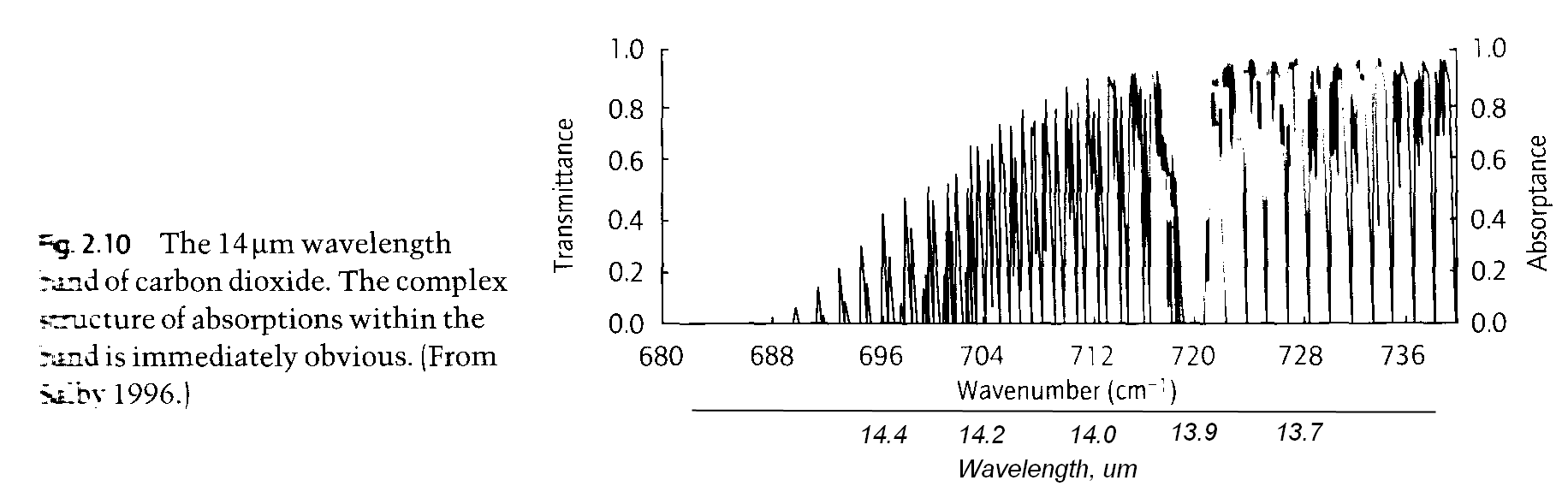
From "Handbook of Atmospheric Sciences", Hewitt & Jackson 2003
Band models are much simpler, and therefore widely used in GCMs. Band models are “paramaterizations”, where a more complex effect is turned into a simpler equation that is easier to solve.
Averaging
Does one calculation of CO2 radiative forcing from an “average atmosphere” gives us the real result for the whole planet?
Asking the question another way, if we calculate the CO2 radiative forcings from all the points around the globe and average the radiative forcing do we get the same result as one calculation for the “average atmosphere”.
This subject was studied in a 1998 paper: Greenhouse gas radiative forcing: Effects of average and inhomogeneities in trace gas distribution, by Freckleton et al. They ran the same calculations with 1 profile (the “standard atmosphere”), 3 profiles (one tropical plus a northern and southern extra-tropical “standard atmosphere”), and then by resolving the globe into ever finer sections.
The results were averaged (except the single calculation of course) and plotted out. It was clear from this research that using the average of 3 profiles – tropical, northern and southern extra-tropics – was sufficient and gave only 0.1% error compared with averaging the calculation at 2.5% resolution in latitude.
The Standard Result
The standard definition of radiative forcing is:
The change in net (down minus up) irradiance (solar plus longwave; in W/m2) at the tropopause after allowing for stratospheric temperatures to readjust to radiative equilibrium, but with surface and tropospheric temperatures and state held fixed at the unperturbed values.
What does it mean? The extra incoming energy flow at the top of atmosphere (TOA) without feedbacks from the surface or the troposphere (lower part of the atmosphere). The stratospheric adjustment is minor and happens almost immediately (there are no oceans to heat up or ice to melt in the stratosphere unlike at the earth’s surface). Later note added – “almost immediately” in the context of the response of the surface, but the timescale is the order of 2-3 months.
The common CO2 doubling scenario, from pre-industrial, is:
278ppm -> 556 ppm
And the comparison to the present day, of course, depends on when the measurement occurs but most commonly uses the 278ppm value as a comparison.
IPCC AR4 (2007) pre-industrial to the present day (2005), 1.7 W/m2
IPCC AR4 (2007) doubling CO2, 3.7 W/m2
Just for interest.. Myhre at al (1998) calculated the effects of CO2 – and 12 other trace gases – from the current increases in those gases (to 1995). They calculated separate results for clear sky and cloudy sky. Clear sky results are useful in comparisons between models as clouds add complexity and there are more assumptions to untangle.
They also ran the calculations using the very computationally expensive Line by Line (LBL) absorption, and compared with a Narrow Band Model (NBM) and Broad Band Model (BBM).
CO2 current (1995) compared to pre-industrial, clear sky – 1.76W/m2, cloudy sky 1.37W/m2
(The NBM and BBM were within a few percent of the LBL calculations).
There are lots of other papers looking at the subject. All reach similar conclusions, which is no surprise for such a well-studied subject.
Where does the IPCC Logarithmic Function come from?
The 3rd assessment report (TAR) and the 4th assessment report (AR4) have an expression showing a relationship between CO2 increases and “radiative forcing” as described above:
ΔF = 5.35 ln (C/C0)
where:
C0 = pre-industrial level of CO2 (278ppm)
C = level of CO2 we want to know about
ΔF = radiative forcing at the top of atmosphere.
(And for non-mathematicians, ln is the “natural logarithm”).
This isn’t a derived expression which comes from simplifying down the radiative transfer equations in one fell swoop!
Instead, it comes from running lots of values of CO2 through the standard 1d model we have discussed, and plotting the numbers on a graph:
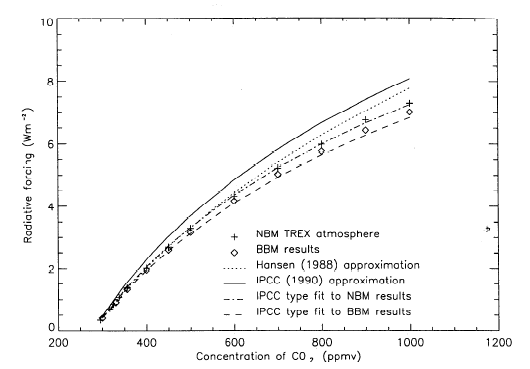
Radiative Forcing vs CO2 concentration, Myhre et al (1998)
From New estimates of radiative forcing due to well mixed greenhouse gases, Myhre et al, Geophysical Research Letters (1998).
The graph reasonably closely approximates to the equation above. It’s very useful because it enables people to do a quick calculation.
E.g. CO2 = 380ppm, ΔF = 1.7W/m2
CO2 = 556ppm, ΔF = 3.7 W/m2
Easy.
Benefit of Using “Radiative Forcing” at TOA (top of atmosphere)
First of all, we can use this number to calculate a very basic temperature increase at the surface. Prior to any feedbacks – or can we? [added note, James McC kindly pointed out that my calculation of temperature is wrong and so maybe it is too simplistic to use this method when there is an absorbing and re-transmitting atmosphere in the way. I abused this approach myself rather than following any standard work. All errors are mine in this bit – we’ll let it stand for interest. See James McC’s comments in About this Blog)
In Part One of this series, in the maths section at the end (to spare the non-mathematically inclined), we looked at the Stefan-Boltzmann equation, which shows the energy radiated from any “body” at a given temperature (in K):
Total energy per unit area per unit time, j = εσT4
where ε= emissivity (how close to a “blackbody”: 0-1), σ=5.67×10⁻⁸ and T = absolute temperature (in K).
The handy thing about this equation is that when the earth’s climate is in overall equilibrium, the energy radiated out will match the incoming energy. See The Earth’s Energy Budget – Part Two and also Part One might be of interest.
We can use the equations to do a very simple calculation of what ΔF = 3.7W/m2 (doubling CO2) means in terms of temperature increase. It’s a rough and ready approach. It’s not quite right, but let’s see what it churns out.
Take the solar incoming absorbed energy of 239W/m2 (see The Earth’s Energy Budget – Part One) and comparing the old (only solar) – and new (solar + radiative forcing for doubling CO2 values), we get:
Tnew4/Told4 = (239 + 3.7)/239
where Tnew = the temperature we want to determine, Told = 15°C or 288K
We get Tnew = 289.1K or a 1.1°C increase.
Well, the full mathematical treatment calculates a 1.2°C increase – prior to any feedbacks – so it’s reasonably close.
[End of dodgy calculation that when recalculated is not close at all. More comments when I have them].
Secondly, we can compare different effects by comparing their radiative forcing. For example, we could compare a different “greenhouse” gas. Or we could compare changes in the sun’s solar radiation (don’t forget to compare “apples with oranges” as explained in The Earth’s Energy Budget – Part One). Or albedo changes which increase the amount of reflected solar radiation.
What’s important to understand is that the annualized globalized TOA W/m2 forcing for different phenomena will have subtly different impacts on the climate system, but the numbers can be used as a “broad-brush” comparison.
Conclusion
We can have a lot of confidence that the calculations of the radiative forcing of CO2 are correct. The subject is well-understood and many physicists have studied the subject over many decades. (The often cited “skeptics” such as Lindzen, Spencer, Christy all believe these numbers as well). Calculation of the “radiative forcing” of CO2 does not have to rely on general circulation models (GCMs), instead it uses well-understood “radiative transfer equations” in a “simple” 1-dimensional numerical analysis.
There’s no doubt that CO2 has a significant effect on the earth’s climate – 1.7W/m2 at top of atmosphere, compared with pre-industrial levels of CO2.
What conclusion can we draw about the cause of the 20th century rise in temperature from this series? None so far! How much will temperature rise in the future if CO2 keeps increasing? We can’t yet say from this series.
The first step in a scientific investigation is to isolate different effects. We can now see the effect of CO2 in isolation and that is very valuable.
Although there will be one more post specifically about “saturation” – this is the wrap up.
Something to ponder about CO2 and its radiative forcing.
If the sun had provided an equivalent increase in radiation over the 20th century to a current value of 1.7W/m2, would we think that it was the cause of the temperature rises measured over that period?
Update – CO2 – An Insignificant Trace Gas? Part Eight – Saturation is now published
References
Greenhouse gas radiative forcing: Effects of average and inhomogeneities in trace gas distribution, Freckleton at al, Q.J.R. Meteorological Society (1998)
New estimates of radiative forcing due to well mixed greenhouse gases, Myhre et al, Geophysical Research Letters (1998)


 The Science of Doom
1.7 per sq meter/radiation due to sun per sq meter = 1.7/1365 = insignificant
John, there is something about the radiative forcing graphs which I don’t understand. When I look at the shape of the graph, it appears as though the Y axis would be ZERO when CO2 is about 250 ppm. How can there be no radiative forcing when CO2 is 250 ppm. Given that the function is logarithmic, I would expect to see the rate of increase of the radiative forcing greatest going from low very low CO2 levels up. If I remember my calculus correctly, the derivative of ln(X) = 1/X + C. So as CO2 increases the rate of change of the Y axis, or radiative forcing should be getting sharply smaller.
This formula ΔF = 5.35 ln (C/C0) also seems a bit out of whack with reality. I worked this backward using the assumption that temperature change from 1880 to 2009 was in the range of .5dC to 1.0dC. This seems to be the range of dispute between warmists and deniers. Working backward, I come up with a formula in which k is only 3.2 or so. ΔF would than equal 3.2ln(CO2n/CO2o). That change flattens out the graph lines by quite a bit. AS a result the flatter lines would cross more closely to ZERO, ZERO. What I am missing here?
See answers to your questions at the end.
John Phillips:
Insignificance can be a judgement call.
To be accurate, we need to compare the energy increase per m^2 at top of atmosphere from CO2 with the sun’s incoming absorbed energy averaged over that same area.
This means we get:
Incoming absorbed solar energy per unit surface area = S(1-A)/4
where A is albedo (=0.3)
So incoming solar absorbed energy averaged over the earth’s surface = 239 W/m^2.
(Check out The Earth’s Energy Budget – Part One if this concept doesn’t seem right).
And of course, I didn’t cover the other gases, methane, N02, tropospheric ozone..
So the cumulative effect of the various trace gases to 2005 is believed to be 2.4 W/m^2.
“The common CO2 doubling scenario, from pre-industrial, is:”
How does one get to 576ppm given
1) China hit peak coal production in 2006 and will be out of coal by 2050
3) The EU will be completely out of coal by 2050, with the UK leading the parade in 9 years
2) US ‘recoverable’ coal reserves turn out to be overstated by a factor of at least 2.
http://pubs.usgs.gov/of/2008/1202/
Science – “To be accurate, we need to compare the energy increase per m^2 at top of atmosphere from CO2 with the sun’s incoming absorbed energy averaged over that same area.”
Thanks. Good point. 2.4/239 is more significant, but still only about 1% increase. I still wonder how the complex climate system processes that increase, with negative or positive feedback.
Your posts are very good, making the fundamentals understandable to non-climate scientists.
The mention about 1% increase in solar incoming short-wave radiation got me thinking: actual measured variation in solar output is much smaller that this….but I’ve read somewhere that band-by-band it is larger (i.e. the spectrum varies more than its integral).
Is it true? and when one speak about negligeable variations in solar output, this is measured by satelites (TOA) or station (on the ground)?
If it is measured at TOA, and given there are windows in the short wave range like there is in the long wave range, what about a detailed computation of what happen for short waves from TOA to ground? Is the ground variation of incoming short waves still negligeable (<<1%), even factoring out variation in cloud cover?
s.ofd.,
The problem is the feedbacks, combined with a trivial increase of ~1%, will not get us to doom.
The problem is that the CO2 driven catastrophic changes in climate that AGW theory predicts are simply not happening. And there is no indication they will be.
The TOA, by the way, is not really where people live and weather happens, is it?
Given that the changes we’re worried about are expected to mostly take place over the next century, this is unsurprising.
Knocking down a strawman adds nothing to the argument.
On the other hand, evidence of warming is all around us. Diminishing arctic sea ice, loss of mass of the greenland and antarctic ice sheets, ranges of a large number of species moving north (insects, birds), horticultural zones in the NH moving northwards, all sorts of recorded phenomena like first bloom happening earlier (cherry blossoms in Japan, records for which go back for centuries, gardeners records in England, of which quite a few go back a century or more, some much more, etc).
We don’t live on the sun, either, therefore anything happening there can’t be important, right?
hunter:
“The problem is that the CO2 driven catastrophic changes in climate that AGW theory predicts are simply not happening.”
Well this series so far is not about that, it’s about understanding:
– the basics of CO2
– the science behind how it adds radiation to the surface
– how we quantify that radiative forcing
– quantifying its impact vs water vapor
– the evidence for its effect in the atmosphere
Many people in the thick of the debate don’t understand the basics but would like to. And so we hear many comments like:
-“water vapor is 95% of the greenhouse effect”
-“adding a few ppm to CO2 can’t possibly have any effect”
-“CO2 is already saturated and can’t have any further effect”
“it’s all made up”
Without a sound foundation anything sounds plausible.
If you have a comment, a challenge, a question on the foundations as presented, here’s your chance.
scienceofdoom,
No, the basics are fine.
Please excuse the brief answer.
Of course the basics are fine.
I did not mean to jump ahead.
So I am back, and do have some questions.
Perhaps you covered them, and if so please excuse the redundancy.
– So if there was no water vapor in the atmosphere, what would the impact be on temperatures, all else being unchanged?
– Is CO2’s impact a diminishing logarithmic effect as far as its ghg impact or not?
Thanks, and enjoy the doom song.
We would be like the Moon…blistering hot during the day, ice cold at night. The desert is a place on Earth with no water vapor in the atmosphere.
The warming that is occurring is overnight, and at the poles, which to me means that the “insulation” is even-ing out temperatures.
hunter:
If there was no water vapor?? Big question. How could there be? There would have to be no oceans..
I think that’s a question that isn’t easy to answer.
No latent heat transfer, no clouds, no ocean heat transport…
But if one day suddenly and magically all the water vapor disappeared out of the atmosphere and magically it didn’t replenish – the longwave radiation change is calculated to be – on average – a 75 W/m^2 drop in longwave radiation at the top of atmosphere.
So roughly speaking we are talking about a new average surface temperature of less than 0’C (32’F). I think. But then there would be no clouds so that would warm things up because clouds have a net cooling effect.. But no latent heat removal from the surface..
Let’s say – a lot colder but not as cold as removing the CO2 and methane as well.
Does that answer that question?
And Is CO2’s impact a diminishing logarithmic effect?
Yes, that’s in the post.
If CO2 levels go to 576ppm we will have about 3.7W/m^2 of radiative forcing at TOA, and if it quadruples we will have “only” about 7.4W/m^2.
If it was possible to double again to 8x pre-industrial levels then “only” 11 W/m^2.
However, the log function is an approximate fit to the graph of the numerical calculations (see in the post), and as the graph only goes to 1000ppm I’m not sure whether the graph still follows that shape.
I noticed that I fluffed one of the CO2 concentration numbers.
Two different pre-industrial numbers get used, but sticking with the IPCC 1750 approximation of 278ppm, doubling would be 556ppm, not 576..
So I changed the post.
Well, our host has answered hunter, so perhaps I shouldn’t, but still …
It doesn’t matter, since the earth has a lot of water, but … water vapor feedbacks are about 50% of warming, as a feedback, and this was predicted by physics-based models and those predictions have been backed up by AQUA satellite observations using the AIRS sensor system.
Observations confirm model results … imagine that!
No, it’s a constant logarithmic forcing, not a decreasing one.
You may, or may not, understand why the answer to your question is “no”.
Unfortunately, I’m burdened by having a BS in Mathematics.
scienceofdoom,
Thanks for the clarification and the patience.
So if the atmosphere had no CO2 in it, what would the impact be?
dhogaza,
I am not so burdened, so perhaps you can help me a bit more?
How is it logarithmic but not a diminishing effect?
By diminishing I am trying to understand that if a factor- forget CO2 for a second- is logarithmic and is doubled, is its impact doubled?
Hunter, perhaps I misunderstood what you were trying to say …
“By diminishing I am trying to understand that if a factor- forget CO2 for a second- is logarithmic and is doubled, is its impact doubled?”
That would be a linear, not logarithmic, relationship.
Each doubling of CO2 yields a constant increase in forcing, so each molecule of added CO2 has a diminishing effect, yes, at the concentrations we’re interested in.
dhogaza,
Thank you for the clarification.
So the impact of increasing, from what is believed to be the pre-industrial CO2 ppm level of 278, to 333ppm is greater than going from 333 to today’s 388?
scienceofdoom,
Sorry about the questions. I am trying to understand your basics.
You mentioned what I believe was something to the effect that heat would be stored up in the system for a future impact. Where would it be stored?
hunter:
No CO2
If there was no CO2 in the atmosphere the temperature would be around 10’C cooler, all other things being equal. So the average global surface temp would be around 5’C.
I don’t think you are looking for an accurate number.. just an idea?
Logarithms
On “logarithmic”, in case it’s not clear to anyone, I believe dhogaza is striving for technical clarity. But for those less used to what the idea means:
– a logarithmic relationship is a diminishing relationship, so each time you double a parameter the result only increases by a constant amount each time
– a “diminishing” logarithmic relationship is either a more descriptive way of saying logarithmic (how I believe hunter meant it), or a relationship where the output slows even more, say you double the parameter and output increases by 1, double the parameter again and output now increases by 0.9 instead of 1..
Storing of heat
Not sure what you have in mind here. I can’t see anything in this post. Can you find the comment or idea that needs explaining?
Yes. I had first interpreted hunter’s question to be in the second sense given by scienceofdoom, and after clarification came to understand that hunter meant it in the first sense.
Also, hunter, it’s log base 2, the base is implied by the “doubling”.
Very interesting series, thanks.
I am eagerly awaiting the sections on negative climate feedbacks, which have prevented a runaway heating in the past, when CO2 levels were considerably higher than in modern times.
Climate models (of the mainstream —–ist variety) are apparently tweaked toward the positive feedback end of the scale, which intuitively seems quite bass ackward.
Observed temperature trends are approximating the lower range of IPCC and GISS projections that assumed a diminishing of CO2 levels, when in fact CO2 levels continue to increase.
A moderator’s reminder:
peoplewhodontagreewithus-ists will be moderated out. Check the Etiquette
scienceofdoom and dhogaza,
Thanks. yes, irt to comparative impacts, I am looking for what my grandfather would call ‘rule of thumb’ ways to follow this. He was an MIT grad in engineering and liked to reduce issues to solid concepts that could be followed fairly clearly. It served him well in a variety of enterprises. It is a habit I cultivate.
So if I am following this properly, no H2O vapor = ~0oC, and no CO2 = ~5oC?
As to the logarithmic impact of CO2, are you saying that X00ppm of CO2 ~ Yo temp forcing, so 2(X00)ppm CO2 ~2Yo temp impact?
Or is it that X00 ppm of CO2 = Yo temp forcing, and 2(X00)ppm CO2 = <1.0(Yo) temp forcing?
Thanks,
hunter – using your notation Y0+1, not 2Y0, on the right side.
log2(2*N) = N+1
“I am eagerly awaiting the sections on negative climate feedbacks, which have prevented a runaway heating in the past, when CO2 levels were considerably higher than in modern times.
Climate models (of the mainstream —–ist variety) are apparently tweaked toward the positive feedback end of the scale, which intuitively seems quite bass ackward.”
If your first statement were correct, you might have a point, but it doesn’t require negative climate feedbacks to prevent runaway heating in the past.
Positive feedbacks can lead to a convergent series (i.e. converges to some limit), they don’t necessary lead to a divergent series (grows without limit).
As it happens, all the evidence is that feedbacks in earth’s climate lead to a convergent series, therefore there’s no runaway heating.
Unlike Venus. What’s different than Venus? Among other things, its closer to the sun, but I don’t know offhand if that was sufficient to flip it into a runaway state that didn’t end until it reached its current (very hot) temperature, water all gone, etc.
I am going to repeat your second paragraph:
“Climate models (of the mainstream —–ist variety) are apparently tweaked toward the positive feedback end of the scale, which intuitively seems quite bass ackward.”
Because it includes a very typical, yet very wrong, misconception of feedbacks in models that gets endlessly repeated.
Feedbacks *arise* from the physics built into GCMs. They aren’t “tweaked in that direction”. They’re an emergent property.
hunter:
I wasn’t sure I understood your question exactly, but check out my earlier comment for some values:
You must be on a computer. If it’s a Windows PC there will be a calculator somewhere. Put some of the numbers in and use the log function (or natural log “ln” function) and you will get a sense of the results.
Note that the formula is about the empirical relationship between CO2 levels and radiative forcing.
How does this relate to temperature? Well energy radiated is proportional to the 4th power of temperature in Kelvin.
If you look at the formula above (under the heading “Benefits of using Radiative Forcing..”) where I worked out the very approximate no-feedback surface temperature rise, you can plug in the number for 4x CO2.
Actually it works out to the same temperature rise again.
– 2x CO2 (278-556ppm) results in a radiative forcing of 3.7W/m^2 and approximately 1.1’C temperature rise (all other things being equal)
– 4x CO2 (278- 1114ppm) results in a radiative forcing of 7.4W/m^2 and approximately 2.2’C temperature rise (all other things being equal)
Al Fin:
Of course, everyone wants to jump ahead and work out the final answer. Climate models, the future, the past.. the answer!
For now let’s work on the basis that climate is very complex.
That’s why we have this series on CO2 to put the spotlight on one important element of the climate.
There are positive and negative feedbacks in the climate system. I’m sure – I hope – we have champions of both who are reading this blog.
I believe the way to consider CO2 – even if we learn nothing more – is that it has a clear effect.
It has an effect that we can quantify.
And given that we can see clearly – for many readers, at least more clearly than at the start – that CO2 has a warming effect on the surface, if there had been no increase in CO2 in the last 100 years it would almost certainly be cooler.
How much – at this stage of course we can’t say.
scienceofdoom,
Thank you. The answer was, so to speak blowing in the wind- or on your blog post. CO2’s impact, if I am understanding you correctly acts on what non-technical people would call diminshing return basis. It is simlar to building material: a 2X6 is not 50% stronger than a 2X4.
My take on CO2’s effect is that it has an impact that is quantified in the lab. But in the actual area of interest- the atmospehre- the results are far less certain. Something as complex as a 10’s of mile thick ocean of gases with aerosols, soots, water in all three states, land, ocean and ice on the surface and things like volcanos, industry, ocean outgassing/evap/ingassing, land use changes -natural or not, not to mention solar impacts, etc. is not going to lend itself to straightforward statements like ‘This = that’.
But I am jumping ahead of your excellent pacing.
On what do you base this opinion? Where is the science wrong?
You followed with a bunch of unrelated stuff that doesn’t affect that basic physics of what’s going on with CO2 alone in the atmosphere. Solar impacts? Doesn’t affect CO2 forcing. And so on with many of the things you list.
Now, a few of those things you list – land use changes, outgassing/ingassing, etc, can affect the amount of CO2 in the atmosphere, of course. BUT the actual amount of CO2 that’s in the atmosphere is easy to determine, in a way that allows scientists to totally ignore such processes – THEY MEASURE IT.
And once we know how much CO2 is in the atmosphere, the forcing can be calculated in isolation.
You are entitled to your own opinion, but my recollection is that when I took college physics, my *opinion* didn’t count for squat. Neither will yours when it comes to the physics.
You need to do your work, then show your work, that shows that the physics being presented by our host is wrong.
“seems complex to me” is known as an argument from personal incredulity, and has no persuasive power.
dhogaza:
It seems like hunter is just commenting on the amazing complexity of the rest of the climate. The sum total of CO2 and all other effects.
Well that’s how I read it anyway.
Well, this isn’t the first blog that hunter’s posted on.
And this:
Would seem to make it clear (as I thought his first graph did) that he doesn’t believe that you can work with the radiative forcing due to CO2 (without feedbacks) in isolation.
“this = that” statements like “a doubling of CO2 adds X w/m2 forcing”.
But maybe I’m wrong. If hunter says so, I’ll take hunter at his/her word.
[…] 2010 by scienceofdoom In the series CO2 – An Insignificant Trace Gas? we concluded (in Part Seven!) with the values of “radiative forcing” as calculated for the current level of CO2 […]
Thanks again!
Just a small – maybe unrelated – question. Has anyone given any thought to the simple effect of thermal insulation of the bulk gases O2 and N2? Like, the efficiency of double glazing comes from the fact that thermal transfer in the form of kinetic energy of gas molecules is a very slow process. The heavier the molecule, the lower is the speed and the slower is the process. For example the energy elements we use in my country (where triple-glazing is a must) contains Argon gas – heavier than Oxygen.
Thus my question: how much of the warming above the “base level” is due to thermal insulation and how much is due to the “greenhouse” effect?
Now, when I am at it: The “greenhouse” effect is actually a misnomer. Greenhouses work by entrapping the warm air, preventing convection – like the walls of your house. You can build a greenhouse using thin plastic foil that doesn’t absorb or reflect IR radiation. We do it in my country regularly. Or am I wrong?
Kenneth
Kenneth:
The “greenhouse” effect is often in quotes. Every time I use it I try and put it in quotes.
For exactly the reason you describe. The “so-called greenhouse effect”, we are really saying. Greenhouses have a slight property of admitting solar radiation and blocking some infrared radiation from leaving, but mainly the glass – or any material – stops convection. CO2 and other trace gases which absorb longwave radiation are really working differently.
For the first part of the question you are really talking about conduction, which is usually very inefficient at moving heat in gases.
Most of the heat movement in the troposphere (lower part of the atmosphere) is from convection. The surface warms the lowest part of the atmosphere, so it expands and therefore rises because its density has reduced. A certain amount of heat is also from latent heat – which is evaporation of water and then condensation higher up.
About conduction and convection. This is just my point – because the air is such a bad CONDUCTOR it will function as an insulator, although it is as you say – convection is the prime factor. But still…
Another effect of the gases in the atmosphere is to cool down the surface thus decreasing the black body radiation – thus decreasing the total heat loss.
Sorry for “doodling” like this, but I assume you have the right answers!
dhogaza,
Yes we have all been on this moveable feast for awhile now.
This seems to be a fairly civilized place to stop by.
Kenneth:
I’m not totally sure of the question.
Radiation, convection, conduction and latent heat all have their place in moving heat around. Conduction is by far the worst and therefore insignificant when we talk about the atmosphere, but not when we talk about the oceans.
The gases have more than one effect on the surface. If there was no atmosphere the temperature of the surface would be around -18’C, not +15’C.
This is because they re-radiate longwave back to the earth’s surface – as described through this series. Then they remove heat by convection.
At the end of CO2 – An Insigificant Trace Gas – Part Three you can see how the temperature profile (the “lapse rate”) would look if heat didn’t move by convection compared with the effect of convection.
[…] Another Update – Part Seven – The Boring Numbers […]
dhogaza,
My writing on this is not as clear as I would like.
What I am suggesting is that the evidence shows that saying “X amount of energy into the water ocean/atmosphere system = Y” is not going to work outside of models and labs.
[…] So far on this blog I haven’t really mentioned AGW, until now. A few allusions here and there. One very minor non-specific claim at the end of Part Seven. […]
Thanks for your excellent series!
I have been trying to dig out facts on this subject, and how they come together, for some time now. John Houghton’s book “Global Warming” (4th Edn.) – said to be an undergrad. textbook – is an insult to readers’ intelligence by comparison.
(But maybe that’s today’s undergraduates. It does have pretty pictures, e.g. of a greenhouse, of Arrhenius himself, of a bit of Amazonian rainforest canopy, and of a golden toad. We were made of sterner stuff back in the fifties, the only pictures you got was stuff like spectrophotometers.)
Anyway,
Anyway – as I was saying when I pressed the wrong bloody key and sent you the unfinished comment – I managed to calculate from some of the info buried by Houghton in different places, that the total net global warming from 1750 to 2005, was about 0.4 degrees C. When I compared this trivial amount with the comparitively wild and erratic record of smoothed (!) global temperatures from 1850 to 2005 – which includes a FALL of this order from 1880 to 1910 – it seemed to me that something else, and a good deal of it, was going on.
I am now happy that my sums were in the right ball park, and will read the rest of your blog and further posts with great interest, and in the hope of further enlightment. And I will buy a copy of your book when you get around to it.
My thanks and regards
I should check my comments better; I meant to say the global warming calculated for CO2 ON ITS OWN, was about 0.4 C.
I thinks that’s all I wanted to say…
James McC:
Thanks for the kind comments. And I’ll make sure I put a few old-school (“real”) graphics in some of my posts..
Thank you for this series and the comments in follow up. I’m finding the series well explained with technical precision, and within the grasp for the less technically inclined, which is where I place myself.
In trying to break things down to a basic value, I’m arriving at a different figure for the net effect of doubling CO2 than 1.2C
If the total Greenhouse effect translates to roughly 30C and CO2 accounts for 26% of the Greenhouse effect, that translates to roughly 7.80C of the total Greenhouse effect that is attributed to CO2.
If we start at a ppm CO2 concentration of 0, CO2 would have doubled 9x to reach a concentration of 240 ppm. At todays level of 388 ppm, concentrations of CO2 have doubled 9.62 times.
Using 7.80C of geenhouse effect attributed to CO2, at 9.62 doublings of CO2, that translates to .81C effect per doubling of CO2.
I understand these are very back of the evelope figures, however, even if we plug in 32C as the total Greenhouse effect to account for more warming, the value per doubling of CO2 works out to .86C.
If it needs to be said, I don’t think I’ve discovered something that eluded all the scientists, I’m asking because I’m trying to make sense of the basics.
Thank you for any response and thank you too for this series.
Mark H:
Thanks for the kind comments. It’s an interesting approach you are trying – everyone has to work through the concepts in different ways to get things clear in their head. Or clearer, at least!
The logarithmic relationship is more a handy rule of thumb rather than the fundamental equation governing the result of the radiative transfer equations.
1. Let’s start with the first problem. If we start at a ppm CO2 concentration of 0, how many times do you have to double this concentration to get to 240ppm?
0x2x2x2x2x2x2x2x2x2= 0 and stays like this with yet more doubling..
2^9 =512 so maybe you didn’t start with zero but with 240/512 = 0.47?
2. The second thing to point out is that the “handy ready reckoner” of the logarithmic relationship links radiative forcing, not temperature, with CO2 concentrations. (See above).
Radiative forcing is then related to surface temperature by the “ready reckoner” of the Stefan Boltzman law. (Radiation is proportional to T^4, where T is absolute temperature).
But the real point is that the log relationship is just the rough fit to the plot of the actual results from the numerical solution to the RTE (above). Because we don’t have the values below C=280ppm it might not be such a good fit for lower concentrations.
Also the graph probably fits some other empirical relationships between the 280ppm – 1000ppm range.
I’m sure someone can find R=a x (C/Co)^b relationship (find “a” and “b” where R=radiative forcing).
Well, feel free to ask away. Absorption and re-radiation of energy through a vertical column in the atmosphere is not an easy subject to grasp, it’s not intuitive unlike gravity or wind resistance.
I have just finished reading this series. It is very interesting and it will take me a while to work though the math.
What has me confused is that looking at the radiation leaving the earth, it looks like 100% of the 15um radiation is absorbed. yet the radiative forcing graph shows that we have just started up the curve.
Gut feel says this does not make sense. More CO2 will not capture more radiation as the current amount of CO2 is already capturing it all. The absorbed energy is then radiated or transfered by kinetic energy.
I am going to go through the math to see if I can follow the logic. In that I am rusty, it will take a while.
Can anone help me bridge this?
Bingham:
Good questions. There are two parts to the answer.
The first part is covered in Part Four which shows the mathematical relationships that can be used to describe “saturation”.
Just as a note, this term saturation gets used in two ways. One by physicists in a technical way, and the other by non-physicists in a more polemic way, i.e. “CO2 is saturated so it can’t have any more effect“. It’s important to check which meaning is being used..
In the technical usage of the term, you can see (in Part Four) that the transmittance (=1-absorptance) relationship changes from approximately exp (-u) to exp (-√u).
This is because the CO2 absorption band (and any band) extends out either side in wavelength from its central absorption. So more CO2 brings more absorption, but at a slower rate.
There is a second reason. And in the long-awaited Part Eight, I will cover “saturation” as best I can, but am still trying to think of a better way to explain this second part. I am looking for inspiration..
James McC posted some comments on several parts of this series over in About this Blog
And pointed out a glaring error in my calculations of temperature rise as a result of the increase in radiative forcing.
Thanks James McC.
Take a look at them over there.. I will fix up the issues in the text and eventually figure out the answer to the conundrum.
[…] called “radiative forcing” and comes with a number of definitions you can see in Part Seven of the CO2 series (along with my mistaken attempt to do a “back of envelope” calculation of surface […]
I think you’ll find that GCM’s don’t even use band models because they’re still too computationally intensive. They use empirically fitted equations known in the trade as parameterizations. A while back some of those parameterizations for some of the models were found to be less than accurate, but that should have been fixed by now.
For calculating the first order temperature effect of changes in CO2 and CH4, I prefer to use MODTRAN ( http://geoflop.uchicago.edu/forecast/docs/Projects/modtran.orig.html ). Pick an atmosphere and other initial conditions and set the altitude to 70 or 100 km looking down. Record Iout. Make a change in conditions and then adjust the surface temperature offset to reproduce the original Iout. It’s an iterative process, but it doesn’t take long.
At very low concentrations, the effect of CO2 is linear, not logarithmic. The plot of log(CO2) vs forcing or T starts to bend around 10 ppmv. See this graph.
I see that adding links causes moderation here too. You should see about getting CA Assistant to work here. The quicktag buttons make composing a lot easier.
I just stumbled across your site this morning and rapidly read through all seven sections of “insignificant-trace-gas”. You’ve done a spectacular job. Is it fair to say that on earth we get dF~ln(CO2) because CO2 is a trace gas and there is all this other stuff going on and that on Venus we get optical thickness ~ CO2^(1/2) because at leading order venus has a pure CO2 atmosphere?
John E. Pearson:
Thanks for the kind comments.
Unfortunately I haven’t studied Venus at all, so I have no idea of the comparison idea.
Generally, I would be cautious about the “conceptual reasons” why particular overall results work out how they do – simply because so many non-linear effects work together to produce the result.
For example, who would predict the effects of tiny changes in stratospheric water vapor? See The Strange Case of Stratospheric Water Vapor, Non-linearities and Groceries.
Ok. We can’t talk about venus. But would it be equally fair to say that we can’t extrapolate the logarithmic dependence that climate models yield for the CO2 dependence of terrestrial temperature far beyond the range over which it has been been calculated? The reason I ask is that you often hear that there is something fundamental about the logarithmic temperature dependence and that it holds over very large ranges of [CO2]. If I’ve read you correctly you’re saying that over the limited range of CO2 from say 200-1000 ppm it happens that the climate models give dT proportional to log(CO2/220ppm) over 2-3 doublings but that for CO2 much larger than 1000 ppm there is no reason whatsoever to expect the logarithmic relation to hold?
John E Pearson:
Good question. From the data I have seen your assumption about my viewpoint is correct.
Others may have seen the solutions to the problem out to higher concentrations of CO2 and this logarithmic relationship may still hold. I don’t know.
It’s true that the relationship between concentration of CO2 and absorption by CO2 is not a linear one. Increase CO2 and the absorption by CO2 will not increase as much. Roughly exp(-sqrt(amount of CO2)) once the atmosphere is optically thick at that wavelength – see CO2 – Part Four
BUT, the solution to the RTE is not trivial and has many non-linearities. The only way to get the right answer is to turn on the big computers, put in the relevant climate conditions (temperature profile, concentration profile of water vapor, CO2 etc) and calculate the change in outgoing longwave radiation.
If we could skip all of that and just look at the absorption by CO2 in isolation the answer would be much easier – but the answer comes out much different. This is why many people have reached incorrect conclusions about CO2’s effect on climate they aren’t solving the RTE, they are just working out the transmittance through a known amount of CO2. This ignores many other important factors.
[…] equations, not solvable on the pocket calculator. Part Five showed two important solutions. And Part Seven showed the current best solutions along with what “radiative forcing” actually means, […]
ΔF = 5.35 W/m^2 (ln [383ppmV/278ppmV]) = 1.71 W/m^2
The result is applied into the formula for obtaining change of T caused by the increase of CO2:
ΔT = 1.714 W/m^2 (ln [co2/co2])/4 (σ) (Tbb) = 0.143 K
And using the thermal sensitive instead the change of radiative forcing:
ΔT = 5.35 W/m^2 (ln [co2/co2])/4 (σ) (Tbb^3) = 0.44 K
Compared with the water vapor “radiative forcing” of 7.34 W/m^2, it would be:
ΔF = 7.34 W/m^2 (ln [H2Og/H2Og] = 28.71 W/m^2
Introducing this magnitude to the formula for obtaining ΔT:
ΔT = 28.71 W/m^2 (ln [H2O/H2O])/4 (σ) (Tbb^3) = 29.4 K
Real ciphers.
[…] Part Seven – The Boring Numbers – the values of “radiative forcing” from CO2 for current levels and doubling of CO2. […]
[…] In the past many people had slightly different approaches, so usually it is prepared in a standard way – explained further in CO2 – An Insignificant Trace Gas? Part Seven – The Boring Numbers. […]
[…] CO2 – An Insignificant Trace Gas? Part Seven – The Boring Numbers […]
[…] that looks very like the Beer-Lambert law of absorption! Nothing like the IPCC result shown in CO2 – An Insignificant Trace Gas? Part Seven – The Boring Numbers: Radiative Forcing vs CO2 concentration, Myhre et al […]
[…] to show these results as radiative forcing. (You can find a more formal definition of the term in CO2 – An Insignificant Trace Gas? Part Seven – The Boring Numbers – although here it is not calculated according to the strict definition of allowing […]
[…] basic (but hard to calculate) radiative physics – already covered in many places including CO2 – An Insignificant Trace Gas? Part Seven – The Boring Numbers (and the preceding parts of the series) – tells us that, all other things being equal, a […]
Tom Lux on April 1, 2011 at 4:02 am:
Because the radiative forcing is with respect to an initial condition of pre-industrial CO2 concentrations of 280ppm.
By definition, at 280ppm, radiative forcing = 0.
This doesn’t mean “no radiative effect of CO2”.
The calculation is based on the “simple” physics of the radiative transfer equations AND the definition of radiative forcing – see the article.
This calculation is before the surface/troposphere comes into equilibrium.
And in any case, radiative forcing is “with all other things being equal” – usually they are not.
“Just for interest.. Myhre at al (1998) calculated the effects of CO2 – and 12 other trace gases – from the current increases in those gases (to 1995). They calculated separate results for clear sky and cloudy sky. Clear sky results are useful in comparisons between models as clouds add complexity and there are more assumptions to untangle.”
Also, just for interest.. In 1998 Dr. Sherwood IDSO (author of 500 technical publications and the founders of the Center for the Study of Carbon Dioxide and Global Change) published a paper which presented his results from eight “natural experiments” (his term) which he developed to determine the impact of increased CO2 on global warming. What makes these experiments of interest is that the results obtained by Dr. Idso using eight very different experiments to test for the relationship of CO2 to warming, all yielded results which were very close to one another. In my opinion, both believers and skeptics will find this article interesting because of the unique methods used by Idso in his effort to understand the relationship of CO2 to warming. For example, in one experiment he assesses the impact of CO2 on the warming of Venus vs Mars to arrive at an estimate of the ability of CO2 produce a greenhouse effect. In another experiment he takes an entirely different approach as he measures the impact of the daily change in atmospheric water vapor vs temperature during the advent of rainy periods in the summer in Phoenix, Az. His eight unique creative experiments are at the very least, thought provoking.
About Idso
http://en.wikipedia.org/wiki/Sherwood_B._Idso
Link to the paper…
Click to access idso98.pdf
Thomas Lux:
I’ll take a look at Idso’s paper. It reminded me that the great Ramanathan has covered this topic and references to Idso – not necessarily the same data and not the same paper.
The paper is The Role of Ocean-Atmosphere Interactions in the CO2 Climate Problem, V Ramanathan, Journal of Atmospheric Sciences, 1981. Unfortunately I can’t see a free copy on Google Scholar.
Also the material from the 1981 paper is covered in a review article that is easier to understand: Trace Gas Greenhouse Effect and Global Warming, V Ramanathan, Ambio, 1998. Likewise not currently available free.
At some stage I hope to write about this topic.
The issue of back-radiation vs top of atmosphere radiation is covered to a small extent in the series Understanding Atmospheric Radiation and the “Greenhouse” Effect.
[…] questions and no doubt many people have similar ones. The definition of radiative forcing (see CO2 – An Insignificant Trace Gas? Part Seven – The Boring Numbers) is at the tropopause, which is the top of the troposphere (around 12km above the […]
[…] a big secret, but really it’s discussed on quite a few AGN-affirming websites e.g. (here and here). If the effect of C on T_s were linear, we’d be talking about a much larger temperature […]
Do “line by line” (LBL) models remain computationally challenging? Can you point me to a technical paper that sets it up? I can’t say I know how to solve it, but it is a numerical integration, and in the Bayesian computational work I usually do, that kind of thing is done all the time. Could look at importance sampling or nested sampling.
LBL models are discussed in this thirteen part series
Those threads contain also some references to papers on LBL calculation.
Essentially all aspects of a full LBL calculation are discussed and most implemented in the code of part 5 of that series. Some additions like Voigt line shape are not included in that code, but that influences significantly only calculations of upper stratosphere.
Doing a really full calculation that handles properly line shapes and azimuthal angle distributions and that has a grid spacing that picks all important lines takes a lot of time, but a fairly good approximation can be obtained with much less calculation. There are also still open questions concerning tails of lines and continuum absorption that affect the results as much as relaxing a little on the extreme accuracy in the integration.
What’s important varies from case to case making important sampling complex. The efficiency of the calculation can certainly be improved greatly by optimizing the choice of lines to include and the cut-off distance from line centers.
The choice in applications where computational efficiency is important is, however, to use band models whose sufficient accuracy has been verified through comparison with LBL models. More information on that can be found here
http://rami-benchmark.jrc.ec.europa.eu/HTML/
hypergeometric,
If you have the computer skills to run a FORTRAN program on a PC, there’s a free line-by-line program, LBLRTM, available from the internet. This program uses the Voigt profile at all altitudes and includes water vapor continuum absorption.
hypergeometric,
Running multiple LBL simulations on a home PC or Mac is straightforward with Matlab – both Pekka and myself did that using the code in the link Pekka provided. (I’m not sure what it’s like using non-Matlab solutions).
But they are computationally challenging from a climate modeling perspective.
If you consider the planet being divided into a large number of cells and then calculating the various thermodynamic, mass balance and equations of motion multiple times per day for each cell – where is the biggest computational cost? If you run LBL for radiative transfer at say 20 levels in the atmosphere it turns out to overwhelm all the other computational efforts.
But let’s suppose you have massive computing power – what then?
Well, you would rather increase the number of cells by 100 to get better resolution on all the momentum, thermodynamic and mass balance equations and use a band model for radiative transfer, rather than stick with the current grid size and use a full LBL.
Because computing power was much more limited 20 or so years ago, and because even today the above “opportunity cost” of LBL models exists, there have been lots of evaluations of band models against LBL to demonstrate how well band models perform.
For references on setting it up – Pekka has pointed to the link with the models and the code. Essentially it’s quite simple and just standard physics known as the Schwarschild equations.
These equations of radiative transfer are derived in Understanding Atmospheric Radiation and the “Greenhouse” Effect – Part Six – The Equations.
If you know the temperature profile and GHG concentration profile (CO2, CH4, water vapor) then solving these equations numerically tells you the spectrum and flux at each point in the atmosphere. Applying basic thermodynamic equations tells you the change in temperature.
[…] http://www.realclimate.org/index.php…gument-part-ii http://clivebest.com/blog/?p=4597 https://scienceofdoom.com/2010/02/19/…oring-numbers/ […]
TB Says:
“The LIA was not a global event is was a regional one – please provide evidence to the contrary.”
Well Mr. TB the evidence is several glaciers in northern and southern hemispheres.
http://www.appinsys.com/GlobalWarming has documented a study of 169 receding glaciers worldwide (Johannes Oerlemans, “Extracting a Climate Signal from 169 Glacier Records”, published in Science, 2005). These indicate the pattern that is consistent for most glaciers worldwide – the recession of the glaciers started at the end of the little ice age in the 1700s. The recession of glaciers started long before anthropogenic CO2 levels rose.
A recent paper by Syun-Ichi Akasofu at the International Arctic Research Center (University of Alaska Fairbanks) provides an analysis of warming trends in the Arctic. [http://www.iarc.uaf.edu/highlights/2007/akasofu_3_07/index.php ] shows examples of glaciers in Greenland and Alaska, which have been receding from the time of the earliest records (about 1800 for Greenland and 1900 for Alaska). There are a large number of similar records from the European Alps and elsewhere (Grove, 1982). Therefore, it can be assumed that many glaciers advanced during the Little Ice Age and have been receding since then. Thus, the retreat is not something that happened only in recent years.”
The retreats showed no acceleration toward the 1900s but a steady retreat of a natural climate change event.
There are many worldwide traces of the medieval warm period followed by the little ice age. In the Alps, for instance, medieval mountain passes, forests, and even a silver mine were suddenly overrun by ice and snow. The miners had stacked up their tools because they thought they were going to be back the next spring to mine more silver, only the snow never abated, the glacier advanced as it had before several times.
Alpine passes, normally blocked year around with snow and ice, became functional during the medieval warm period. This development allowed trade between Italy and Germany to flourish. Then the little ice age returned that lead to the dark ages.
An old Roman port is found high and dry showing sea levels where much higher in the historical past. Another port was found in Great Britain.
Instead of science we have paypal science designed to scare up monies from various government sources with politicians beating the global warming drum for speculation and power gains. Unbiased science gets excommunicated form the science groups as it does not support the consensus boards members most of which are actually government bureaucrats who desire to continue their charades for money, prestige and power. Big science has gone medieval over the ignorance of the masses, just like prior to the Renaissance.
Google search tells that this comment is a response to a comment in a discussion thread at WUWT. Why it’s copied here to a thread that’s not in any way related to it’s content?
Sorry, my bad. I was having trouble with the firefox software that night and was in a hurry, this after doing upgrades on software updates that required a reboot. But there is significance in it. But the webmaster can remove it since it was a mistake. This is what I ment to post:
Despite the physics of ‘Green House Gasses’ the temps are not running away and the Oceans are not heating up as before.
When you look at the lapse rate of Venus, when you get to an altitude where the pressure is that of Earth’s sea level pressure, the ambient temperature is near that of Earth’s.
So all this hullabaloo of a runaway greenhouse effect is not evident on Venus. It appears that density and not chemistry rules on ambient average temps. And the air heating the oceans is laughable, try heating your bathtub with an air gun, there’s not enough heat in the air to even do a skin effect.
No, I primarily blame the sun with the Earth’s water and convection systems moderating the sun’s incoming effect. What primarily causes so much global warming is the major media hype and exaggerations on what it report’s. Politicians and unscrupulous scientists smelling monetary blood go after the juggler of the poorly informed.
Calling the Arctic the canary of the climate is one such false flag, the canary would be the major glaciers that show a consistent, natural climate change, not an accelerated one. I don’t buy CO2 as a major GHG, it’s not abundant enough to have a significant effect.
Scottar
What do you calculate is the radiative forcing (defined above) from a doubling of CO2 from 280 ppmv to 560 ppmv?
If you get a different answer, can you explain:
1. Are the radiative transfer equations wrong?
You can see them derived and explained in Understanding Atmospheric Radiation and the “Greenhouse” Effect – Part Six – The Equations.
2. Is the HITRAN database wrong?
1 & 2:
Your Missing the forest for the trees. I explained it in this:
{When you look at the lapse rate of Venus, when you get to an altitude where the pressure is that of Earth’s sea level pressure, the ambient temperature is near that of Earth’s.
So all this hullabaloo of a runaway greenhouse effect is not evident on Venus. It appears that density and not chemistry rules on ambient average temps. And the air heating the oceans is laughable, try heating your bathtub with an air gun, there’s not enough heat in the air to even do a skin effect.}
So the Hot House effect is not due to the forcing of CO2, it’s a density effect primarily.
Besides that former IPCC reviewer Dr. Richard S. Lindzen stated in his overview of the climate forcings:
“In fact, the greenhouse effect is only about 25% of what it would be in a pure radiative situation. The reason for this is the presence of convection (heat transport by air motions), which bypasses much of the radiative absorption.”
Take in to account that water absorbs the majority of the solar radiation (not just vapor, but the oceans toward the red end and on the shores where submerged land can transfer the blackbody heat to the oceans). The rest is molecular convection.
Dr. Lindzen also notes “Moreover, most of that warming occurred before the bulk of the minor greenhouse gases were added to the atmosphere. There is ample evidence that the average equatorial sea surface has remained within + or – 1.0C of its present temperature for billions of years, yet current models predict average warming of from 2 to 4C even at the equator. It should be noted that for much of the Earth’s history, the atmosphere had much more CO2 than is currently anticipated for centuries to come. The global average temperature record for the past century or so is irregular and not without problems. It does, however, show an average increase in temperature of about 0.45 degree centigrade + or – 0.15C with most of the increase occurring before 1940, followed by some cooling through the early 1970s and a rapid (but modest) temperature increase in the late 1970s.”
The temperature record show that more warming occurred before the industrial period then after. So this claim that CO2 has a major forcing factor is just not reflected in the real climate data past what the warmistas claim. The sun rules, CO2 is just a false flag.
Scottar,
Still, worth figuring out if the trees are allegedly insignificant because you have a different value for radiative forcing.
When people say “..it’s not abundant enough to have a significant effect..” this suggests a lack of physics.
That’s why I ask for equations and numbers. Questions about semantics are less interesting. Well, they are interesting once we know whether we are in agreement on numbers and equations or not.
What Richard Lindzen says here:
“In fact, the greenhouse effect is only about 25% of what it would be in a pure radiative situation. The reason for this is the presence of convection (heat transport by air motions), which bypasses much of the radiative absorption.”
– is agreed by all climate science.
So given that everyone agrees with Richard Lindzen why do you think anyone has any interest in radiative forcing?
You state it like it is a controversial point or a point of difference. It’s not.
Check any introductory atmospheric physics text book – I can point you to a few if you like.
“Still, worth figuring out if the trees are allegedly insignificant because you have a different value for radiative forcing.”
What the hell do you mean by that, Lindzen and others have stated, (and the real world data supports this- not the lab nor computer programs data), CO2 radiative forcing is vastly swamped by water and convective forces. There’s not enough CO2 to make a nats worth of spit! The whole AGW radiative forcing claim is mostly based on flawed conclusions on flawed surface temperature data which has big gaps and has been corrupted by self serving, self funding greedy scientists and bureaucrats. All the IPCC claims are bunk!
“Check any introductory atmospheric physics text book – I can point you to a few if you like.”
Go ahead, I have looked at the uncompromised data and have reached conclusions that concur with scientist like Dr. Springer, Professor gray, Dr. Ball and more coming out. The equations can’t explain why the temps increased faster before the industrial revolution then after- followed by the present 2 decade stall.
Scottar,
Sure when you compress a gas, it gets warmer. But that’s a one time increase in energy that will radiate or conduct away. You can’t explain why the surface of Venus stays hot using density and pressure alone. You must include radiation from the atmosphere back to the surface so that the net loss of energy by thermal radiation and convection matches the input of solar radiation. The atmosphere of Venus is not completely opaque to solar radiation. The light level at the surface during the day is sufficient for visible light photography (see the pictures from the Soviet lander) and is about the same as at the Earth’s surface on a day with heavy cloud cover.
“Sure when you compress a gas, it gets warmer. But that’s a one time increase in energy that will radiate or conduct away. You can’t explain why the surface of Venus stays hot using density and pressure alone.”
Such Childish apologetics. We have in the SW a place called the Grand Canyon and I have seen this most every day where I live. There is an average temperature differential where it’s generally cooler at the rim but hotter near the bottom. So you see things like snow on the rim where it’s shirtsleeve weather at the bottom.
So why should Venus be any different where you have 90 bars pressure, the equivalent of around a depth of 2,953 feet underwater. So that gives the atmosphere great heat retention. “About 80% of the incoming solar radiation is reflected back to space by the SO2 cloud layer, about 10% is absorbed by the atmosphere and only 10% manages to get through it and heat the surface. However, the thermal radiation emitted by the surface gets trapped by the same atmosphere and clouds. The result is an amazing 5000C difference between the surface and cloud-top temperatures. And there is no water to moderate this.
Let’s compute what would happen were Earth suddenly equipped with an atmosphere as dense as Venuses. Given the similarities in mass and diameter of the 2 planets, we can assume this new atmosphere would behave similarly to Venus’, and in particular, purely adiabatically below 60km (instead of below 12km as at present).
For another simplification, let’s also imagine the new atmosphere to be just as our current one but without any water.
The lapse rate for dry Earth atmosphere is 9.760 K/km.
How much higher would the surface temperature be, with a dry atmosphere and a 60-km-thick troposphere?
9.760 * (60-12) = 468K higher than at present (288K)
The total for Earth is then 756K. Compare that to Venus’ surface temperature of 735K.
For an amazing coincidence, that’s 97% of the above, whilst the ratio of absorbed Solar radiation at Venus compared to Earth is… 96%.
The temperature difference between the surface and the upper troposphere does not depend much (it depends but rather weakly) on the strength of the GHE. It’s agreed that a very weak greenhouse effect will result in a similar difference as a strong one.
The actual surface temperature together with the temperature at all levels of the troposphere are, however, strongly dependent on the strength of the GHE.
With very weak GHE the surface is as cold as it is without any atmosphere, and the troposphere is still colder. The significance of GHGs is to cool the upper troposphere and maintain the circulation that assures the presence of the lapse rate, but the energy fluxes related to that are so small that the surface temperature is not affected significantly.
With a strong GHE the temperature of a planet without atmosphere is equaled by an effective temperature that represents some kind of average of the troposphere. As the lapse rate is again maintained by circulation driven by radiative heating and cooling, the surface is warmer. This is the influence of the GHE on the surface temperature.
In the first case the bare planet temperature is at the surface, in the second case high up in the atmosphere. In both cases the temperatures at other levels are then determined by a lapse rate that’s roughly the adiabatic lapse rate.
“As the lapse rate is again maintained by circulation driven by radiative heating and cooling, the surface is warmer. This is the influence of the GHE on the surface temperature.”
Your claim that the lapse rate is dependent on radiative heating is just quirky, It’s appears to be dependent on the makeup of the atmosphere and the gas laws.
I’m not sure but the ideal gas law may apply, but the variable would be solar radiation coming in.
Scottar
Water and convective forces are important, and they alone determine some details, but CO2 is also essential and that claim is based on physics, not an flawed temperature data. Lindzen, Spencer and all other well known skeptical climate scientists agree fully on this. They all have made explicit statements on that, and those statements are not difficult to find, if you wish to learn something.
Everybody agrees also on the presence of the lapse rate in most of the atmosphere. All understanding of atmosphere has that as an essential component. What you tell about Grand Canyon contradicts nobody.
Those laws give the upper limit for the lapse rate. They do not tell that the upper limit must be reached. A strong GHE is needed to maintain the lapse rate and the strong circulation that we have. Without GHE that circulation would die out.
More importantly the lapse rate does not make the surface warm. With weak GHE the surface would be cold and the troposphere still colder.
Scottar,
That would depend entirely on the composition of the thicker atmosphere, which you do not define sufficiently to allow an actual calculation. Is there water vapor present at all in the new atmosphere? Removing water vapor would lower the effective height of emission and lower the surface temperature. If the CO2 concentration in an atmosphere with a surface pressure of 90 bar were still the same, then the surface would be warmer because the total amount of CO2 in the atmosphere would also increase by a factor of 90. This, obviously, would raise the effective height of emission and thus the surface temperature. In principle, this is no different from increasing CO2 without adding any other gas.
Adding an optically transparent gas to the atmosphere to increase the surface pressure to 90 bar would also raise the effective height of emission causing the surface temperature to increase, but not to Venus temperature levels. You assert that increasing the mass of the atmosphere to the level of Venus would increase the height of the tropopause to the same level as for Venus. You also assert that the temperature at this higher tropopause would be the same as for the current atmosphere You have supplied zero evidence that these assertions would be correct, your irrelevant comments about the Grand Canyon notwithstanding.
The height of the tropopause is not determined by the mass of the atmosphere alone. It’s the altitude where convective heat transfer stops. There is no reason to believe that increasing the surface pressure to 90 bar would raise the tropopause by 60 km if the transparency of the atmosphere to LW IR remained the same.
“That would depend entirely on the composition of the thicker atmosphere, which you do not define sufficiently to allow an actual calculation…..”
I realize all this about water.
“If the CO2 concentration in an atmosphere with a surface pressure of 90 bar were still the same, then the surface would be warmer because the total amount of CO2 in the atmosphere would also increase by a factor of 90.”
That is a ludicrous statement, the pressure depends on the atomic weight of the gas. If it where nitrogen then the pressure would change along with the warming temp independent of the forcing factor.
“You have supplied zero evidence that these assertions would be correct, your irrelevant comments about the Grand Canyon notwithstanding.”
Here’s one that shows that CO2 follows temps without the apparent forcing:
http://www.elsevier.com/locate/gloplacha
Jul 19, 2013
The Phase Relation Between Atmospheric Carbon Dioxide and Global Temperature
Ole Humlum et al, Elsevier Journal of Global and Planetary Change
And a more detailed explanation of the “Venus effect”:
Hyperventilating on Venus
Posted on May 6, 2010 by Anthony Watts
By Steve Goddard
Venus Envy
Posted on May 8, 2010 by Anthony Watts
By Steve Goddard
Excerpts:
If there were no Sun (or other external energy source) atmospheric temperature would approach absolute zero. As a result there would be almost no atmospheric pressure on any planet -> PV = nRT.
On Earth the dry lapse rate is 9.760 K/km. On Venus, the dry lapse rate is similar at 10.468 K/km. This means that with each km of elevation you gain on either Earth or Venus, the temperature drops by about 10C.
It is very important to note that despite radically different compositions, both atmospheres have approximately the same dry lapse rate. This tells us that the primary factor affecting the temperature is the thickness of the atmosphere, not the composition. Because Venus has a much thicker atmosphere than Earth, the temperature is much higher.
dT = -10 * dh where T is temperature and h is height.
With a constant lapse rate, an atmosphere twice as thick would be twice as warm. 3 times as thick would be 3 times as warm. etc.
WUWT commenter Julian Braggins provided a very useful link which adds a lot of important information.
“The much ballyhooed greenhouse effect of Venus’s carbon dioxide atmosphere can account for only part of the heating and evidence for other heating mechanisms is now in a turmoil,” confirmed Richard Kerr in Science magazine in 1980.
End of Excepts:
The Earth’s troposphere varies from 6 to 20 KM being thicker at the equator. Based on the information that it have the Venus troposphere is around 58km.
SOD has given me links to explore so I will have to investigate them and other things so you won’t here form me for awhile, I have other pressing things and working with a dialup internet speed hampers me allot.
“That would depend entirely on the composition of the thicker atmosphere, which you do not define sufficiently to allow an actual calculation…..”
I realize all this about water.
“If the CO2 concentration in an atmosphere with a surface pressure of 90 bar were still the same, then the surface would be warmer because the total amount of CO2 in the atmosphere would also increase by a factor of 90.”
That is a ludicrous statement, the pressure depends on the atomic weight of the gas. If it where nitrogen then the pressure would change along with the warming temp independent of the forcing factor.
“You have supplied zero evidence that these assertions would be correct, your irrelevant comments about the Grand Canyon notwithstanding.”
Here’s one that shows that CO2 follows temps without the apparent forcing:
http://www.elsevier.com/locate/gloplacha
Jul 19, 2013
The Phase Relation Between Atmospheric Carbon Dioxide and Global Temperature
Ole Humlum et al, Elsevier Journal of Global and Planetary Change
And a more detailed explanation of the “Venus effect”:
Hyperventilating on Venus
Posted on May 6, 2010 by Anthony Watts
By Steve Goddard
Venus Envy
Posted on May 8, 2010 by Anthony Watts
By Steve Goddard
Excerpts:
If there were no Sun (or other external energy source) atmospheric temperature would approach absolute zero. As a result there would be almost no atmospheric pressure on any planet -> PV = nRT.
On Earth the dry lapse rate is 9.760 K/km. On Venus, the dry lapse rate is similar at 10.468 K/km. This means that with each km of elevation you gain on either Earth or Venus, the temperature drops by about 10C.
It is very important to note that despite radically different compositions, both atmospheres have approximately the same dry lapse rate. This tells us that the primary factor affecting the temperature is the thickness of the atmosphere, not the composition. Because Venus has a much thicker atmosphere than Earth, the temperature is much higher.
dT = -10 * dh where T is temperature and h is height.
With a constant lapse rate, an atmosphere twice as thick would be twice as warm. 3 times as thick would be 3 times as warm. etc.
WUWT commenter Julian Braggins provided a very useful link which adds a lot of important information.
“The much ballyhooed greenhouse effect of Venus’s carbon dioxide atmosphere can account for only part of the heating and evidence for other heating mechanisms is now in a turmoil,” confirmed Richard Kerr in Science magazine in 1980.
End of Excepts:
The Earth’s troposphere varies from 6 to 20 KM being thicker at the equator. Based on the information that it have the Venus troposphere is around 58km.
SOD has given me links to explore so I will have to investigate them and other things so you won’t here form me for awhile, I have other pressing things and working with a dialup internet speed hampers me allot.
DeWitt,
I agree with what you write, but I think that the case is even stronger than what I read from your comment.
As far as I can see the main influence of additional optically inactive gas is through pressure broadening of the spectral lines. I made a very crude test by increasing the line width by factors of 10 and 100 in a model. The model case was a simple example case of SoD’s model, which is not bound to be one of the standard atmospheres, but determines the surface temperature and the whole temperature profile based of radiative energy balance and the maximum lapse rate of 6.5 K/km. The height of the tropopause defined as that part of the atmosphere, where the limit of 6.5 K/km determines the lapse rate does not change much (only few hundred meters, the calculation cannot tell more precisely). What changes more is the temperature profile above this altitude. In that model the temperature starts to rise in the stratosphere immediately above the tropopause with the original pressure, but keeps on falling with a smaller lapse rate, when the pressure is high.
The resulting GHE is stronger and the surface is about 15 C higher when the pressure is 100 times the original. The main reason for the increase is that pressure broadening increases the weight of high altitudes in the outgoing radiation.
Pressure broadening is very important for the GHE, but the present atmospheric pressure is already high enough to make most of the effect. Thus even a huge increase by a factor of 100 leads to a modest effect only.
Pekka,
Thanks for doing the calculation. I guess the main difference would be that pressure broadening extends to higher altitude.
I did some calculations a few years ago from the other end, replacing some of the CO2 in the atmosphere of Venus with a transparent gas. Replacing half the CO2 drops the surface temperature on the order of 10C, as I remember without trying to find the data. At that time I had a subscription to Spectralcalc and used the HITRAN high pressure and temperature CO2 line database. It wasn’t a trivial calculation, so, as I remember, I only did the one example.
It was also interesting to note that the fairly low levels of water vapor and sulfuric acid in the Venusian atmosphere make a significant difference, as they nicely fill holes in the CO2 spectrum. With the holes nearly filled, there is only a small difference between the Venusian atmospheric spectrum at the surface looking up and a black body. The difference is enough, though, that the effective temperature of the atmosphere is slightly lower than the surface and you get a net radiative transfer upward of ~5 W/m².
That, by the way, is another difference in the Venusian atmosphere compared to the Earth’s atmosphere, no real window in the spectrum. I vaguely remember a comment by Ramanathan in one of his papers stating that as long as there is a window, you can’t get a runaway greenhouse effect. Water vapor doesn’t fill the window in the Earth’s atmosphere until the temperature gets a lot higher, 50-60 C, or thereabouts.
Scottar,
The paper of Humlum et al is on a different issue. It’s a simple correlation analysis found erroneous by others. Masters and Benestad write
Goddard’s posts contain nothing of significance, only the same unfounded assertions that GHE would not be the main reason for the warm/hot surfaces of the Earth and Venus. Correctly used theories of physics explain the temperatures without the need to introduce unfounded assertions.
As has been stated time after time:
1) Thermodynamics tells that there’s an upper limit for the lapse rate, it’s the adiabatic lapse rate.
2) Existence of the upper limit does not tell that the upper limit is reached. In the case of the planetary atmospheres that requires circulation. Circulation dies off, if nothing drives it. What drives the circulation in both the Earth and the Venusian atmosphere is GHE.
3) The existence of the lapse rate does not tell the temperature level. It does not tell, what altitude has the temperature that corresponds to the intensity of the outgoing radiation according to Stefan-Boltzmann law. That altitude depends mainly on the amount of GHGs. It’s so high up on Venus, because there’s so much CO2. With very little GHGs that temperature would be at the surface whatever the pressure of optically inactive gases like N2.
“The paper of Humlum et al is on a different issue. It’s a simple correlation analysis found erroneous by others. Masters and Benestad write.”
The paper has been supported by others who made the same observations- economist!
Aug 05, 2009
Correct Timing is Everything – Also for CO2 in the Air
Guest Editorial by Tom V. Segalstad on CO2 Science
http://www.co2science.org/articles/V12/N31/EDIT.php
International peer-reviewed journal Energy & Fuels, Dr. Robert H. Essenhigh (2009), Professor of Energy Conversion at The Ohio State University, addresses the residence time (RT) of anthropogenic CO2 in the air. He finds that the RT for bulk atmospheric CO2, the molecule 12CO2, is ~5 years, in good agreement with other cited sources (Segalstad, 1998), while the RT for the trace molecule 14CO2 is ~16 years. Both of these residence times are much shorter than what is claimed by the IPCC.
Atmospheric verification of anthropogenic CO2 emission trends
Roger J. Francey, Cathy M. Trudinger, Marcel van der Schoot, Rachel M. Law, Paul B. Krummel, Ray L. Langenfelds, L. Paul Steele, Colin E. Allison, Ann R. Stavert, Robert J. Andres & Christian Rödenbeck
Nature Climate Change 3, 520–524 (2013) doi:10.1038/nclimate1817
“ Goddard’s posts contain nothing of significance, only the same unfounded assertions that GHE would not be the main reason for the warm/hot surfaces of the Earth and Venus.”
It is my perception- Goddard may not have credentials but I go by real data, not unsubstantiated mathematical formulas, the real data defines the math, not the other way around. Goddard is a researcher who is observing the real data. I see by your bio your are:
Professor emeritus (retired 31 July 2009)
Energy economics
Research interests
Energy economics, energy markets, mathematical modeling
You are like Gavin Schmidt on Real Climate who is more interested in climate models then climate.
“What drives the circulation in both the Earth and the Venusian atmosphere is GHE.”
Typical warmista rhetoric, what drives atmospheric circulation is the weather due to uneven heating from the equator to the poles, and what drives the weather is the Sun which is what drives the climate. GHE has little to do with planetary heating. As you stated the big difference between Earth and Venus is Venus not atmosphere window for the radiative heat to escape. At the most, GHE is just an added forcing, particularly with water in it’s 3 forms. But water acts more like a moderator then a forcing to keep the planet form experiencing extremes in temps, look at the desert areas, they have extremes in day-night temperatures, nothing to hold back the heat.
And here is opposing papers to your observations:
Analyzing the Earth’s Heat Radiation Using MODTRAN
Update
By Ed Caryl
The results show that CO2’s forcing wanes severely past the 50ppm level and in the presence of humidity, which is in most area of the planet, it gets zilches out. Mr. Caryl has correctly interpreted the results of what the satellites are seeing. Water and the sun trump whatever forcing CO2 would provide and the forcing effect of CO2 degrades to zilch past the 50ppm level. Even water vapor’s forcing zilches out past a humidity of 40%!
Scottar,
I could go on to discuss all your points, but that’s not really needed as you have not presented anything of substance. I pick just one of them, the MODTRAN calculations of Ed Caryl.
He has clearly not understood the web interface of MODTRAN as he has done calculations using impossible values for humidity. He shows curves that are supposed to refer to humidities of 0, 1%, 5%, 10%, 50%, and 90%, but in reality the results tell that he has used humidities that are 0, 1, 5, 10, 50, and 90 times the humidity of the standard atmosphere that MODTRAN makes available. 5 or more times the standard value is not only extremely high but such values are totally impossible. They go far above the 100% relative humidity that’s the highest possible value. MODTRAN does not check whether the input values are possible at all but performs the calculations as if they were true. With that extreme amounts of water vapor, there’s indeed a state of saturation, and CO2 has little influence on the MODTRAN results.
This has, however, nothing to do with the real atmosphere, and proves only that Ed Caryl is totally ignorant of atmospheric physics. Otherwise he would have understood immediately that something is wrong with his calculation. Similarly we can conclude that every person who uses those results is also totally ignorant of real atmospheric physics.
“I could go on to discuss all your points, but that’s not really needed as you have not presented anything of substance. I pick just one of them, the MODTRAN calculations of Ed Caryl.”
Frankly, I should believe you who apparently does not have any experience in atmospheric physics except from the academic chair:
Ed started his career in the U. S. Air Force. During part of that time he maintained the weather instrumentation on Typhoon/Hurricane Hunter aircraft in the Pacific. He also worked as an Electronics Technician at Boeing Aircraft and for RCA Service Company at Thule Air Base in Greenland. Ed then majored in physics at the University of Washington for 2 years, also taking courses in math, chemistry, anthropology, sociology, economics, and creative writing.
Ed has more practical experience then you have shown.
And he doesn’t understand atmospheric physics, I beg to differ:
http://notrickszone.com/2011/02/11/is-co2-warming-a-mirage/
Is CO2 Warming a Mirage?
Your the kind of guy who goes out and says the temperature is 75 degrees- warm. Ed is the kind of guy who will say the temperature is 75% at 80% relative humidity, very warm.
And here is another guy who has a detailed explanation of why the GHE is not prominent on Venus that support Goddards observations (Goddard- CIV Electrical Engineer):
http://theendofthemystery.blogspot.com.au/2010/11/venus-no-greenhouse-effect.html
Monday, November 22, 2010
Venus: No Greenhouse Effect
I think you all know Dr. S. Fred Singer, who has a resume longer then your armchair rest, that makes you look like a boy scout. He too does not see a pronounced effect in the climate data from GHG’s other then H2O:
“Since I am primarily a data guy, I’ll confine my comments here to discussing recent climate trends but note that the global climate has warmed since the Little Ice Age (about 1400-1700 AD), and it will likely continue to warm for another 200-300 years, in fits and starts, towards a max temp roughly matching that of the Medieval Warm Period.”
“While the IPCC claims that a large temperature increase occurred between 1977 and the turn of the century (presumably based mainly on sea surface temperatures (SST), recent SST data published by Viktor Gouretski and John Kennedy in Geophysical Research Letters (2012) and the latest Ocean Heat Content (OHC) data from the National Oceanic Data Center (NODC) show only a minor warming between 1975 and 2000; Hadley NMAT data show nearly the same results. In short, SST and NMAT show a ~zero difference between 1942 and 1995, while OHC showed a difference of less than 0.1° C.”
But I will try to present your views on Mr. Caryl’s results on the website.
Scottar,
To which I reply: typical Sky Dragon Slayer nonsense.
SoD,
DC is more interesting than this idiot, who also clearly has no interest in learning anything because he already knows it all. Next thing you know he’s going to cite NN as an authority.
Scottar,
If Ed is so clever, then why does he make that stupid error, and more importantly, how is it possible that he doesn’t realize that he has made a stupid error. All of us make errors in calculations, but those with some understanding on the issues notice that something is wrong and correct it rather than write a blog post fully based on the error.
Studying even a little, how the UChicago MODTRAN works you can recreate his error and get his results. The full model output of those calculations tells explicitly, how the moisture levels are much higher than possible in the atmosphere. Thus there’s no way to avoid concluding that his calculation is totally wrong.
Let the facts speaks, and not your prejudices.
I finally got a hold of Mr. Caryl. He relayed this to me:
The MODTRAN web site at the University of Chicago suffered from an acute lack of documentation. That has been improved recently, and with the recent improvements I would not have made that same mistake.
The site:
Has a link to that updated version in DOC format:
http://tallbloke.files.wordpress.com/2012/09/analyzing-earths-w-modtran-update-1.doc
He sent me the DOC file.
He Commented: “MODTRAN was initially written by the US Air force, many years ago, in FORTRAN, as a card deck fed into an IBM computer. They needed it to model the atmosphere to write code for the aiming systems in IR guided missiles. The problem with it is that the water vapor assumptions are tied to specific water vapor profiles with altitude for specific latitude bands. It also has limited wavelength resolution. They needed to do that to simplify the rocket code. The “1” in the menu for water vapor is the standard profile for each defined location, and the effect of changes to that are not explained. If it were updated, the resolution improved, made more flexible and user friendly, MODTRAN could answer some of our questions on the effect of increasing CO2. As it is, it is used to confuse. I suspect on purpose.”
And from his:
http://notrickszone.com/2011/02/11/is-co2-warming-a-mirage/
11 February 2011
Is CO2 Warming a Mirage?
By Ed Caryl
“I wrote CO2 is a Mirage because of my experience with mirages while living in and driving through much desert in the western US and Mexico. I ran across a paper (cited in the article) describing how the long wave radiation was absorbed by the CO2 in air in about one meter. Mirages over pavement can be seen to take place in about a meter or less above the surface. Over a fairly flat desert with little vegetation, the will be a bit higher. With more vegetation, they rarely form, but when they do they are higher yet. Conduction wouldn’t act like that. Radiation would. I think this is the visible manifestation of back radiation. But it can only take place strongly over a flat, black, surface, and adding 25% more CO2 would only reduce the height of the warmed air by a few inches. As these conditions only occur over a tiny percent of the earths surface, there can’t be much contribution to global warming. At the top of the atmosphere, more CO2 can only contribute to more cooling, radiating more heat to space.”
“MODTRAN isn’t contrived. It is useful for the purpose for which it was developed. The problem is that it assumes a “standard” distribution of water vapor with altitude, that can only be adjusted wholesale up or down for the whole water column. It would be much more useful if one could input the real changes in the distribution with altitude that take place over time. Perhaps someday, when Sidewinder missiles begin missing targets, they will improve it.”
Seems like Mr. Carly has a better understanding of atmospheric physics then you do so I don’t see where he miscalculated.
Scottar,
Thank you for your help in proving my point.
Nobody with any understanding in the atmospheric physics could have been fooled by the lacking instructions of MODTRAN to believe that the results were calculated correctly. Nobody with such understanding would have written a blog post based on such erroneous results.
Here are some actual numbers from the Archer MODTRAN ( http://climatemodels.uchicago.edu/modtran/ ) implementation changing only the water vapor scale factor:
Tropical atmosphere, ground temperature offset 0 (299.7K), 400 ppm CO2, 1.7 ppm CH4, 28 ppb Tropospheric Ozone, Stratospheric Ozone Scale Factor 1.
Water vapor scale factor: 0.5, 1.0, 2.0
water vapor pressure @ 0 km (mbar):9.49, 19.0, 37.9
saturated water vapor pressure at 299.7K and 1013mbar: 34.9mbar
So at a water vapor scale factor setting of 2, the relative humidity would be greater than 100%.
If one doesn’t know what a particular input to a program does, one should at least try to find out. Ed Caryl obviously didn’t even try. That means regardless of other credentials, he’s demonstrated incompetence in something that should have been trivial (see below). Anyone who takes him seriously knowing this must, therefore, be at least as incompetent or only interested in deluding themselves and trying to delude others.
Scale factor is a well known term that has a specific meaning, see, for example, the Wikipedia entry.
Scottar cites Ed the Influential Authority (April 25, 2014 at 5:29 pm):
Now Ed does have some significant claim to expertise – namely that he reaches the same conclusions as Scottar.
However, being a science blog we don’t accept “I like the cut of his gib and his kickass conclusions”. Instead we ask for evidence. It’s sadly very old school..
Now Ed obviously hasn’t made any more attempt than Scottar to learn about atmospheric radiation.
There’s a pretty simple equation of absorption, the Beer Lambert law.
All you have to do is look up in the HITRAN database what the actual absorption coefficient is – by wavelength – and you can calculate the absorption at the surface per meter of atmosphere.
Has Ed done this? Does Influential Ed even know about the HITRAN database? Does Influential Ed know that absorption is a coefficient which is strongly wavelength dependent?
Probably not. So despite having the amazing credentials of “agreeing with Scottar” we have to give him 0.01 out of 10 for basic research.
All of this information can be found, for example, in Understanding Atmospheric Radiation and the “Greenhouse” Effect – Part Nine or in textbooks on atmospheric physics..
And to save people the enormous hassle of clicking the above link, I reproduce a few examples here:
Interested students can take a look at the linked article from whence these graphs came, and also learn about pressure broadening, or how it is that the absorption is quite different at lower pressures. They can also find the HITRAN paper and read it and follow up on the 100s of references.
What should be completely clear to everyone is that CO2 absorption is not simple and while CO2 absorbs 95% of radiation in the wavenumber range of 667.4 – 667.9 cm-1 (14.97 – 14.98 μm) that is only a tiny part of the story. At other wavenumbers (frequencies) it absorbs much less.
There is a large range of wavenumbers where the absorption through the whole troposphere is only around 50%.
Elementary to calculate this and validate the above graphs. It just takes a bit of time and a bit of research.
But because we reach a different conclusion from Ed the Influential Authority, Scottar will point out that Ed’s “credentials” trumps anything like a HITRAN database or a calculation from first principles, or extracts from textbooks on atmospheric physics by professors of physics.
If you have read lots about CO2’s absorption properties and haven’t learnt these essentials then you are spending time at the wrong blogs – if you want to be a real skeptic, that is.
SOD:
“Scottar cites Ed the Influential Authority”
Well first of all I don’t base my conclusions just on what Ed Caryl see’s’ or claims alone. His conclusions are based on real observations and real data. The Beer Lambert law must support what is observed in real observations. It doesn’t really matter what your instruments say about what CO2 alone will do in some given wavelength, it’s how it reacts in the presence of the atmosphere with everything ease, and the data just doesn’t support the alleged forcing:
Some recent findings:
http://stevengoddard.wordpress.com/2014/04/13/climategate-scientists-getting-rid-of-the-1940s-temperature-spike-in-the-arctic/
Apr 08, 2014
Climategate Scientists Getting Rid Of The 1940’s Temperature Spike In The Arctic
Icecap.us:
Lovejoy Global Warming Paper 100% Wrong to Omit Previous Natural Warm Periods Say Friends of Science
Lovejoy is from the once great McGill University in Canada.
AND on the same site:
Apr 22, 2014
NASA discovers: Greenland WAS Green 3 million years ago
And then there’s this observation Caryl made:
And finally a note about some leading scientists and their backgrounds:
Chicken Little Was a Climatologist
Echoed by others.
There are some leading scientists that have said and shown that the alleged forcing of CO2 from the instruments just does not show up. It’s more like CO2 is more an indicator then a agent. Caryl showed that in his:
http://notrickszone.com/2011/02/11/is-co2-warming-a-mirage/
P Gosselin on 11. Februar 2011
Is CO2 Warming a Mirage?
And I went out to the link that DeWitt Payne gave: Here are some actual numbers from the Archer MODTRAN ( http://climatemodels.uchicago.edu/modtran/ )
It echoes what SOD and Caryl had on their websites. And I never saw Caryl use any parameters on the Water Vapor Scale parameter greater then one. And he stated: The “1” in the menu for water vapor is the standard profile for each defined location, and the effect of changes to that are not explained. So I don’t think it means what Pekka Pirilä claimed it meant.
If you have a climate program, that scans the climate foot, but the resulting shoe don’t fit the foot, then what’s wrong? The climate foot or the program? That’s what Caryl, me and others observes. And the MODTRAN site itself says:
“The model does not compute global warming….The MODTRAN model simulates the emission and absorption of infrared radiation in the atmosphere. The smooth curves are theoretical emission spectra of blackbodies at different temperatures.”
The great physicist Richard Feynman said no matter how smart you are, who you are, how beautiful your theory, if the data doesn’t support your theory, it’s wrong! Einstein noted a model or a hypothesis cannot “prove” anything. But data can invalidate a hypothesis or model. Einstein described the “Key” to science well when he said: “The case is never closed.” “Many experiments may prove me right but it takes only one to prove me wrong.”
Dr. Frederick Seitz, a world-famous physicist and former president of the U.S. National Academy of Sciences, the American Physical Society, and Rockefeller University, wrote in the Wall Street Journal: “I have never witnessed a more disturbing corruption of the peer review process than events that led to this IPCC report.”
Freeman Dyson, who replaced Einstein’s title of “the most brilliant physicist on the planet.” Commented- “I just think they don’t understand the climate,” he said of climatologists. “Their computer models are full of fudge factors.” There are all kinds of false flags with CO2 and it’s alleged forcings.
I have forwarded the comments to Ed and he will have to address the loose ambiguities, but bottom, line it appears that SOD and it’s participants are hyping the science.
It would be nice if I had the Bandwidth to run the MODTRAN program myself or I was able to get it on CD but I don’t and not sure if I can. And I’m currently at a disadvantage, my main browser has gotten crappy lately after a recent update. I may likely have to do some cleanup and reinstalling to get it’s robustness back. But I’m in the middle of something that’s in the middle of something else that’s in the middle of another thing.
So I will have to use my research sense and BS detector to evaluate SOD’s claims of CO2’s forcing claims. So far your claims smell funny.
Scottar: I think your analysis of Venus fairly accurate: The high surface temperature is caused by 70 km of lapse rate (ie atmosphere) between surface and the higher atmosphere in radiative equilibrium with incoming SWR. That lapse rate depends mostly on Cp and g (through convection), not the optical properties of the gas comprising those 70 km. However, if more CO2 were added to the Venusian atmosphere, the portion of the atmosphere where radiative equilibrium determines temperature will rise – say to 71 km – and the surface temperature will rise another 10 degC due to the lapse rate. Richard Lindzen discusses this subject in an article entitled: “Taking the Greenhouse Effect Seriously”
http://citeseerx.ist.psu.edu/viewdoc/download?doi=10.1.1.160.448&rep=rep1&type=pdf
So, even if your view of the atmosphere isn’t “radiation-centric”, you still should take the enhanced greenhouse effect seriously.
I don’t think many serious scientists doubt the idea that an instantaneous doubling of CO2 will reduce the radiative flux to space by about 4 W/m2. This result can be derived from laboratory measurements of the IR spectrum of CO2 made long before politically active climate scientists got involved. (Databases of the spectroscopic properties of GHGs (such as HITRAN) were originally compiled by the AIr Force, which needed accurate information for engineering projects beginning in the 1960s.) To restore equilibrium between incoming and outgoing radiation after doubling CO2, the surface or troposphere must warm until an additional 4 W/m2 escape to space. If that warming were uniform everywhere, the temperature rise would be about 1 degC – the no-feedbacks climate sensitivity. The debate among consensus and skeptic climate scientists is how much that warming will be amplified by feedbacks, mostly water vapor and clouds. (ie ECS and TCR)
In their misguided efforts to attribute as much warming to man as possible, the consensus may have over-estimated their understanding of natural and unforced climate variability (such as the MWP and the current pause). If climate sensitivity really is around 3 degC or greater, nobody in the second half of the 21st century will care about whether it was hotter during the MWP than it was in 1960 or 1980 or 1998 or which Alpine passes were ice free during the Roman Warm Period. Without geo-engineering, the warming forced by aGHGs will be greater than any natural variability seen during the Holocene. However, even the IPCC believes that climate science doesn’t rule out a climate sensitivity of 1.5 degC. There is some pretty good information on this subject here at SOD and reliable information about the physics that underlies this subject.
“However, even the IPCC believes that climate science doesn’t rule out a climate sensitivity of 1.5 degC.”
Knowing what I know about the IPCC I would not quote anything from that organization:
http://pickeringpost.com/story/the-ipcc-scamsters-are-at-it-again-/3030
Apr 03, 2014
The IPCC Scamsters Are At It Again!
“They are a bunch of ideological, brain dead, hirsute Green gophers charged with collecting other Green gophers’ alarmist reports and presenting them to media as “science”. Media then slavishly report it to you as fact. William Schlesinger, IPCC backer and President of the “Cary Institute of Ecosystem Studies” has reluctantly been forced to acknowledge that over 80% of IPCC members has absolutely no qualification or background in anything concerning climate. The IPCC is charged with the job of scaring the pants off you in order to get governments world-wide to give them lots of your money via a tax on CO2
“Sue and Settle” practices, also referred to as “friendly lawsuits”, are cozy deals whereby far-Left radical Green groups file lawsuits against sympathetic Government “warmist” Agencies. Court “consent orders” are then issued based upon the prearranged settlement amounts made in advance behind closed doors. Tens of millions are extorted from uncomplaining Green governments and given back to Green groups like Earthjustice, who recently netted $4,655,000, the US based Sierra Club, $967,000 and the Natural Resources Defense Council, $252,000. The IPCC then creams the normal 10% of the ongoing scam.
The IPCC rejects any report that doesn’t claim anthropogenic warming, and always throws in a few goodies like its recently discredited, “the Himalayas will soon be devoid of snow” nonsense. Figures are massaged, graphs are inverted and reports are altered in an attempt to convince the gullible of their expertise in “climate science”. Long lunches are spent inventing emotive doomsday phrases designed for you to elect Green-sympathetic governments, like Julia Gillard’s, that will happily give them billions more of your taxes.
…..but both ice-caps have increased in area, Europe and the US have just recorded 3 years of record cold conditions, atmospheric CO2 levels have continued to vary by the normal 0.1%, US “Tornado Alley” had 30% fewer tornados last season, there are no tidal increases anywhere and the climate is still changing normally in its own erratic way, as it always has.”
Science, along with government, has taken a severe, crony turn, most of media is owned by 4 corporate conglomerates. There are many science groups in cahoots with the cronies.
Did you notice this one?
“Densities and temperatures in the Venus mesosphere and lower
thermosphere retrieved from SOIR on board Venus Express:
Carbon dioxide measurements at the Venus terminator”
Click to access Mahieux_12.pdf
For new readers seeing Scottar’s comments but who also want to understand a few basics:
1. Repeating the citation of Richard Lindzen:
This comment is not at all controversial in climate science. Now introductory climate science textbooks all tackle the subject a little differently but usually discuss:
a) how the temperature profile in the atmosphere comes about by convection – the lapse rate.
[For more, see Temperature Profile in the Atmosphere – The Lapse Rate and Potential Temperature].
b) what the temperature profile would be without convection, usually with the simplifed “semi-gray” model (ask if you want to know more)
c) how increases in GHG concentration reduce the outgoing radiation to space
So everyone knows – and writes about – the fact that convection largely bypasses radiative exchange in the troposphere (lower atmosphere) and yet still there is an idea about increases in GHG concentration changing the radiation balance of the climate system. How can this be?
2.
AGW is a different thing from the “greenhouse” effect.
This is explained in New Theory Proves AGW Wrong!.
The “greenhouse” effect is a necessary building block for AGW, but AGW is not at all necessary for the “greenhouse” effect.
The “greenhouse” effect is a result of the temperature profile in the atmosphere (the lapse rate) combined with the ability of GHGs to absorb and re-emit radiation on its journey from the surface out to space. [To over-simplify, the increasing opacity of the atmosphere causes the emission of radiation from the higher and colder parts of the atmosphere, which reduces the ability of the climate system to lose energy to space]
The explanation is built on fundamental physics and spectroscopic measurements. People who write comments like Scottar’s above haven’t read or haven’t understood any atmospheric physics textbooks.
The radiative transfer equations, as derived and explained in Understanding Atmospheric Radiation and the “Greenhouse” Effect – Part Six – The Equations were not invented by the IPCC. Nobel Prize winning physicists derived them a long time ago.
The spectroscopic measurements, as stored in the HITRAN database are the careful work of 1000’s of spectroscopic professionals over many decades. The IPCC had no part in their work either.
At least one of these two building blocks would need to be proven wrong to destroy the “greenhouse” effect. Of course, people can rant away, but they’ve come to the wrong place.
And just to be crystal clear, the calculation of radiative forcing from changing GHG concentrations uses the fact of convection, it doesn’t ignore it.
3. The question about the effect of increasing GHGs on the climate does not depend on the above uncontroversial points, but on the role of feedbacks. These include the GHG effect of changing water vapor, the changing lapse rate mainly due to water vapor in the upper atmosphere, changes in clouds & cloud types and the changing albedo from the melting of ice.
In this point, if we return to Richard Lindzen, Prof Lindzen does believe that increasing GHGs may not be a cause for concern – due to negative feedbacks in the climate system. This is an entirely different matter from his statement cited in point 1 above.
Lindzen has outlined a number of ideas over 20 years as to why feedbacks might be negative.
On the subject of feedbacks, Lindzen is in a minority of climate scientists. Being in a minority doesn’t mean right or wrong.
But being as this is a science blog and not a ranting blog, it is important to be able to understand one idea vs another idea and what ideas actually support an argument versus what ideas are irrelevant in support or otherwise of an argument.
And also, it is important to be able to understand what physics principles are well-supported and which ones are not well-supported.
I also point new readers to the Etiquette, one relevant extract reads:
scienceofdoom says, April 7, 2014 at 5:28 am:
“[To over-simplify, the increasing opacity of the atmosphere causes the emission of radiation from the higher and colder parts of the atmosphere, which reduces the ability of the climate system to lose energy to space]”
So you’re still on about this?
No, SoD. The more IR active gases (the so-called GHGs) in the atmosphere, the more it is able to cool to space. Without any such gases present, the atmosphere would still be able to warm, but not adequately able to cool.
Hence, the absorbed solar energy is MORE able to escape back to space from the earth system with atmospheric IR active gases than without. It is WITHOUT these gases present that the surface heat is ‘trapped’ by the atmosphere. By all the N2 and O2 and Ar.
All energy absorbed from the sun does not and cannot go directly back to space by way of IR radiation from the surface with an radiatively ‘inert’ atmosphere in between and without any hint of warming, SoD. That is the central flaw in the GHE thinking. As soon as an atmosphere is placed on top of a solar-heated surface there will be substantial conductive > convective energy loss. This energy is lost from the surface and absorbed by the atmosphere (warming it) and is therefore not available to be radiated out to space.
Also, SoD, our available ToA OLR data back to the mid 80s do not show any declining trend (rather the opposite) even as the total atmospheric CO2 content has increased by more than 15%. I heard atmospheric H2O content rose within that period as well, albeit NOT since around 1998.
OLR from ToA simply follow surface and tropospheric temperatures (+ humidity and clouds), SoD. Not the content of IR active gases. And you know it.
Kristian states:
And I know it! Nice.
For readers who want to post comments at this blog (unlike Kristian) please read the Etiquette, for example:
I should have included “accusations of lying”, but I think it is obvious in the above extract.
For people who think Kristian is onto something they can read of all of Kristian’s comments already posted on this blog, mostly in one article, starting from around these comments and decide for themselves whether Kristian has attempted to answer any of the basic questions asked.
Many people arrive at this blog determined to tell everyone why myself and other commenters haven’t understood how CO2 can’t have any significant effect on the climate, only to be asked to produce equations or at least confirm or deny what they believe about particular equations.
Their ignorance is plain to see. Assertions, no equations, dodging the subject, refusing to confirm whether a particular equations is right or wrong and then restating their strongly held opinions.
If the physics is so obviously on their side, why aren’t all these people arriving and producing textbook equations and demonstrating how the solution produces the result they so strongly believe in?
Open any physics textbook and you will find equations. You can’t determine the answer to complex physics questions without:
a) establishing which equations are the correct ones
b) establishing what boundary conditions are to be used
c) from a & b producing some solutions
Kristian wrote: “The more IR active gases (the so-called GHGs) in the atmosphere, the more it is able to cool to space… Hence, the absorbed solar energy is MORE able to escape back to space from the earth system with atmospheric IR active gases than without.”
Your first statement (that I quoted) is 100% correct (and sometimes ignored). Your second statement is sometimes right (more CO2 should cause the stratosphere to cool) AND sometimes wrong, because GHGs both absorb AND emit LWR. To determine which process dominates, you need physics that encompasses BOTH processes. In most textbooks, emission is discussed in a section on blackbody radiation and absorption is covered in a separate section on Beer’s Law. Unfortunately, few basic textbooks present the Schwarzschild eqn (which doesn’t even have an entry in Wikipedia), but this is the equation used to calculate radiative transfer through many materials:
dI/ds = increase from emission – decrease from absorption
dI/ds = n*o*B(lambda,T) – n*o*I_0
dI/ds = n*o*( B(lambda,T) – I_0 )
where dI is the incremental change in the intensity of light at a particular wavelength as it travels an incremental distance ds through a medium, o is the absorption cross-section/coefficient at that wavelength, n is the density of GHG molecules, I_0 is the intensity of light at the wavelength entering the ds increment, and B(lambda,T) is the Planck function for blackbody radiation and T is the temperature of the gas in the ds increment.
When B(lambda,T) is greater than I_0, increasing n (GHGs) increases the flux through the segment and radiative cooling dominates absorptive warming. When the opposite is true, absorption dominates radiative cooling and more GHGs will reduce the flux. How can we tell which factor is more important?
Blackbody radiation is produced after light has passed far enough through a medium that emission and absorption have come into equilibrium. (All of the derivations of Planck’s Law start with the assumption that radiation is in equilibrium with its surroundings. Our atmosphere is too optically thin at many wavelengths to produce equilibrium, so we can’t apply Planck’s Law to it.) When the blackbody radiation emitted by the surface of the earth ( I_0 = B(lambda,T=290degK) ) enters the usually cooler atmosphere, I_0 is usually less than B(lambda,T) for the atmosphere. The higher the light travels in the troposphere, the colder it gets, so dI/ds is negative there. Radiative forcing is the combination of this decrease in the upward flux plus a small increase in downward flux. The 3.7 W/m2 radiative forcing for 2XCO2 is calculated by numerically integrating the Schwarzschild eqn over all wavelengths and through the troposphere.
The stratosphere is warmed by UV light absorbed by ozone and oxygen. Here B(lambda,T) is bigger than I_0 at the wavelengths CO2 absorbs strongly. More CO2 at this altitude increases radiative cooling more than absorption, cooling the stratosphere.
When using a laboratory spectrophotometer, we use a light bulb with a 4000 degK filament to generate I_0 capable of overwhelming B(lambda,T). When you omit the emission term and integrate the absorption term, you get Beer’s Law for absorption: I = I_0*exp(-n*o*s)
Radiative transfer calculations using the Schwarzschild eqn are only possible when we know the composition and temperature profile of the atmosphere. When dI/ds is negative, we know that warming must occur somewhere to restore equilibrium between incoming and outgoing radiation. We can calculate by repeated approximation how much warming must occur to restore equilibrium, but this process is useless for the troposphere because temperature in most of the troposphere is determined by convection and the lapse rate, not radiative equilibrium. In fact, so much heat is transported upward by convection that the loss from radiative cooling by GHGs in most of the troposphere is bigger than gain from absorption. Radiative cooling thereby creates an unstable lapse rate and initiates convection.
So, you are correct about the critical importance of radiative cooling by GHGs, but you still need to properly integrate that understanding with the undoubted absorption by GHGs. If the Schwarzschild eqn isn’t the correct method to combine emission and absorption, what is?
Pekka, DeWitt and others: I’m not sure why the composition of a thicker atmosphere makes so much difference My understanding is based on what I read here about gray models and lapse rate summarized by “Figure 2.9” of this post:
The curved line shows what the temperature would be if convection didn’t take place and radiative equilibrium determined temperature. Since the lapse rate is the inverse of the slope in this plot, any lapse rate more SHALLOW = higher than appropriate would be convectively unstable. The tropopause is at the altitude where the curved line for radiative equilibrium becomes too shallow for convective stability.
Unfortunately, Figure 2.9 is misleading for our planet (and maybe all planets) because the gray model curve is nowhere too shallow. Unlike the gray model, the earth’s atmosphere becomes far less transparent at lower altitudes due to increasing water vapor. Elsewhere I read that the surface of the earth would be about 350 degK without convection, so I picture the radiative equilibrium curve for the earth as flattening out and intersecting the temperature axis around 350 degK – which would clearly make it more shallow than the reciprocal of 6.5 degK/km. The lapse rate line should be drawn tangent to the radiative equilibrium line at the point where the slope first becomes “shallower” than 1/km/6.5 degK. Is sure would be nice see a good picture of this – the ones I see show the combined radiative-convective curves, but not the components.
If I raised the current atmosphere 70 km and filled the space underneath with non-GHGs, it isn’t obvious to me why the surface temperature wouldn’t rise 455 degK. (The pressure at the bottom of the non-GHG layer would be very high, perhaps the 90 atm on Venus.) If I then let those two layers mix, I find it hard to believe that the temperature would be more like Earth than Venus.
Looking at Figure 2.9 above, it is interesting to ask what happens when you start with a non-GHG atmosphere and slowly add GHGs. Even the first added GHGs molecules absorb outgoing LWR and produce some DLR, so the surface temperature should rise. a) Those who believe in an isothermal atmosphere without GHGs start with a vertical line (at 255 degK for the earth) for the radiative equilibrium curve and that line becomes curved as GHGs are added. Convection doesn’t begin until the curve becomes shallow enough that the lapse rate is unstable and that will require a lot of GHGs. b) Those who think the transparent atmosphere will follow the thermodynamic lapse rate without GHG’s will expect convection to start as soon as any GHG is added to the atmosphere.
It’s all quite complicated as radiative transfer calculations require a knowledge of the temperature profile, but want to use the results to predict temperature.
Frank,
The atmosphere shown in that Fig 2.9 is too shallow at the surface, i.e. at the discontinuity of that graph. When the surface heats the air just above, the curve becomes too shallow immediately above the heated air. Thus convection leads to a new temperature profile that includes also adiabatic lapse rate.
The gray atmosphere presented in that figure is optically rather thin. Therefore the greenhouse effect leaves such a large discontinuity at the surface in absence of convection. For the same reason the curve is not too shallow at any altitude except the surface.
The simplest case of optically (very) thin atmosphere has the skin temperature (surface temperature divided by fourth root of 2) at all altitudes in absence of convection. With convection it has the adiabatic lapse rate up to the tropopause where the temperature is the skin temperature. Above that the optically skin atmosphere is isothermal.
Switching to the case of real absorption spectrum makes a difference. This figure from Pierrehumbert’s book shows both the pure radiative equilibrium and the profile with convection for dry air.
All the warming is due to GHG’s, other gases do not add anything to the temperature (except by changing the properties of the GHGs through pressure broadening). Taking some gas and compressing does heat the gas, but keeping it at high pressure does not keep it hot, if it can lose the heat as an atmosphere and the surface can without GHGs. The surface radiates at a power determined by it’s temperature. It can be warmer than without atmosphere only because it’s heated by downwelling radiation. That’s the only source for the extra heat that staying warm requires.
Thanks, Pekka. The figure from Pierrehumbert’s book looked strange at first because the vertical axis was pressure, not altitude. When considering lapse rates, it is clearer to use altitude and see a straight line. When considering radiation equilibrium, there may be advantages to pressure as the vertical axis because its proportional the mass of GHG radiation passes through. I’m not sure how to use Pierrehumbert’s graphs to address the hypothetical situation I raised above – raising the atmosphere 70 km and filling the space with a non-GHG atmosphere.
Frank,
That figure does not help with your question. I do also agree that comparing that figure with other sources is difficult because of the choice of scales.
Concerning your question, the last paragraph of my previous comment should give the answer: Adding optically inert gases in any way and in any amount cannot affect much the surface temperature. It’s limited by the energy balance at surface. The atmospheric temperature profile might change a bit more, the surface temperature only little.
We have the balance
IR emission = SW absorption + IR absorption – convection and evaporation
Optically inert gases enter here directly only in the last negative term. Indirectly they affect IR absorption, but only through their influence on GHGs. That’s the only way they enter into the calculation of radiative heat transfer. Therefore adding inert gases has a very limited influence if the absolute amount of GHEs stays the same.
Removing most of the inert gases would have a large effect, because the line shape effect is large at very low pressures. It’s much less above the present pressure level.
Mars has a weak GHE due to the low pressure and narrow spectral lines, Venus has a GHE that corresponds to the amount of CO2 and other GHGs.
Pekka, I know that pressure broadening is important in the real world, but it helps to understand a simpler situation: a single species that absorbs all outgoing wavelengths equally and none of the incoming. I think the term gray atmosphere is the term applied to this situation. From the perspective of Figure 2.9, there are two domains: a) high in the atmosphere where outward radiation can escape fast enough to maintain radiative equilibrium without convection and b) lower in the atmosphere where outward radiation flux must be supplemented by convection. As long as the lower layer is “optically thick enough” that convection starts, then making it optically thicker simply could produce more convection, not more warming.
When I asked earlier about raising the earth’s troposphere 70 km and filling the space with a high pressure, non-GHG atmosphere, I (mistakenly) proposed a layer where the needed outward heat flux through the new layer might be maintained by radiation alone. (You and DeWitt have been discussing whether the lapse rate through that layer transparent layer should be 0 or Cp/g.) If I want to raise the troposphere 70 km and fill the gap with a gas that clearly has a fixed maximum lapse rate (that determines surface temperature), I probably need a gas with the minimum optical thickness to produce some convection.
Frank,
I’m not sure, what you mean by the above. It’s true that the temperature difference between the bottom and top of such a layer does not change with more GHGs, but that layer affects in addition layers below or the surface. Making that layer optically thicker increases emission from that layer downwards. Emission up from the layer decreases if it’s temperature is kept the same and if the layer is optically thick enough, because the emission that exits the layer comes from closer to surface of the layer.
Maintaining convection consumes always free energy as convection leads always to some dissipation. Thus maintaining strong convection consumes a lot of free energy, while a slow almost laminar convection can be maintained with very little free energy. GHE is the main source of free energy as it leads to a difference in the average temperatures of the absorbing regions and emitting regions. (The latitudinal temperature differences at the constant altitude of the surface are not efficient in driving convection.)
Adding more optically inactive gases cannot lead to a major change in the height of the convective part of the atmosphere, the troposphere. A convective atmosphere is always well mixed, thus it cannot have separate layers of air that contains GHGs and that is free of them. In the Earth atmosphere the stratosphere is also well mixed, as there are sufficient mechanisms for convective and turbulent mixing in spite of the fact that it’s not convective in the same way as the troposphere.
It’s very difficult to imagine a case with a separate layers of optically inactive and optically active gases even with stratification, but in all cases it remains true that the surface temperature is determined almost totally by the amount and radiative properties of the GHGs (and clouds and aerosols). There will always be a lapse rate comparable to the adiabatic up to some altitude, where regular convection stops. Above that altitude the temperature profile may have different shapes, but the adiabatic lapse rate is a limit at all altitudes where the density is sufficient for convection.
Pekka,
There’s some ambiguity in the statement: “optically thin.” Even at a very small absorptivity, the ratio of the LW and SW absorptivity should still be important. If the ratio is one, then the atmosphere above the tropopause, defined as where energy transfer by convection becomes insignificant compared to radiation, will be isothermal. But if the ratio is greater than one, the atmosphere will warm with altitude and cool if the ratio is less than one. I think.
Correct me if I’m wrong, but I’m pretty sure that the simple model you describe is only true if the SW absorptivity is much less than the LW absorptivity. If they’re equal, then there is no tropopause as the atmosphere would be isothermal at the same temperature as the surface, so no convection would be needed.
If the SW absorptivity is zero, then the stratosphere temperature depends only on the absorption of solar radiation by the surface and its LW emissivity, not the LW absorptivity/emissivity of the atmosphere. For a black body surface and So = 240 W/m², the stratosphere temperature will be equal to (So/(2σ))^0.25 = 214.5 K and a surface temperature of 255.07K.
Actually the surface emissivity affects only the surface temperature and tropospheric temperature, but cancels out of the stratospheric temperature.
Pekka,
The surface LW emissivity only cancels if the SW absorptivity is constant. Lower the SW absorptivity and the reflected SW is lost.
DeWitt,
Right, I knew that, but decided to keep the message short assuming that using the word emissivity rather than absorptivity presents a sufficient hint on what I meant. Additional assumptions about the spectral properties are necessary as well, but the idea should be clear.
DeWitt,
I used the expression similarly with Pierrehumbert to mean fully transparent to SW and so transparent to LW that the intensity may be taken as independent of altitude. In addition the absorption must be sufficient to allow assuming that conduction is negligible.
I am a bit confused over Your perspective on the higher atmosphere. It`s like when you get higher than the tropopause, there is nothing happening any more, with the exeption of radiation. When I search for wind, clouds and water it looks like stratosphere is a lively place. When there is a warming of ozone, one should think that there is also some convection. How can you be so sure of that what happens at the surface is not affecting stratosphere temperatures? Different states of water give different energy transitions, even in stratosphere? Or is the troppause as quiet as it seems in theory?
Nobodyknows,
Many of the comments above are for a simple model of an atmosphere with characteristics significantly different from the Earth. When temperature increases with altitude, as it does in the Earth’s atmosphere, vertical movement of air from small differences in density is hindered because a packet of air moved upward with no mixing will be denser than the air around it and less dense than the air around it if moved downward. This leads to stratification, hence the name stratosphere.
However, that doesn’t mean no movement happens, just that upward movement requires a massive input of energy compared to horizontal movement. Wind speed decreases with altitude in the stratosphere but increases with altitude in the troposphere. The jet streams are in the troposphere just below the tropopause.
Nobodyknows,
There are two basic ways energy is transferred in the atmosphere, radiation and convection. Convection may also transport latent energy as water vapor.
Vertical convection can occur only, when air is light enough to ascend when compared to air above, or heavy enough to descend when compared with air below. This requirement means in practice that the temperature must fall with height according to the adiabatic lapse rate. This requirement must be applied locally and at the particular time, but average properties tell, whether such conditions are likely to develop.
That part of the atmosphere, where vertical convection takes regularly place is troposphere. Stratosphere has it’s name from being stratified, which means that it’s temperature profile does not allow vertical convection. In part of the stratosphere the temperature increases with temperature. That leads to very strong stratification. In other parts the temperature may fall, but more slowly than the adiabatic lapse rate. That’s enough to stop vertical convection, but smaller external disturbances may lead to temporary convection in this case than where the temperature increases with altitude.
The above explains why the warm air of upper stratosphere, cannot convectively warm lower parts of the atmosphere. It cannot warm the lower atmosphere effectively by radiation either, because most of IR emission of stratospheric air occurs at wavelengths near the center of strongest absorption peaks of CO2. Radiation at those wavelengths is absorbed so strongly at all lower altitudes that it gets absorbed near the altitude of emission. For this radiation the green house effect operates effectively in reverse. The main GHE reduces heat loss from the surface to space, this reverse GHE prevents even more effectively heat from upper stratosphere from getting transferred down to lower parts of stratosphere or to troposphere.
Pekka
Thank you for the answers. It clarified something. I did not really think that stratospheric radiation had some influence on surface temperatures. But what has put up some questions is the huge energy transports at the Ocean surface, in the form of evaporation and conduction, if that will not affect the lapse rate high in the atmosphere? The energy transports in and out of Oceans seem to be much bigger than I dreamt of.
Nobodyknows,
Most of the energy does indeed go through the route:
1) Solar radiation passes through the atmosphere and ocean surface getting absorbed in the top few meters of water
2) The energy is transported to the surface
3) The surface releases the energy to the near surface air by evaporation, conduction/convection or radiation
4) The energy is transported to higher altitudes by convection, transport of latent heat (water vapor) and radiative heat transfer
5) IR is emitted at some level of the the atmosphere and exits the troposphere.
When energy has passed trough tropopause, only a small part of that comes back to the troposphere, most ends up in the open space either directly or by being first absorbed in the stratosphere and re-emitted from there.
The above list tells only the most important chain. Part of the solar radiation is absorbed on continents or in the atmosphere, and there are other similar additional effects, but well more than half goes trough the route of my list.
The lapse rate is maintained by the convection of step (4). It’s value is reduced by water vapor in regions, where air is not dry, because condensation of water vapor heats the air at the location where condensation takes place.
Apologies if this has already been covered, but what is the effect of the radiative forcing on the temperature at sea-level?
If I understand correctly most of the additional heating from a doubling of CO2 (from recent levels) acts initially near the TOA, so has a lower effect at the surface than would an equal amount of shortwave radiation.
Ooops, should have said the additional heating acts near the effective radiating height for frequencies of interest (for the original CO2 level), but the question still applies.
Mikky,
The radiative forcing acts at tropopause, because that’s the altitude where regular convection stops. The strength of this effect is influenced by all lower altitudes, but the actual effect gets combined with changes in convection throughout the troposphere.
The change in temperature is approximately equal at all heights from surface to tropopause, because convection keeps the lapse rate essentially constant.
If I understand your question, the radiative ‘forcing’ acts all throughout the atmosphere. The TOA flux change, i.e. attenuation at the TOA, has a contribution from the direct surface => TOA component, as well as from layers within the atmosphere.
Pekka and RW, thanks for the replies, so to estimate the temperature change one can “simply” do that by scaling up the outgoing longwave spectrum so that the total area matches the incoming shortwave energy flux?
Mikky,
Pekka has given a way to think about the problem.
Another way to think about it is if the top of the troposphere heats up more to begin with then convection from the surface will reduce. So the surface will heat up.
The whole reason why radiative forcing at the troposphere is a useful definition is explained in Wonderland, Radiative Forcing and the Rate of Inflation
and Wonderland and Radiative Forcing – Part Two.
Thanks, I must confess to some faulty thinking, originally thought that extra heating would only come from IR photons that previously escaped to space, i.e. at high altitudes. Bit of a schoolboy error I think (the high altitude bit): if the probability of escape from layers of the atmosphere changes from (say) 0.99 to 0.98, then EVERY layer gets twice the heating (0.01 becomes 0.02).
Scottar rambles away in his comment of April 29, 2014 at 9:31 am.
This nicely demonstrates that he has absolutely no idea what constitutes evidence for a claim, nor how to construct a physics hypothesis nor how to attack a physics hypothesis.
Given that many people show up on this blog and take similar approaches towards the subject of physics it is probably worth a post on the subject.
But for now I explain a few basics to people who wonder about the last few decades of temperature history and haven’t had any physics education.
I will try and explain it very simply. I don’t expect Scottar to pay any attention to what I write, it is for the silent readers.
A climate model depends on many different factors. We can group them into categories but for now let me just list a few to demonstrate their complexity, and remember that a climate model works by breaking up the globe into a grid – see Models, On – and Off – the Catwalk – Part One:
– the albedo of the climate system and of the earth’s surface
– the temperature profile through the atmosphere
– the water vapor content vs height
– the deep ocean circulation
– cloud height
– % of cloud cover
– wind speed & momentum
A diversion/parody
Now, by way of example, let’s turn to a subject that no one cares about – angular momentum. This is a well proven subject in mechanics. You can find it explained in many physics textbooks and it is completely uncontroversial. It is also a component of ocean GCMs.
[Premise] However, ocean GCMs struggle to reproduce the deep ocean circulation.
[Conclusion] Therefore, angular momentum is clearly a flawed subject in physics. Climate scientists don’t understand how to properly use angular momentum and this is why ocean models struggle to reproduce observations of deep ocean circulation.
I hope just about everyone reading can see that the conclusion does not follow from the premise?
Why?
Because there are hundreds of factors going into ocean GCMs. Angular momentum is just one of them.
The Reductionist Approach to Science
This has been very successful over the past 500 years. We isolate a component, we find a way to keep all other factors constant while changing the one factor we are interested in, and the result is a better understanding of physics (or chemistry or another branch of science).
Conclusion
Atmospheric radiation is a well understood subject. In an earlier comment I criticized Ed the Influential Authority (as cited by Scottar) by demonstrating that Ed didn’t know anything about the absorption characteristics of CO2 in the atmosphere.
Scottar’s response is to comment on the last decades of temperature history as his “counter argument” on the wavelength dependence of CO2.
Really?
How about experimental work on the wavelength dependence of CO2?
How about actually accepting that spectroscopy professionals have not spent 40+ years inventing results and publishing them in the Journal of Quantitative Spectroscopy and Radiative Transfer.
How about the fact that climate possibly depends on more than one factor?
I find it hard to believe anyone can be as bone-headedly stupid as Scottar but the alternative is prohibited by this blog’s Etiquette.
[…] references and footnotes to keep the curious busy for quite some time. I recommend it highly: CO2 – An Insignificant Trace Gas? Part Seven – The Boring Numbers | The Science of Doom __________________ 98 Boxster 2.5L BSX #129 PCA National DE Instructor PCA Zone 8 DE/Time Trial […]
@scienceofdoom: Thank you for your dedication to using facts and making the physics understandable. I can see that there is clear evidence of global warming based on temperature data, however I would like to understand better how the physics of the oceans participate in the cycle. What is latent heat loss exactly (what I understand to be the energy involved in the conversion of water to ice and back to vapor), and does the energy get emitted from the infrared spectrum? I’ve read about deep ocean circulation, but I find the topic difficult to understand, because it seems that the consensus is that how the oceans work is little understood. If you have an article dedicated to this subject, I’d like to know about it.
How do you explain the seeming gap between predicted temperatures in climate models based on this science, and observed temperatures? The “a lot of complex factors” argument is out of step with the simplistic assertion that more C02 = higher average temperatures. Equilibrium I understand, not being able to predict the weather on a daily basis I understand, but when the two graphs seem to diverge noticeably it is hard for me to understand how a provable science has to work so hard to explain (or make excuses for?) its results.
Erin,
You might start here: https://scienceofdoom.com/2010/03/23/models-on-and-off-the-catwalk-part-two/ There are several other posts that are specifically climate model related. You’ll often find links to the other posts at the bottom of the article before the comments. Or you can use the search function.
That statement should always be accompanied by the caveat ‘all other things being equal’. Unfortunately, all things are never equal with a system as complicated as the Earth. However, it seems fairly clear that most of the climate models are too sensitive to forcing, resulting in projected global average temperatures that are too high.
Erin,
Earlier in the comments thread I made this comment:
The point being, it is basic science to calculate the effect of GHGs on the outgoing longwave radiation from the climate system (so long as you know the surface temperature, the atmospheric temperature profile and the concentration profile of each GHG). I’ve provided examples in many articles.
On the other hand it’s not ‘basic science’ to predict the atmospheric circulation, to the ocean circulation, both of which are critical factors in predicting the future.
Lots of websites, organisations and PR companies make simplistic statements. Why judge atmospheric physics from them?
Let’s take the analogy of a small boat crossing the Atlantic.
(Analogies don’t prove anything, they are for illustration. For proof, please review Theory and Experiment – Atmospheric Radiation).
We’ve done a few crossings and it’s taken 45 days, 42 days and 46 days (I have no idea what the right time is, I’m not a nautical person).
We measure the engine output – the torque of the propellors. We want to get across quicker. So Fred the engine guy makes a few adjustments and we remeasure the torque at 5% higher. We also do Fred’s standardized test, which is to zip across a local sheltered bay with no currents, no waves and no wind – the time taken for Fred’s standarized test is 4% faster. Nice.
So we all set out on our journey across the Atlantic. Winds, rain, waves, ocean currents. We have our books to read, Belgian beer and red wine and the time flies. Oh no, when we get to our final destination, it’s actually taken 47 days.
Clearly Fred is some kind of charlatan! No need to check his measurements or review the time across the bay. We didn’t make it across the Atlantic in less time and clearly the ONLY variable involved in that expedition was the output of the propellor.
Well, there’s no point trying to use more powerful engines to get across the Atlantic (or any ocean) faster. Torque has no relationship to speed. Case closed.
Analogy over.
Read the article I cited.
Erin,
On latent heat, have a read of Sensible Heat, Latent Heat and Radiation.
I don’t think I have anything useful about ocean currents, but a good introduction about the deep ocean currents is Thermohaline circulation.
I didn’t find the numbers boring at all! Just what I needed! Thanks!
I am a physician with weak knowledge of physics and climate science. I have a question about graphs showing absorption of outgoing earthlight. These graphs show flux or energy emitted on the y axis and show wavelength or wave number on the x axis. One can see a large “CO2 bite” take out of the energy at wavenumbers 650-700.
Here is my question: Is it possible to follow heat emitted using satellites over time? If so, is it possible to demonstrate that the “CO2 bite” has become larger as more CO2 has been added to the atmosphere?
Bruce,
It’s a good question but it’s not as simple as you might think to do this experimentally.
1. Satellites measuring outgoing longwave radiation (OLR) across the spectrum are rare. Well, over the last 15 years there has been the AIRS satellite, but prior to that it was just occasional measurements.
2. The total radiance at each wavelength actually depends on the surface temperature as well as how much the CO2 takes out of the spectrum. It also depends on the absorption by the water vapor continuum in this range of wavelengths (this is hard to explain in a sentence or two but more in the series Visualizing Atmospheric Radiation.
Now perhaps you are wondering whether the whole idea of CO2 absorption is quite speculative. Not at all. It’s very repeatable and boring to put radiation of different wavelengths through gases with different proportions of CO2 and get exactly the same amount of absorption each time. For example, if you want bedtime reading you can read Journal of Quantitive Spectroscopy and Radiative Transfer where there are decades of papers on this subject by people who do these kind of measurements.
Likewise, if we know the surface temperature, the atmospheric temperature profile and the concentration of CO2, water vapor and other GHGs, we can calculate the spectrum of radiation at the top of the atmosphere and compare it with satellite measurements. The results match, which is why the theory of radiative transfer is fundamental physics (and used in all kinds of measurements).
For example, this comparison of theory and experiment is shown in Theory and Experiment – Atmospheric Radiation:
For more, take a look at that article.
Bruce asked: Is it possible to follow heat emitted using satellites over time? If so, is it possible to demonstrate that the “CO2 bite” has become larger as more CO2 has been added to the atmosphere?
Let’s do some simple calculations to determine if what you ask is possible. Our satellites in space show that the planet is emitting an average of about 240 W/m2 of heat (thermal infrared or LWR). CO2 is near 400 ppm and increasing about 2 ppm/yr or 5%/decade. At that rate it would take 14 decades to double (1.05^14 = 20) or 20 decades using linear rather than exponential growth. According to laboratory measurements of radiation, a doubling of CO2 will reduce radiative cooling to space by 3.7 W/m2 or 0.26 W/m2/decade. Requires measuring an 0.1% change in 240 W/m2/decade – from space.
Even worse, the planet is warming (because of that reduction in emission of heat to space). A warmer planet emits more heat to space, compensating with some lag for the reduction caused by CO2.
Even worse, the 240 W/m2 average we do measure varies with the seasons (almost 10 W/m2) and weather and phenomena like ENSO.
No, we can’t measure what you would like us to measure.
What we can do is use data from laboratory measurements to predict what we should “see” at various locations on the planet. “See” means measure the radiation intensity at all wavelengths coming down from the sky to the surface or up from the Earth to space. The former is easier to do. First, a radiosonde is sent to measure the temperature and humidity at all altitudes overhead. Then the spectrum of radiation reaching the surface is compared with what we calculate based on laboratory measurements. This has been done from Antarctica to the tropics, producing changes in downward radiation of more than 100 W/m2 due to temperature differences and large changes in the spectrum due to changes in water vapor. Agreement between theory and experiment with these large changes should give you confidence we can calculate small changes. SOD provided this link to compare theory and experiment.
In general, it is a bad idea to expect to confirm the physics of climate change by observing the planet. The climate change you are seeking is changing extremely slowly, weather changes chaotically, large El Ninos and La Ninas are massive disruptions.
Hello, very nice blog you have here. I hope you check the old articles from time to time so you can answer to my comment.
I would like to discuss the following section:
Tnew4/Told4 = (239 + 3.7)/239
where Tnew = the temperature we want to determine, Told = 15°C or 288K
We get Tnew = 289.1K or a 1.1°C increase.
Why do you take the value of 239? The current temperature is not because of the solar radiation of 239 W/m2, its due to the solar radiation of 239 W/m2 + the current radiation forcing of 157 W/m2 which brings it to 396 W/m2. You are going to raise the total energy warming the planet from this value of 396 W/m2 to 399.7 W/m2.
So we get
Tnew4/Told4 = (396 + 3.7)/396
where Tnew = the temperature we want to determine, Told = 15°C or 288K
We get Tnew = 288.67K or a 0.67°C increase.
What you are doing is calculating the ratio by which an earth without an atmosphere would increase given an extra 3.7 W/m^2. Then you multiply that ratio with the temperature of the earth with an atmosphere to get to the end value.
Off course it requires way less energy to heat non greenhouse gas -18 degree Earth than it does to heat pre industrial revolution +15 degree greenhouse earth.
Put differently the 239 comes from how much the sun shines on the top of the atmosphere and how much the earth radiates into space from the top of the atmosphere. This value is in equilibrium as you explained in another post. Obviously when we get more greenhouse gasses this value will not change! It will be the 396 W/m^2 that will change. So this should show in your calculations.
I also looked at calculations I came across at other places that try to derive the climate sensitivity parameter from the Boltzmann equation.
I came across this: landa = Ts / 4*sigma*Te^4
Here: http://web.ma.utexas.edu/mp_arc/c/11/11-16.pdf
She used Ts = 288 and Te = 255, again I would argue that 255 (temperature of a blackbody radiation 239 W/m^2) has no place in these calculations and it should also equate to 288. (289 is closer if I take your value of 396 btw)
Then that equation simplifies to landa = 1 / 4*sigma*T^3
Similar to the one I found here:
clivebest.com/blog/?p=4923
Where he uses an emissivity factor to make the earth a greybody instead of a blackbody.
Now you wrote on another page that the earth could be seen as close to a blackbody. So if we take the simplified formula and T = 289 then that solves for landa to 0.1827. Significantly lower than the 0.3 commonly quoted.
This could only come close to 0.3 (but not quite, 0.285) if we use an emissivity of 0.64 which wikipedia claims of the earth taking cloud cover into account.
But would this not already be effectively a feedback loop of the water vapor?
And even when not half of the atmosphere by mass (pressure, same thing if you think about it) lies under 5000 meter altitude. So half of the radiative forcing should take place here under the clouds (assuming that the average cloud lies at 5000 meter) and thus the emissivity that matters for that half at least is that of the earth’s surface which is quite close to 1, lets say 0.95. So the total emissivity should be somewhere in between 0.64 and 0.95 then.
However clouds are vapor and does not absorb the same wavelengths as CO2 albeit there’s some overlap as you showed in part 1. Thus assigning a lower emissivity to the earth due to the clouds seems to be a mistake from the getgo. The source of the radiation is the Earth and giving it a lower emissivity (which would increase the effect of CO2) because it already has gasses surrounding it that traps radiation that the CO2 cant trap a second time seems illogical to say the least.
Thus the question remains. Where does the 1-1.2 degree no-feedback calculation comes from? Because I get different figures using two different, albeit it similar methods.
Thank you for your attention.
I hope you can shine a good light on this.
Regards,
Jan
Jan: 239 W/m2 is used because it was the best estimate of the average amount of radiation being absorbed (post-albedo). And emitted by the planet assuming a steady state before rising GHGs.
Most of what you have written is correct. There are multiple ways to answer this question.
A doubling of CO2 was calculated by Myhre to reduce LWR radiative cooling to space by 3.7 W/m2. The calculation assumes nothing else changes and is sometimes referred to as an instantaneous doubling. Under this hypothetical situation, the law of conservation of energy demands that temperature rise (somewhere below the tope of the atmosphere or TOA). That rise will continue until the planet emits 3.7 W/m2 and no radiative imbalance at the TOA exists.
To determine how much warming is needed to eliminate this imbalance, we need to know how much more radiation the planet emits for each degC its temperature rises. This is called the climate feedback parameter (W/m2/K).
As you noted, one can postulate that the Earth emits 239 W/m2 because it behaves like a blackbody at 255:
W = -oT^4
dW/dT = -4oT^3 = -3.76 W/m2/K
According to this model, the 3.7 W/m2 radiative imbalance from 2XCO2 will be negated by 0.98 K of warming. (By convention, the negative sign represents heat lost by the planet, though this convention is sometimes ignored.)
As you noted, others (presumably including this post) postulate a graybody model for the Earth, where emission of 239 W/m2 is the result of a surface temperature of 288 K and an emissivity of 0.615 (or slight variants of these values).
W = -eoT^4
dW/dT = -4oeT^3 = -3.33 W/m2
According to this model, the 3.7 W/m2 radiative imbalance from 2XCO2 will be negated by 1.11 K of warming.
A few postulate a model where the Earth behaves like at blackbody at 288, but this model doesn’t explain why the Earth emits 239 W/m2. Most people would call this “wrong”, but technically one is free to postulate any model one wants.
Climate models divide the planet up into roughly a million grid cells with realistic temperatures and calculate how much more radiation they absorb and emit. From their output, climate scientists have determined that a warming planet emits 3.21 W/m2/K (+/-0.05 W/m2/K) more radiation to space – assuming nothing else changes. According to this model, the 3.7 W/m2 radiative imbalance from 2XCO2 will be negated by 1.15 K of warming. This is what most people call the no-feedbacks climate sensitivity.
If you want to be more sophisticated, the following model I devised may be useful. Others explain this differently. The planet’s radiative imbalance (I) is:
I = (S/4)*(1-a) – eoTs^4
where a is albedo, S is incoming solar radiation, Ts is surface temperature and e is the planet’s effective emissivity given an average Ts of 288 K.
dI/dTs = -4eoTs^3 – (oTs^4)*(de/dTs) – (S/4)*(da/dTs)
dI/dTs is the climate feedback parameter. Here emissivity hasn’t been treated as a constant. The first term is called Planck feedback and is -3.3 W/m2. The third term is the change in reflection of SWR by clouds and the surface, called cloud SWR and ice albedo feedbacks. The sum of the first and second terms is called LWR feedback. The second term includes: a) the effect on emissivity of rising humidity (water vapor is a GHG reducing emissivity) with temperature, b) the change in emissivity due rising humidity causing more warming higher in the atmosphere than at the surface, and c) the change in emissivity of clouds due to a change in their altitude/temperature or composition. These are called water vapor, lapse rate and cloud LWR feedbacks. (And while we are being more sophisticated, the composition of atmosphere predicted by climate model changes with warming and those changes result in a doubling of CO2 producing an effective forcing (reduction of radiative cooling to space) from 2.4 to 4.4 W/m2.)
No one knows the correct values for de/dTs, da/dTs, or feedbacks, but they can be abstracted from the output of climate models. Most climate models predict dI/dTs is around -1 W/m2/K. Current forcing is about 2.5 W/m2 and ocean heat uptake is about 0.7 W/m2, so current warming of roughly 1 degK is sending about 1.8 W/m2 more radiation to space (emission of LWR and reflection of SWR). That’s -1.8 W/m2/K; almost half as much warming at steady state as predicted by climate models. This approach is called an energy balance model.
Assuming I haven’t made any mistakes, all of these answers begin with different models/assumptions and are as “correct” or “wrong” as the assumptions on which they are based. Confusion arises because different people use different assumptions without making them clear.
A sincere thanks to Frank for your post on Feb 19.
You explain these things better than I thought possible!
Kiasom: You are welcome. But the thanks really belong to the host of this blog and the community it attracted, who generously shared their knowledge with me and helped correct many of my misconceptions and mistakes. Eventually I was able to paste the pieces of a puzzle (differing models, assumption and perspectives) into a picture that makes sense to me.
Please see my discussion of the interplay of co2 and h2o at the tropopause or top of the troposphere.
http://www.resistorcfd.com/articles/climate-change-spoiler-its-not-co2
Reading the linked page is a total waste of time if you actually want to know anything about atmospheric radiative transfer and how it results in the greenhouse effect.
Mike: At your blog, you wrote (with my emphasis):
“From 1750 to 1920 CO2 increased from 277 to 307 ppm (roughly) and the earth cooled slightly. Interestingly solar irradiance increased by one watt per square meter during this period. From 1940 to 1965 solar irradiance increased as did earth’s average annual temperature. Since about 1970, temperature change has been steadily upward. THE LINK BETWEEN CO2 CONCENTRATION AND AVERAGE GLOBAL SURFACE TEMPERATURE DOES NOT CORRELATE. What other man made causes could be directly responsible?”
Radiative fluxes entering and exiting the atmosphere are effected by CO2 (and to a lesser extend other GHGs), anthropogenic and volcanic aerosols, changing solar irradiation, and anthropogenic changes in surface albedo (aka land use). We can only determine whether CO2 has or has not caused warming FROM OBSERVATIONS when the warming from CO2 is large and these other factors are small or we can correct for the effect of these other factors. We try to quantify the effect CO2 and these other factors by measuring or calculating their effect (called radiative forcing) on the net radiative flux crossing the top of the atmosphere (TOA). The periods you have chosen to focus on involve small and highly uncertain changes in temperature and forcing. These periods can’t prove anything.
In the last half-century (1970-2020), we have the best data on warming and changes in GHGs and other forcing. The planet has warmed slightly less than 1.0 degC in this period and CO2 has increased from 325 ppm to 415 ppm, a 1.28-fold increase, about 1/3 of a doubling. (1.28^3 = 2.1) With two more 1.28-fold increases, might expect about 3 degC of warming for a doubling of CO2 (crudely in line with what the IPCC projects), IF nothing else influenced that first 1.0 degC of warming and nothing else influences subsequent warming.
When all of the factors that influence radiative heat transfer entering and exiting the atmosphere are accounted for we can do a better job of calculating our planet’s “climate sensitivity” to radiative forcing (in W/m2). Then we can use radiative transfer calculations to determine that a doubling of CO2 causes a roughly 3.5 W/m2 reduction in radiative cooling to space to convert radiative forcing in W/m2 to “doublings of CO2”. We can calculate the expected warming when equilibrium (ECS) has been reached and an insignificant amount of heat is flowing into the ocean or the warming when forcing stops (TCR) but the ocean is still being warmed by the atmosphere and the atmosphere cooled by the ocean. Such calculations are called energy balance models and they include all of the uncertainties in forcing and warming. Energy balance models show central estimates climate sensitivity at the low end of AR5’s range and the 90% confidence interval is nowhere near zero. The latest energy balance results come from skeptics Lewis and Curry (2018) and the authors of the climate sensitivity chapter of AR6. They are proof the CO2 causes warming.
https://journals.ametsoc.org/view/journals/clim/31/15/jcli-d-17-0667.1.xm
If you could do the same calculation over some of the periods you chose – with less warming and much more uncertainly about forcing and warming, the confidence interval will be enormous – meaning you would haven’t proven anything.
There is still the problem of “unforced” variability or chaos. If climate can warm or cool without any forcing, how do we know that some or all of the 1 degC of warming in the last half-century wasn’t caused by unforced variability OR that a larger amount of warming wasn’t negated by unforced variability? We don’t! Fortunately, the proxy record for the last ten millennia doesn’t provide much precedent for unforced or unforced GLOBAL change approaching 1 degC, and the odds of that happening over the last half century – precisely when GHGs rose most rapidly – are low. We suspect that some historic variability such as the LIA was at least partially forced by weak solar activity and volcanoes. Ice core records from Greenland show an MWP, RWP and MinoanWP (2 degC warmer), but those same warm periods are not found in Antarctic Ice cores and other areas. So this variability does not appear to be global in extent. Furthermore, we know that variability at high latitudes is amplified by surface albedo feedback and greater than global variability at low latitudes.
The clearest example of unforced variability I know of is El Nino, where global temperature can increase 0.3 degC in six months and fall 0.3 degC over the next six months – without any major change in the radiative fluxes across the TOA. El Ninos are caused in part by a chaotic slowing in upwell of deep cold water off the coast of Peru and downwelling of warm water in the Western Pacific. The AMO may be a much slower form of natural variability associated with changes in the MOC in the Atlantic Ocean, but we’ve got good data on only to oscillation (of 65 years). It is believed that more than half of the warming from 1920 to 1945 (perhaps 0.3 degC) was due to unforced variability, as was the Pause in warming in the 2000s.
Fortunately, we don’t need to rely on the complications forcing and an observed warming to determine that rising GHGs cause warming. Radiative transfer calculations show that – if nothing else changes – rising GHGs slow the rate at which thermal IR escapes to space. These calculations are grounded in quantum mechanism and have been thoroughly validated in the laboratory and in the atmosphere. The law of conservation of energy demands that this slowing must cause the planet to warm somewhere below the TOA until a balance between incoming and outgoing radiation is restored.
The problem you discuss of radiation traveling at an angle to the surface is easily solved by the “two-stream approximation” – breaking the radiative fluxes in the atmosphere into three vector components: one traveling in +z direction (upward), one in the -z direction, and ignoring the horizontal components that cancel and neither heat nor cool the planet. Then you integrate over hemispheres, resulting in a PI/2 greater flux than the simple flux perpendicular to a plane. Such calculations are common when using Planck’s Law. You can read (and criticize) the Wikipedia article I wrote on how Schwarzschild Equation of Radiation Transfer is used in climate science and the subject is also discussed here at ScienceofDoom.
https://en.wikipedia.org/wiki/Schwarzschild%27s_equation_for_radiative_transfer
If you imagine a thin layer of atmosphere, the GHG’s it contains emit equal amounts of thermal IR in the upward and downward directions, and absorb the same FRACTION of the radiation passing up or down through it, However, upward radiation from the generally warmer atmosphere below is more intense than the downward flux from the cooler atmosphere above. So the outward flux in the troposphere (where most absorption and emission occurs) decreases with altitude and this decrease gets larger in magnitude as the concentration of GHG’s rises.
Radiation transfer calculations are done with layers of atmosphere thin enough that net absorption and emission produces change in intensity (dI) that is much smaller than the intensity of the incoming radiation (I). In this case, numerical integration of the changing flux with altitude isn’t effected by the overlapping absorption bands of water vapor and CO2.
“From 1750 to 1920 CO2 increased from 277 to 307 ppm (roughly) and the earth cooled slightly.”
I think this is wrong. We have the CET measurements that show very little change. But we also have sea level measurements that show an increase. Perhaps some more melting across the earth, but certainly some ocean warming since LIA. Impossible to say how great impact CO2 had on this..