Feeds:
Posts
Comments

Archive for the ‘Climate History’ Category

In previous articles we have discussed the Milankovitch hypothesis – classically paraphrased as:

Solar insolation at 65ºN in summer determines the start and end of ice ages – with minimum summer insolation preventing snow melt at high latitudes which allows perennial snow cover, positive feedback from reflected solar radiation and the consequent growth of ice sheets.

Conversely maximum solar insolation at high latitudes causes ice sheets to melt and (with the same positive feedback effect) ends the ice age.

And “summer” is usually taken as  the insolation on June 21st even if it is a somewhat arbitrary date (we can also average over a month or the season).

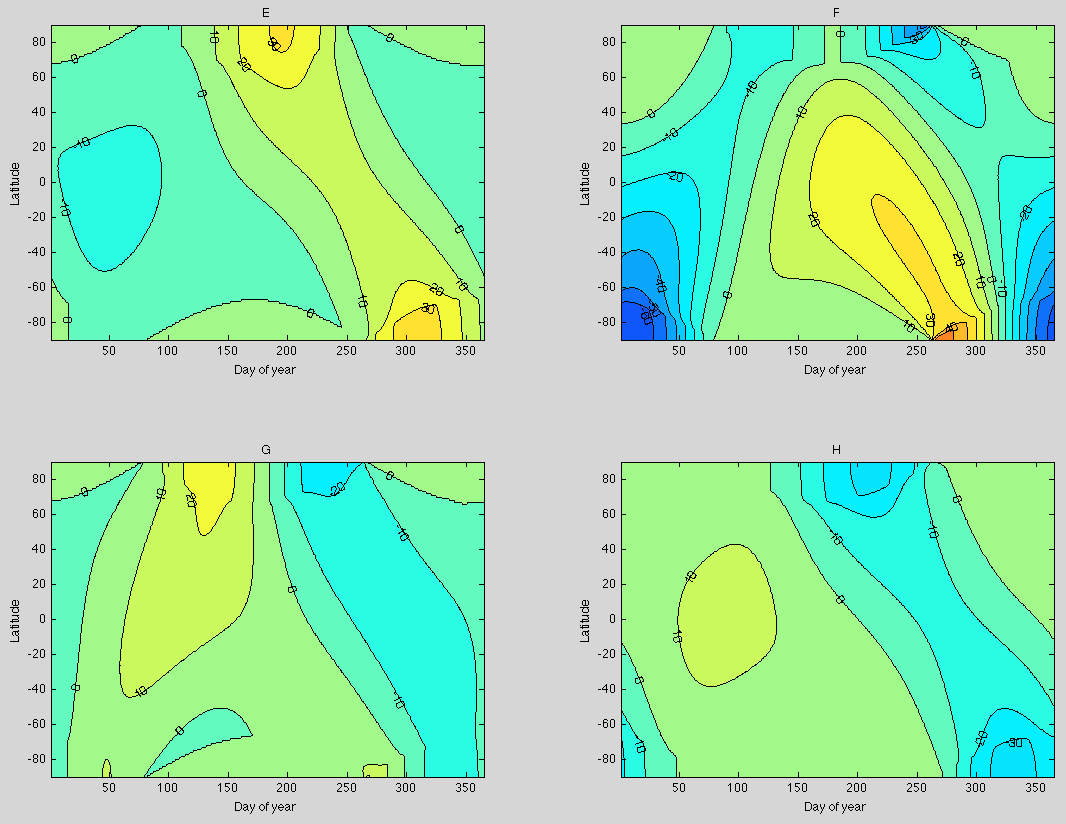
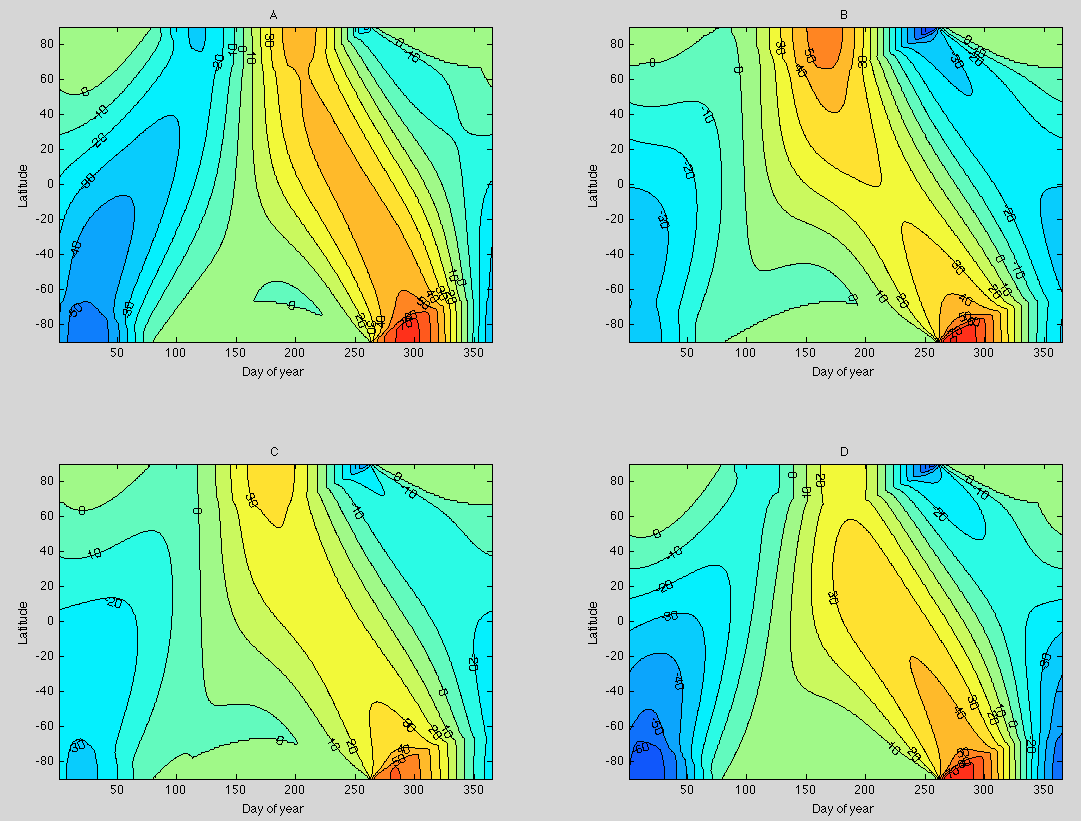
So I produced a few contour plots, showing the insolation anomaly by latitude and day of year compared with the present for 8 different years between the start of the last ice age (about 115 kyrs ago) and today.

The challenge for readers is to identify which graph corresponds to the end of the last ice age. And some kind of reason why you chose that graph.

I made them a little smaller so that they could be more easily compared – just click on each set to expand.

The x-axis (left to right) is day of year, and June 21st is about day 200 (actually it is 172, thanks to Climateer for pointing this out!). The y-axis (bottom to top) is the latitude. The colors represent the same in each graph and the contour lines are 10 W/m² apart.

ice-ages-part11-A-D-499px

Figures A – D – Click for larger view

ice-ages-part11-E-H-499px

Figures E – H – Click for larger view

Articles in the Series

Part One – An introduction

Part Two – Lorenz – one point of view from the exceptional E.N. Lorenz

Part Three – Hays, Imbrie & Shackleton – how everyone got onto the Milankovitch theory

Part Four – Understanding Orbits, Seasons and Stuff – how the wobbles and movements of the earth’s orbit affect incoming solar radiation

Part Five – Obliquity & Precession Changes – and in a bit more detail

Part Six – “Hypotheses Abound” – lots of different theories that confusingly go by the same name

Part Seven – GCM I – early work with climate models to try and get “perennial snow cover” at high latitudes to start an ice age around 116,000 years ago

Part Seven and a Half – Mindmap – my mind map at that time, with many of the papers I have been reviewing and categorizing plus key extracts from those papers

Part Eight – GCM II – more recent work from the “noughties” – GCM results plus EMIC (earth models of intermediate complexity) again trying to produce perennial snow cover

Part Nine – GCM III – very recent work from 2012, a full GCM, with reduced spatial resolution and speeding up external forcings by a factors of 10, modeling the last 120 kyrs

Part Ten – GCM IV – very recent work from 2012, a high resolution GCM called CCSM4, producing glacial inception at 115 kyrs

Eleven – End of the Last Ice age – latest data showing relationship between Southern Hemisphere temperatures, global temperatures and CO2

Twelve – GCM V – Ice Age Termination – very recent work from He et al 2013, using a high resolution GCM (CCSM3) to analyze the end of the last ice age and the complex link between Antarctic and Greenland

Thirteen – Terminator II – looking at the date of Termination II, the end of the penultimate ice age – and implications for the cause of Termination II

Fourteen – Concepts & HD Data – getting a conceptual feel for the impacts of obliquity and precession, and some ice age datasets in high resolution

Fifteen – Roe vs Huybers – reviewing In Defence of Milankovitch, by Gerard Roe

Sixteen – Roe vs Huybers II – remapping a deep ocean core dataset and updating the previous article

Seventeen – Proxies under Water I – explaining the isotopic proxies and what they actually measure

Eighteen – “Probably Nonlinearity” of Unknown Origin – what is believed and what is put forward as evidence for the theory that ice age terminations were caused by orbital changes

Nineteen – Ice Sheet Models I – looking at the state of ice sheet models

Read Full Post »

In Part Nine we looked at a GCM simulation over the last 120,000 years, quite an ambitious project, which had some mixed results. The biggest challenge is simply running a full GCM over such a long time frame. To do this, the model had a reduced spatial resolution, and “speeded” up all the forcings so that the model really ran over 1,200 years.

The forcings included ice sheet size/location/height, as well as GHGs in the atmosphere. In reality these are feedbacks, but GCMs are not currently able to produce them.

In this article we will look one of the latest GCMs but running over a “snapshot” period of about 700 years. This allows full spatial resolution, but has the downside of not covering anything like a full glacial cycle. The aim here is to run the model with the orbital conditions of 116 kyrs BP to see if perennial snow cover forms in the right locations. This is a similar project to what we covered with early GCMs in Part Seven – GCM I and work from around a decade ago in Part Eight – GCM II.

The paper has some very interesting results on the feedbacks which we will take a look at.

Jochum et al (2012)

The problem:

Models of intermediate complexity.. and flux- corrected GCMs have typically been able to simulate a connection between orbital forcing, temperature, and snow volume. So far, however, fully coupled, nonflux- corrected primitive equation general circulation models (GCMs) have failed to reproduce glacial inception, the cooling and increase in snow and ice cover that leads from the warm interglacials to the cold glacial periods.

Milankovitch (1941) postulated that the driver for this cooling is the orbitally induced reduction in Northern Hemisphere summertime insolation and the subsequent increase of perennial snow cover. The increased perennial snow cover and its positive albedo feedback are, of course, only precursors to ice sheet growth. The GCMs failure to recreate glacial inception, which indicates a failure of either the GCMs or of Milankovitch’s hypothesis.

Of course, if the hypothesis would be the culprit, one would have to wonder if climate is sufficiently understood to assemble a GCM in the first place. Either way, it appears that reproducing the observed glacial–interglacial changes in ice volume and temperature represents a good test bed for evaluating the fidelity of some key model feedbacks relevant to climate projections.

The potential causes for GCMs failing to reproduce inception are plentiful, ranging from numerics on the GCMs side to neglected feedbacks of land, atmosphere, or ocean processes on the theory side. It is encouraging, though, that for some GCMs it takes only small modifications to produce an increase in perennial snow cover (e.g., Dong and Valdes 1995). Nevertheless, the goal for the GCM community has to be the recreation of increased perennial snow cover with a GCM that has been tuned to the present-day climate, and is subjected to changes in orbital forcing only.

Their model:

The numerical experiments are performed using the latest version of the National Center for Atmospheric Research (NCAR) CCSM4, which consists of the fully coupled atmosphere, ocean, land, and sea ice models..

CCSM4 is a state-of-the-art climate model that has improved in many aspects from its predecessor CCSM3. For the present context, the most important improvement is the increased atmospheric resolution, because it allows for a more accurate representation of altitude and therefore land snow cover.

See Note 1 for some more model specifics from the paper. And a long time we looked at some basics of CCSM3 – Models, On – and Off – the Catwalk – Part Two.

Limitations of the model – no ice sheet module (as with the FAMOUS model in Part Nine):

The CCSM does not yet contain an ice sheet module, so we use snow accumulation as the main metric to evaluate the inception scenario. The snow accumulation on land is computed as the sum of snowfall, frozen rain, snowmelt, and removal of excess snow. Excess snow is defined as snow exceeding 1 m of water equivalent, approximately 3–5 m of snow.

This excess snow removal is a very crude parameterization of iceberg calving, and together with the meltwater the excess snow is delivered to the river network, and eventually added to the coastal surface waters of the adjacent ocean grid cells. Thus, the local ice sheet volume and the global fresh- water volume are conserved.

Problems of the model:

Another bias relevant for the present discussion is the temperature bias of the northern high-latitude land. As discussed in the next section, much of the CCSM4 response to orbital forcing is due to reduced summer melt of snow. A cold bias in the control will make it more likely to keep the summer temperature below freezing, and will overestimate the model’s snow accumulation. In the annual mean, northern Siberia and northern Canada are too cold by about 1ºC–2ºC, and Baffin Island by about 5ºC (Gent et al. 2011). The Siberian biases are not so dramatic, but it is quite unfortunate that Baffin Island, the nucleus of the Laurentide ice sheet, has one of the worst temperature biases in CCSM4. A closer look at the temperature biases in North America, though, reveals that the cold bias is dominated by the fall and winter biases, whereas during spring and summer Baffin Island is too cold by approximately 3ºC, and the Canadian Archipelago even shows a weak warm bias.

[Emphasis added, likewise with all bold text in quotes].

Their plan:

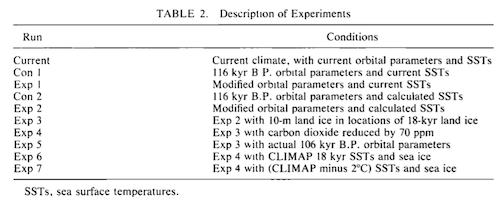
The subsequent sections will analyze and compare two different simulations: an 1850 control (CONT), in which the earth’s orbital parameters are set to the 1990 values and the atmospheric composition is fixed at its 1850 values; and a simulation identical to CONT, with the exception of the orbital parameters, which are set to the values of 115 kya (OP115). The atmospheric CO2 concentration in both experiments is 285 ppm.

The models were run for about 700 (simulated) years. They give some interesting metrics on why they can’t run a 120 kyr simulation:

This experimental setup is not optimal, of course. Ideally one would like to integrate the model from the last interglacial, approximately 126 kya ago, for 10 000 years into the glacial with slowly changing orbital forcing. However, this is not affordable; a 100-yr integration of CCSM on the NCAR supercomputers takes approximately 1 month and a substantial fraction of the climate group’s computing allocation.

Results

First of all, they do produce perennial snow cover at high latitudes.

The paper has a very good explanation of how the different climate factors go together in the high latitudes where we are looking to get perennial snow cover. It helps us see why doing stuff in your head, using basic energy balance models, and even running models of intermediate complexity (EMICs) cannot (with confidence) produce useful answers.

Let’s take a look.

Jochum et al 2012

Jochum et al 2012

Figure 1

This graph is comparing the annual solar radiation by latitude between 115 kyrs ago and today.

Incoming solar radiation –  black curve – notice the basic point that – at 115 kyrs ago the tropics have higher annual insolation while the high latitudes have lower annual insolation.

Our focus will be on the Northern Hemisphere north of 60ºN, which covers the areas of large cooling and increased snow cover. Compared to CONT [control], the annual average of the incoming radiation over this Arctic domain is smaller in OP115 by 4.3 W/m² (black line), but the large albedo reduces this difference at the TOA to only 1.9 W/m² (blue line, see also Table 1).

Blue shows the result when we take into account existing albedo – that is, because a lot of solar radiation is already reflected away in high latitudes, any changes in incoming radiation are reduced by the albedo effect (before albedo itself changes).

Green shows the result when we take into account changed albedo with the increased snow cover found in the 115 kyr simulation.

In CCSM4 this larger albedo in OP115 leads to a TOA clear-sky shortwave radiation that is 8.6 W/m² smaller than in CONT —more than 4 times the original signal.

The snow/ice–albedo feedback is then calculated as 6.7 W/m² (8.6–1.9 W/m²). Interestingly, the low cloud cover is smaller in OP115 than in CONT, reducing the difference in total TOA shortwave radiation by 3.1 to 5.5 W/m² (green line). Summing up, an initial forcing of 1.9 W/m² north of 60ºN, is amplified through the snow–ice–albedo feedback by 6.7 W/m², and damped through a negative cloud feedback by 3.1 W/m².

The summary table:

Jochum-2012-table-1

Because of the larger meridional temperature (Fig. 1a) and moisture gradient (Fig. 4a), the lateral atmospheric heat flux into the Arctic is increased from 2.88 to 3.00 PW. This 0.12 PW difference translates into an Arctic average of 3.1 W/m²; this is a negative feedback as large as the cloud feedback, and 6 times as large as the increase in the ocean meridional heat transport at 60ºN (next section).

Thus, the negative feedback of the clouds and the meridional heat transport almost compensate for the positive albedo feedback, leading to a total feedback of only 0.5 W/m². One way to look at these feedbacks is that the climate system is quite stable, with clouds and meridional transports limiting the impact of albedo changes. This may explain why some numerical models have difficulties creating the observed cooling associated with the orbital forcing.

I think it’s important to note that they get their result through a different mechanism from one of the papers we reviewed in Part Nine:

Thus, in contrast to the results of Vettoretti and Peltier (2003) the increase in snowfall is negligible compared to the reduction in snowmelt.

Their result:

The global net difference in melting and snowfall between OP115 and CONT leads to an implied snow accumulation that is equivalent to a sea level drop of 20 m in 10,000 years, some of it being due to the Baffin Island cold bias. This is less than the 50-m estimate based on sea level reconstructions between present day and 115 kya, but nonetheless it suggests that the model response is of the right magnitude.

Atlantic Meridional Overturning Current (AMOC)

This current has a big impact on the higher latitudes of the Atlantic because it brings warmer water from the tropics.

The meridional heat transport of the AMOC is a major source of heat for the northern North Atlantic Ocean, but it is also believed to be susceptible to small perturbations.

This raises the possibility that the AMOC amplifies the orbital forcing, or even that this amplification is necessary for the Northern Hemisphere glaciations and terminations. In fact, JPML demonstrates that at least in one GCM changes in orbital forcing can lead to a weakening of the MOC and a subsequent large Northern Hemisphere cooling. Here, we revisit the connection between orbital forcing and AMOC strength with the CCSM4, which features improved physics and higher spatial resolution compared to JPML.

In essence they found a limited change in the AMOC in this study. Interested readers can review the free paper. This is an important result because earlier studies with lower resolution models or GCMs that are not fully coupled have often found a strong role for the MOC in amplifying changes.

Conclusion

This is an interesting paper, important because it uses a full resolution state-of-the-art GCM to simulate perennial snow cover at 115 kys BP, simply with pre-industrial GHG concentrations and insolation from 115 kyrs BP.

The model has a cold bias (and an increased moisture bias) in high latitude NH regions and this raises questions on the significance of the result (to my skeptical mind):

  • Can a high resolution AOGCM with no high latitude cold bias reproduce perennial snow cover with just pre-industrial GHG concentration and orbital forcing from 115 kyrs ago?
  • Can this model, with its high latitude cold bias, reproduce a glacial termination?

That doesn’t mean the paper isn’t very valuable and the authors have certainly not tried to gloss over the shortcomings of the model – in fact, they have highlighted them.

What the paper also reveals – in conjunction with what we have seen from earlier articles – is that as we move through generations and complexities of models we can get success, then a better model produces failure, then a better model again produces success. Also we noted that whereas the 2003 model (also cold-biased) of Vettoretti & Peltier found perennial snow cover through increased moisture transport into the critical region (which they describe as an “atmospheric–cryospheric feedback mechanism”), this more recent study with a better model found no increase in moisture transport.

The details of how different models achieve the same result is important. I don’t think any climate scientist would disagree, but it means that multiple papers with “success” may not equate to “success for all” and may not equate to “general success”. The details need to be investigated.

This 2012 paper also demonstrates the importance of all of the (currently known) feedbacks – increased albedo from increased snow cover is almost wiped out by negative feedbacks.

Lastly, the paper also points out that their model, run over 700 years, fails to produce significant cooling of the Southern Polar region:

More importantly, though, the lack of any significant Southern Hemisphere polar response needs explaining (Fig. 1). While Petit et al. (1999) suggests that Antarctica cooled by about 10ºC during the last inception, the more recent high-resolution analysis by Jouzel et al. (2007) suggest that it was only slightly cooler than today (less than 3ºC at the European Project for Ice Coring in Antarctica (EPICA) Dome C site on the Antarctic Plateau). Of course, there are substantial uncertainties in reconstructing Antarctic temperatures..

I don’t have any comment on this particular point, lacking much understanding of recent work in dating and correlating EPICA (Antarctic ice core) with Greenland ice cores.

Articles in the Series

Part One – An introduction

Part Two – Lorenz – one point of view from the exceptional E.N. Lorenz

Part Three – Hays, Imbrie & Shackleton – how everyone got onto the Milankovitch theory

Part Four – Understanding Orbits, Seasons and Stuff – how the wobbles and movements of the earth’s orbit affect incoming solar radiation

Part Five – Obliquity & Precession Changes – and in a bit more detail

Part Six – “Hypotheses Abound” – lots of different theories that confusingly go by the same name

Part Seven – GCM I – early work with climate models to try and get “perennial snow cover” at high latitudes to start an ice age around 116,000 years ago

Part Seven and a Half – Mindmap – my mind map at that time, with many of the papers I have been reviewing and categorizing plus key extracts from those papers

Part Eight – GCM II – more recent work from the “noughties” – GCM results plus EMIC (earth models of intermediate complexity) again trying to produce perennial snow cover

Part Nine – GCM III – very recent work from 2012, a full GCM, with reduced spatial resolution and speeding up external forcings by a factors of 10, modeling the last 120 kyrs

Part Ten – GCM IV – very recent work from 2012, a high resolution GCM called CCSM4, producing glacial inception at 115 kyrs

Pop Quiz: End of An Ice Age – a chance for people to test their ideas about whether solar insolation is the factor that ended the last ice age

Eleven – End of the Last Ice age – latest data showing relationship between Southern Hemisphere temperatures, global temperatures and CO2

Twelve – GCM V – Ice Age Termination – very recent work from He et al 2013, using a high resolution GCM (CCSM3) to analyze the end of the last ice age and the complex link between Antarctic and Greenland

Thirteen – Terminator II – looking at the date of Termination II, the end of the penultimate ice age – and implications for the cause of Termination II

Fourteen – Concepts & HD Data – getting a conceptual feel for the impacts of obliquity and precession, and some ice age datasets in high resolution

Fifteen – Roe vs Huybers – reviewing In Defence of Milankovitch, by Gerard Roe

Sixteen – Roe vs Huybers II – remapping a deep ocean core dataset and updating the previous article

Seventeen – Proxies under Water I – explaining the isotopic proxies and what they actually measure

Eighteen – “Probably Nonlinearity” of Unknown Origin – what is believed and what is put forward as evidence for the theory that ice age terminations were caused by orbital changes

Nineteen – Ice Sheet Models I – looking at the state of ice sheet models

References

True to Milankovitch: Glacial Inception in the New Community Climate System Model, Jochum, Jahn, Peacock, Bailey, Fasullo, Kay, Levis & Otto-Bliesner, Journal of Climate (2012) – free paper

Notes

Note 1 – more on the model:

The ocean component has a horizontal resolution that is constant at 1.125º in longitude and varies from 0.27º at the equator to approximately 0.7º in the high latitudes. In the vertical there are 60 depth levels; the uppermost layer has a thickness of 10 m and the deepest layer has a thickness of 250 m. The atmospheric component uses a horizontal resolution of 0.9º x 1.25º with 26 levels in the vertical. The sea ice model shares the same horizontal grid as the ocean model and the land model is on the same horizontal grid as the atmospheric model.

Read Full Post »

In Part Seven we looked at some early GCM work – late 80’s to mid 90’s. In Part Eight we looked at some papers from the “Noughties” – atmospheric GCMs with prescribed ocean temperatures and some intermediate complexity models.

All of these papers were attempting to do the most fundamental of ice age inception – perennial snow cover at high latitudes. Perennial snow cover may lead to permanent ice sheets – but it may not. This requires an ice sheet model which handles the complexities of how ice sheets grow, collapse, slide and transfer heat.

Given the computational limitations of models even running a model to produce (or not) the basics of perennial snow cover has not been a trivial exercise, but a full atmospheric ocean GCM with an ice sheet model run for 130,000 years was not a possibility.

In this article we will look at a very recent paper, where fully coupled GCMs are used. “Fully coupled” means an atmospheric model and an ocean model working in tandem – transferring heat, moisture and momentum.

Smith & Gregory (2012)

The problem:

It is generally accepted that the timing of glacials is linked to variations in solar insolation that result from the Earth’s orbit around the sun (Hays et al. 1976; Huybers and Wunsch 2005). These solar radiative anomalies must have been amplified by feedback processes within the climate system, including changes in atmospheric greenhouse gas (GHG) concentrations (Archer et al. 2000) and ice-sheet growth (Clark et al. 1999), and whilst hypotheses abound as to the details of these feedbacks, none is without its detractors and we cannot yet claim to know how the Earth system produced the climate we see recorded in numerous proxy records. This is of more than purely intellectual interest: a full understanding of the carbon cycle during a glacial cycle, or the details of how regional sea-level changed as the ice-sheets waxed and waned would be of great use in accurately predicting the future climatic effects of anthropogenic CO2 emissions, as we might expect many of the same fundamental feedbacks to be at play in both scenarios..

..The multi-millennial timescales involved in modelling even a single glacial cycle present an enormous challenge to comprehensive Earth system models based on coupled atmosphere–ocean general circulation models (AOGCMs). Due to the computational expense involved, AOGCMs are usually limited to runs of a few hundred years at most, and their use in paleoclimate studies has generally been through short, ‘‘snapshot’’ runs of specific periods of interest.

Transient simulations of glacial cycles have hitherto only been run with models where important climate processes such as clouds or atmospheric moisture transports are more crudely parameterised than in an AOGCM or omitted entirely. The heavy restrictions on the feedbacks involved in such models limit what we can learn of the evolution of the climate from them, particularly in paleoclimate states that may be significantly different from the better-known modern climates which the models are formulated to reproduce. Simulating past climate states in AOGCMs and comparing the results to climate reconstructions based on proxies also allows us to test the models’ sensitivities to climate forcings and build confidence in their predictions of future climate.

[Emphasis added. And likewise for all bold text in future citations].

Their model:

For these simulations we use FAMOUS (FAst Met. Office and UK universities Simulator), a low resolution version of the Hadley Centre Coupled Model (HadCM3) AOGCM. FAMOUS has approximately half the spatial resolution of HadCM3, which reduces the computational cost of the model by a factor of 10.

[For more on the model, see note 1]

Their plan:

Here we present the first AOGCM transient simulations of the whole of the last glacial cycle. We have reduced the computational expense of these simulations by using FAMOUS, an AOGCM with a relatively low spatial resolution, and by accelerating the boundary conditions that we apply by a factor of ten, such that the 120,000 year cycle occurs in 12,000 years. We investigate how the influences of orbital variations in solar irradiance, GHGs and northern hemisphere ice-sheets combine to affect the evolution of the climate.

There is a problem with the speeding up process – the oceans respond on completely different timescales from the atmosphere. Some ocean processes take place over thousands of years, so whether or not the acceleration approach produces a real climate is open to discussion.

Their approach:

The aim of this study is to investigate the physical climate of the atmosphere and ocean through the last glacial cycle. Along with changes in solar insolation that result from variations in the Earth’s orbit around the sun, we treat northern hemisphere ice-sheets and changes in the GHG composition of the atmosphere as external forcing factors of the climate system which we specify as boundary conditions, either alone or in combination. Changes in solar activity, Antarctic ice, surface vegetation, or sea- level and meltwater fluxes implied by the evolving ice- sheets are not included in these simulations. Our experimental setup is thus somewhat simplified, with certain potential climate feedbacks excluded. Although partly a matter of necessity due to missing or poorly modelled processes in this version of FAMOUS, this simplification allows us to more clearly see the influence of the specified forcings, as well as ensuring that the simulations stay close to the real climate.

Let’s understand the key points of this modeling exercise:

  1. A full GCM is used, but at reduced spatial resolution
  2. The forcings are speeded up by a factor of 10 over their real life versions
  3. Two of the critical forcings applied are actually feedbacks that need to be specified to make the model work – that is, the model is not able to calculate these critical feedbacks (CO2 concentration and ice sheet extent)
  4. Five different simulations were run to see the effect of different factors:
    • Orbital forcing only applied (ORB)
    • GHG only forcing applied (GHG)
    • Ice sheet extent only applied (ICE)
    • All of the above with 2 different ice sheet reconstructions (ALL-ZH & ALL-5G – note that ALL-ZH has the same ice sheet reconstruction as ICE, while ALL-5G has a different one)

Here are the modeled temperature results compared against actual (Black) for Antarctica and Greenland:

From Smith & Gregory 2012

From Smith & Gregory 2012

Figure 1

Lots of interesting things to note here.

When we look at Antarctica we see that orbital forcing alone and Northern hemisphere ice sheets alone do little or nothing to model past temperatures. But GHG concentrations by themselves as a forcing provide a modeled temperature that is broadly similar to the last 120kyrs – apart from higher frequency temperature variations, something we return to later. When we add the NH ice sheets we get an even better match. I’m surprised that the ice sheets don’t have more impact given that amount of solar radiation they reflect.

Both GHGs and ice sheets can be seen as positive feedbacks in reality (although in this model they are specified), and for the southern polar region GHGs have a much bigger effect.

Looking at Greenland, we see that orbital forcing once again has little effect on its own, while GHGs and ice sheets alone have similar effects but individually are a long way off the actual climate. Combining into all forcings, we see a reasonable match with actual temperatures with one sheet reconstruction and not so great a match for the other. This implies – for other models that try to model dynamic ice sheets (rather than specify) the accuracy may be critical for modeling success.

We again see that higher frequency temperature variations are not modeled at all well, and even some lower frequency variations – for example the period from 110 kyr to 85 kyr has some important missing variability (in the model).

The authors note:

The EPICA data [Antarctica] shows that, relative to their respective longer term trends, temperature fell more rapidly than CO2 during this period [120 – 110 kyrs], but in our experiments simulated Antarctic temperatures drop in line with CO2. This suggests that there is an important missing feedback in our model, or that our model is perhaps over-sensitive to CO2, and under-sensitive to one of the other forcing factors. Tests of the model where the forcings were not artificially accelerated rule out the possibility of the acceleration being a factor.

Abrupt Climate Change

What about the higher frequency temperature signals? The Greenland data has a much larger magnitude than Antarctica for this frequency, but neither are really reproduced in the model.

The other striking difference between the model and the NGRIP reconstruction is the model’s lack of the abrupt, millennial scale events of large amplitude in the ice-core data. It is thought that periodic surges of meltwater from the northern hemisphere ice-sheets and subsequent disruption of oceanic heat transports are involved in these events (Bond et al. 1993; Blunier et al. 1998), and the lack of ice-sheet meltwater runoff in our model is probably a large part of the reason why we do not simulate them.

The authors then discuss this a little more as the story is not at all settled and conclude:

Taken together, the lack of both millennial scale warm events in the south and abrupt events in the north strongly imply a missing feedback of some importance in our model.

CO2 Feedback

The processes by which sufficient quantities of carbon are drawn down into the glacial ocean to produce the atmospheric CO2 concentrations seen in ice-core records are not well understood, and have to date not been successfully modelled by a realistic coupled model. FAMOUS, as used in this study, does have a simple marine biogeochemistry model, although it does not respond to the forcings in these simulations in a way that would imply an increased uptake of carbon. A further FAMOUS simulation with interactive atmospheric CO2 did not produce any significant changes in atmospheric CO2 during the early glacial when forced with orbital variations and a growing northern hemisphere ice-sheet.

Accurately modelling a glacial cycle with interactive carbon chemistry requires a significant increase in our understanding of the processes involved, not simply the inclusion of a little extra complexity to the current model.

Conclusion

This is a very interesting paper, highlighting some successes, computational limitations, poorly understand feedbacks and missing feedbacks in climate models.

The fact that 120 kyrs of climate history has been simulated with a full GCM is great to see.

The lack of abrupt climate change in the simulation, the failure to track the fast rate of temperature fall at the start of ice age inception and the lack of ability to model key feedbacks all indicate that climate models – at least as far as the ice ages are concerned – are at a rudimentary stage.

(This doesn’t mean they aren’t hugely sophisticated, it just means climate is a little bit tricky).

Articles in the Series

Part One – An introduction

Part Two – Lorenz – one point of view from the exceptional E.N. Lorenz

Part Three – Hays, Imbrie & Shackleton – how everyone got onto the Milankovitch theory

Part Four – Understanding Orbits, Seasons and Stuff – how the wobbles and movements of the earth’s orbit affect incoming solar radiation

Part Five – Obliquity & Precession Changes – and in a bit more detail

Part Six – “Hypotheses Abound” – lots of different theories that confusingly go by the same name

Part Seven – GCM I – early work with climate models to try and get “perennial snow cover” at high latitudes to start an ice age around 116,000 years ago

Part Seven and a Half – Mindmap – my mind map at that time, with many of the papers I have been reviewing and categorizing plus key extracts from those papers

Part Eight – GCM II – more recent work from the “noughties” – GCM results plus EMIC (earth models of intermediate complexity) again trying to produce perennial snow cover

Part Ten – GCM IV – very recent work from 2012, a high resolution GCM called CCSM4, producing glacial inception at 115 kyrs

Pop Quiz: End of An Ice Age – a chance for people to test their ideas about whether solar insolation is the factor that ended the last ice age

Eleven – End of the Last Ice age – latest data showing relationship between Southern Hemisphere temperatures, global temperatures and CO2

Twelve – GCM V – Ice Age Termination – very recent work from He et al 2013, using a high resolution GCM (CCSM3) to analyze the end of the last ice age and the complex link between Antarctic and Greenland

Thirteen – Terminator II – looking at the date of Termination II, the end of the penultimate ice age – and implications for the cause of Termination II

Fourteen – Concepts & HD Data – getting a conceptual feel for the impacts of obliquity and precession, and some ice age datasets in high resolution

Fifteen – Roe vs Huybers – reviewing In Defence of Milankovitch, by Gerard Roe

Sixteen – Roe vs Huybers II – remapping a deep ocean core dataset and updating the previous article

Seventeen – Proxies under Water I – explaining the isotopic proxies and what they actually measure

Eighteen – “Probably Nonlinearity” of Unknown Origin – what is believed and what is put forward as evidence for the theory that ice age terminations were caused by orbital changes

Nineteen – Ice Sheet Models I – looking at the state of ice sheet models

References

The last glacial cycle: transient simulations with an AOGCM, Smith & Gregory, Climate Dynamics (2012)

Notes

Note 1: FAMOUS

The ocean component is based on the rigid-lid Cox-Bryan model (Pacanowski et al. 1990), and is run at a resolution of 2.5° latitude by 3.75° longitude, with 20 vertical levels. The atmosphere is based on the primitive equations, with a resolution of 5° latitude by 7.5° longitude with 11 vertical levels (see Table 1).

Version XDBUA of FAMOUS (simply FAMOUS hereafter, see Smith et al. (2008) for full details) has a preindustrial control climate that is reasonably similar to that of HadCM3, although FAMOUS has a high latitude cold bias in the northern hemisphere during winter of about 5°C with respect to HadCM3 (averaged north of 40°N), and a consequent overestimate of winter sea-ice extent in the North Atlantic.

The global climate sensitivity of FAMOUS to increases in atmospheric CO2 is, however, similar to that of HadCM3.

FAMOUS incorporates a number of differences from HadCM3 intended to improve its climate simulation—for example, Iceland has been removed (Jones 2003) to encourage more northward ocean heat transport in the Atlantic. Smith and Gregory (2009) demonstrate that the sensitivity of the Atlantic meridional overturning circulation (AMOC) to perturbations in this version of FAMOUS is in the middle of the range when compared to many other coupled climate models. The model used in this study differs from XDBUA FAMOUS in that two technical bugs in the code have been fixed. Latent and sensible heat fluxes from the ocean were mistakenly interchanged in part of the coupling routine, and snow falling on sea-ice at coastal points was lost from the model. Correction of these errors results in an additional surface cold bias of a degree or so around high latitude coastal areas with respect to XDBUA, but no major changes to the model climatology. In addition, the basic land topography used in these runs was interpolated from the modern values in the ICE-5G dataset (Peltier 2004), which differs somewhat from the US Navy-derived topography used in Smith et al. (2008) and HadCM3.

Read Full Post »

In Part Seven we looked at a couple of papers from 1989 and 1994 which attempted to use GCMs to “start an ice age”. The evolution of the “climate science in progress” has been:

  1. Finding indications that the timing of ice age inception was linked to redistribution of solar insolation via orbital changes – possibly reduced summer insolation in high latitudes (Hays et al 1976 – discussed in Part Three)
  2. Using simple energy balance models to demonstrate there was some physics behind the plausible ideas (we saw a subset of the plausible ideas in Part Six – Hypotheses Abound)
  3. Using a GCM with the starting conditions of around 115,000 years ago to see if “perennial snow cover” could be achieved at high latitudes that weren’t ice covered in the last inter-glacial – i.e., can we start a new ice age?

Why, if an energy balance model can “work”, i.e., produce perennial snow cover to start a new ice age, do we need to use a more complex model? As Rind and his colleagues said in their 1989 paper:

Various energy balance climate models have been used to assess how much cooling would be associated with changed orbital parameters.. With the proper tuning of parameters, some of which is justified on observational grounds, the models can be made to simulate the gross glacial/interglacial climate changes. However, these models do not calculate from first principles all the various influences on surface air temperature noted above, nor do they contain a hydrologic cycle which would allow snow cover to be generated or increase. The actual processes associated with allowing snow cover to remain through the summer will involve complex hydrologic and thermal influences, for which simple models can only provide gross approximations.

[Emphases added – and likewise in all following quotations, bold is emphasis added]. So interestingly, moving to a more complex model with better physics showed that there was a problem with (climate models) starting an ice age. Still, that was early GCMs with much more limited computing power. In this article we will look at the results a decade or so later.

Reviews

We’ll start with a couple of papers that include excellent reviews of “the problem so far”, one in 2002 by Yoshimori and his colleagues and one in 2004 by Vettoretti & Peltier. Yoshimori et al 2002:

One of the fundamental and challenging issues in paleoclimate modelling is the failure to capture the last glacial inception (Rind et al. 1989)..

..Between 118 and 110 kaBP, the sea level records show a rapid drop of 50 – 80 m from the last interglacial, which itself had a sea level only 3 – 5 m higher than today. This sea level lowering, as a reference, is about half of the last glacial maximum. ..As the last glacial inception offers one of few valuable test fields for the validation of climate models, particularly atmospheric general circulation models (AGCMs), many studies regarding this event have been conducted.

Phillipps & Held (1994) and Gallimore & Kutzbach (1995).. conducted a series of sensitivity experiments with respect to orbital parameters by specifying several extreme orbital configurations. These included a case with less obliquity and perihelion during the NH winter, which produces a cooler summer in the NH. Both studies came to a similar conclusion that although a cool summer orbital configuration brings the most favorable conditions for the development of permanent snow and expansion of glaciers, orbital forcing alone cannot account for the permanent snow cover in North America and Europe.

This conclusion was confirmed by Mitchell (1993), Schlesinger & Verbitsky (1996), and Vavrus (1999).. ..Schlesinger & Verbitsky (1996), integrating an ice sheet-asthenosphere model with AGCM output, found that a combination of orbital forcing and greenhouse forcing by reduced CO2 and CH4 was enough to nucleate ice sheets in Europe and North America. However, the simulated global ice volume was only 31% of the estimate derived from proxy records.

..By using a higher resolution model, Dong & Valdes (1995) simulated the growth of perennial snow under combined orbital and CO2 forcing. As well as the resolution of the model, an important difference between their model and others was the use of “envelope orography” [playing around with the height of land].. found that the changes in sea surface temperature due to orbital perturbations played a very important role in initiating the Laurentide and Fennoscandian ice sheets.

And as a note on the last quote, it’s important to understand that these studies were with an Atmospheric GCM, not an Atmospheric Ocean GCM – i.e., a model of the atmosphere with some prescribed sea surface temperatures (these might be from a separate run using a simpler model, or from values determined from proxies). The authors then comment on the potential impact of vegetation:

..The role of the biosphere in glacial inception has been studied by Gallimore & Kutzbach (1996), de Noblet et al. (1996), and Pollard and Thompson (1997).

..Gallimore & Kutzbach integrated an AGCM with a mixed layer ocean model under five different forcings:  1) control; 2) orbital; 3) #2 plus CO2; 4) #3 plus 25% expansion of tundra based on the study of Harrison et al. (1995); and (5) #4 plus further 25% expansion of tundra. The effect of the expansion of tundra through a vegetation-snow masking feedback was approximated by increasing the snow cover fraction. In only the last case was perennial snow cover seen..

..Pollard and Thompson (1997) also conducted an interactive vegetation and AGCM experiment under both orbital and CO2 forcing. They further integrated a dynamic ice-sheet model for 10 ka under the surface mass balance calculated from AGCM output using a multi-layer snow/ice-sheet surface column model on the grid of the dynamical ice-sheet model including the effect of refreezing of rain and meltwater. Although their model predicted the growth of an ice sheet over Baffin Island and the Canadian Archipelago, it also predicted a much faster growth rate in north western Canada and southern Alaska, and no nucleation was seen on Keewatin or Labrador [i.e. the wrong places]. Furthermore, the rate of increase of ice volume over North America was an order of magnitude less than that estimated from proxy records.

They conclude:

It is difficult to synthesise the results of these earlier studies since each model used different parameterisations of unresolved physical processes, resolution, and had different control climates as well as experimental design.

They summarize that results to date indicate that orbital forcing alone nor CO2  alone can explain glacial inception, and the combined effects are not consistent. And the difficulty appears to relate to the resolution of the model or feedback from the biosphere (vegetation).

A couple of years later Vettoretti & Peltier (2004) had a good review at the start of their paper.

Initial attempts to gain deeper understanding of the nature of the glacial–interglacial cycles involved studies based upon the use of simple energy balance models (EBMs), which have been directed towards the simulation of perennial snow cover under the influence of appropriately modified orbital forcing (e.g. Suarez and Held, 1979).

Analyses have since evolved such that the models of the climate system currently employed include explicit coupling of ice sheets to the EBM or to more complete AGCM models of the atmosphere.

The most recently developed models of the complete 100 kyr iceage cycle have evolved to the point where three model components have been interlinked, respectively, an EBM of the atmosphere that includes the influence of ice-albedo feedback including both land ice and sea ice, a model of global glaciology in which ice sheets are forced to grow and decay in response to meteorologically mediated changes in mass balance, and a model of glacial isostatic adjustment, through which process the surface elevation of the ice sheet may be depressed or elevated depending upon whether accumulation or ablation is dominant..

..Such models have also been employed to investigate the key role that variations in atmospheric carbon dioxide play in the 100 kyr cycle, especially in the transition out of the glacial state (Tarasov and Peltier, 1997; Shackleton, 2000). Since such models are rather efficient in terms of the computer resources required to integrate them, they are able to simulate the large number of glacial– interglacial cycles required to understand model sensitivities.

There has also been a movement within the modelling community towards the use of models that are currently referred to as earth models of intermediate complexity (EMICs) which incorporate sub-components that are of reduced levels of sophistication compared to the same components in modern Global ClimateModels (GCMs). These EMICs attempt to include representations of most of the components of the real Earth system including the atmosphere, the oceans, the cryosphere and the biosphere/carbon cycle (e.g. Claussen, 2002). Such models have provided, and will continue to provide, useful insight into long-term climate variability by making it possible to perform a large number of sensitivity studies designed to investigate the role of various feedback mechanisms that result from the interaction between the components that make up the climate system (e.g. Khodri et al., 2003).

Then the authors comment on the same studies and issues covered by Yoshimori et al, and additionally on their own 2003 paper and another study. On their own research:

Vettoretti and Peltier (2003a), more recently, have demonstrated that perennial snow cover is achieved in a recalibrated version of the CCCma AGCM2 solely as a consequence of orbital forcing when the atmospheric CO2 concentration is fixed to the pre-industrial level as constrained by measurements on air bubbles contained in the Vostok ice core (Petit et al., 1999).

This AGCM simulation demonstrated that perennial snow cover develops at high northern latitudes without the necessity of including any feedbacks due to vegetation or other effects. In this work, the process of glacial inception was analysed using three models having three different control climates that were, respectively, the original CCCma cold biased model, a reconfigured model modified so as to be unbiased, and a model that was warm biased with respect to the modern set of observed AMIP2 SSTs.. ..Vettoretti and Peltier (2003b) suggested a number of novel feedback mechanisms to be important for the enhancement of perennial snow cover.

In particular, this work demonstrated that successively colder climates increased moisture transport into glacial inception sensitive regions through increased baroclinic eddy activity at mid- to high latitudes. In order to assess this phenomenon quantitatively, a detailed investigation was conducted of changes in the moisture balance equation under 116 ka BP orbital forcing for the Arctic polar cap. As well as illustrating the action of a ‘‘cyrospheric moisture pump’’, the authors also proposed that the zonal asymmetry of the inception process at high latitudes, which has been inferred on the basis of geological observations, is a consequence of zonally heterogeneous increases and decreases of the northwards transport of heat and moisture.

And they go on to discuss other papers with an emphasis on moisture transport poleward. Now we’ll take a look at some work from that period.

Newer GCM work

Yoshimori et al 2002

Their models – an AGCM (atmospheric GCM) with 116kyrs orbital conditions and a) present day SSTs b) 116 kyrs SSTs. Then another model run with the above conditions and changed vegetation based on temperature (if the summer temperature is less than -5ºC the vegetation type is changed to tundra). Because running a “fully coupled” GCM (atmosphere and ocean) over a long time period required too much computing resources a compromise approach was used.

The SSTs were calculated using an intermediate complexity model, with a simple atmospheric model and a full ocean model (including sea ice) – and by running the model for 2000 years (oceans have a lot of thermal inertia). The details of this is described in section 2.1 of their paper. The idea is to get some SSTs that are consistent between ocean and atmosphere.

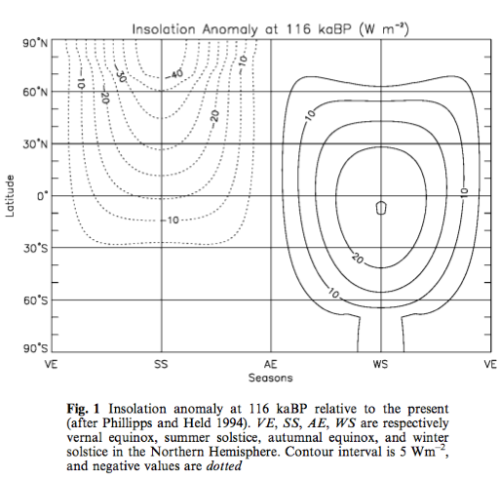
The SSTs are then used as boundary conditions for a “proper” atmospheric GCM run over 10 years – this is described in section 2.2 of their paper. The insolation anomaly, with respect to present day: Yoshimori-2002-Fig1-insolation-anomaly-116kaBP
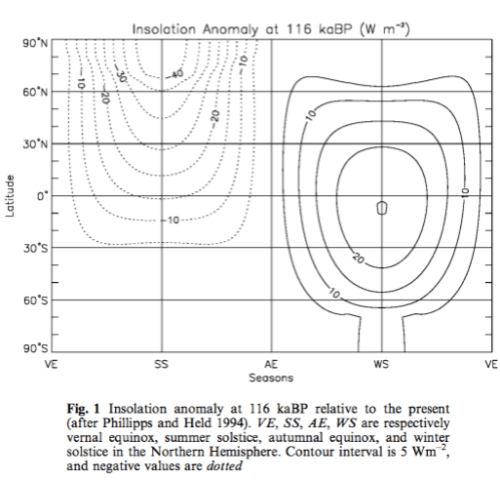
Figure 1

They use 240 ppm CO2 for the 116 kyr condition, as “the lowest probably equivalent CO2 level” (combining radiative forcing of CO2 and CH4). This equates to a reduction of 2.2 W/m² of radiative forcing. The SSTs calculated from the preliminary model are colder globally by 1.1ºC for the 116 kyr condition compared to the present day SST run. This is not due to the insolation anomaly, which just “redistributes” solar energy, it is due to the lower atmospheric CO2 concentration. The 116kyr SST in the northern North Atlantic is about 6ºC colder. This is due to the lower insolation value in summer plus a reduction in the MOC (note 1). The results of their work:

  • with modern SSTs, orbital and CO2 values from 116 kyrs – small extension of perennial snow cover
  • with calculated 116 kyr SST, orbital and CO2 values – a large extension in perennial snow cover into Northern Alaska, eastern Canada and some other areas
  • with vegetation changes (tundra) added – further extension of snow cover north of 60º

They comment (and provide graphs) that increased snow cover is partly from reduced snow melt but also from additional snowfall. This is the case even though colder temperatures generally favor less precipitation.

Contrary to the earlier ice age hypothesis, our results suggest that the capturing of glacial inception at 116kaBP requires the use of “cooler” sea surface conditions than those of the present climate. Also, the large impact of vegetation change on climate suggests that the inclusion of vegetation feedback is important for model validation, at least, in this particular period of Earth history.

What we don’t find out is why their model produces perennial snow cover (even without vegetation changes) where earlier attempts failed. What appears unstated is that although the “orbital hypothesis” is “supported” by the paper, the necessary conditions are colder sea surface temperatures induced by much lower atmospheric CO2. Without the lower CO2 this model cannot start an ice age. And an additional point to note, Vettoretti & Peltier 2004, say this about the above paper:

The meaningfulness of these results, however, remain to be seen as the original CCCma AGCM2 model is cold biased in summer surface temperature at high latitudes and sensitive to the low value of CO2 specified in the simulations.

Vettoretti & Peltier 2003

This is the paper referred to by their 2004 paper.

This simulation demonstrates that entry into glacial conditions at 116 kyr BP requires only the introduction of post-Eemian orbital insolation and standard preindustrial CO2 concentrations

Here are the seasonal and latitudinal variations in solar TOA of 116 kyrs ago vs today:
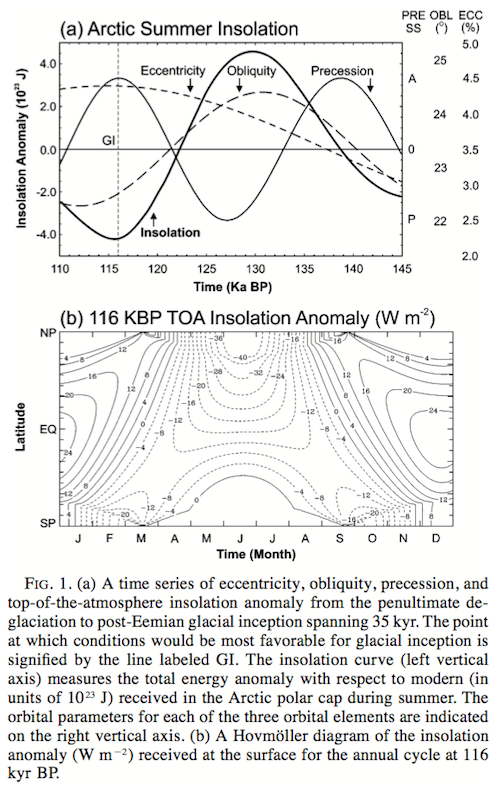
From Vettoretti & Peltier 2003

From Vettoretti & Peltier 2003

The essence of their model testing was they took an atmospheric GCM coupled to prescribed SSTs – for three different sets of SSTs – with orbital and GHG conditions from 116 kyrs BP and looked to see if perennial snow cover occurred (and where):

The three 116 kyr BP experiments demonstrated that glacial inception was successfully achieved in two of the three simulations performed with this model.

The warm-biased experiment delivered no perennial snow cover in the Arctic region except over central Greenland.

The cold-biased 116 kyr BP experiment had large portions of the Arctic north of 608N latitude covered in perennial snowfall. Strong regions of accumulation occurred over the Canadian Arctic archipelago and eastern and central Siberia. The accumulation over eastern Siberia appears to be excessive since there is little evidence that eastern Siberia ever entered into a glacial state. The accumulation pattern in this region is likely a result of the excessive precipitation in the modern simulation.

They also comment:

All three simulations are characterized by excessive summer precipitation over the majority of the polar land areas. Likewise, a plot of the annual mean precipitation in this region of the globe (not shown) indicates that the CCCma model is in general wet biased in the Arctic region. It has previously been demonstrated that the CCCma GCMII model also has a hydrological cycle that is more vigorous than is observed (Vettoretti et al. 2000b).

I’m not clear how much the model bias of excessive precipitation also affects their result of snow accumulation in the “right” areas.

In Part II of their paper they dig into the details of the changes in evaporation, precipitation and transport of moisture into the arctic region.

Crucifix & Loutre 2002

This paper (and the following paper) used an EMIC – an intermediate complexity model – which is a trade off model that has courser resolution, simpler parameterization but consequently much faster run time  – allowing for lots of different simulations over much longer time periods than can be done with a GCM. The EMICs are also able to have coupled biosphere, ocean, ice sheets and atmosphere – whereas the GCM runs we saw above had only an atmospheric GCM with some method of prescribing sea surface temperatures.

This study addresses the mechanisms of climatic change in the northern high latitudes during the last interglacial (126–115 kyr BP) using the earth system model of intermediate complexity ‘‘MoBidiC’’.

Two series of sensitivity experiments have been performed to assess (a) the respective roles played by different feedbacks represented in the model and (b) the respective impacts of obliquity and precession..

..MoBidiC includes representations for atmosphere dynamics, ocean dynamics, sea ice and terrestrial vegetation. A total of ten transient experiments are presented here..

..The model simulates important environmental changes at northern high latitudes prior the last glacial inception, i.e.: (a) an annual mean cooling of 5 °C, mainly taking place between 122 and 120 kyr BP; (b) a southward shift of the northern treeline by 14° in latitude; (c) accumulation of perennial snow starting at about 122 kyr BP and (d) gradual appearance of perennial sea ice in the Arctic.

..The response of the boreal vegetation is a serious candidate to amplify significantly the orbital forcing and to trigger a glacial inception. The basic concept is that at a large scale, a snow field presents a much higher albedo over grass or tundra (about 0.8) than in forest (about 0.4).

..It must be noted that planetary albedo is also determined by the reflectance of the atmosphere and, in particular, cloud cover. However, clouds being prescribed in MoBidiC, surface albedo is definitely the main driver of planetary albedo changes.

In their summary:

At high latitudes, MoBidiC simulates an annual mean cooling of 5 °C over the continents and a decrease of 0.3 °C in SSTs.

This cooling is mainly related to a decrease in the shortwave balance at the top-of-the atmosphere by 18 W/m², partly compensated for by an increase by 15 W/m² in the atmospheric meridional heat transport divergence.

These changes are primarily induced by the astronomical forcing but are almost quadrupled by sea ice, snow and vegetation albedo feedbacks. The efficiency of these feedbacks is enhanced by the synergies that take place between them. The most critical synergy involves snow and vegetation and leads to settling of perennial snow north of 60°N starting 122 kyr BP. The temperature-albedo feedback is also responsible for an acceleration of the cooling trend between 122 and 120 kyr BP. This acceleration is only simulated north of 60° and is absent at lower latitudes.

See note 2 for details on the model. This model has a cold bias of up to 5°C in the winter high latitudes.

Calov et al 2005

We study the mechanisms of glacial inception by using the Earth system model of intermediate complexity, CLIMBER-2, which encompasses dynamic modules of the atmosphere, ocean, biosphere and ice sheets. Ice-sheet dynamics are described by the three- dimensional polythermal ice-sheet model SICOPOLIS. We have performed transient experiments starting at the Eemian interglacial, at 126 ky BP (126,000 years before present). The model runs for 26 kyr with time-dependent orbital and CO2 forcings.

The model simulates a rapid expansion of the area covered by inland ice in the Northern Hemisphere, predominantly over Northern America, starting at about 117 kyr BP. During the next 7 kyr, the ice volume grows gradually in the model at a rate which corresponds to a change in sea level of 10 m per millennium.

We have shown that the simulated glacial inception represents a bifurcation transition in the climate system from an interglacial to a glacial state caused by the strong snow-albedo feedback. This transition occurs when summer insolation at high latitudes of the Northern Hemisphere drops below a threshold value, which is only slightly lower than modern summer insolation.

By performing long-term equilibrium runs, we find that for the present-day orbital parameters at least two different equilibrium states of the climate system exist—the glacial and the interglacial; however, for the low summer insolation corresponding to 115 kyr BP we find only one, glacial, equilibrium state, while for the high summer insolation corresponding to 126 kyr BP only an interglacial state exists in the model.

We can get some sense of the simplification of the EMIC from the resolution:

The atmosphere, land- surface and terrestrial vegetation models employ the same grid with latitudinal resolution of 10° and longitudinal resolution of approximately 51°

Their ice sheet model has much more detail, with about 500 “cells” of the ice sheet fitting into 1 cell of the land surface model.

They also comment on the general problems (so far) with climate models trying to produce ice ages:

We speculate that the failure of some climate models to successfully simulate a glacial inception is due to their coarse spatial resolution or climate biases, that could shift their threshold values for the summer insolation, corresponding to the transition from interglacial to glacial climate state, beyond the realistic range of orbital parameters.

Another important factor determining the threshold value of the bifurcation transition is the albedo of snow.

In our model, a reduction of averaged snow albedo by only 10% prevents the rapid onset of glaciation on the Northern Hemisphere under any orbital configuration that occurred during the Quaternary. It is worth noting that the albedo of snow is parameterised in a rather crude way in many climate models, and might be underestimated. Moreover, as the albedo of snow strongly depends on temperature, the under-representation of high elevation areas in a coarse- scale climate model may additionally weaken the snow– albedo feedback.

Conclusion

So in this article we have reviewed a few papers from a decade or so ago that have turned the earlier problems (see Part Seven)  into apparent (preliminary) successes.

We have seen two papers using models of “intermediate complexity” and coarse spatial resolution that simulated the beginnings of the last ice age. And we have seen two papers which used atmospheric GCMs linked to prescribed ocean conditions that simulated perennial snow cover in critical regions 116 kyrs ago.

Definitely some progress.

But remember the note that the early energy balance models had concluded that perennial snow cover could occur due to the reduction in high latitude summer insolation – support for the “Milankovitch” hypothesis. But then the much improved – but still rudimentary – models of Rind et al 1989 and Phillipps & Held 1994 found that with the better physics and better resolution they were unable to reproduce this case. And many later models likewise.

We’ve yet to review a fully coupled GCM (atmosphere and ocean) attempting to produce the start of an ice age. In the next article we will take a look at a number of very recent papers, including Jochum et al (2012):

So far, however, fully coupled, nonflux-corrected primitive equation general circulation models (GCMs) have failed to reproduce glacial inception, the cooling and increase in snow and ice cover that leads from the warm interglacials to the cold glacial periods..

..The GCMs failure to recreate glacial inception [see Otieno and Bromwich (2009) for a summary], which indicates a failure of either the GCMs or of Milankovitch’s hypothesis. Of course, if the hypothesis would be the culprit, one would have to wonder if climate is sufficiently understood to assemble a GCM in the first place.

We will also see that the strength of feedback mechanisms that contribute to perennial snow cover varies significantly for different papers.

And one of the biggest problems still being run into is the computing power necessary. From Jochum (2012) again:

This experimental setup is not optimal, of course. Ideally one would like to integrate the model from the last interglacial, approximately 126 kya ago, for 10,000 years into the glacial with slowly changing orbital forcing. However, this is not affordable; a 100-yr integration of CCSM on the NCAR supercomputers takes approximately 1 month and a substantial fraction of the climate group’s computing allocation.

More on this fascinating topic very soon.

Articles in the Series

Part One – An introduction

Part Two – Lorenz – one point of view from the exceptional E.N. Lorenz

Part Three – Hays, Imbrie & Shackleton – how everyone got onto the Milankovitch theory

Part Four – Understanding Orbits, Seasons and Stuff – how the wobbles and movements of the earth’s orbit affect incoming solar radiation

Part Five – Obliquity & Precession Changes – and in a bit more detail

Part Six – “Hypotheses Abound” – lots of different theories that confusingly go by the same name

Part Seven – GCM I – early work with climate models to try and get “perennial snow cover” at high latitudes to start an ice age around 116,000 years ago

Part Seven and a Half – Mindmap – my mind map at that time, with many of the papers I have been reviewing and categorizing plus key extracts from those papers

Part Nine – GCM III – very recent work from 2012, a full GCM, with reduced spatial resolution and speeding up external forcings by a factors of 10, modeling the last 120 kyrs

Part Ten – GCM IV – very recent work from 2012, a high resolution GCM called CCSM4, producing glacial inception at 115 kyrs

Pop Quiz: End of An Ice Age – a chance for people to test their ideas about whether solar insolation is the factor that ended the last ice age

Eleven – End of the Last Ice age – latest data showing relationship between Southern Hemisphere temperatures, global temperatures and CO2

Twelve – GCM V – Ice Age Termination – very recent work from He et al 2013, using a high resolution GCM (CCSM3) to analyze the end of the last ice age and the complex link between Antarctic and Greenland

Thirteen – Terminator II – looking at the date of Termination II, the end of the penultimate ice age – and implications for the cause of Termination II

Fourteen – Concepts & HD Data – getting a conceptual feel for the impacts of obliquity and precession, and some ice age datasets in high resolution

Fifteen – Roe vs Huybers – reviewing In Defence of Milankovitch, by Gerard Roe

Sixteen – Roe vs Huybers II – remapping a deep ocean core dataset and updating the previous article

Seventeen – Proxies under Water I – explaining the isotopic proxies and what they actually measure

Eighteen – “Probably Nonlinearity” of Unknown Origin – what is believed and what is put forward as evidence for the theory that ice age terminations were caused by orbital changes

Nineteen – Ice Sheet Models I – looking at the state of ice sheet models

References

On the causes of glacial inception at 116 kaBP, Yoshimori, Reader, Weaver & McFarlane, Climate Dynamics (2002) – paywall paper – free paper

Sensitivity of glacial inception to orbital and greenhouse gas climate forcing, Vettoretti & Peltier, Quaternary Science Reviews (2004) – paywall paper

Post-Eemian glacial inception. Part I: the impact of summer seasonal temperature bias, Vettoretti & Peltier, Journal of Climate (2003) – free paper

Post-Eemian Glacial Inception. Part II: Elements of a Cryospheric Moisture Pump, Vettoretti & Peltier, Journal of Climate (2003)

Transient simulations over the last interglacial period (126–115 kyr BP): feedback and forcing analysis, Crucifix & Loutre 2002, Climate Dynamics (2002) – paywall paper with first 2 pages viewable for free

Transient simulation of the last glacial inception. Part I: glacial inception as a bifurcation in the climate system, Calov, Ganopolski, Claussen, Petoukhov & Greve, Climate Dynamics (2005) – paywall paper with first 2 pages viewable for free

True to Milankovitch: Glacial Inception in the New Community Climate System Model, Jochum et al, Journal of Climate (2012) – free paper

Notes

1. MOC = meridional overturning current. The MOC is the “Atlantic heat conveyor belt” where the cold salty water in the polar region of the Atlantic sinks rapidly and forms a circulation which pulls (warmer) surface equatorial waters towards the poles.

2. Some specifics on MoBidiC from the paper to give some idea of the compromises:

MoBidiC links a zonally averaged atmosphere to a sectorial representation of the surface, i.e. each zonal band (5° in latitude) is divided into different sectors representing the main continents (Eurasia–Africa and America) and oceans (Atlantic, Pacific and Indian). Each continental sector can be partly covered by snow and similarly, each oceanic sector can be partly covered by sea ice (with possibly a covering snow layer). The atmospheric component has been described by Galle ́e et al. (1991), with some improvements given in Crucifix et al. (2001). It is based on a zonally averaged quasi-geostrophic formalism with two layers in the vertical and 5° resolution in latitude. The radiative transfer is computed by dividing the atmosphere into up to 15 layers.

The ocean component is based on the sectorially averaged form of the multi-level, primitive equation ocean model of Bryan (1969). This model is extensively described in Hovine and Fichefet (1994) except for some minor modifications detailed in Crucifix et al. (2001). A simple thermodynamic–dynamic sea-ice component is coupled to the ocean model. It is based on the 0-layer thermodynamic model of Semtner (1976), with modifications introduced by Harvey (1988a, 1992). A one-dimensional meridional advection scheme is used with ice velocities prescribed as in Harvey (1988a). Finally, MoBidiC includes the dynamical vegetation model VE- CODE developed by Brovkin et al. (1997). It is based on a continuous bioclimatic classification which describes vegetation as a composition of simple plant functional types (trees and grass). Equilibrium tree and grass fractions are parameterised as a function of climate expressed as the GDD0 index and annual precipitation. The GDD0 (growing degree days above 0) index is defined as the cumulate sum of the continental temperature for all days during which the mean temperature, expressed in degrees, is positive.

MoBidiC’s simulation of the present-day climate has been discussed at length in (Crucifix et al. 2002). We recall its main features. The seasonal cycle of sea ice is reasonably reproduced with an Arctic sea-ice area ranging from 5 · 106 (summer) to 15 · 106 km2 (winter), which compares favourably with present-day observations (6.2 · 106 to 13.9 · 106 km2, respectively, Gloersen et al. 1992). Nevertheless, sea ice tends to persist too long in spring, and most of its melting occurs between June and August, which is faster than in the observations. In the Atlantic Ocean, North Atlantic Deep Water forms mainly between 45 and 60°N and is exported at a rate of 12.4 Sv to the Southern Ocean. This export rate is compatible with most estimates (e.g. Schmitz 1995). Furthermore, the main water masses of the ocean are well reproduced, with recirculation of Antarctic Bottom Water below the North Atlantic Deep Water and formation of Antarctic Intermediate Water. However no convection occurs in the Atlantic north of 60°N, contrary to the real world. As a consequence, continental high latitudes suffer of a cold bias, up to 5 °C in winter. Finally, the treeline is around about 65°N, which is roughly comparable to zonally averaged observations (e.g. MacDonald et al. 2000) but experiments made with this model to study the Holocene climate revealed its tendency to overestimate the amplitude of the treeline shift in response to the astronomical forcing (Crucifix et al. 2002).

Read Full Post »
For those interested, I’ve been using a mindmap to try and keep on top of all of the different papers and ideas. It’s a work in progress. The iPad app produces a pdf output but not a scalable graphic (just a blurred one).

Lots of papers and extracts:

Ice Ages-3

Articles in the Series

Part One – An introduction

Part Two – Lorenz – one point of view from the exceptional E.N. Lorenz

Part Three – Hays, Imbrie & Shackleton – how everyone got onto the Milankovitch theory

Part Four – Understanding Orbits, Seasons and Stuff – how the wobbles and movements of the earth’s orbit affect incoming solar radiation

Part Five – Obliquity & Precession Changes – and in a bit more detail

Part Six – “Hypotheses Abound” – lots of different theories that confusingly go by the same name

Part Seven – GCM I – early work with climate models to try and get “perennial snow cover” at high latitudes to start an ice age around 116,000 years ago

Part Eight – GCM II – more recent work from the “noughties” – GCM results plus EMIC (earth models of intermediate complexity) again trying to produce perennial snow cover

Part Nine – GCM III – very recent work from 2012, a full GCM, with reduced spatial resolution and speeding up external forcings by a factors of 10, modeling the last 120 kyrs

Part Ten – GCM IV – very recent work from 2012, a high resolution GCM called CCSM4, producing glacial inception at 115 kyrs

Pop Quiz: End of An Ice Age – a chance for people to test their ideas about whether solar insolation is the factor that ended the last ice age

Eleven – End of the Last Ice age – latest data showing relationship between Southern Hemisphere temperatures, global temperatures and CO2

Twelve – GCM V – Ice Age Termination – very recent work from He et al 2013, using a high resolution GCM (CCSM3) to analyze the end of the last ice age and the complex link between Antarctic and Greenland

Thirteen – Terminator II – looking at the date of Termination II, the end of the penultimate ice age – and implications for the cause of Termination II

Read Full Post »

In Part Six we looked at some of the different theories that confusingly go by the same name. The “Milankovitch” theories.

The essence of these many theories – even though the changes in “tilt” of the earth’s axis and the time of closest approach to the sun don’t change the total annual solar energy incident on the climate, the changing distribution of energy causes massive climate change over thousands of years.

One of the “classic” hypotheses is increases in July insolation at 65ºN cause the ice sheets to melt. Or conversely, reductions in July insolation at 65ºN cause the ice sheets to grow.

The hypotheses described can sound quite convincing. Well, one at a time can sound quite convincing – when all of the “Milankovitch theories” are all lined up alongside each other they start to sound more like hopeful ideas.

In this article we will start to consider what GCMs can do in falsifying these theories. For some basics on GCMs, take a look at Models On – and Off – the Catwalk.

Many readers of this blog have varying degrees of suspicion about GCMs. But as regular commenter DeWitt Payne often says, “all models are wrong, but some are useful“, that is, none are perfect, but some can shed light on the climate mechanisms we want to understand.

In fact, GCMs are essential to understand many climate mechanisms and essential to understand the interaction between different parts of the climate system.

Digression – Ice Sheets and Positive Feedback

For beginners, a quick digression into ice sheets and positive feedback. Melting and forming of ice & snow is undisputably a positive feedback within the climate system.

Snow reflects around 60-90% of incident solar radiation. Water reflects less than 10% and most ground surfaces reflect less than 25%.  If a region heats up sufficiently, ice and snow melt. Which means less solar radiation gets reflected, which means more radiation is absorbed, which means the region heats up some more. The effect “feeds itself”. It’s a positive feedback.

In the annual cycle it doesn’t lead to any kind of thermal runaway or a snowball earth because the solar radiation goes through a much bigger cycle.

Over much longer time periods it’s conceivable that (regional) melting of ice sheets leads to more (regional) solar radiation absorbed, causing more melting of ice sheets which leads to yet more melting. And the converse for growth of ice sheets. The reason it’s conceivable is because it’s just that same mechanism.

Digression over.

Why GCMs ?

The only alternative is to do the calculation in your head or on paper. Take a piece of paper, plot a graph of the incident radiation at all latitudes vs the time period we are interested in – say 150 kyrs ago through to 100 kyrs – now work out by year, decade or century, how much ice melts. Work out the new albedo for each region. Calculate the change in absorbed radiation. Calculate the regional temperature changes. Calculated the new heat transfer from low to high latitudes (lots of heat is exported from the equator to the poles via the atmosphere and the ocean) due to the latitudinal temperature gradient, the water vapor transported, and the rainfall and snowfall. Don’t forget to track ice melt at high latitudes and its impact on the Meridional Overturning Circulation (MOC) which drives a significant part of the heat transfer from the equator to poles. Step to the next year, decade or century and repeat.

How are those calculations coming along?

A GCM uses some fundamental physics equations like energy balance and mass balance. It uses a lot of parameterized equations to calculate things like heat transfer from the surface to the atmosphere dependent on the wind speed, cloud formation, momentum transfer from wind to ocean, etc. Whatever we have in a GCM is better than trying to do it on a sheet of paper (and in the end you will be using the same equations with much less spatial and time granularity).

If we are interested in the “classic” Milankovitch theory mentioned above we need to find out the impact of an increase of 50W/m² (over 10,000 years) in summer at 65ºN – see figure 1 in Ghosts of Climates Past – Part Five – Obliquity & Precession Changes.  What effect does the simultaneous spring reduction at 65ºN have. Do these two effects cancel each other out? Is the summer increase more significant than the spring reduction?

How quickly does the circulation lessen the impact? The equator-pole export of heat is driven by the temperature difference – as with all heat transfer. So if the northern polar region is heating up due to ice melting, the ocean and atmospheric circulation will change and less heat will be driven to the poles. What effect does this have?

How quickly does an ice sheet melt and form? Can the increases and reductions in solar radiation absorbed explain the massive ice sheet growth and shrinking?

If the positive feedback is so strong how does an ice age terminate and how does it restart 10,000 years later?

We can only assess all of these with a general circulation model.

There is a problem though. A typical GCM run is a few decades or a century. We need a 10,000 – 50,000 year run with a GCM. So we need 500x the computing power – or we have to reduce the complexity of the model.

Alternatively we can run a model to equilibrium at a particular time in history to see what effect the historical parameters had on the changes we are interested in.

Early Work

Many readers of this blog are frequently mystified by my choosing “old work” to illuminate a topic. Why not pick the most up to date research?

Because the older papers usually explain the problem more clearly and give more detail on the approach to the problem.

The latest papers are written for researchers in the field and assume most of the preceding knowledge – that everyone in that field already has. A good example is the Myhre et al (1998) paper on the “logarithmic formula” for radiative forcing with increasing CO2, cited by the IPCC TAR in 2001. This paper has mystified so many bloggers. I have read many blog articles where the blog authors and commenters throw up their metaphorical hands at the lack of justification for the contents of this paper. However, it is not mystifying if you are familiar with the physics of radiative transfer and the papers from the 70’s through the 90’s calculating radiative imbalance as a result of more “greenhouse” gases.

It’s all about the context.

We’ll take a walk through a few decades of GCMs..

We’ll start with Rind, Peteet & Kukla (1989). They review the classic thinking on the problem:

Kukla et al. [1981] described how the orbital configurations seemed to match up with gross climate variations for the last 150 millennia or so. As a result of these and other geological studies, the consensus exists that orbital variations are responsible for initiating glacial and interglacial climatic regimes. The most obvious difference between these two regimes, the existence of subpolar continental ice sheets, appears related to solar insolation at northern hemisphere high latitudes in summer. For example, solar insolation at these latitudes in August and September was reduced, compared with today’s values, around 116,000 years before the present (116 kyr B.P.), during the time when ice growth apparently began, and it was increased around 10 kyr B.P. during a time of rapid ice sheet retreat [e.g., Berger, 1978] (Figure 1).

And the question of whether basic physics can link the supposed cause and effect:

Are the solar radiation variations themselves sufficient to produce or destroy the continental ice sheets?

The July solar radiation incident at 50ºN and 60ºN over the past 170 kyr is shown in Figure 1, along with August and September values at 50ºN (as shown by the example for July, values at the various latitudes of concern for ice age initiation all have similar insolation fluctuations). The peak variations are of the order of 10%, which if translated with an equal percentage into surface air temperature changes would be of the order of 30ºC. This would certainly be sufficient to allow snow to remain throughout the summer in extreme northern portions of North America, where July surface temperatures today are only about 10ºC above freezing.

However, the direct translation ignores all of the other features which influence surface air temperature during summer, such as cloud cover and albedo variations, long wave radiation, surface flux effects, and advection.

[Emphasis added].

Various energy balance climate models have been used to assess how much cooling would be associated with changed orbital parameters. As the initiation of ice growth will alter the surface albedo and provide feedback to the climate change, the models also have to include crude estimates of how ice cover will change with climate. With the proper tuning of parameters, some of which is justified on observational grounds, the models can be made to simulate the gross glacial/interglacial climate changes.

However, these models do not calculate from first principles all the various influences on surface air temperature noted above, nor do they contain a hydrologic cycle which would allow snow cover to be generated or increase. The actual processes associated with allowing snow cover to remain through the summer will involve complex hydrologic and thermal influences, for which simple models can only provide gross approximations.

They comment then on the practical problems of using GCMs for 10 kyr runs that we noted above. The problem is worked around by using prescribed values for certain parameters and by using a coarse grid – 8° x 10° and 9 vertical layers.

The various GCMs runs are typical of the approach to using GCMs to “figure stuff out” – try different runs with different things changed to see what variations have the most impact and what variations, if any, result in the most realistic answers:

Rind et al 1989-1

We have thus used the Goddard Institute for Space Studies (GISS) GCM for a series of experiments in which orbital parameters, atmospheric composition, and sea surface temperatures are changed. We examine how the various influences affect snow cover and low-elevation ice sheets in regions of the northern hemisphere where ice existed at the Last Glacial Maximum (LGM). As we show, the GCM is generally incapable of simulating the beginnings of ice sheet growth, or of maintaining low-elevation ice sheets, regardless of the orbital parameters or sea surface temperatures used.

[Emphasis added].

And the result:

The experiments indicate there is a wide discrepancy between the model’s response to Milankovitch perturbations and the geophysical evidence of ice sheet initiation. As the model failed to grow or sustain low-altitude ice during the time of high-latitude maximum solar radiation reduction (120-110 kyrB.P.), it is unlikely it could have done so at any other time within the last several hundred thousand years.

If the model results are correct, it indicates that the growth of ice occurred in an extremely ablative environment, and thus demanded some complicated strategy, or else some other climate forcing occurred in addition to the orbital variation influence (and CO2 reduction), which would imply we do not really understand the cause of the ice ages and the Milankovitch connection. If the model is not nearly sensitive enough to climate forcing, it could have implications for projections of future climate change.

[Emphasis added].

The basic model experiment on the ability of Milankovitch variations by themselves to generate ice sheets in a GCM, experiment 2, shows that in the GISS GCM even exaggerated summer radiation deficits are not sufficient. If widespread ice sheets at 10-m elevation are inserted, CO2 reduced by 70ppm, sea ice increases to full ice age conditions, and sea surface temperatures reduced to CLIMAP 18 kyr BP estimates or below, the model is just barely able keep these ice sheets from melting in restricted regions. How likely are these results to represent the actual state of affairs?

That was 1989 GCM’s.

Phillipps & Held (1994) had basically the same problem. This is the famous Isaac Held, who has written extensively on climate dynamics, water vapor feedback, GCMs and runs an excellent blog that is well-worth reading.

While paleoclimatic records provide considerable evidence in support of the astronomical, or Milankovitch, theory of the ice ages (Hays et al. 1976), the mechanisms by which the orbital changes influence the climate are still poorly understood..

..For this study we utilize the atmosphere-mixed layer ocean model.. In examining this model’s sensitivity to different orbital parameter combinations, we have compared three numerical experiments.

They describe the comparison models:

Our starting point was to choose the two experiments that are likely to generate the largest differences in climate, given the range of the parameter variations computed to have occurred over the past few hundred thousand years. The eccentricity is set equal to 0.04 in both cases. This is considerably larger than the present value of 0.016 but comparable to that which existed from ~90 to 150k BP.

In the first experiment, the perihelion is located at NH summer solstice and the obliquity is set at the high value of 24°.

In the second case, perihelion is at NH winter solstice and the obliquity equals 22°.

The perihelion and obliquity are both favorable for warm northern summers in the first case, and for cool northern summers in the second. These experiments are referred to as WS and CS respectively.

We then performed another calculation to determine how much of the difference between these two integrations is due to the perihelion shift and how much to the change in obliquity. This third model has perihelion at summer solstice, but a low value (22°) of the obliquity. The eccentricity is still set at 0.04. This experiment is referred to as WS22.

Sadly:

We find that the favorable orbital configuration is far from being able to maintain snow cover throughout the summer anywhere in North America..

..Despite the large temperature changes on land the CS experiment does not generate any new regions of permanent snow cover over the NH. All snow cover melts away completely in the summer. Thus, the model as presently constituted is unable to initiate the growth of ice sheets from orbital perturbations alone. This is consistent with the results of Rind with a GCM (Rind et al. 1989)..

In the next article we will look at more favorable results in the 2000’s.

Articles in the Series

Part One – An introduction

Part Two – Lorenz – one point of view from the exceptional E.N. Lorenz

Part Three – Hays, Imbrie & Shackleton – how everyone got onto the Milankovitch theory

Part Four – Understanding Orbits, Seasons and Stuff – how the wobbles and movements of the earth’s orbit affect incoming solar radiation

Part Five – Obliquity & Precession Changes – and in a bit more detail

Part Six – “Hypotheses Abound” – lots of different theories that confusingly go by the same name

Part Seven and a Half – Mindmap – my mind map at that time, with many of the papers I have been reviewing and categorizing plus key extracts from those papers

Part Eight – GCM II – more recent work from the “noughties” – GCM results plus EMIC (earth models of intermediate complexity) again trying to produce perennial snow cover

Part Nine – GCM III – very recent work from 2012, a full GCM, with reduced spatial resolution and speeding up external forcings by a factors of 10, modeling the last 120 kyrs

Part Ten – GCM IV – very recent work from 2012, a high resolution GCM called CCSM4, producing glacial inception at 115 kyrs

Pop Quiz: End of An Ice Age – a chance for people to test their ideas about whether solar insolation is the factor that ended the last ice age

Eleven – End of the Last Ice age – latest data showing relationship between Southern Hemisphere temperatures, global temperatures and CO2

Twelve – GCM V – Ice Age Termination – very recent work from He et al 2013, using a high resolution GCM (CCSM3) to analyze the end of the last ice age and the complex link between Antarctic and Greenland

Thirteen – Terminator II – looking at the date of Termination II, the end of the penultimate ice age – and implications for the cause of Termination II

Fourteen – Concepts & HD Data – getting a conceptual feel for the impacts of obliquity and precession, and some ice age datasets in high resolution

Fifteen – Roe vs Huybers – reviewing In Defence of Milankovitch, by Gerard Roe

Sixteen – Roe vs Huybers II – remapping a deep ocean core dataset and updating the previous article

Seventeen – Proxies under Water I – explaining the isotopic proxies and what they actually measure

Eighteen – “Probably Nonlinearity” of Unknown Origin – what is believed and what is put forward as evidence for the theory that ice age terminations were caused by orbital changes

Nineteen – Ice Sheet Models I – looking at the state of ice sheet models

References

Can Milankovitch Orbital Variations Initiate the Growth of Ice Sheets in a General Circulation Model?, Rind, Peteet & Kukla, JGR (1989) – behind a paywall, email me if you want to read it, scienceofdoom – you know what goes here – gmail.com

Response to Orbital Perturbations in an Atmospheric Model Coupled to a Slab Ocean, Phillipps & Held, Journal of Climate (1994) – free paper

New estimates of radiative forcing due to well-mixed greenhouse gases, Myhre et al, GRL (1998)

Read Full Post »

It is common to find blogs and articles from what we might call the “consensus climate science” corner that we know what caused the ice ages.

The cause being changes in solar insolation at higher latitudes via the orbital changes described in Part Four and Five. These go under the banner of the “Milankovitch theory”.

While that same perspective is present in climate science papers, the case is presented more clearly. Or perhaps I could say, it’s made clear that the case is far from clear. It’s very very muddy.

Here are Smith & Gregory (2012):

It is generally accepted that the timing of glacials is linked to variations in solar insolation that result from the Earth’s orbit around the sun (Hays et al. 1976; Huybers and Wunsch 2005). These solar radiative anomalies must have been amplified by feedback processes within the climate system, including changes in atmospheric greenhouse gas (GHG) concentrations (Archer et al. 2000) and ice-sheet growth (Clark et al. 1999), and whilst hypotheses abound as to the details of these feedbacks, none is without its detractors and we cannot yet claim to know how the Earth system produced the climate we see recorded in numerous proxy records.

[Emphasis added].

Still, there are always outliers in every field and one paper doesn’t demonstrate a consensus on anything. So let’s take a walk through the mud..

Wintertime NH High Latitude Insolation

Kukla (1972):

The link between the Milankovitch mechanism and climate remains unclear. Summer half-year insolation curves for 65°N are usually offered on the assumption that the incoming radiation could directly control the retreat or advance of glaciers, thus controlling the global climate.

The validity of this assumption was questioned long ago by Croll (1875) and Ball (1891). Modern satellite measurements fully justify Croll’s concept of climate formation, with ocean currents playing the basic role in distributing heat and moisture to continents. The simplistic model of Koppen and Wegener must be definitely abandoned..

..The principal cold periods are found, within the accuracy limits of radiometric dating, to be precisely parallelled by intervals of decreasing winter insolation income for Northern Hemisphere (glacial insolation regime) and vice versa. Gross climatic changes originate in winters on the continents of the Northern Hemisphere.

Just for interest for history buffs, he also comments:

Two facts are highly probable: (1) in A. D. 2100 the globe will be cooler than today (Bray 1970), and (2) Man-made warming will hardly be noticeable on global scale at that time.

Self-Oscillations of the Climate System

Broecker & Denton (1990):

Although we are convinced that the Earth’s climate responds to orbital cycles in some fashion, we reject the view of a direct linkage between seasonality and ice-sheet size with consequent changes to climate of distant regions. Such a linkage cannot explain synchronous climate changes of similar severity in both polar hemispheres. Also, it cannot account for the rapidity of the transition from full glacial toward full interglacial conditions. If global climates are driven by changes in seasonality, then another linkage must exist.

We propose that Quaternary glacial cycles were dominated by abrupt reorganizations of the ocean-atmosphere system driven by orbitally induced changes in fresh water transports which impact salt structure in the sea. These reorganizations mark switches between stable modes of operation of the ocean-atmosphere system. Although we think that glacial cycles were driven by orbital change, we see no basis for rejecting the possibility that the mode changes are part of a self-sustained internal oscillation that would operate even in the absence of changes in the Earth’s orbital parameters. If so, as pointed out by Saltzman et al. (1984), orbital cycles can merely modulate and pace a self-oscillating climate system..

..Existing data from the Earth’s glacier system thus imply that the last termination began simultaneously and abruptly in both polar hemispheres, despite the fact that summer insolation signals were out of phase at the latitude of the key glacial records..

..Although variations in the Earth’s orbital geometry are very likely the cause of glacial cycles (Hays et al., 1976; Imbrie et al., 1984), the nature of the link between seasonal insolation and global climate remains a major unanswered question..

[Emphasis added].

Strictly speaking this is a “not quite Milankovitch” theory (and there are other flavors of this theory not covered in this article). I put forward this paper because Wallace S. Broecker is a very influential climate scientist on this topic and the subject of the thermohaline circulation (THC) in past climate, has written many papers, and generally appears to stick with a “Milankovitch” flavor to his theories.

Temperature Gradient between Low & High Latitude

George Kukla, Clement, Cane, Gavin & Zebiak  (2002):

Although the link between insolation and climate is commonly thought to be in the high northern latitudes in summer, our results show that the start of the last glaciation in marine isotope stage (MIS) 5d was associated with a change of insolation during the transitional seasons in the low latitudes.

A simplified coupled ocean-atmosphere model shows that changes in the seasonal cycle of insolation could have altered El Nino Southern Oscillation (ENSO) variability so that there were almost twice as many warm ENSO events in the early glacial than in the last interglacial. This indicates that ice buildup in the cooled high latitudes could have been accelerated by a warmed tropical Pacific..

..Since the early 1900s, the link between insolation and climate has been seen in the high latitudes of the Northern Hemisphere where summer insolation varies significantly.

Insolation at the top of the atmosphere (TOA) during the summer solstice at 65°N is commonly taken to represent the solar forcing of changing global climate. This is at odds with the results of Berger et al. (1981), who correlated the varying monthly TOA insolation at different latitudes of both hemispheres with the marine oxygen isotope record of Hays et al. (1976). The highest positive correlation (p ≤ 0.01) was found not for June but for September, and not in the high latitudes but in the three latitudinal bands representing the tropics (25°N, 5°N, and 15°S)..

..At first glance the implications of our results appear to be counterintuitive, indicating that the early buildup of glacier ice was associated not with the cooling, but with a relative warming of tropical oceans. Recent analogs suggest that it might even have been accompanied by a temporary increase of globally averaged annual mean temperature. If correct, the main trigger of glaciations would not be the expansion of snow fields in subpolar belts, but rather the increase in temperature gradient between the low and the high latitudes.

[Emphasis added].

A Puzzle

George Kukla et al (2002) – written along with a cast of eminents like Shackleton, Imbrie, Broecker:

At the end of the last interglacial period, over 100,000 yr ago, the Earth’s environments, similar to those of today, switched into a profoundly colder glacial mode. Glaciers grew, sea level dropped, and deserts expanded. The same transition occurred many times earlier, linked to periodic shifts of the Earth’s orbit around the Sun. The mechanism of this change, the most important puzzle of climatology, remains unsolved.

[Emphasis added].

Gradient in Insolation from Low to High Latitudes

Maureen Raymo & Kerim Nisancioglu (2003):

Based mainly on climate proxy records of the last 0.5 Ma, a general scientific consensus has emerged that variations in summer insolation at high northern latitudes are the dominant influence on climate over tens of thousands of years. The logic behind nearly a century’s worth of thought on this topic is that times of reduced summer insolation could allow some snow and ice to persist from year to year, lasting through the ‘‘meltback’’ season. A slight increase in accumulation from year to year, enhanced by a positive snow-albedo feedback, would eventually lead to full glacial conditions. At the same time, the cool summers are proposed to be accompanied by mild winters which, through the temperature-moisture feedback, would lead to enhanced winter accumulation of snow. Both effects, reduced spring-to-fall snowmelt and greater winter accumulation, seem to provide a logical and physically sound explanation for the waxing and waning of the ice sheets as high-latitude insolation changes.

Then they point out the problems with this hypothesis and move onto their theory:

We propose that the gradient in insolation between high and low latitudes may, through its influence on the poleward flux of moisture which fuels ice sheet growth, play the dominant role in controlling climate from ~3 to 1 million years ago..

And conclude with an important comment:

..Building a model which can reproduce the first-order features of the Earth’s Ice Age history over the Plio-Pleistocene would be an important step forward in the understanding of the dynamic processes that drive global climate change.

In a later article we will look at the results of GCMs in starting and ending ice ages.

Summertime NH High Latitude Insolation

Roe (2006):

The Milankovitch hypothesis is widely held to be one of the cornerstones of climate science. Surprisingly, the hypothesis remains not clearly defined despite an extensive body of research on the link between global ice volume and insolation changes arising from variations in the Earth’s orbit. In this paper, a specific hypothesis is formulated. Basic physical arguments are used to show that, rather than focusing on the absolute global ice volume, it is much more informative to consider the time rate of change of global ice volume.

This simple and dynamically-logical change in perspective is used to show that the available records support a direct, zero-lag, antiphased relationship between the rate of change of global ice volume and summertime insolation in the northern high latitudes.

[Emphasis added]

And with very nice curve fits of his hypothesis.

Length of Southern Hemisphere Summer

Huybers & Denton (2008):

We conclude that the duration of Southern Hemisphere summer is more likely to control Antarctic climate than the intensity of Northern Hemisphere summer with which it (often misleadingly) covaries. In our view, near interhemispheric climate symmetry at the obliquity and precession timescales arises from a northern response to local summer intensity and a southern response to local summer duration.

And with very nice curve fits of their hypothesis.

Warming in Antarctic Changes Atmospheric CO2

Wolff et al (2009):

The change from a glacial to an interglacial climate is paced by variations in Earth’s orbit.

However, the detailed sequence of events that leads to a glacial termination remains controversial. It is particularly unclear whether the northern or southern hemisphere leads the termination. Here we present a hypothesis for the beginning and continuation of glacial terminations, which relies on the observation that the initial stages of terminations are indistinguishable from the warming stage of events in Antarctica known as Antarctic Isotopic Maxima, which occur frequently during glacial periods. Such warmings in Antarctica generally begin to reverse with the onset of a warm Dansgaard–Oeschger event in the northern hemisphere.

However, in the early stages of a termination, Antarctic warming is not followed by any abrupt warming in the north.

We propose that the lack of an Antarctic climate reversal enables southern warming and the associated atmospheric carbon dioxide rise to reach a point at which full deglaciation becomes inevitable. In our view, glacial terminations, in common with other warmings that do not lead to termination, are led from the southern hemisphere, but only specific conditions in the northern hemisphere enable the climate state to complete its shift to interglacial conditions.

[Emphasis added]

A Puzzle

In a paper on radiative forcing during glacial periods and attempts to calculate climate sensitivity, Köhler et al (2010) state:

Natural climate variations during the Pleistocene are still not fully understood. Neither do we know how much the Earth’s annual mean surface temperature changed in detail, nor which processes were responsible for how much of these temperature variations.

Another Perspective

Final comments from the always fascinating Carl Wunsch:

The long-standing question of how the slight Milankovitch forcing could possibly force such an enormous glacial–interglacial change is then answered by concluding that it does not do so..

..The appeal of explaining the glacial/interglacial cycles by way of the Milankovitch forcing is clear: it is a deterministic story..

..Evidence that Milankovitch forcing ‘‘controls’’ the records, in particular the 100 ka glacial/ interglacial, is very thin and somewhat implausible, given that most of the high frequency variability lies elsewhere. These results are not a proof of stochastic control of the Pleistocene glaciations, nor that deterministic elements are not in part a factor. But the stochastic behavior hypothesis should not be set aside arbitrarily—as it has at least as strong a foundation as does that of orbital control. There is a common view in the paleoclimate community that describing a system as ‘‘stochastic’’ is equivalent to ‘‘unexplainable’’.

Nothing could be further from the truth (e.g., Gardiner, 1985): stochastic processes have a rich physics and kinematics which can be described and understood, and even predicted.

Conclusion

This is not an exhaustive list of hypotheses because I have definitely missed some (Wunsch, in another paper, notes there are at least 30 theories).

It’s also possible I have misinterpreted the key point of at least one of the hypotheses above (apologies to any authors of papers if so). Attempting to understand the ice ages, and attempting to survey the ideas of climate science on the ice ages are both daunting tasks.

What should be clear from this small foray into the subject is that there is no “Milankovitch theory”.

There are many theories with a common premise – solar insolation changes via orbital changes “explain” the start and end of ice ages – but then each with a contradictory theory of how this change is effected.

Therefore, a maximum of one of these theories is correct.

And my current perspective – and an obvious one from reading over 50 papers on the causes of the ice ages – is the number of confusingly-named “Milankovitch theories” that are correct is zero.

Articles in the Series

Part One – An introduction

Part Two – Lorenz – one point of view from the exceptional E.N. Lorenz

Part Three – Hays, Imbrie & Shackleton – how everyone got onto the Milankovitch theory

Part Four – Understanding Orbits, Seasons and Stuff – how the wobbles and movements of the earth’s orbit affect incoming solar radiation

Part Five – Obliquity & Precession Changes – and in a bit more detail

Part Seven – GCM I – early work with climate models to try and get “perennial snow cover” at high latitudes to start an ice age around 116,000 years ago

Part Seven and a Half – Mindmap – my mind map at that time, with many of the papers I have been reviewing and categorizing plus key extracts from those papers

Part Eight – GCM II – more recent work from the “noughties” – GCM results plus EMIC (earth models of intermediate complexity) again trying to produce perennial snow cover

Part Nine – GCM III – very recent work from 2012, a full GCM, with reduced spatial resolution and speeding up external forcings by a factors of 10, modeling the last 120 kyrs

Part Ten – GCM IV – very recent work from 2012, a high resolution GCM called CCSM4, producing glacial inception at 115 kyrs

Pop Quiz: End of An Ice Age – a chance for people to test their ideas about whether solar insolation is the factor that ended the last ice age

Eleven – End of the Last Ice age – latest data showing relationship between Southern Hemisphere temperatures, global temperatures and CO2

Twelve – GCM V – Ice Age Termination – very recent work from He et al 2013, using a high resolution GCM (CCSM3) to analyze the end of the last ice age and the complex link between Antarctic and Greenland

Thirteen – Terminator II – looking at the date of Termination II, the end of the penultimate ice age – and implications for the cause of Termination II

Fourteen – Concepts & HD Data – getting a conceptual feel for the impacts of obliquity and precession, and some ice age datasets in high resolution

Fifteen – Roe vs Huybers – reviewing In Defence of Milankovitch, by Gerard Roe

Sixteen – Roe vs Huybers II – remapping a deep ocean core dataset and updating the previous article

Seventeen – Proxies under Water I – explaining the isotopic proxies and what they actually measure

Eighteen – “Probably Nonlinearity” of Unknown Origin – what is believed and what is put forward as evidence for the theory that ice age terminations were caused by orbital changes

Nineteen – Ice Sheet Models I – looking at the state of ice sheet models

References

Hopefully in the order they appeared in the article:

The last glacial cycle: transient simulations with an AOGCM, Robin Smith & Jonathan Gregory, Climate Dynamics (2012)

Insolation and Glacials, George Kukla (1972)

The role of ocean-atmosphere reorganizations in glacial cycles, Wallace Broecker & George Denton, Quaternary Science Reviews (1990)

Last Interglacial and Early Glacial ENSO, George Kukla, Clement, Cane, Gavin & Zebiak (2002)

Last Interglacial Climates, George Kukla et al, Quaternary Research (2002)

The 41 kyr world: Milankovitch’s other unsolved mystery, Maureen Raymo & Kerim Nisancioglu, Paleoceanography (2003)

In defense of Milankovitch, Gerard Roe, Geophysical Research Letters (2006)

Antarctic temperature at orbital timescales controlled by local summer duration, Huybers & Denton, Nature Geoscience (2008)

Glacial terminations as southern warmings without northern control, E. W. Wolff, H. Fischer & R. Röthlisberger, Nature Geoscience (2009)

What caused Earth’s temperature variations during the last 800,000 years? Data-based evidence on radiative forcing and constraints on climate sensitivity, Peter Köhler, Bintanja, Fischer, Joos,  Knutti, Lohmann, & Masson-Delmotte, Quaternary Science Reviews (2010)

Quantitative estimate of the Milankovitch-forced contribution to observed Quaternary climate change, Carl Wunsch, Quaternary Science Reviews (2004)

Read Full Post »

In Part Four we  started looking at the changes in solar insolation due to the different orbital effects.

Eccentricity itself has a negligible effect on solar insolation. Obliquity and precession change the (geographic and temporal) distribution of solar radiation, but not the annual amount.

Here is the annual variation for each season at 65ºN:

TOA-time-65N-500kyr-by-quarter

Figure 1

There is less variation by year than the value on any given day (compare fig 5 & 6) in Part Four.

Here is the corresponding graph for 55ºN:

TOA-time-55N-500kyr-by-quarter

Figure 2

Of course, higher solar radiation in one part of the year due to tilt, or obliquity, means less solar radiation in the “opposite” part of the year.

In the graphs above we see that at the peak of the Eemian inter-glacial, JJA (June-July-August) radiation is a minimum, MAM (March-April-May) is on the upswing towards its peak, SON is on a downswing past its peak and of course, DJF is very low and not changing much because there isn’t much sun at high latitudes during the winter.

So what about the annual variation? Let’s zoom in on the period around the Eemian inter-glacial. The top graph shows the daily average insolation for four different years, and the bottom graph shows the annual average by year:

TOA-time-120k-150kyrs-65'N-by-day-and-annual

Figure 3

And for reference the annual variation over the last 500 kyrs:

TOA-time-500ky-65N-annual-variation

Figure 4

And the same data for 55ºN:

TOA-time-120k-150kyrs-55'N-by-day-and-annual

Figure 5

TOA-time-500ky-55N-annual-variation

Figure 6

As we would expect, the peaks and troughs occur at the same times for 55ºN and 65ºN.

What is different between the two latitudes is the change in annual insolation with time at a given latitude. The 65ºN insolation varies by 7 W/m² over the last 500 kyrs, while the 55ºN figure is not quite 3 W/m². By comparison 45ºN varies by less than 1 W/m².

Around the 30 kyrs centered on the Eemian inter-glacial, the variation is:

  • 65ºN – 5.5 W/m²
  • 55ºN – 2.2 W/m²
  • 45ºN – 0.3 W/m²

And if we take the steepest part of the increase from 145  kyr – 135 kyr, we get a per century value of:

  • 65ºN – 40 mW/m² per century
  • 55ºN – 25 mW/m² per century
  • 45ºN – 2 mW/m² per century
  • (and in the southern hemisphere there were similar reductions in insolation over this period)

Now by comparison, due to increases in atmospheric CO2 and other “greenhouse” gases, the “radiative forcing” prior to any feedbacks (i.e., all other things remaining the same) is about 1.7 W/m² over 130 years, or 1.3 W/m² per century.

Now this has been applied globally of course, but in any case recent changes have been 30 – 50 times the rate of increase of high latitude radiative change during one of the key transitions in our past climate.

These values and comparisons aren’t aimed at promoting or attacking any theory, they are just intended to get some understanding of the values in question.

Of course, annual changes are smaller than seasonal changes. So let’s look back at the seasonal values around 120 kyrs – 150 kyrs:

TOA-time-120k-150kyrs-65'N-by-season

Figure 7

And let’s make it easier to understand the changes by looking at the anomaly plot (signal minus the mean for each season):

TOA-detrended-time-120k-150kyrs-65'N-by-season

Figure 8

We have quite large changes (comparatively) in each season. For example, the March-April-May figure increases by 60 W/m² from 143 kyrs ago to 130 kyrs ago, which is almost 0.5 W/m² per century, on a par with recent radiative forcing changes due to GHGs.

The problem with just looking at MAM – and is the reason why I started plotting all these results – is if the increase in MAM insolation caused more rapid ice melt at the end of winter, then didn’t the similarly large reduction in SON (autumn) insolation cause more ice to be there ready for spring? Each year has all the seasons so the whole year has to be considered..

And if there is such a clear argument for one season being some kind of dominant force compared with another season (some strong non-linearity), why isn’t there a consensus on what it is (along with some evidence)?

Huybers & Wunsch (2005) noted:

Taking these two [Milankovitch and chaos] perspectives together, there are currently more than 30 different models of the seven late Pleistocene glacial cycles.

Lastly, for interest, here is a typical spectral power plot of the TOA solar insolation (normalized). This one happens to have each season as a separate curve, but there isn’t much difference between each period so the plots pretty much overlay each other. The 3 vertical magenta lines represent (from left to right) the frequencies of 41 kyrs, 23 kyrs and 19 kyrs:

TOA-Spectral-power-last500ky-by-season-65N

Figure 7

In some later articles we will look at the spectral characteristics of the ice age record so knowing the spectral characteristics of orbital effects on insolation is important.

Articles in the Series

Part One – An introduction

Part Two – Lorenz – one point of view from the exceptional E.N. Lorenz

Part Three – Hays, Imbrie & Shackleton – how everyone got onto the Milankovitch theory

Part Four – Understanding Orbits, Seasons and Stuff – how the wobbles and movements of the earth’s orbit affect incoming solar radiation

Part Six – “Hypotheses Abound” – lots of different theories that confusingly go by the same name

Part Seven – GCM I – early work with climate models to try and get “perennial snow cover” at high latitudes to start an ice age around 116,000 years ago

Part Seven and a Half – Mindmap – my mind map at that time, with many of the papers I have been reviewing and categorizing plus key extracts from those papers

Part Eight – GCM II – more recent work from the “noughties” – GCM results plus EMIC (earth models of intermediate complexity) again trying to produce perennial snow cover

Part Nine – GCM III – very recent work from 2012, a full GCM, with reduced spatial resolution and speeding up external forcings by a factors of 10, modeling the last 120 kyrs

Part Ten – GCM IV – very recent work from 2012, a high resolution GCM called CCSM4, producing glacial inception at 115 kyrs

Pop Quiz: End of An Ice Age – a chance for people to test their ideas about whether solar insolation is the factor that ended the last ice age

Eleven – End of the Last Ice age – latest data showing relationship between Southern Hemisphere temperatures, global temperatures and CO2

Twelve – GCM V – Ice Age Termination – very recent work from He et al 2013, using a high resolution GCM (CCSM3) to analyze the end of the last ice age and the complex link between Antarctic and Greenland

Thirteen – Terminator II – looking at the date of Termination II, the end of the penultimate ice age – and implications for the cause of Termination II

References

Obliquity pacing of the late Pleistocene glacial terminations, Peter Huybers & Carl Wunsch, Nature (2005)

All graphs produced thanks to the Matlab code supplied by Jonathan Levine.

Read Full Post »
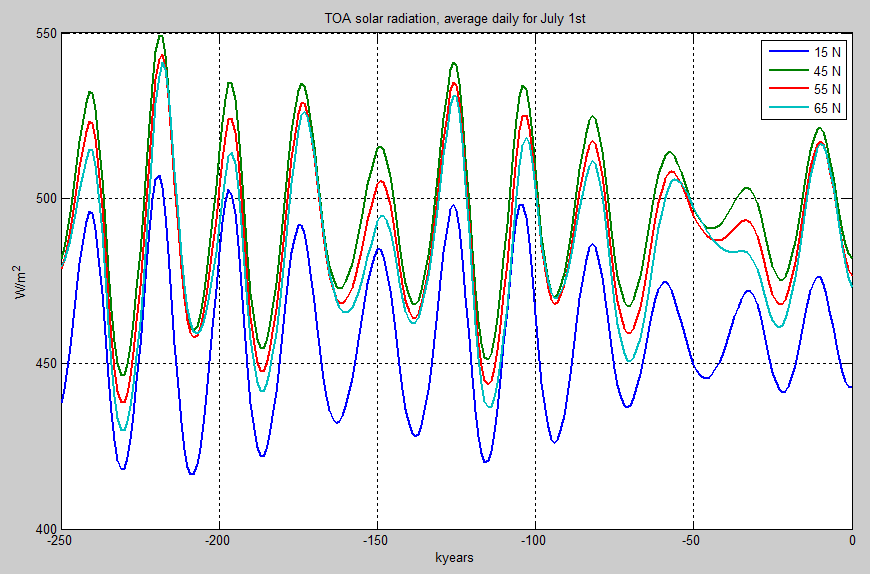
In Part Three we had a very brief look at the orbital factors that affect solar insolation.

Here we will look at these factors in more detail. We start with the current situation.

Seasonal Distribution of Incoming Solar Radiation

The earth is tilted on its axis (relative to the plane of orbit) so that in July the north pole “faces” the sun, while in January the south pole “faces” the sun.

Here are the TOA graphs for average incident solar radiation at different latitudes by month:

From Vardavas & Taylor (2007)

From Vardavas & Taylor (2007)

Figure 1

And now the average values first by latitude for the year, then by month for northern hemisphere, southern hemisphere and the globe:

TOA-solar-total-by-month-and-latitude-present

Figure 2

We can see that the southern hemisphere has a higher peak value – this is because the earth is closest to the sun (perihelion) on January 3rd, during the southern hemisphere summer.

This is also reflected in the global value which varies between 330 W/m² at aphelion (furthest away from the sun) to 352 W/m² at perihelion.

Eccentricity

There is a good introduction to planetary orbits in Wikipedia. I was saved from the tedium of having to work out how to implement an elliptical orbit vs time by the Matlab code kindly supplied by Jonathan Levine. He also supplied the solution to the much more difficult problem of insolation vs latitude at any day in the Quaternary period, which we will look at later.

Here is the the TOA solar insolation by day of the year, as a function of the eccentricity of the orbit:

Daily-Change-TOA-Solar-vs-Eccentricity-2

Figure 3 – Updated

The earth’s orbit currently has an eccentricity of 0.0167. This means that the maximum variation in solar radiation is 6.9%.

Perihelion is 147.1 million km, while aphelion is 152.1 million km. The amount of solar radiation we receive is “the inverse square law”, which means if you move twice as far away, the solar radiation reduces by a factor of four. So to calculate the difference between the min and max you simply calculate: (152.1/147.1)² = 1.069 or a change of 6.9%.

Over the past million or more years the earth’s orbit has changed its eccentricity, from a low close to zero, to a maximum of about 0.055. The period of each cycle is about 100,000 years.

Here is my calculation of change in total annual TOA solar radiation with eccentricity:

Annual-%Change-TOA-Solar-vs-Eccentricity

Figure 4

Looking at figure 1 of Imbrie & Imbrie (1980), just to get a rule of thumb, eccentricity changed from 0.05 to 0.02 over a 50,000 year period (about 220k years ago to 170k years ago). This means that the annual solar insolation dropped by 0.1% over 50,000 years or 3 mW/m² per century. (This value is an over-estimate because it is the peak value with sun overhead, if instead we take the summer months at high latitude the change becomes  0.8 mW/m² per century)

It’s a staggering drop, and no wonder the strong 100,000 year cycle in climate history matching the Milankovitch eccentricity cycles is such a difficult theory to put together.

Obliquity & Precession

To understand those basics of these changes take a look at the Milankovitch article. Neither of these two effects, precession and obliquity, changes the total annual TOA incident solar radiation. They just change its distribution.

Here is the last 250,000 years of solar radiation on July 1st – for a few different latitudes:

TOA-Solar-July1-Latitude-vs0-250k-499px

Figure 5 – Click for a larger image

Notice that the equatorial insolation is of course lower than the mid-summer polar insolation.

Here is the same plot but for October 1st. Now the equatorial value is higher:

TOA-Solar-Oct1-Latitude-vs0-250k-499px

Figure 6 – Click for a larger image

Let’s take a look at the values for 65ºN, often implicated in ice age studies, but this time for the beginning of each month of the year (so the legend is now 1 = January 1st, 2 = Feb 1st, etc):

TOA-Solar-65N-bymonth-vs0-250k-lb-499px

Figure 7 – Click for a larger image

And just for interest I marked one date for the last inter-glacial – the Eemian inter-glacial as it is known.

Come up with a theory:

  • peak insolation at 65ºN
  • fastest rate of change
  • minimum insolation
  • average of summer months
  • average of winter half year
  • average autumn 3 months

Then pick from the graph and let’s start cooking.. Having trouble? Pick a different latitude. Southern Hemisphere – no problem, also welcome.

As we will see, there are a lot of theories, all of which call themselves “Milankovitch” but each one is apparently incompatible with other similarly-named “Milankovitch” theories.

At least we have a tool, kindly supplied by Jonathan Levine, which allows us to compute any value. So if any readers have an output request, just ask.

One word of caution for budding theorists of ice ages (hopefully we have many already) from Kukla et al (2002):

..The marine isotope record is commonly tuned to astronomic chronology, represented by June insolation at the top of the atmosphere at 60′ or 65′ north latitude. This was deemed justified because the frequency of the Pleistocene gross global climate states matches the frequency of orbital variations..

..The mechanism of the climate response to insolation remains unclear and the role of insolation in the high latitudes as opposed to that in the low latitudes is still debated..

..In either case, the link between global climates and orbital variations appears to be complicated and not directly controlled by June insolation at latitude 65’N. We strongly discourage dating local climate proxies by unsubstantiated links to astronomic variations..

[Emphasis added].

I’m a novice with the historical records and how they have been constructed, but I understand that SPECMAP is tuned to a Milankovitch theory, i.e., the dates of peak glacials and peak inter-glacials are set by astronomical values.

Articles in the Series

Part One – An introduction

Part Two – Lorenz – one point of view from the exceptional E.N. Lorenz

Part Three – Hays, Imbrie & Shackleton – how everyone got onto the Milankovitch theory

Part Five – Obliquity & Precession Changes – and in a bit more detail

Part Six – “Hypotheses Abound” – lots of different theories that confusingly go by the same name

Part Seven – GCM I – early work with climate models to try and get “perennial snow cover” at high latitudes to start an ice age around 116,000 years ago

Part Seven and a Half – Mindmap – my mind map at that time, with many of the papers I have been reviewing and categorizing plus key extracts from those papers

Part Eight – GCM II – more recent work from the “noughties” – GCM results plus EMIC (earth models of intermediate complexity) again trying to produce perennial snow cover

Part Nine – GCM III – very recent work from 2012, a full GCM, with reduced spatial resolution and speeding up external forcings by a factors of 10, modeling the last 120 kyrs

Part Ten – GCM IV – very recent work from 2012, a high resolution GCM called CCSM4, producing glacial inception at 115 kyrs

Pop Quiz: End of An Ice Age – a chance for people to test their ideas about whether solar insolation is the factor that ended the last ice age

Eleven – End of the Last Ice age – latest data showing relationship between Southern Hemisphere temperatures, global temperatures and CO2

Twelve – GCM V – Ice Age Termination – very recent work from He et al 2013, using a high resolution GCM (CCSM3) to analyze the end of the last ice age and the complex link between Antarctic and Greenland

Thirteen – Terminator II – looking at the date of Termination II, the end of the penultimate ice age – and implications for the cause of Termination II

References

Last Interglacial Climates, Kukla et al, Quaternary Research (2002)

Modeling the Climatic Response to Orbital Variations, John Imbrie & John Z. Imbrie, Science (1980)

Read Full Post »
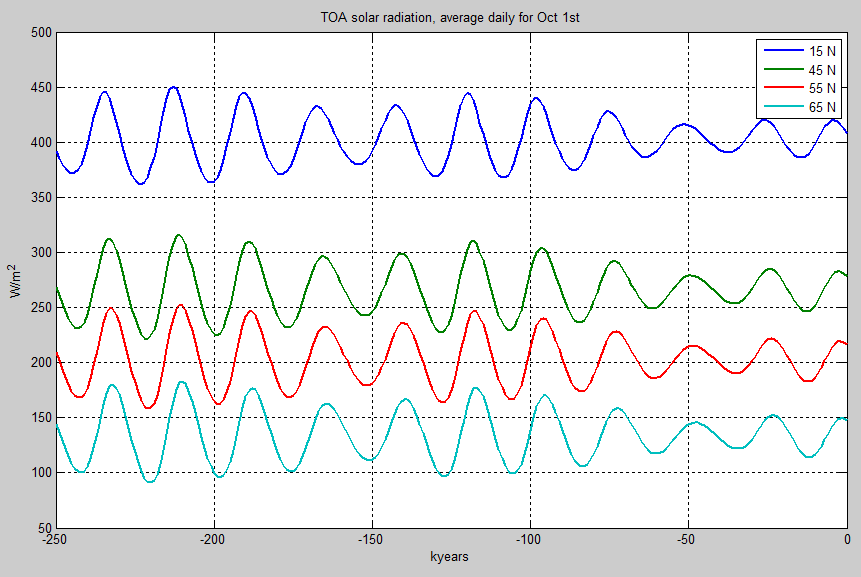
In Part Two we looked at one paper by Lorenz from 1968 where he put forward the theory that climate might be “intransitive”. In common parlance we could write this as “climate might be chaotic” (even though there is a slight but important difference between the two definitions).

In this article we will have a bit of a look at the history of the history of climate – that is, a couple of old papers about ice ages.

These papers are quite dated and lots of new information has since come to light, and of course thousands of papers have since been written about the ice ages. So why a couple of old papers? It helps to create some context around the problem. These are “oft-cited”, or seminal, papers, and understanding ice ages is so complex that it is probably easiest to set out an older view as some kind of perspective.

At the very least, it helps get my thinking into order. Whenever I try to understand a climate problem I usually end up trying to understand some of the earlier oft-cited papers because most later papers rely on that context without necessarily repeating it.

Variations in the Earth’s Orbit: Pacemaker of the Ice Ages by JD Hays, J Imbrie, NJ Shackleton (1976) is referenced by many more recent papers that I’ve read – and, according to Google Scholar, cited by 2,656 other papers – that’s a lot in climate science.

For more than a century the cause of fluctuations in the Pleistocene ice sheets has remained an intriguing and unsolved scientific mystery. Interest in this problem has generated a number of possible explanations.

One group of theories invokes factors external to the climate system, including variations in the output of the sun, or the amount of solar energy reaching the earth caused by changing concentrations of interstellar dust; the seasonal and latitudinal distribution of incoming radiation caused by changes in the earth’s orbital geometry; the volcanic dust content of the atmosphere; and the earth’s magnetic field. Other theories are based on internal elements of the system believed to have response times sufficiently long to yield fluctuations in the range 10,000 to 1,000,000 years.

Such features include the growth and decay of ice sheets, the surging of the Antarctic ice sheet; the ice cover of the Arctic Ocean; the distribution of carbon dioxide between atmosphere and ocean; and the deep circulation of the ocean.

Additionally, it has been argued that as an almost intransitive system, climate could alternate between different states on an appropriate time scale without the intervention of any external stimulus or internal time constant.

This last idea is referenced as Lorenz 1968, the paper we reviewed in Part Two.

The authors note that previous work has provided evidence of orbital changes being involved in climate change, and make an interesting comment that we will see has not changed in the intervening 38 years:

The first [problem] is the uncertainty in identifying which aspects of the radiation budget are critical to climate change. Depending on the latitude and season considered most significant, grossly different climate records can be predicted from the same astronomical data..

Milankovitch followed Koppen and Wegener’s view that the distribution of summer insolation at 65°N should be critical to the growth and decay of ice sheets.. Kukla pointed out weaknesses.. and suggested that the critical time may be Sep and Oct in both hemispheres.. As a result, dates estimated for the last interglacial on the basis of these curves have ranged from 80,000 to 180,000 years ago.

The other problem at that time was the lack of quality data on the dating of various glacials and interglacials:

The second and more critical problem in testing the orbital theory has been the uncertainty of geological chronology. Until recently, the inaccuracy of dating methods limited the interval over which a meaningful test could be made to the last 150,000 years.

This paper then draws on some newer, better quality data for the last few hundred thousand years of temperature history. By the way, Hays was (and is) a Professor of Geology, Imbrie was (and is) a Professor of Oceanography and Shackleton was at the time in Quarternary Research, later a professor in the field.

Brief Introduction to Orbital Parameters that Might Be Important

Now, something we will look at in a later article, probably Part Four, is exactly what changes in solar insolation are caused by changes in the earth’s orbital geometry. But as an introduction to that question, there are three parameters that vary and are linked to climate change:

  1. Eccentricity, e, (how close is the earth’s orbit to a circle) – currently 0.0167
  2. Obliquity, ε, (the tilt of the earth’s axis) – currently 23.439°
  3. Precession, ω, (how close is the earth to the sun in June or December) – currently the earth is closest to the sun on January 3rd

The first, eccentricity, is the only one that changes the total amount of solar insolation received at top of atmosphere in a given year. Note that a constant solar insolation at the top of atmosphere can be a varying solar absorbed radiation if more or less of that solar radiation happens to be reflected off, say, ice sheets, due to, say, obliquity.

The second, obliquity, or tilt, affects the difference between summer and winter TOA insolation. So it affects seasons and, specifically, the strength of seasons.

The third, precession, affects the amount of radiation received at different times of the year (moderated by item 1, eccentricity). So if the earth’s orbit was a perfect circle this parameter would disappear. When the earth is closest to the sun in June/July the Northern Hemisphere summer is stronger and the SH summer is weaker, and vice versa for winters.

So eccentricity affects total TOA insolation, while obliquity and precession change its distribution in season and latitude. However, variations in solar insolation at TOA depend on e² and so the total variation in TOA radiation has, over a very long period, only been only 0.1%.

This variation is very small and yet the strongest “orbital signal” in the ice age record is that of eccentricity. A problem, that even for the proponents of this theory, has not yet been solved.

Last Interglacial Climates, by a cast of many including George J. Kukla, Wallace S. Broecker, John Imbrie, Nicholas J. Shackleton:

At the end of the last interglacial period, over 100,000 yr ago, the Earth’s environments, similar to those of today, switched into a profoundly colder glacial mode. Glaciers grew, sea level dropped, and deserts expanded. The same transition occurred many times earlier, linked to periodic shifts of the Earth’s orbit around the Sun. The mechanism of this change, the most important puzzle of climatology, remains unsolved.

[Emphasis added].

History Cores

Our geological data comprise measurements of three climatically sensitive parameters in two deep-sea sediment cores. These cores were taken from an area where previous work shows that sediment is accumulating fast enough to preserve information at the frequencies of interest. Measurements of one variable, the per mil enrichment of oxygen 18 (δ18O), make it possible to correlate these records with others throughout the world, and to establish that the sediment studied accumulated without significant hiatuses and at rates which show no major fluctuations..

.. From several hundred cores studied stratigraphically by the CLIMAP project, we selected two whose location and properties make them ideal for testing the orbital hypothesis. Most important, they contain together a climatic record that is continuous, long enough to be statistically useful (450,000 years) and characterized by accumulation rates fast enough (>3 cm per 1,000 years) to resolve climatic fluctuations with periods well below 20,000 years.

The cores were located in the Southern Indian ocean. What is interesting about the cores is that 3 different mechanisms are captured from each location, including δ18O isotopes which should be a measure of ice sheets globally and temperature in the ocean at the location of the cores.

Hays, Imbrie & Shackleton (1976)

Hays, Imbrie & Shackleton (1976)

Figure 1

There is much discussion about the dating of the cores. In essence, other information allows a few transitions to be dated, while the working assumption is that within these transitions the sediment accumulation is at a constant rate.

Although uniform sedimentation is an ideal which is unlikely to prevail precisely anywhere, the fact that the characteristics of the oxygen isotope record are present throughout the cores suggests that there can be no substantial lacunae, while the striking resemblance to records from distant areas shows that there can be no gross distortion of accumulation rate.

Spectral Analysis

The key part of their analysis is a spectral analysis of the data, compared with a spectral analysis of the “astronomical forcing”.

The authors say:

.. we postulate a single, radiation-climate system which transforms orbital inputs into climatic outputs. We can therefore avoid the obligation of identifying the physical mechanism of climatic response and specify the behavior of the system only in general terms. The dynamics of our model are fixed by assuming that the system is a time-invariant, linear system – that is, that its behavior in the time domain can be described by a linear differential equation with constant coefficients. The response of such a system in the frequency domain is well known: frequencies in the output match those of the input, but their amplitudes are modulated at different frequencies according to a gain function. Therefore, whatever frequencies characterize the orbital signals, we will expect to find them emphasized in paleoclimatic spectra (except for frequencies so high they would be greatly attenuated by the time constants of response)..

My translation – let’s compare the orbital spectrum with the historical spectrum without trying to formulate a theory and see how the two spectra compare.

The orbital effects:

From Hays et al (1976)

From Hays et al (1976)

Figure 2

The historical data:

From Hays et al (1976)

From Hays et al (1976)

Figure 3

We have also calculated spectra for two time series recording variations in insolation [their fig 4 – our fig 2], one for 55°S and the other for 60°N. To the nearest 1,000 years, the three dominant cycles in these spectra (41,000, 23,000 and 19,000 years) correspond to those observed in the spectra for obliquity and precession.

This result, although expected, underscores two important points. First, insolation spectra are characterized by frequencies reflecting obliquity and precession, but not eccentricity.

Second, the relative importance of the insolation components due to obliquity and precession varies with latitude and season.

[Emphasis added]

In commenting on the historical spectra they say:

Nevertheless, five of the six spectra calculated are characterized by three discrete peaks, which occupy the same parts of the frequency range in each spectrum. Those correspond to periods from 87,000 to 119,000 years are labeled a; 37,000 to 47,000 years b; and 21,000 to 24,000 years c. This suggest that the b and c peaks represent a response to obliquity and precession variation, respectively.

Note that the major cycle shown in the frequency spectrum is the 100,000 peak.

There is a lot of discussion in their paper of the data analysis, please have a read of their paper to learn more. The detail probably isn’t so important for current understanding.

The authors conclude:

Over the frequency range 10,000 to 100,000 cycle per year, climatic variance of these records is concentrated in three discrete spectral peaks at periods of 23,000, 42,000, and approximately 100,000 years. These peaks correspond to the dominant periods of the earth’s solar orbit and contain respectively about 10, 25 and 50% of the climatic variance.

The 42,000-year climatic component has the same period as variations in the obliquity of the earth’s axis and retains a constant phase relationship with it.

The 23,000-year portion of the variance displays the same periods (about 23,000 and 19,000 years) as the quasi-periodic precession index.

The dominant 100,000 year climatic component has an average period close to, and is in phase with, orbital eccentricity. Unlike the correlations between climate and the higher frequency orbital variations (which can be explained on the assumption that the climate system responds linearly to orbital forcing) an explanation of the correlations between climate and eccentricity probably requires an assumption of non-linearity.

It is concluded that changes in the earth’s orbital geometry are the fundamental cause of the succession of Quarternary ice ages.

Things were looking good for explanations of the ice ages in 1975..

For those who want to understand more recent evaluation of the spectral analysis of temperature history vs orbital forcing, check out papers by Carl Wunsch from 2003, 2004 and 2005, e.g. The spectral description of climate change including the 100 ky energyClimate Dynamics (2003).

A Few Years Later

Here are a few comments from Imbrie & Imbrie (1980):

Since the work of Croll and Milankovitch, many investigations have been aimed at the central question of the astronomical theory of the ice ages:

Do changes in orbital geometry cause changes in climate that are geologically detectable?

On the one hand, climatologists have attacked the problem theoretically by adjusting the boundary conditions of energy-balance models, and then observing the magnitude of the calculated response. If these numerical experiments are viewed narrowly as a test of the astronomical theory, they are open to question because the models used contain untested parameterizations of important physical processes. Work with early models suggested that the climatic response to orbital changes was too small to account for the succession of Pleistocene ice ages. But experiments with a new generation of models suggest that orbital variations are sufficient to account for major changes in the size of Northern Hemisphere ice sheets..

..In 1968, Broecker et al. (34, 35) pointed out that the curve for summertime irradiation at 45°N was a much better match to the paleoclimatic records of the past 150,000 years than the curve for 65°N chosen by Milankovitch..

Current Status. This is not to say that all important questions have been answered. In fact, one purpose of this article is to contribute to the solution of one of the remaining major problems: the origin and history of the 100,000-year climatic cycle.

At least over the past 600,000 years, almost all climatic records are dominated by variance components in a narrow frequency band centered near a 100,000-year cycle. Yet a climatic response at these frequencies is not predicted by the Milankovitch version of the astronomical theory – or any other version that involves a linear response..

..Another problem is that most published climatic records that are more than 600,000 years old do not exhibit a strong 100,000-year cycle..

The goal of our modeling effort has been to simulate the climatic response to orbital variations over the past 500,000 years. The resulting model fails to simulate four important aspects of this record. It fails to produce sufficient 100k power; it produces too much 23k and 19k power; it produces too much 413k power; and it loses its match with the record around the time of the last 413k eccentricity minimum, when values of e [eccentricity] were low and the amplitude of the 100k eccentricity cycle was much reduced..

..The existence of an unstable fixed point makes tuning an extremely sensitive task. For example, Weertman notes that changing the value of one parameter by less than 1 percent of its physically allowed range made the difference between a glacial regime and an interglacial regime in one portion of an experimental run while leaving the rest virtually unchanged..

This would be a good example of Lorenz’s concept of an almost intransitive system (one whose characteristics over long but finite intervals of time depend strongly on initial conditions).

Once again the spectre of the Eminent Lorenz is raised. We will see in later articles that with much more sophisticated models it is not easy to create an ice-age, or to turn an ice-age into an inter-glacial.

Articles in the Series

Part One – An introduction

Part Two – Lorenz – one point of view from the exceptional E.N. Lorenz

Part Four – Understanding Orbits, Seasons and Stuff – how the wobbles and movements of the earth’s orbit affect incoming solar radiation

Part Five – Obliquity & Precession Changes – and in a bit more detail

Part Six – “Hypotheses Abound” – lots of different theories that confusingly go by the same name

Part Seven – GCM I – early work with climate models to try and get “perennial snow cover” at high latitudes to start an ice age around 116,000 years ago

Part Seven and a Half – Mindmap – my mind map at that time, with many of the papers I have been reviewing and categorizing plus key extracts from those papers

Part Eight – GCM II – more recent work from the “noughties” – GCM results plus EMIC (earth models of intermediate complexity) again trying to produce perennial snow cover

Part Nine – GCM III – very recent work from 2012, a full GCM, with reduced spatial resolution and speeding up external forcings by a factors of 10, modeling the last 120 kyrs

Part Ten – GCM IV – very recent work from 2012, a high resolution GCM called CCSM4, producing glacial inception at 115 kyrs

Pop Quiz: End of An Ice Age – a chance for people to test their ideas about whether solar insolation is the factor that ended the last ice age

Eleven – End of the Last Ice age – latest data showing relationship between Southern Hemisphere temperatures, global temperatures and CO2

Twelve – GCM V – Ice Age Termination – very recent work from He et al 2013, using a high resolution GCM (CCSM3) to analyze the end of the last ice age and the complex link between Antarctic and Greenland

Thirteen – Terminator II – looking at the date of Termination II, the end of the penultimate ice age – and implications for the cause of Termination II

References

Variations in the Earth’s Orbit: Pacemaker of the Ice Ages, JD Hays, J Imbrie & NJ Shackleton, Science (1976)

Modeling the Climatic Response to Orbital Variations, John Imbrie & John Z. Imbrie, Science (1980)

Last Interglacial Climates, Kukla et al, Quaternary Research (2002)

Read Full Post »
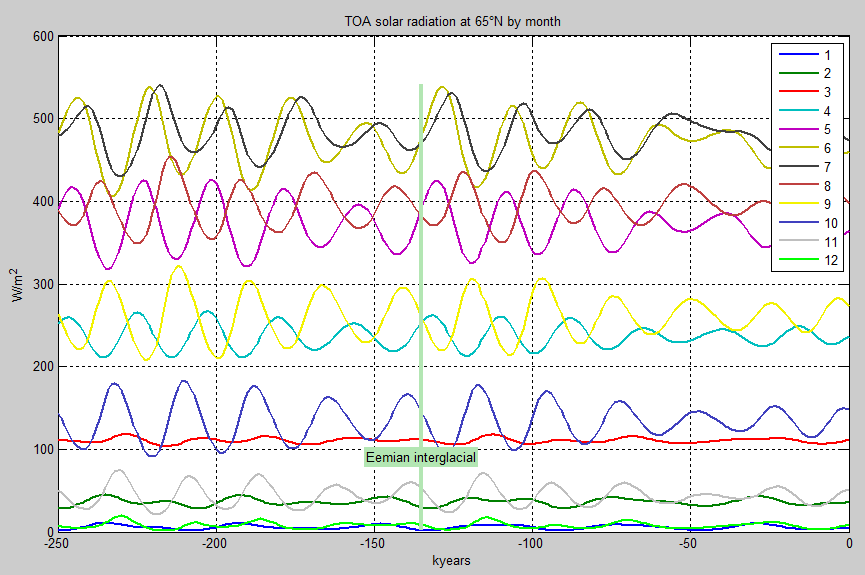
« Newer Posts - Older Posts »